Babe: Pig in the City (1998)

2017 #42
George Miller | 92 mins | streaming (HD) | 1.85:1 | Australia / English | U / G

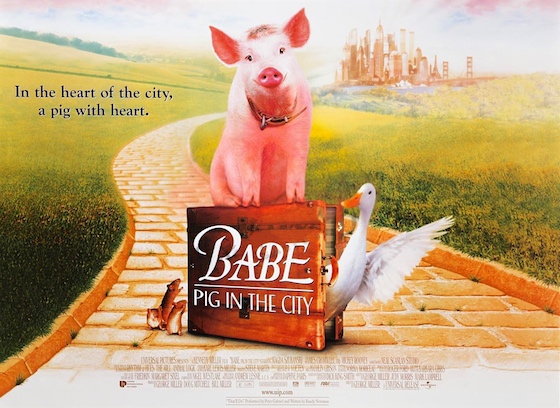
Babe: Pig in the City

Between making the first Mad Max trilogy and winning an Oscar with kids’ animation Happy Feet, George Miller produced beloved family flick Babe, which was such a success he took the directing reins for this follow-up. I remember it going down very poorly at the time — Rotten Tomatoes doesn’t quite support that, but a quick scan reveals many of the reviews to be retrospective. Some were wise to it from the off, however: Roger Ebert gave it full marks and his presenting partner Gene Siskel chose it as the best movie of the year! Not everyone’s got on that bandwagon (it still has a low rating on IMDb), but it’s definitely developed a cult following. Sign me up, because I too thought it was rather brilliant.

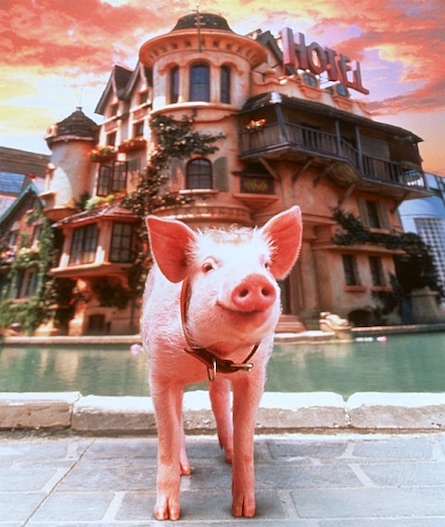
Set immediately after the events of the first film, it sees everyone’s favourite sheep-pig travelling to the big city to raise money to save his farm. There, he ends up staying at a kind of hotel for animals, and winds up in all kinds of hijinks. There’s no point trying to describing it — the movie is barking. Also oinking, and quacking, and… yeah, you get the joke.

In some ways it feels like a kids’ movie made for adults. Sure, it’s about cute talking animals, but a lot of the jokes are squarely aimed at knowing grown-ups, as is some of the emotional stuff, such as a scene where the Jack Russell is clearly running off to Heaven, which probably (hopefully, even) goes over younger children’s heads. As that may suggest, it’s also a very dark movie. Most of the darkness is eventually undercut, subverted, or rescued, but not always immediately — the situations are allowed to get bleak first.

Pig in a hotel

There’s an above-the-call-of-duty quality to the filmmaking, too. It’s lovelily designed, in a hyper-real cartoon-strip way, and beautifully shot, by Andrew “Lord of the Rings” Lesnie no less. Plus there’s a credits song written by Randy Newman and performed by, of all people, Peter Gabriel. And that’s not some kind of “they used a song by them” coincidence — its lyrics are based around the famous “that’ll do, Pig” catchphrase. Barmy.

Pig in the City made me really made me want to rewatch the original — I enjoyed it as a kid, but as an adult would I see all sorts of extra stuff that I missed before? Or was it the success of the “cute talking pig movie” original that gave Miller & co the freedom to cut loose in the sequel? Comments I’ve read suggest the latter. Well, even if Babe doesn’t merit revisiting as an adult, this sequel certainly does. I’m not sure I’ve ever seen anything else quite like it.

4 out of 5

Review Roundup

This may look like a pretty random selection for a review roundup… and it is. But they do have two things in common: I watched them all in 2017, and I gave them all 3 stars.

Yeah, not much, is it?

Anyway, in today’s roundup:

  • The Girl on the Train (2016)
  • Lions for Lambs (2007)
  • Tea for Two (1950)


    The Girl on the Train
    (2016)

    2017 #113
    Tate Taylor | 112 mins | streaming (HD) | 1.85:1 | USA / English | 15 / R

    The Girl on the Train

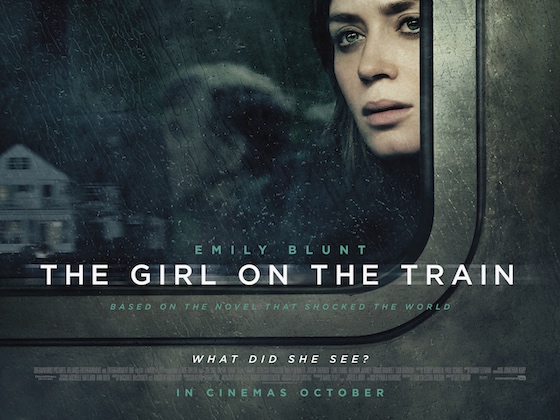
    Based on a bestselling novel, The Girl on the Train stars Emily Blunt as Rachel, an alcoholic divorcee whose commuter train passes her old home every day. She tortures herself by observing her ex (Justin Theroux), his new wife (Rebecca Ferguson) and their child, as well as her former neighbours Scott (Luke Evans) and Megan (Haley Bennett), who she imagines living a perfect life. But after Rachel sees something that shatters the image she’s created, she wakes up from a black out, with mysterious injuries, and to the news that Megan has gone missing…

    The whole story unfurls with a good deal of histrionics and a questionable level of psychological realism, but as a straightforward potboiler it has some degree of entertainment value. In fact, if it had been made with a little more panache then it may even have been seen as a throwback to the kind of melodramas they produced in the ’40s and ’50s. Because it doesn’t seem to have that level of self-awareness, I guess it’s just the modern-day equivalent.

    3 out of 5

    Lions for Lambs
    (2007)

    2017 #121
    Robert Redford | 92 mins | streaming (HD) | 2.35:1 | USA / English | 15 / R

    Lions for Lambs

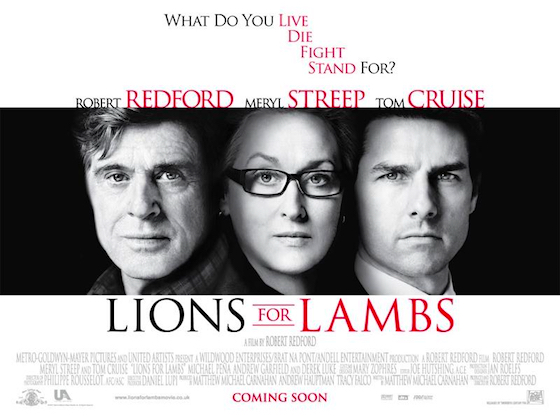
    The US intervention in the Middle East is obviously one of the most significant geopolitical events of our age, but how many films have really got to grips with it? Some, like The Hurt Locker, have given a sense of its impact to those on the ground. Lions for Lambs tried to take a more intellectual standpoint, with three interconnected storylines: a young and ambitious US senator (Tom Cruise) details a new military strategy to an experienced and sceptical journalist (Meryl Streep); a college professor (Robert Redford) tries to engage a talented but apathetic student (Andrew Garfield); and two soldiers become stranded in Afghanistan (Michael Peña and Derek Luke), providing a link between the other two stories.

    Screenwriter Matthew Michael Carnahan originally conceived the work as a play, before realising the Afghanistan section needed the scale of a movie. Nonetheless, his original conception shows through: the film is very talky and stagey, and the other two storylines could certainly be performed on stage with no changes necessary. You can also tell it’s driven by disillusionment in the US’s actions, and it has everyone in its critical sights: the government, the media, the education system… It feels more like a polemic than a movie, lecturing the viewer; although, like everyone else, it doesn’t seem to offer any firm answers.

    Streep and Cruise both give excellent performances. I suppose being a smarmy senator isn’t much of a stretch for the latter, but Streep’s turn as an insecure journalist is the highlight of the film. You need acting of that calibre to keep you invested in a movie like this, and it almost works, but ultimately the film has too little to say.

    3 out of 5

    Tea for Two
    (1950)

    2017 #162
    David Butler | 94 mins | DVD | 4:3 | USA / English | U

    Tea for Two

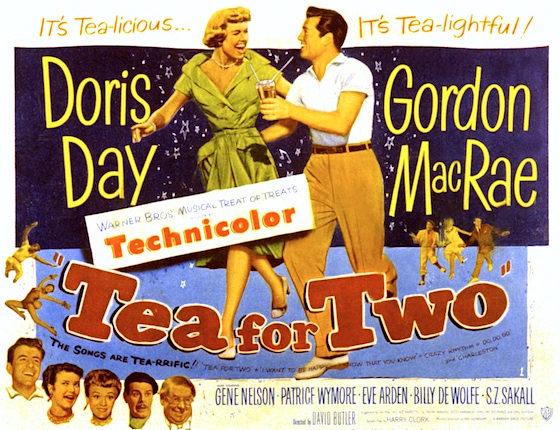
    Musical comedy starring Doris Day (radiant as ever) and Gordon MacRae (given little to do as her love interest).

    The songs are largely forgettable, with a couple of sweet exceptions, but at least there are other things to recommend it, like some impressive dancing from Gene Nelson, particularly during a routine on a flight of stairs. There’s a solid helping of amusing one-liners too, most of them claimed by Eve Arden as Day’s wry assistant Pauline, the rest by S.Z. Sakall as her embattled uncle. Said uncle is, by turns, a bumbling old codger and an underhanded schemer who uses tricks to try to ruin his niece’s happiness just so he can win a bet. Best not to dwell on that too much…

    The same goes for the rushed ending, in which our heroine is in financial ruin, so her assistant basically whores herself out to a rich lawyer so they can still put on the show. Hurrah! And talking of things not to dwell on, there’s also the title, which has absolutely nothing to do with the story (other than it being probably the best song). Conversely, the name of the play it’s based on — No, No, Nanette — is bang on. Ah well.

    Nonetheless, Tea for Two is all-round likeable entertainment; the kind of movie you put on for a pleasantly gentle Sunday afternoon.

    3 out of 5

  • Deadpool 2 (2018)

    2018 #120
    David Leitch | 119 mins | cinema | 2.39:1 | USA / English | 15 / R

    Deadpool 2

    The quickest way to review Deadpool 2 is simply to say it’s like the first one, but more — in a good way.

    A slightly longer (and possibly confusing unless you read it slowly) way to review it would be to say that I enjoyed it less than I enjoyed the first one the first time I saw it, but I enjoyed it more than I enjoyed the first one the second time I saw it. To clarify: when I first watched Deadpool, I loved it, and gave it five stars (just about). When I rewatched it two years later in preparation for the sequel, I was less bowled over. I think a lot of its initial effectiveness was due to the freshness of its whole schtick, which has naturally gone away on a rewatch (not helped by the saturation of it in DP2’s marketing campaign). In particular, I was surprised how sparse I found the humour to be on that rewatch. Maybe that prepared me for this one: the gags aren’t literally non-stop — it sometimes pauses to attempt emotion or to convey plot — but when they do come they’re thick and fast, so much that I’m sure some will get missed (there are too many to remember specific examples, but there was stuff I thought was very funny that didn’t get much of a reaction in my screening. Or it could just be only me that liked those gags, of course.)

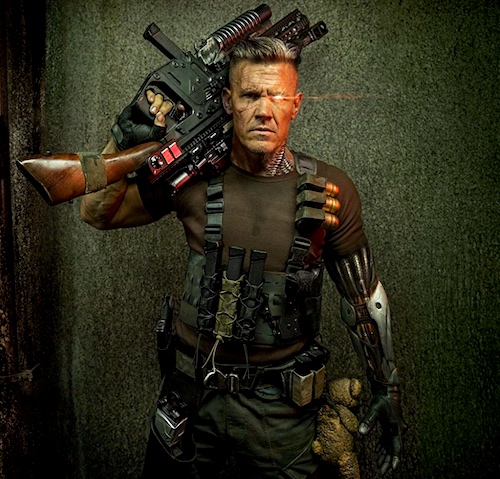
    So, although DP2 couldn’t equal the sheer newness of watching DP1 for the first time, it’s refined the formula in such a way that I do think it’s a more enjoyable film. Maybe “refined” isn’t always the right word — in some cases it’s just chucked in even more stuff — but I think other elements have been honed. For example, the first film’s plot was a no-great-shakes origin story on which to hang gags and action. The sequel’s plot is still only scrappily adhered to, with the point once again being to deliver humour, but it does have a stronger throughline overall. Partly that comes from the villain, Josh Brolin’s Cable, who has a clear goal that conflicts with what Deadpool’s up to. Partly it comes from some thematic stuff about fatherhood and family. I’m not saying DP2’s overburdened in this department — it’s still an action-comedy — but I couldn’t tell you what the first film was about, thematically, and this one it’s made very evident.

    That Deadpool, he'll say anything

    That said, sometimes it’s bit heavy-handed. I can see what they were going for by giving the film a heart and some emotion — it builds off the first film, for one thing, where Vanessa was such a motivator for Wade; and they’re trying to add depth and texture to the film — but… it doesn’t work when it’s given too much focus. Everything else in the film is a pisstake turned up to eleven, and the fourth-wall breaking means Deadpool can make a gag about clichés or crappy writing even as the film ploughs ahead and does it anyway. So why isn’t he making gags whenever the film pauses for an emotional heart-to-heart type scene? Why does that sappiness flow on (and on) untouched? Okay, maybe the character cares too much to be wisecracking at those moments… but do we? Does the soppiness fit with the foul-mouthed, gore-splattered irreverence that characterises the rest of the movie? I’m not sure it does.

    Other things they’ve oomphed up, but to appropriate effect, included references to the X-Men and the action scenes. In the case of the former, I was surprised how many X-references there were in the first film, but DP2 has even more, including a superb one-shot cameo and a surprise appearance by a character who’s been in a ‘real’ X-Men film but here is done more faithfully. As to the latter, the first film had some fun action beats, but here you can feel the benefit of hiring John Wick/Atomic Blonde director (and former stunt coordinator) David Leitch — everything is slicker, quicker, and bigger. Again, it’s more, but in a good way. Humour aside, if you just wanted a straightforward action flick, I think it would satisfy on that level too.

    Cable, ready for action

    As for its level as a satire of superhero movies, some people have criticised the way it calls out genre tropes but then does them anyway, like Deadpool exclaiming “CGI fight!” right before there’s a CGI fight. But I think that’s almost the point. It’s not trying to deconstruct the genre, just poke fun at it with self-awareness while still being very much a part of it. Would it be cleverer if it went a step further and actually subverted stuff more often? Maybe. Probably. But there is humour in the self-awareness, even if it’s an easier kind for the filmmakers to fall back on — they don’t have to avoid clichés, so long as they humorously point out they’re indulging in them.

    Ironically, there are two or three occasions where Deadpool specifically makes a joke along the lines of “well that’s just lazy writing”, which were particularly amusing to me because (as I recall) they were at moments where the writing didn’t need to do more than it did. By which I mean, the writers could’ve been “not lazy” and dressed those moments up, but, functionally, they didn’t need to; so it’s not really lazy writing, just not needlessly tarted up writing… if that makes sense. It’s like movies with MacGuffins: usually they invest time explaining what the MacGuffin is and why it matters, but functionally it could be anything, all that matters is everyone wants it. Deadpool 2 doesn’t have a MacGuffin, but if it did it would be called “MacGuffin” and it would be explained simply as “a thing everyone wants” and Deadpool would say “well that’s just lazy writing”. (Flip side to all this: I can’t recall the exact circumstances of all the “lazy writing” jokes, so I’m prepared to accept they might not actually fit this theory.)

    X gon' give it to ya

    All of that said, Deadpool 2’s primary goal is plain, clear, and simple: it wants to entertain you by almost any means necessary, be that elaborate action sequences, almost non-stop gags, cultural references, deep-cut comic book Easter eggs, or even changing history (er, kinda). Mostly, it works — it wants to be fun and, if you’re on its wavelength, it is. Sometimes, more is more.

    4 out of 5

    Deadpool 2 is in cinemas everywhere, still. My review of the extended Super Duper $@%!#& Cut is here.

    Shrek the Third (2007)

    2018 #101
    Chris Miller | 93 mins | Blu-ray | 1.78:1 | USA / English | U / PG

    Shrek the Third

    Shrek the Third is notorious as The Bad One; the one where the bubble burst on the phenomenon that had sustained two well-reviewed and immensely financially successful films. The list of failed threequels is long — so long, you almost wonder why anyone bothers to make them — and while Shrek the Third does indeed do little to buck that trend, it could be worse.

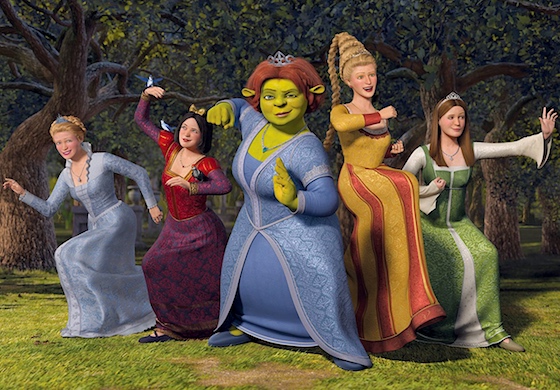
    The title isn’t just a variation from calling the film Shrek 3, but also hints at the plot: when the king dies, Shrek is next in line to the throne. But he’s been struggling so much at royal engagements that he wants out of that life anyway, never mind a promotion. Fortunately, there is a possible alternative: a young lad called Arthur. While Shrek, Donkey and Puss set off to find this spare heir, Princess Fiona and a cohort of other fairytale princesses must fend off an attack from Prince Charming, who still has eyes on the throne.

    It’s not a terrible plot for a Shrek movie, but it’s not particularly original either. Thematically, Shrek’s disinterest in being royalty was covered in the last film, though at least this time it’s bolstered with a fatherhood angle. The choice of villain, however, straight up takes the last film’s secondary antagonist and recycles him as a primary antagonist — if there’s a more literal example of sequels representing diminishing returns, I can’t think of it.

    Action princesses

    As for everything else, there are some good ideas and funny bits here and there, but there’s also something that’s just… off. It’s not consistently amusing or creative enough. It doesn’t have the same effortless energy and pace as the first two. And some of its ideas sound decent on paper, but just don’t work in the film. For example, the fairytale twist on a high school where they find Arthur — Shrek’s got good mileage out of spoofing the real world before, so you can see the genesis of the idea, but it just doesn’t land here, with the setting being an irritant rather than an amusing parallel.

    Although the film still credits Andrew Adamson, writer and/or director of both previous films, as among its executive producers, I reckon there must have been debilitating changes behind the scenes, because the whole production just comes up short. Like, where the previous films offered legitimately exciting action scenes, the ones here could be decent but come off flat. It shouldn’t matter — this is a fantasy comedy, not an action movie — but it’s just one part that’s emblematic of the whole. Another is the song choices, which, like the fairytale high school thing, are seemingly okay but actually just wrong. As in, most of them are good songs, but they so often don’t actually quite fit the movie — I mean, Live and Let Die during a funeral?

    Shrek the Third isn’t entirely without merit, but something seems to have gone awry between conception and execution, and it doesn’t zing in the way its predecessors did.

    3 out of 5

    Muppet Review Roundup

    In today’s roundup:

  • The Muppets Take Manhattan (1984)
  • Muppets from Space (1999)


    The Muppets Take Manhattan
    (1984)

    2018 #48
    Frank Oz | 90 mins | streaming (HD) | 16:9 | USA / English | U / G

    The Muppets Take Manhattan

    Apparently (so I read somewhere) at the time this was intended to be the end of the Muppets — the performers were fed up and wanted to move on to other things, and they conceived this third movie as a capstone on the whole affair. That seems inconceivable now — I mean, just how much Muppet stuff has followed it? To date, five more movies, at least two TV series I can immediately think of, plus other specials, countless guest appearances, a theme park attraction…

    I think that tiredness shows through in the finished product. Or maybe it’s just the changing attitudes — they’d just made The Dark Crystal, which maybe indicates they had a hankering for more serious fare. Supposedly the first draft was dismissed by director Frank Oz as being “way too over jokey”, which is surely a terrible criticism of a Muppet screenplay, but Jim Henson encouraged him to tinker with it to emphasise the characters and their relationships. This was partly in response to The Great Muppet Caper, a particularly wacky effort that hadn’t done well at the box office, so they were toning it down.

    Well, I regard the Muppets as primarily comedy characters, and so it’s no wonder this one seems to miss the mark. There’s some occasional funny stuff, the odd good skit, but mostly Take Manhattan just kinda plods along. Personally I thought Caper was a bit of a poor sequel, but this is less good again. It straight up lacks some of the things that make the Muppets so memorable — there isn’t a single fourth wall break, for instance. There’s all together too much focus on plot, even though it’s a very thin one, and the gang spend most of the movie split up, meaning it lacks their camaraderie. So much for focusing on the relationships!

    Muppets in Manhattan

    There are still celebrity cameos, at least, though I feel they’ve aged particularly poorly. Well, there’s Joan Rivers (even if her younger self is always unrecognisable to those of us who mainly knew her in later made-of-plastic years), Elliot Gould, and Liza Minelli, so it’s not all bad. Other than that, the credits explicitly name who the cameos are, but I didn’t even recognise half the names. In fact, the best one is some other Henson puppets: the cast of Sesame Street! Though the presence of puppets isn’t always welcome: a furious Miss Piggy rollerskating after a mugger, filmed in wide shots that I can only assume feature a human in a Miss Piggy suit, is the stuff of nightmares.

    Nonetheless, I shall give The Muppets Take Manhattan a 3 — just. That’s the same as I gave Muppet Caper, which is a shame (that film was more of a 3.5 whereas this is a 2.5), but it’s not so bad that I can give it an outright 2. It’s middling. It’s fans-only, I guess. Some bits work, some bits are good, but overall it’s not quite there as a Muppet movie.

    3 out of 5

    Muppets from Space
    (1999)

    2018 #75
    Tim Hill | 85 mins | streaming (HD) | 16:9 | USA / English | U / G

    Muppets from Space

    I’m afraid things aren’t going to pick up here: Muppets from Space is the lowest rated Muppet movie on IMDb. Personally, it would not be my pick for the worst film starring our felty friends… but it’s not that great, either.

    Hailing from the same era that gave us the likes of Independence Day (which gets directly spoofed), Men in Black (some of them show up), and The Phantom Menace (no references that I could detect, but they came out the same year, so…), you can see why the Muppet movie makers would’ve been inspired to move into the sci-fi realm. The plot concerns finally explaining just what Gonzo is, which is not only unnecessary but feels kind of against the spirit of the thing — no one knows what he is, there’s only one of him, that’s kind of the joke. Well, not after this film…

    Related to that, there’s almost a good thematic thing about belonging, and who your real family is or can be, but it’s only loosely nodded at early on before sort of popping up right at the end, without enough building blocks in between to really make it work as a payoff. But we don’t come to the Muppets for the themes, we come for the gags, and in that respect From Space is… fine. Well, I mean, it’s not really all that funny… or interesting… It just kind of toddles along until an underwhelming ending (it would’ve been better if (spoilers!) it turned out the aliens weren’t Gonzo’s people, thereby leaving what he is a mystery). And there’s a Dawson’s Creek cameo, because they were filming in the studio next door, which obviously feels terribly dated now, but that’s how these things always go I guess.

    So, I didn’t actively dislike it in the way I did Muppets Most Wanted (that’s why I’m giving it a 3 rather than a 2), but that might be the kindest thing I can say about it. Like Muppets Take Manhattan, it sits firmly in the middle of the field — not expressly unlikeable, if you enjoy the Muppets, but with nothing to elevate it.

    3 out of 5

  • Coco (2017)

    2018 #109
    Lee Unkrich | 105 mins | Blu-ray (3D) | 2.39:1 | USA / English | PG / PG

    Coco

    Pixar’s 19th feature is an American-produced animated fantasy movie that co-opts a foreign culture to tell a story about a guitar-playing kid remembering his dead family — wait, doesn’t that sound familiar? Yes, in broad strokes, Coco is Kubo and the Two Strings Pixar-style. But, instead of Japan, this is Mexico, based around the famed Day of the Dead festival — which has also already been the subject of an American animated movie, The Book of Life. But that didn’t get the best notices, and Kubo didn’t get the respect it deserves, and this is Pixar in non-sequel mode, and so Coco has been praised to the high heavens. And it is good. But I didn’t think it was that good.

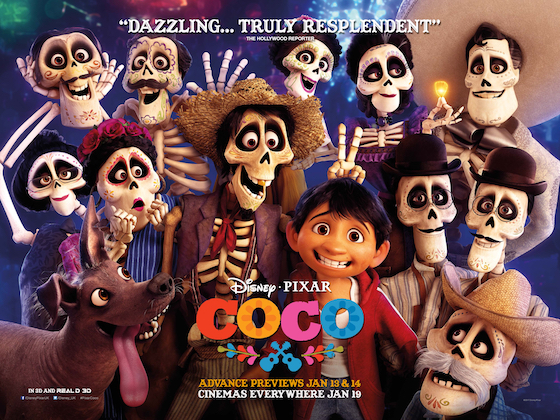
    So, to start again: Coco is the story of Miguel (Anthony Gonzalez), a kid who desperately wants to be a musician like his idol, Ernesto de la Cruz (Benjamin Bratt). Unfortunately for Miguel, all music is banned in his family, due to his great-great-grandfather abandoning his wife and young daughter to pursue it as a career. On the Day of the Dead, a convoluted and overlong first act eventually gets us to a point where Miguel finds himself actually in the Land of the Dead, surrounded by the skeletal form of everyone who’s passed away. To get back to the land of the living he must go on a quest, accompanied by downtrodden Héctor (Gael García Bernal), who’s being forgotten by the living and needs Miguel to reestablish his memory in the real world. More or less. I mean, the rules get more fiddly and complicated than that.

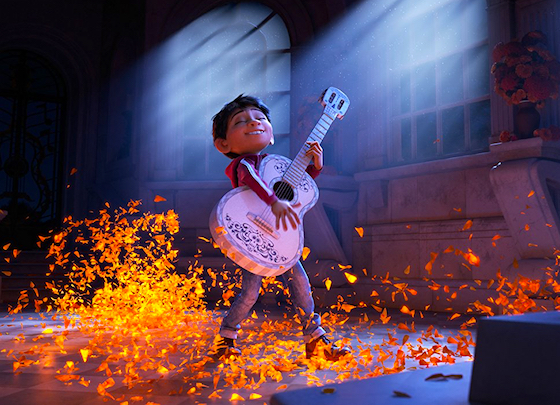
    The magic of music

    Frankly, the rambling length was my biggest problem with Coco. It’s not badly flabby, but it’s not as taut as I’d’ve liked it to be either, especially during stretches where you’re waiting for it to get to an inevitable plot twist or development. That’s not to say it’s without surprises — it pulls quite a dark plot twist about an hour in — and surprise isn’t the only virtue a story can have, of course, but it did reach a point where I was virtually shouting at the screen for them to finally get on with what was inevitably going to happen. Surely that’s a sign of something not working.

    Maybe that was the music — quite a central part of the storyline, as you may’ve inferred, but I can’t say I was a fan. Mostly it’s fine, but there’s the occasional musical number that just slowed things down. It’s not a musical in the strictest sense either, so the film does stop a bit in order to get each song underway (at least it usually then tries to progress the narrative while the song continues). The big number is the Oscar-winning Remember Me, which has grown on me slightly since I first heard it but, again, I’m not particularly a fan. I don’t know what it is, really, because when I’ve come across mariachi-style music in movies before I’ve often quite liked it. I guess it’s this particular set of tunes, then.

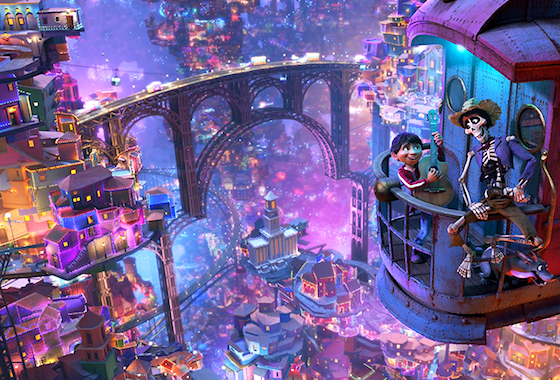
    Naturally it looks great — it’s Pixar, would you expect anything less? The colourful Land of the Dead stuff is the best visually, wide shots creating epic vistas, with stunning architecture that suggests quite a world… not that we get to explore it very thoroughly, even though the quest narrative takes us to a few different locations. We certainly don’t get any indication how it functions for the other 364 days of the year. Zootropolis showed us a glimpse of a well-imagined full-scale world, teasing enough that I wanted to explore it comprehensively in further stories. Coco’s just looks pretty.

    Colourful vistas

    Maybe I’m being too picky? Maybe I’m just trying to work out what it was everyone else loved so much, when I saw a pretty standard Pixar buddy quest story with new surface flourishes. Or perhaps I’m right, and other people were blinded by the emotional ending? The final few minutes are certainly effective at tugging at the heartstrings — even though I hadn’t fully invested in the rest of the film, even I felt a pang… albeit slightly undercut by once again having to yell at the characters to get on with what they were inevitably going to do. Not everything should move at a mile a minute, but c’mon, sometimes you’re just being languorous.

    Reportedly Coco had the longest active production of any Pixar movie, with work beginning in 2011 and (obviously) being completed in 2017. There are quite a few deleted scenes included on the Blu-ray which (from a brief flick through) seem to suggest the story once went in quite a different direction. I saw one person say those scenes suggest a much worse movie, too. I guess they kept tweaking the plot, then, maybe until it eventually resembled that familiar broad Pixar shape that dates right back to the original Toy Story.

    Coco is good, but I certainly wouldn’t say it’s perfect. And I think I might go watch Kubo again now, actually.

    4 out of 5

    The UK becomes probably the last major market to get Coco on disc with its release on DVD, Blu-ray, and 3D Blu-ray today.

    The Hangover Parts II & III

    In today’s roundup:

  • The Hangover Part II (2011)
  • The Hangover Part III (2013)


    The Hangover Part II
    (2011)

    2018 #56
    Todd Phillips | 102 mins | streaming (HD) | 2.35:1 | USA / English | 15* / R

    The Hangover Part II

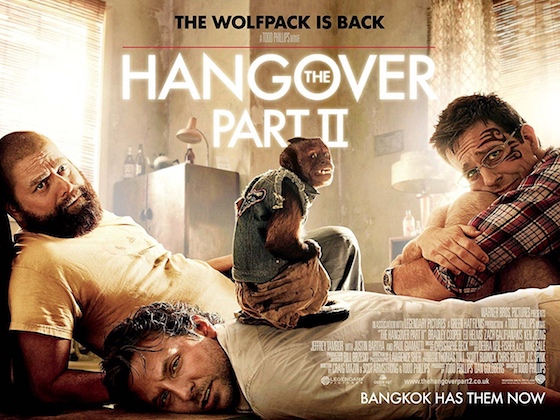
    The Hangover was a surprisingly big hit back in 2009 (was it really so long ago?), so naturally it spawned a sequel. That went down less well, mired in criticisms of just being a rehash of the original. I don’t know what people expected, really — The Hangover was sold on its high-concept setup, so naturally they repeat that for the sequel.

    For those who don’t remember said setup, it’s a bunch of mates gathering for a bachelor party, only they wake up the next morning with no memories of the night before, surrounded by evidence that a bunch of crazy random stuff has happened, and one of their party missing — in the first film it’s the groom, which naturally has potential to upend the wedding; in this one it’s the bride’s brother, which is almost as bad. So they must retrace their steps to find the missing person, along the way learning what the hell they got up to the night before.

    The devil, then, is in the detail. The big change is that the first film was set in Las Vegas and this one is in Bangkok. Other than that… look, I’m not going to list specifics, because what would be the point? But as I say, it’s the same broad outline, only with different specific events. I suppose I can see why some might feel they’d seen all that before, but when so many movies have the same plot without even meaning to, can we really begrudge a sequel for sticking to the same shape and structure as its forebear?

    Monk-eying around

    I wonder if part of the reason some people were so disappointed was their heightened expectations. The first was a very popular film, so I guess its fans expected a lot of a sequel. Receiving something that was almost a copy must’ve felt inferior. Personally, I only thought the original was okay — quite amusing, for what it was. I thought the sequel was at least equally as good. If anything, being free of expectations, I enjoyed Part II more. Thinking back on it, I didn’t actually laugh that often… but, somehow, I didn’t mind. So I guess I… kind of like the characters? And so hanging out with them for another couple of hours… was enough? Well, I didn’t expect to have that reaction.

    Anyway, clearly fans of The Hangover need to approach this rehash sequel with caution; and if you hated Part I then Part II is samey enough that you don’t want to bother. But if, like me, you enjoyed the original well enough but that was all, this follow-up might surprise you.

    3 out of 5

    The Hangover Part III
    (2013)

    2018 #102
    Todd Phillips | 100 mins | streaming (HD) | 2.35:1 | USA / English | 15 / R

    The Hangover Part III

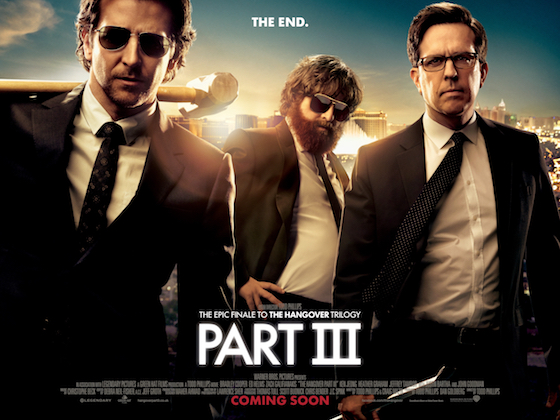
    Clearly the people in charge of the Hangover series took on board criticism that Part II just rehashed Part I’s plot, because Part III takes the same characters and spins them off onto a wholly different narrative. There isn’t even a hangover involved. Unfortunately, that didn’t work either: based on ratings found across the web, it’s the least popular of the trilogy.

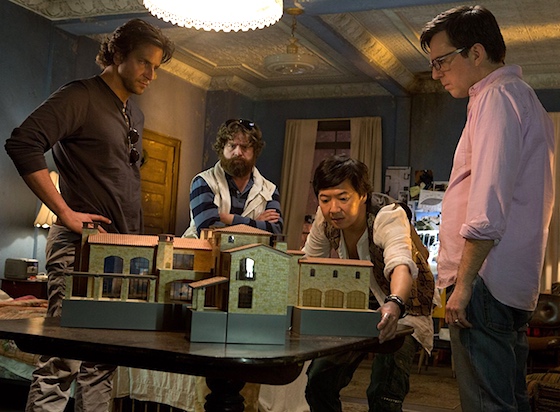
    Picking up after the events of the second film, it begins with Chow escaping from prison, leading a former criminal rival to force the Wolf Pack to track him down. Cue the gang finding themselves involved in a heist in Tijuana, before events take them back to Vegas to bring the series full circle. In the most fundamental change to the series’ MO, these events unfold linearly, meaning it ditches the piecing-the-night-together element of the previous two films. You can see why they tried to put the same characters through a new crazy adventure, but it’s missing something without that mystery structure.

    Even worse, it’s just not as funny and the story isn’t as engaging. Some people say it’s completely humourless, which I think is a bit harsh, but it’s also a more serious film than it should be. The stakes are too high, and the need to construct a story that progresses sequentially leads to a focus on plot. Say what you will about the repeated structure in the first two films, but it allowed for the insertion of almost any random situation that seemed funny — what occurred the night before only has to just about hang together, because the guys are re-encountering their adventures out of order and without all the facts. Here, with the characters sober and the story unfurling in chronological order, there must be clear cause-and-effect from one scene to the next. That seems to have hampered the writers’ funny-bones. It almost becomes a comedic crime thriller rather than just a comedy — albeit a ludicrous, derivative one — which feels like it’s missing the point.

    A model heist

    It’s also too long, especially when it moves onto an epilogue that seems to keep reaching an endpoint only for there to be another scene. Eventually there’s a montage of clips from all the previous films, which seems to be under the impression this was some epic saga and something more significant than it actually is. And then, to rub salt in the wound, there’s a mid-credits scene that suggests a better Hangover movie than the one we just watched.

    Apparently the lead cast members all took convincing to return for this film, eventually being swayed by a $15 million payday (plus gross points). I mean, fair play, I’d appear in worse movies than this if I was being offered $15 million. At least it’s kind of alright, depending on how forgiving you’re feeling, with a few funny lines and bits; but it is also definitely the weakest and least memorable of the trilogy.

    2 out of 5

    * Just as with the first film, the BBFC took issue with some of the photographs shown during the end credits, and so they were cropped to secure a 15. The version streaming on Amazon is unedited, however, meaning that technically what I watched hasn’t been passed by the BBFC. But there’s nothing there that your average fifteen-year-old hasn’t already seen on the internet anyway. ^

  • Jumanji: Welcome to the Jungle (2017)

    2018 #89
    Jake Kasdan | 119 mins | Blu-ray (3D) | 2.39:1 | USA / English | 12 / PG-13

    Jumanji: Welcome to the Jungle

    As Avengers: Infinity War breaks almost all opening weekend records, a surprise box office champ from last year makes it to UK DVD and Blu-ray. Well, it’s not all that surprising that Jumanji: Welcome to the Jungle did well at the box office — it’s the belated sequel to a successful film that has become a childhood favourite for many, and it stars one of the few current actors who’s more-or-less guaranteed to get a film good gross on his appearance alone, The Rock — but how well it did shocked many who commentate on such things. In the US, although it only opened at #2 (behind The Last Jedi in its second weekend), it climbed to #1 for its third weekend, then stayed there for four of the next five weeks. Eventually it overtook every Spider-Man movie to become Sony’s highest-grossing film ever domestically. Worldwide, it’s taken just shy of $957 million to be Sony’s second highest-grossing film of all time (behind Skyfall). That’s more than just some vague nostalgia for an old Robin Williams movie.

    Set 20 years later, a group of mismatched high school kids wind up in detention and are assigned to clear out an old classroom. There they find an old games console with a single game: Jumanji. They boot it up, select their characters… and are sucked into the console, finding themselves inhabiting their avatars inside the game’s jungle world. In order to escape they must complete the game, by battling against a gang of mercenaries to return a jewel to its rightful home.

    Search for the high school kid inside yourself

    It’s a very different setup to the original movie, which is refreshing — it could’ve just been a rehash with modern effects (while the Williams movie still has a lot going for it, the mid-’90s CGI is definitely not one of them). That said, it’s not as innovative or inventive as the first movie. The way that brought the board game’s environment to life in the real world was a unique concept, whereas this sequel merely offers an Indiana Jones-esque jungle adventure, albeit with self-aware characters. It doesn’t even use the fact it’s supposedly a video game that much, aside from a few jokes (our heroes have ridiculous only-in-a-game abilities and weaknesses; non-player characters sometimes have looping dialogue).

    Where it does work is the characters and the performances. The headline cast are excellent, playing at once their in-game characters and evoking the real world counterparts who’ve inhabited them. Much of the film’s fun comes from the juxtapositions: the most obvious is Jack Black as a self-obsessed teenage girl in the body of an overweight middle-aged man, but there’s also Dwayne Johnson as a scaredy nerd in the body of, well, The Rock; Kevin Hart as a bulky jock reduced to being a short-ass backpack carrier; and Karen Gillan as an under-confident academic girl now in the body of a sexy Lara Croft type. Well, frankly, I’m not sure how much Hart brings to the table, but Johnson and Gillan are really good (and — minor spoiler! — share what is perhaps one of the best kisses in screen history), and Black is clearly having a whale of a time. The quality of the characters quietly builds to a point where the epilogue back in the real world is surprisingly emotional.

    MVPs not NPCs

    Unfortunately, not everything works that well. The main thing that suffers is the villain. I suppose there has to be one, if only to provide an obstacle at the climax, but that’s also the only reason he’s there — an antagonist for the sake of it. He either needs more time investment, to make him a proper character, or, actually, less — make him even more of an uninteresting obstacle than he already is. Heck, they could’ve got some gags out of the weak plots of old video games. It’s a similar situation with world building. For example, the city they visit looks fantastic in the establishing shot, but there’s no time invested in it — it’s just a place for an action scene, clearly meant to provide visual variety from the other settings of jungle, jungle, and jungle. Maybe that’s ok, but you feel like there could be more to this world.

    These issues with plot construction extend to individual gags, some of which feel like setups in need of pay-offs. For example, Hart’s character has a weakness for cake. We learn that, then he accidentally eats some cake and loses a life, but… that’s it? The scene is mildly amusing thanks to the OTT way it causes him to die, but it feels like that’s a reminder — “weaknesses matter, and cake is his” — before a proper pay-off later. But there isn’t one. I mean, how about this: not only does cake kill him, but he can’t resist it (it’s like, you know, a weakness). So in the rhino scene, instead of just dropping him, they drop a trail of cake to lure him along; then, rather than the rhinos just being distracted by him running away, he eats the cake and explodes, which takes out the rhinos. (Hire me, Hollywood!)

    There is running. There is also jumping. Yep, definitely a video game.

    In some respects these are all nitpicks. They don’t detract from the main fun of the film, which is the mismatch between real-world kids and their in-game avatars, and putting those characters through an action-adventure. The result is amusing and exciting, and ultimately a lot of fun, even if a bit of polish could’ve made it better. Nonetheless, I probably enjoyed it more than the original.

    4 out of 5

    Jumanji: Welcome to the Jungle is released on DVD and Blu-ray in the UK today.

    Review Roundup: Comedy Documentaries About Music

    In today’s does-what-it-says-on-the-tin roundup:

  • Anvil: The Story of Anvil (2008)
  • Popstar: Never Stop Never Stopping (2016)


    Anvil:
    The Story of Anvil

    (2008)

    2017 #117
    Sacha Gervasi | 77 mins | streaming (HD) | 16:9 | Canada / English | 15

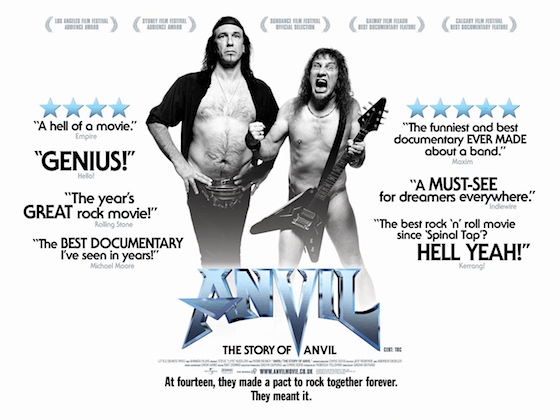
    Anvil: The Story of Anvil

    This is the real Spinal Tap: a rockumentary about heavy metal group Anvil, who once headlined alongside Whitesnake and Bon Jovi, and are cited as an influence on groups like Megadeth and Metallica, but who haven’t enjoyed the same success as any of them. The film follows the group as they attempt to relaunch with a tour and new album.

    Truth is stranger than fiction, as they say, and, thanks to This is Spinal Tap, Anvil at first feels like fiction, with broad characters and a humorous tone. But it isn’t a blatant rip-off of Rob Reiner’s influential mockumentary, it’s a true story.

    That knowledge gives the whole thing a different air. It’s not so much tinged with sadness as endlessly sad — hopes and dreams that have come to nothing, even though they’re still pursued; how those continued pursuits falter and fail. And, perhaps worst of all, is the esteem other bands hold them in — the influence they admit to have taken from Anvil — and yet Anvil themselves languish in crummy jobs with no wide recognition, while the people who ripped them off (as one of them even admits) are famous and successful.

    A lot of comedy would actually be quite sad if it wasn’t fiction. Anvil proves that.

    4 out of 5

    Popstar:
    Never Stop Never Stopping

    (2016)

    2018 #41
    Akiva Schaffer & Jorma Taccone | 83 mins | streaming (HD) | 2.35:1 | USA / English | 15 / R

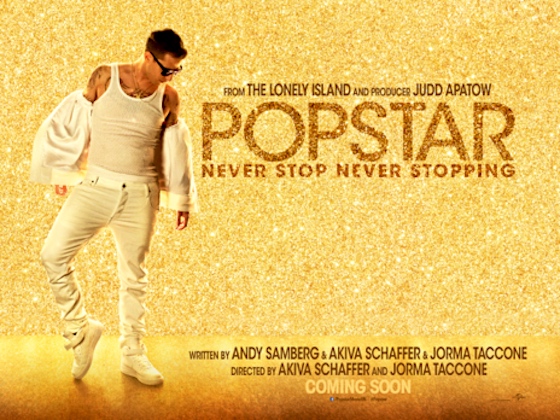
    Popstar: Never Stop Never Stopping

    This is Spinal Rap: comedy trio The Lonely Island star as the Style Boyz, a popular pop-rap boy band who disbanded after their frontman, Conner4Real (Brooklyn Nine-Nine’s Andy Samberg), decided to go solo. The mockumentary follows Conner as he goes on tour to launch his second album.

    Popstar is every inch a modern do-over of This is Spinal Tap. That’s not to say it’s a straight-up remake, but it’s certainly a spiritual sequel, with many similar building blocks: not very bright musicians; unsuccessful musical endeavours; and lots of fully-realised spoof songs. Where Spinal Tap satirised the metal scene of the ’80s, Popstar turns its sights on the world of present-day mainstream music. In both cases, the base funniness is enough that you don’t need much familiarity with reality to get the gags.

    It only bears so much comparison to its forebear (there’s nothing as iconic as “it goes up to 11” to be found here), but as a modern take on the same genre, it has merit. And, most importantly, I thought it was consistently very amusing.

    4 out of 5

  • The Monster Squad (1987)

    2017 #43
    Fred Dekker | 79 mins | streaming (HD) | 2.35:1 | USA / English | 15 / PG-13

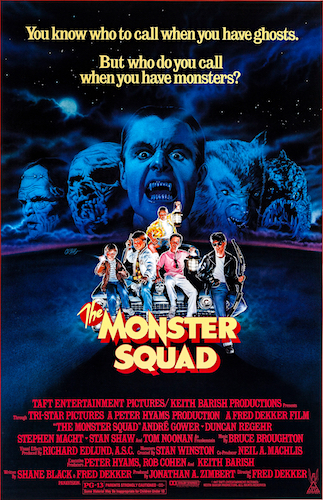
    The Monster Squad

    When I rewatched The Nice Guys on Blu-ray, I also watched the (pathetic selection of) special features, in which Ryan Gosling mentions being a fan of Shane Black before he knew who Shane Black was because growing up he loved The Monster Squad. To cut to the obvious, that inspired me to watch the thing.

    It’s about a group of young kids who idolise classic monster movies, but basically find themselves in one when Dracula and friends come alive and set about finding an amulet that will allow them to control the world. The film wasn’t a success on its original release, but has gained a cult following since. It feels like that kind of movie, too.

    It’s also the kind of film I can imagine you’d love if you saw it at the right age, but the “right age” is not, it would seem, the one I am now. Really, it’s a kids’ movie, despite the BBFC’s 15 certificate. There’s more swearing and stuff than you’d typically expect from a kids’ movie, which I’m sure led to that classification, though as it’s not been submitted since 1990 perhaps they’d give it a 12 today. Nonetheless, the tone feels more aimed at, say, ten-year-olds — it stars kids who are 12 and under, and I bet they’re a moderately realistic version thereof, despite what ratings bodies would like.

    Frankie comes from Hollywood

    That’s not to say it’s without value for those of us coming to it late. There’s great make-up and creature effects, better than you might expect given the overall quality of the film, which is what you get when Stan Winston’s involved. It’s under 80 minutes long, which keeps things pleasantly fast — there’s very little titting about with bits of plot that we know where they’re going, it just gets there. There are some good lines too, as you’d expect from a Shane Black screenplay, although it’s surprisingly scrappily constructed. Perhaps that’s Fred Dekker’s limited skill as a director rather than Black’s screenplay? This was early in his career, mind, so maybe Black wasn’t up to scratch yet — it came out the same year as the film that made his name, Lethal Weapon… which I didn’t actually like much either, so…

    The Monster Squad wasn’t a huge success for me, then, but I imagine if you saw it at the right age it would become a nostalgic favourite.

    3 out of 5