Cecil M. Hepworth shorts

I know I’m generally quite poor about posting reviews nowadays (“nowadays” being “for the past five years”, considering that’s roughly how long ago my backlog stretches), but I do have the Archive 5 to dig into that, and sometimes post reviews of newer watches too. What really suffers, however, are short films. I have no consistent plan to correct that, but here at least are reviews of three shorts I’ve watched this year with a simple connection: they were all directed by early British filmmaker Cecil M. Hepworth.

  • Alice in Wonderland (1903)
  • Explosion of a Motor Car (1900)
  • The Indian Chief and the Seidlitz Powder (1901)


    Alice in Wonderland

    (1903)

    Cecil M. Hepworth & Percy Stow | 9 mins | digital HD | 4:3 | UK / silent

    The first screen adaptation of Lewis Carroll’s beloved novel is a whistle-stop tour of some of its best-known moments. What it loses in not being able to retain any of Carroll’s memorable prose or dialogue, it makes up for by being a neat showcase for some early-cinema special effects — Alice shrinks and grows; a baby turns into a pig; and so on. There’s little doubt that this isn’t the best filmed version of the tale (unless you have a fondness for early cinema over anything made later), but it’s a valuable glimpse into the ambition and skill of the form’s pioneers.

    The only surviving print is in terrible shape and missing several minutes of footage (it was originally 12 minutes long), but at least we have some way of seeing this important bit of film history. Talking of which, you can watch it on the BFI’s official YouTube channel, although they only provide it in standard definition. Fortunately, there’s a full HD version here.

    3 out of 5


    Explosion of a Motor Car

    (1900)

    Cecil M. Hepworth | 2 mins | digital SD | 4:3 | UK / silent

    Cars randomly exploding for almost no reason is a hallmark of action cinema, but it begins even earlier than the codification of that genre, as this short from 1900 shows.

    We watch as a car full of people merrily trundles along a suburban street… then, suddenly, there’s a puff of smoke and the vehicle is reduced to a pile of parts. A policeman comes over to inspect, at which point body parts rain from the sky. It would be gruesome if it weren’t so obviously comical… especially when the policeman begins to casually pile them up. And that’s the end.

    Basically, it’s a comedy sketch à la 1900. I guess it was probably inspired by fears of this modern new invention, the motor car, but at least it plays those for laughs. There are worse ways to spend 90-or-so seconds (depending on the playback speed of the version you watch — the BFI version is here).

    3 out of 5


    The Indian Chief and
    the Seidlitz Powder

    (1901)

    Cecil M. Hepworth | 2 mins | digital SD | 4:3 | UK / silent

    So, I bought the 88 Films Blu-ray of ’70s British-produced Western Hannie Caulder (mentioned in my May failures), had a little look at the booklet and, for whatever reason, the opening paragraph of the essay by Lee Broughton caught my eye. To quote: “The British have been making Westerns since the early days of silent cinema (see The Indian Chief and the Seidlitz Powder [Cecil M. Hepworth, 1901]) and they continue to make Westerns today (see The English [Hugo Blick, 2022]).” This, first off, reminded me that I’d meant to watch The English (I find Blick’s work to be both fascinating and somehow off-putting, so I always feel I should watch them but, when there’s such a plethora of choice nowadays, it’s easier to go for something, well, easier). More relevantly, it sent me off to Google this short, having recognised the director’s name (partly from watching the above-reviewed shorts a couple of months earlier) and, more importantly, being interested in the early days of cinema — especially as shorts such as these can usually be found online, if they survive. You often end up with low-quality DVD rips on YouTube, but, thankfully, this one is available on the BFI for free.

    All of that said, it’s… not all that. It’s a Western in technicality only: the sole character is a Native American chief; though you’d only infer that from the title, because his costume is terrible. There are no other signifiers that this is a Western — the basic set could be a store or storeroom anywhere, and presumably Seidlitz Powder was a product sold in British shops. I presume that because the short is a one-gag comedy based around the effects of that product, and so British audiences must’ve known about it. As far as I’m aware, it’s not a product still in existence today, so thank goodness for the BFI’s explanatory notes (also at the link above) to illuminate the context of the joke.

    Other than that, the film is noteworthy for containing a sequence in slow motion. It’s an inherently cinematic effect, so it’s always interesting to see it deployed so early in the form’s history. Indeed, it stands at odds with how the other ‘effects’ in the film are achieved: the chief’s belly swells by the performer (Hepworth himself, possibly? I don’t know, but I believe he often appeared in his own films; equally, someone is operating the camera) fiddling around inside his costume and shaking it about until it inflates. Then he “bounce[s] around like a balloon”, says the BFI — rather overselling it, as he just kind of leaps about a bit. There is one more cinematic technique: a jump cut to allow for a puff of smoke when his stomach bursts… followed by the performer awkwardly folding up his now over-large costume before darting out the door.

    So, two minutes filled with casual racism, 120-year-old topical humour, and some weak theatrical ‘special’ effects. But hey, at least we can experience British cinema’s early forays into uniquely cinematic technique and a key genre.

    2 out of 5


  • Archive 5, Vol.11

    I have a backlog of 515 unreviewed feature films from my 2018 to 2023 viewing. This is where I give those films their day, five at a time, selected by a random number generator.

    Today, the main emergent theme is “films that weren’t so great” — although there are a couple of bright spots to be found, still.

    This week’s Archive 5 are…

  • Dumb and Dumber (1994)
  • Bill & Ted Face the Music (2020)
  • Mangrove (2020)
  • Out of Africa (1985)
  • Rambo: Last Blood (2019)


    Dumb and Dumber

    (1994)

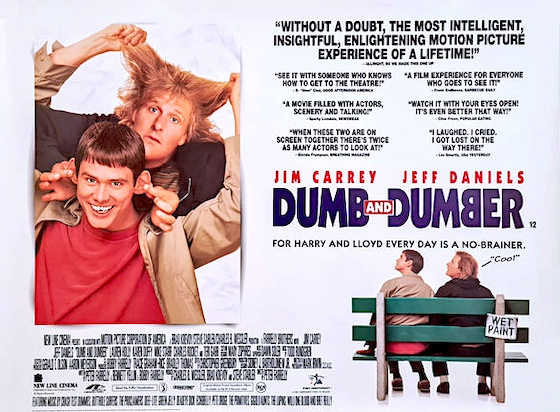
    Peter Farrelly | 107 mins | digital HD | 16:9 | USA / English | 12 / PG-13

    Dumb and Dumber

    The nicest thing I can say about Dumb and Dumber is that it does at least live up to its title: it starts dumb and gets dumber.

    Despite the film’s later reputation in some circles as a modern comedy… if not “classic”, then certainly “success” — enough to eventually earn it both a prequel and sequel, at any rate — I’m clearly not alone in this view: apparently the original draft of the screenplay was so poor that it gained an enduringly negative reputation among investors; to the extent that, even once it had been rewritten, it had to be pitched under a fake title in order to get people to even read it. I feel like the final result only goes some way towards fixing that, with an oddly episodic structure and some bizarrely amateurish bits of filmmaking for a studio movie (the audio quality is relatively poor; there’s too much reliance on samey master shots).

    There are a few genuinely funny bits between all the gurning, guffawing, and scatology. It’s a shame they’re not in an overall-better film.

    2 out of 5

    Dumb and Dumber was #119 in my 100 Films in a Year Challenge 2021. It featured on my list of The Worst Films I Saw in 2021.


    Bill & Ted Face the Music

    (2020)

    Dean Parisot | 88 mins | digital HD | 2.39:1 | USA & Bahamas / English | PG / PG-13

    Bill & Ted Face the Music

    I wasn’t that big a fan of the original Bill & Ted films, so I didn’t have high hopes for this — after all, most decades-later revival/reunion movies are primarily about trying to please existing fans, not win round new ones; and it feels like a good number of them fail even in that regard. Face the Music is definitely full of the requisite nods and references, both explicit and subtle, major and minor; but they’re all in the right spirit and it kinda works (albeit a bit scrappily at times), bound together by a deceptively simple, pervasive niceness.

    Alex Winter is particularly great as Bill. Given all the stories we hear about how awesome Keanu Reeves is in real life, it’s no surprise that — despite being the much (much) bigger movie star — he’s generous enough to be a co-lead and let Winter shine. Brigette Lundy-Paine is absolutely bang on as Ted’s daughter, aping Reeves’ performance in all sorts of ways. As the younger Bill, Samara Weaving is clearly game, but doesn’t carry it quite as naturally (apparently she was cast after Reeves discovered she was the niece of Hugo Weaving, who he’d of course worked with on the Matrix trilogy, so that might explain that).

    “Be excellent to each other” is a message the world needs now more than ever, and that’s as true four years on as it was back in 2020. For me, that makes this third outing Bill and Ted’s most excellent adventure.

    4 out of 5

    Bill & Ted Face the Music was #136 in my 100 Films in a Year Challenge 2021.


    Mangrove

    (2020)

    aka Small Axe: Mangrove

    Steve McQueen | 127 mins | TV HD | 2.39:1 | UK / English | 15

    Small Axe: Mangrove

    The line between film and TV continues to blur with Mangrove: a 127-minute episode of an anthology TV series, Small Axe, conceived and directed by Oscar winner Steve McQueen, that premiered as the opening night film of the London Film Festival. It was made for television, but in form and pedigree it’s a movie. Just another example in a “does it really matter?” debate that continues to rage — and is only likely to intensify with the increasing jeopardy faced by theatrical exhibition. (I wrote this intro almost four years ago, and while theatrical is fortunately still hanging in there post-pandemic, I do think the line remains malleable.)
    I only ended up watching two episodes/films from Small Axe in the end. I did intend to go back and finish them, especially as they were heaped with critical praise, but the second (Lovers Rock) bored me to tears, which didn’t help. This first was better, but still not wholly to my taste. It tells an important true story about racially-motivated miscarriages of justice, but I found it overlong and with too much speechifying dialogue. That kind of thing works better in a courtroom setting, I find, so perhaps that’s why I felt the film was at its best once it (finally) got to the courtroom. When it’s good, it really is very good.

    4 out of 5

    Mangrove was #246 in my 100 Films in a Year Challenge 2020.


    Out of Africa

    (1985)

    Sydney Pollack | 161 mins | digital HD | 16:9 | USA & UK / English | PG / PG

    Out of Africa

    This is very much the kind of thing that was once considered a Great Movie, in an “Oscar winner” sense, but nowadays is sort of dated and attracts plenty of less favourable reviews. It’s long, historical, and white — not how we like our movies about Africa nowadays, for understandable reasons.

    Certainly, there are inherent problems with its attitude to colonialism, but to a degree that’s tied to how much tolerance you have for “things were different in the past” as an argument for understanding. In this case, just because these white Europeans shouldn’t have taken African land and divvied it up among themselves and treated the inhabitants as little better than cattle, that doesn’t mean the individuals involved weren’t devoid of feeling or humanity. People like Karen, the film’s heroine, were trying to do what they thought was right within the limited scope of what society at the time allowed them to think. With the benefit of a more enlightened modern perspective, we can see that was still wrong and that they didn’t go far enough, but (whether you like it or not) there is an element of “things were different then”.

    Morals aside, the story is a bit slow going, bordering on dull at times, but it’s mostly effective as a ‘prestige’ historical romance, which I think is what it primarily wants to be. It’s quite handsomely shot, although not as visually incredible as others make out, and John Barry’s score is nice — you can definitely hear it’s him: on several occasions it reminded me of the “love theme”-type pieces for his Bond work.

    3 out of 5

    Out of Africa was #212 in my 100 Films in a Year Challenge 2020.


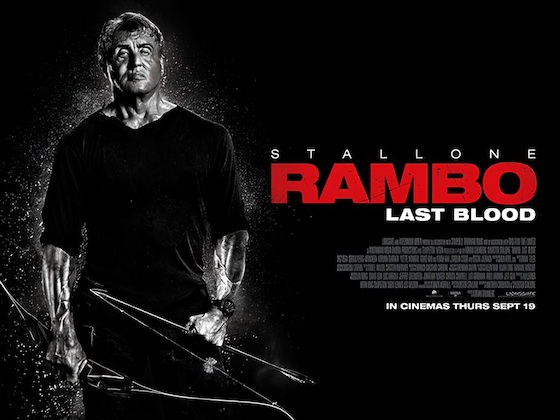
    Rambo: Last Blood

    (2019)

    Adrian Grünberg | 89 mins | digital HD | 2.39:1 | USA, Hong Kong, France, Bulgaria, Spain & Sweden / English & Spanish | 18 / R

    Rambo: Last Blood

    Sylvester Stallone’s belated returns to the roles that made his name have worked out pretty well so far, I think, with Rocky Balboa and Rambo (i.e. Rambo 4) being among my favourites for both those franchises; not to mention Creed and its sequel. Unfortunately, here is where that streak runs out.

    Running a brisk 89 minutes (in the US/Canada/UK cut — a longer version was released in other territories), the film is almost admirably to-the-point. We all know where it’s going, and more or less what plot beats it will hit along the way, so it doesn’t belabour anything, it just gets on with it. However, you eventually realise why other films ‘indulge’ in the kind of scenes this one has done away with: movies are about more than just plot, they’re about character and emotion and why things happen. Last Blood is so desperate to get to the action that it strips those things back to their bare minimum, thus undermining our investment. And then, weirdly, it hurries through the action scenes too. The climax packs in as many gruesome deaths in as short a time span as possible, meaning none but the most stomach-churning have any impact; and even those disgusting ones are mercifully fleeting. More, it feels rushed and of little consequence. Far from a grand send-off to the Rambo saga (which a slapped-on voiceover-and-montage finale attempts to evoke), it feels like a short-story interlude.

    Did Rambo deserve better? Well, I wouldn’t necessarily go that far. But, on the evidence of this, it might be best if they don’t try again.

    2 out of 5

    Rambo: Last Blood was #74 in my 100 Films in a Year Challenge 2020.


  • The Kid Detective (2020)

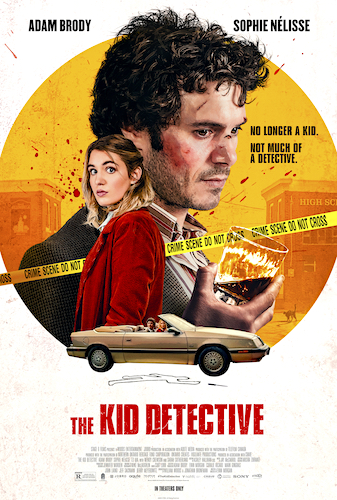
    Evan Morgan | 96 mins | digital (HD) | 2.39:1 | Canada / English | 15 / R

    The Kid Detective

    Sometimes a movie (or a book, or a series, or whatever) comes along with a premise that you wonder why someone hasn’t thought of sooner (with the inevitable caveat that, sometimes, someone has and you’re just not aware of it). The Kid Detective is one of those occasions (or was for me, at any rate) — what would a ‘kid detective’ (you know, like the Hardy Boys or the Famous Five or whatever) be like when they grew up?

    There’s a few different ways you could spin a setup like that, and here writer-director Evan Morgan takes a fairly realist approach: the “kid detective” in question, Abe Applebaum, was a quirky story for the local paper when he was a child, investigating “mysteries” of the schoolyard variety; but when a real crime takes place and he (unsurprisingly) fails to solve it, that’s the end of the fun and games. Nonetheless, as a 32-year-old adult (played by Adam Brody), Abe has tried to keep his childhood fantasy going, running a real detective agency. Except there’s not much to actually investigate in a small town, and the fact he’s never grown up leads to derision from all around, rendering him a miserable washed-up has-been. So when a high schooler (Sophie Nélisse) asks him to investigate the murder of her boyfriend, Abe sees a chance to finally prove himself.

    When I say “a premise you wonder why someone hasn’t thought of sooner”, I suppose what I also implicitly mean is “something I am interested in”; something that scratches an itch I didn’t even know I had. Of course, that automatically creates expectations — even if you can’t state them exactly, you now have a notion of what you want out of this thing; of the itch that needs to be scratched. Fortunately, The Kid Detective was everything I expected it to be and more. It’s a successfully amusing extrapolation of its premise. It kind of has to be a comedy, because the basic idea is too silly to take seriously in the ‘real world’, and it manages that without tipping over into farce. But, somewhat remarkably, it’s also a solid mystery in its own right, with a surprisingly moving conclusion. It’s a balancing act that shows the validity of comedy-drama (aka dramedy) as a tone. It’s a mode that’s sometimes dismissed as “not funny enough to be a comedy, not affecting enough to be a drama”, but when it works, it’s arguably more like real life than either of those extremes.

    Drink driving

    It also doesn’t mean the film has to play broad. Take Brody’s performance, for example: he balances the sardonic humour and introspection just right, rendering Abe believable as someone who is actually pretty darn clever but has lost his way and self-belief. Or there’s the ‘big denouement’, which is just two characters sat at a table talking. It’s both relatively understated and means the finale arrived at a point where I (at least) wasn’t quite expecting it, making it all the more effective and powerful. With hindsight, maybe I should have seen where it was going, and so maybe you could argue the film suckered me. But, you know what, I’m glad it did. It’s nice to be surprised by a mystery’s resolution. It happens too rarely as you get older and become narrative-savvy and everything’s predictable. One moment even gave me goosebumps, and you’ve got to love anything that can elicit such a physical reaction.

    Clearly, I was the target audience for this. I couldn’t have told you I wanted it, but when I heard about it I was eager to see it. As I said, that has both pros and cons: to the former, I’m ready to be won over; to the latter, raised expectations can lead to disappointment. Fortunately, The Kid Detective aces it and I loved it.

    5 out of 5

    The UK TV premiere of The Kid Detective is on Film4 tonight at 9pm, and available to stream on Channel 4’s catchup service for 30 days afterwards.

    It was #147 in my 100 Films in a Year Challenge 2021, and placed 4th on my list of The Best Films I Saw in 2021.

    2024 | Week 3

    I’ve already covered Barbie, so here are the other films I watched during Week 3…

  • Chicken Run: Dawn of the Nugget (2023)
  • The Best of the Martial Arts Films (1990)


    Chicken Run:
    Dawn of the Nugget

    (2023)

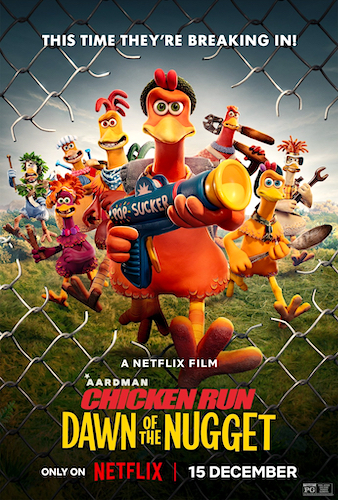
    Sam Fell | 98 mins | digital (HD) | 2.00:1 | UK, USA & France / English | PG / PG

    Chicken Run: Dawn of the Nugget

    I wasn’t a massive fan of the original Chicken Run (it’s not bad, but it pales in comparison to some of Aardman’s other works, not least any of the main Wallace & Gromit films), so I approached this belated sequel more with trepidation than excitement. You could interpret a near-quarter-century wait as indicative of holding off until someone had a genuinely good idea; or you could see it as a shameless effort to generate a hit by tickling childhood nostalgia through a return to a cult-ish favourite. Behind-the-scenes stories of unnecessary cast changes (the primary offender: apparently 55-year-old Julia Sawalha is now too aged (for a voice role as a hen?) so they recast her with 51-year-old Thandiwe Newton) did nothing to bring confidence.

    Anyway, setting all that aside, the end result is… adequate. I’d probably have said the same of the first one, so maybe that’s no surprise. But even that felt like it had some moments that stood out, whereas this is just unrelentingly fine. The plot concerns the chickens having to break in to a farm — yes, it’s taken 25 years to have the genius idea of “what if we just reversed the story?” The immediate point of reference for break-in-type movies nowadays is the Mission: Impossible franchise, which features a noteworthy heist a least once per film. And so Dawn of the Nugget references M:I, and the gag goes thus: “It’s an impossible mission.” “Uh, shouldn’t it be the other way around?” That level of underscored bluntness is about the level all the humour operates at: unsubtle, unsophisticated, unvaried, and uninspired.

    The arguable exception in terms of quality is the animation itself. That it’s done well almost goes without saying — Aardman remain one of the masters of stop-motion (Laika having challenged them in recent years) — but, on the other hand, there’s nothing to wow you. It’s more than competent, slick and expressive and so on, but there’s no imagery you’ll take away; no shot or sequence that would make you reach for adjectives like “beautiful” or “stunning”.

    Aardman’s next major effort (it’s a bit unclear if it’s a feature or a short, as it’s going direct to the BBC in the UK) is a return to Wallace & Gromit, planned for later this year (no doubt a Christmastime treat, as usual). As I said, I prefer that duo, so I’m always excited to see them back on the screen. I just hope that belated sequel (almost 20 years since their feature film and 16 since their last short) doesn’t feel this… unnecessary.

    3 out of 5

    Chicken Run: Dawn of the Nugget is the 5th film in my 100 Films in a Year Challenge 2024.


    The Best of the Martial Arts Films

    (1990)

    aka The Deadliest Art

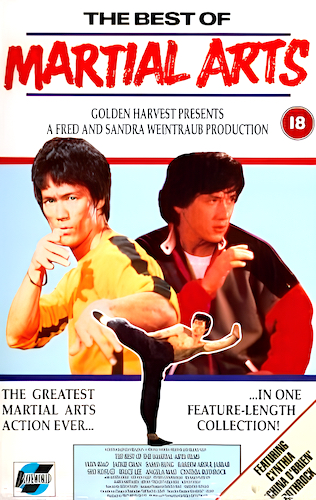
    Sandra Weintraub | 91 mins | Blu-ray | 16:9 | USA & Hong Kong / English | 18

    The Best of Martial Arts UK VHS cover

    Originally released on VHS (back when martial arts films weren’t necessarily easy to come by for consumers, so I’m told), this hour-and-a-half selection of fight scenes is now available remastered / reconstructed in HD, with all the film clips also in their original aspect ratios, included on Eureka’s When Taekwondo Strikes Blu-ray. Hurrah!

    It is, primarily, a showcase for fight scenes. Whole uninterrupted sequences are shared, which is at least the right way to do it if that’s what you’re doing; unlike modern TV clip-show compilations, which seem to feel the need to cut the scenes to shreds and intersperse them with inane talking heads. There are a few interviews included here too, but rather than early-career comedians who’ll discuss anything for a paycheque, the interviewees include stars Sammo Hung, Jackie Chan, Cynthia Rothrock, and, er, Keith Cooke; plus Robert Clouse, director of Enter the Dragon.

    “Best Of” is more a titling convention than a fact, considering the film was co-funded by Golden Harvest and so only has access to their back catalogue, thus skipping entirely the output of the legendary Shaw Brothers studio. But then, what else would you expect them to call it — Some Pretty Good Bits of the Martial Arts Films We Had the Rights to Include? Of course, however you look it, 90 minutes of fight scenes is a pretty hollow experience — there’s no narrative; even the interviews offer mostly behind-the-scenes anecdotes rather than, say, a “history of the genre” approach. But if that’s all you expect, you get your money’s worth, because there are some stunners in here.

    Mind you, as well as being mostly limited to one studio, it’s also limited by time: having been made in 1990, there’s no Jet Li, no Donnie Yen; Van Damme is mentioned as a “rising star”… You could do the whole film over again — several times — if you were able to encompass a wider spread of studios and stars. But nowadays there’s no need: we can just head to YouTube for our out-of-context fight scene fulfilment… so long as you know what you’re looking for, anyway. That will always be the value of a curated experience.

    3 out of 5

    The Best of the Martial Arts Films is the 6th film in my 100 Films in a Year Challenge 2024.


  • Barbie (2023)

    Greta Gerwig | 114 mins | Blu-ray (UHD) | 2.00:1 | USA & UK / English | 12 / PG-13

    Barbie

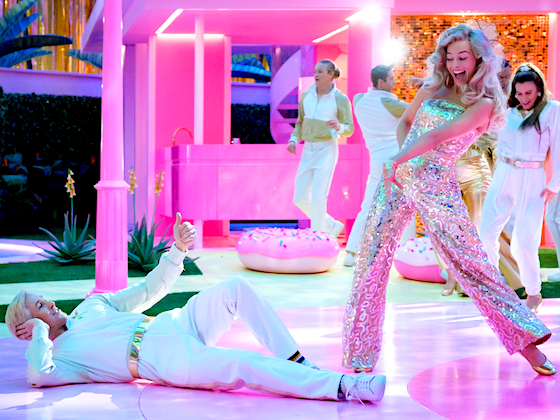
    Once upon a time, a movie based on a children’s toy would’ve been IP slop; or, at best, surprisingly entertaining IP slop. Heck, there are dozens of direct-to-video animated Barbie movies that prove exactly that: they look cheap; they’re there to generate money from little girls (primarily) demanding to see the video of the toy they like; but some of them aren’t actually all that bad.

    But that was a couple of decades ago. Now, the majority of our mainstream movie culture is based around originally-for-kids IP that people who have reached adult ages still apparently obsess over. And when it comes to “movies based on toys” specifically, we can look back to The LEGO Movie (released a whole decade ago this month) for a work that transcended what it “should have been” (an expensive 90-minute toy commercial) to become something genuinely entertaining; that used its IP in creative and fun and, yes, even meaningful ways. It’s those footsteps that the Barbie movie seeks to walk in.

    And, thanks to some savvy behind-the-scenes choices, it succeeds! Heck, it almost succeeds too well. This is definitely a movie primarily aimed at adults, with enough silliness and bright colours on the side to not alienate kids too much. Though by “kids” I mean “teenagers”. Sure, the 12A and PG-13 ratings are permissive enough to take your six-your-old who actually plays with Barbies, but they’re going to be left floundering — or, worse, bored — as the film debates feminism, the patriarchy, and gender roles in general. This is a film about where Barbie, the toy, sits in our culture; what it represents, and what it should represent, and how successful or not it is at doing that. It’s not an essay film — those themes are smartly addressed along the way as part of a storyline about Barbie-the-toy crossing over into our real world, for various reasons — but nor is it a bright-and-colourful bit of fluff to entertain small kids. Maybe it could have been — that’s what Pixar used to excel at — but it’s not the route the filmmakers chose to go down.

    Pretty as a picture

    As for the meat of what the film has to say and how it says it… oy, I’m not sure I want to get into that discourse. It’s just asking to have annoying people jump up in your replies. Nonetheless, it’s quite bold for an IP title like this to criticise the patriarchy by inverting it and making a matriarchy the oppressive state; but without feeding into right-wing numpties by saying “see, women would be just as bad!”. People say the film is about feminism, which is true, but it’s specifically about what I’d consider the true meaning of feminism — which is really about genuine equality — rather than what reactionaries imagine it is, i.e. “women are best and should be in control”. It could also have hit that note in a shallow, almost accidental way; for example, if it had been a parade of “aren’t men stupid and annoying?” jokes. Put another way, the film cares as much about the Kens and their right to be individuals as it does the Barbies and their right to be powerful. (I said I didn’t want to write anything particularly ‘risky’ and look what I’ve gone and done…)

    Also, thanks to my personal predilections, I particularly enjoyed how the film deconstructed itself; or, rather, the fact it was aware that it’s content based on product and engaged with that to some extent. It sits alongside other recent works like The Matrix Resurrections and Return to Monkey Island as works of art that have an awareness of where they sit in culture and why they exist, and are prepared to engage with that, to deconstruct it and analyse it, in quite an overt and meta fashion within the works themselves. Personally, that’s something I’ve wanted and dreamt of seeing, but never expected to get from studio IP — such self-awareness is kinda frowned upon when it’s saying “I exist for no artistic reason, purely to make more money for the studio”, as The Matrix 4 did most explicitly. What’s great about all three of these works is that they go beyond that obvious point, too.

    In something of an about turn, others have criticised the film for not being subtle in the way it handles these issues. My friends, you’re watching a movie based on a toy, aimed at as wide an audience as possible. This isn’t an abstruse Palme d’Or contender — it’s a film that can hit your everyman round the face with a bright-pink hammer three times over and they still might miss the point. Sometimes, it’s the right choice to be, if not “on the nose”, then certainly overt. It’s ok for a story to have a point, and for that point to be clear.

    Tarantino's favourite scene

    The other point of discourse the film has fired up came after the Oscar nominations, when co-writer/director Greta Gerwig and star/producer Margot Robbie were… nominated, actually, but not in the categories some people felt they should be nominated in. Although, if they’d swapped the nominations around, I expect they’d be annoyed the other way too. So, Gerwig gets a screenplay nod (which she might win, I guess?) but not a directing one (which she wouldn’t have, let’s face it), and Robbie is nominated for producing the film (a definite achievement — she’s spoken a lot in interviews about the efforts that went into making the film they wanted to make, and convincing the studio and toy manufacturers to go along with it) but not for acting (which she probably wouldn’t have won anyway). I don’t mean neither would have been deserving of the other nomination, but the directing gong seems almost sewn up for Christopher Nolan (for various reasons), and actress is a two-horse race between others. Besides, the real achievement is that the film exists as it is, with the content that it has — that’s a feat of writing and producing, not acting or, truly, directing (sure, in many other movies the director is king queen, but you get the distinct impression Barbie was significantly powered by Robbie; and when one person is both (co-)writer and director, surely a lot of their conceptual energy is injected at the writing stage).

    Competitors aside, the quality of work can always be argued on its own merits. Gerwig’s direction is pacey and bright and fun, but is it as good as what she did in Lady Bird or Little Women? Which is to say, it fits the material well enough, but is it really special enough for an awards win? And also, who the fuck cares? Awards are kinda arbitrary. She did a good job. When it comes to Robbie’s performance, complaints have focused on the fact Ryan Gosling is nominated. Well, he’s in a different category — the fact he gave one of the five best supporting actor performances in 2023 has no bearing whatsoever on whether Robbie gave one of the five best, er, actressing performances of 2023. But yeah, Gosling does almost steal the film out from under Robbie, because he’s consistently hilarious with just enough introspection to add some character. That’s certainly the initial impression, I think. But Robbie is the film’s emotional core (yes, the movie about the plastic doll has emotions), which ultimately allows her to hang on to her own movie. That’s not something to underestimate: a lesser performer could have been overshadowed. Instead, they’re both excellent, particularly when they’re sharing a scene.

    Barbie and Ken

    By rights, a Barbie movie should’ve been something inoffensively plasticky for little girls, possibly with some trite “you can do anything you want” message in between all the different outfits designed to sell more toys. Instead, Gerwig and Robbie have gone deeper and further in every respect — taking that “you can do anything”-type aphorism and dissecting it to find how true it is, or isn’t, and why. But they’ve wrapped that up in a movie that doesn’t forget to celebrate the thing it’s about, both by acknowledging Barbie’s good intentions and with piles of references to its history (what we’d call fan service if this was a a boys’ IP with tonnes of Lore or whatever). And, perhaps most importantly for a movie that, remember, is based on a toy — a thing that’s supposed to bring joy and fun and entertainment — they’ve made something full of fun and joy and entertainment.

    4 out of 5

    Barbie is the 4th film in my 100 Films in a Year Challenge 2024. It placed 9th on my list of The Best Films I Saw in 2024.

    Archive 5, Vol.8

    I have a(n insanely huge) backlog of 533 unreviewed feature films from my 2018 to 2023 viewing (not to mention the 77 shorts, but they’re a problem for another day). This is where I give those films their day, five at a time, selected by a random number generator.

    Today, it’s killers galore with Korean zombies, comical hitmen, rampaging security robots, and plain ol’ murderers. Plus, dying of boredom in Saturday detention.

    This week’s Archive 5 are…

  • One Cut of the Dead (2017)
  • The Breakfast Club (1985)
  • Chopping Mall (1986)
  • Dead Man’s Folly (1986)
  • Wild Target (2010)


    One Cut of the Dead

    (2017)

    aka Kamera o tomeru na!

    Shinichiro Ueda | 96 mins | Blu-ray | 16:9 | Japan / Japanese | 15

    One Cut of the Dead

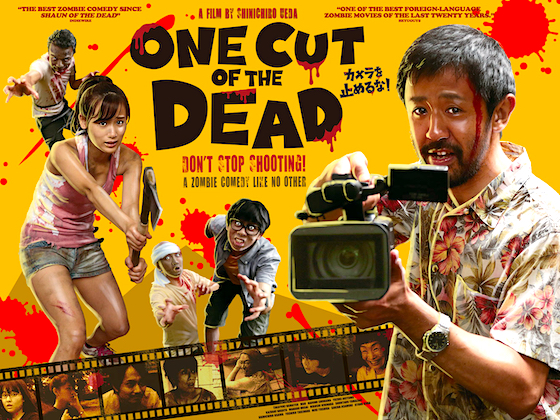
    You know, it’s not just my reviews that are tardy: I bought this because it was hyped up, both as “good” and as “see it knowing as little as possible”, and it went on my “must watch soon” pile… where it sat for 14 months. And that’s far from the most egregious example of “ooh, I must get round to that” equally a long, long delay.

    Now, it’s taken me another 46 months to write this review. Eesh. On the bright side, perhaps I shouldn’t be so worried about spoilers anymore. I mean, if you’ve not seen it by now, whose fault is that? And it definitely is the kind of film where the less you know the better, because it’s going to pull the rug out from under you. Of course, even knowing that means you’re on the lookout for what’s going to happen; and the film gives you a helping hand, because right from the off there are nods to the conceit. Still, I’ll try to be fairly vague.

    It’s a film of three parts. The first is, with hindsight, an establisher; setup and groundwork for what comes next. Alternatively, some genre fans will take that as the purpose of the movie, and what follows as extraneous. Then there’s a long, slow middle section. Again, no direct spoilers, but we know where this part of the narrative ends up, so it feels like it’s over-expounding stuff (we don’t need as much backstory as we get) and consequently goes on a bit. Halfway through, I began to wonder what all the fuss was about. I worried that I’d left it too long to see it and let the hype get the better of me.

    But, ultimately, it’s all setup for the final half-hour, and it pays off in hilarity. The middle could still do with a trim, but it’s worth sticking with for the payoff.

    4 out of 5

    One Cut of the Dead was #54 in my 100 Films in a Year Challenge 2020.


    The Breakfast Club

    (1985)

    John Hughes | 97 mins | Blu-ray | 1.85:1 | USA / English | 15 / R

    The Breakfast Club

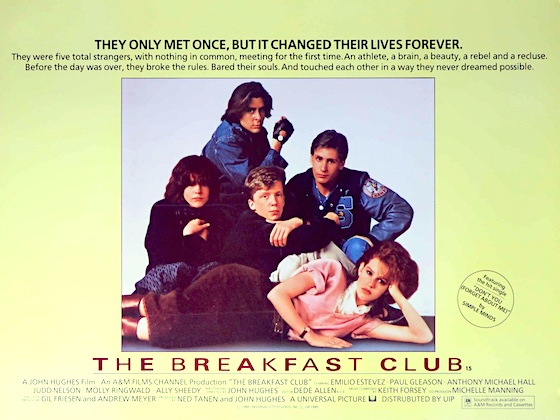
    Is The Breakfast Club the definitive ’80s high school movie? It’s got to be on the shortlist, right? Personally, I preferred Heathers, or, if you want to stay within the John Hughes universe, Ferris Bueller, but that doesn’t mean this is without its qualities.

    If you’re unfamiliar, it’s about a gaggle of misfits in Saturday detention. Over the course of the day, the unlikely group form a bond — well, there’s a surprise. One thing I did like about that: even after they’ve become ‘friends’, the slightest thing can still set off their animosity to one another. They’ve not really changed and it’s a fragile allegiance. The stuff about how they’d never talk to each other in real life after this rings true. So, I don’t want to come down too heavily in the region of the idea that the film might be clichéd. I’ve read other modern reviews criticise it for that, and you have to wonder: when you’re writing about a popular movie 35 years after it came out, was the film clichéd or did it create the clichés? That said, my favourite observation in this sphere was: “if this is cliché, then life is too.” Oh boy is that a sentiment I agree with about so many fictions that are deemed “cliché”.

    That said, I guess we’re beyond the film’s era of influence now. I mean, if you made something like this today, it would probably be an arthouse-aimed indie production (in fairness, the original is also an indie), probably produced for a similar (or lower) budget than it was almost 40 years ago; and it would be adored and analysed by 30- and 40-something-year-old cineastes while actual teenagers were at the multiplex watching MCU XXIV. (You can tell I wrote these notes four years ago, because I would not now suggest the latest MCU release as a default popular success.)

    On the other hand, I know we all look down on remakes, but if you’re going to remake any popular film, this is the kind of thing that would withstand it. It’s so much about its era that if you took the basic concept and remixed it for the 2020s, there are a several interesting avenues to be explored. I’m sure cliques still exist in American high schools (based on media depictions, they never seem to go away), so you’d still get the contrasting personalities; and you could shift the sexual dynamics, the way different groups view each other, and sort out the ending (the way certain characters are ‘fixed’ is very of its time, and not in a good way); and put a modern spin on it all, of course, with some race and LGBT points. You know, make it “woke”, as dickheads say. That would be a pretty different film, but that’s entirely the point: if you’re going to remake something, make it different, make it new. (To be clear, I’m not criticising the original film for not including those elements — it’s a product of its time and it’s not choosing to be about those things, which is entirely valid.)

    I appreciate I’ve talked more about what the film could be today than what it is. Oops. But, look, this is the kind of film where I can’t remember any of the characters’ names — if I wanted to talk in specifics, I’d have to refer to them by their actors (or do a bit of googling, of course). That’s another way of saying I did like it, but it’s not a film that’s stuck with me in the way it has for its many fans.

    4 out of 5

    The Breakfast Club was #56 in my 100 Films in a Year Challenge 2020. It was viewed as an additional film in my Blindspot 2020 project, after I failed to watch it for Blindspot 2019.


    Chopping Mall

    (1986)

    Jim Wynorski | 76 mins | digital (HD) | 16:9 | USA / English | 18 / R

    Chopping Mall

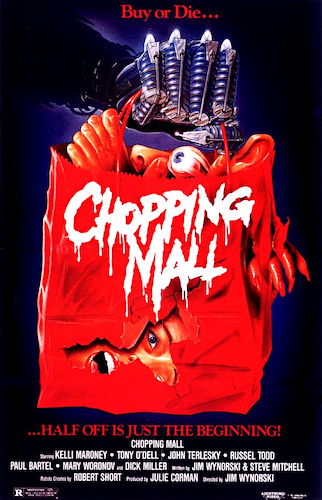
    Blood, boobs, and berserk ’bots are the order of the day in this campy sci-fi actioner.

    That’s right: “sci-fi actioner”. I don’t know where I’d heard about this, or if I’d just made inferences from the title and poster, but I’d assumed it was a regular slasher whose USP was simply “it’s set in a shopping mall”. But nope, it’s actually about security robots who go barmy and start killing a bunch of young people who’d locked themselves in a mall overnight. According to IMDb, it was originally released as Killbots — a more to-the-point title — but it performed poorly, and the producers’ reasoning was the title had made audiences think it was a Transformers-like kids movie (if anyone did take their kids to see it, boy, were they in for a surprise!) So, after cutting over quarter-of-an-hour, they re-released it with the more-clearly-exploitation-y title and… well, I don’t know if it as a major success or anything, but I guess it performed better and that’s the version that has endured.

    I don’t know what was in those deleted 15 minutes, but presumably nothing of great import. Indeed, the short running time is a blessing: it gets on with things at the start, and doesn’t try to drag them out later. It knows what we’ve come to a movie like this for, and it delivers that with admirable efficiency. What’s left is so barmy and schlocky that it’s kinda fun, even if most of it doesn’t make a lick of sense. Even allowing for the implausible setup (lightning sends robot security guards berserk), there’s little to no logic in what follows (the robots have turned murderous? Fine, but why are they such shit shots? And why, when they have an easy shot, do they suddenly stop shooting? And so on).

    Chopping Mall is no lost gem, although it may make you nostalgic for an era when they actually made stuff like this. Would the world be a better place if people were still churning out low-budget schedule-fillers full of gratuitous-but-clearly-fake violence and unnecessary-but-welcome nudity? I don’t know, but I doubt it could be any worse. At least it might’ve desensitised younger generations enough that we wouldn’t have to suffer endless rounds of “sex scenes are bad, actually” discourse on Twitter…

    3 out of 5

    Chopping Mall was the 13th new film I watched in 2023.


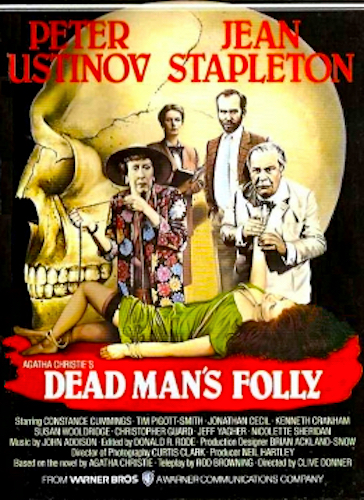
    Dead Man’s Folly

    (1986)

    Clive Donner | 94 mins | digital (SD) | 4:3 | USA / English | PG

    Dead Man's Folly

    This second of three TV movies starring Peter Ustinov as Poirot marks the fourth of his six appearance as the character overall, and it might be the low point of the generally-underwhelming bunch. Ustinov was no doubt a quality performer, and I know his version of Poirot has its fans, but, for me, he remains a lesser interpreter of the Belgian sleuth.

    This particular film does nothing to outweigh his shortcomings. I don’t know if it’s the fault of the original story, this adaptation, or just me, but I didn’t feel there was enough provided for the the viewer to join in with the whodunnit guessing game, which I think is half the fun of a murder mystery. Events just unfurled until, eventually, Poirot explained it all. Add to that a portrayal of Poirot’s sometime-sidekick Hastings by Jonathan Cecil that verges on the lascivious, and production elements (costuming, hairdos, music) that are painfully ’80s, and the recipe is all-round distasteful.

    2 out of 5

    Dead Man’s Folly was #154 in my 100 Films in a Year Challenge 2021.


    Wild Target

    (2010)

    Jonathan Lynn | 98 mins | digital (HD) | 2.35:1 | UK & France / English & French | 12 / PG-13

    Wild Target

    In this remake of French comedy-thriller Cible émouvante, Bill Nighy plays an ageing hitman who falls for his latest target, pretty young thief Emily Blunt. Romance blossoms, in what must be one of the most implausible storylines ever committed to film. That’s partly because of the 33-year age gap between 26-year-old Blunt and 59-year-old Nighy (who, frankly, seems even older — the age gap may be roughly father/daughter, but she feels more like his granddaughter), but also because the movie does little to overcome this blatant shortcoming. If it wants us to buy it, it needs to sell it, but instead it half-arses it. When you learn that Helena Bonham-Carter was originally cast in Blunt’s role (but had to pull out due to commitments to Alice in Wonderland), it all begins to make sense: you can imagine a relationship between her and Nighy working on screen, and presumably they didn’t bother to retool the screenplay in between actor changes.

    All of which says, the film just about survives because there’s enough else going on. The hitman and thief wind up on the run from the people who want her dead, with a young apprentice (Rupert Grint) in tow, and the ensuing farcical hijinks are all daft fun, with the great cast (which also includes Martin Freeman, Eileen Atkins, and Rupert Everett, among others) clearly having a good time. Sometimes that’s off-putting, but here it’s infectious.

    4 out of 5

    Wild Target was #59 in my 100 Films in a Year Challenge 2021.


  • 2024 | Week 2

    Hey, look, it’s an actual reviews post! Well I never! Wonders will never cease! Etc.

    Yeah — I thought, “new year, new start”, and so here I am with short reviews of the first three films I watched in 2024. I was going to call this “Weeks 1–2”, even though they’re all from Week 2, because beginning the year with a post titled “Week 2” just felt wrong. But then I figured I’d begun the year already with my various other posts, so in some respects Week 2 feels natural and right. I could’ve waited for “Weeks 2–3” (there are only three films reviewed herein, after all), but I wanted to set out the stall of “look, reviews are back!” Whether they’ll stay back… I mean, they didn’t in 2023… But we live in hope.

    Anyway, onwards to:

  • Lift (2024)
  • Only Yesterday (1991), aka Omohide poro poro
  • Jackass Forever (2022)


    Lift

    (2024)

    F. Gary Gray | 104 mins | digital (UHD) | 2.40:1 | USA / English | 12 / PG-13

    Lift

    Netflix’s latest original is a high-concept heist thriller, in which a gang of art thieves are recruited by Interpol to steal a terrorist’s gold bullion fortune from a passenger flight in mid-air.

    I love a good heist movie, and Lift is certainly a heist movie. The joy of the genre, at least for me, is in the almost magic trick-esque way in which our gang pull off the score — doubly so when it’s eventually revealed in a third-act twist that what we thought was going on wasn’t going on at all. Unfortunately, that means someone — the writer, director, whoever’s in charge — needs to have a big, clever idea, and those are hard to come by. Lift‘s heist isn’t bad, it’s just nothing special. On the bright side, it ticks the box of having that last-minute reveal. Again, it’s not a particularly innovative subversion (if you were tasked with guessing it, it would probably be your first idea), but at least it’s there.

    Another common aspect of the subgenre is snappy, funny dialogue. Not so here, I’m afraid. Indeed, the dialogue is unrelentingly mediocre, and never more so than when it tries to be funny. Characters’ emotional arcs are built via Screenwriting 101 backstory dumps. You know: “How did you learn that?” “Well, when I was a kid, this very specific thing happened that taught me exactly that.” Perhaps belying a lack of confidence in the screenplay (or perhaps just Netflix realising they don’t need to spend as much as they have in the past), the film doesn’t look particularly expensive either, with middle-of-the-road CGI. Like everything else, it’s not bad, but you’re never going to imagine they went down the Mission: Impossible / Christopher Nolan route of staging it for real.

    The cast is headed by Kevin Hart, doing his best to channel whatever he’s learnt from previous co-stars and be a charming leading man type. I’ve seen worse, but it’s not a natural fit. The Interpol agent / love interest at his side is Gugu Mbatha-Raw, who you can feel is doing her best to inject some verve into proceedings. Some of the supporting roles hint at where the budget may actually have gone. Why else would Jean Reno drop in as a villain who’s mostly just on the end of a phone? Or Sam Worthington pop by as a senior Interpol agent who’s not even interesting enough to turn out to be a secret baddie? Plus most of the henchmen are faces you might recognise from British TV, like Torchwood’s Burn Gorman and Peaky Blinders’ Paul Anderson, who you’d think would be getting better offers than Henchman #2 at this point.

    If this review sounds full of faint praise… yeah, that’s about right. Lift is nothing special, but if a gang of crooks pulling off a seemingly-impossible score is your bag, then it’s passably entertaining fare for an undemanding Friday or Saturday night.

    3 out of 5

    Lift is the 1st film in my 100 Films in a Year Challenge 2024.


    Only Yesterday

    (1991)

    aka Omohide poro poro

    Isao Takahata | 119 mins | digital (HD) | 1.85:1 | Japan / Japanese | PG / PG

    Only Yesterday

    The fifth feature animation from Studio Ghibli’s other director, Only Yesterday introduces us to 27-year-old Tokyoite Taeko as she prepares to take a short summer holiday working on a farm in the countryside, which brings up memories of her ten-year-old self. The latter were the subject of the original manga the film is based on, with Takahata adding the storyline of the older Taeko reflecting on her childhood as a way of tying the stories together into a cohesive narrative.

    I didn’t know that piece of trivia going in, but I sensed something along those lines, because I generally dislike movies that play as “nostalgic vignettes from the author’s childhood”, and this is no exception. The ‘present day’ stuff, on the other hand, is very good, with beautiful moments in and about nature, and superb character beats related to what Taeko really wants and what she’s really like. (“Ever since I was little, I just pretend to be nice,” she says at one point, a sentiment I certainly felt I could agree with. Mind you, it’s in moments like this that the film’s dual timelines pay off, contrasting how younger Taeko behaved and how she has and hasn’t changed.

    Only Yesterday is sort of a film of two simultaneous halves, then. Not that I would lose the childhood bits entirely, but I would prefer a version of the film that pared them back considerably, only retaining the material that really enlightens the older Taeko’s storyline. As it stands, the bits I didn’t care for were quite tedious, but the bits I liked were captivating.

    4 out of 5

    Only Yesterday is the 2nd film in my 100 Films in a Year Challenge 2024. It was viewed as part of Blindspot 2024.


    Jackass Forever

    (2022)

    Jeff Tremaine | 96 mins | digital (HD) | 16:9 | USA / English | 18 / R

    Jackass Forever

    A decade and change after their last outing, the Jackass crew are back (minus some members, for various reasons, and plus some new ones; the latter distinctly upping the diversity quotient), doing the same crazy and dangerous shit they always did. Why? I think most of them are asking themselves the same thing. There was a definite sense in the last film that they were getting too old for this and it was time to call it a day, so what inspired them to come back to it — even older, even more prone to injury, with even longer recovery times — I don’t know.

    It certainly wasn’t fresh ideas. Despite all that time away to think up new stunts, nothing here feels particularly innovative or freshly imagined. Maybe that’s a highfalutin’ thing to analyse about a franchise that has always been just about doing dumb stunts, but some of them have been memorable, even to the extent of transcending the series itself (surely you’ve heard about the paper cuts, even if you haven’t seen it?) Forever is just variations on a theme; sometimes literally, as they expressly revisit old stunts in slightly different ways, like testing an athletic cup against various fast-and-hard objects, or pitting ringleader Johnny Knoxville against a bull — a stunt that ends rather seriously. Maybe if the film had taken that as a cue to say something about mortality or ageing… but that wouldn’t be so much fun, would it?

    So, it is what it is, which is it what it always has been: a bunch of silliness, usually resulting in pain and injury for the cast, and sometimes in laughter for the audience. It’s not the best Jackass film, but it’s not so significantly inferior as to warrant a lower rating. If you were a fan back in the day, you might appreciate the value of hanging out with old favourites for one last rodeo. And if you’re watching the films afresh, presuming you enjoyed them enough to get through the first three, you may as well watch the fourth too.

    3 out of 5

    Jackass Forever is the 3rd film in my 100 Films in a Year Challenge 2024.


  • 2023 | Weeks 3–4

    “Wait, did I miss Weeks 1 and 2?”, you may have asked yourself upon seeing this post pop up wherever you see my posts. And the answer is: no, I missed them, because I failed to watch a single film in either Week 1 or Week 2 of 2023. Most extraordinary.

    Anyway, I wrote about that in January’s monthly review, so let’s get on with reviewing. I will note that I’ve skipped a couple of films from these weeks. Normally I only do that when I’ve already written their review and it’s long enough I feel it should be posted solo. I haven’t formally started writing about either The Girl Who Knew Too Much or Black Girl yet, but I have an inkling they’re both going to be quite long (the latter, definitely), so I’ve set them aside for the time being. Which leaves us with…

  • The Magician (1926)
  • Glass Onion (2022)
  • My Year of Dicks (2022)
  • Shotgun Wedding (2022)
  • The Banshees of Inisherin (2022)


    The Magician

    (1926)

    Rex Ingram | 80 mins | Blu-ray | 1.33:1 | USA / silent

    The Magician

    Based on W. Somerset Maugham’s novel, itself inspired by the antics of real-life occultist Aleister Crowley, The Magician concerns a mad scientist, Oliver Haddo (Paul Wegener), trying to complete an alchemical spell to create life by kidnapping a pretty virginal sculptor, Margaret (Alice Terry), so he can cut out her heart and use her blood. But why just kidnap a young woman when you can hypnotise her into marrying you? And why just kill her when you can use your hypnotic control to, er, take her gambling in Monte Carlo and make lots of money?

    Wait, what?

    Yeah, The Magician is kind of an odd film. Whether that’s due to Maugham’s original work and his desire to write a takedown of Crawley, or if it was the impetus of director Rex Ingram fancying a jolly around Europe with his wife, who he’d cast in the lead female role, I don’t know. Either way, the varied asides (before the eponymous Haddo even turns up, Margaret is paralysed in a sculpting accident and goes for experimental surgery to get it fixed) slow the pace, possibly to pad out what is really quite a slight story. On the other hand, there are some atmospheric sequences scatted throughout, like a demonstration of Haddo’s powers at a snake charming show, or a devilish orgy (yes, you read that right; no, it’s not at all shocking by modern standards). Plus, as if to balance out all the stuff with dark magic, Ingram finds room for dashes of humour, giving a bit of texture and stopping the film from becoming too self-serious.

    However, The Magician remains most noteworthy today as a stylistic precursor to Universal’s initial run of horror movies in the early ’30s — James Whale’s Frankenstein, in particular, seems to have taken some cues from this film’s climax. It’s a fairly entertaining melodramatic fantasy-horror in its own right, but is primarily worth a look for those interested in the early development of the horror genre in Hollywood, or for silent movie fans who’d like something with a supernatural edge. General audiences are probably fine sticking to the established classics it influenced.

    3 out of 5

    The Magician is the 1st film in my 100 Films in a Year Challenge 2023.


    Glass Onion

    (2022)

    aka Glass Onion: A Knives Out Mystery

    Rian Johnson | 139 mins | digital (UHD) | 1.85:1 | USA / English | 12 / PG-13

    Glass Onion

    In some respects, Glass Onion delivered a movie closer to what I’d been expecting from the first Benoit Blanc mystery, Knives Out; that is to say, a proper murder mystery that is also unabashedly a comedy. Don’t get me wrong, I found Knives Out amusing — even more so with subsequent rewatches — but it has a kind of dry humour, with a wit more likely to raise a wry smile of acknowledgement than a guffaw. Glass Onion surely has such moments too, but it also has big, broad laughs that stand out more on a first viewing.

    The mystery at its core remains a true Christie-style puzzler, with enough about-turn twists to keep you off balance — you can try and guess what’s going on if you want, but it’s just as much fun to be swept along for the ride — but the surrounding material is satirical almost to the point of parody. Kate Hudson’s airhead influencer is more caricature than character, for example, while there’s no doubt that Edward Norton’s billionaire is a merciless pisstake of Elon Musk. That’s annoyed certain right-wing commentators. The rest of us can just enjoy the accurate pillorying.

    This overall shift in tone will, I think, dictate which of the two movies viewers prefer — i.e. whichever one hews closer to your personal taste. On the other hand, maybe you’ll be like me, and enjoy them both for their own particular quirks. I’ve already watched Knives Out three times, so I’ll have to watch Glass Onion a couple more to make any kind of fair comparison. Fortunately, I intend to.

    5 out of 5

    Glass Onion placed 1st on my list of The Best Films I Saw in 2023.


    My Year of Dicks

    (2022)

    Sara Gunnarsdóttir | 26 mins | digital (HD) | 1.78:1 | USA & Iceland / English

    My Year of Dicks

    One of the standout moments of this year’s Oscars nominations announcement was when Riz Ahmed read out the Best Short Animation nominees, thus having to proclaim “My Year of Dicks” to the world — especially as it was immediately followed by “An Ostrich Told Me the World Is Fake and I Think I Believe It”. Only one of those is currently available to watch online, so I did.

    The autobiographical story of screenwriter Pamela Ribon trying to lose her virginity in early-’90s Texas, My Year of Dicks unfolds across five vignettes, each telling a different (but connected) story of sexual misadventure. The chaptered structure gives away that this is kinda five short films strung together; but they’re also a series, with a definite through-narrative (if you’ve ever watched any narrative film before, you’ll easily spot the early supporting character who’s destined to have greater significance). So, while it doesn’t fully work as a single ‘film’ (it feels like binge-watching a series of short episodes), there is at least a reason to lump them all together as a unit.

    The parts are further differentiated by employing a variety of animation styles to depict Pam’s fantasies and inner feelings. It’s an effective use of the medium to help overcome the fact that the actual stories are relatively rote “coming of age” tales. The most successful of all is the excruciating “sex talk” with Pam’s dad, in which a bombardment of animated self destruction reflects the desire for escape we’re all feeling at that point.

    As a story based around female sexuality, My Year of Dicks has an air of timeliness about it. Equally, it feels like such barriers have been continually been being broken down for the past 20 or 30 years now; in which case, one does wonder if its success has as much to do with the amusement value in seeing that title on the Oscar short list as it does the film itself.

    3 out of 5

    You can watch My Year of Dicks for free on Vimeo.


    Shotgun Wedding

    (2022)

    Jason Moore | 101 mins | digital (UHD) | 2.39:1 | USA / English | 15 / R

    Shotgun Wedding

    Jennifer Lopez and Josh Duhamel are about to get married in front of their family and friends at a remote tropical resort when pirates turn up demanding a ransom. Action and hilarity ensue. How exciting the action and how hilarious the hilarity is where opinions may differ.

    For my money, the end result is a perfectly serviceable star-driven action-comedy. It’s the kind of middle-of-the-road, made-for-date-night fare that people keep bemoaning we’re losing thanks to Marvel’s box office dominance, even though Hollywood actually seems to keep making them (for another example from just last year, see The Lost City), and they get fairly widely slated every time one actually comes out.

    Okay, the vast majority of the film’s funniest ideas and moments were in the trailer (heck, the way the first promo was edited to make the film look like a rom-com, only to about-turn into an action movie, is probably the best gag associated with the entire project), but the film itself has held back a couple of laugh-worthy moments, and even a few plot twists. No wheels are reinvented, but it’s fine as bit of non-demanding, Friday-night, never-going-to-watch-it-again, easy viewing.

    3 out of 5

    Shotgun Wedding is the 5th film in my 100 Films in a Year Challenge 2023.


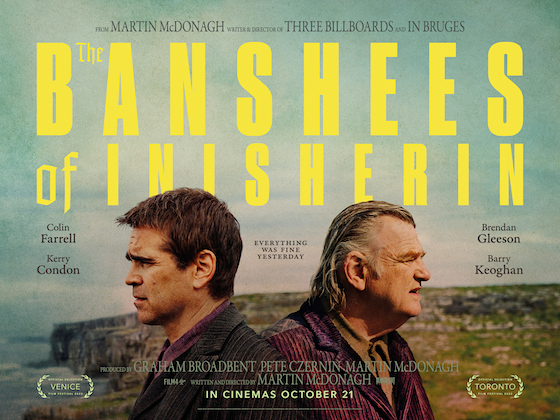
    The Banshees of Inisherin

    (2022)

    Martin McDonagh | 114 mins | digital (UHD) | 2.39:1 | Ireland, UK & USA / English | 15 / R

    The Banshees of Inisherin

    The new film from the writer-director of Three Billboards reunites the star pairing from his first movie, In Bruges, for an altogether different — but equally as hilarious — tale of two Irishmen. Here, Colin Farrell and Brendan Gleeson play lifelong friends on a small island off the coast of Ireland in the 1920s; that is until one day Gleeson decides he just doesn’t like Farrell anymore. Cue a serious of escalating encounters as Gleeson tries to get his former mate to just leave him be.

    After the quite heavy, discourse-provoking narrative of Three Billboards, Banshees feels somewhat like McDonagh heading for smaller-scale, less contentious waters. Not that I think he’s running in fear — he doesn’t seem like one to avoid confrontation or provocation around his art — but I think that Banshees feels more of a piece with Bruges, in that it’s focused on just a handful of characters and their fairly everyday lives. That said, things do get a bit… outrageous; and the Irish civil war is ticking away on the mainland, suggesting at least one thematic interpretation of the friends’ fallout. That’s not to mention the subplots involving Farrell’s sister outgrowing her place on the island, or the woes of the local village idiot (played superbly by Barry Keoghan) and his abusive father, who happens to be the island’s policeman.

    All of which might begin to sound a bit serious. But then, juggling life-and-death issues and hilarity is almost McDonagh’s trademark. Indeed, the film’s biggest laugh is related to the story of a woman’s death; meanwhile, its saddest moment involves not the abuse or self-mutilation of any of the human characters, but rather the fate of a beloved animal (that might read as a spoiler, but I consider it fair warning for animal lovers). In viewing, it’s consistently very funny, but creeps up on you with Stuff To Think About, too. I enjoyed it a lot; maybe not as much has In Bruges or Glass Onion (no relatable comparison there other than I watched them both this month), but enough that my score rounds up.

    5 out of 5

    The Banshees of Inisherin is the 6th film in my 100 Films in a Year Challenge 2023.


  • Archive 5, Vol.6

    Hey, wouldja look what it is! After getting off to a fairly strong start back at the beginning of 2022, I allowed my Archive 5 strand to fall by the wayside while I made a concerted attempt to stay up-to-date reviewing my new viewing (with mixed success). But now it’s back, hopefully on a more permanent basis. And I guess going forward it should include what’s left of 2022, because otherwise I’m stuck trying to catch up on those reviews before I can even begin 2023. But not just yet, because I selected today’s five films back when Vol.6 should originally have been posted (last February, gasp!)

    For those who’ve forgotten, I have a backlog of 421 unreviewed feature films from my 2018 to 2021 viewing (448 if we add in 2022 too). This column is where I give those films their day, five at a time, selected by a random number generator.

    Today, some films sizzle with heat or tension, while others fizzle into disappointment. This week’s Archive 5 are…

  • Paris When It Sizzles (1964)
  • 7500 (2019)
  • The Rhythm Section (2020)
  • Carefree (1938)
  • The Lie (2018)


    Paris When It Sizzles

    (1964)

    Richard Quine | 110 mins | digital (HD) | 16:9 | USA / English | U

    Paris When It Sizzles

    William Holden and Audrey Hepburn are clearly having a whale of a time in this marvellously cine-literate romp about a struggling screenwriter (Holden) and the secretary (Hepburn) hired to type up the script he hasn’t actually started. With the deadline just two days away, the pair rush to put a script together, which plays out as a film-within-a-film, also starring Holden and Hepburn, and allowing them even more fun as they get to overact extraordinarily. The “inside baseball” feel of the thing is furthered by a handful of surprise cameos.

    Perhaps it’s me just misjudging the era, but the whole thing feels somewhat ahead of its time. In the way its such an insider’s riff on the movie industry, it feels like something you wouldn’t expect to have emerged until maybe the ’90s (The Player being an obvious point of reference). How well that worked for audiences at the time, I don’t know — maybe it did come across as too esoteric — but, viewed today by anyone with an idea of the history and inner workings of the Hollywood machine — it’s a lot of madcap fun.

    5 out of 5

    Paris When It Sizzles was #129 in my 100 Films in a Year Challenge 2020. It placed 20th on my list of The Best Films I Saw in 2020.


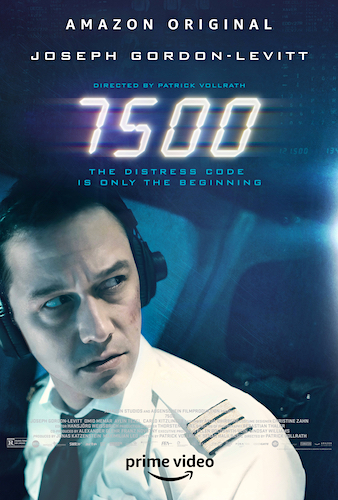
    7500

    (2019)

    Patrick Vollrath | 93 mins | digital (UHD) | 2.39:1 | Germany, Austria & USA / English, German & Turkish | 15 / R

    7500

    After a title sequence that uses security camera footage to follow some shifty-looking blokes around Berlin airport, the film fades up in a passenger airplane cockpit as the crew arrive and begin their regular pre-flight routines. It’s a location we won’t leave for the next 80 minutes, as the unremarkable flight to Paris takes a turn when the aforementioned shifty-looking blokes attempt to invade the cockpit mid-flight, leaving it up to copilot Joseph Gordon-Levitt to try to rescue the situation.

    A tense thriller set entirely in one confined location and told in (near-as-dammit-)real-time? This film could have been made just for me. Suffice to say, I was suitably pleased. This kind of style and pace clearly won’t be to everyone’s taste (I mean, the first 15 or so minutes are almost entirely about watching the pilots just doing their everyday job), but there’s something about the format that does it for me. I think it’s something to do with the inescapability of real-time — that what’s happening and what will happen is going to last as long as it lasts, no shortcuts — that serves to underscore the tension of a thriller storyline. That said, in this case the final act does lose some of the momentum and tension, as much as it tries to maintain it, meaning it feels like it limps to the end, with the really suspenseful stuff having expired a little after the hour mark. It’s not that this final act is bad, just that it feels like a comedown from what’s gone before.

    Still, Gordon-Levitt is great throughout, carrying a large chunk of the film singlehanded, and there’s ultimately a more nuanced treatment of the terrorists than you might expect. I saw someone criticise it for trying to humanise one of them, as if that was problematic. Sure, terrorists are bad guys, but they’re still human beings underneath, and they’ve been plenty demonised enough in plenty of less thoughtful media — I’m not sure it should be considered controversial or a step too far to suggest that one of them (out of four) might be a misguided teenager rather than Evil Personified. On the flip side, I read another review that trashed the film for “featuring brown terrorists again”. I imagine those two reviewers would have a lot to disagree about…

    4 out of 5

    7500 was #144 in my 100 Films in a Year Challenge 2020.


    The Rhythm Section

    (2020)

    Reed Morano | 110 mins | digital (HD) | 2.39:1 | UK & USA / English & French | 15 / R

    The Rhythm Section

    I don’t know about you, but sometimes I watch movies with a bad rep in case I see something in them that everyone else* missed — because that does happen. In that vein, The Rhythm Section isn’t some overlooked masterpiece, but I don’t really get why everyone hated it so much.

    Blake Lively uglies up and forces an English accent to star as Stephanie Patrick, a drug-addicted prozzie who used to be a pretty Oxford student until her family died in a plane crash three years earlier, which a journalist now tells her was a terrorist attack that MI6 have covered up. Events lead her to a disgraced agent (Jude Law) who agrees to train her to hunt down the people responsible.

    Hardly the most plausible storyline ever, but it’s no more ludicrous than many a thriller. So, as a genre piece, well, it’s certainly not the greatest action-thriller ever made, but it’s decent overall with a couple of neat twists on the usual formula. The primary one is that our heroine isn’t actually very good at being an action hero and keeps fucking up. Normally these films are about highly competent super agents (Jason Bourne, John Wick, etc), or newbies who take to it like a duck to water. Stephanie’s borderline incompetence is not only a mite more realistic, it makes a refreshing change, and at times is even successfully used to heighten the tension.

    Unfortunately, other aspects were stale on arrival. For no reason, it begins halfway through and then does the “8 Months Earlier” thing. This is a personal bugbear of mine, because it’s a trick that’s been used to death at this point, routinely trotted out to no real purpose. Usually it’s used as a cheap way to deliver some action upfront because otherwise there won’t be any until somewhere in Act Two, which is just an insult to the audience’s attention span. In other cases, the film just got unlucky. I imagine when they conceived of a single-shot car chase it seemed like an original idea — as it probably did to all the other filmmakers who attempted the same thing around the same time; not least Netflix’s Extraction, which did it bigger and therefore better. Oh well.

    Ultimately, I suppose The Rhythm Section is fundamentally derivative, with only fleeting moments of originality. But I still thing everyone else was overly negative — it’s not bad, just not strikingly fresh. I think if you enjoy Bourne-esque action-thrillers, you should enjoy this.

    3 out of 5

    * It’s never everyone else, but you know what I mean. ^

    The Rhythm Section was #138 in my 100 Films in a Year Challenge 2020.


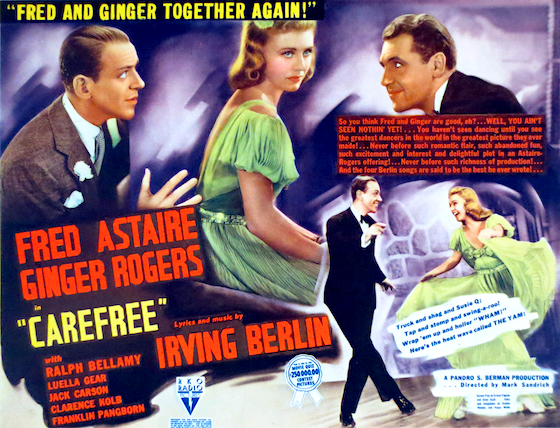
    Carefree

    (1938)

    Mark Sandrich | 83 mins | digital (SD) | 4:3 | USA / English | U

    Carefree

    Fred Astaire is a psychiatrist prone to misogynistic views and unethical practices who mimes playing the harmonica and performs dance routines with golf balls, and Ginger Rogers does a song & dance about yams (because Astaire thought it was so silly, he refused to sing it. He was right). Yeah, I think it’s fair to say this isn’t the couple’s finest hour. The public agreed: this was the first Astaire-Rogers film to lose money on its initial release.

    That said, it’s not without the occasional charm. Rogers still shines — the sequence where she goes around playing naughty pranks with a cheeky grin while under the influence of anaesthetic is a delight — and there’s a slow-motion dream-sequence dance that is rather lovely. But these are fleeting pleasures amongst the distasteful storyline (see: my description of Astaire’s character) and less refined moments (there’s a song about yams).

    2 out of 5

    Carefree was #97 in my 100 Films in a Year Challenge 2021.


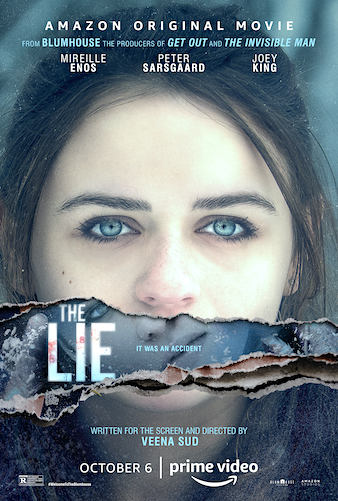
    The Lie

    (2018)

    Veena Sud | 95 mins | digital (UHD) | 2.39:1 | USA / English | 15 / R

    The Lie

    Although it debuted to most of the world as one in a series of eight Blumhouse original movies that premiered together on Amazon Prime in 2020, The Lie is listed as a 2018 film because that’s when it premiered at TIFF under a different title (Between Earth and Sky). The fact it went from being a standalone production to one of a series released en masse provides a clue as to how well it went down.

    The film has a solid premise that starts out well enough: a father (Peter Sarsgaard) and daughter (Joey King) are driving to a ballet retreat when they spot her best friend waiting by the side of the road, so they offer her a lift. Later, they stop in the middle of nowhere so the friend can go to the bathroom, but she falls off a bridge into an icy river. Or possibly the daughter pushed her. Either way, presumably she couldn’t survive the fall, and her body has washed away. Fearing how all that would look, they set about covering it up… which is where things go awry, both for the characters and us viewers. The longer the story goes on, the further it departs from actions and consequences that feel plausible. It’s not ludicrously far-fetched, it just doesn’t feel right; like people wouldn’t make those decisions, or those decisions wouldn’t have those consequences. The lead cast give it their best shot, but they’re battling against material that’s below their skills.

    Then there’s an inevitable last-minute twist that just hurls the whole thing off a bridge. Kate Erbland for IndieWire wrote that it “should rank among the all-time great fake-outs,” and she’s sort of right: it could have been a reveal for the ages, but rather than eliciting a pleasant “OMG I don’t believe it!”, it plays as “ugh, I don’t believe it.”

    2 out of 5

    The Lie was #245 in my 100 Films in a Year Challenge 2020.


  • 2022 | Week 35

    When I revived 2007’s weekly(-ish) review compilation format at the start of 2022, the main objective was to write shorter reviews (not necessarily as short as the couple-of-sentences-per-film I wrote back in 2007, but not worrying about trying to do full write-ups for everything), which would help enable me to stay more up-to-date. Well, the former has only been partially successful, and that means the latter has slipped, too: here we are, rapidly heading towards the end of December, and I’m only just posting reviews of films I watched at the end of August / start of September. I’m certainly not going to have 2022 finished before 2023 begins.

    Hey-ho, there’s nothing to be done about it — other than remind myself I was intending to be more concise and more on top of things, and continue to try to push myself in that direction. In the meantime, on we go, with…

  • Mona Lisa (1986)
  • Mirror (1975), aka Zerkalo
  • Clerks (1995)
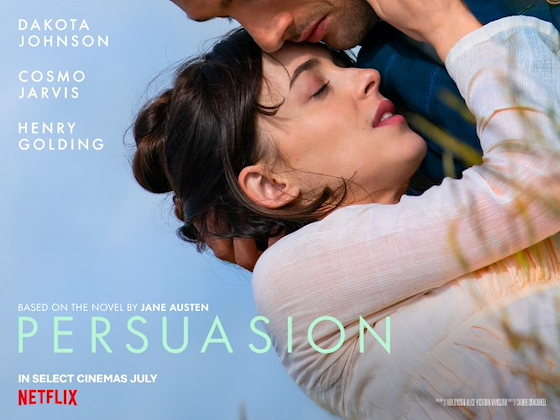
  • Persuasion (2022)
  • He Walked by Night (1948)


    Mona Lisa

    (1986)

    Neil Jordan | 104 mins | Blu-ray | 1.85:1 | UK / English | 15 / R

    Mona Lisa

    Neo-noir filtered through a British sensibility — which means you get a character study merely garnished with genre thrills, especially when the character in question is played by Bob Hoskins, adding depth and complexity to your could-be-straightforward protagonist.

    Said protagonist is George, a recently-released minor gangster looking for work. He’s an interesting mix of a character: streetwise but also kinda naïve; racist and judgemental, but without really meaning it. It’s like he’s just reciting stuff he’s heard from everyone else, rather than it being stuff he really believes. Well, isn’t that true of so many with horrendous opinions? These days they just get them from YouTube. George’s prejudices are somewhat challenged when he’s assigned to drive around a high-class call girl, Simone, who happens to be black. Although Hoskins took most of the plaudits (including an Oscar nomination and BAFTA win), as Simone, Cathy Tyson breathes an equal amount of life into a character that, similarly, in lesser hands could’ve just been a plot-driving mystery. (She was also nominated for a BAFTA, incidentally.)

    The film’s style is an interesting mishmash, in that it has an element of British grit and groundedness — especially being shot on grainy film, all on location in London, in a world of everyday gangsters and prostitutes — but with fantastical and/or genre flourishes — George’s friend Thomas creates weird art stuff and engages in literary discussions; nighttime London is shot to look like a vision of Hell; and then there’s all the noir stuff in the construction of the story. There’s a version of this film that fully gives in to that genre, but the comedy and ‘fantasy’ dilutes the neo-noir aspects, making the film more unique, and distinctly British.

    The fact Arrow initially released Mona Lisa as the de facto lesser half of a double-bill with earlier Hoskins-starring gangster flick The Long Good Friday does it something of a disservice (though it’s also is the primary reason I had it in my collection to prompt me to watch it, so swings and roundabouts). This is a film more than worthy of standing on its own; and one that, while not poorly regarded or completely forgotten, merits a wider rediscovery.

    4 out of 5

    Mona Lisa is the 53rd film in my 100 Films in a Year Challenge 2022. It was viewed as part of “What Do You Mean You Haven’t Seen…?” 2022. It placed 11th on my list of The Best Films I Saw in 2022.


    Mirror

    (1975)

    aka Zerkalo

    Andrei Tarkovsky | 107 mins | digital (HD) | 1.37:1 | Soviet Union / Russian | U

    Mirror

    Andrei Tarkovsky’s poetic evocation of memory and mid-20th-century Soviet history. If that sounds a bit Arty, just wait ’til you hear Criterion’s blurb, which says it’s “as much a poem composed in images, or a hypnagogic hallucination, as it is a work of cinema.” Oh dear, sounds like Hard Work, right? Well, it is.

    Calling it “visual poetry” might sound like pretentiousness, but it really isn’t — Mirror definitely plays more like that than a traditional narrative film. And, just like most poetry, I didn’t really get it. I must confess that I was tuning out by the end; partly due to tiredness, which is my own fault; but partly that the film gave me nothing to really latch on to; no (clear) narrative or character or anything for me to focus on to keep my wavering attention in the right place. On the bright side, it avoided being a total disaster in my eyes by having some nice-looking bits, and individual scenes or sequences that kinda work. But I absolutely do not “get it” as a whole cohesive piece of art.

    Clearly, this kind of thing works for some people — Sight & Sound’s most recent poll ranked it 31st, and the director’s poll (which I would normally argue errs slightly more mainstream) went even better and placed it 8th. Each to their own. Based on his work that I’ve seen so far, I just don’t think Tarkovsky’s for me.

    2 out of 5

    Mirror is the 54th film in my 100 Films in a Year Challenge 2022. It was viewed as part of Blindspot 2022.


    Clerks

    (1994)

    Kevin Smith | 88 mins | DVD | 1.85:1 | USA / English | 15 / R

    Clerks

    There’s no escaping the fact that Clerks is very much a product of its time, both in itself as a work of art, and in how it became a breakout success. (Can you imagine a film like this launching a career like Kevin Smith had (for a bit) if it was made today? Best you could hope for now is being seen by half-a-dozen festival-goers before the director gets tapped to be Kevin Feige’s puppet on some Marvel content.) That said, for all its ’90s-time-capsule-ness, it holds up pretty well as a piece of entertainment. By which I mean, I laughed multiple times and was never bored.

    The story, such as it is, concerns a pair of convenience store workers hanging out for a day, and the various little dramas and incidents that occur to and around them. Serving as both writer and director, Smith quite cleverly turns bugs into features. No budget? Make that the whole aesthetic, with grainy 16mm photography and an everyday setting in which ‘nothing’ happens. Non-pro actors? Have everyone deliver all their lines mile-a-minute, thus making the whole thing feel kinda heightened and stylised, to the point where you can’t be sure if most of the cast can’t act or it was all a deliberate choice. This is further fed by Smith often letting scenes play out in long takes with no cuts — if these guys can remember all their lines to do a whole scene in a oner, they must be pretty professional, right?

    Impressively for a first-timer behind the camera, Smith doesn’t go overboard with directorial flourishes. There’s the occasional shot or sequence with some extra pizzazz to keep up the visual interest, but he seems to know that less is more; that this is the kind of film that plays best in medium shots. This might sound like basic stuff, but evidence shows that first-time filmmakers with something to prove are regularly tempted to go all-out and make something that feels Directed. That might be nice for a showreel, but for an actual film, restraint goes a long way.

    Technique aside, the content just works. These characters are likeable enough to hang out with for 90 minutes, because that’s effectively all we’re doing. But there’s enough variety in their conversations and situations, and enough genuinely funny lines and moments, that it works and is enjoyable, rather than being a dull or directionless slice-of-life piece.

    4 out of 5

    Clerks is the 55th film in my 100 Films in a Year Challenge 2022.


    Persuasion

    (2022)

    Carrie Cracknell | 108 mins | digital (UHD) | 2.00:1 | USA / English | PG / PG

    Persuasion

    Jane Austen adaptations appear to be perennially popular, so it was probably only a matter of time before Netflix attempted one. Here, they’ve retained the original setting but given proceedings a modern-ish wash, apparently influenced by their hit series Bridgerton style (I’ve never seen Bridgerton, so this is based on the trailers and that others have made the same comparison). The result? A trailer that met with a great deal of displeasure from Austen fans, not keen on the apparent irreverence to the source material. I’ve never read Austen, either, so I’ll leave exact comparisons to the more knowledgeable.

    That said, I can’t say the trailer fully won me over, but I thought I’d allow the film its chance. And it’s not terrible — there are lots of nice scenes and moments to be found. Unfortunately, they’re undercut by the bits everyone talked about from the trailer: the clearly-Fleabag-inspired gurns to camera; the banal and misplaced modern-style dialogue. The really sad thing is that there aren’t actually very many of those bits — the ones that were widely cited as “examples” are nearly all of them, in fact — and so there is nearly a very nice film here.

    Dedicated fans of Austen’s original work, and those who prefer their period dramas played straight and faithful, will likely still find those moments off-putting. If you’re prepared to overlook the missteps, this Persuasion is largely likeable.

    3 out of 5

    Persuasion is the 56th film in my 100 Films in a Year Challenge 2022.


    He Walked by Night

    (1948)

    Alfred Werker | 79 mins | digital (HD) | 4:3 | USA / English | PG

    He Walked by Night

    “A film that started as a humble low-budget offering from a second-tier studio, but wound up being one of the most influential films of its era” is how ‘Czar of Noir’ Eddie Muller describes He Walked by Night in his introduction for TCM’s Noir Alley strand. That’s partly because it inspired the radio series Dragnet, which was immensely significant in the development of police procedural series, a genre that remains a bread-and-butter staple of TV entertainment to this day. But also because it was shot by cinematographer John Alton — “the greatest noir stylist of all time”, says Muller, and here he produced “one of the most dramatically photographed film noirs ever”. There’s debate over whether the film was actually helmed by its credited director, Alfred Werker, or if Anthony Mann actually did most of the work. “It doesn’t really matter,” says Muller, “because the picture’s held together by the stunning visual style of its singular cinematographer”.

    Well, I can’t disagree. This is a gorgeously shot film, and a concise exemplar of all we know of film noir style — primarily, abundant shadows. But it’s not just the imagery that makes it work. There are multiple tense suspense sequences, often making great use of silence — this is a film not afraid to be quiet when it’s effective — climaxing with an incredibly atmospheric chase and shootout in the LA storm drain system. We spend a lot of time with the villain, Roy Martin — the film is definitely a howcatchem; no whodunit mystery here — who’s superbly played by Richard Basehart. Coming back to the point about silence, Martin is a loner, so he doesn’t get much dialogue a lot of the time, but Basehart still effectively conveys how smart and cunning he is. Also worthy of note is Whit Bissell as an electronics dealer who unwittingly sold on ‘inventions’ that Martin had in fact stolen. The poor guy is clearly innocent and been duped, but he ends up between a rock and a hard place when the police aren’t sure they believe that.

    The overall style of He Walked by Night is intensely procedural and serious about it, but it still finds room for glimpses of character, both from the cops and the criminals; and there’s humour, too. That helps give it a bit of light and shade, and also genuine reality — you’ll find humorousness everywhere in real life, however serious events may be.

    4 out of 5

    He Walked by Night is the 57th film in my 100 Films in a Year Challenge 2022.