aka La Passion de Jeanne d’Arc / Jeanne d’Arc’s lidelse og død
2015 #69
Carl Th. Dreyer | 96 mins | Blu-ray | 1.37:1 | France / silent (Danish) | PG
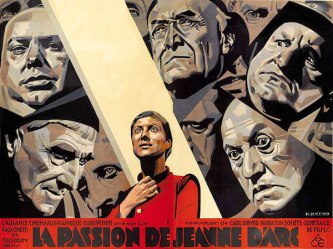 Widely regarded as one of the greatest movies of all time (look at the lists!), Danish director Carl Theodor Dreyer’s French-produced silent movie depicts the last hours in the life of Joan of Arc (Falconetti), a nineteen-year-old who is on trial by the Church for claiming God instructed her to fight to free France from British rule. You probably know it doesn’t turn out well for her.
Such a summary, while not inaccurate, is almost disingenuous. “This is by all odds the least religious and least political Joan ever made,” write Jean and Dale D. Drum (in a piece included in the booklet accompanying Masters of Cinema’s Blu-ray release), because Dreyer was explicitly not interested in the political or theological issues of the trial, which he felt were no longer relevant by the 20th Century. As he wrote in 1950, “I have tried to show that people in the medieval tragedy were, behind their historical costumes, people just as you and I are, caught up in the web of political and religious opinions and prejudices of the time.” With those religious and political issues set aside, Dreyer was instead focused on the universality of Joan’s experience as a human being. He was attempting to relate the tale — and, more importantly, the emotions — of a young woman sure of her convictions but persecuted for them.
 Dreyer based his telling on the written records of Joan’s trial. Although that’s grand for claims of historical accuracy, it’s hard to deny that silent cinema is ill-suited to thoroughly portraying something dialogue-heavy. There are many things silent film can — and, in this case, does — do very well indeed, but representing extensive verbal debate isn’t one of them. Bits where the judges argue amongst themselves — in silence, as far as the viewer is concerned — leave you longing to know what it is they’re so het up about. Sometimes it becomes clear from how events transpire; other times, not so much.
Dreyer’s faithfulness was not in aid of precisely representing what happened, however. For instance, the film takes place over a day or two, at most, while in reality Joan’s imprisonment, trial and execution took most of a year. Events were condensed so as to provide “a kind of bird’s-eye view, where all the unnecessary elements disappear” (Dreyer, quoted by Drum & Drum). This was partly in aid of what Dreyer described as “psychological realism”: rather than slavish fidelity to the facts of the era, it was about accurately and universally conveying the human experience.
According to Chris Marker (also in Masters of Cinema’s booklet), the aesthetic element of achieving this goal is one reason the film has endured so. Dreyer’s efforts to make the events seem ‘present’, as opposed to historical, works to make the film eternally present; they help it to transcend not only the 15th Century, but also the more recognisable trappings of “a silent-era movie”. The actors wear no make-up, perform in  neutral costumes on sparsely-decorated sets, and are almost entirely shot in close-ups — all elements that avoid the usual grandiosity of historical movies, both in the silent era and since. What we perceive as being ‘grand’ changes over time (things that were once “epic” can become small scale in the face of increasing budgets, for instance); pure simplicity, however, does not age much.
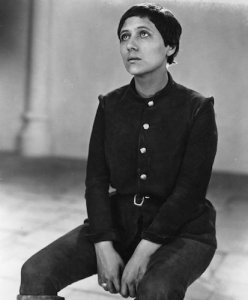
The near-constant use of close-ups, in particular, is one of the film’s most renowned elements. Dreyer was inspired by D.W. Griffith’s Intolerance, feeling this was an area film could excel in a way theatre obviously couldn’t. For Dreyer’s goal of giving us access to Joan’s very soul, it’s arguably the perfect medium — eyes are the window, and all that. This hinges on Falconetti’s acting. In her only major screen appearance, she delivers a performance that is still considered one of the greatest ever. It’s hard to pinpoint what she’s doing, but her wide eyes and almost crazed expression convey more subtlety than that sketched summary might imply. She is Joan, you feel, which again was Dreyer’s goal: he wanted his cast to inhabit their characters; to be them. He insisted the words from the trial record were spoken accurately (even though they obviously couldn’t be heard by the audience) and he built a whole 15th Century city set so that the actors might feel they were really there. As the film is shot largely in close-ups, that feels like a stupendous waste of money; and it led to the crew having to drill holes in walls and dig pits in the floor in order to get the shots Dreyer desired. But hey, whatever works.
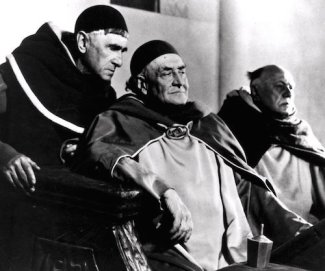 The actors playing the judges may be less individually memorable than Joan, but it’s their conflict — the personal battle between Joan and these men, as Dreyer saw it — that drives the film. Dreyer believed the judges felt genuine sympathy for Joan; that they did what they did not because of politics (they represented England, and she had led several successful campaigns against the Brits) but because of their devout belief in religious dogma. Dreyer says he tried to show this in the film, though it strikes me the judges still aren’t portrayed too kindly: they regularly seem contemptuous of Joan, and are outright duplicitous at times. Maybe that’s just religion for you.
Despite being one of the film’s most famed elements, Joan isn’t entirely constructed of close-ups. When Dreyer breaks free of such constraints, the dynamic camerawork on display transcends many people’s view of silent cinema. A swinging pan as maces are dropped from a window was a personal highlight, but there are some great, dramatic push-ins during the trial. That’s just the tip of the iceberg. There’s the editing as well: it’s surprisingly fast-cut at times, and the use of montage for some sequences (particularly in the torture chamber and the epic climax) makes for stunning visual cinema.
Reportedly Dreyer’s preferred soundtrack was complete silence, which makes sense given his other aims and views on depicting realism rather than interpretation. That sounds a little like an endurance test, however, and so of course the film is usually presented with a score. In the US, it’s now routinely accompanied by Richard Einhorn’s Voices of Light. Clearly it’s a noteworthy soundtrack because it feels like the vast majority of reviews and comments online make reference to it. Masters of Cinema’s Blu-ray doesn’t include it, 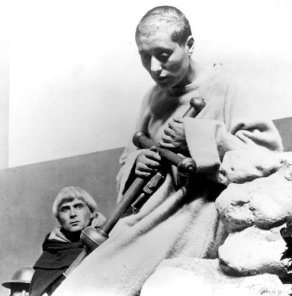 however, so I have no opinion. Instead, they offer two alternatives. On the correct-speed 20fps version, there’s a piano score by silent film composer Mie Yanashita. Apparently this is the only existing score set to 20fps, and Masters of Cinema spent so much restoring the picture that there was no money left to commission an original score. Personally, I don’t think they needed to. Yanashita’s is classically styled, which works best for the style of the film, and it heightens the mood of some sequences without being overly intrusive, by and large. Compared to Dreyer’s preferred viewing method, of course it affects the viewing experience — how could it not, when it marks out scenes (with pauses or a change of tone) and emphasises the feel of sequences (with changes in tempo, for instance). That’s what film music is for, really, so obviously that’s what it does. Would the film be purer in silence? Maybe. Better? That’s a matter of taste. This particular score is very good, though.
The Masters of Cinema disc also includes the film in a 24fps version, which is how it used to be presented most of the time (what with that being the standard speed for so long; it’s also the version Einhorn’s score was written for). I watched just the climax at that speed, and I’d agree with the scholarly consensus that it’s clearly running too fast. If it was the only version you knew, you might not notice; but in direct comparison, people are clearly moving unnaturally fast and the pacing of camera moves and edits feels off, like there’s not quite long enough to appreciate what you’re being shown. At 24fps the Blu-ray includes an avant-garde score by Loren Connors. It feels apocalyptic and so, in its own way, is somewhat appropriate, but it’s far too dissonant for my taste. I can’t imagine enduring it for the entire film, even at the commensurately shorter running time. Silent London’s review describes it as “tedious and barbaric… insensitive and intrusive”, and advises first-time viewers to “steer well clear.” I concur.
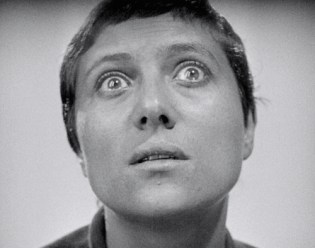 Some viewers describe how they’ve found The Passion of Joan of Arc to be moving, affecting, or life-changing on a par with a religious experience. I wouldn’t go that far, but then I’m not religious so perhaps not so easily swayed. As a dramatic, emotional, film-viewing experience, however, it is highly effective. As Dreyer wrote in 1950, “my film on Joan of Arc has incorrectly been called an avant-garde film, and it absolutely is not. It is not a film just for theoreticians of film, but a film of general interest for everyone and with a message for every open-minded human being.” A feat of visual storytelling unique to cinema, it struck me as an incredible movie, surprisingly accessible, and, nearly 90 years after it was made, timeless.
The Passion of Joan of Arc was viewed as part of my What Do You Mean You Haven’t Seen…? 2015 project, which you can read more about here.
It placed 14th on my list of The 20 Best Films I Saw For the First Time in 2015, which can be read in full here.
Also of note: this is the 1,000th feature film review I’ve published. (For what it’s worth, 2015 #112 will be 100 Films #1000. I’ll probably reach that in August.)

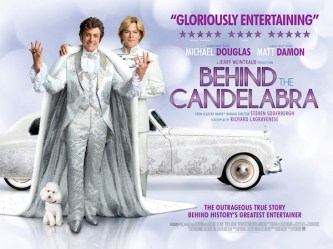 Steven Soderbergh’s supposed last-ever film (or, if you’re American, Steven Soderbergh’s first project after he supposedly quit film) is the story of Scott Thorson (Matt Damon), a young bisexual man in the ’70s who encounters famed flamboyant pianist Liberace (Michael Douglas) and ends up becoming his lover, which is just the start of a strange, tempestuous relationship.
 It looks great, too. The film, that is, not Rob Lowe’s face. The design teams have realised an excellent recreation of the period, which is then lensed with spot-on glossy cinematography by DP ‘Peter Andrews’. Occasionally the film moves outside that heightened, shiny world into places odder and grubbier, with one shot of Liberace peering over the door of a porn shop private video booth (really) that’s particularly striking.

 Between the mega-hits of
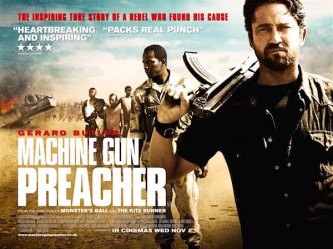
  The problem with the last point is that, in real life, Sam is still over there, still doing the same thing, while conflicts rage on. But this is a film — you need to find some kind of conclusion. The makers have tried, but its an incredibly half-arsed climax; less a resolution to the entire story and more Sam having learnt one lesson from something that went wrong a little earlier.
 mashed together with a polemical charity documentary about Africa, and then with some
 Tom Hanks is Walt Disney and Emma Thompson is author P.L. Travers in “The Making of Mary Poppins: The Movie”. Disney has been desperate to turn Travers’ fictional nanny into a movie for years after he made a promise to his daughter; Travers has resisted, but now needs the money. She’s brought to LA to consult on the script, and proceeds to make life miserable for screenwriter Don DaGradi (Bradley Whitford) and songsmiths Robert and Richard Sherman (B.J. Novak and Jason Schwartzman). At the same time, we see the story of a family in Australia from the eyes of a little girl Ginty (Annie Rose Buckley), as they struggle with the whims of her father (Colin Farrell), a bank manager who’s a little too fond of the bottle. Guess what the connection is!
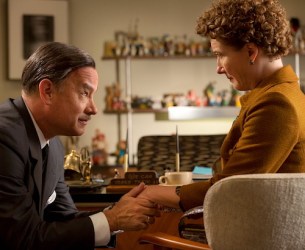 Similarly, Hanks’ part seems to be little more than a cameo at first, but he steadily appears often enough to make it a supporting role. Reportedly he has perfectly captured many of Disney’s real traits and idiosyncrasies, and who are we to doubt the word of people who knew the man? His performance is not just a shallow, simple impersonation, but there’s not that much meat to Disney’s character arc either.
 Some will find the story lacking in dirt, particularly when it comes to the portrayal of Disney. But it’s not whitewashed either, and do you really think the Disney Corporation would have allowed a movie to go ahead that depicts their founding father in a negative light? For that, I don’t think it’s as twee as it could have been — there’s definite conflict over what’s being done with Poppins, and, even with the film having turned out to be a solid-gold classic, we often find ourselves sympathising with Travers.
 2014 Academy Awards
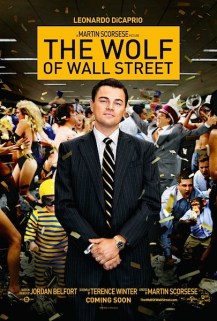 When someone says “100-million-dollar epic”, you probably don’t imagine a film about a swindling stockbroker; but, with a three-hour running time and a nine-figure budget, that’s exactly what Martin Scorsese’s black comedy biopic is.
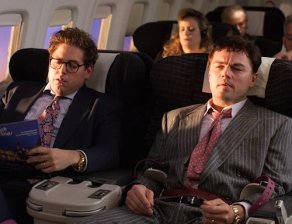 and the closing shot clearly shows how many people have already judged them to represent something desirable, regardless of what position the film might take. Some people want this lifestyle, in spite of all the problems it wrought, and even if the film had clearly condemned it that wouldn’t change. In the end, to say Scorsese approves of it purely because he doesn’t lambast it is too simplistic a reading.
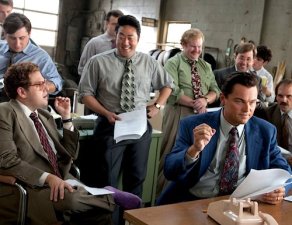 but almost every supporting character gets a memorable line or scene, a moment where they shine brighter than everyone else; and even when the smaller roles aren’t dominating a scene, they’re part of a first-rate ensemble that functions like a well-oiled machine. My personal favourite was P.J. Byrne’s ‘Rugrat’, but yours may well be someone else.
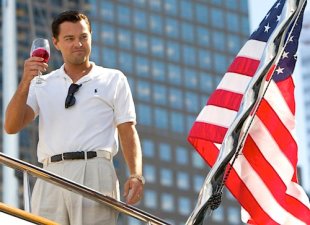 As one of
  The big winner at the 2002 Oscars (four gongs from eight nominations), A Beautiful Mind adapts the true story of John Nash (Russell Crowe), a Cold War-era mathematics student at Princeton who hit upon a groundbreaking theory and ended up working covertly for the government…
 but the display of range probably merited it; perhaps more so, in retrospect, than his win for Gladiator the year before.
 A Beautiful Mind won Best Picture in spite of being up against the incredibly more innovative, entertaining, and game-changing double-bill of
  I figured I ran the risk of affecting the outcome of the Scottish independence referendum if I posted this review yesterday (because of course I have that kind of reach and influence), but after Mel Gibson’s historical(ly-dubious) epic wound up on
  Judged as that, Gibson’s three-hour (near as damn it) movie is a pleasingly traditional epic. Many big films these days are just long, but the story here has scope too — it’s about a war, essentially. And war means battles, which are a particular highlight. The standout is surely the famed Battle of Stirling Bridge — you know, the one where the Scots moon the English. Funny and all, but just a small part of a larger sequence. Gibson has the confidence to show the build-up to the fighting, outline the tactics that will be used, and only then launch into the fray. It’s this measured approach that makes it so effective, rather than the crash-bang-wallop straight-to-the-slaughter style of more recent movies. Due to its notoriety I’d assumed the aforementioned clash was the film’s climax, but it’s actually the centrepiece, pretty precisely in the middle of the film. Fortunately there’s enough else going on (because this isn’t actually An Action Movie) that it doesn’t make things feel lopsided.
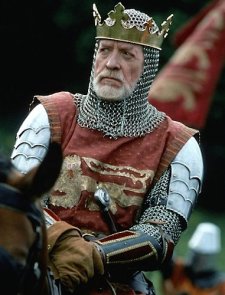 It also doesn’t suffer from that film’s accent issues. Mel Gibson isn’t an American-Scot (or an Australian one), instead delivering an accent that sounds passable to this Englishman. He believed he was too old for the part, which may well be true, but when the rest of it is so inaccurate what does that matter? He’s a solid leading man and a commanding-enough presence. The supporting cast are an array of recognisable Celtish faces — including at least one Irishman playing a Scot and a Scot playing an Irishman — and, because they’re from our fair isles, of course they’re all brilliant. Best of all, however, is Patrick McGoohan. He makes for a fantastic Evil King, given some juicy lines that are even juicier thanks to his delivery. He may not be moustache-twirling-ly memorable like an Alan Rickman creation, but any scene is enlivened by his presence.
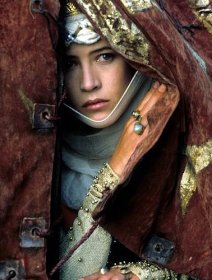 Then there’s that issue of historical accuracy. I know I said we should ignore it, but even if you accept fiction films shouldn’t be slavish history lessons (and not everyone does), how far can they ignore the facts? Often with such films the viewer assumes they’re true until someone says, “actually, I think you’ll find in reality…” Not so with Braveheart: you don’t have to know anything of Scottish history to guess that the face-to-face chats (and more, wink-wink-nudge-nudge) between Wallace and the future-Queen must be almost entirely poppycock (and, in fact, you can drop that “almost”).
 If you were looking for the archetype of an epic movie, Lawrence of Arabia would be a strong contender. It has a wide scope in just about every regard, from the desert locations that stretch as far as the eye can see, to the thousands of extras that fill them, to the glorious 70mm camerawork that captures it all, to the sweeping story that also contains a more personal throughline, to the 3½-hour running time.
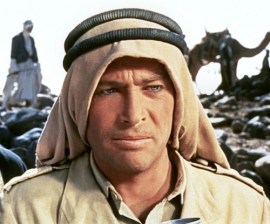 As such, the film hangs on the performance of O’Toole. We’re told Lawrence is an enigmatic figure and his depiction arguably supports that — we never fully get inside his head; we’re always observing him. And yet that’s no bad thing, because even as Lawrence’s confidence waxes and wains, as his allegiances shift and alter, we can feel what he wants to achieve, why he thinks he can. He attempts the impossible and succeeds, which is why he later attempts a bigger impossibility, and must leave the pieces to the more level-headed men, who didn’t have his genius but can therefore play the political game better than he.
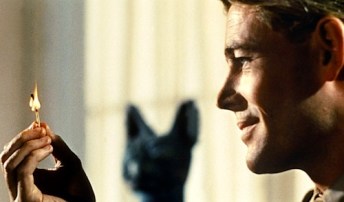 A similar legacy is left by those behind the scenes. Maurice Jarre’s score is the reference point for many a period desert epic — indeed, his music is so synonymous with such settings that it has arguably transcended its source to simply be what music for those locations and times is. It graces a film edited with class by Anne V. Coates, where scenes are allowed to play in luxuriantly long takes at times, while at others smash edits throw us from one location to another. This is undoubtedly supported by F.A. Young’s cinematography, where the wide frame can encompass so much action that there’s no need to cut amongst close-ups; and which can show the world in such majesty that you want it to hold for long, lingering takes. Even viewed on the small screen, the 70mm photography shines, especially on Blu-ray.
 As with any great film, Lawrence of Arabia is at least the sum of its parts. Replace any of the artists I’ve mentioned, or surely many more, and it would not be the film it is. In fact, when working on such a scale, this is more than a film — it’s an experience. And if that sounds pretentious, well, tough. If you haven’t experienced it yet, try not to leave it as long as I did.
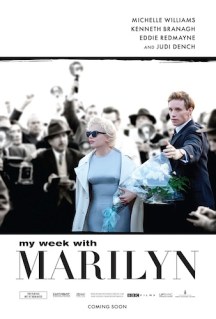 1956: global superstar Marilyn Monroe (Michelle Williams) comes to England to star opposite Laurence Olivier (Kenneth Branagh) in his latest directorial effort,
 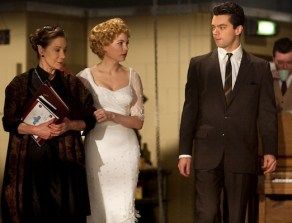 The supporting cast is a veritable who’s who of recognisable British faces, stars of screens both big and small. Barely a speaking part goes by without an actor you’re certain to recognise. I’d list them but, honestly, there are far, far too many. Despite Marilyn coming with a hefty entourage, Williams is the only American in the cast, meaning American accents are lumbered (to varying degrees of success) upon Zoe Wanamaker, Toby Jones, Dougray Scott, and Dominic Cooper. Hey, of course Dominic Cooper’s in it — is it even legal to make a mid-budget British movie without him now?
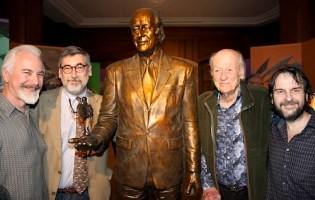
 If you don’t know that name then you must be a young whippersnapper, because otherwise Ray Harryhausen needs no introduction.
 Sometimes they’re a bit jerky, maybe, and the inevitable issues of scale show they’re models fighting or interacting with actors on set… but for all that they’re still not significantly less realistic than so many modern computer-based techniques, and they carry a charm and obvious level of skill that said renderings usually lack.
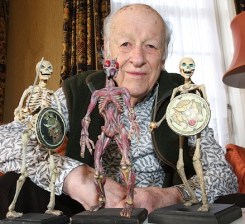 One thing I always wonder about ‘specialist’ documentaries is, do they have crossover appeal? Will someone with no interest in Harryhausen, or even in Cinema, get something out of this? Probably not, I guess. But that’s not a bad thing per se, because this is an informative overview of a man’s influential body of work that deserves all the appreciation it can muster. Even if, like me, you’re not that familiar with said work, this is a film that will show you why you should be.
 100Films.co.uk