2015 #144
Bill Condon | 128 mins | streaming (HD) | 2.35:1 | UK & Belgium / English | 15 / R
 It’s The Julian Assange Movie, in which Benedict Cumberbatch dons a lanky white wig and an Australian accent to portray one of the most significant figures of our times, whether you like it or not.
The story is told from the perspective of Daniel Berg, played by Daniel Brühl, who first encounters Assange in Germany and is somewhat captivated by him. Daniel helps Assange to really launch WikiLeaks, and is by his side through their early fame-garnering exposés. He functions a little as Assange’s moral compass, too, especially when they receive some stolen US military files relating to their controversial Middle Eastern exploits…
Cumberbatch’s performance is the showstopper here, and it’s been justly praised. It can seem a little over the top and affected, but then people who actually knew Assange say it’s bang on, so I think we have to take it that’s what he’s like rather than it being Cumberbatch overplaying. I largely rate him as an actor anyway, so he earns the benefit of the doubt. Brühl excels in the less showy role, however — much like he did in Rush, in fact, though even that role had its share of affectations to work with, which this part does not.
Daniel is torn between ‘saving the world’ and a love interest, played by Alicia Vikander, who is everywhere right now but I think this is the first time I’ve actually seen her in something. There’s nothing remarkable about her part,  so I can’t really judge her. The same goes for the rest of the cast, where a wide array of starry and/or acclaimed names (Peter Capaldi, Laura Linney, Anthony Mackie, Alexander Siddig, Dan Stevens, David Thewlis, Stanley Tucci, Carice van Houten (who’s big in Belgium, it would seem)) don’t falter, but nonetheless struggle to make a mark when none are awarded anything meaty to do.
The rest of the film is unfortunately hit or miss. It begins with an absolutely fantastic two-and-a-half-minute title sequence that covers the whole history of human mass communication, from hieroglyphs to the internet and everything in between. It’s succinct, thorough, and excellent, probably the best thing about the entire movie. Elsewise, Bill Condon’s direction is a little rote. At times he seems to want to be clever and cutting edge, with on-screen tech and the visual representation of WikiLeak’s virtual office space, but it’s inconsistent, a grab-bag of tricks without a guiding principle. The rest of the movie is shot plainly. Not badly, just plainly; normally; almost old-fashioned-ly. Its directorial style doesn’t match the material. For contrast, look to David Fincher’s The Social Network, which also told the story of cutting-edge ever-so-now tech developments, but did so with filmmaking that could be described in similar terms.
Every once in a while the film interjects a US-set subplot that seems to go nowhere. The posters and trailers imply these American officials were people hunting Assange; instead, they’re relatively minor cogs in the political wheel who get caught out by what he does.  They don’t seem to have any particular significance in themselves — they’re not famous, nor more wronged than anyone else — so maybe they’re just meant to be emblematic? As in, Laura Linney’s character is there to be representative of Assange’s effect, not the only person it happened to. Or was she the only person fired, and that’s the point? The film doesn’t make it clear.
In terms of understanding, it’s also very much a movie of Now. It assumes you know an awful lot of real-world context — essentially, the history of the last decade or two. Before too long, it’ll be a tough film for new viewers to follow or engage with without some kind of degree. Not everything should be made with an eye to its longevity, but one wonders how successful The Fifth Estate is in and of itself. It’s almost fiction-filmmaking as journalism: it’s about something that just happened — in some respects, is still happening — rather than an attempt to look back and explain those happenings in a historical context.
Indeed, one wonders how enlightening the film is in any respect. Assange is clearly a difficult person to get to know, by turns crusading hero and egotistical wannabe. That’s how the film depicts him, and if that’s accurate to life, well, that’s not the film’s fault — what’s wrong with having a primary character who isn’t a hero? Anyway, that’s the role Daniel is there to fulfil —  he’s the honourable one; the one who’s actually invested in the site’s supposed values. But then the film is partly based on his book, so he would be the good guy.
In the end, this is an immensely complex story, with many different and contradictory sides to tell, and the film isn’t up to the task of covering them all. Great performances, though.
This review is part of the 100 Films Advent Calendar 2015. Read more here.

 Before he descended into self-parody, Tim Burton made movies like this: a biopic of the eponymous ’50s filmmaker, renowned for his so-bad-they’re-good productions. Burton still contributes his trademark dark quirkiness, but it conjures a subject-appropriate tone rather than aimless Burtonesqueness.
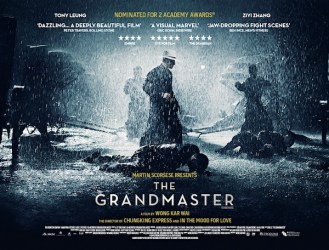 As a Western viewer, if you know anything about Ip Man beyond “he’s the chap who trained Bruce Lee”, it’s probably thanks to the
  It helps that it’s gorgeously shot. Ultra-crisp blue-black rain-soaked night time duels; rich golden hues in pre-occupation Foshan; cold bright-white snowy landscapes; a train platform fight that’s almost sepia-like. Between the photography and the ever-excellent action choreography of Yuen Woo-ping (
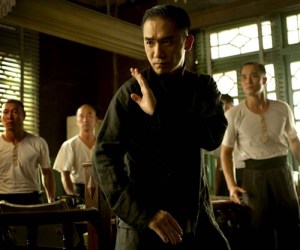 However you look at it, the other Ip Man films are undoubtedly more palatable to a mainstream audience. Does that mean they’re worse? No. Better? Not necessarily. But I don’t think The Grandmaster is all it could’ve been. It seems to run out of story and lose its way as it gets towards the end. The focus shifts entirely to Gong Er, and it feels less clear what it’s meant to about as a whole film. It becomes a movie of great moments, and maybe even scenes, but an unsatisfying whole. But oh, the images…
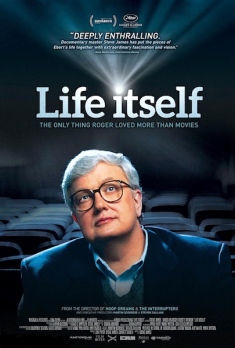 Roger Ebert was an influential, respected, beloved critic for decades, and one with an interesting life: he began in old-school newspaper journalism, defined TV movie criticism, and eventually spearheaded the profession’s move online. So it merits recounting in this documentary by the director of
 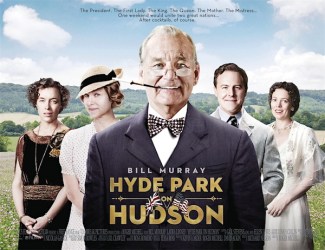 Wannabe-prestige picture Hyde Park on Hudson is like two films playing at once: the dramatic/romantic story of President FDR’s (Bill Murray) burgeoning affair with his distant cousin Daisy (Laura Linney), and the comedy-drama of his meeting with King George VI (aka “the one Colin Firth played in
  For what it’s worth, the film was born of the discovery of Daisy’s letters and diaries, which told of the relationship. Apparently the screenwriter was one of the people who found these, so I guess that’s where his interest lies. The film is a UK production from Film4, however, and made in the wake of the global success of The King’s Speech, so perhaps that explains the root of the royal involvement. While both stories have some potential, they aren’t made to gel, switching back and forth as if in some kind of narrative relay that enables the film to run a theatrical distance.
 with vibrant colours evoking a place of sunny happiness, but anything set at night is graded with a terribly extreme, not to mention awfully rote, case of teal-and-orange.
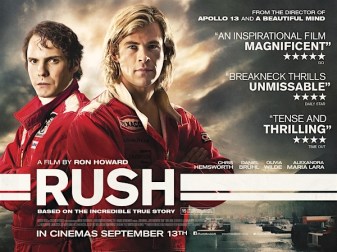 Screenwriter Peter Morgan (of
 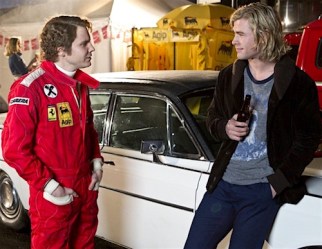 I presume the point of engaging with their personal lives away from the track was to add depth; to make sure it was a two-hander, rather than just about one or other of the drivers, and to ensure Hunt wasn’t just two-dimensional. However, without any growth on his part, or even some kind of active change, he’s just as flat, only now the star of some pointless scenes.
 If that narrative fits snuggly into familiar plot beats, what are you meant to do? Change the truth to make it less like fiction? That’d be a first. Saying that, I’m taking it on faith (based on comments in the making-of) that the true story was so perfect you wouldn’t believe it if it had been fiction. Maybe they did streamline it. But assuming it’s real… well, it’s not the filmmakers’ fault if life imitates art.
 All in all, I’m a little surprised how well-liked Rush is. I mean, as of posting it’s at #162 on
 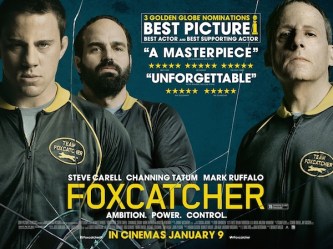 The director of
 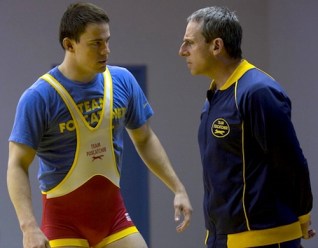 Fortunately, it has three leads who are up to carrying a narrative of that nature. In a rare dramatic role, and lumbered with a hefty prosthetic noise, Carrell’s John Du Pont almost feels like a caricature rather than a plausible human being… but apparently the film has actually toned down how odd the man was, so what are you gonna do? It’s a memorable performance none the less. Tatum is an understated lead, demonstrating he’s a better actor than you might expect as he displays emotional complexities in a man who doesn’t seem especially emotionally complex. Showing a character struggling with feelings he probably doesn’t quite understand is quite a feat, especially when it’s not explicitly conveyed in dialogue, so applause for Tatum there. Ruffalo, meanwhile, provides typically strong support, embodying a wrestler — right down to a very specific, unusual way of carrying himself — from the guy who plays Bruce Banner rather than the Hulk.
 making one wonder if anything the film may suggest is consequently wide of the mark.
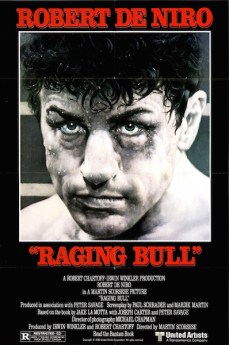 It would be boring if we all liked the same stuff, wouldn’t it? I’m sure there’s at least one ‘universally’-loved classic that we each dislike. Heck, tends to be every ‘universally’-loved classic has at least one Proper Critic that dislikes it. The flip side of this is that, in my opinion, if you don’t like something that everyone else does, there’s a fair chance it’s you who’s missing something. That’s a rule I apply to others, naturally, but I also try to bear it in mind myself (and, at the risk of sounding terribly arrogant, I think a few more people could do with thinking the same).
 The aforementioned fights, on the other hand, are full-on Cinema, and glorious for it. The make-up is also very good. Relatedly, De Niro’s physical transformation, from lithe boxer to washed-up fatso, is remarkable. Decades before the likes of Christian Bale and his
 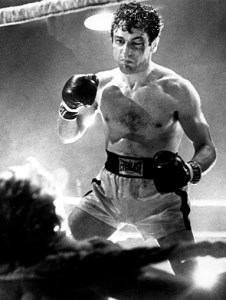 Based on where we find him at the end, I guess LaMotta would appreciate a Shakespeare quotation. For all the film’s “greatest of all time” acclaimedness, this is the one that came to my mind:
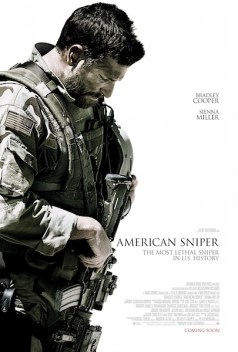 Politics aside, American Sniper is an adequately-made film. Eastwood’s direction is at best workmanlike, at worst laughably clichéd. Jason Hall’s screenplay rehashes better movies’ insights into the mental effects of war on combatants. Neither elicit much excitement from a half-arsed sniper-vs-sniper storyline. The film belongs to a bulked-up Bradley Cooper, who
 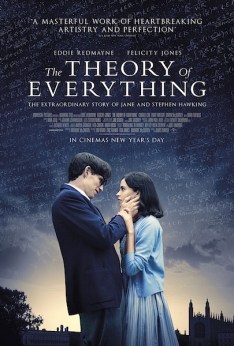 Biopic of genius cosmologist Stephen Hawking and his wife/caregiver Jane, on whose memoir the film is based.
 100Films.co.uk