The LEGO Ninjago Movie (2017)

2018 #167
Charlie Bean, Paul Fisher & Bob Logan | 101 mins | Blu-ray (3D) | 2.40:1 | USA & Denmark / English | U / PG
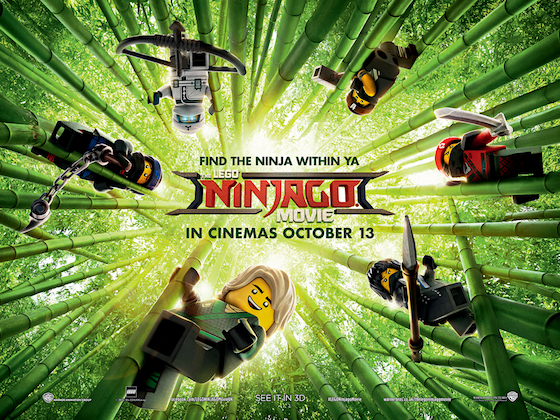
The LEGO Ninjago Movie

After the somewhat surprising success of The LEGO Movie, both critically (96% on Rotten Tomatoes) and commercially ($469.2 million worldwide), Warner Bros and LEGO realised they were on to a good thing and so did what any movie studio does in such circumstances: plowed ahead not only with a sequel (out next February), but also spin-offs. The first one, The LEGO Batman Movie, continued the trend (90% Tomatometer; $312 million gross); the next one — this one — …didn’t. With a rotten 55% on the Tomatometer and a worldwide box office take of just $123.1 million (less than either previous film’s domestic gross alone), what went wrong? Did they flood the market with LEGO movies too quickly? Was Ninjago just not as attractive or familiar a brand as Batman or LEGO generally? Or is it just not a very good movie? Well, I’ll come to that.

The film sets its scene in Ninjago City, which is constantly terrorised by villain Garmadon (Justin Theroux) and his armies. Fortunately for the good folk of Ninjago, they have a team of mech-driving colour-coded super-ninjas to protect them. In real life, those ninjas are just high school kids, and not particular popular ones — especially Lloyd (Dave Franco), aka the Green Ninja, who everyone knows is Garmadon’s son. When Lloyd’s daddy issues lead him to slip up, the ninjas have to save the city — and, in the process, Lloyd and Garmadon have to sort out their differences.
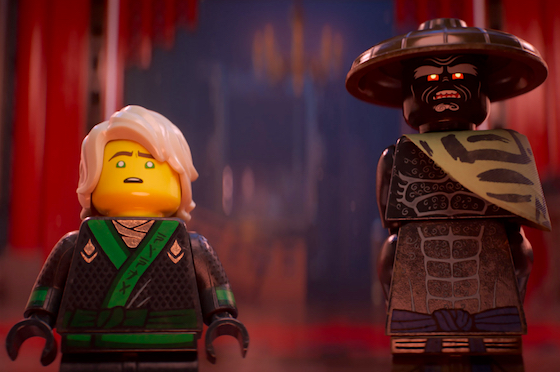
The Garmadons

The LEGO Ninjago Movie is quite clear that the focus of its story is the relationship between Lloyd and Garmadon, but it’s perhaps a little too focused on that. There are a bunch of other characters thrown into the mix — Lloyd’s five teammates; their master, Wu (Jackie Chan); Lloyd’s mother (Olivia Munn) — but the film doesn’t afford the screen time to do any of them justice. In fact, the film probably would’ve been a lot better if it had cut back on the number of beats in the Lloyd/Garmadon story and devoted a bit more time to giving everyone a little subplot. If it kept busy doing that it might’ve picked up the pace a bit as well, because although Ninjago is more or less the same length as the two previous LEGO movies, it feels much longer.

Partly this is because it just doesn’t feel as inspired as the other movies — it lacks the spark of ingenuity that ignited their characters, humour, and stories. At times it feels entirely half-hearted. For example, Lloyd’s big mistake makes his teammates all hate him, but they immediately go on a journey with him anyway; Master Wu says the length of that journey will give them time to come back round to Lloyd, but the film never bothers to suggest that’s happening — as soon as they need to all get along again, they do. Clearly this was meant to have some emotional effect on Lloyd (even the handful of people who used to like him don’t anymore), but that’s never really given the emphasis to be felt either — so what was the point of them falling out with him in the first place?
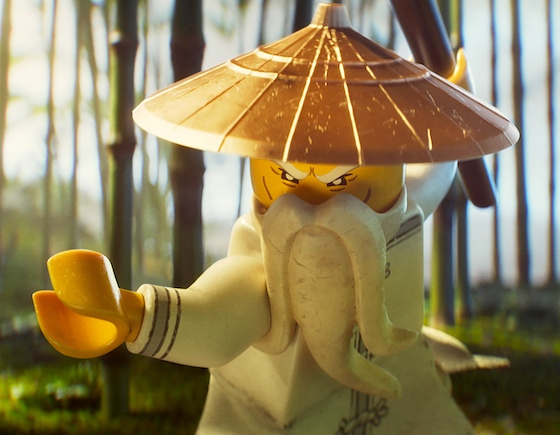
Even in LEGO, Jackie Chan kicks ass

That said, it does muster suitable amusement in places, though not as regularly as the other two films. And if you’re a fan of Eastern genre movies — kung fu, giant monsters/mechs, samurai, etc — the whole shape and style of the film is a broad reference to that kind of cinema, which is fun for those in the know. Unfortunately, it comes up somewhat short in the action stakes — the mech sequences seem to be inspired by the Michael Bay school of throw tonnes of visual information at the screen and whizz through it at lightning speed, making some of it hard to distinguish, even with the separation benefits of 3D.

Despite all these negatives, I didn’t actively dislike The LEGO Ninjago Movie. It’s good in places, most of it ticking along at a level of passable entertainment — but it ticks along for too long, it’s not funny enough, and it can’t bring it all together in the way the other two films did. It suffers most of all from those comparisons, because it’s simply not a patch on the other two LEGO movies.

3 out of 5

The LEGO Ninjago Movie is available on Sky Cinema from today.
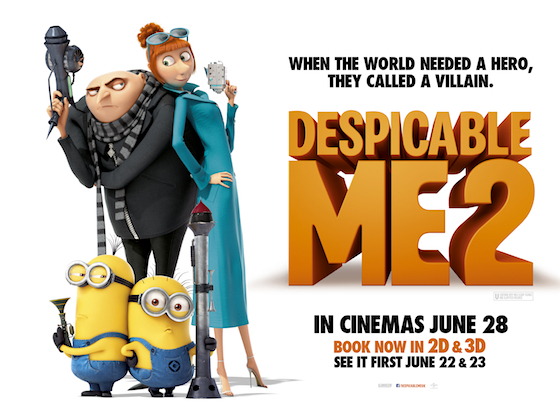
Despicable Me 2 (2013)

2018 #155
Pierre Coffin & Chris Renaud | 98 mins | download (HD+3D) | 1.85:1 | USA, France & Japan / English | U / PG

Despicable Me 2

In this sequel to the popular animated comedy (which I wasn’t that fond of, personally), supervillain turned adoptive dad Gru (Steve Carell) is dragged back into his old world when the Anti-Villain League recruit him in order to track down the villain who stole a dangerous serum. Meanwhile, Gru’s daughters think he needs a girlfriend, and the AVL agent assigned as his partner, Lucy Wilde (Kristen Wiig), seems the perfect fit. Also, his yellow Minions are still around, getting up to all sorts of ker-azy antics.

That’s the concise version, anyhow. This is a film that rambles around a lot in the telling, presumably out of fear that it might ever become boring to hyperactive youngsters. Unfortunately, it almost had the opposite effect on me. The main plot just felt like a shape on which to hang the romantic and Minion subplots, but those subplots just felt like a constant distraction from the main plot. The end result is a film that’s narratively unsatisfying on all fronts.

So. Many. Minions.

Instead, entertainment value comes from individual scenes or moments. Personal preference will dictate just how entertaining those are, however. I didn’t feel there was much consistency, with the humour able to spin on a dime from being pretty amusing to falling flat. It doesn’t help that it feels way too long, overloaded with subplots that don’t go anywhere meaningful and the Minions’ sketch-like shenanigans. And there’s a lot of the Minions, clearly the breakout stars of the first movie (and hence why the series’ next film was entirely centred around them). While they amuse me on occasions, I mostly find them annoying, and am slightly baffled that anyone over the age of about six can find them significantly amusing.

But it looks pretty great in 3D, at least — turns out Gru’s long pointy nose was made for the format — and it’s quite funny and imaginative in places. Still, a good trim would’ve benefitted it enormously. Unless you do really enjoy the Minions, I guess.

3 out of 5

The UK network TV premiere of spin-off Minions is on ITV today at 6:15pm.

Godzilla: City on the Edge of Battle (2018)

aka Gojira: Kessen Kidō Zōshoku Toshi

2018 #156
Hiroyuki Seshita & Kôbun Shizuno | 101 mins | streaming (HD) | 16:9 | Japan / English | PG

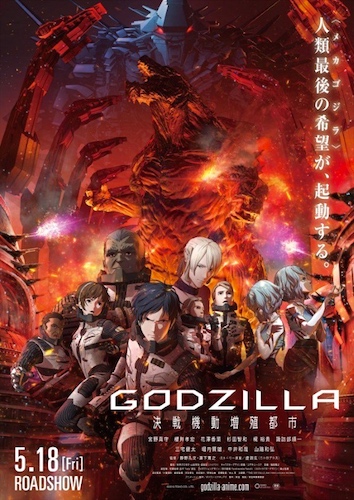
Godzilla: City on the Edge of Battle

The 31st official Godzilla film from Japan’s Toho studio is the second part of their anime trilogy. Released theatrically in Japan, it’s a Netflix exclusive in the rest of the world — which is probably for the best, because it means we don’t have to pay money specifically for this shite.

Picking up where the previous film left off, City of the Edge of Battle is set on Earth 20,000 years in the future, where a 300-metre-tall Godzilla (the largest ever, fact fans) rules the planet. I could go into the rest of the backstory, but we’ll be here for a paragraph or two — you can either watch the first film or, better yet, save yourself a couple of hours and just don’t bother with any of it. But anyway: in this instalment, the party that have landed on Earth to defeat Godzilla discover a tribe of humans (or, possibly, just a human-like species) who have somehow survived Godzilla’s reign. They in turn lead them to the remains of Mechagodzilla, a failed project by alien chums to help defeat Godzilla. Left alone for 20 millennia, the mech’s “nanometal” has grown into an entire city, which they now hope to use to defeat Godzilla.

There are some neat sci-fi ideas in this trilogy — aside from the Battlestar Galactica-esque stuff I talked about last time, there’s some interesting notions about how the planet might’ve changed and evolved over 20,000 years without us, and a city that’s grown itself has potential — but promising concepts alone are not enough to overcome the clunky dialogue, dull visuals, unmemorable characters, turgid philosophising, and sauntering plot. And if you’re here for the eponymous big guy, once again he doesn’t even get involved until over an hour in, just in time for the final big action sequence. That’s so badly done, it requires constant narration from the human command centre to explain what’s supposed to be going on. It would make as much sense as an audio drama as it does as a film.

Look, Godzilla is in this film! (Eventually.)

Another way this second film suffers is that many actions are built on motivations that were established and explained in the first film, but which aren’t restated here — and they were easy to miss in the first one anyway, because it was overloaded with exposition and jargon. It should be no surprise that this sequel is no better in that regard, justifying my decision to watch it in English this time. It did seem weird to switch language part way through a trilogy, but it’s not like any of the characters were memorable enough that I associated their voices with them, so why not? Well, I always feel I should watch anime in its original Japanese, for purism’s sake, but English is just easier — especially when the amount of made-up jargon flying around made the first film something of a chore to read.

I didn’t really enjoy the first film, but generously gave it 3 stars on the basis that it wasn’t completely terrible and had some ideas with potential. This sequel squanders most of that. I still like the mythology they’ve loaded into this universe — the conflicting ideologies of the different species on the spaceship; the situation on Earth when they return (the human-like tribe; the self-built city-with-a-brain) — but it’s all bungled in the execution, coming out as gloop that is, at best, barely intelligible, and, at worst, flat out boring. And if there wasn’t already more than enough backstory, mystery, and potential conflict to be going on with (which there was), City on the Edge of Battle throws a ton more into the mix. But hey, maybe the third film will actually generate some excitement if it has to rush to wrap all that up?

2 out of 5

Godzilla: City on the Edge of Battle is available on Netflix now. The final film is scheduled for release in Japan in November, and worldwide in early 2019.

Paddington 2 (2017)

2018 #58
Paul King | 103 mins | streaming (UHD) | 2.35:1 | UK & France / English | PG / PG

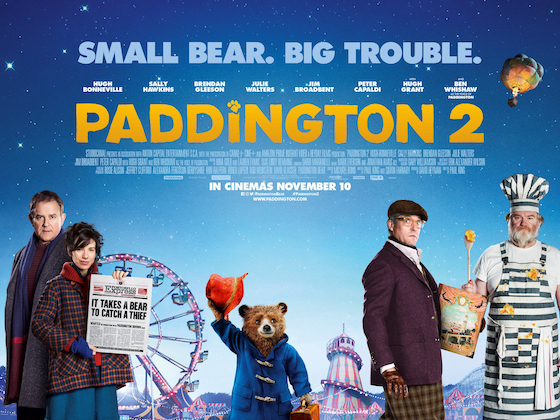
Paddington 2

Famous for its untarnished 100% Rotten Tomatoes score after almost 200 reviews (the best critical record of any film ever), Paddington 2 consequently comes with an awful lot of hype attached — perhaps too much for a movie that is, at heart, just a kind-hearted bit of fun about a marmalade-loving bear. But then, in our current climate, such a film is less barely necessary (unlike many sequels) and more a bear necessity.

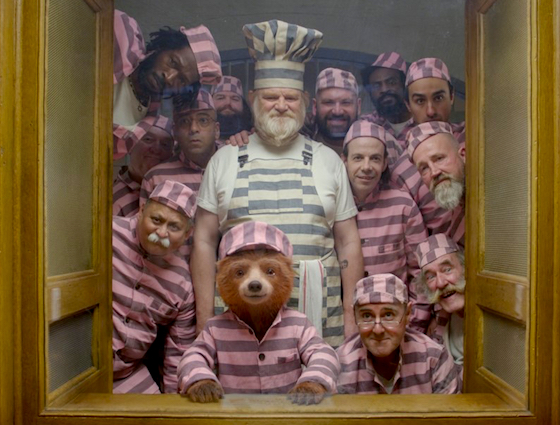
Said bear (voiced by Ben Whishaw) wants to buy a unique, and consequently expensive, pop-up book for his Aunt Lucy’s 100th birthday. When the book is stolen by failed actor Phoenix Buchanan (Hugh Grant), he manages to frame Paddington, who is consequently sent to prison. His adoptive family (Hugh Bonneville, Sally Hawkins, et al) set out to prove his innocence, while Paddington makes the most of his jail time by making friends and livening the place up.

The film’s joy lies less in the facts of the storyline and more in the emotions it inspires. The whole thing has clearly been crafted with a lot of love, inventiveness, generosity, and a good-hearted outlook on life, which comes across from all the characters and their actions, making for a resolutely charming and feel-good film that’s beautifully made. Of course, the first one had a lot of those elements too, but they’ve managed that rare thing of striking gold twice. One thing the first movie didn’t have is Hugh Grant, who proves he’s more than just a stuttering romcom lead with a superbly witty turn as the film’s villain. HIs BAFTA nomination wasn’t as silly as it perhaps sounded.

Friendly criminals

But while there’s nothing bad about Paddington 2, and an awful lot to like, I feel like my expectations for its absolute perfectness were set too high. I feel like I should be giving it 5 stars just because of how lovely everyone else said it was — and it was lovely, but 5 stars lovely? I’m not sure. I did like it a lot — it’s funny, clever, sweet, and good-natured — but I wasn’t bowled over in the way I’d been led to believe I would be. Maybe I would’ve been if I’d seen it before all the hype? That element of almost-disappointment means I can’t give it full marks, but it’s still a film I’d definitely recommend, especially if you’re after something thoroughly nice, or that’s both suitable for and entertaining to the entire family. I look forward to watching it again sometime and refining my opinion. Maybe in a double-bill with the first film, which I’m currently tempted to say was slightly better.

4 out of 5

Paddington 2 is available to stream on Amazon Prime Video UK as of yesterday.

Lupin the Third: The Secret of Mamo (1978)

aka The Mystery of Mamo / Rupan Sansei / Rupan Sansei: Rupan tai Kurōn

2018 #112
Sôji Yoshikawa | 102 mins | DVD | 16:9 | Japan / English | 15 / PG-13

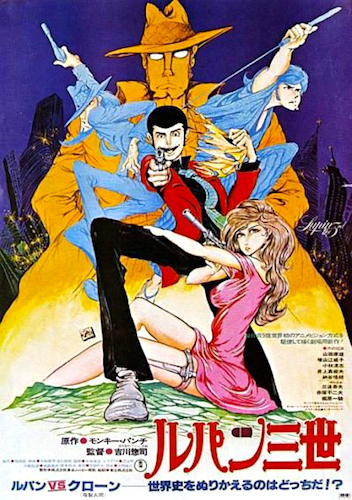
Lupin the Third: The Secret of Mamo

Best known to Western audiences thanks to Hayao Miyazaki’s feature debut The Castle of Cagliostro, Lupin the 3rd is more than just one film in the Studio Ghibli co-founder’s illustrious career — it’s a popular and long-running franchise in Japan, with almost innumerable iterations: starting life as a manga which has run on and off since 1967, it has so far been adapted into six TV series, seven animated films, 26 feature-length TV specials, two live-action movies, and sundry other bits and bobs. Despite all that, this is one of only three Lupin III productions that has been available in the UK since the DVD era (the others being the fourth TV series, titled The Woman Called Fujiko Mine, and Cagliostro, natch), though that increases by one today with the Blu-ray release of the latest complete TV series, Lupin the 3rd: Part IV.

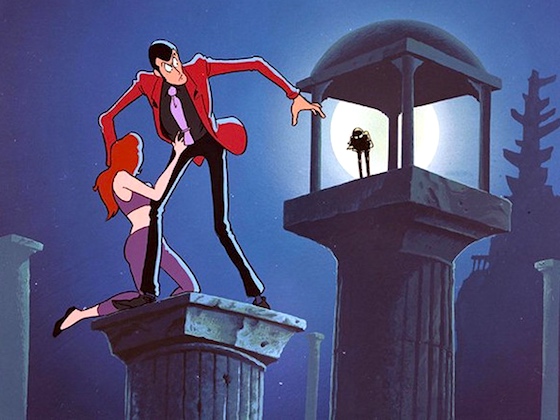
The Secret of Mamo (more commonly known in English as The Mystery of Mamo, or in Japan as Lupin vs. the Clone) was the first big-screen outing for Lupin III. It was produced while the second TV series was being broadcast, with the intention of making a film that was more similar to the original manga, something Japanese censorship standards prevented the TV series from being. So, the tone is kids’ comedic adventure, but there’s nudity, moderately graphic violence, and a scene of sexy torture. Well, it’s not that graphic really… though it depends on your position on these things, I guess. Anyway, I’m certainly surprised the Americans let it pass as a PG-13, just because of the nudity. She may be a cartoon, but it’s not subtle.

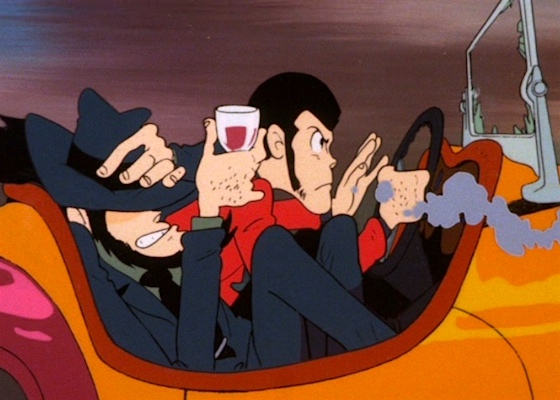
Car chase!

Anyhow, the plot sees master thief Lupin III, along with his regular sidekicks Jigen and Goemon, pilfering the Philosopher’s Stone (I guess Americans would need to call it the Sorcerers Stone) at the request of his on-off love interest Fujiko Mine, who actually wants it for the mysterious Mamo. His nefarious schemes draw Lupin and co into a web that sees them pursued not only by Mamo’s forces, but also the Americans, and Lupin’s regular nemesis, Interpol Inspector Zenigata.

One of the major inspirations behind Lupin the 3rd’s creation was James Bond, and so, appropriately enough, this is a globetrotting adventure that takes in Transylvania, Egypt, France, Spain, the Caribbean, and Colombia. Similarly, it also showcases some great action scenes, particularly an extended car chase through Paris and then the mountains. Unlike Bond, there’s a definite cartoonishness to many of the antics, and the third act takes a turn into outright science-fiction that gets a bit crazy. It’s also not entirely similar to The Castle of Cagliostro, therefore, showing how much Miyazaki brought his own tone and style to that film.

That said, I thought the lead characters’ relationships felt clearer from the start here than they did in Cagliostro, which very much felt like a sequel or spin-off where you were meant to know who everyone was (as I noted in my review). It could just be I’m a little more familiar with them all now, but perhaps the film was indeed made to be more newcomer-friendly — it was the first movie, after all; though it is spun off from a TV series… Well, it’s quite neatly done, nonetheless — this isn’t “Lupin III Begins” with them all meeting for the first time, nor is there a viewer-surrogate being introduced to them all, but it handles how and when each character arrives into the narrative in such a way that it’s kept fairly clear how they relate to one another. It’s subtly done, so, as I say, it could be serendipitous or my own improved awareness.

The mysterious Mamo

It’s also perhaps worthy of note that the film is available with four different English dubs. The 2013 US DVD from Discotek Media includes them all, so lucky you if you have that. Everywhere online will tell you that Manga UK’s 2008 DVD includes the dub Manga produced in 1996, which seems logical, but, being the inquisitive soul that I am, I read up on it myself, and I’m 99% certain it’s actually the 2003 Geneon dub. According to Wikipedia, the Geneon dub “took a liberal approach with translating the Japanese dialogue,” so I compared the dub to the subtitles included for the Japanese audio, and they were totally different. You can see why anime fans hate it when discs only include “dubtitles”. Maybe I should’ve watched it in its original language…

Anyway, the film itself is a very fun adventure, with an entertaining anarchism as well as exciting action and mostly amusing humour. Ever since I watched Cagliostro I’ve been meaning to watch some more Lupin the 3rd because I always hoped I’d enjoy it, and so far I’m being proven right. At least I’ve got the two Blu-ray-released TV series to tuck into next, but I’d like to see more of the extensive back catalogue make it to the UK. I guess that probably depends on how the Part IV release sells…

4 out of 5

Lupin the 3rd: Part IV is released on Blu-ray in the UK today by All the Anime.

Shrek the Third (2007)

2018 #101
Chris Miller | 93 mins | Blu-ray | 1.78:1 | USA / English | U / PG

Shrek the Third

Shrek the Third is notorious as The Bad One; the one where the bubble burst on the phenomenon that had sustained two well-reviewed and immensely financially successful films. The list of failed threequels is long — so long, you almost wonder why anyone bothers to make them — and while Shrek the Third does indeed do little to buck that trend, it could be worse.

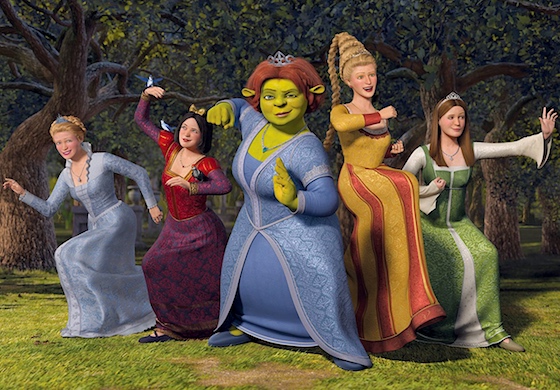
The title isn’t just a variation from calling the film Shrek 3, but also hints at the plot: when the king dies, Shrek is next in line to the throne. But he’s been struggling so much at royal engagements that he wants out of that life anyway, never mind a promotion. Fortunately, there is a possible alternative: a young lad called Arthur. While Shrek, Donkey and Puss set off to find this spare heir, Princess Fiona and a cohort of other fairytale princesses must fend off an attack from Prince Charming, who still has eyes on the throne.

It’s not a terrible plot for a Shrek movie, but it’s not particularly original either. Thematically, Shrek’s disinterest in being royalty was covered in the last film, though at least this time it’s bolstered with a fatherhood angle. The choice of villain, however, straight up takes the last film’s secondary antagonist and recycles him as a primary antagonist — if there’s a more literal example of sequels representing diminishing returns, I can’t think of it.

Action princesses

As for everything else, there are some good ideas and funny bits here and there, but there’s also something that’s just… off. It’s not consistently amusing or creative enough. It doesn’t have the same effortless energy and pace as the first two. And some of its ideas sound decent on paper, but just don’t work in the film. For example, the fairytale twist on a high school where they find Arthur — Shrek’s got good mileage out of spoofing the real world before, so you can see the genesis of the idea, but it just doesn’t land here, with the setting being an irritant rather than an amusing parallel.

Although the film still credits Andrew Adamson, writer and/or director of both previous films, as among its executive producers, I reckon there must have been debilitating changes behind the scenes, because the whole production just comes up short. Like, where the previous films offered legitimately exciting action scenes, the ones here could be decent but come off flat. It shouldn’t matter — this is a fantasy comedy, not an action movie — but it’s just one part that’s emblematic of the whole. Another is the song choices, which, like the fairytale high school thing, are seemingly okay but actually just wrong. As in, most of them are good songs, but they so often don’t actually quite fit the movie — I mean, Live and Let Die during a funeral?

Shrek the Third isn’t entirely without merit, but something seems to have gone awry between conception and execution, and it doesn’t zing in the way its predecessors did.

3 out of 5

Coco (2017)

2018 #109
Lee Unkrich | 105 mins | Blu-ray (3D) | 2.39:1 | USA / English | PG / PG

Coco

Pixar’s 19th feature is an American-produced animated fantasy movie that co-opts a foreign culture to tell a story about a guitar-playing kid remembering his dead family — wait, doesn’t that sound familiar? Yes, in broad strokes, Coco is Kubo and the Two Strings Pixar-style. But, instead of Japan, this is Mexico, based around the famed Day of the Dead festival — which has also already been the subject of an American animated movie, The Book of Life. But that didn’t get the best notices, and Kubo didn’t get the respect it deserves, and this is Pixar in non-sequel mode, and so Coco has been praised to the high heavens. And it is good. But I didn’t think it was that good.

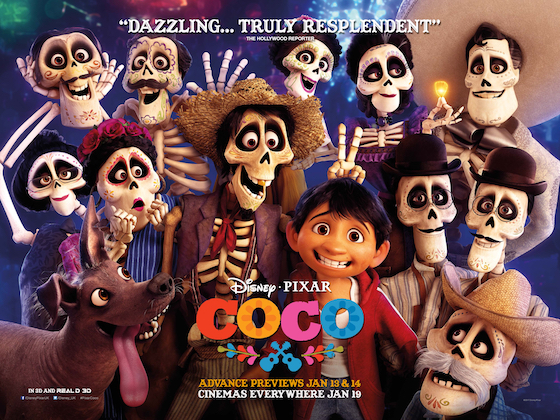
So, to start again: Coco is the story of Miguel (Anthony Gonzalez), a kid who desperately wants to be a musician like his idol, Ernesto de la Cruz (Benjamin Bratt). Unfortunately for Miguel, all music is banned in his family, due to his great-great-grandfather abandoning his wife and young daughter to pursue it as a career. On the Day of the Dead, a convoluted and overlong first act eventually gets us to a point where Miguel finds himself actually in the Land of the Dead, surrounded by the skeletal form of everyone who’s passed away. To get back to the land of the living he must go on a quest, accompanied by downtrodden Héctor (Gael García Bernal), who’s being forgotten by the living and needs Miguel to reestablish his memory in the real world. More or less. I mean, the rules get more fiddly and complicated than that.

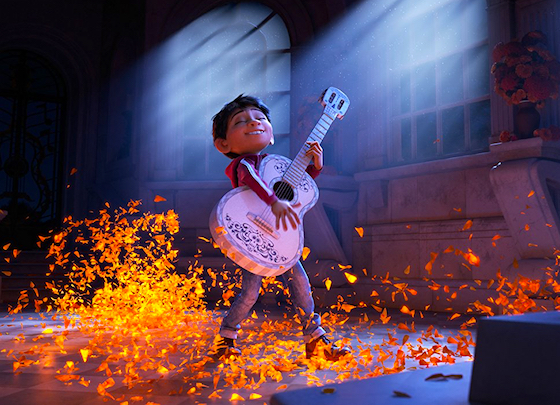
The magic of music

Frankly, the rambling length was my biggest problem with Coco. It’s not badly flabby, but it’s not as taut as I’d’ve liked it to be either, especially during stretches where you’re waiting for it to get to an inevitable plot twist or development. That’s not to say it’s without surprises — it pulls quite a dark plot twist about an hour in — and surprise isn’t the only virtue a story can have, of course, but it did reach a point where I was virtually shouting at the screen for them to finally get on with what was inevitably going to happen. Surely that’s a sign of something not working.

Maybe that was the music — quite a central part of the storyline, as you may’ve inferred, but I can’t say I was a fan. Mostly it’s fine, but there’s the occasional musical number that just slowed things down. It’s not a musical in the strictest sense either, so the film does stop a bit in order to get each song underway (at least it usually then tries to progress the narrative while the song continues). The big number is the Oscar-winning Remember Me, which has grown on me slightly since I first heard it but, again, I’m not particularly a fan. I don’t know what it is, really, because when I’ve come across mariachi-style music in movies before I’ve often quite liked it. I guess it’s this particular set of tunes, then.

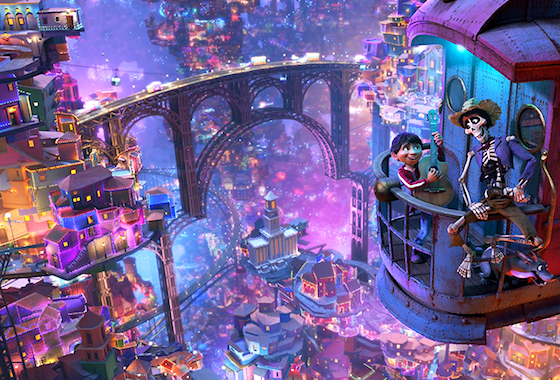
Naturally it looks great — it’s Pixar, would you expect anything less? The colourful Land of the Dead stuff is the best visually, wide shots creating epic vistas, with stunning architecture that suggests quite a world… not that we get to explore it very thoroughly, even though the quest narrative takes us to a few different locations. We certainly don’t get any indication how it functions for the other 364 days of the year. Zootropolis showed us a glimpse of a well-imagined full-scale world, teasing enough that I wanted to explore it comprehensively in further stories. Coco’s just looks pretty.

Colourful vistas

Maybe I’m being too picky? Maybe I’m just trying to work out what it was everyone else loved so much, when I saw a pretty standard Pixar buddy quest story with new surface flourishes. Or perhaps I’m right, and other people were blinded by the emotional ending? The final few minutes are certainly effective at tugging at the heartstrings — even though I hadn’t fully invested in the rest of the film, even I felt a pang… albeit slightly undercut by once again having to yell at the characters to get on with what they were inevitably going to do. Not everything should move at a mile a minute, but c’mon, sometimes you’re just being languorous.

Reportedly Coco had the longest active production of any Pixar movie, with work beginning in 2011 and (obviously) being completed in 2017. There are quite a few deleted scenes included on the Blu-ray which (from a brief flick through) seem to suggest the story once went in quite a different direction. I saw one person say those scenes suggest a much worse movie, too. I guess they kept tweaking the plot, then, maybe until it eventually resembled that familiar broad Pixar shape that dates right back to the original Toy Story.

Coco is good, but I certainly wouldn’t say it’s perfect. And I think I might go watch Kubo again now, actually.

4 out of 5

The UK becomes probably the last major market to get Coco on disc with its release on DVD, Blu-ray, and 3D Blu-ray today.

Batman: Gotham by Gaslight (2018)

2018 #105
Sam Liu | 77 mins | Blu-ray | 1.78:1 | USA / English | 15 / R

Batman: Gotham by Gaslight

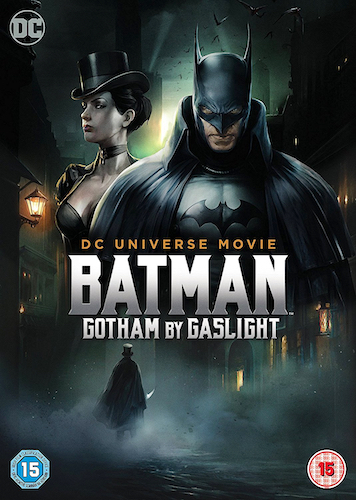
I was all up for this adaptation of Gotham by Gaslight when it was first announced — I’m a fan of the original book, as well as the sequel (which they’ve also used parts of); and, I thought, even if they chose to deviate from it then I like the basic concept of “Batman meets steampunk”. But then the last few DC animations I’ve seen have been subpar, and the trailer for this one looked rather bland, so I decided to opt for a rental instead of purchase. Well, I never got round to doing that, and then Amazon slashed the price of the Blu-ray, so I ended up buying it — it still cost more than a rental, but if I liked it I’d save money in the long run. Fortunately, that turned out to be the case.

If you’re not familiar with Brian Augustyn and Mike Mignola’s original tale, it involves Batman battling Jack the Ripper in late 19th Century Gotham City. It’s regarded as the first Elseworlds story, which is DC’s branding for stories that take place in different times, places, or “what if” scenarios — “what if Superman had landed in Russia?”, for example. This animation is a rather loose adaptation, which takes the basic concept from Augustyn and Mignola’s work but otherwise almost completely rebuilds it, mixing in a lot of ‘Easter egg’ stuff (like appearances from many more well-known Bat-characters) and some elements of the sequel comic, Master of the Future.

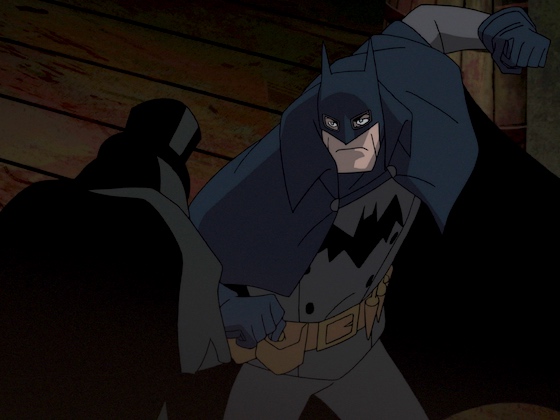
Fisticuffs!

So anyone expecting a straight-up adaptation may be disappointed, but taken as a film in its own right, for the most part it works. Having all the different familiar characters pop up makes it feel like a proper Batman tale, rather than a Ripper story that happens to have a costumed vigilante in it. Most prominent is Selina Kyle, aka Catwoman, although she isn’t really the latter here — Batman gets fully suited up, but the most Miss Kyle gets is a whip. The relationship between Bruce Wayne and Selina is one of the film’s best aspects, in fact, with the Elseworld setting seeming to allow a different focus than the usual antagonism that pairing has in screen adaptations — as one of the filmmakers says in the audio commentary, “it’s not a movie about Batman and Catwoman, it’s about Bruce and Selina.” Jim Krieg’s screenplay is good across the board, with several nice passages and scenes, even if at times it rests too heavily on exposition and speachifying.

The one change that didn’t work for me is that it glosses over the bit about Bruce have recently returned from Europe, his return to Gotham coinciding with the Ripper’s arrival, thus making Bruce Wayne a suspect. Perhaps this isn’t a major point, but it’s a grace note that helps sell the whole concept for me. This wasn’t an oversight, however: they consciously decided to make Jack the Ripper a Gotham serial killer in this universe, so his London crimes never happened. But surely the point of using Jack the Ripper is the crimes he’s famous for? I think everyone knows he was a London serial killer, but the film does nothing to dispel this prior knowledge, nothing to establish that this version emerged for the first time in Gotham.

The idea behind the change was to widen the suspect pool for the “whodunnit” element — if the Ripper had just come from London, his identity has to be someone who’s just arrived in Gotham. I can see where they’re coming from, but there are other ways round the problem — for example, the Gotham Ripper could’ve turned out to be a copycat, which would’ve added to the twist. As it stands, the identity of the Ripper (which has been changed from the book) is a huge twist, and, fair play to them, they pull it off. I’ll say no more because of spoilers, but I’m surprised it didn’t seem to cause outcry online. Maybe after the furore around The Killing Joke people just stopped paying attention.

Miss Selina Kyle

As with most of these DC animations, the quality of the visual is more TV than feature film, but they make the most of what they’ve got. There’s a squareness to the character designs, using few and simple lines, that is almost appealing. Perhaps it was inspired by Mignola’s artwork, though it does still feel sanitised compared to his exaggerated style. Also, a lot of effort is put into establishing this version of Gotham, with plenty of wide shots and scenes set in many different locations. Those were both deliberate choices to help make the city a major part of the film, and to give it life and texture as a Victorian metropolis. It’s an admirable effort considering the new era was a bit of a production headache: on their other movies, things like generic background characters and props can be recycled from film to film, but here every single element had to be designed and created from scratch.

Voice casting is mostly spot on. Again, effort was put into evoking the period without wanting to go overboard — they didn’t want the voices to sound modern, but they didn’t want everyone doing English accents or something either. Bruce Greenwood makes for a dependable Batman and Anthony Head is perfectly dry as Alfred, but the foremost performance is perhaps Jennifer Carpenter as Selina. She’s most famous for Dexter, where she’s such a tomboy, but here she conveys a kind of Victorian elegance, with a hefty dash of feminism, very well. Inspired casting. Just as good is Scott Patterson as Commissioner Gordon. Best known for his modern, working-class character in Gilmore Girls, I didn’t even realise it was him until the credits rolled. Well, partly this is a problem with billing — only Greenwood and Carpenter get it. They’re the leads, so of course they’d get top billing, but Head and Patterson have sizeable roles and are surely just as famous? I guess it doesn’t matter, but it was a bit of a surprise to hear a recognisable voice crop up when they hadn’t been announced (as it were) by the opening credits.

The Ripper approaches...

In other merits, there are some surprisingly decent action sequences — a mid-way one atop an airship is the highlight — plus a nice music score by Frederik Wiedmann, which was partly influenced by Hans Zimmer’s work on the Guy Ritchie Sherlock Holmes films, but I swear I heard some overtones of Danny Elfman’s Batman in there also. In all the film is only an hour-and-a-quarter long, but it doesn’t feel like too much of a quickie — there’s enough incident here to fuel a ‘proper’ movie. I mean that in a positive way.

As I said at the start, I expected very little of Gotham by Gaslight, for various reasons. I came away pleasantly surprised. In the commentary they talk about how much they enjoyed making it — how everyone involved, from the executives down to the storyboarders, all thought it was a particularly special project — and how they’d like to make a sequel, and they’ve got an idea for one involving the Joker. I’ve no idea how this has performed commercially, but I hope they get the chance.

4 out of 5

Another Elseworlds-y Batman animation, Batman Ninja, is released on DVD and Blu-ray in the UK this week, and will be reviewed in due course.

Shrek 2 (2004)

The 100 Films Guide to…

Shrek 2

Not so far, far away…

Country: USA
Language: English
Runtime: 93 minutes
BBFC: U
MPAA: PG

Original Release: 19th May 2004 (USA)
UK Release: 2nd July 2004
Budget: $150 million
Worldwide Gross: $919.8 million

Stars
Mike Myers (Wayne’s World, The Love Guru)
Eddie Murphy (Beverly Hills Cop, Norbit)
Cameron Diaz (Charlie’s Angels, The Holiday)
Antonio Banderas (The Mask of Zorro, The Skin I Live In)
John Cleese (Monty Python and the Holy Grail, A Fish Called Wanda)
Julie Andrews (Mary Poppins, The Princess Diaries)
Jennifer Saunders (Muppet Treasure Island, Absolutely Fabulous: The Movie)
Rupert Everett (An Ideal Husband, St. Trinian’s)

Directors
Andrew Adamson (Shrek, The Chronicles of Narnia: Prince Caspian)
Kelly Asbury (Spirit: Stallion of the Cimarron, Gnomeo & Juliet)
Conrad Vernon (Monsters vs Aliens, Sausage Party)

Screenwriters
Andrew Adamson (The Chronicles of Narnia: The Lion, the Witch and the Wardrobe, Mr. Pip)
Joe Stillman (Shrek, Planet 51)
J. David Stem (The Rugrats Movie, The Smurfs)
David N. Weiss (All Dogs Go to Heaven, The Smurfs 2)

Story by
Andrew Adamson (Shrek the Third, Cirque du Soleil: Worlds Away)

Based on
Shrek!, a picture book by William Steig — even more loosely than last time, though.


The Story
Newlyweds Shrek and Fiona travel to meet her parents, the King and Queen of Far Far Away. They’re less than pleased about their daughter marrying an ogre, especially as the King made a deal with Fairy Godmother for her son, Prince Charming, to be Fiona’s husband — and she insists that bargain be fulfilled.

Our Heroes
Shrek and Donkey, off another whirlwind adventure! After Shrek has a lover’s tiff with his new bride, he sets off to try to make himself what he thinks she wants: human.

Our Villain
Fairy Godmother might seem sweet and helpful, but she actually runs a factory with oppressed workers (they don’t even have dental!) and is manipulating the King so her son can become his heir.

Best Supporting Character
When Fairy Godmother orders the King to deal with Shrek, he seeks out a renowned ogre hunter: Puss in Boots. He may look like an adorable little kitty, but he’s a devil with a sword.

Memorable Quote
“It looks like we’re up chocolate creek without a Popsicle stick!” — Gingerbread Man

Memorable Scene
As a party begins at which Prince Charming will kiss Fiona and make her fall in love with him, Fairy Godmother entertains the guests with a rendition of Holding Out for a Hero — as Shrek and friends storm the castle to rescue his wife.

Memorable Music
The use of pop songs was a defining characteristic of the first Shrek, so naturally that continues here. However, there are also a lot more diegetic songs this time: Jennifer Saunders gets two musical numbers as Fairy Godmother (one an amusing riff on typical Disney numbers, the other mentioned above), plus Tom Waits and Nick Cave both sing (as the same character). The film also includes two really good covers of Holding Out for a Hero (the second, by Frou Frou, plays over the credits), which is some kind of achievement.

Making of / Letting the Side Down
For the UK release, two minor roles were redubbed: Doris the Ugly Stepsister, voiced by chat show host Larry King originally, was replaced by chat show host Jonathan Ross; and the red carpet announcer, voiced by Joan Rivers in the US, was replaced by Kate Thornton, who also must’ve done red carpet stuff at some point, I dunno. I guess it seemed like a fun idea at the time — the idea, presumably, was to localise famous voices with ones that would be better-known in other countries — but they shouldn’t’ve bothered: it’s just distracting, and neither replacement gives a very convincing performance. I think this was the first time such voice localisation had been done, and it seemed to kick off a minor fad for it. I thought it had gone away, but they recently defaced Kung Fu Panda 3 with a similar trick.

Previously on…
Shrek 2 picks up pretty closely from the end of Shrek — you probably need to see that to make full sense of this one.

Next time…
A further two sequels followed, plus a spin-off movie (which has its own spin-offs, including a six-season TV series). There’s also a 4D theme park attraction (which uses a plot that was rejected for Shrek 2) and numerous TV specials. There are always rumours of the franchise getting resurrected, too.

Awards
2 Oscar nominations (Animated Film, Original Song (Accidentally in Love))
2 Saturn Award nominations (Animated Film, DVD Special Edition)
7 Annie Award nominations (Animated Feature, Animated Effects, Directing, Music, Storyboarding, Voice Acting (Antonio Banderas), Writing)
Nominated for the Palme d’Or (again!)

Verdict

Having said Shrek has aged and dated, I think Shrek 2 has fared better. Arguably the first one has more pure originality, giving birth to an irreverent fairytale meta-verse, but Shrek 2 expands on those building blocks and plays with the ideas. There are lots of fun movie spoofs (though many are from the same era, so their effectiveness could partly be nostalgia), the climax is a legitimately good action sequence (see Memorable Scene), and there’s even a decent thematic throughline about what you’re prepared to do or give up for the one you love. Plus the animation looks a lot more polished — three years makes a huge difference in computer animation, especially in the early noughties. The first one has its moments, for sure, and perhaps some of them are better or more memorable too, but as an overall film I prefer the sequel.

Shrek (2001)

The 100 Films Guide to…

Shrek

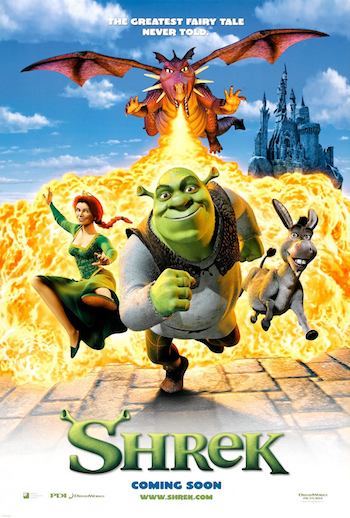
The greatest fairy tale never told.

Country: USA
Language: English
Runtime: 90 minutes
BBFC: U
MPAA: PG

Original Release: 16th May 2001 (USA)
UK Release: 29th June 2001
Budget: $60 million
Worldwide Gross: $484.4 million

Stars
Mike Myers (Austin Powers: International Man of Mystery, The Cat in the Hat)
Eddie Murphy (Coming to America, Dreamgirls)
Cameron Diaz (There’s Something About Mary, Gangs of New York)
John Lithgow (Cliffhanger, Rise of the Planet of the Apes)

Directors
Andrew Adamson (The Chronicles of Narnia: The Lion, the Witch and the Wardrobe , Cirque du Soleil: Worlds Away)
Vicky Jenson (Shark Tale, Post Grad)

Screenwriters
Ted Elliott (Aladdin, Pirates of the Caribbean: The Curse of the Black Pearl)
Terry Rossio (The Mask of Zorro, Pirates of the Caribbean: Dead Man’s Chest)
Joe Stillman (Beavis and Butt-Head Do America, Gulliver’s Travels)
Roger S.H. Schulman (Balto, Mulan II)

Based on
Shrek!, a picture book by William Steig.


The Story
When his swamp is overrun with fairytale creatures, ogre Shrek sets off to confront the man responsible, Lord Farquaad. To get his land back, Shrek must rescue the Princess Fiona from her dragon-guarded castle, so that Farquaad can marry her. But all is not as it appears…

Our Hero
Shrek is a grumpy Scottish-accented ogre who just wants to be left alone in his swamp, but events conspire to get in his way. Of course, as things transpire, he really has a heart of gold.

Our Villain
Men of his stature are in short supply, though there are those who think little of him — it’s Lord Farquaad, who wants Fiona to be his bride primarily so he can become king.

Best Supporting Character
Shrek’s new best friend (whether he likes it or not), wise-cracking ass Donkey, gets many of the best lines.

Memorable Quote
Gingerbread Man: “Do you know… the Muffin Man?”
Lord Farquaad: “The Muffin Man?”
Gingerbread Man: “The Muffin Man.”
Lord Farquaad: “Yes, I know the Muffin Man. Who lives on Drury Lane?”
Gingerbread Man: “Well, she’s married to the Muffin Man…”
Lord Farquaad: “The Muffin Man?”
Gingerbread Man: “The Muffin Man!
Lord Farquaad: “She’s married to the Muffin Man…”

Memorable Scene
As Shrek, Fiona, and Donkey travel back to Lord Farquaad, they’re jumped upon by Robin Hood (who, for no apparent reason, has a French accent) and his Merry Men, attempting to rescue Fiona by, in part, singing a merry song. But she doesn’t want rescuing and so goes all Matrix on their merry arses.

Memorable Music
As part of its generally irreverent take on myths and fairytales, Shrek is laden with contemporary popular music. It was all very modern at the time, but, 17 years on, it’s obviously dated itself, sounding distinctly early-millennium-y now.

Technical Wizardry
The overall animation quality may be looking a bit dated now, but Shrek hails from the era when every major new computer-animated movie was breaking ground in the field, in one way or another. In Shrek‘s case, it was the ability to realistically animate hair and grass.

Next time…
To date there have been three sequel movies, a spin-off movie (which then has its own world of attendant spin-offs, including a six-season TV series), a 4D theme park attraction (which was included in 3D on some DVD releases of the film), plus numerous TV specials and the like, as well as a stage musical version. There are constant rumours of the franchise getting a big-screen continuation, too.

Awards
1 Oscar (Animated Feature)
1 Oscar nomination (Adapted Screenplay)
1 BAFTA (Adapted Screenplay)
5 BAFTA nominations (Film, Supporting Actor (Eddie Murphy), Music, Sound, Special Visual Effects)
1 BAFTA Children’s Award (Film)
1 Saturn Award (DVD Special Edition)
4 Saturn Award nominations (Fantasy Film, Supporting Actor (Eddie Murphy), Writing, Music)
8 Annie Awards (Animated Theatrical Feature, Individual Achievement for Directing in an Animated Feature, Individual Achievement for Writing in an Animated Feature, Voice Acting by a Male Performer in an Animated Feature (Eddie Murphy), Individual Achievement for Effects Animation, Individual Achievement for Music Score an Animated Feature, Individual Achievement for Production Design in an Animated Feature, Individual Achievement for Storyboarding in an Animated Feature)
4 Annie Award nominations (Individual Achievement for Character Animation (x3), Individual Achievement for Production Design in an Animated Feature)
Nominated for the Hugo for Best Dramatic Presentation
Nominated for the Palme d’Or (seriously)

Verdict

DreamWorks’ irreverent riff on fairytale animations was a breath of fresh air back in 2001, allowing them to net the first Best Animated Feature Oscar ahead of Disney or Pixar. A decade and a half of imitators have taken the shine off that somewhat, as have advances in technology (old CGI ages worse than old cel animation), but it remains an amusing and quotable film, with a surprisingly strong moral message at its heart.