Madagascar (2005)

2008 #89
Eric Darnell & Tom McGrath | 82 mins | TV | U / PG

MadagascarIt had been my impression that this summer’s sequel, Madagascar: Escape 2 Africa, was a weaker follow-up to a middling original. Clearly I was reading the wrong review, because Rotten Tomatoes offers a different consensus: “an improvement on the original, with more fleshed-out characters, crisper animation and more consistent humor.” Oh. So what of the original?

The characters may not offer great depth, but they serve their purpose well enough. The plot focuses on Marty the zebra, voiced by Chris Rock, who wants to escape to the wild, and Alex the lion, voiced by Ben Stiller, who doesn’t — but doesn’t have a choice when they’re whisked off half-an-hour in. This might leave David Schwimmer’s giraffe Melman and Jada Pinkett Smith’s hippo Gloria with little to do but support, but in an 80-minute kids’ animation you can’t expect an Altman-esque portmanteau.

The animation is better than I expected. At the time, the angular style looked cheap, like a step back from the realism-aiming work of Pixar and the Shrek team. It’s just stylised however, still allowing plenty of expression in characters’ faces and detail in their movements and the locations. It’s not a exceptional example of how brilliant computer animated films can be (unquestionably Pixar’s forte, especially in the likes of Ratatouille and WALL-E’s earlier scenes), but it’s better than some sparse and clunky efforts (such as Aardman’s Flushed Away).

Equally, the humour is above average. Large laughs may be sporadic but are there, particularly in a few moments that nicely spoof other films. Standouts include Planet of the Apes and American Beauty — clearly aimed at the adult audience who have been dragged along by the kids, have come expecting Pixar-level entertainment, or want to see what Chris Rock and Sacha Baron Cohen can be doing in a family film. Plus there’s the penguins, a little band of wannabe escapees who thankfully aren’t overused, especially as the last few years have seen a severe overload of penguin movies (March of the Penguins, Happy Feet, Surf’s Up…) If there’s one element that could’ve been bumped up it’s the monkeys; on the other hand, like the penguins, they’re not done to death.

Madagascar doesn’t reach the highs of Pixar — no surprise there — but it’s at least nudging the ballpark. If the sequel’s better then I might even seek it out before it makes it all the way down to TV.*

4 out of 5

* I never did; and now it’s been on TV (several times), I still haven’t. ^

Enchanted (2007)

2008 #80
Kevin Lima | 103 mins | DVD | PG / PG

EnchantedYou’ve probably heard about Enchanted: it’s the one that starts out as a traditionally animated Disney film, before The Normal Girl Who Will Marry A Prince is thrown into a Magic Portal by The Evil Stepmother and finds herself in present-day New York. It’s one of those concepts so good it just makes you think, “why haven’t they thought of that before?”
Thankfully, they pull it off. It’s very funny, riffing on many recognisable elements from Disney’s considerable library of classics, and manages to produce a number of catchy songs of its own. Amy Adams is brilliant in the lead role, managing to be infectiously sweet rather than sickeningly sugary, while Susan Sarandon has a whale of a time in her boundlessly camp (though disappointingly small) role. The rest of the cast are good too, especially a wonderfully vacant James Marsden as The Prince.

The plot is ultimately predictable, but no more than you’d expect considering the target audience — certainly, kids will likely go through all the requisite emotions, and it would probably be more disappointing if they did try anything truly shocking. Still, it’s crammed with more than enough fun invention and new ideas to make up for any unsurprising plot beats.

Quite simply, Enchanted is a fantastic concept, beautifully executed. A veritable success.

4 out of 5

Ultimate Avengers II (2006)

aka Ultimate Avengers 2: Rise of the Panther

2008 #83
Will Meugniot & Richard Sebast | 70 mins | DVD | 12 / PG-13

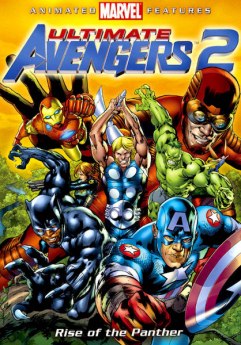
Ultimate Avengers IISome things in life baffle me. Form dictates I now list a couple of humorous examples, but we’ll skip that and get to the point: why would you make a direct-to-DVD movie that has a subtitle on the box but not on the film itself? I can understand why titles get tweaked on cinema-release posters and/or subsequent DVD releases — for marketing purposes, say; or clarity — but why, when your title is going direct to the DVD stage, do the titles not match? And why does the box add the subtitle rather than remove it for on-shelf simplicity? I have no answers — it baffles me, remember — but this is the sort of thing I sometimes muse about. The sort of thing that most other people don’t even notice, never mind care about.
Insignificant title issues aside, the fact that (as of writing) 2,365 people have bothered to rate the first Ultimate Avengers on IMDb, while only 1,325 have bothered to rate this second, suggests many were so disappointed by the initial film they didn’t bother with the sequel. Which is something of a shame, because it’s a lot better. Problematically, it’s heavily grounded in the first, picking up several threads that were left hanging — enough so as to make that weak franchise opener required viewing, sadly.

Why’s it better? We’ll get the obvious out of the way: yes, it’s a modern genre sequel, so yes, it’s ‘darker’. In this case that means “more adult”, touching on issues you might not expect in superhero animation with such a low certificate — marital problems, survivor’s guilt, political isolationism, even vague allusions to alcoholism. None are dealt with in any great depth I should add, but it will likely please adult fans wishing for something more “grown-up”. There’s also a greater amount of violence, though much of it is implied, or just off screen, or against bug-like aliens. The animation still isn’t great, though at times seems improved. Equally, while both script and story are better — there’s no pace issue this time — there’s still plenty of clanging dialogue, and the adult subplots aren’t exactly subtly executed.

The climax also has its share of flaws. While most of the story is nicely balanced, it’s over-efficient in wrapping up, in the way that only animation seems allowed to be — for whatever reason, this exact story would comfortably fill a two-hour live-action version. The worst effect of this is that some points aren’t treated with their deserved weight — the death of a major character is so hasty and glossed over that I didn’t even realise it had happened until a brief shot of a memorial in the closing scene. On a less pressing note, the giant alien robots of the final battle leave the film just one leg (per robot) away from becoming a total War of the Worlds rip-off. But this tale is of American origin, so the aliens are defeated not by a clever plot twist, but by brute force.

Despite my attention to the film’s weak points there’s actually plenty to enjoy here, provided animated superhero movies are your thing. There’s more action than the first instalment, a more interesting story, more character development… Even if it’s done at quite a basic level it’s still adequately entertaining, enough that you might wish there was a third. An improvement then, if still flawed, but — ultimately — enjoyable.

4 out of 5

For my review of the first Ultimate Avengers, please look here. Live-action sequel Avengers: Age of Ultron is in UK cinemas from this Thursday, 23rd April 2015.

Ultimate Avengers (2006)

2008 #82
Curt Geda & Steven E. Gordon | 68 mins | DVD | PG / PG-13

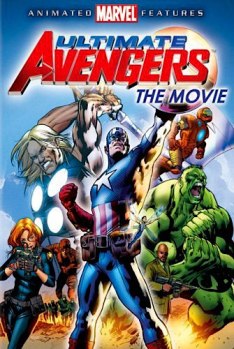
Ultimate AvengersWith the big-screen live-action Avengers movie on its way in just two-and-a-half years — once we’ve had a variety of tie-ins to lead into it, of course — now seemed as good a time as any to check out this direct-to-DVD animated version (and its sequel).

I won’t say too much about the plot because, if the rumours are true, the live action film may follow it fairly closely — indeed, the first 15 minutes of Ultimate Avengers presents a roll call of elements already introduced in this summer’s Iron Man and The Incredible Hulk: the Avengers Initiative, a super solider serum, a black Nick Fury, Captain America frozen in ice (OK, so that was only in a deleted scene…) But to follow this story wouldn’t necessarily be a bad thing… as long as there were some tweaks.

The primary problem is balance. Ultimate Avengers spends the entire first half assembling the team, the story crawling along at a snail’s pace; consequently, there’s nothing like enough time to do the remaining plot justice, leaving much of it to feel rushed. However, the tale itself retains an appropriately comic-book feel — no surprise considering it’s adapted from a specific storyline — while still containing just about enough information to keep newcomers covered. Were it properly paced, and bolstered by the main characters being introduced in their own films, there’s no real reason this wouldn’t suffice in live action.

On the other hand, in its current incarnation it’s very much Captain America’s story — possibly a problem for the 2011 version, as it will follow Cap’s debut feature by just two months. If his solo outing isn’t a success — particularly if whoever plays him is no good — it would likely sink an Avengers movie that was as focused on him as this. Not encumbered with such problems here it works fine, though it’s disappointing how little we see of other major players — Tony Stark/Iron Man barely features and there’s even less of Thor. That said, Bruce Banner/Hulk gets a key subplot which could be even better if fully developed.

Dodging further predictive comparisons for a moment, the animation quality is variable. Some is very good — mainly the opening World War II-set action sequence — but most is no better than you’d expect from a kid’s TV cartoon (unless they’ve got even worse recently). It does the job adequately, but there’s little exemplary. If there’s a theme emerging it’s this: promise is shown, but not fully realised. That’s not the fault of the medium of course, but rather the brief running time and unbalanced structure.

When the live-action Avengers reaches our screens, I suspect this animated outing will be of greater interest — an intriguing point of comparison between a direct-to-DVD fan-aimed version and a Summer Blockbuster mass audience version of (possibly) the same story. Of course, by that point, Ultimate Avengers will be half a decade old and no longer such a contemporary — or memorable — example.

3 out of 5

Ultimate Avengers II will be reviewed tomorrow, Tuesday 21st April 2015. Live-action sequel Avengers: Age of Ultron is in UK cinemas from Thursday 23rd.

Batman: Gotham Knight (2008)

2008 #65
Shojiro Nishimi, Futoshi Higashide, Hiroshi Morioka, Yasuhiro Aoki, Toshiyuki Kubooka & Jong-Sik Nam | 73 mins | DVD | 15 / PG-13

Batman: Gotham KnightGotham Knight is an American-Japanese produced anime — the animation is Japanese and anime-styled, but the original soundtrack is English — that aims to bridge the gap between Batman Begins and The Dark Knight. In this case that equates to six short films, with some narrative connections, strung together to make a movie.
Overseen by executive produce Bruce Timm (Batman: The Animated Series, and most of the DCAU) and all with story credits to Jordan Goldberg (Nolan’s assistant on Batman Begins and now associate producer on The Dark Knight), the shorts, in order of appearance, are:

  • Have I Got a Story For You, written by Josh Olson (A History of Violence) and directed by first-time director Shojiro Nishimi;
  • Crossfire, written by Greg Rucka (Gotham Central and other comics) and directed by first-time director Futoshi Higashide;
  • Field Test, written by Goldberg and directed by Hiroshi Morioka (Tsubasa Chronicle);
  • In Darkness Dwells, written by David Goyer (Batman Begins, Blade trilogy) and directed by Yasyhiro Aoki (one episode of Tweeny Witches);
  • Working Through Pain, written by Brian Azzarello (100 Bullets and other comics) and directed by first-time director Toshiyuki Kubooka;
  • Deadshot, written by Alan Burnett (Batman: Mask of the Phantasm) and directed by Jong-Sik Nam (He-Man 2002).
  • Compiling that list, one has to wonder about the blurb’s claim that these shorts are directed by “some of the world’s most visionary animators”. I suppose the key word is “animators” (rather than “directors”), as some have worked on things like Neon Genesis Evangelion, various iterations of Gundam, and even Akira. Regardless of their level of experience, they all seem to do a fine job here, even managing a couple of vaguely memorable moments among fairly stock dialogue scenes and effective, if occasionally unoriginal, fights.

    The six-stories/one-film concept works well enough on the whole. While these are clearly standalone pieces in terms of style and each telling a complete story, they still work best when viewed together — most follow on from the preceding entry and some elements skip across films. These links are nicely varied. For example, while the end of Film 1 merely leads directly to Film 2, there’s a relatively minor action at the end of Film 3 that is picked up in Film 5, and a large chunk of Film 3 is spent on something seemingly insignificant that is picked up on in Film 6. There are some missed opportunities in this respect, such as the transition from the fourth to fifth entries. It would be neater if Batman’s injury in Film 5 was the one from Film 4; based on the settings and their consecutive sequence, I presume this is what was intended, so it’s a shame the wound’s in a completely different place.

    Gotham Knight seems to be squarely aimed at fans — who else could work out that the long-haired mustachioed crime lord here is actually Eric Roberts’ character in The Dark Knight! This is just one of several other factors that seem strange considering Gotham Knight is meant to bridge Nolan’s two live-action Bat-epics: Alfred is the traditional posh Englishman; few/no other characters sound like their Nolan-era counterparts; one segment even features the Burton-style Batmobile! It’s also a shame that the Scarecrow short isn’t last as it would lead even more directly into The Dark Knight. On the other hand, it succeeds in crafting a decent-enough ‘real world’ explanation for Killer Croc, which is no small feat, and Kevin Conroy, now in his mid-50s, still makes a good younger Batman. Thankfully he doesn’t attempt Bale’s over-done Bat-voice, though a nod in that direction might’ve been nice.

    I’ve managed to get this far without invoking The Animatrix, unquestionably the forefather of this and other similar projects. Gotham Knight takes the concept a step further by linking its shorts so clearly, and while it’s not wholly satisfying in this respect, it’s a successful enough step in the right direction. If we do get a The Dark Knight 2, I’d be quite happy to see another direct-to-DVD effort in this vein.

    4 out of 5

    Flushed Away (2006)

    2008 #57
    David Bowers & Sam Fell | 81 mins | DVD | U / PG

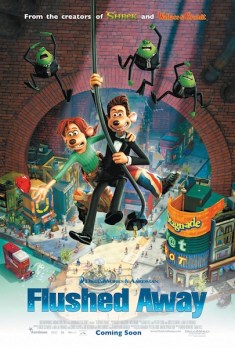
    Flushed AwayAardman Animations, the Bristol-based company most famous for Wallace & Gromit and Creature Comforts, branch out into CGI for the first time with this tale of rats trying to save the sewers of London. CGI rats? Yes, thoughts of Ratatouille are inevitable. Can Aardman beat Pixar at their own game? You might be surprised…

    The primary reason for comparison here, as mentioned, are the rats. Despite Pixar’s stated intention to redeem rats in the eyes of viewers — to turn them from vermin into loveable little fluffy things, essentially — I felt the same about bloody rodents at the end of Ratatouille as I did at the start. Here, however, they’re Disneyfied (oh the irony) — where Pixar had cartooned versions of the real thing, Aardman have given them a human shape. It’s surely this disjunction from reality that makes them more likeable, but it does mean there’s never that distracting “but they’re vermin” impulse. They’re humanisation is helped by the performances of a star-studded cast, including Hugh Jackman and Kate Winslet amongst the ratty voices. Ian McKellen is a fabulously dastardly villain, ably supported by a pair of comedy henchman… and Jean Reno as a French frog. Yep, the humour is that British.

    One thing Pixar unquestionably still excel at is the actual animation, however. Ratatouille is gorgeous to watch and will take some effort to beat; Flushed Away, on the other hand, doesn’t really come close to Pixar’s earlier efforts, never mind Ratatouille’s artistry. It’s mostly passable, especially once the action migrates to the mini-London in the sewers, but at other times it looks little better than a computer game. The second biggest mistake (I’ll get to the worst in a minute) is opening the film in a pristine up-market house — presumably it was an artistic choice to have it so tidy and clean, but this has the unfortunate side effect of highlighting the animation’s plainness right from the start. Once the story moves underground the level of detail improves, but it takes a little while to get there.

    A bigger error was made with the lip-synching, however, and obviously this dogs the film throughout. Aardman consciously designed the characters’ mouth movements to imitate the clay animation the company usually employs (Flushed Away is CG because of the volume of water featured, an element too complex to achieve in stop motion). Instead of invoking that stop motion feel it just looks cheap and underdone — such jerkiness is easily ignored as part of the technique when viewing clay animation, but there’s no need or excuse for it in CGI. Ultimately it looks like the animators were lazy or the rendering has skipped frames, and is frequently distracting.

    It’s possible to put the disappointing quality of the animation aside though, because the script’s a good’un. Like the animation it doesn’t really get going until we’re flushed into the sewers, but once there it’s pleasantly witty, full of good one-liners and clever visual gags. The latter includes a good line in intertextuality, with entertaining and easily-noticed references to Finding Nemo, X-Men and others, including numerous nods to Wallace & Gromit. They don’t dominate, but their variety makes for a nice bit of I-spy for both kids and adults of varying degrees of film-buffery.

    Despite the inevitable comparisons, Flushed Away is really a very different beast to Ratatouille. Pixar’s effort is, for want of a better word, artistic; Flushed Away is simply a family-orientated slice of adventure-comedy… rather of the kind you might expect Pixar to produce. Aardman’s initial CG effort is not better or worse than ‘the other CG rat flick’, but it is perhaps more like what you — or, at least, kids — would expect. With a starry cast, strong script and good sense of visual comedy, Flushed Away manages to overcome its lower production values to create an above-average piece of entertainment. And that’s, as Wallace would say, cracking.

    4 out of 5

    WALL-E (2008)

    2008 #48
    Andrew Stanton | 98 mins | cinema | U / G

    “Pixar films” seem to have become a bit of a genre unto themselves — yes, they fit into “animation” (always dubious as a genre), “family” (almost as bad), “comedy”, and occasionally a few others, but, much as the Bond films have their own rules and expectations outside the “action” and “spy thriller” conventions, the work of Pixar always achieves special and particular attention. WALL-E subverts some of these expectations (it’s not a buddy comedy, mainly) and has received huge amounts of praise — “consequently”, some might add. It is indeed a very good film, but you’ll surely have heard all that elsewhere; instead, I’m going to draw attention to a couple of things that bothered me.
    Most of these issues can be attributed to the fact that WALL-E is a film of two halves. They’re not exactly poorly linked, as elements from each feed into the other, but they are notably different. The first presents a realistically-rendered future Earth, deserted by humans (who are nonetheless represented on hologram screens by live-action actors) and now only inhabited by insects and a trash-collecting robot called WALL-E. Silent but for R2D2-like bleeps, WALL-E quickly endears himself to the audience through his actions. He’s cute, funny and likable, and the early scenes cement him in the audience’s sympathies, which is certainly handy for later. When EVE — a futuristic, iPod-alike ‘female’ robot — turns up, the film becomes a sweet love story, as WALL-E tries to instill the human-like emotions he’s developed into the cold new robot. A very funny and surprisingly touching love story, this is the film’s better half.

    The second travels out into space, taking us to meet cartoon humans on a cartoony spaceship. It jars painfully with the realism that pervades the Earth-bound scenes, and the continued use of real actors in holograms highlights the cartoonish style of the future humans. There’s nothing wrong with a cartoon style, I hasten to add — certainly, it works better in films like The Incredibles and Ratatouille than the attempts at realism do in the Toy Story films — but it’s the contrast that’s uncomfortable. The story itself also takes a weak turn here: it becomes a light kiddy-adventure runaround, which is fun and still has flashes of humour and heart, but is nowhere near as daring or as effective as the first half. This is where the sympathies engaged earlier become important, because it’s the audience’s affection for WALL-E that provides most of the genuine quality in this half.

    If I were to broadly characterise the two halves, I’d say the first is everything you’d hoped for after the advance hype, while the second is something you could have feared. It’s not bad — it’s still a superior light kiddy-adventure runaround, with exciting-enough sequences and a largely interesting (if unoriginal and preachy) plot — but it’s not as groundbreaking or engaging as the first half. Worst of all is when the cartoon humans land on the realistic Earth, however — it brings to mind films like Who Framed Roger Rabbit, where cartoon characters are placed in the real world. In this instance, that’s not a positive comparison.

    WALL-E is a good film. The bits that work do so perfectly, keeping the overall quality high, and the weaker sections are ultimately only poor by comparison. If the whole film were like the second half I’d probably merrily accept it as a cartoon runaround but, coming after that beautiful beginning, it only served to gradually erode the fifth star from my rating. It’s a shame, in that respect. On the other hand, this is still one of Pixar’s very best films — I’d certainly rate it above the even-more-over-praised Ratatouille, and probably slot it close behind The Incredibles or Toy Story 2 at the top of the scale. Being pipped by films of that level — and then only just — is nothing to be ashamed of.

    4 out of 5

    Presto (2008)

    2008 #47b
    Doug Sweetland | 5 mins | cinema | U / G

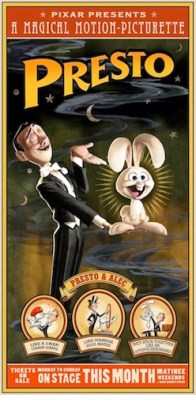
    PrestoThe last Pixar film I bothered to head to the cinema for was 1999’s Toy Story 2, back in the days before “it’s made by Pixar” was reason enough to see a film (remember those times? They seem so long ago…) Their only other releases had been the first Toy Story (my enjoyment of which being the motivation to see the sequel) and the unappealing A Bug’s Life. Since then I haven’t had enough desire to expend the effort — or the money — to catch any of their films on the big screen. I explain this because, I’m reliably informed, all Pixar films are preceded by a short while in cinemas… but, because I’ve only seen most of them on DVD, I forgot this, so was initially surprised to see a caged rabbit when I was expecting an adorable little robot.

    This rabbit, it turns out, is called Alec, and he’s a bit of a bastard. I think we’re supposed to root for him, and I’m sure kids (and many adults too) will, but while his owner (the titular magician) isn’t especially nice to our starring bunny (the plot is concerned with Alec trying to get a carrot that Presto won’t give him, yet), Presto doesn’t treat Alec quite as badly as Alec treats Presto. On the other hand, the overload of OTT physical violence is all in the name of humour, so that’s OK. It’s not as satirically extreme as The SimpsonsItchy & Scratchy though, which will ironically lead some to declare it promotes violence as comical. But then such ludicrousness is political correctness for you — in fact, Presto‘s brand of violence is very funny indeed. Completely dialogue free, it quickly becomes a breakneck feast of visual, mostly slapstick, humour. It may be violent, but it’s also highly witty, marvelously inventive, and wholly entertaining… even if the hero is morally dubious. But then, Roadrunner was a total wanker and he always won.

    You can’t judge shorts on the same level as features, because they’re a different form — that’s why I don’t include them in the main numbering on this blog, and why I once felt the need to go on about that. So while awarding Presto a full five stars doesn’t mean it’s likely to be vying with The Dark Knight or… well, The Dark Knight… for my Film of the Year, it is thoroughly deserved. It’s a perfectly entertaining piece of short comedy, and it’s great that Pixar continues to facilitate wide exposure for such work.

    5 out of 5

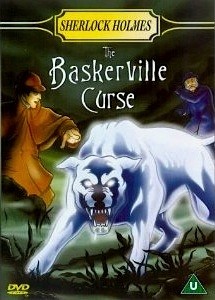
    The Baskerville Curse (1983)

    2008 #25
    Eddy Graham | 67 mins | DVD | U / G

    The Baskerville CursePeter O’Toole is Sherlock Holmes (well, his voice) once again in this animated Conan Doyle adaptation from the ’80s (see also my reviews of two others, The Sign of Four and A Study in Scarlet). Of course, this is an adaptation of that perennially popular Holmes story, The Hound of the Baskervilles, and as such O’Toole barely features. A shame, as he’s the only half decent thing in this mess.

    As I’ve previously expressed, The Hound of the Baskervilles is not my favourite Holmes story, though it has its moments and there have been some enjoyable screen versions. Unfortunately, this pointlessly renamed offering retains all of the original’s faults but loses most of the best bits, despite wasting time on train journeys, telegram writing and pointless flashbacks to things we saw just minutes earlier. The animation is poor, even for a production of this level, with dire character design and a total lack of atmosphere (it opens with jolly music over views of primary-coloured countryside!) There are further flaws, but there’s no point wasting any more time going through them. I can only hope that the final entry in this series, The Valley of Fear, will be closer in quality to the other two instalments.

    In retrospect, I’m certain I underrated the 1939 adaptation of The Hound of the Baskervilles. I’m equally certain that I shall have no such regrets over this lame attempt.

    1 out of 5

    The Baskerville Curse featured on my list of The Five Worst Films I Saw in 2008, which can be read in full here.

    Beowulf: Director’s Cut (2007)

    2008 #19
    Robert Zemeckis | 110 mins | DVD | 12

    Beowulf Director's CutBack to catching up on last year’s films that I missed, this time with Beowulf in its Director’s Cut form — which, much to my amusement at the time, prominently featured a BBFC 18 icon on its initial cover art but only received a 12 when classified. Clearly the BBFC didn’t feel the “bolder, never-before-seen images” were any more unsuitable for kiddies than the originals. Personally, I’m not so sure. This version of the film is bloody violent (literally); more so than Lord of the Rings, which is the comparison the BBFC make. I’m not a parent and I’m not pro-censorship (far from it), but this feels more like a 15 to me.

    Anyway, that’s not the point. What of the film itself? Well, let’s stick with the violence for a moment. It’s bloody and brutal… and completely undermined by the quality of the animation. I like animated films; I have absolutely no problem with animated films for adults; but the issue here is that most of the characters (especially the ‘extras’) seem of about the same quality as humans in Shrek. So while the battle scenes are often very violent, it becomes hard to take them seriously because it’s all too cartoony. Perhaps this is where classifying became problematic. But it’s not just the violence — the animation is awkward throughout. It’s not lifelike enough to be confused with reality, but not ‘animated’ enough to accept on that level. The characters move stiffly, are mostly too smooth (things do improve with aged characters in the final act), and are ‘dead behind the eyes’. The creatures are largely less realistic CGI than you’d see in a live action film. There are even times when things aren’t far above the graphics from a high-end computer game.

    It’s not all bad. Anthony Hopkins is entertaining (and sounding more Welsh than ever), and I enjoyed Alan Silvestri’s score. The screenplay plays fast and loose with the original poem, but Gaiman and Avery have justified this and it’s mostly pretty good. While the third act initially slows the film’s pace to a crawl, the tiredness of an older Beowulf and an exciting duel with a dragon make it the best bit, despite the occasional lack of internal logic (why doesn’t the dragon’s fire burn his heart?) It goes someway to making up for the Beowulf-Grendel battle earlier on. In a rare attempt at genuine faithfulness, Beowulf strips naked for the fight so as to be on equal terms with Grendel. Understandably, the filmmakers don’t want his CGI manhood flying around, so he’s always shot with something helpfully blocking his groin. Problem is, the lengths and tricks involved in achieving this are too reminiscent of similar bits in Austin Powers, turning what should be a big heroic action sequence into a comedic exercise (though, it must be said, not an especially amusing one).

    I wanted to like Beowulf. All those people on IMDb who whined that it was animated and you couldn’t do an animated action movie for adults annoyed me something rotten, and I really wanted them to be proved wrong. Plus I like many of Zemeckis’ other films, I like the poem, and there’s a lot of potential for a good adaptation. But the weak CGI, sometimes leaden dialogue (I forgot to mention the 300-wannabe “I am Beowulf” and comedically repetitive “I’ve come to kill your monster”), and uncertain level of violence all get in the way. For the majority of its running time, Beowulf left me with a sadly inescapable feeling of disappointment.

    2 out of 5

    There seem to be a couple of conflicting reports on how different the two cuts are. A comparison lists 90 seconds of new material, but shows the running times to be four-and-a-half minutes different (without credits). On the other hand, the BBFC list the director’s cut as being just 30 seconds longer. However much is completely new, there’s definitely added blood in existing scenes and some shots have been replaced with more graphic versions.