Archive 5, Vol.5

I have a backlog of 427 unreviewed feature films from my 2018 to 2021 viewing. This is where I give those films their day, five at a time, selected by a random number generator.

Today, melancholic Frenchmen, screwball Americans, and royal Africans are followed by a superhero team-up and a lesson on the evils of social media.

This week’s Archive 5 are…

  • La Belle Époque (2019)
  • The Awful Truth (1937)
  • Coming to America (1988)
  • Scooby-Doo! & Batman: The Brave and the Bold (2018)
  • The Social Dilemma (2020)


    La Belle Époque

    (2019)

    Nicolas Bedos | 115 mins | cinema | 2.35:1 | France / French | 15 / R
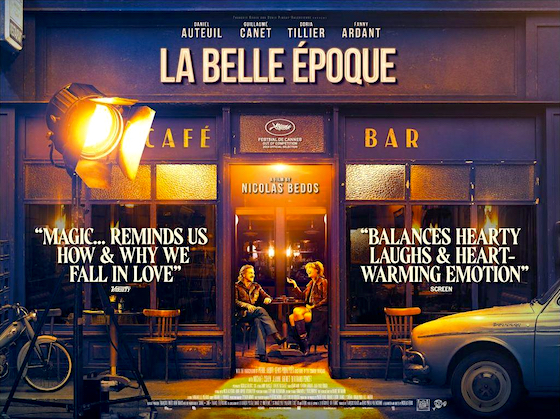
    La Belle Époque

    Sixtysomething Victor (Daniel Auteuil) is officially a grumpy old man, and his marriage is on the rocks because of it. To cheer him up, his son buys him an experience with his friend’s company, who stage bespoke historical reenactments as a form of time travel. When Victor’s wife finally has enough and throws him out, he uses his experience to revisit 1974, when they first met and fell in love.

    To oversimplify things, it’s kind of like Groundhog Day by way of Charlie Kaufman: the immersive theatrical experience recalls Synechdoche, New York (in a superficial way, I guess), and Victor’s desire to live it over and over again is, well, obvious. Except he’s not stuck there, but choosing it. It’s a mix of nostalgia and melancholy, because, of course, he’s not actually reliving that day, however much he comes to believe in it.

    Advance reviews led me to believe La Belle Époque would be little more than a pleasant diversion, but there’s a lot more to it than that. It clearly has something to say as regards the power of nostalgia and the need to live in the present. But, deep thoughts aside, it’s also a charmingly romantic film — sharply witty, unexpectedly beautiful in places, and genuinely emotional by the end. It’s a shame that it seems to have had half-hearted distribution outside of France (perhaps the fault of it being acquired by Disney, I suspect with an English-language remake in mind, rather than a ‘proper’ distributor of foreign fare who would’ve shown it more love) because I think it deserves, and would reward, a wide audience.

    5 out of 5

    La Belle Époque was #140 in my 100 Films in a Year Challenge 2019. It placed 7th on my list of The 15 Best Films of 2019.


    The Awful Truth

    (1937)

    Leo McCarey | 91 mins | Blu-ray | 1.37:1 | USA / English | U
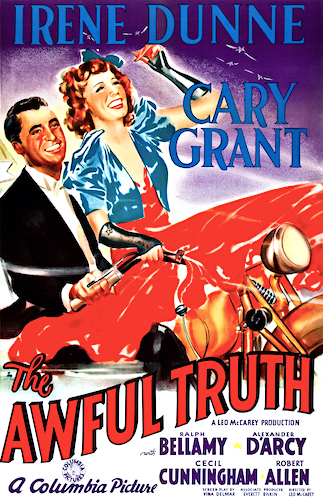
    The Awful Truth

    When Leo McCarey received his Best Director Oscar for this film, he said that he got it for the wrong film — a clear reference to his fondness for Make Way for Tomorrow, which he made the same year. I’m not wholly sure I agree with him, although Tomorrow’s is clearly the ‘worthier’ picture — but that doesn’t always mean better.

    The Awful Truth was the first of three screen pairings of Irene Dunne and Cary Grant, and the film that refined the latter’s famous screen persona. Here, the duo play a married couple who begin to divorce, only to then interfere with each other’s further romances. When it’s on form, the film is up there with the best of its subgenre: a sparkling screwball comedy with glorious dialogue, a pair of splendid lead performances, and a magnificent dog. Unfortunately, it goes on a mite too long and begins to lose steam in the final act. While that might hold the film back from perfection (and so open the door to the idea that Make Way for Tomorrow is somehow superior), the magnificence of what comes before means it’s still a must-see for fans of this style of comedy.

    4 out of 5

    The Awful Truth was #95 in my 100 Films in a Year Challenge 2021.


    Coming to America

    (1988)

    John Landis | 117 mins | digital (HD) | 16:9 | USA / English | 15 / R
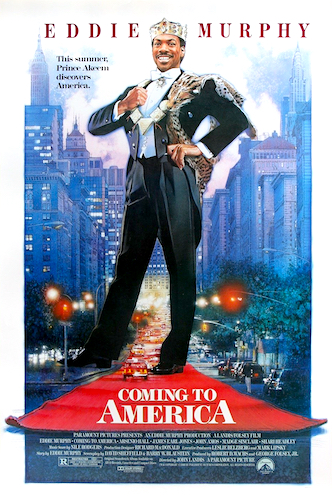
    Coming to America

    Eddie Murphy plays a pampered but bored African prince, who dodges an arranged marriage to travel to America and find a bride. With that plot and the fact it was made a few decades ago, I was half expecting Coming to America to have aged badly. If nothing else, it seemed primed to base its humour around cringe-inducing culture-clash awkwardness — not necessarily an invalid kind of comedy, but not one I personally enjoy.

    As it turns out, it’s nothing of the sort. In fact, it’s actually rather sweet and kind-hearted, with just enough lewdness to give it a kick rather than make it eye-rollingly vulgar (I’m sure it would only take a couple of minor trims to get that 15/R rating down to a 12/PG-13). Some have criticised it for being too slow — including director John Landis, who asked Paramount if he could re-edit it for the Blu-ray release (they refused) — but I thought it was quite well paced. It doesn’t move at whipcrack speed, but it doesn’t need to. All in all, it holds up well enough that I can see why they decided to produce a belated sequel (which is still on my watchlist).

    4 out of 5

    Coming to America was #28 in my 100 Films in a Year Challenge 2021.


    Scooby-Doo! & Batman:
    The Brave and the Bold

    (2018)

    Jake Castorena | 75 mins | digital (HD) | 1.78:1 | USA / English | PG
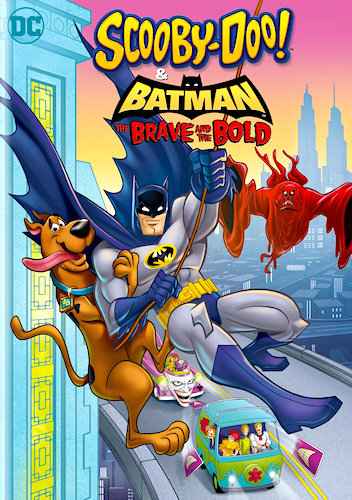
    Scooby-Doo! & Batman: The Brave and the Bold

    There are an awful lot of Batman movies nowadays (58 and counting, according to my Letterboxd list), but I thought I was at least aware of them all. Turns out not, because I hadn’t even heard of this one until I happened to see someone log it on Letterboxd several years after its release. (It’s a direct-to-video production that they didn’t bother to release on Blu-ray, so that’ll be a big part of why it slipped under my radar.)

    A plot description is pretty unnecessary here: the title tells you all you need to know. The reason it’s a particularly unwieldy one is because Scooby-Doo and friends team-up with, specifically, the Batman from animated series Batman: The Brave and the Bold. I watched a selection of episodes from that show a few years ago and, frankly, didn’t enjoy most of them (although a couple are excellent: Mayhem of the Music Meister is so good I watched it twice in as many days, which regular readers will know is very unlike me), so I didn’t have high hopes for this movie either.

    At least it’s an appropriate iteration of Batman to crossover with Scooby-Doo, because (a) the whole point of the show was team-ups, with every episode seeing Batman join forces with a different DC hero (the subtitle is derived from a classic DC team-up comic), and (b) the overall tone of the show was camp and comical, which chimes well with Scooby-Doo. In fact, despite Scooby-Doo getting top billing, the film is really a feature-length episode of Batman: The Brave and the Bold guest starring Mystery Inc, rather than the other way round. I mean, it’s set in Gotham City, stuffed with appearances and cameos by other DC characters, and (most of all) it uses The Brave and the Bold’s animation style, even featuring a version of the series’ title sequence and theme music — with a Scooby makeover, of course. Nonetheless, it also adopts plenty of the tropes of a Scooby-Doo story, like the unmasking at the end.

    Thanks to all that, it’s everything you’d expect from “Scooby-Doo meets Batman” — they leave nothing on the table, right down to having Scooby actually say, “Holy Scooby-Dooby-Doo, Batman!” And would you have it any other way? It’s a daft concept, mashing these two cheesy franchises together — there’s no point trying to be above it. By embracing what it is, it delivers what you’d expect as well as could be imagined. For that, I quite enjoyed it on the whole. And so I would say that, if the basic idea of it doesn’t interest you, give it a miss; but if you think it sounds potentially appealing, you should definitely watch it.

    3 out of 5

    Scooby-Doo! & Batman: The Brave and the Bold was #105 in my 100 Films in a Year Challenge 2020.


    The Social Dilemma

    (2020)

    Jeff Orlowski | 94 mins | digital (UHD) | 16:9 | USA / English | 12 / PG-13

    The Social Dilemma

    One of those Netflix documentaries that everyone seems to be talking about for a while but then forgets just as quickly, The Social Dilemma is essentially about how dangerous social media is, as told to us by the people who created it. Not the Mark Zuckerberg of the world, obviously — they’re still raking in far too much cash to want to dissuade us from using their products — but various other developers and whatnot who’ve been involved over the years.

    Naturally, the main reaction to all this information is: “OMG, I totally need to change all my social media habits!” And do people? Not as far as I’ve seen. As one contributor in the doc comments, “knowing what was going on behind the curtain, I still wasn’t able to control my usage. So that’s a little scary.” Eesh. We’re doomed.

    4 out of 5

    The Social Dilemma was #20 in my 100 Films in a Year Challenge 2021.


  • Archive 5, Vol.3

    I have a backlog of 437 unreviewed feature films from my 2018 to 2021 viewing. This is where I give those films their day, five at a time, selected by a random number generator.

    Today, everything from silent comedies to afterlife comedies to toy-licence-based adventure comedies (a burgeoning genre we’re sure to see more of in years to come). Plus a revisionist Arthurian legend for good measure.

    This week’s Archive 5 are…

  • Guinevere (1994)
  • The Kid (1921/1972)
  • Defending Your Life (1991)
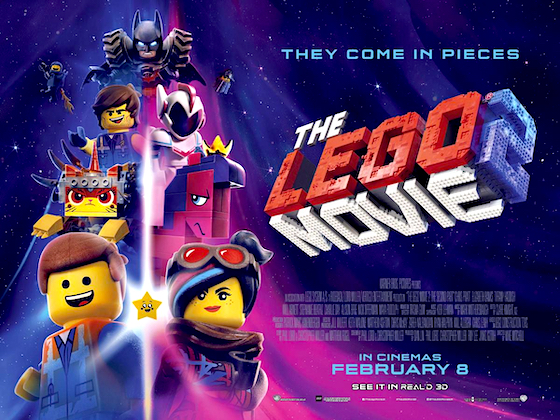
  • The LEGO Movie 2: The Second Part (2019)
  • Sherlock Jr. (1924)


    Guinevere

    (1994)

    Jud Taylor | 91 mins | digital (SD) | 4:3 | USA & Lithuania / English

    Guinevere

    This Lifetime TV movie is like an American Renaissance faire cosplay version of Arthurian legend. Its attempt at a feminist take on the famed stories is interesting, but deserves better writing, filmmaking, and accents.

    Most of Guinevere’s flaws come from its low-rent made-for-US-TV-in-the-’90s roots (the mediocre direction; the tacky music score), but that’s also its biggest asset, because when and for whom it was made means it was shot on film, which gives it a certain gloss (even when downgraded to SD) that taped or digital productions simply lack.

    Story-wise, the love triangle stuff from legend is there, but given a YA spin — it’s practically Arthurian Twilight. Are you Team Arthur or Team Jacob? The feminist bent is not subtle either, which, given changes in attitudes over the past few decades, makes you wonder if it’s ripe for a re-adaptation (it’s based on a trilogy of novels with magnificently florid titles like Child of the Northern Spring and Queen of the Summer Stars).

    You see, despite everything, I didn’t hate it. Maybe I should — it’s not good, by any means — but I liked what it was trying to do, even while it didn’t do it well (at all). It’s a concept someone should definitely take another run at.

    2 out of 5

    Guinevere was #209 in my 100 Films in a Year Challenge 2020.


    The Kid

    (1921/1972)

    Charlie Chaplin | 50 mins | DVD | 4:3 | USA / silent | U

    The Kid

    Charlie Chaplin’s first feature-length work as star and director sees his Tramp character caring for an abandoned child (Jackie Coogan). I say “feature length”, but when you combine a re-edit Chaplin performed in 1972 with PAL speedup, it runs just 50 minutes. I’ve gotta say, I appreciated that. I’ve felt some of Chaplin’s other films have gone on a bit, whereas this didn’t outstay its welcome. That said, I did feel the Dreamland sequence near the end was filler. That aside, it’s quite a nice film. Coogan is particularly effective — he has just the right look for the role, and was obviously very good at imitation and/or taking direction.

    Regarding the length, the original 1921 release was 68 minutes, but for a 1972 reissue Chaplin cut some footage, appears to have sped up the frame rate of the rest, and added a score and some sound effects too. It’s only this cut that gets released on disc nowadays (often with the excised footage included as deleted scenes). The original cut clearly still exists, and yet everyone just seems to overlook it — it’s only if you bother to read up on the film that you discover what most people are watching and reviewing as “a 1921 film” is actually a 50-years-later director’s cut. Imagine if we all just ignored, say, Blade Runner’s original version and just treated The Final Cut as— oh, wait. Never mind.

    4 out of 5

    The Kid was #60 in my 100 Films in a Year Challenge 2020.


    Defending Your Life

    (1991)

    Albert Brooks | 111 mins | Blu-ray | 1.85:1 | USA / English | PG / PG

    Defending Your Life

    Writer-director Albert Brooks stars as a loner advertising exec who dies and finds himself in a bureaucratic afterlife where he has to prove that he overcame his fears. While he awaits his trial, he finally meets the love of his (after)life, Julia (Meryl Streep).

    For a film that’s literally about life and death, Defending Your Life is rather gentle. Like, it’s rarely laugh-out-loud funny, but it’s often slightly amusing. And it’s unhurried, too: its 111 minutes aren’t tedious by any means, but it doesn’t rush anywhere. A fun side effect of this is how casual its world-building is. This is a very specific vision of the afterlife, an entire world with its own rules, and while that’s all explained, it’s not laid out in minute detail like a how-to guide. I feel like this is something movies used to happily do but has been eroded by the need for everything to be over-explained and -analysed.

    I liked Defending Your Life a good deal (I’ve picked up a couple more of Brooks’s films on Blu-ray off the back of it), and part of that is certainly its laidback style. Nonetheless, perhaps if it were snappier — quicker witted and paced — it might be a better-remembered film, comparable to something roughly contemporaneous like Groundhog Day.

    4 out of 5

    Defending Your Life was #113 in my 100 Films in a Year Challenge 2021.


    The LEGO Movie 2:
    The Second Part

    (2019)

    Mike Mitchell | 107 mins | Blu-ray (3D) | 2.40:1 | USA, Denmark, Norway & Australia / English | U / PG

    The LEGO Movie 2

    After the surprise success of The LEGO Movie, naturally a sequel had to follow. Unfortunately, it’s altogether less surprising, because it’s that old fashioned sequel thing: a less-good do-over of the first movie.

    The Second Part feels less focused than its predecessor. It still has a positive message (about not needing to grow up, and about playing together, or something), but it takes a while to get to it, rather than baking it into the entire experience. Maybe that’s intellectualising things a bit — this is a family-friendly adventure-comedy starring toys, after all. But still, the overall journey doesn’t feel as exciting or fun. There are fun little bits on the way, but, moment to moment, it lacks the spark of the first one.

    For a specific example, take the breakout hit of the first film, the irritating song Everything Is Awesome. That angle has been doubled down on, with multiple attempts at emulating the “irritating but kinda loveable” song formula; but while these numbers are annoying while they last, they don’t have the irrepressible catchiness of the first film’s signature achievement — a mixed blessing, to be sure (at least they won’t be stuck in your head afterwards). The end credits are accompanied by a song that jokes about the credits being the best part… but, in this case, the credits kinda are the best part.

    3 out of 5

    The LEGO Movie 2: The Second Part was #33 in my 100 Films in a Year Challenge 2020.


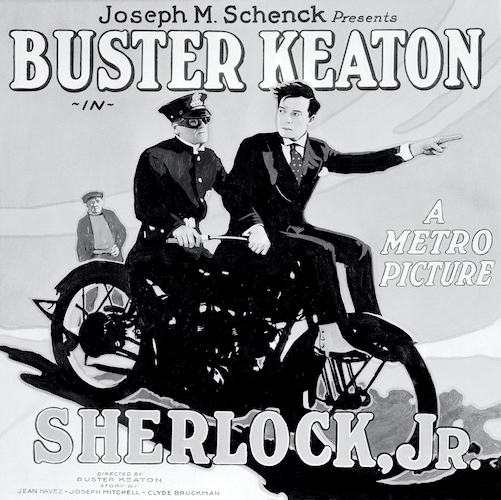
    Sherlock Jr.

    (1924)

    Buster Keaton | 45 mins | Blu-ray | 1.33:1 | USA / silent | U

    Sherlock Jr

    Apparently there are ever-raging arguments within the silent film fan community about who was the best comedian of the era. Charlie Chaplin’s got the most widespread recognition, but Buster Keaton and Harold Lloyd have their advocates, of course, and I guess there are probably people shouting in favour of smaller names too. I didn’t think I’d ever pick a ‘side’ in these debates — I’m certainly not about to go seeking them out and wading in — and, fundamentally, I do hold with the notion that the greats are all great and so why not appreciate them all? — but, from what I’ve seen thus far, I’m finding Keaton’s work more consistently enjoyable than Chaplin’s. Sherlock Jr. is my favourite of his that I’ve seen so far.

    Keaton plays a film projectionist who’s studying to be a detective on the side. When he’s framed for the theft of a watch, his apparent guilt doesn’t give him much chance to put his skills to the test. But when he falls asleep during a movie, he steps inside it and becomes the world’s greatest detective. And when I say “steps inside”, I mean it in the most literal sense possible: the projectionist walks through the screen and into the movie, and is suddenly subject to its whims — for example, he’s confounded whenever it cuts to a new location. The sequence is both thoroughly entertaining and technically faultless — and I say that viewing it nearly 100 years after it was made, after all the advances in technique and effects we’ve had in that time. Reportedly, the film’s cameraman, Byron Houck, went as far as using surveying equipment to ensure the camera was positioned correctly so the transitions were seamless. The effort paid off.

    The same is true in several other incredible sequences, like a billiards game filled with trick shots, which Keaton rehearsed for four months with a pool expert and then took five days to film. Or a motorbike chase with more I-can’t-believe-he-just-did-that death-defying stunts than one of Tom Cruise’s impossible missions. The technical skill is faultless and, even if you’re not wowed by how they pulled it off, the sequences are immensely entertaining in their own right. Maybe it’s just personal taste, but this is why I have a preference for Keaton: his skits are more ingenious, better paced, and backed up with impressive stunt work. When you mix those daredevil antics with genuine movie magic, as he does here, you get a majestic, unforgettable farce.

    5 out of 5

    Sherlock Jr. was #102 in my 100 Films in a Year Challenge 2019. It was viewed as part of What Do You Mean You Haven’t Seen…? 2019. It placed 3rd on my list of The Best Films I Saw in 2019.


  • Archive 5, Vol.2

    I have a backlog of 442 unreviewed feature films from my 2018 to 2021 viewing. This is where I give those films their day, five at a time, selected by a random number generator.

    Today: musical comedies from ’41 and ’51; murder mysteries from ’33 and ’73; and an animated film that changed the Oscars.

    This week’s Archive 5 are…

  • Royal Wedding (1951)
  • A Study in Scarlet (1933)
  • Chicken Run (2000)
  • The Last of Sheila (1973)
  • Road to Zanzibar (1941)


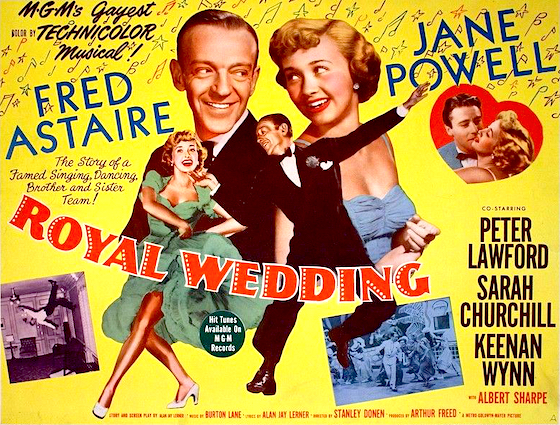
    Royal Wedding

    (1951)

    aka Wedding Bells

    Stanley Donen | 93 mins | digital (SD) | 4:3 | USA / English | U

    Royal Wedding

    Cynically, I assumed this US production was designed as a cash-in to a news event, most likely the wedding of Princess Elizabeth (i.e. the Queen) and Philip. Although those are indeed the eponymous nuptials, they actually took place several years earlier, in 1947; and in the UK, for its initial release the film was retitled Wedding Bells so audiences wouldn’t think it was a documentary about the real event. So much for my modern cynicism.

    The actual plot is semi-biographical, inspired by the real-life dance partnership of the film’s star, Fred Astaire, and his sister Adele, and who she went on to marry. Here the sister is played by Jane Powell (almost 30 years Astaire’s younger) as the duo take their successful Broadway show across the ocean to London in time for the royal wedding. Such window dressing aside, the plot that unfurls is run-of-the-mill, with both siblings finding themselves in romantic entanglements, and the songs are unmemorable too. The object of Astaire’s affection is played by Sarah Churchill, daughter of Winston Churchill, which adds a bit of fun trivia, at least.

    There is one noteworthy highlight: a set piece in which Astaire dances up the walls and across the ceiling of his hotel room, an effect that’s achieved seamlessly — there’s no wobble or what have you to give away the trickery, and Astaire’s choreography helps hide the behind-the-scenes technique too. There are one or two other neat bits if you’re a fan of dance-y musicals, but, on the whole, this is a thoroughly middle-of-the-road Astaire musical — not bad, just no more than adequate.

    3 out of 5

    Royal Wedding was #180 in my 100 Films in a Year Challenge 2021.


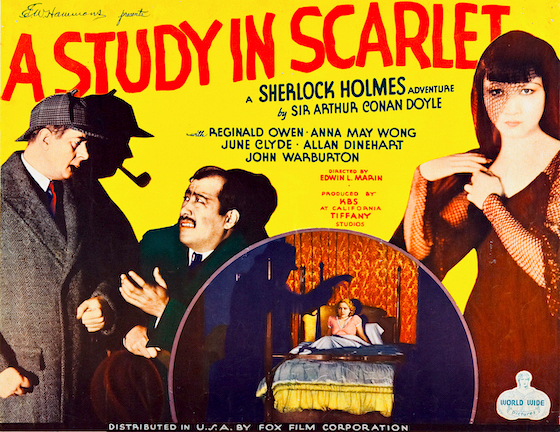
    A Study in Scarlet

    (1933)

    Edwin L. Marin | 72 mins | Blu-ray | 1.33:1 | USA / English | U

    A Study in Scarlet

    For some reason, cinema has a long history of taking the titles of original Sherlock Holmes stories but then producing an entirely new plot underneath. A Study in Scarlet — the very first of Sir Arthur Conan Doyle’s Holmes works — seems to be a particularly afflicted tale. It features the first meeting of Holmes and his roommate / sidekick / chronicler, Dr Watson, but I think there are two adaptations that actually show this — and, ironically, neither of them are actually called A Study in Scarlet (one is the debut episode of Sherlock, A Study in Pink, and the other is the first episode of the Russian series The Adventures of Sherlock Holmes and Dr. Watson, which is called Acquaintance). According to IMDb, “the Conan Doyle estate quoted the producers a price for the rights to the title and a considerably higher price to use the original story” — perhaps they did that all the time, hence my observed phenomena.

    Obviously, this ‘poverty row’ effort is one such example of title/story mismatch: this so-called adaptation stars Sherlock Holmes and Dr Watson… and that’s where similarities to the novel end. The pair don’t even live at 221b Baker Street — for no apparent reason, it’s been changed to 221a. Did the filmmakers just misremember one of the most famous addresses in literature? Having only paid for the rights to the title, the producers hired director Robert Florey (the Marx Brothers’ The Cocoanuts; Murders in the Rue Morgue) to write a new story, and actor Reginald Owen — who stars as Holmes — wrote the dialogue. Owen hoped this would be the first in a series of Holmes films starring himself. It wasn’t.

    Physically, Owen isn’t anyone’s ideal image of Holmes, but his actual performance is adequate. Much the same can be said of the whole film: it’s an entertaining-enough 70-minute crime romp, with enough incident to create a brisk pace, and a use of the rhyme Ten Little Indians that makes you wonder if Agatha Christie saw this movie before she published And Then There Were None six years later (or is it just a coincidence? The audio commentators spend a good deal of time chewing it over). Given second billing behind Owen is bona fide Chinese-American movie star Anna May Wong, even though she has relatively little screen time. She makes her mark, though, with a role that doesn’t simply conform to racial stereotypes (possibly an unintended side effect of her late casting rather than genuine progressivism by the filmmakers, but sometimes you gotta take what you can get).

    This particular Study in Scarlet is a long way from being a definitive Sherlock Holmes movie, but for fans of ’30s detective flicks, it’s nonetheless a likeable little adventure.

    3 out of 5

    A Study in Scarlet was #206 in my 100 Films in a Year Challenge 2021.

    Chicken Run

    (2000)

    Peter Lord & Nick Park | 84 mins | digital (HD) | 16:9 | UK, USA & France / English | U / G

    Chicken Run

    I’ve always enjoyed Aardman’s work. I grew up watching the Wallace & Gromit shorts on TV, and have seen all of their feature output — except their first. I’m not sure why it’s taken me 20 years to get round to Chicken Run. I guess when it was originally released I had grown out of “kid’s movies” but not yet grown back into them; but since then, to be honest, something about it never particularly appealed to me. It certainly has its fans: it’s still the highest grossing stop motion film ever; there was a push to get it an Oscar Best Picture nomination, the failure of which led to the creation of a category it could’ve won, Best Animated Feature (trust the Academy to shut the door after the horse had bolted); and when Netflix recently announced a sequel, there was much pleasure on social media.

    So, finally getting round to it, would I discover what I’d been missing all along? Unfortunately, no. I thought it was fine. In no way did I dislike it, but nor did it charm me in the way of my favourite Aardman productions. It’s rather dark for U-rated film — it doesn’t mince its words or imagery about the fact the chickens are being killed — and that contributes to some particularly effective sequences, like when our heroes end up inside the pie machine, or a suitably exciting climactic action sequence. There are some reliably decent gags along the way, too.

    I’m sure I’ll watch the sequel. Maybe I’ll like it more. But, I confess, the fact they’ve now announced a new Wallace & Gromit movie for the year after does have me even more excited.

    3 out of 5

    Chicken Run was #148 in my 100 Films in a Year Challenge 2020.


    The Last of Sheila

    (1973)

    Herbert Ross | 120 mins | digital (SD) | 1.85:1 | USA / English | 15* / PG

    The Last of Sheila

    I’d never even heard of this before Rian Johnson mentioned it as an inspiration for Knives Out 2. Co-written by Anthony Perkins (yes, Norman Bates from Psycho) and Stephen Sondheim (yes, the famous musical composer), The Last of Sheila is a murder mystery firmly in the Agatha Christie mould — despite the writers’ pedigree, there are no significant horror elements (even the deaths are, at worst, on the PG/12 borderline) and certainly no song-and-dance numbers (excepting a magnificently inappropriate song over the end credits, sung by Bette Midler). Apparently Perkins and Sondheim used to host elaborate scavenger hunts for their friends in the late ’60s and early ’70s, and they adapted them into a screenplay at the suggestion of a guest, Herbert Ross, who produced and directed the film (seems only fair).

    Further inspiration came from their professional lives and acquaintances, because the potential victims and suspects are all actresses, agents, and the like, gathered for a Mediterranean cruise aboard a producer’s yacht. He proposes they play a game about secrets and gossip — but clearly one of the secrets in play is too big, because someone winds up murdered. A well-constructed mystery is unfurled throughout the film, although its execution is a little variable: a fun, very Christie-esque first half gives way to long talky scenes in the second, as characters stand around and explain the plot to each other. But when that plot is as good as this — with some nice surprises, plus motives dark enough to give it a little edge — it feels churlish to object too strongly.

    4 out of 5

    The Last of Sheila was #186 in my 100 Films in a Year Challenge 2021.
    * IMDb says it was given a 15 on video, but the BBFC say it hasn’t been rated since 1973, when it got an AA. The BBFC site is crap nowadays; IMDb will accept any old junk users submit. You decide. ^


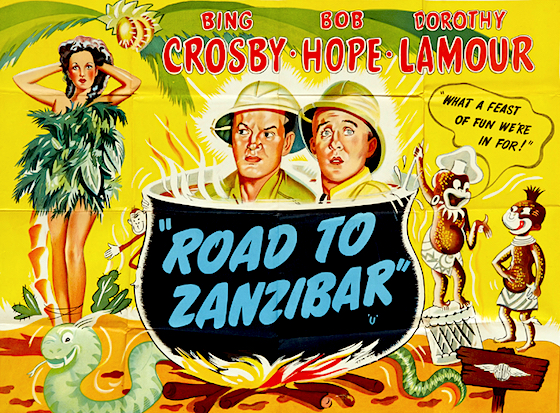
    Road to Zanzibar

    (1941)

    Victor Schertzinger | 87 mins | DVD | 1.33:1 | USA / English | PG

    Road to Zanzibar

    The second in what became the Road To… series — though it was never intended as such. What ended up becoming Road to Zanzibar was initially an original feature, first offered to Fred MacMurray (this before his roles in the likes of Double Indemnity and The Apartment) and George Burns (an actor I’m not particularly familiar with). After they rejected it, apparently someone at Paramount remembered Road to Singapore had done relatively well, and that Bob Hope and Bing Crosby seemed like a good pairing, and so they were offered it.

    As I wrote in my last review of a Road To film (which was over 11 years ago?! Jesus…), if you’ve seen one Road To film then you’ve a fair idea what to expect from any other — essentially, a suitably daft bit of fluff and fun. This one’s a bit thin — on plot, on gags, on everything — but it skates by on the charm of Bob and Bing, joined, as ever, by Dorothy Lamour. The only serious problem is the same as Singapore: dated depictions of African stereotypes. It kind of gets away with it by being a spoof of “African adventure”-type movies, but maybe that’s me being kind with hindsight. Either way, the bit where the tribe’s African dialogue is subtitled with contemporary American vernacular is one of the film’s more amusing gags.

    3 out of 5

    Road to Zanzibar was #110 in my 100 Films in a Year Challenge 2019.


  • 2022 | Weeks 1–3

    Here we go — finally, and somewhat later than anticipated (it’s been a slow start to the year, viewing-wise) — the new review format for 2022!

    …which you’ll have already seen in Archive 5, of course; and is fundamentally similar to what I was doing before in roundups and what-have-you; and which I’ve already ‘broken’, because my review of Flight of the Navigator came out so long that I posted it alone.

    But still, the intention is this is now my regular review format, popping up every week or two (or three) to review everything in a more timely fashion than I have for many, many years. We’ll see how it goes — I feel like I need to relearn how to write short pieces, because longer reviews feel like they should get their own posts, and that’s happened to pieces intended for every one of these roundups so far this year.


    Anyway — to kick things off for 2022, a film with a broadly appropriate title. Because, despite (deliberately misleading) hints to the contrary, I’m carrying on. Get it? Carrying on watching. And “spying” is a synonym of “watching”, right? (Look, there aren’t any Carry On films with more apposite titles, okay?)

    These weeks’ films are…

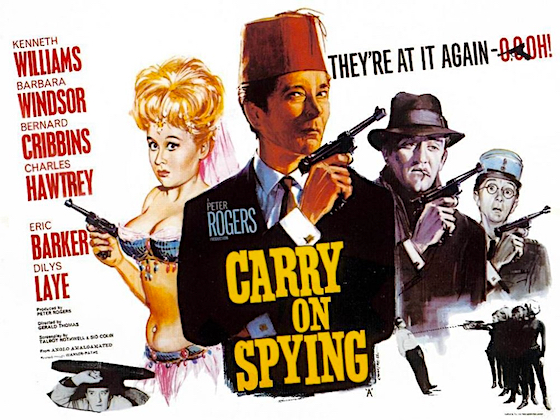
  • Carry On Spying (1964)
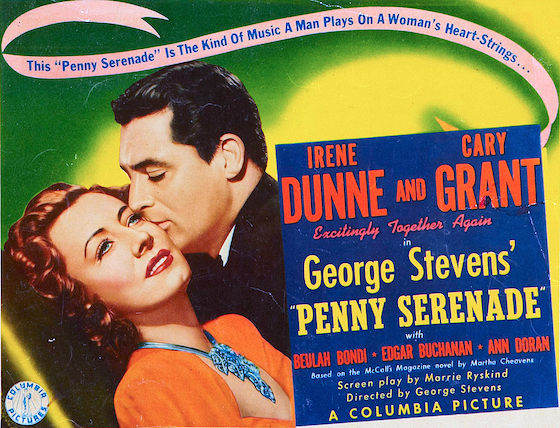
  • Penny Serenade (1941)
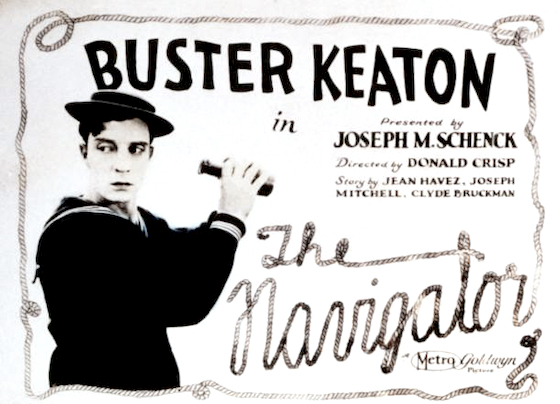
  • The Navigator (1924)
  • In the Line of Fire (1993)
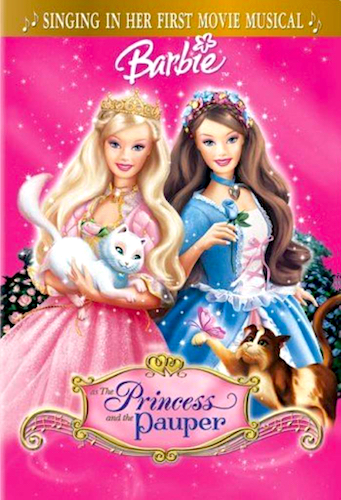
  • Barbie as The Princess and the Pauper (2004)
  • Free Guy (2021)


    Carry On Spying

    (1964)

    Gerald Thomas | 84 mins | digital (SD) | 16:9 | UK / English | U

    Carry On Spying

    Believe it or not, I’ve never actually seen a Carry On film before. Maybe that’s not so surprising these days. They were once such a part of British culture that they produced 30 of the things, but I think they were seen as “a bit old fashioned” even before I was born, and by 2022’s standards… oof. But, lest you get the wrong end of the stick (oo-er, etc), this isn’t me intending to finally dive into all of them. Rather, as well as its timely title, I chose to watch Carry On Spying primarily because it’s a James Bond spoof — the first, I believe, seeing as it was released in July 1964, when the Bond series only encompassed Dr. No and From Russia with Love (Goldfinger would follow a couple of months later).

    With Bond not yet even properly into its initial phenomenon phase (the first two films were hits, but it was the next two that skyrocketed its popularity), you might think Spying came too soon, and would be disadvantaged by being produced before the famous Bond formula was fully in place. Instead, it sets its spoofing sights a little wider, including an extended riff on The Third Man. I couldn’t tell you everything it’s drawing on, but its third-act villain’s lair — all sleek metal corridors and little road-train thingies and jump-suited identikit henchpeople — appears to be a take-off of You Only Live Twice, some three years before that film even came out. So I can only presume Spying’s point of reference there is something else, which I can’t quite remember; some other spy fiction that was already doing stuff the Bond franchise would still be pulling off years later. That doesn’t reflect too positively on YOLT, when you think of it, although Bond’s cultural dominance and longevity has come to ensure it’s the one that’s remembered for pioneering all this stuff.

    I don’t know how many Carry On films were genre spoofs, but the series’ reputation is more for smut and innuendo. There’s pleasantly little of that here — some, for sure, mostly based around Barbara Windsor (of course) as a trainee agent; but while it’s all fundamentally juvenile, it’s not as ceaselessly ribald as I was expecting. Satisfyingly, it remains primarily focused on its chosen genre. In that respect, I’ve definitely seen worse spoofs.

    3 out of 5

    Carry On Spying is the 1st film in my 100 Films in a Year Challenge 2022.


    Penny Serenade

    (1941)

    George Stevens | 120 mins | digital (HD) | 4:3 | USA / English | U

    Penny Serenade

    This is the third and final film to pair up stars Irene Dunne and Cary Grant as a married couple (I’ve watched all their collaborations within the past couple of years, but not posted reviews of the first two yet. I thought it was within the last year, but turns out I watched my first in May 2020. These strange days have really messed with my sense of the passage of time!) But where their first two films were screwball romcoms, this is undoubtedly a melodrama, following a couple as they meet, marry, and attempt to start a family.

    Dunne and Grant both make a fair fist of the serious stuff — Grant, in particular, gives an uncommonly sensitive performance at times — although they can’t resist slipping back into a spot of almost-slapstick given half a chance, with various individual sequences playing more like one of their comedies. Those scenes stand at odds with the film’s overall narrative and tone, which goes for full-on weepy. Indeed, if anything, I thought it was overdone, in particular an ending that throws in sudden tragedy followed so quickly by a pat happy ending that it feels almost distasteful.

    The film’s hook is that it begins with Dunne planning to leave, before she discovers a book of records that, as she plays them, take her back through their relationship. Different songs provoking specific memories is a neat narrative device on paper, but doesn’t really come across on screen. Aside from the first track, and maybe a later burst of Happy Birthday (although that could be almost any birthday, surely), the songs don’t seem to have any special relevance to the memories they supposedly call forth. It doesn’t help that, to modern ears, they all sound kinda samey. Plus, that the songs lead everything to unfurl in chronological order, with every major beat of their life story accounted for, is certainly convenient.

    If you can look past such artifice, and just want to revel in an old-fashioned bit of heart-tugging, Penny Serenade is fit to make you shed a tear. Personally, I’d rather the headline duo had given us another bout of screwball tomfoolery.

    3 out of 5

    Penny Serenade is the 3rd film in my 100 Films in a Year Challenge 2022.


    The Navigator

    (1924)

    Donald Crisp & Buster Keaton | 66 mins | Blu-ray | 1.33:1 | USA / silent | U

    The Navigator

    This is my fourth Buster Keaton feature now (I’ve only previously reviewed The General, but Sherlock Jr made it into my 2019 top 3), and he’s established himself as my favourite of the major silent comedians (I rarely enjoy Chaplin’s films as much as I feel I should; and, in fairness to Harold Lloyd, I’ve only seen one of his so far, which I liked a lot). The Navigator was the biggest hit of his career, though is probably my least favourite of his I’ve seen so far — though I don’t want to damn it with false criticism, because it’s still a brisk and entertaining comedy.

    Keaton stars as a spoiled rich kid whose marriage proposal is rejected. He’d already booked the honeymoon tickets, so sets off by himself; but, due to several points of confusion, he ends up adrift at sea on a decommissioned ship, empty but for one other passenger: his would-be fiancée (Kathryn McGuire). It’s up to this pair of brats to get along and survive while they hope for rescue. (Rescue does not come quickly. Considering McGuire’s father is a successful shipping magnate who’s aware of what’s happened, you’d think he’d send a vessel after them; but then, he might have his own problems, owing to a bunch of foreign spies who… look, it’s best not to overthink the logistics and plausibility of the plot.)

    Although Keaton gets the lion’s share of the gags, as well he might, for a stretch in the middle he and McGuire form an effective double act. The two rich kids being hilariously useless at household basics, like making coffee or opening a tin of food, is well observed; a flash-forward to their automated solutions is also fun. While Keaton still gets to show off by himself — particularly in an elaborate underwater diving sequence, naturally saved for the final act — McGuire makes the most of the material she’s given.

    The only outright demerit to the film is that the finale hasn’t aged particularly well: the ship finally drifts near land, but it’s an island with a village-full of black natives, at which McGuire immediately exclaims “cannibals!” That she’s sort of proven right when they start attacking the ship is… well, maybe not even worse, but at least just as bad. Still, by 1920s standards, maybe we can take comfort in the fact that it’s only casual racism…

    More than that, the reason I say it’s my least favourite Keaton so far is simply that it doesn’t have as many comedic highs as his very best work. Nonetheless, his genius regularly shines through in moments and even whole sequences, and there are a couple of individual gags that are all-timers.

    4 out of 5

    The Navigator is the 4th film in my 100 Films in a Year Challenge 2022.


    In the Line of Fire

    (1993)

    Wolfgang Petersen | 129 mins | digital (HD) | 2.39:1 | USA / English | 15 / R

    In the Line of Fire

    Clint Eastwood is a Secret Service agent who failed to stop the JFK assassination, now taunted by John Malkovich’s mysterious wannabe-assassin and his threats to kill the current President. It’s a fundamentally strong idea for a thriller, and works especially well by having the villain constantly phoning the hero for little chats. Malkovich’s always makes for a first-rate antagonist, and his slightly loony personality clashes well with Eastwood’s stoic, dry-witted, old-fashioned tough guy. There are a couple of chase scenes and shoot-outs here and there, but, rather than any elaborate physical action, it’s the verbal sparring that represents the film’s highlights.

    On the downside, the pace is a little on the slow side (perhaps matched to the “too old for this shit” age of Eastwood’s hero — in real life, he’d be a whole decade past the mandatory retirement age) and there are one too many clichés as important plot points (don’t get too attached to the partner who’s always talking about his wife and kids). Plus, there’s a wholly unnecessary romance between 62-year-old Clint and 39-year-old Rene Russo — the film doesn’t need it, even if there wasn’t that age gap. It leads to an (almost) sex scene that’s worthy of the Naked Gun films, which is amusing but tonally misplaced.

    They used to make this kind of political thriller on the regular back in the ’90s, one of those bread-and-butter genres for grownups that have fallen by the wayside in favour of hyper-budgeted kids’-movie spectacle that men of allegedly adult age flock to nowadays. In the Line of Fire may not truly stand out among its brethren of the era, but I do wish they still made ’em like this.

    4 out of 5

    In the Line of Fire is the 6th film in my 100 Films in a Year Challenge 2022.


    Barbie as
    The Princess and the Pauper

    (2004)

    William Lau | 85 mins | digital (SD) | 16:9 | USA & Canada / English | U

    Barbie as The Princess and the Pauper

    One of the many film lists I have my eye on completing is Letterboxd 100: Animation, which lists the highest-rated animated feature films on the site (with a few caveats). There are over 40 titles left that I’ve not seen, and I could’ve chosen to watch almost any of them… but I chose the Barbie one. Well, not the Barbie one, because there are actually two Barbie titles on the list. And that’s not some temporary fluke: they’ve been on there for quite a while now. This merited investigation.

    As you’ve no doubt gathered from the title, this particular Barbie film is a reimagining of Mark Twain’s The Prince and the Pauper. A fairytale-esque story, about a princess, done as a musical? Yep, this is very much a wannabe Disney, but without the production values of that major studio: the computer animation here looks more like a PS2 cutscene. But hiding beneath the cheap animation is a halfway decent musical fairytale. Take the second musical number, How Can I Refuse, for example: it’s every inch in the mould of a “Disney villain’s song”, but is better than some genuine examples, and comes complete with a dance routine by the antagonist and his two henchman. This film has ambition, I’ll give it that.

    Other songs vary in quality. When the eponymous duo first meet, there’s an unintentionally hilarious number in which they sing about how similar they are, the indentured servant and the pampered royal. If you say so, girls. A later track is a typical “you be you” song, but sung to a pet cat who behaves like a dog. That’s a level of barminess I can get on board with.

    I would never have dreamed of watching this if it weren’t on the Letterboxd animation list. Now, I wouldn’t exactly say I’m glad I watched it, but I enjoyed it more than I thought I would — even if sometimes that was due to laughing at it rather than with it.

    3 out of 5

    Barbie as The Princess and the Pauper is the 7th film in my 100 Films Challenge 2022.


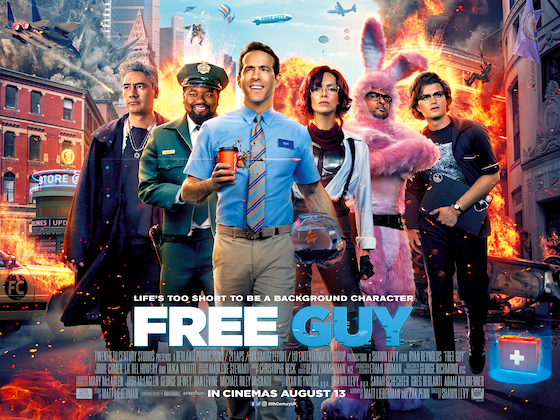
    Free Guy

    (2021)

    Shawn Levy | 115 mins | digital (HD) | 2.39:1 | USA / English | 12 / PG-13

    Free Guy

    Ryan Reynolds plays his role again as Guy, a bank worker in city riddled with crime and superheroics. But, it turns out, Guy isn’t real — he’s an NPC in a computer game, programmed to do the same thing over and over and basically be ignored by the real-world players. Until, that is, he spots the woman of his dreams (Jodie Comer) and his programming breaks as Guy becomes self-aware.

    The basic concept sounds like a fun, fresh, and timely idea, right? Video games have never been more popular, AI is ever-improving, and there’s room for both gags and action in the core idea — that’s the winning Marvel formula, right there. Unfortunately, the execution is as if someone found a way to make a new movie by collaging others. Free Guy is just The LEGO Movie + The Truman Show + Wreck-It Ralph + Ready Player One + the PG-13 version of Deadpool 2 — not put in a blender, but cut up and stuck back together side-by-side, with snippets of Groundhog Day, Fortnite, and multiple Disney-owned properties scattered in for good measure.

    That last aspect, the Disney references, has been singled out for particular derision on social media. The film was initially produced by 20th Century Fox, but ended up a Disney title after the buyout, which allows a bunch of stuff they own to pop up in the movie. I know we’re supposed to find this infinitely depressing — a sad reminder that Disney are on course to own all culture, and that’s a bad thing — and it is bad, of course… but the bit with Captain America’s shield still made me laugh. Sorry, not sorry. Yeah, you can be miserable about this stuff, because obviously the total homogenisation of all American media under The Walt Disney Company is not worth that a couple of meta gags; but the homogenisation of all American media under The Walt Disney Company is happening anyway, so we may as well enjoy the gags we get along the way.

    Whether you have that kind of attitude or not will probably dictate how much you enjoy Free Guy. Its originality is surface deep, at best, and at every second it will call to mind some other film that already did the same thing. But, allowing for that, it’s still a fairly entertaining couple of hours of action-comedy.

    3 out of 5

    Free Guy is the 8th film in my 100 Films in a Year Challenge 2022.


  • The Secret Life of Pets 1&2

    Imaginatively-titled sequel The Secret Life of Pets 2 is available on Netflix in the UK from today, so what better time for me to finally get round to reviewing both that film and its predecessor? (Unfortunately, the first one isn’t currently available on any subscription streaming service.)

    The Secret Life of Pets
    (2016)

    2019 #73
    Chris Renaud | 86 mins | digital (HD+3D) | 1.85:1 | USA, France & Japan / English | U / PG

    The Secret Life of Pets

    In a Manhattan apartment, terrier Max’s quiet life as favourite pet is upended when his owner brings home stray Duke. But they must put their quarrels aside when they get lost in the city and discover that abandoned magician’s bunny Snowball is building an army of lost pets, determined to wreak their revenge. — adapted from IMDb

    Make your main character a cute little terrier-like dog and you’ve basically halfway sold me on your movie already (see: Hotel for Dogs; Benji). It works best with a real cute little dog, of course, but The Secret Life of Pets is proof the effect can carry over to animation, at least somewhat. It helps that the behaviour of the various animals in the film is all quite well observed — heightened, obviously, but there are many reasonable riffs on pet behaviour… that is until the revolutionary group led by a bunny, who’s followed by a tattooed pig and a lizard, hijack an animal control van. That’s a bit silly.

    From the trailers, I thought the animation style looked a bit flat — presumably a deliberate choice, almost like it was going for a Peanuts Movie kinda style — but watching it in 3D adds some pleasing depth and shapeliness, especially as I don’t think flatness actually was the intended effect for the whole movie.

    The Secret Life of Pets mostly reheats, remixes, and recombines stuff you’ve seen done in other movies (although as it came out around the same time as Finding Dory, it’s really a toss up as to who can claim that “animals in control of a human vehicle” climax), but it manages just enough charm to tick over as entertaining rather than irritatingly derivative.

    3 out of 5

    The Secret Life of Pets 2
    (2019)

    2020 #81
    Chris Renaud | 86 mins | digital (HD+3D) | 1.85:1 | USA, France & Japan / English | U / PG

    The Secret Life of Pets 2

    Max faces some major changes after his owner gets married and has a child. On a family trip to the countryside, Max meets farm dog Rooster and attempts to overcome his fears. Meanwhile, Gidget tries to rescue Max’s favourite toy from a cat-packed apartment; and Snowball sets off on a mission to free a white tiger from a circus. — adapted from IMDb

    As the above plot description goes some way to indicating, The Secret Life of Pets 2 feels like watching three episodes of a Secret Life of Pets TV series strung together: for most of its running time, it cuts back and forth between three completely unrelated storylines, seemingly just so that every major character from the last movie has something to do. Things do tie together in the final quarter-hour for an all-action climax, but that doesn’t stop them being entirely disconnected until that point.

    The only thing that really elevates it above TV-level is the visuals, which show off suitably expensive and slick animation, especially in 3D. At this point it almost goes without saying that computer-animated movies look fantastic in 3D, but it’s still pleasing.

    None of which is to say The Secret Life of Pets 2 is an outright bad movie. It’s a step down from the first (as things have panned out, I’ve given them both the same score, but the first one is kind of a 3+), but it has its moments — like the opening five minutes, where Max bonds with his owner’s new kid, which are sweet and cute; or the casting of Harrison Ford as a take-no-bullshit farm-dog, which is perfect. If you liked the first movie, this one passes some time amiably.

    3 out of 5

    The Secret Life of Pets 2 is available on Netflix in the UK from today.

    The 100-Week Roundup XXVIII

    The 100-Week Roundup covers films I still haven’t reviewed 100 weeks after watching them. Sometimes these are short ‘proper’ reviews; sometimes they’re only quick thoughts, or even just the notes I made while viewing.

    This week’s selection includes a few more films from April 2019

  • Early Man (2018)
  • Amour (2012)
  • Ralph Breaks the Internet (2018)


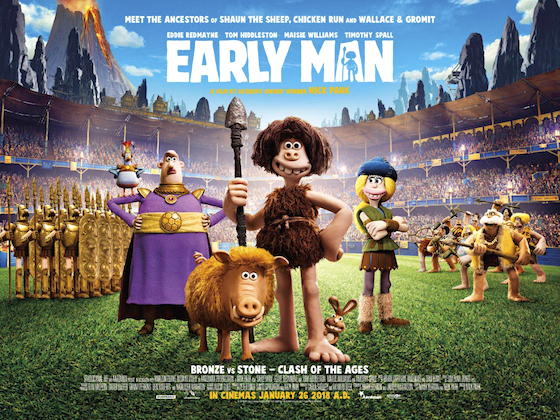
    Early Man
    (2018)

    2019 #56
    Nick Park | 89 mins | digital (HD) | 1.85:1 | UK, France & USA / English | PG / PG

    Early Man

    Only the third feature film directed by Wallace & Gromit creator Nick Park, Early Man is about a prehistoric tribe who invented football (aka soccer) and must defend their home from a more advanced civilisation by playing a winner-takes-all footie match.

    So, despite the Stone/Bronze Age setting, this is a sports movie — and with that in mind, the plot is as rote as they come. And, if you hadn’t guessed yet, the period setting is less historically accurate than Game of Thrones (at least Thrones is inspired by things that really happened). Plus, there are plenty of bizarre choices — like, if the story’s set in Britain, why is Tom Hiddleston doing a weird Generic European accent? But, for all that, this is an Aardman production, and so there’s tonnes of pleasure to be found in incidental details; the asides and background jokes and grace notes that frequently raise a full-blown laugh, or at the very least a warm smile.

    There’s also something to be said for the film being quite delightfully Brit-centric. When so many productions aim to be bland enough to appeal to a global audience, Park and co haven’t shied away from including an array of gags that are like to only be caught by Brits and/or footie fans. For example, there’s a reveal of the backstory of the tribe and their relationship to the sport that’s an obvious riff on England’s relationship to international football, and I don’t know how apparent that would be to overseas viewers; or characters with names like Goona and Asbo. Not that such things should turn off the uninitiated, however. For pun lovers alone there’s plenty of material, not to mention general quirkiness. I could try to explain what goes on with the duck, but it’s better I leave it for you to discover.

    Early Man isn’t Aardman’s strongest production, but their productions have a base-level charm that’s high enough to keep it ticking over, with the occasional inspired flourish to boot.

    3 out of 5

    Amour
    (2012)

    2019 #59
    Michael Haneke | 127 mins | digital (HD) | 1.85:1 | Austria, France & Germany / French & English | 12 / PG-13

    Amour

    German director Michaell Haneke may be much acclaimed by the arthouse crowd, but I’m not a huge fan of his previous works that I’ve seen (1997’s Funny Games and 2005’s Hidden — it seems I gave the latter four stars, which is not how I remember it). Palme d’Or, Oscar, and BAFTA winner Amour is the exception, however, even while some of its more arty asides hold it back somewhat.

    It’s the story of an ageing couple, Georges and Anne. When Anne has a stroke, Georges is left caring for her as her health continues to decline. In its depiction of this relationship — the strains placed on it and how it survives them — Amour is a truthful, affecting, and deeply moving character drama. Most of the major events (diagnoses, tests, a second stroke) happen off screen, with the film more concerned with day-to-day realities, but that’s part of where its power lies. It’s not so much about the big drama, more the reality of coping.

    But in between this powerful material, there’s random art house shenanigans, like a pigeon wandering into the apartment before Georges shoos it out, or a montage of impressionist paintings. Why do we see these things? I’ve not the foggiest. I guess Haneke had a purpose in mind, but goodness knows what it was — although, as he said in one interview, “consider the pigeon just a pigeon. You can interpret it any way you want. I wouldn’t describe it as a symbol. I have problems with symbols, because they always mean something specific. I don’t know what the pigeon means,” so maybe not. When combined with an overall slow pace, this resulted in the film becoming a bit of a slog for me, which was a real shame. The bits that are good — that are insightful and impactful and emotional — are so good, but, for me, those longueurs get in the way.

    4 out of 5

    Ralph Breaks the Internet
    (2018)

    2019 #62
    Rich Moore & Phil Johnston | 112 mins | digital (UHD) | 2.39:1 | USA / English | PG / PG

    Ralph Breaks the Internet

    The sequel to Wreck-It Ralph is indeed called Ralph Breaks the Internet, when Ralph Wrecks the Internet was right there. Although, if they wanted to be truly accurate, a better titled would’ve been Corporate Synergy: The Movie.

    The plot sees Ralph and his chum Vanellope heading out into the internet to fix the arcade game they live in. That includes an extended sequence set ‘inside’ the Oh My Disney website — originally the Disney Infinity game, but that got cancelled during production so had to be changed. I think that rather indicates the mindset and motives behind this movie: $ advertising $ . Most famously, it includes a sequence where Vanellope encounters the Disney princesses. It’s quite a funny sequence, somewhat undermined by the “no one can understand Merida (because she speaks Scottish)” gag. Imagine if they’d tried that with Tiana or Pocahontas or Moana and their accent/dialect…

    When it’s not being a big advert for its production company, Ralph Breaks the Internet seems to think it’s a clever satire of the online world. It does references and stuff, but doesn’t develop them enough to be genuine commentary — for example, Ralph finds ‘the comment section’ and it’s depressing, and then someone tells him “the first rule of the internet is never read the comments”, and… that’s it. It’s stating a widely-accepted truism as if it’s some kind of revelation or point unto itself. This extends right to the climax, which sees our heroes fighting with a giant virus born of toxic masculinity, an idea that’s somewhere between timely and fucking ridiculous (how does toxic masculinity inherently create a computer virus?)

    Other problems include a pile of plot holes and inconsistencies (such as when Vanellope does or doesn’t use her glitching ability, among others); that it’s a structural mess (the plot bounces from place to place just so it can even get started, then major motivating goals are dismissed and moved on from), which leads to it being needlessly long (surely kids’ animations are best around the 90-minute mark). Also, frankly, I don’t particularly like the characters or the style of humour they create. That’s only worsened when you shoehorn in blatant advertising, half-witted satire, and muddled messages.

    The best Disney canon movies are timeless. Heck, some of the worst ones are, too. But Ralph 2 is so about the ‘right now’ of when it was made, it’s probably already dated today, just a couple of years later, never mind how it’ll hold up in a couple of decades.

    2 out of 5

  • The 100-Week Roundup XXVI

    The 100-Week Roundup covers films I still haven’t reviewed 100 weeks after watching them. Sometimes these are short ‘proper’ reviews; sometimes they’re only quick thoughts, or even just the notes I made while viewing.

    This week’s selection, the final two films from March 2019, includes a pair of awards-worthy short animations — the first won an Oscar, the second was nominated for one. I was going to include more films in this week’s roundup (effectively bundle two weeks into one), but it felt like a disservice to this pair.

  • Paperman (2012)
  • Waltz with Bashir (2008)


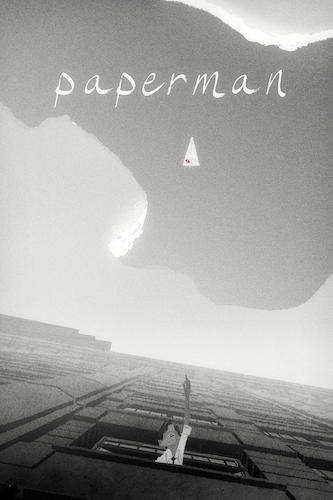
    Paperman
    (2012)

    2019 #48a
    John Kahrs | 7 mins | Blu-ray (3D) | 1.85:1 | USA / silent | U / G

    Paperman

    This Disney short was originally released alongside Wreck-It Ralph (and can now be found on that film’s Blu-ray; as well as on Disney+, I presume) and, as I recall, attracted a lot of praise at the time, primarily for its visual style. That was an innovation in creating 2D-looking animation via a 3D system — so it seems a bit daft that I watched it in 3D. I have to wonder if the added visual dimension highlights the underlying 3D animation, because it’s quite obviously been created in 3D with a 2D style over the top.

    That said, it look gorgeous, however you cut it. There’s an inherent beauty in how it’s executed, while the chosen black-and-white style emphasises the apparent setting (’40s New York) and also gives it a timeless quality. The 2D/3D combination works well, giving it the fluidity and dynamism of CG animation, but with a certain roughness — a hand-made-ness — that comes from 2D cel animation. Of course, that’s artificial, injected via design choices (like scruffy outlines on the characters), but it feels authentic.

    As for the actual story, it’s a charming little romantic number involving paper aeroplanes… until those sheets of folded paper become sentient and omniscient, at which point it lost me with its silliness. But as an exercise in style: lovely.

    4 out of 5

    Waltz with Bashir
    (2008)

    aka Vals Im Bashir

    2019 #49
    Ari Folman | 87 mins | TV | 16:9 | Israel, France, Germany, USA, Finland, Switzerland, Belgium & Australia / Hebrew, Arabic, German & English | 18 / R

    Waltz with Bashir

    One night at a bar, an old friend tells director Ari Folman about a recurring nightmare in which he is chased by vicious dogs. They conclude that there’s a connection to their Israeli Army service in the first Lebanon War of 1982. Ari can’t remember that period of his life, so he meets and interviews old friends and veterans, hoping to discover the truth about that time and reconstruct his own memories of the conflict. — adapted from IMDb

    This search for the truth has led Waltz with Bashir to be labelled an “animated documentary”, which sounds like an odd idea, almost oxymoronic — you can tell a true story with animation, of course, but can you document something? Well, yes. Rather than talking heads, what animation allows is the visualisation of the narrators’ memories and dreams alike, and means we can flow between them, too. On a practical level, it allows the film to stage scenes that would be impossible in live-action without a huge budget, meaning it doesn’t have to compromise on the stories it tells. More thematically, having a shared style between ‘reality’ and ‘dream’, plus the distancing effect of it being drawn, not ‘real’ — of being unequivocally created, not just filmed — helps to underscore larger points about the reliability (or otherwise) of memory. The dreams are connected to the memories; are the memories a kind of dream?

    Given the time period being remembered, of course the film is about war and how that affects the mind of its participants, but it’s also memory in general, I think. You’d think such extreme, unique experiences would be unforgettable, and yet the workings of the mind and memory aren’t that straightforward. One strand I found particularly fascinating was the way people are haunted by the suffering of animals in the conflict, perhaps more so than by the human-related atrocities they saw. Is this just a coincidence of the people Folman spoken to? Is it a particular interest of Folman himself? Or is it a genuine phenomenon? I don’t know the answer, but (outside of, say, War Horse) I don’t remember it being such a clear thread in a war-related film or documentary before.

    I’ve seen people say they couldn’t connect with Waltz with Bashir because they didn’t know the history of the period well enough. Conversely, I felt that was part of why the film was so effective: not really knowing what was going on or what was being referred to, I was discovering it as the character did. Some parts along the way could perhaps have used further clarity or explanation for those of us entirely unfamiliar with the conflict, but there’s enough information disclosed to be going on with. I found the film’s ending to be powerful beyond words, and part of what makes it so shocking and impactful is not knowing about it, of learning about it for the first time with the characters.

    5 out of 5

  • The 100-Week Roundup XXIV

    The 100-Week Roundup covers films I still haven’t reviewed 100 weeks after watching them. Sometimes these are short ‘proper’ reviews; sometimes they’re only quick thoughts, or even just the notes I made while viewing.

    This week’s selection includes three films from March 2019

  • Bruce Almighty (2003)
  • Isle of Dogs (2018)
  • Life Is Beautiful (1997)


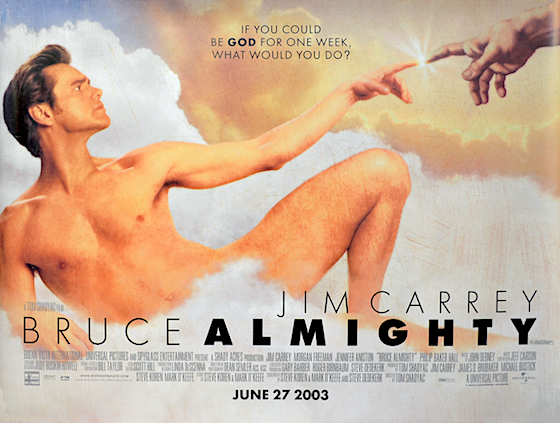
    Bruce Almighty
    (2003)

    2019 #31
    Tom Shadyac | 97 mins | digital (HD) | 16:9 | USA / English | 12 / PG-13

    Bruce Almighty

    Television reporter Bruce Nolan (Jim Carrey) doesn’t think the world is treating him fairly, but when he angrily rages against God, he actually gets a response. God (Morgan Freeman) decides to take a holiday, leaving Bruce in charge with His divine powers. As Burce puts his omnipotent powers to the test, he comes to realise that with great power comes… yeah. — liberally adapted from IMDb

    I mean, in fairness to Bruce, Spider-Man only came out the year before — maybe he just hadn’t seen it yet.

    Anyway, Bruce Almighty is almost entirely fuelled by Carrey’s antics — if you enjoy his zany style, you’ll lap it up; if you hate it, there are no redeeming qualities that haven’t been done better in other broadly-similarly-themed films (see Groundhog Day, for example). I say “almost entirely” because there are brief asides where Morgan Freeman or Steve Carrell get to steal a scene. Indeed, Freeman earned the film’s only out-loud laugh from me when he casually throws in one of Carrey’s best-known catchphrases.

    Personally, I’m in between on comedy-mode Carrey, and so that’s where I landed on Bruce Almighty. He doesn’t push his schtick so far that it becomes irritating to me, as in the Ace Ventura films (I quite liked them as a kid but feel I’d hate them now), but nor is it inspired enough to really transcend being just what it is.

    3 out of 5

    Isle of Dogs
    (2018)

    2019 #32
    Wes Anderson | 97 mins | digital (HD) | 2.35:1 | USA & Germany / English & Japanese | PG / PG-13

    Isle of Dogs

    Wes Anderson has a weird proclivity for killing dogs in his movies, so it seems almost like some kind of atonement that he’d turn around and make a movie whose title is a homophone for “I love dogs”.

    This animated adventure is set in a near-future Japan, where a canine flu is spreading through the city of Megasaki. To stop it, the mayor orders all dogs be banished to Trash Island — starting with Spots, the pet of his orphaned 12-year-old nephew, Atari. So Atari steals a plane and flies to Trash Island, where he teams up with five stray dogs to search for his exiled pal.

    Isle of Dogs attracted a certain amount of criticism when it was released for its treatment of the Japanese characters and, especially, language; primarily, that the Japanese dialogue is not subtitled, thereby ‘othering’ those characters because we’re prevented from engaging with them. When watching the film, my first thought was those complaints were being a bit daft: the dogs speak English, the humans speak Japanese, and we’re clearly being placed with the dogs — the humans are ‘other’ because they’re human, not because they’re Japanese. But then the film keeps jumping through hoops to get around this, for example with translators on TV to re-speak the Japanese in English; or an American exchange student to speak for another group with English dialogue. This is where it does tip into being problematic; where it can feel like a Western director playing around with another culture.

    All of which said, I still very much enjoyed the film. As a fellow Anglophone admirer of Japanese culture, that aspect broadly worked for me. Setting aside the controversy, it’s still amusing, in Anderson’s normal mode, with a suitably exciting and action-packed quest narrative.

    5 out of 5

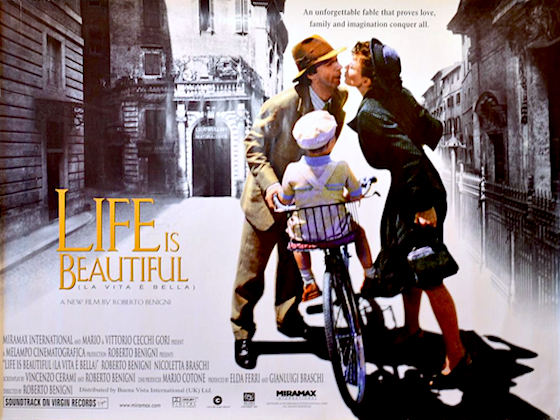
    Life Is Beautiful
    (1997)

    aka La vita è bella

    2019 #33
    Roberto Benigni | 116 mins | digital (HD) | 1.85:1 | Italy / Italian, English & German | PG / PG-13

    Life is Beautiful

    In 1930s Italy, a carefree Jewish librarian named Guido starts a fairytale life by courting and marrying a woman from a nearby city. They have a son and live happily together until the occupation of Italy by German forces, when they’re separated and sent to concentration camps. Determined to shelter his son from the horrors of his surroundings, Guido pretends that their time in the camp is merely a game. — adapted from IMDb

    Every summary of Life is Beautiful concentrates on the “they end up in the Holocaust” bit — which is fair enough, it’s rather a major thing. But this is really a film of two halves. The first is a broad, sketch-like comedy, in which Guido (played by cowriter-director Roberto Benigni) bumbles around, woos his wife, and starts a lovely life. It’s the kind of comedy in which there’s a single sequence where a bunch of sketches all pay off at once, in a series of coincidences that’s somewhere between artful and ludicrous. The second half is a kind of concentration camp comedy, which is just as unwieldy as that sounds. The almost farcical humour of the first half attempts to linger on, but it buts awkwardly against the unspeakable horrors that occur.

    Eventually it comes to an ending that I was similarly divided about. It’s clearly designed to be hyper-emotional, and it pulls at some very obvious strings to get there quickly, which seems to work for many viewers, but I didn’t feel it. Why? Well, it’s based in the relationship between father and son, and I don’t think the rest of the film really is. The first half of the film is all about investing us in the relationship between Guido and his wife — we follow their relationship from the very beginning, and the film charms us and connects us to their coupling. But then the second half virtually tosses that aside to make the important relationship the one between Guido and his son. We get two or three quick scenes that incidentally suggest a good father/son bond, then it’s off to the camp, which is a whole other kettle of fish. We’re not given the time to properly buy into this father/son relationship. That’s not to say I don’t believe it, just that we’re only learning about it at the same time as we’re supposed to be affected by its endurance. Doing both at once doesn’t work, in my opinion. Now, if the first half (or even just the first act) had been about Guido and his son’s wonderful relationship before the occupation, it would have established that well and connected us to it; then, if the rest of the film unfolded as-is, I think it would have made for a much more powerful ending, because it would have had the full weight of their entire relationship behind it. Instead, as well as being a film of two halves, Life is Beautiful ends up a film of two relationships, one in each half.

    Despite the film winning awards at Cannes and the Oscars, and being in the top 10% of IMDb’s Top 250, etc, this “two halves” thing — the awkward balancing act between comedy and tragedy — has been noted by critics ever since its initial release. It makes for a wavering viewing experience. It’s kind of inappropriate, but kind of isn’t; it kind of celebrates the ingenuity of the human spirit, but kind of belittles the real tragedy in the process; it’s kind of a success, but kind of a well-meaning misguided effort. It’s this sense that the film’s heart is in the right place that sees my score err upwards.

    4 out of 5

    Life is Beautiful was viewed as part of What Do You Mean You Haven’t Seen…? 2019.

  • The 100-Week Roundup XXIII

    Regular readers will remember that I started 2021 on the back foot with these 100-week roundups, being about a month behind. Well, after some effort the past few weeks, I’m pleased to report I’ve now caught up — which, if you think about it, only means I’ve caught up to being just 100 weeks behind. Hurrah?

    Anyway, as always, this roundup covers films I still hadn’t reviewed 100 weeks after watching them. Sometimes these are short ‘proper’ reviews; sometimes they’re only quick thoughts, or even just the notes I made while viewing. This week’s collection includes the final film from February and the first from March 2019

  • Sherlock Gnomes (2018)
  • Swimming with Men (2018)


    Sherlock Gnomes
    (2018)

    2019 #22
    John Stevenson | 86 mins | digital (HD) | 2.35:1 | UK & USA / English | U / PG

    Sherlock Gnomes

    As if the idea of making a children’s animated movie based on Romeo & Juliet but starring garden gnomes and the music of Elton John wasn’t barmy enough, here we have a sequel that riffs off another classic of English literature, Sherlock Holmes.

    The plot naturally takes the form of a whodunnit, with Gnomeo (voiced by James McAvoy) and Juliet (Emily Blunt) recruiting Sherlock Gnomes (Johnny Depp, for some reason) and his assistant, Dr Gnome Watson (what creative renaming), to investigate the disappearance of their garden ornament friends. Don’t worry too much about the plot, though: I guessed the twist in the very first scene. (Fortunately, there is another twist beyond that.) Instead, treat it as a bright and breezy kids’ adventure. It’s not particularly clever or funny, but much of it is perfectly fine, with the occasional bit that’s quite good, like a Flushed Away-esque sewer scene or a hound of the Baskervilles gag, plus some creative use of animation to render things like Sherlock’s visions or Romeo’s escape plan.

    The Elton John songs are even more incongruously shoehorned in than they were last time — I know he’s a producer, or it’s made by his company or whatever, but, other than that, they have absolutely no reason to be here. Worst of all is a new number, written by Elton and regular collaborator Bernie Taupin but sung by Mary J. Blige. At least it makes the rest of the John back catalogue on the soundtrack seem less objectionable.

    3 out of 5

    Swimming with Men
    (2018)

    2019 #29
    Oliver Parker | 97 mins | digital (HD) | 2.35:1 | UK / English | 12

    Swimming with Men

    Here’s a sort of aquatic riff on The Full Monty, as a man suffering a midlife crisis (Rob Brydon) joins an all-male amateur synchronised swimming team, mostly made up of other mostly-middle-aged British character actors: Rupert Graves, Jim Carter, Daniel Mays, Adeel Akhtar, and Thomas Turgoose. It seems like your typical Britcom setup, but it’s actually based on a true story — the Swedish team it’s about play themselves in the film — which has been filmed several other times now: in Sweden as The Swimsuit Issue; in France as Sink or Swim; plus a documentary about the real team, Men Who Swim. I haven’t seen any of those to compare, but the British variant holds up pretty well by itself, with enough gentle amusement and heartwarming camaraderie to make for a pleasant watch.

    3 out of 5

  • The 100-Week Roundup XXII

    The 100-Week Roundup covers films I still haven’t reviewed 100 weeks after watching them. Sometimes these are short ‘proper’ reviews; sometimes they’re only quick thoughts, or even just the notes I made while viewing. This week’s collection includes three more feature films and one short from February 2019

  • Hacksaw Ridge (2016)
  • Leave No Trace (2018)
  • Inception: The Cobol Job (2010)
  • Fences (2016)


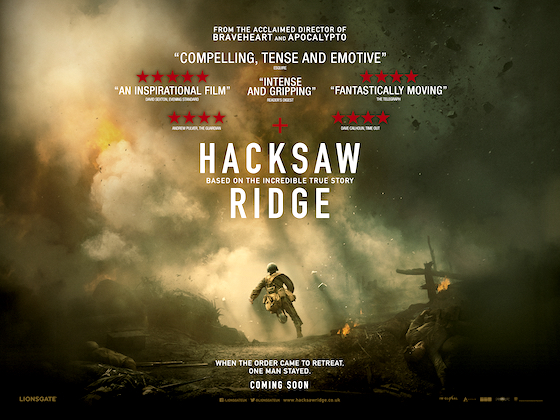
    Hacksaw Ridge
    (2016)

    2019 #17
    Mel Gibson | 139 mins | digital (HD) | 2.35:1 | Australia & USA / English | 15 / R

    Hacksaw Ridge

    Hacksaw Ridge tells the true story of Desmond T. Doss (Andrew Garfield), an American who believed that World War II was justified — so he joined the army to serve his country — but also that killing was wrong — so he refused to carry a weapon. Serving as a combat medic, Doss ended up at the bloody Battle of Okinawa, where he saved the lives of 75 men without firing a shot, and became the first conscientious objector to earn the Medal of Honor.

    It’s an extraordinary true story — the kind of thing that would seem ludicrous if someone made it up — so it earns its place on the screen. Unfortunately, I don’t think the best way to tell it was by letting Mel Gibson carve it from a block of cheese. When the film’s not wasting time on clichéd bootcamp stuff, it’s earnestly indulging in its subject matter to an eye-rolling degree. Indulgence is also the name of the game when it comes to the war, too: for a movie about a guy who wouldn’t kill, it certainly revels in its gory depictions of combat. Handled the right way, such grotesquery could have supported the point that Desmond is right, but Gibson seems to be enjoying the slaughter too much.

    And yet for all of Gibson’s amping it up, some of the real-life stories are even more incredible than what’s in the film — there are stories in IMDb’s Trivia section (here and here, for example) that stretch credulity so far it was decided to leave them out because audiences would never believe it. Considering how OTT the stuff left in is, it seems a shame to have left out something that could be backed up as a true account.

    3 out of 5

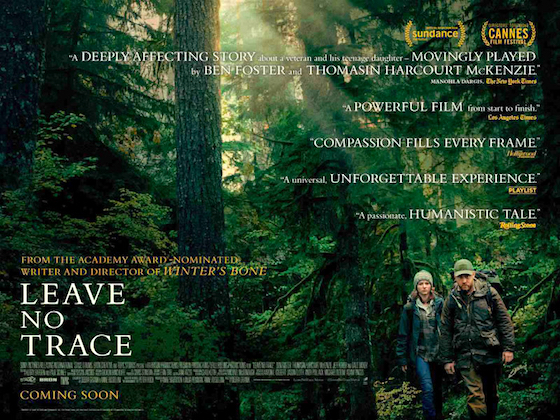
    Leave No Trace
    (2018)

    2019 #18
    Debra Granik | 109 mins | digital (HD) | 1.85:1 | USA & Canada / English | 12 / PG

    Leave No Trace

    Traumatised military veteran Will (Ben Foster) and his teenage daughter, Tom (Thomasin McKenzie), have lived in isolation for years in a public park outside Portland, Oregon, only occasionally venturing in to the city for food and supplies. But when they’re spotted by a jogger, they’re arrested and put into social services. Tom finally gets a sense of what it might be like to integrate with society, but Will clashes with his new surroundings, and soon they set off on a harrowing journey back to the wild. — adapted from IMDb

    I don’t like summarising too much of a film’s storyline at the start of a review, but Leave No Trace is one of those films where the character work is more important than the shifts of the plot. It’s a double portrait: that of a damaged man who can’t cope with society, and his loving daughter who he’s taken on the same path, for good or ill. Will’s lifestyle and parenting methods are entirely at odds with what’s seen as acceptable by society (hence the arrest and being placed in care), but does that make him wrong? The pair’s life in the woods is a “back to nature” approach, detached from technology and the hum of modernity, which many profess to strive for — he’s just actually gone and lived it. But Tom, as just a young teenager, has had this life thrust upon her — it’s what her dad wants, but she’s never known anything else to have the choice.

    So the film rests on the two lead performances. Ben Foster is reliably superb as a father doing his best for his daughter — and, actually, not doing a bad job — but struggling with his own issues and traumas. But the star is Thomasin McKenzie, in what’s proven (rightly) to be a breakout role (she quickly followed this with another leading role in Jojo Rabbit, and will next be seen in new movies from Edgar Wright, M. Night Shyamalan, and Jane Campion). She was just 17 when the film was shot, but is entirely convincing as a 13-year-old, and yet the character also seems old for her age. It’s a weird dichotomy, that. It never crossed my mind that the actress was any older than the character — it’s not just that she looks young, it’s a quality in the performance — and yet she also conveys that sense of being “wise beyond her years”. As if that wasn’t enough, the film’s emotional crux lies with her, delivered in a single emotional gut-punch of a line that’s liable to make you choke up just remembering it.

    4 out of 5

    Inception: The Cobol Job
    (2010)

    2019 #20a
    Ian Kirby | 15 mins | Blu-ray | 16:9 | USA / English | 12

    Inception: The Cobol Job

    Remember motion comics? They were a brief fad where comic books were adapted into movies/series by simply adding movement and sound to the original artwork. (I say “brief fad”, they may still make them for all I know, but there was a rash of them about ten years ago that seems to have abated.) That’s what this animated prequel to Christopher Nolan’s Inception is: a moving version of the one-shot comic (originally published online, but also included in print with some releases of the movie), written by Jordan Goldberg with art by Long Vo, Joe Ng, and Crystal Reid of Udon.

    As motion comics go, the animation here isn’t bad. It’s still clearly derived from a comic book rather than being born into animated form, but it’s got a decent amount of movement and dynamism. But its main fault is not having any voice actors. There’s music (taken from Hans Zimmer’s score for the feature) and sound effects, which complement the atmosphere and help connect it to the film proper, but having to read speech and thought bubbles really keeps it in “motion comic” rather than “animated short” territory. Were the producers at Warner really so cheap that they couldn’t’ve afforded a couple of voice actors for an afternoon’s work?

    As for the story, it’s a nice little prequel to Inception, more-or-less tonally in-keeping with Nolan’s work. It sets up the backstory behind the film’s opening heist and some of its subplots… though, kinda ironically, The Cobol Job also begins in media res, so you could do a prequel to the prequel to explain how they got there. Stories within stories within stories? How very Inception.

    3 out of 5

    Fences
    (2016)

    2019 #21
    Denzel Washington | 139 mins | digital (HD) | 2.39:1 | USA & Canada / English | 12 / PG-13

    Fences

    Troy Maxson (Denzel Washington) is a working-class African-American in 1950s Pittsburgh, doing his best to provide for his family: wife Rose (Viola Davis), teenage son Cory (Jovan Adepo), his son from a previous relationship (Russell Hornsby), and Troy’s mentally impaired brother, Gabe (Mykelti Williamson). But this seemingly-happy dynamic is tried when Troy’s secrets are forced to come to light, and his bitterness at the hand life dealt him threatens his family’s dreams. — adapted from IMDb

    Fences is adapted from a 1985 play by August Wilson, which was revived on Broadway in 2010, and many of the lead cast members from that award-winning production transfer to this film version, not least star (and now director, too) Denzel Washington. Perhaps that’s why the end result is so very stagey.

    It’s not just the limited locations or talky screenplay that give that away — there’s no reason you can’t make a film that’s set in limited locations or heavily based around dialogue, so it goes beyond that. The stage roots show through partly in that so much important stuff is kept offscreen and we’re only told about it through dialogue — I don’t think you’d tell this story this way if it originated for the screen, or indeed as a novel. Then there’s the way the actors move around, the way they come and go from the ‘stage’, the way scenes are blocked — it feels like it’s been lifted off a stage set, plonked on an equivalent real location, then filmed. Then there’s the style of the dialogue — it has a certain kind of familiar theatricality, which I can’t quite define but I always know when I hear it.

    All of which serves as a distraction from whatever Fences is meant to be about. And, frankly, it goes on a bit, with many scenes feeling in need of a massive tighten. It’s not that it’s bad, but it feels very worthy; very self consciously important. Perhaps for some people it is.

    3 out of 5