
Henry Selick | 100 mins | Blu-ray | PG / PG
 I’ve only ever read one thing by Neil Gaiman. It’s not fan-favourite Neverwhere, nor the previously-adapted Stardust. It’s not Hugo-winners American Gods or The Graveyard Book, nor the Hugo-withdrawn Anansi Boys. It’s not any of Sandman. It’s not even Whatever Happened to the Caped Crusader?, his take on Batman.
And it’s not Coraline either.
Which is a shame, because either that or “I’ve never read anything by Neil Gaiman” would have made much better introductions. Indeed, the latter was my original plan, but honesty overcame me — I’ve read his graphic novel/miniseries Marvel 1602. And I just remembered that I’ve also read Good Omens, the novel he co-wrote with Terry Pratchett. So much for my neat little introduction.
But regardless of one’s familiarity with Gaiman, his work comes recommended. Coraline alone won a Hugo, Nebula and Stoker, while the film adaptation was Oscar-nominated (naturally it lost to whichever Pixar film was eligible) and widely well reviewed (an 89% Tomatometer). All of which seems to set it up for a fall. But like, say, The Dark Knight*, it manages to fulfil its promise — Coraline, in short, is excellent.
Where to begin? Well, Coraline is a fairytale, really, albeit a modern one — it doesn’t come at you with princesses or witches or talking animals, but Volkswagens and new homes and stairlifts (all or none of those may be significant to the plot). The fact it’s a fairytale is perhaps neither here nor there, though I do think it pushes aside some logic complaints I’ve seen levelled against the film — do we need a villain’s origins, for example? No, not here. I’m not saying Coraline uses its fairytale basis as an excuse to toss aside narrative sense, just that, if viewed through the prism of 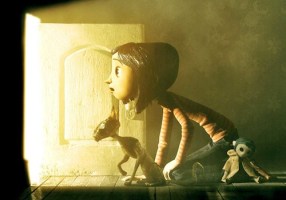 “fairytale story rules” rather than “real-world fantasy story rules” some viewers may have been more forgiving. Also, I’m digressing into a critical blind alley.
It’s also a Proper fairytale, by which I mean two things: one, it has a moral message; two, it’s scary. Very scary, in places. For much of the film there’s a beautiful creepy atmosphere, enhanced by drifting fog and skewed camera angles, but towards the end — when (I write while trying not to spoil too much) the full truth of the Other Mother is revealed — it’s not just kids who are likely to be freaked out. Dark themes and situations abound, though the full implications of some are pared back or glossed past, probably with good reason. Coraline is a “kid’s film” but, like writer/director Henry Selick’s previous The Nightmare Before Christmas or much of Pixar’s output, it’s as least as enjoyable for adults.
And as for the moral subtext… well, it may be very familiar — “be careful what you wish for” and/or “you don’t know what you’ve got till it’s gone” — but Gaiman and Selick certainly have a new, fantastical, mythical spin on it. Some critics say the story is arranged from plot points seen elsewhere and lacks originality, but then critics of everything say that because every story has roots in another. Coraline’s telling displays more than enough originality to keep it going, thankyouverymuch.
The animation, however, is an undeniable triumph. Set and character designs are gorgeous; the stop-motion movement is fluid, nuanced and detailed; the numerous technical accomplishments impressive. Sequence after sequence dazzles, each more magical — or frightening — than the last. Even if you want to criticise the story or characters, 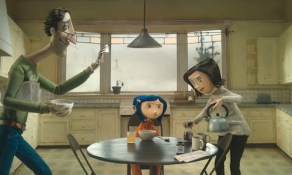 I find it hard to believe anyone could watch this and not enjoy much or all of it on a visual level. And if you don’t — honestly, are you sure you like films?
Only occasionally is one reminded that Coraline was filmed in 3D, when things poke out towards the screen or sink deep into it; but it’s not gratuitous, and if you didn’t know it was designed for 3D you might not even notice. The flattened sets and awkward perspective of the real world, versus the depth and beauty of the Other one, are still conveyed well in 2D. (I’ve had a brief look at the 3D version contained on the Blu-ray disc and will report my views on that another time, when I’ve attempted to watch it in full.)
Much like the animation, Bruno Coulais’ score is hauntingly beautiful. OK, it’s undoubtedly Elfman-esque, but it fits the film to a tee. Also in the audio realm (yes, this is a tenuous link to join two brief comments in a single paragraph), the voice cast are all spot-on, from seasoned pros like French and Saunders to bright young thing Dakota Fanning. Some may take issue with her vocal, or the character, but… well, allow me to employ a longer paragraph:
Reading some other reviews and their comments, it becomes apparent that one’s opinion of the film may depend a little on one’s opinion of Coraline herself. Roger Ebert, for example, considers her to be “not a nice little girl… unpleasant, complains, has an attitude and makes friends reluctantly”, though he notes that “it’s fine with me that Coraline is an unpleasant little girl. It would be cruelty to send Pippi Longstocking down that tunnel, but Coraline deserves it. Maybe she’ll learn a lesson.” For me, however, Coraline is an independent and strong-willed individual with good reason for most of her grievances. Does she need to learn a lesson? Undoubtedly. This is a fairytale, after all, and lesson-learning is more-or-less the point. Perhaps if you think Coraline is unlikeable and deserves the woes heaped upon her you’ll like the film less (I should add that Ebert gave it three-out-of-four, however); but if you get on with the character — and I’m certain many among the film’s supposed target audience, kids, would — then she’s a likeable companion to learn the story’s lesson with.
In general, I’m unconvinced by the criticisms I’ve read. Even those who assert it’s too scary for children tend to have shown it to kids who were too young — please, think about what Parental Guidance actually means before you go showing a PG to a three-year-old. All I can end with is a reiteration of my earlier comment: Coraline, in short, is excellent.

* I’m well aware I could choose any number of classic films whose reputation precedes them. The Dark Knight, however, is similar to Coraline in that it’s a recent release where we’re looking at a year or two of praise & rewards rather than decades of considered thought. Ergo, it’s a better point of reference.
Coraline begins on Sky Movies Premiere today at 10am and 5:30pm, and is on every day at various times until Thursday 10th June.
It placed 6th on my list of The Ten Best Films I Saw For the First Time in 2010, which can be read in full here.

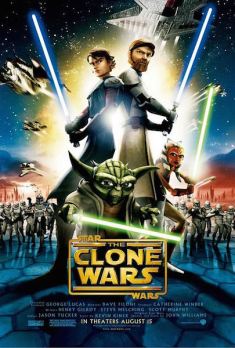 The Clone Wars can boast an awful lot of firsts within the
  Catherine Taber’s Padmé impression is probably the most convincing of the lot and, coincidentally sharing the same scenes, Corey Burton’s Truman Capote impression as Ziro the Hutt is entertainingly obvious. Count Dooku doesn’t particularly benefit from the involvement of Christopher Lee, but at least Samuel L. Jackson is vaguely recognisable lending his actual voice to Mace Windu. Most of the cast deliver the kind of performance you typically find in kids’ cartoons — i.e. not all that good, no doubt due to the pressures of producing as many episodes as possible as cheaply as possible. Dubious line readings abound, though in fairness this may be down to the awkward lines they’re forced to deliver.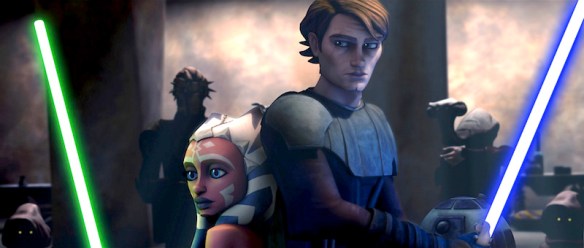
 It may sound like a piece of trivia that this was originally conceived as three episodes of
  it just doesn’t have the epic quality that imbued all the other Star Wars films. Not every film has to be an epic, even ones set within the same universe/storyline, but by wheeling out all the main characters and then showing them complete just one moderately low-key mission, The Clone Wars does feel like a single instalment of a TV series and not an appropriately-scaled cinematic experience.
 When I (first) reviewed
  is a new addition I swear, while he also listens to a (digital, at least) cassette player rather than an iPod (other MP3 players are available, naturally). It’s not a major flaw — unlike, perhaps, the fact that the “covert” and top-secret Nerv organisation has great big signs plastered all over town and everyone seems to know about them — but, still, maybe a new bit of animation to replace the tape-playing close-ups would’ve been nice.
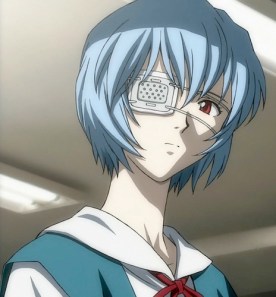 The pros and cons of the series remain. Shinji is alternately interesting, perhaps even complex, and a whiney little irritant. Here he has a character arc at least, suggesting he may be more sufferable next time out. His relationship with Major — sorry,
 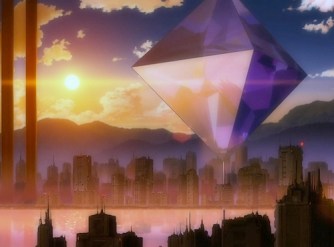 Another factor thrown up by the TV-series-to-feature conversion is the image quality. An HD big screen is a mixed blessing here. On one hand, it looks great on Blu-ray, with crisp lines and solid colours, the result of re-filming, colouring and CGI-ing the original animation elements rather than using the finished TV shots. On the other, such clarity sometimes shows up a lack of detail in the original animation — these elements were created for 4:3 mid-’90s TV, not a hi-def (home) cinema — and the solid colours and money-saving techniques (for example, showing something static rather than a lip-synched (ish) mouth during conversations) can remind the viewer of cheaper TV roots. Perhaps I’m being overly critical though, because much of it does look fabulous; at the very least, the thorough ground-up rebuild means it looks better than the TV series ever will, never mind has.
 It’s enough to make one scurry back to the series for answers, though the three movies still to come promise whole new characters, plots and a — frankly, much-needed — brand-new ending. After two misfires (one in the series, one in
 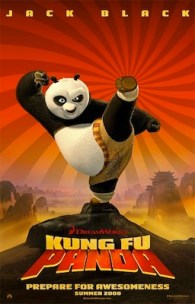 I nearly watched Kung Fu Panda on a plane once, but planes are rubbish places to watch films so I decided against it. (I watched
 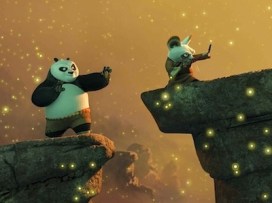 Panda features some beautiful animation — not a phrase you usually associate with CG ‘toons (though Pixar are pushing into this area with the likes of
 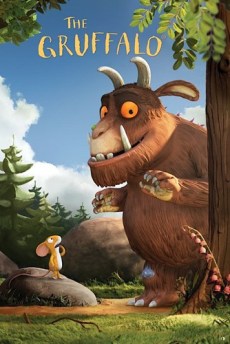 Julia Donaldson and Axel Scheffler children’s book The Gruffalo was a bit after my time but, I’m told, is incredibly popular with The Youth Of Today (not the ones that hang out on street corners earning ASBOs, obviously). It’s certainly a pleasant read, with rhythmic poetry and the kind of repetition that allows children to join in with ease, but it’s also quite short — fine for a children’s book, but not so good for attempting a screen adaptation of any length.
 Avatar is The Film That Changed Cinema. The past tense can safely be used, despite the film only having been out a couple of days — it doesn’t matter if we like it, filmmakers and Hollywood executives have decided it’s the artistic and commercial way forward, and so it shall be. It barely even matters if people actually go to see it; not that it’s in much danger of flopping, coming in the wake of years of extreme hype and numerous sycophantic reviews.
 The Wraith of Cobble Hill is a perfect example for this debate as its modern, urban story seems to clash with the cartoonish style employed to bring it to the screen. There are no flights of fantasy, few implausible shots, nothing that couldn’t be achieved in live action even on a low budget. Ultimately the only reason for it being animated is, why shouldn’t it be? Personally, I’m not convinced it works; at the very least, it distracted me enough to consider it.
 Having finished 2007 with
  Wallace and Gromit are phenomenally popular, as proven this Christmas Day when their latest adventure became the most-watched programme on British TV for three years (and that was just the overnights — ratings will rise when official figures are released in a couple of weeks). Not only that, but the TV premiere of
  100Films.co.uk