2011 #85
Sam Liu & Lauren Montgomery | 64 mins | Blu-ray | 1.78:1 | USA / English | 12 / PG-13
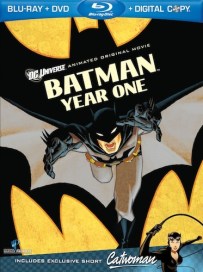 DC Comics’ latest direct-to-DVD animated movie is an adaptation of Frank Miller and David Mazzucchelli’s seminal 1987 Batman story, acclaimed as one of the greatest graphic novels of all time, and one of those that is often credited with helping the comic book medium grow up in the late ’80s.
The story concerns two men arriving in a sprawling metropolis that has become a rundown hive of criminal activity and police corruption. One a police officer, who sets out to be an honest force in a corrupt organisation; the other a billionaire who has trained himself to become a vigilante; both setting out to solve the city’s crime problem in their own way. They are, of course, Lieutenant James Gordon and Bruce Wayne, and the fact we know where this is going is incidental.
The film tells, quite literally, the story of Batman’s first year fighting crime — there are on-screen dates and everything. I say “quite literally”, but that’s not really true: Batman doesn’t turn up until a few months in. The plot description I’ve written above is actually a pretty decent variation of how the film pitches itself. Of course we know where it’s going, but it tries to make the emergence of the Batman concept more natural by treating it as if we don’t know. Because in the real world, dressing up in a cape and pretending you’re a bat is far from the first idea that springs to mind if you want to fight crime.
 As with the comic, this is a very down-to-Earth version of the Batman story. It’s even less sci-fi-y than Chris Nolan’s much-praised realistic films, in fact. There’s no Batmobile, no Batcave, no Bat signal, only a few gadgets (and those that are used are fully plausible), no cartoonish super-villains… This Gotham is a city where crime comes from gangsters, drug dealers, muggers and a thoroughly corrupt police force, and that’s what Batman sets out to fight. As in the Nolan films, the costumed foes will come later, a response to the Bat himself. It’s not afraid to take its time telling this story either. Especially at the start, the pace is very measured — there’s no rush to action or to Batman, but instead a slow build of character and drama. Some may see this as a flaw — those after a Batman Action Movie, largely — but it sets the tone for what is a more character-driven tale.
Top billing for the film goes to Breaking Bad’s Bryan Cranston, the voice of Jim Gordon. That might seem odd, but when you watch the film it becomes natural: there’s not just surprisingly little of Batman, there’s surprisingly little Bruce Wayne. It may concern the origin of Batman, but this is played as Gordon’s story; he’s the one who must face police corruption, a troubled marriage, personal threats, and hunt for the new vigilante stalking Gotham’s streets. Meanwhile, Bruce’s decision to adopt the Batman guise, plus his initial struggles to do it professionally, are conveyed in a couple of brief — albeit effective — scenes scattered throughout the film.
 Cranston, given easily the fullest character, gives the best performance too. Star of The O.C. and Southland, Ben McKenzie, was chosen to portray a 25-year-old Bruce Wayne in part due to his own youth. He’s fine when delivering dialogue, but his voiceover narration is oddly flat. Other ‘star’ name casting, like Battlestar Galactica’s Katee Sackoff or TV genre stalwart Eliza Dushku, only appear in small roles. Dushku makes for a surprisingly fitting Selina Kyle/Catwoman, considering the character design looks nothing like her. It’s a shame her story is such an aside — it would’ve been better to see some more of her and bring her up against Batman properly. Sackoff’s character, on the other hand, is just barely in it.
It’s been a good few years since I read the original comic, but it seems to me this was a pretty faithful adaptation — one of the reasons it’s shorter than the average DCU animated movie, in fact, is because they didn’t want to artificially draw out the story. This faithfulness certainly has its pros, but also cons. To put them succinctly, watching Year One can help you appreciate the work Christopher Nolan & company did expanding and rounding out the story when they more-or-less adapted it to make Batman Begins.
For those who’ve seen Begins but never read Year One, it’s not just the obvious “Bruce Wayne becomes Batman” plot that’s paralleled by Nolan’s work: there are numerous sequences, plot threads and themes that are taken almost verbatim from this telling of the story. These elements are integrated as one part of a different whole in that film, though — there’s nothing to do with Ra’s Al Ghul or the Scarecrow here. 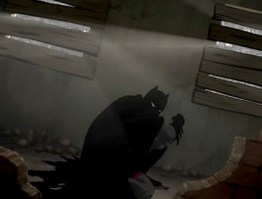 Indeed, you can tell Nolan cherry-picked most of Year One’s best scenes for his version, because they’re generally speaking the ones that shine here too. (It makes me want to watch Begins again to see just how much of this made it in there.)
The other con of being so faithful is that, unfortunately, some of what kind of works on the page doesn’t necessarily in a standalone film. The birth of Catwoman is a subplot that doesn’t really go anywhere, for instance. It has potential to, but it’s never adequately developed and certainly isn’t resolved. The comic gets away with this a bit because you’re aware her later development and adventures were already told, or will be told later, but in a standalone film it could do with rounding off. Despite the obvious fact that the whole point of the story is to setup Batman for future tales, Year One does manage an ending. Obviously it’s not completely resolved — as with any superhero film — but it rounds out much of what it set in motion… mainly, again, on Gordon’s side of the story.
As a film in itself, the animation is beautifully fluid, in particular creating some excellent fight sequences. Of course there are times when the limited budget of a direct-to-DVD feature shows through — the streets are always very empty during car chases; occasionally we see static shots where there should be some movement, especially during dialogue — but all told there’s nothing to really criticise and much to like. Christopher Drake’s music also occasionally shines through. I confess to missing the work of Hans Zimmer and James Newton Howard, which is Batman’s musical soundscape for me now, but Drake sensibly doesn’t try to ape their style and instead makes his own work.
 Unfortunately Batman: Year One has arrived at the party a bit too late to be the definitive screen telling of Batman’s origin — by taking the best bits of Miller & Mazzucchelli’s tale and expanding it with some work of their own, Chris Nolan & friends take that title. But as a film in its own right, Year One is largely successful. Children (or childish fans) seeking animated Batman thrills may be disappointed by its slower pace and focus on character, because this is solid adult-focused entertainment.
Batman: Year One is released on DVD and Blu-ray in the US tomorrow, Tuesday 18th October, and on HMV-exclusive DVD in the UK on Friday 21st October.

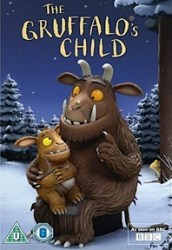 Shown on BBC One over Christmas, this animated adaptation of Julia Donaldson and Axel Scheffler’s The Gruffalo’s Child is the sequel to the Oscar-nominated adaptation of Julia Donaldson and Axel Scheffler’s The Gruffalo (of course). For my money, it’s every bit as good as the first film.
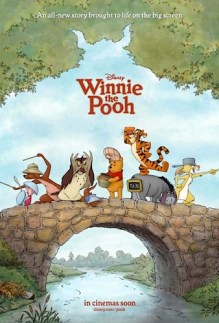 Winnie the Pooh, as many reviews on its release were keen to point out, is for small children. It doesn’t have the attempts to placate adults with their own jokes that elevate/plague most American animation; it’s only an attention-span-friendly hour long; and it has a lovely, genial, friendly tone, with brightly coloured characters, plinky-plonky songs and heartwarming moral messages.
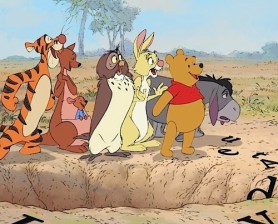 The majority of the film’s other elements click into place nicely too. The traditional animation is gorgeously executed, the voices are the ones we surely all know from growing up alongside Disney’s Pooh output, particularly Jim Cummings pulling double time as both Pooh and Tigger, as he has for decades. The exception I’d make is Bud Luckey’s Eeyore. I don’t know if he’s always sounded like that and I’d forgotten, but his voice didn’t work for me. It’s not the only problem: the songs can be a bit insipid; equally, a couple transcend that to work beautifully; and there’s no denying that it is a bit short; but then it doesn’t outstay its welcome, and hey,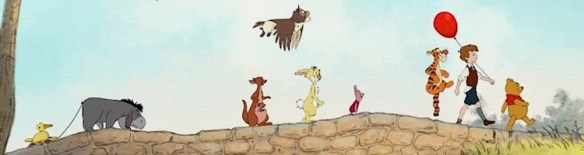
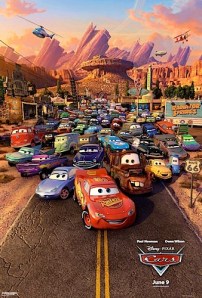 Since the creation of the Oscar for Best Animated Feature, only two Pixar features have failed to win:
  how the building of the interstate killed off so many small towns is both historically accurate (more or less) and emotional — but I imagine it also explains why the film can feel so long.
 having them talk to each other and giving them personalities, and it doesn’t need to make sense because his age isn’t even close to double digits and he’s just playing. But does that make it a viable idea for a film?
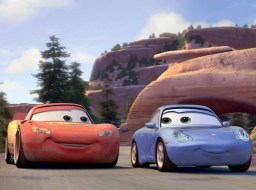 Cars is undoubtedly a below-par Pixar movie. It’s not a bad film — it has funny bits, exciting bits, a good moral message, some nice cameos and references and that kind of thing — but it doesn’t stand comparison to even a regular Pixar outing, never mind the best of their output. But hey, if you can produce 10 features that manage a 90%+ score on
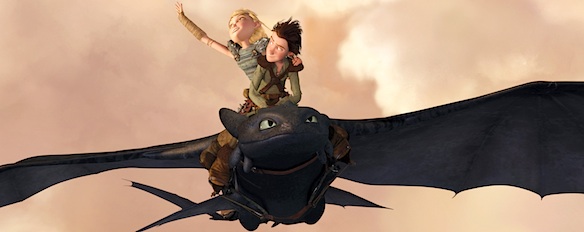
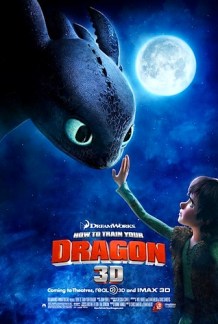 I saw a trailer for How to Train Your Dragon at the cinema a few months before its release. Having never heard anything of it, I thought it looked to have basic animation and a too daft tone. I wrote it off, expecting the kind of animated movie that would be slagged off as a Pixar-wannabe… and probably still land an Oscar nomination because there never seem to be many contenders for the animated feature award. Imagine my surprise, then, when it garnered endless positive reviews and a huge box office. What?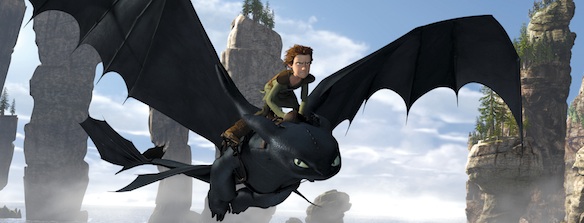
 With box office and critical acclaim sliding, Disney abandoned traditional 2D animation for their significant films in the early ’00s, switching to the computer-animated 3D that was doing so well for Pixar and Dreamworks. I don’t know if it helped the box office any, but it didn’t help with critics — it wasn’t the medium that was at fault, it was the storytelling. Notoriously, as soon as Pixar’s John Lasseter was put in creative control of the whole of Disney he instituted a return to 2D animation. The Princess and the Frog was the much-heralded first film after this change.
 there are just too many stacked up back to back for my taste. The voodoo material seems like it might be a bit on the scary side for kids, though maybe that’s just because too many children’s films are sanitised these days — I agree with the regular argument that it was better when films and TV aimed at kids included a bit of a scare or sadness, rather than more modern entertainment’s attempts to keep them wrapped in cotton wool for too long. The death of a character in the climax also sits in the same vein.
 where the musical numbers fit effortlessly into the flow of the story rather than stopping the film for a showpiece. This is also true of the very best entries in the canon —
  Disney’s 50th animated feature is Rapunzel in all but name, for no particularly good reason. It seemed to be met with universal praise on its release last year, critics hailing it as a return to Disney’s previous quality after a run of lacklustre releases, in particular the underwhelming return to 2D in the year before’s
  a number I usually particularly enjoy. It has one, I suppose, but it’s one of the weakest examples I’ve ever heard.
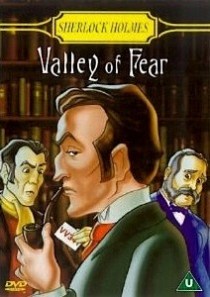 I don’t recall how exactly I came across these animated Sherlock Holmes adaptations starring the voice of Peter O’Toole as the eponymous detective, or how I came to decide to view all of them, but it’s been almost four years since I reviewed the first… and three years since I reviewed the third. Now, finally, I get to the final episode. Such is the erraticism of using LOVEFiLM. (At least I have an excuse for my dawdling here — my incredibly slow viewing of all the Rathbone/Bruce Holmses is entirely my own tardiness.)
 Once, a few years ago, SFX published an anime special (it was their first, I think) with a rundown of the Best Ever Anime Films. You’d expect it to be topped by something regularly cited and, considering the source magazine, science-fiction/fantasy-y —
  It’s not scary in the slightest (well, maybe in the slightest, for some kids, but note the U and G ratings), but in terms of how it balances real-life dramas with the fantasy element. Only in both the real and fantasy worlds it’s a lot nicer, friendlier and cheerier than del Toro’s acclaimed fantasy-horror. To put it more succinctly, they share a similar structure and balance, but a completely different tone.
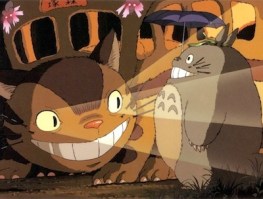 The English-friendly version has advantages too: I love any subtitles which use semicolons. It’s not inundated with them, but there was at least one. Semicolons are so underused. I love a good semicolon.
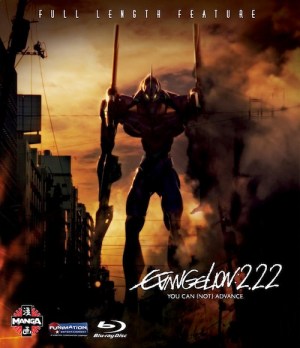 Just over a year since the
  For my money, the first 40 minutes or so of the film are (by and large) the best bits. It opens with a barnstorming action sequence, a great scene for newbies and fans alike as we’re introduced to Eva pilot Mari, who didn’t appear in the TV series. That she then disappears for most of the film, only to make a thoroughly mysterious return later, is one of those explanation-lacking flaws. I’m sure it won’t look so bad once the next two films provide us with answers. Well, I hope not.
 Then the gang take a trip to a scientific installation which is trying to preserve the oceans and their wildlife. It feels like animation shouldn’t be as effective for such a sequence as, say, the footage in a David Attenborough documentary, but nonetheless it feels extraordinary, in its own way. It also marks itself out with the interaction of the characters on a fun day out rather than their usual high-pressure monster-fighting world. And then it’s back to that world for another impressive three-on-one Angel attack.
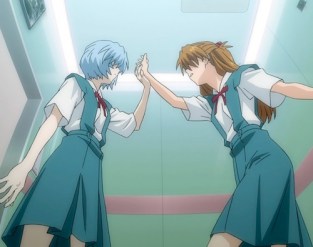 But it’s all building somewhere. For one, there’s another of the film’s best sequences — certainly, its most shocking, which readily earns the 15 certificate. I don’t want to spoil it for anyone yet to see the film, because it’s one of the plot points that differs from the TV series, but it involves the death of a main character in a brutal, deranged way. I say “death” — they pop up in the third film trailer that runs after the end credits, so there’s more to this yet…
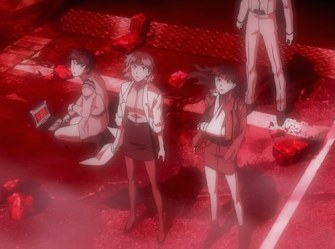 And then, after the end credits, there’s a brief scene that throws another spanner in the works! Double-cliffhanger-tastic… one might say…
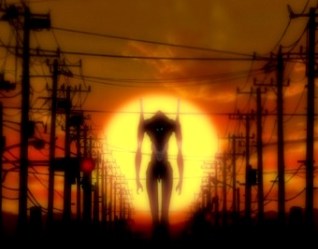 In short, if you’ve always liked Evangelion then you won’t be waiting for me to tell you this is a must-see reimagining; if
  100Films.co.uk