
Rich Moore | 101 mins | Blu-ray | 2.39:1 | USA / English | PG / PG
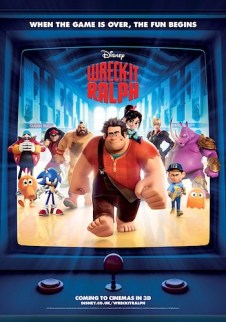 Disney’s 51st and/or 52nd animated classic (depends who you listen to) is, essentially, Toy Story with video games. Arcade games, to be precise. Turns out that all the characters from said entertainments hang out in the plug bar that powers them all, though behind-the-scenes they’re not necessarily like their characters — most of the villains are pretty nice guys, who have Bad-Anon (Bad Guys Anonymous) meetings to share their woes. But as the game he stars in reaches its 30th anniversary, Wreck-It Ralph has had enough of being an outsider, and when the other characters in his game imply he’ll be included if he can win a medal — which he can’t, because he’s a bad guy — he sets out into other games to try to get one.
Cue fun antics as our hero careens through various other games, right? Wrong. He goes to… two. OK, we see glimpses of a few more, and the Bad-Anon meeting takes place in Pac Man, but essentially he pops into one game to get said medal and introduce an apocalyptic MacGuffin, and then another for the rest of the plot. That latter game is Sugar Rush, a candy-themed cart racer. I’m pretty sure the production team must’ve spent the entire production eating candy for “research”, because the gaudy world and much of the film’s pace has all the idleness and restraint of a kid on a sugar high — i.e. none.
 Unfortunately, despite the rarely-filmed milieu of video games, it’s all a bit predictable — like I said, it basically does with video game characters what Toy Story did with toys, both in terms of the story and its themes of acceptance. At least one wearing subplot had me involuntarily exclaim “oh get on with it!” out loud (and I was watching by myself). The pace rarely lets up, and at 101 minutes that becomes tiring. When it does give you a break, you kinda wish it would get a wriggle on, because it’s obvious where things are going and it’s wasting time getting there. Of course, most mainstream films (especially kids’ movies) are going to follow broadly the same arcs — however bad it gets we know the hero will win, etc — but the trick is to make you enjoy the journey, not long to arrive at the destination. I spent most of the third act almost drumming my fingers as I waited for it to get to the latter.
For fans of retro — and indeed current — computer games, there’s plenty of cameos and references to be excited about, both in terms of familiar faces (various characters from Sonic, Mario and Street Fighter, for instance, amongst many others) and clear riffs on other franchises and genres. I’m not really a gamer though, so while I recognised many of them (from the days when I did engage in such pursuits) there wasn’t exactly a thrill in it. I think that pleasure of recognition, and some almost in-joke-level bits, can lead certain viewers to enjoy the film more than it otherwise merits. That’s nice for them, but does nothing for the rest of us.
 Wreck-It Ralph isn’t actually a bad film. There’s a fair bit of inventiveness with the concept, and the makers have worked hard to establish a world with rules (though your mileage may vary on how successfully they’ve done that), but it descends into a breathless, sugar-fuelled, reheated runabout. I imagine young kids will adore its colourfulness and its energy, and won’t be bothered by the over-familiar plotting and life lessons; but, beyond nostalgia for arcade gamers, I don’t believe it has huge amounts to offer a grown-up viewer.

Wreck-It Ralph debuts on Sky Movies Premiere at 1:45pm and 7:15pm today, and is already available on demand through Sky Movies and Now TV.
This review is part of the 100 Films Advent Calendar 2013. Read more here.
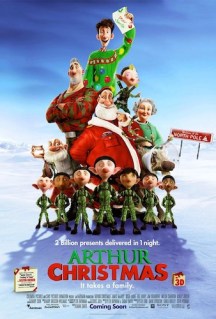 Aardman’s second CG feature attracts a starry cast (not just the leads — check out who’s credited as “Lead Elf”!) to the story of how Santa really delivers all those presents in one night: a giant spaceship-like craft and thousands of SAS-esque elves. But when one child is missed, Santa’s clumsy son Arthur resolves to fix it.
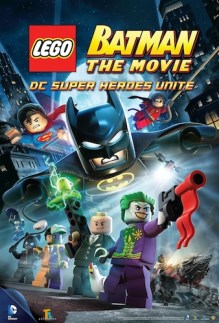 Well. What can I say? Curiosity got the better of me.
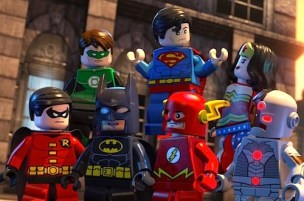 This wouldn’t matter so much if what was left was entertaining, but it’s a little weak. I’ve seen a couple of the LEGO Star Wars TV specials and found them to be quite fun, but LEGO Batman can’t reach their level. It’s not just that it’s almost four times as long as one of those, it’s that the humour it does contain doesn’t hit home in the same way. It’s often too juvenile, too “that’ll do”, too “I can tell this is supposed to be humorous but it’s just not funny”. I know I started by saying that I just watched this through curiosity, but partly it was that I’d found those Star Wars specials enjoyable enough and thought this would be more of the same with superheroes. It wants to be, but it isn’t.
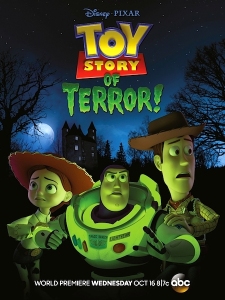 The fourth
 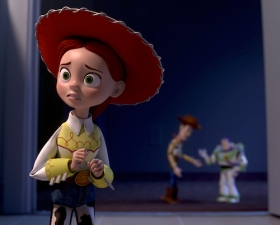 The second half is more familiar Toy Story stomping ground — indeed, if there’s one bum note, it’s that the villain and his ‘plot’ are almost a rehash of
 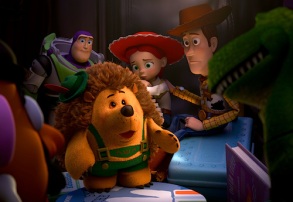 Apparently Toy Story of Terror! spent two years in development. While that might seem excessive for a mere under-half-hour animation, the time and effort have paid off handsomely: the result is a thoroughly entertaining short — and one that actually embraces its seasonal theme, rather than forcing it in as an afterthought. Terrific.
 The island town of Swallow Falls exists for one purpose: sardines; the fishing, packing, and distribution thereof. But when the world suddenly realises that sardines are gross, the town’s economy is left in tatters and the only foodstuff the islanders have is sardines. (While we’re on the glum bit, the location of Swallow Falls is identical to the real-world location of Bermuda, except in this reality almost every inhabitant is Caucasian and the island is indisputably part of the US. This is why you don’t scrutinise the geopolitics of kids’ movies, especially American ones.)
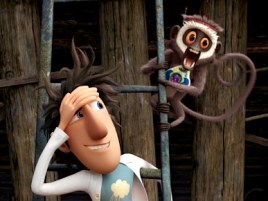 not an unworthy aim, and something Cloudy also achieves, but not a main consideration in my personal assessment of things. The main selling point is that it’s very funny. Of course there’s the slapstick cartoon humour, which is well done, but there’s also a lot of great one-liners, random asides, and the like. Not ‘adult jokes’ by any means, but I think it makes the film fun for grown-ups too.
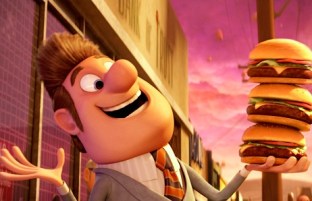 He’s a very funny character, but that’s in the writing, directing and animation — the voice work is spectacularly minimal. Apparently Harris was offered the lead but turned it down for the “more interesting” part of Steve. Nothing against Hader, but if I were the directors I’d have tried to persuade him to do both.
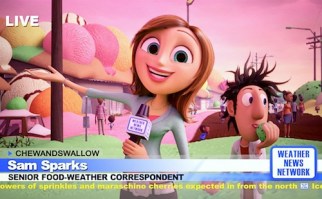 I should probably learn to stop writing off non-Pixar animated movies so readily (and, based on what I’ve heard and seen of their last few efforts, maybe slacken off on the Pixar love. I say that as if it’s news — plenty of people already have; and I’ve never been wholly on that bandwagon anyway. But I digress…) Big, bold, colourful, funny and exciting, Cloudy with a Chance of Meatballs is the kind of film I imagine a lot of kids love and watch on loop. In the process they may even be learning some Important Moral Lessons, which, crucially, aren’t too heavy-handed. Many of these aspects work for adults too. I don’t know if you’d want to watch it on loop, but you may certainly want to watch it again.
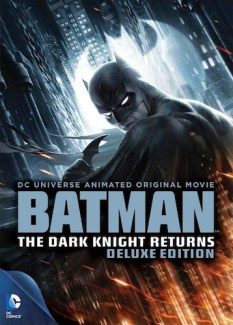 Warner Premiere’s $7 million animated adaptation of one of the seminal graphic novels is here rejigged from its original
  one of which is basically a climax before the halfway mark. Considering Miller’s original structure, that arguably leaves the film with a good three or four climaxes scattered throughout.
 and a feature-length documentary all about the original graphic novel,
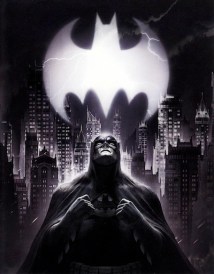
  While I’ll continue to champion viewing the two halves of The Dark Knight Returns as separate movies, this single-film version is far from a travesty. If you’ve already got the separate releases, it definitely isn’t worth picking this up just for the film; so a purchase depends on how much value you place on the commentary and Masterpiece documentary (oh, and four art cards found in the box, which I’ve used to illustrate this review). If you don’t own the existing releases then whichever way works out as most cost-effective (bearing in mind which extras can be found where, of course) is the way to go.
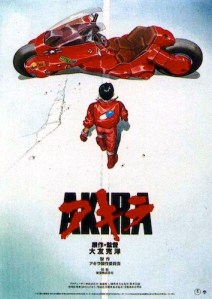 For many Westerners of a certain generation, Akira was their first (conscious) exposure to anime. Not so me: a step or two down,
 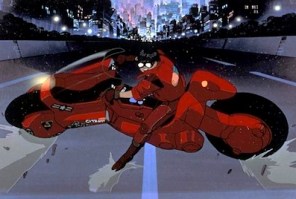 The visuals remain something to be savoured; they’re probably the film’s strongest point, in my opinion. Akira was an expensive production and it pays off on screen. It’s not just the bike chases that I appreciated either, while an extra decade of experience made the ending a bit less freakish! The other strong point is the audio. The BD’s booklet goes on about “hypersonic” sound. I’ve no idea if that worked on my system, but it sounded fantastic regardless.
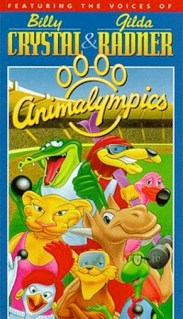 Originally commissioned as a pair of specials for US TV, Animalympics was dropped by the network when the US pulled out of the Moscow Olympics, then repurposed by its makers as a feature film. You might be able to guess the plot from the title: various animals compete in an Animal Olympics. It’s a series of sketches, essentially, although arranged to provide some narratives throughout.
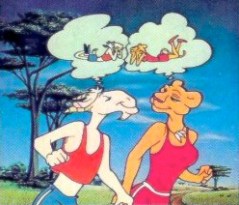 As per anything which is made up of sketches, some bits are funnier than others; and, as American animation, it is primarily aimed at kids, though I thought it was enjoyable enough for grown-ups too. Gouldman’s score is catchy in places, but nothing to rival The Things We Do For Love or Dreadlock Holiday or… I could go on for a few, actually. I’m just going to go listen to some 10cc…
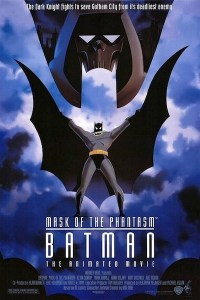 Batman movies have a habit of provoking strong reactions.
 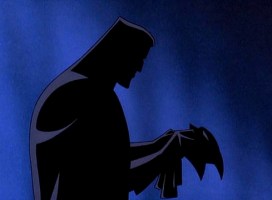 One of the main reasons the film succeeds is that look back at Bruce Wayne’s early days as a crime fighter. Batman’s origin is oft told — too oft, truth be told — but they thankfully don’t rehash it here. Instead, early in Batman’s career Bruce falls in love and finds happiness, causing him to question whether to continue down the path he’s already dedicated his life to. The scene where he talks to his parents’ grave, expressing his guilt at potentially finding happiness after so much mourning, is one of the most powerful, emotional moments in all of Batman’s many iterations.
 But instead of falling in some nasty halfway-house, Phantasm turns up trumps on all fronts.
 The two-part animated adaptation of Frank Miller’s comic, regularly voted among the top three stories ever told in the medium, concludes here. If you’ve not seen
 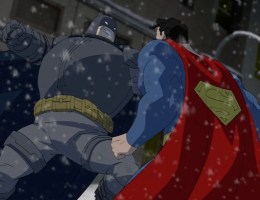 Nonetheless, a pair of big battles form the cruxes around which the story works: Batman vs the Joker, and Batman vs Superman. I won’t spoil the outcomes for those who’ve not read the book, but both are excellently realised on screen. Action can be tricky in comics — you’re stuck with a series of still images to convey fast-paced, often intricate movement. I also generally have the impression that action sequences are not 2D animation’s forte — too many frames need to be drawn, too many different angles to make it quick and exciting enough. The Dark Knight Returns is one of the exceptions, however, and the two big sequences in Part II — as well as a couple of smaller ones — outclass anything in Part I, which was good in the first place. I’d go so far as to say the Superman fight improves on the novel’s version, at least in a visceral sense — Miller delivers Batman’s internal monologue and a certain pleasing disregard of Supes, while Oliva wisely skips any kind of voice over and delivers the entire duel blow for blow. It’s a fantastic climax.
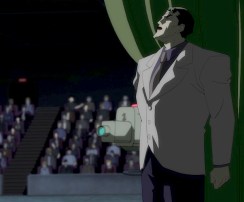 The story may provide some déjà vu for those only acquainted with live-action Batman, because Christopher Nolan borrowed liberally from Miller’s TDKR for his TDKR,
  There were many sceptics when DC first announced they were going to tackle such a sacred Bat-story, and not all were convinced by Part I. I don’t imagine Part II will change their minds, but for those of us who did enjoy the first animated interpretation of Miller’s seminal tale, this is even better. In fact, even without its first half, I’d say it joins the ranks of my very favourite Bat-films.
 100Films.co.uk