2014 #134
Steven Spielberg | 107 mins | Blu-ray | 2.35:1 | USA & New Zealand / English | PG / PG
 1981: Steven Spielberg reads a French review of his movie Raiders of the Lost Ark. His high-school-level French serves him well enough, although there’s repeated use of one word he doesn’t know: Tintin.
25 years later: Spielberg has been struggling to make a film version of Hergé’s character for quarter of a century. While developing a live-action version that would feature actors under heavy prosthetics so as to resemble their comic book counterparts, he realises Tintin’s famous dog, Snowy, will need to be computer generated. He reaches out to Peter Jackson and Weta, fresh off their ground-breaking work on The Lord of the Rings. Their test footage is so successful, it gives Spielberg another idea…
2011: after 30 years, Spielberg finally brings the boy reporter to the big screen as a motion-captured animation. Reviews and public reception are mixed, particularly in the US, but they’re all daft because The Adventures of Tintin: The Secret of the Unicorn is bloody brilliant.
Combining events from three of Hergé’s original albums, the story sees Tintin (Jamie Bell) purchase a model ship that is highly desired by the mysterious Sakharine (Daniel Craig). A riddle hidden inside the model sets the ever-inquisitive reporter on a quest to find out what nefarious deeds Sakharine is planning, along the way bumping into drunkard Captain Haddock (Andy Serkis), who holds the key to the entire mystery. Cue a globetrotting adventure that, yes, is very much in the Indiana Jones mould.
 Apparently some Tintin purists weren’t so keen on the actual adaptation — elements of The Crab with the Golden Claws have been mixed in to a plot primarily taken from The Secret of the Unicorn, the sequel/second half of which, Red Rackham’s Treasure, is reportedly used sparingly. Plus, in the original tale Sakharine is a minor character who wasn’t responsible for much, apparently. As someone who’s only read one of those three volumes, and even then not since I was young, such things didn’t trouble me. What superstar screenwriters Steven “Doctor Who” Moffat, Edgar “Cornetto trilogy” Wright and Joe “Attack the Block” Cornish have captured is the spirit of Tintin: an engrossing mystery-adventure, laced with gentle satire and smidgens of slapstick comedy, but with real stakes and peril too.
A talented cast are up to the task. Bell adopts a posh-ish accent for the titular hero, and while some of the accusations of blandness aren’t wholly misplaced, he’s plucky and determined enough to make for an appealing lead. The king of mo-cap, Serkis, is able support as Haddock, while Craig makes for a very effective villain — I hope his post-Bond career, whenever that arrives, sees him playing villainous roles more often. Interestingly, it was his mannerisms that have survived the animation process the most. I mean it in an entirely non-critical way when I say every other character could have any actor behind the mo-cap baubles, but Sakharine’s face and body move with all the recognisable movements and expressions of his actor.
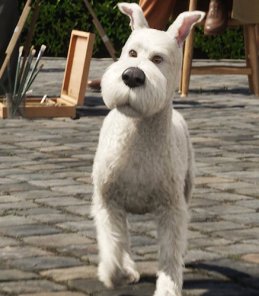 The slapstick is mainly hoisted by Simon Pegg and Nick Frost as the physically-identical Thomson and Thompson — a true advantage of animation, that. I imagine some find their parts tiresome because of their inherently comic role, but they’re likeable versions of the characters. Even more joyous is Snowy, though. Well, I would like him, wouldn’t I? His internal monologue, such a memorable part of Hergé’s books, is omitted (as it is from every film version to date, I believe), but he’s full of character nonetheless. Some of the best sequences involve Snowy running in to save the day. I don’t think they quite got the animation model right (the one glimpsed in test footage included in behind-the-scenes featurettes looks better, for my money), but his characterisation overcomes that.
Bit of an aside, but I think there’s something notable about almost everyone mentioned so far: Moffat, Wright, Cornish, Bell, Serkis, Craig, Pegg, Frost… All British. I know that’s because we’re awesome ‘n’ all, but I think it’s also indicative of Tintin’s status in the English-speaking world — which more or less boils down to “unknown in America”, but also “pretty darn popular in Britain”. At least Spielberg, the man who wanted to cast an American as Harry Potter, seems to know this (further evidence: they’ve hired another British screenwriter for the sequel). For whatever reason, Tintin has never clicked in America, while the books remain very popular over here. It therefore feels like there’s a better chance for the films’ fidelity by using Brits (who have the correct tone and style almost ingrained) than by using people coming to the stories entirely for the first time, and perhaps bringing a more generic blockbuster sensibility. On the other hand, this might just be a horribly xenophobic way of interpreting a coincidental appearance by so many Brits in key roles — after all, Tintin’s Belgian, so it’s not like using Brits is “true to source”.
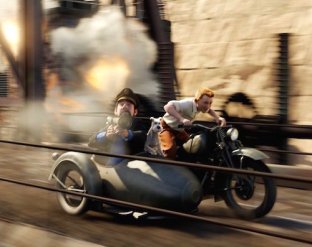 Of course, one very important person is neither British nor Belgian: Spielberg. The screenplay’s balance between peril and comedy is spotlessly enhanced by his peerless direction. In a world stuffed to the gills with lesser blockbusters that palely imitate the groundwork Spielberg and co laid in the ’70s and ’80s, work like this should remind people why he’s still the master of the form. The film is shot with an eye for realism (so much so that some viewers have been convinced it was filmed on real locations with real actors, with some CG augmentation for the cartoonish faces, of course), which helps lend a sense of plausibility and also genuine jeopardy. It’s easy to get carried away when working in CG animation, but often the most impressive works are ones that behave as if they’ve been shot largely within the limitations of real-world filmmaking technology.
That said, Spielberg isn’t afraid to make use of the freedom afforded by working in a computer-generated realm when appropriate: there are some spectacular individual shots, the most obvious being a single-take chase sequence down a hillside through a town. Even better are some of the transitions, which would be literally impossible to realise in live-action — without resorting to effects work, anyway. They’re hard to accurately describe, especially without ruining them, in part because each instance is different; but they do all look incredible, and, again, serve the story rather than being flashy for the sake of it.
 The tone on the whole is resolutely PG — actually, like many an action-adventure blockbuster used to be before everything went slightly darker and PG-13. So, for example, Tintin wields a gun on occasion, but never at another human being. The focus is on the story, which happens to lead to some adrenaline-pumping sequences, rather than a lightweight excuse to link together a bunch of punch-ups and chases. Ironically (though, for anyone who knows what they’re talking about, entirely expectedly) this makes the action all the more exciting. It also mean there’s a lighter touch than many current blockbusters offer; a greater presence for humour, including among the action. I guess that’s not fashionable these days, when everyone’s become so po-faced about their big-budget entertainment. However, with the likes of Iron Man and Guardians of the Galaxy proving immensely popular, perhaps the tide is turning, and maybe the still-on-the-cards Jackson-helmed sequel will find itself better received because of that.
I genuinely don’t understand the muted reaction to this first Tintin, though. It perhaps shows where blockbusters have gone awry in the last decade or two, and perhaps the incidental disdain animation is viewed with among some — I wonder: if the same movie had been produced in live-action, would some of those critics have been better disposed to it? I don’t think it would have actually been a better film, and perhaps it would even have been slightly worse (some of the visual impact would be lost),  but some viewers would have seen it (even subconsciously) as more of a “real movie”.
As I said at the start, those people are Wrong. The Adventures of Tintin is a fantastic adventure movie, and should prove to anyone who doubted Spielberg after Kingdom of the Crystal Skull that, when it comes to globetrotting action-adventures, he’s still the man to beat.
The UK network TV premiere of The Adventures of Tintin: The Secret of the Unicorn is on BBC One today at 4:25pm.
It placed 2nd on my list of The Ten Best Films I Saw For the First Time in 2014, which can be read in full here.
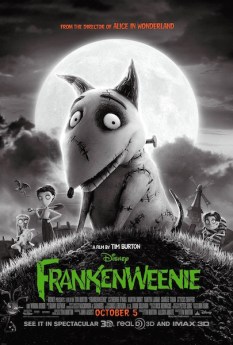 Inspired by two of Burton’s early-’80s shorts (which are most commonly found on Nightmare Before Christmas DVDs), Frankenweenie takes the black-and-white stop-motion visual style from Vincent and the storyline from the live-action Frankenweenie, and expands them out into a feature-length offering.
 Some say it doesn’t have enough of an edge. Well, maybe; but I thought it was surprisingly dark in places. Not so considering it’s a Tim Burton film based on resurrecting the dead, but for a Disney-branded animation, yes. Those edgier bits are here and there rather than consistent, but still, I’m not sure what those critics were expecting from a PG-rated Disney animation. I guess there’s an argument that Burton should have pushed it further and aimed for an adult audience, but can you imagine an American studio agreeing to finance an animation primarily targeted at anyone who’s entered their teens? Because I can’t.

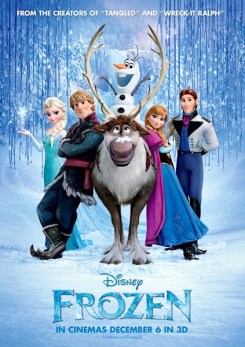 Frozen is a grim single-location thriller about three college kids trapped on a ski-lift overnight, battling hypothermia and worse over a hundred-foot drop. Or at least it was until last year, when Disney went and released its all-consuming mega-musical.
  Unlike the best Disneys, however, I think its appeal resides firmly with little girls — you don’t actually have to go very far on the internet to find people baffled by its success. Plenty of people think the music is bland, the characters underdeveloped, the moral and emotional arcs not fully thought-through, the visual style a rip-off from
 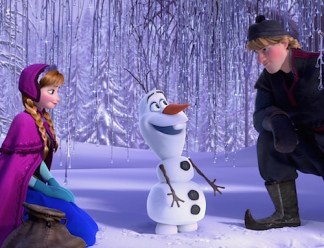 The lack of villain’s song is attributable to the fact that, for nearly the entire film, there are no nasty characters. A villain emerges right at the end to give us a climax, but for once that works — a genuine twist! It’s almost a shame it has to resort to that, but how else do you end a Hollywood movie other than a big dramatic confrontation? Plus, aforementioned snowman Olaf confounded my expectations, pulling off the quite remarkable feat of not being the most irritating CGI character since Jar Jar Binks. (I don’t know who is the most irritating CGI character since Jar Jar Binks, but Olaf is alright.)
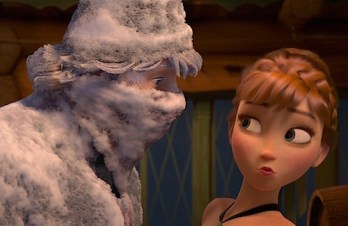 It’s not bad — it’s adequately cartoony — and actually the ice and snow effects are very, very good. It’s the character animation that I felt let it down, especially some of the more minor roles — there were points where their style and movement looked little better than you’d find in a video game cut scene.
 Frozen is by no means a bad Disney movie, and it does have a lot of favourable aspects. Whether the internet’s right and it’s not as good as Tangled, I wouldn’t care to say (I enjoyed Tangled, but at this point have largely forgotten it); conversely, the sometimes-rabid fan base are perhaps being a little over-enthusiastic. There’s nothing wrong with a kids’ movie being beloved by kids, though; and with all the dreadful things the media churns out for little girls to obsess over and centre their life values around, this is undoubtedly one of the most positive.
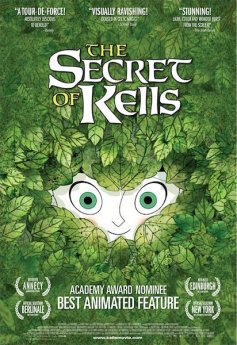 You can lament the quality of Oscar voters’ choices all you want, but if it wasn’t for their 2010 Best Animated Feature nominations I’m not sure many would have heard of this Celtic gem.
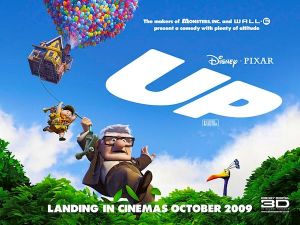 You know Up: it’s the Pixar movie where everyone talks about how amazing the first 10 minutes are, and never seems to have anything to say about the rest of the film.
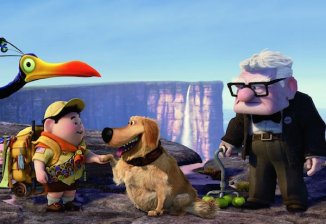 the best bits were shown off in advance. The special features reveal the extent the animators went to when researching real-world locations to influence the film’s strange, alien landscape; sadly, the fact the bizarre rock formations are actually a real thing somewhere in the world is more interesting than how they’re used in the film.
 There seems to be a certain brand of animated film that I think looks dreadful so avoid, then I hear good things about, so I try it and find that, actually, they are really good. There was
 On Blu-ray,
  The best of the bunch is Super Manny, because Manny’s always fun and it’s the most inventively zany. Worst is Earl Scouts, because it’s just a poor Tom & Jerry / Itchy & Scratchy riff — Sky viewers won’t be missing much by not seeing it. Attack of the 50ft. Gummi Bear! falls somewhere between those two stools, as I suppose does Steve’s First Bath, though slightly less objectionably so — there’s fun to be had in how it sets up Flint’s grand uber-romantic date, then how it’s trashed by Steve and the robot built to wash him.
 On the whole, the shorts are passably entertaining if you like slapstick-y 2D animation and want to kill quarter-of-an-hour (or 22 minutes with Earl Scouts thrown in). But there’s nothing particularly innovative or original about any of them — certainly not worth going out of your way for.
 A sequel to the suprisingly-good-in-spite-of-its-name animated comedy, Cloudy with a Chance of Meatballs 2 (innovative title; though better than its original moniker, Revenge of the Leftovers) begins mere minutes after
 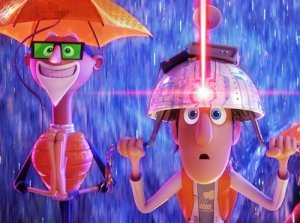 The villain this time is a thinly-veiled riff on Apple and its messianic founder, Steve Jobs. Here they become the aforementioned Life Corp, whose logo (and headquarters) is a giant lightbulb, and the equally-aforementioned Chester V, Flint’s childhood hero. As with almost all hero-since-childhood characters, you can guess where that’s going from the moment he appears at the start of the opening montage. Nonetheless, his storyline and relationship with Flint mostly works — it does take Flint a long time to reach the point of realising The Truth, but for viewers the reveal comes earlier and isn’t treated as an inappropriately big shock. Again, kids less familiar with movie tropes will be even more accepting of it. Plus there’s a Moral Message there for said kiddies (naturally), this time about trusting in your friends. It’s all familiar fare to an adult viewer, but doesn’t dominate to the point of boredom.
 In the end, Cloudy 2 isn’t quite as good as the first film, but not in a “notably inferior” way. It remains relentlessly entertaining, with an admirable energy and drive, which is in part a desperation to not be boring, but not in a shallow way. It may lack the extra little something that the first one has, but if that was an 8-out-of-10 then this is a 7 — which, because it’s fun rather than disappointing, rounds up to:
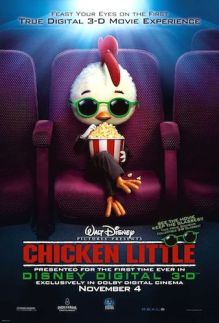 The director of Disney’s woeful
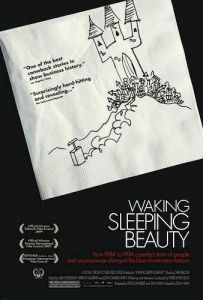 However, Waking Sleeping Beauty is told from the inside: director Don Hahn started out as an assistant director at Disney animation in the ’80s, graduating to producer by the time of Beauty and the Beast. With him he brings behind-the-scenes home movies and access to a stunning array of interviewees. Almost everyone who was anyone at Disney during that time is interviewed, either through archive footage or new audio commentary. It was a tough time, and while Hahn’s portrait is probably not quite warts-and-all, it comes damn close; for example, we get to see some of the caricatures the animators drew in disgust at their new boss, Jeffrey Katzenberg.
 100Films.co.uk