
Pete Docter | 95 mins | Blu-ray | 1.78:1 | USA / English | U / PG
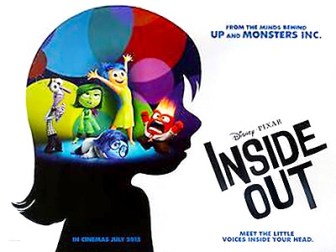 Pixar haven’t had the greatest start to the second decade of the 21st Century. After somehow managing to get lightning to strike thrice with Toy Story 3, they released two mediocre sequels (Cars 2 and Monsters University), and their only original film of the period, Brave, endured a mixed-to-poor reception also (I’ve still not got round to seeing it). This might go some way towards explaining why their release for this year has attracted such acclaim, despite it offering a pretty rote storyline dressed up in some fancy ‘original idea’ clothing (not that it is a truly original idea) and a modicum of genuine emotional resonance.
You see, this is the story of Riley (Kaitlyn Dias), an 11-year-old kid who moves from her small home town to San Francisco and struggles to cope. That’s because the anthropomorphised emotions who live in her head and control her moods and memories are thrown for six, especially when de facto leader Joy (Amy Poehler) and the accidentally-ruinous Sadness (Phyllis Smith) get sucked out of the control room and in to the depths of Riley’s memory, from where they have to find their way back in time to sort everything out. Fancy idea: anthropomorphised emotions. Rote storyline: mismatched pair get lost, have to find way back in time to fix things. Genuine emotional resonance: once-happy 11-year-old kid rendered miserable and struggling to find her place.
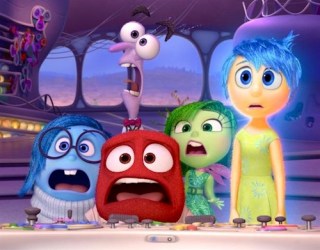 It surprises me not a jot that a Pixar film has been over-praised by critics and initial viewers. That’s pretty much my view of the their last couple of efforts before the recent doldrums, too. Those were, specifically, WALL-E and Up, both of which feature incredible, innovative, boundary-pushing openings followed by rote, familiar, genre-bound second halves. They’re both good films, but the five-star bits are contained within the first 10 to 30 minutes, followed by three- or four-star entertainments for the rest of the running time. Inside Out isn’t quite the same, because the super-high-quality bits aren’t concentrated anywhere. Instead they’re sprinkled here and there, moments of cleverness (though not genius — as I said, the concepts aren’t exactly original) hung on an easy, well-worn formula.
You don’t have to dig very deep into the Blu-ray’s special features to get an idea of how this happened. The story went through many, many, many iterations over the years and years it was in development. No wonder they wound up beating it into such a familiar shape as the quest narrative. It may also explain why some events don’t quite seem explained. I could’ve missed something, of course, but I was wondering why they were demolishing stuff in Riley’s Imagination Land until a deleted scene (culled from a very different take on the story) explained it. Many of the characters are just built from archetypes, too, like a sports-minded dad who doesn’t actually listen to mom — never seen that anywhere before!
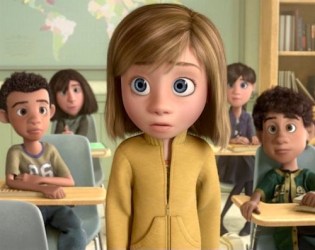 It certainly isn’t as clever or meaningful as some people have tried to make it out to be. For example, a whole internet discussion was sparked by the fact that Riley (an 11-year-old girl, remember) has emotions that are personified as a mix of male and female. When we get a glimpse inside other characters’ heads, their emotions are all of a single gender. ‘What is this saying?’, the internet wonders. Is it to do with the fact that all gender is fluid? That gender is fluid pre-puberty? As Riley is the only one with these mixed genders, are we meant to infer she’s transgender? Fertile ground for discussion. In fact, the answers are: no, no, and no. Director Pete Docter has said he just felt some emotions were more masculine (Anger in particular) and so that’s why they’re male in Riley’s head. Why the single genders in other characters? Shorthand. We only meet them briefly, after all.
Of course, now we’re touching on the issue of the relevance of authorial intent versus consumers’ reading of the final work, which isn’t a discussion I have much interest in engaging with right now. Suffice to say, whatever anyone’s readings of gender issues in Inside Out, none were intended by the filmmakers, and so you’re projecting something on to it rather than being able to unearth a coherent statement.
In other matters, there are some nice jokes and nods aimed squarely at adult viewers, the best being a passing reference to a ’70s noir. (Yes, really. Don’t worry, you’ll spot it.) Meanwhile, the animation and design is fine. I feel that’s the best I can say about it, 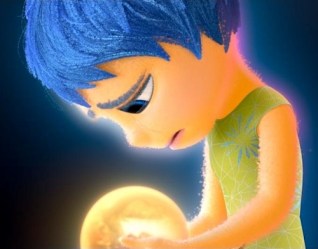 other than that the loose, floating, ‘bubbly’ edges of the emotion characters are quite neat. Apparently the effect was originally meant only for Joy and was immensely difficult to animate, but just as it was to be scrapped John Lasseter commented on how great it was and asked for it to be added to all the characters. Well done Mr Lasseter, though apparently it was an absolute headache for the technical team.
I do wonder if it’s just because this is the first really good original Pixar film for quite a long time (six years and five films on from Up, to be precise) that it’s gone down so well. It is good — there are some neat ideas and a strong moral lesson (even if, as with everything else, it’s not a totally original one; though from the way it’s discussed in some circles (not least the film’s own special features), you’d think it was a philosophical revelation of Nobel-winning proportions). In some respects, these qualities makes it almost a return to Pixar’s early praise-magnet form, which is enough for some to go wild for it. For me, the style and shape of the story those elements are airlifted into is so familiar that there’s little room for surprise (one highly emotional moment excepted). Maybe clearer heads will eventually prevail and people will rein it in a little.

Inside Out is released on DVD and Blu-ray in the UK tomorrow.
 The second release in Warner Premiere’s series of direct-to-video DC Universe Animated Original Movies (which now stretches to
 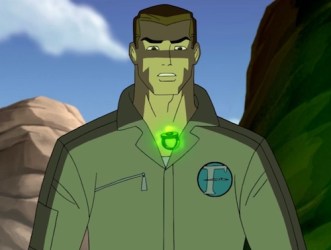 However, there are definitely bits that could’ve been sacrificed or abridged further (the Flash’s two early action sequences, for instance) to make more room to tell the story in full.
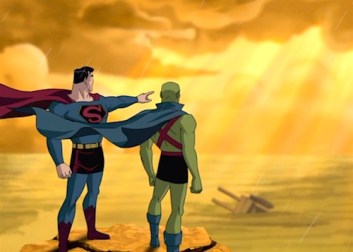 I really wanted to like The New Frontier, for all sorts of reasons. It does start well, with moments of promise sparkling here and there, but the longer it spends juggling so many balls, the fewer it can keep flying smoothly. (Do balls “fly” when juggled? Anyway, you get my point.) Considered as a whole, the overall result is fairly disappointing.
 Four years ago, DreamWorks’
  Tonally, DeBlois has been productively inspired by
  If there’s a flaw, it’s in some of the new characters. The primary villain is underused, introduced too late in the game to become a palpable threat. More time spent building him up, seeing his evil on screen rather than just being told about it, would’ve been appreciated. So too for the mysterious vigilante dragon-rider, who turns out to have a very significant role. The deleted scenes include a prologue that would have introduced the character at the start, which would have better established the mystery and import of their role. It’s clear why it was deleted (to focus on Berk and keep the initial tone light), but I still think it would’ve worked better in the film. In the final cut, the vigilante is mentioned all of once, then turns up and is unmasked about two minutes later. Really, though, these are niggles — even for them, the cumulative consistency is certainly better than, say, its Oscar conquerer
  The kids’ phenomenon of the ’80s/’90s has never quite gone away, and this film is one thing that kept it ticking over in the ’00s. I watched out of nostalgia, which may’ve been a mistake.
 From the heart of Disney’s most recent poor period, Lilo & Stitch is possibly the only film that comes out of that era with any affection. Certainly, it spawned several sequels and a relatively-long-running TV series. By the standards of the films that surround it, it’s a good’un; in the grand scope of all Disney films, however, I didn’t care for it that much.
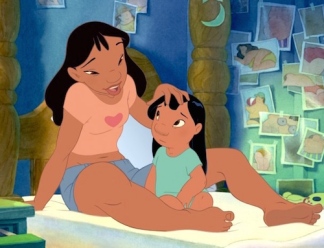 The story is something and nothing. Despite strong and relatively mature thematic notes, it doesn’t quite break free of the family-movie trappings to achieve the kind of insight or age-group transcendence that, say, Pixar movies routinely manage. For kids, though, especially ones who are feeling like misunderstood outsiders, there might be a lot to take from it. The zany antics of the heroes might also work for them in a way they didn’t for me — the ‘craziness’ comes across as a series of vignettes to bide time until the climax, and I didn’t find it massively engaging either. This is also the stage at which Disney had decided musicals were a Bad Idea, so there’s only a couple of non-diegetic songs to keep things ticking over, and… well, your mileage may vary.
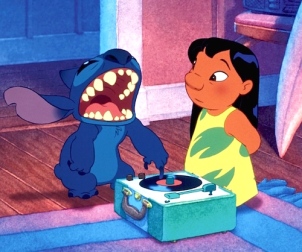 that might be missed by many a viewer, but it gives a subtly different feel. It’s a little more classical, which sits nicely against the very modern zany-aliens storyline.
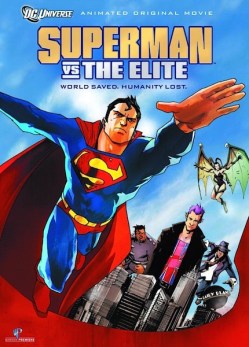 Adapted from acclaimed comic book story What’s So Funny About Truth, Justice & the American Way?, this DC animated movie sees the methods and morals of Superman (George Newbern) being questioned by the public and authorities alike when a super-villain escapes for the umpteenth time and kills more innocent bystanders. In the incident’s wake, a new super-powered team emerges — the titular Elite, led by Manchester Black (Robin Atkin Downes) — and their preparedness to execute criminals is met with great popularity around the world. How much humanity is humanity willing to sacrifice in the pursuit of conflict resolution? Are Superman’s high morals a thing of the past?
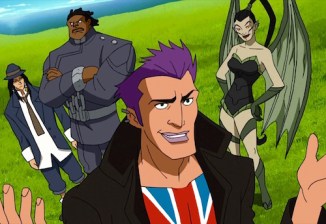 I assumed they were being faithful to a comic that hails from the ’80s, but it was actually published in 2001. It’s like Brit Pop never happened.
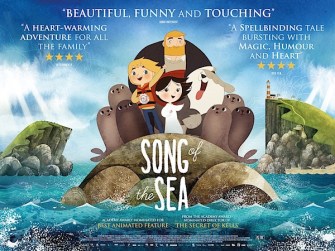 The second feature from director Tomm Moore and his pan-European team of animators (after the excellent, Oscar-nominated
 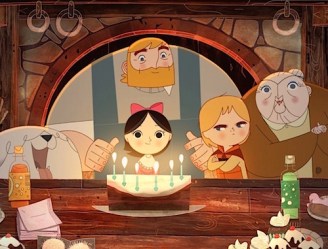 but the motivator for that is clearly resentment towards her for appearing the night his beloved mother left. Their father, too, is hamstrung by his grief, struggling to move on from his wife’s disappearance and fully engage with the world. His kids are his only connection, Saoirse in particular, but his mother makes him realise that clinging to them is damaging their lives too… or is it?
 all are factors that can, and do, elevate the film. Don’t get me wrong: this is a cut above your average animated adventure. I just didn’t enjoy it as much as The Secret of Kells.
 For more positives, Song of the Sea’s animation and design is at least as strong as it was in Moore’s previous film. There’s the ‘house style’ flattened, animated storybook look; a description which could sound like criticism but absolutely is not. Some very beautiful scenes are evoked, meaning that at the very least there’s always imagery to tide you over. I’d list some favourites, but we’d be talking about most of the film. That said, the depiction of a run-down, smoggy Dublin stands out as something different from the countryside idylls of Kells and the rest of the locales in Song of the Sea, but it’s not exactly “beautiful”. Rather, look to the island home of our heroes, a tall rock surrounded by the blue sea; the home of the glowing-eyed long-haired Seanachai (the moment when it suddenly turns around in the montage after Saoirse uses her coat for the first time is my favourite shot in the film, a little sliver of fantasy imagery that magnificently teases what’s to come); or the small sanctuary surrounded by a field of stinging nettles — again, a kind of gentle, on-the-edge-of-the-real-world fantasy that quite appeals to me. The fact the countryside is littered with half-hidden stone figures, which we know to be frozen magical begins, is another nice touch; especially as they’re often surrounded by human litter, the analogy (as I see it) being both that people exist around them but don’t even see them, and also that, presumably through our modern disbelief, we’ve thrown these legends out with our trash.
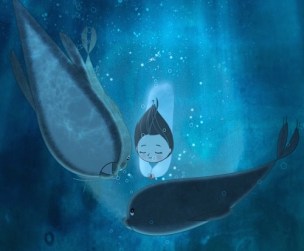 Even as I write, I’m talking myself round to liking Song of the Sea even more than I did on first viewing — and that was quite a lot, albeit coloured by my perception that I didn’t like it as much as The Secret of Kells. If you enjoyed Moore’s earlier film, this unquestionably merits seeking out (if you haven’t already, of course; I mean, I did). If you haven’t seen Kells, well, you’ve so far missed a treat; and now you’re missing two.
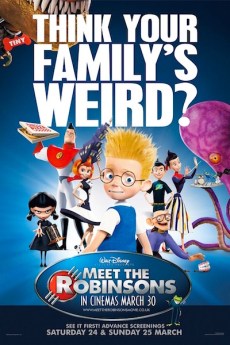 Disney’s 47th Animated Classic comes from their weak ’00s period, after the end of the so-called Renaissance and before what’s apparently been dubbed the neo-Renaissance (presumably no one could think of a synonym). This hails from the tail end of that lamentable era, though, so there are signs of recovery: Meet the Robinsons isn’t bad, just mediocre.
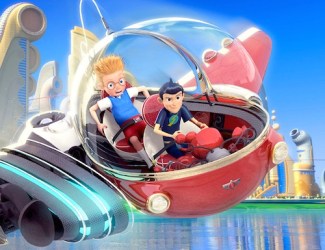 The time travel element of the plot is weakly thought-through. It’s not the point of the film, which is more about family ‘n’ stuff, but it’s central enough that it robs the already-underpowered climax of much weight — you’re too busy thinking “wait, does that make sense?” to be invested in events. Finally, the animation style has aged badly, now looking plain and under-detailed.
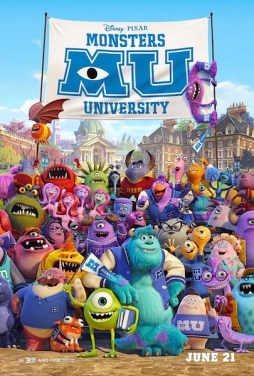 Pixar’s fourth sequel is more
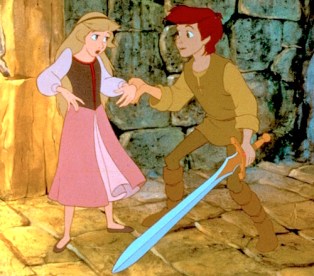
 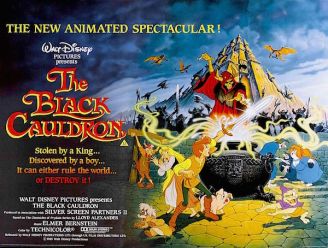 The Black Cauldron is best remembered as an intriguing footnote in the history of Disney animation. Their 25th ‘official’ film, it was the first with no songs, the first to earn a PG (after being cut — twice — to avoid a PG-13), and flopped so badly they disowned it for over a decade. Fully-animated sequences were cut after disastrous test screenings for parents, and famed exec Jeffrey Katzenberg, who came into Disney management during the film’s production, reportedly ordered 12 minutes cut, muddling the film’s story. What a mess.
 It’s always interesting when a company like Disney break outside of the norm, and it’s certainly brought them some degree of success in recent years with the likes of
  100Films.co.uk