Ultimate Avengers II (2006)

aka Ultimate Avengers 2: Rise of the Panther

2008 #83
Will Meugniot & Richard Sebast | 70 mins | DVD | 12 / PG-13
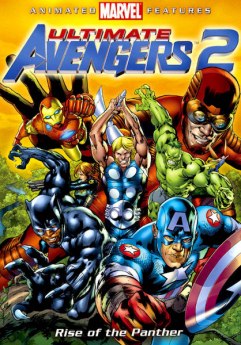
Ultimate Avengers IISome things in life baffle me. Form dictates I now list a couple of humorous examples, but we’ll skip that and get to the point: why would you make a direct-to-DVD movie that has a subtitle on the box but not on the film itself? I can understand why titles get tweaked on cinema-release posters and/or subsequent DVD releases — for marketing purposes, say; or clarity — but why, when your title is going direct to the DVD stage, do the titles not match? And why does the box add the subtitle rather than remove it for on-shelf simplicity? I have no answers — it baffles me, remember — but this is the sort of thing I sometimes muse about. The sort of thing that most other people don’t even notice, never mind care about.

Insignificant title issues aside, the fact that (as of writing) 2,365 people have bothered to rate the first Ultimate Avengers on IMDb, while only 1,325 have bothered to rate this second, suggests many were so disappointed by the initial film they didn’t bother with the sequel. Which is something of a shame, because it’s a lot better. Problematically, it’s heavily grounded in the first, picking up several threads that were left hanging — enough so as to make that weak franchise opener required viewing, sadly.

Why’s it better? We’ll get the obvious out of the way: yes, it’s a modern genre sequel, so yes, it’s ‘darker’. In this case that means “more adult”, touching on issues you might not expect in superhero animation with such a low certificate — marital problems, survivor’s guilt, political isolationism, even vague allusions to alcoholism. None are dealt with in any great depth I should add, but it will likely please adult fans wishing for something more “grown-up”. There’s also a greater amount of violence, though much of it is implied, or just off screen, or against bug-like aliens. The animation still isn’t great, though at times seems improved. Equally, while both script and story are better — there’s no pace issue this time — there’s still plenty of clanging dialogue, and the adult subplots aren’t exactly subtly executed.

The climax also has its share of flaws. While most of the story is nicely balanced, it’s over-efficient in wrapping up, in the way that only animation seems allowed to be — for whatever reason, this exact story would comfortably fill a two-hour live-action version. The worst effect of this is that some points aren’t treated with their deserved weight — the death of a major character is so hasty and glossed over that I didn’t even realise it had happened until a brief shot of a memorial in the closing scene. On a less pressing note, the giant alien robots of the final battle leave the film just one leg (per robot) away from becoming a total War of the Worlds rip-off. But this tale is of American origin, so the aliens are defeated not by a clever plot twist, but by brute force.

Despite my attention to the film’s weak points there’s actually plenty to enjoy here, provided animated superhero movies are your thing. There’s more action than the first instalment, a more interesting story, more character development… Even if it’s done at quite a basic level it’s still adequately entertaining, enough that you might wish there was a third. An improvement then, if still flawed, but — ultimately — enjoyable.

4 out of 5

For my review of the first Ultimate Avengers, please look here. Live-action sequel Avengers: Age of Ultron is in UK cinemas from this Thursday, 23rd April 2015.
Ultimate Avengers (2006)

2008 #82
Curt Geda & Steven E. Gordon | 68 mins | DVD | PG / PG-13

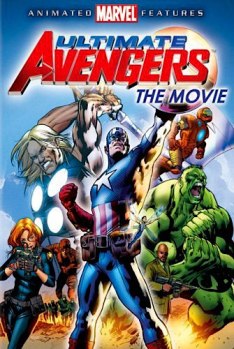
Ultimate AvengersWith the big-screen live-action Avengers movie on its way in just two-and-a-half years — once we’ve had a variety of tie-ins to lead into it, of course — now seemed as good a time as any to check out this direct-to-DVD animated version (and its sequel).

I won’t say too much about the plot because, if the rumours are true, the live action film may follow it fairly closely — indeed, the first 15 minutes of Ultimate Avengers presents a roll call of elements already introduced in this summer’s Iron Man and The Incredible Hulk: the Avengers Initiative, a super solider serum, a black Nick Fury, Captain America frozen in ice (OK, so that was only in a deleted scene…) But to follow this story wouldn’t necessarily be a bad thing… as long as there were some tweaks.

The primary problem is balance. Ultimate Avengers spends the entire first half assembling the team, the story crawling along at a snail’s pace; consequently, there’s nothing like enough time to do the remaining plot justice, leaving much of it to feel rushed. However, the tale itself retains an appropriately comic-book feel — no surprise considering it’s adapted from a specific storyline — while still containing just about enough information to keep newcomers covered. Were it properly paced, and bolstered by the main characters being introduced in their own films, there’s no real reason this wouldn’t suffice in live action.

On the other hand, in its current incarnation it’s very much Captain America’s story — possibly a problem for the 2011 version, as it will follow Cap’s debut feature by just two months. If his solo outing isn’t a success — particularly if whoever plays him is no good — it would likely sink an Avengers movie that was as focused on him as this. Not encumbered with such problems here it works fine, though it’s disappointing how little we see of other major players — Tony Stark/Iron Man barely features and there’s even less of Thor. That said, Bruce Banner/Hulk gets a key subplot which could be even better if fully developed.

Dodging further predictive comparisons for a moment, the animation quality is variable. Some is very good — mainly the opening World War II-set action sequence — but most is no better than you’d expect from a kid’s TV cartoon (unless they’ve got even worse recently). It does the job adequately, but there’s little exemplary. If there’s a theme emerging it’s this: promise is shown, but not fully realised. That’s not the fault of the medium of course, but rather the brief running time and unbalanced structure.

When the live-action Avengers reaches our screens, I suspect this animated outing will be of greater interest — an intriguing point of comparison between a direct-to-DVD fan-aimed version and a Summer Blockbuster mass audience version of (possibly) the same story. Of course, by that point, Ultimate Avengers will be half a decade old and no longer such a contemporary — or memorable — example.

3 out of 5

Ultimate Avengers II will be reviewed tomorrow, Tuesday 21st April 2015. Live-action sequel Avengers: Age of Ultron is in UK cinemas from Thursday 23rd.

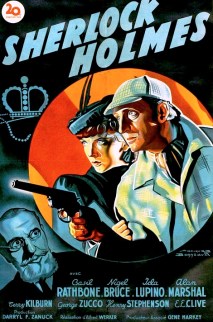
Sherlock Holmes and the Secret Weapon (1943)

2008 #75
Roy William Neill | 66 mins | DVD | PG

The name’s Holmes, Sherlock Holmes, as Universal’s loose adaptations of Britain’s Greatest Detective deliver a low-key proto-Bond, 22 years before Goldfinger applied the same tricks to Britain’s Greatest Spy.
“How so?”, you might ask. Well, Holmes has been employed as a spy for His Majesty’s Government; it begins with an ‘end of the previous adventure’ almost-action sequence that would undoubtedly take place before the opening credits now; there’s a war-winning weapon at stake; a bit of globetrotting (albeit just from Switzerland to London); some double-crossing and side-switching; even a surprisingly nasty torture sequence; a nice race-against-time final act; and an equally-matched villain, with a secret lair, who has devised a clever death for our hero. So the lair is just a house with soundproofing and unbreakable glass, but that’s not a bad effort — I don’t think there are many volcanoes to hollow out in the London area. It may be Bond on a World War Two London scale, but the feeling is there.

I discussed the controversy (for a modern audience, at least) of this updated setting in my last Holmes review, and it’s even more abundant here — seeing Baker Street as a victim of the Blitz, and 221B surrounded by sandbags, is very odd indeed — but at least it employs several elements from a variety of Conan Doyle’s plots, and it’s not unreasonable to assume that, given his skills of deduction and disguise, Holmes would’ve been employed as a spy had he been ‘alive’ during the war. In fact, Holmes actually does some detecting this time, whereas in Voice of Terror he seemed to meander around a bit, and employs several disguises, even if some of them are about as much cop as one of those glasses-nose-and-moustache masks. Of course, it would help the mystery if its solution wasn’t revealed before Tobel (the inventor of the titular war-winning weapon) was even kidnapped, but you can’t have everything.

What lets the film down more is Lionel Atwill as a weak Moriarty, supposedly the film’s grand villain. It’s not all his fault — for one example of poor writing, Holmes deduces the final code after an accidental clue from Watson, while Moriarty gets it by clumsily spilling water over a copy, hardly displaying great powers of deduction — but he doesn’t compare to the scheming, cunning Moriarty we saw played by George Zucco in The Adventures of Sherlock Holmes. On the plus side, the ease with each Moriarty outwitted Holmes in that earlier outing made our hero look a bit ridiculous, whereas here Holmes gets to outwit his nemesis a couple of times, including a particularly nice denouement.

As with Voice of Terror, I enjoyed a lot of Secret Weapon in spite of its distinct un-Holmes-ness — it’s another pacey, exciting World War Two spy thriller. It’s better than its immediate predecessor on the whole, though a spot of miscasting nearly persuaded me to remove another star.

4 out of 5

Road to Singapore (1940)

2008 #61
Victor Schertzinger | 85 mins | VHS | U

Road to SingaporeBob Hope and Bing Crosby star as a pair of young(ish) playboy sailors who run away from responsibility and family expectations in this comedy that launched the perennially popular Road to… series, which would spawn six sequels over the next 22 years.
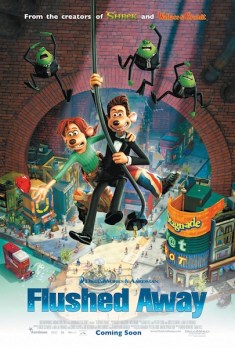
Rather than a “comedy”, Road to Singapore might best be described as a “variety film” — it offers a mix of comedy, excitement, romance and song, a selection of entertainment that is more often provided by a few hours of TV these days. While it’s predominately light-hearted, the overall air is still more serious than that of the one other Road to… film I’ve seen, Road to Morocco: the plot seems to have been the film’s starting point, rather than an afterthought to connect the appropriate set pieces, and a couple of fight scenes are not wholly comedic in their choreography.

Unfortunately, in spite of this, there’s nothing here that’s as memorable as in Morocco. Bob and Bing are a great double act, undoubtedly carrying the film, but while it starts well enough it loses it as it goes on — even at a brief 85 minutes, it begins to drag early in the second half. It’s also worth noting that much of it is incredibly dated now, peppered with things like blacked-up natives (and our heroes blacking up to fit in) and the “good little housewife” routine. This is more an observation than a criticism — it’s very much a film of its time.

It might also be worth noting that, while I found Singapore reasonably entertaining, the friend I was watching with — who has enjoyed several other entries in the series, but had yet to see this — found it lacking. The score, however, is solely my own.

3 out of 5

Flushed Away (2006)

2008 #57
David Bowers & Sam Fell | 81 mins | DVD | U / PG

Flushed AwayAardman Animations, the Bristol-based company most famous for Wallace & Gromit and Creature Comforts, branch out into CGI for the first time with this tale of rats trying to save the sewers of London. CGI rats? Yes, thoughts of Ratatouille are inevitable. Can Aardman beat Pixar at their own game? You might be surprised…
The primary reason for comparison here, as mentioned, are the rats. Despite Pixar’s stated intention to redeem rats in the eyes of viewers — to turn them from vermin into loveable little fluffy things, essentially — I felt the same about bloody rodents at the end of Ratatouille as I did at the start. Here, however, they’re Disneyfied (oh the irony) — where Pixar had cartooned versions of the real thing, Aardman have given them a human shape. It’s surely this disjunction from reality that makes them more likeable, but it does mean there’s never that distracting “but they’re vermin” impulse. They’re humanisation is helped by the performances of a star-studded cast, including Hugh Jackman and Kate Winslet amongst the ratty voices. Ian McKellen is a fabulously dastardly villain, ably supported by a pair of comedy henchman… and Jean Reno as a French frog. Yep, the humour is that British.

One thing Pixar unquestionably still excel at is the actual animation, however. Ratatouille is gorgeous to watch and will take some effort to beat; Flushed Away, on the other hand, doesn’t really come close to Pixar’s earlier efforts, never mind Ratatouille’s artistry. It’s mostly passable, especially once the action migrates to the mini-London in the sewers, but at other times it looks little better than a computer game. The second biggest mistake (I’ll get to the worst in a minute) is opening the film in a pristine up-market house — presumably it was an artistic choice to have it so tidy and clean, but this has the unfortunate side effect of highlighting the animation’s plainness right from the start. Once the story moves underground the level of detail improves, but it takes a little while to get there.

A bigger error was made with the lip-synching, however, and obviously this dogs the film throughout. Aardman consciously designed the characters’ mouth movements to imitate the clay animation the company usually employs (Flushed Away is CG because of the volume of water featured, an element too complex to achieve in stop motion). Instead of invoking that stop motion feel it just looks cheap and underdone — such jerkiness is easily ignored as part of the technique when viewing clay animation, but there’s no need or excuse for it in CGI. Ultimately it looks like the animators were lazy or the rendering has skipped frames, and is frequently distracting.

It’s possible to put the disappointing quality of the animation aside though, because the script’s a good’un. Like the animation it doesn’t really get going until we’re flushed into the sewers, but once there it’s pleasantly witty, full of good one-liners and clever visual gags. The latter includes a good line in intertextuality, with entertaining and easily-noticed references to Finding Nemo, X-Men and others, including numerous nods to Wallace & Gromit. They don’t dominate, but their variety makes for a nice bit of I-spy for both kids and adults of varying degrees of film-buffery.

Despite the inevitable comparisons, Flushed Away is really a very different beast to Ratatouille. Pixar’s effort is, for want of a better word, artistic; Flushed Away is simply a family-orientated slice of adventure-comedy… rather of the kind you might expect Pixar to produce. Aardman’s initial CG effort is not better or worse than ‘the other CG rat flick’, but it is perhaps more like what you — or, at least, kids — would expect. With a starry cast, strong script and good sense of visual comedy, Flushed Away manages to overcome its lower production values to create an above-average piece of entertainment. And that’s, as Wallace would say, cracking.

4 out of 5

Stardust (2007)

2008 #55
Matthew Vaughn | 122 mins | DVD | PG / PG-13

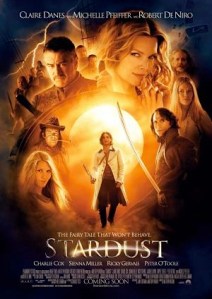
StardustPerhaps the simplest way to describe Stardust — to a film aficionado, at any rate — is as “the British Princess Bride”. That may do it a disservice however, as this tale of a boy entering a magical realm to find a fallen star is sufficiently its own beast to stand apart from such (admittedly lofty) comparisons, and be much more than a simple rehash with different accents.

Stardust succeeds in numerous ways. The plot is a good mix of fantasy archetypes, fairytale morality, a slight-but-knowing modern filter (thanks primarily to top-and-tail narration from Ian McKellen), humour and action. It rattles along, occasionally running the risk of becoming episodic, but thankfully avoiding it by linking and returning to various episodes. For a British film the effects work is perhaps surprisingly good, with impressive sequences that neither suggest restraint or budget limitations, nor smack of ambitious overreaching by the filmmakers (unlike, for example, the recent Tin Man miniseries).

This sort of fantasy adventure film is a somewhat unexpected choice for co-writer/director Vaughn, who previously produced Lock Stock, Snatch and Mean Machine, and directed Layer Cake, but his direction is neither over-grounded in reality (as you might expect from his background), nor over-done to the point of distraction (as if he were compensating). Instead, he demonstrates an entirely appropriate flair and skill, which promises much for future work.

If you watch a lot of British TV the cast seems star-studded, though even if not there’s the likes of Robert De Niro and Michelle Pfeiffer in major roles. Both are clearly having a whale of a time — as is everyone else, to be fair. De Niro’s role is especially surprising and fun, though to say any more would ruin it. It stands out as one of the best and most memorable elements in a film loaded with them. Charlie Cox is a likeable lead, while Claire Danes’ fallen star is pleasing subversive — you’d expect her to be sweetness and light (literally), but she is in fact amusingly stroppy — and Mark Strong is a perfectly villainous villain. They’re just three further standouts from an almost uniformly excellent ensemble. “Almost” because, sadly, the film’s weakest links are also among the cast. Ricky Gervais plays himself, as ever, almost shattering the well-constructed universe in the process; and Sienna Miller is too bitchy — and, to be frank, too wooden — for us to believe our hero could ever really want her.

But these are minor, easily ignored flaws in what is otherwise a fantastically entertaining fantasy. In fact, in recalling it for this review, it’s just magicked itself an extra star. How very appropriate.

5 out of 5

Stardust placed 4th on my list of The Ten Best Films I Saw For the First Time in 2008, which can be read in full here.

The Golden Compass (2007)

2008 #51
Chris Weitz | 113 mins | Blu-ray | PG / PG-13

The Golden CompassThis adaptation of the first novel in Philip Pullman’s His Dark Materals trilogy (known as Northern Lights in the UK, but adopting the US title for the film — unlike Sorcerer’s Stone, it’s actually more appropriate) received quite the critical drubbing on its cinematic release, and wasn’t a huge success at the US box office either, which has cast doubt on the prospects of the following two instalments ever being produced. Which is a shame, because this is actually a fine family fantasy film.

The requisite elements are present and correct: a well-realised alternate world, engaging heroes, slightly camp villains, mysterious items, mysterious backstories, a globe-trotting quest, talking non-human characters, a couple of action sequences and casual doses of spectacle. The latter was something that worried me going into the film, in fact, as the CGI looked dreadful in the trailer. When it won the Oscar I really couldn’t understand how, but now having seen the film — and in high definition to boot — it was, to my surprise, mostly exemplary. There are weak patches, of course (Mrs Coulter’s monkey being the main one), but the majority is either appropriately realistic or in a suitable style enough that it didn’t matter. “Don’t judge a book by it’s cover,” as they say; or indeed a film by its trailer.

Another key sticking point for me was the discarding of the books’ religious elements, which is far too atheistical for most Americans (not that I’ve actually read the books yet, but I always enjoy a good bit of Christian baiting). The filmmakers have found an appropriate way around this however: there’s a subtext, blatant to the intelligent viewer, which carries such views. It will like whoosh over the heads of those who would’ve been offended by it, which is surely the point. Nonetheless, the lack of commercial success suggests that the stir it had already caused served to cement it as “the anti-Christian film” in too many people’s minds. Or perhaps it was merely that too few had heard of the books? Or there’s always those variable reviews…

Leading the cast as Lyra, Dakota Blue Richard’s accent seems forced and occasionally grates, but really speaking she’s pretty good (pun retrospectively intended). The rest of the cast make a good account of themselves, though the likes of Daniel Craig, Derek Jacobi and Christopher Lee were clearly cast in readiness for the intended sequels. Ian McKellen is as good value as ever and the rest of the voice-only actors offer able support. Nicole Kidman never really gets the chance to unleash her full evil potential however.

In fact, therein lies probably the film’s primary weakness. While Golden Compass does work in its own right, it’s as much Part One of a trilogy as Fellowship of the Ring: at the end you feel curiously fulfilled, even though there’s clearly a lot of tale left to tell. I can only hope that the muted success it achieved is enough to get the continuing and concluding parts made, though that seems increasingly, disappointingly, unlikely.

4 out of 5

WALL-E (2008)

2008 #48
Andrew Stanton | 98 mins | cinema | U / G

“Pixar films” seem to have become a bit of a genre unto themselves — yes, they fit into “animation” (always dubious as a genre), “family” (almost as bad), “comedy”, and occasionally a few others, but, much as the Bond films have their own rules and expectations outside the “action” and “spy thriller” conventions, the work of Pixar always achieves special and particular attention. WALL-E subverts some of these expectations (it’s not a buddy comedy, mainly) and has received huge amounts of praise — “consequently”, some might add. It is indeed a very good film, but you’ll surely have heard all that elsewhere; instead, I’m going to draw attention to a couple of things that bothered me.
Most of these issues can be attributed to the fact that WALL-E is a film of two halves. They’re not exactly poorly linked, as elements from each feed into the other, but they are notably different. The first presents a realistically-rendered future Earth, deserted by humans (who are nonetheless represented on hologram screens by live-action actors) and now only inhabited by insects and a trash-collecting robot called WALL-E. Silent but for R2D2-like bleeps, WALL-E quickly endears himself to the audience through his actions. He’s cute, funny and likable, and the early scenes cement him in the audience’s sympathies, which is certainly handy for later. When EVE — a futuristic, iPod-alike ‘female’ robot — turns up, the film becomes a sweet love story, as WALL-E tries to instill the human-like emotions he’s developed into the cold new robot. A very funny and surprisingly touching love story, this is the film’s better half.

The second travels out into space, taking us to meet cartoon humans on a cartoony spaceship. It jars painfully with the realism that pervades the Earth-bound scenes, and the continued use of real actors in holograms highlights the cartoonish style of the future humans. There’s nothing wrong with a cartoon style, I hasten to add — certainly, it works better in films like The Incredibles and Ratatouille than the attempts at realism do in the Toy Story films — but it’s the contrast that’s uncomfortable. The story itself also takes a weak turn here: it becomes a light kiddy-adventure runaround, which is fun and still has flashes of humour and heart, but is nowhere near as daring or as effective as the first half. This is where the sympathies engaged earlier become important, because it’s the audience’s affection for WALL-E that provides most of the genuine quality in this half.

If I were to broadly characterise the two halves, I’d say the first is everything you’d hoped for after the advance hype, while the second is something you could have feared. It’s not bad — it’s still a superior light kiddy-adventure runaround, with exciting-enough sequences and a largely interesting (if unoriginal and preachy) plot — but it’s not as groundbreaking or engaging as the first half. Worst of all is when the cartoon humans land on the realistic Earth, however — it brings to mind films like Who Framed Roger Rabbit, where cartoon characters are placed in the real world. In this instance, that’s not a positive comparison.

WALL-E is a good film. The bits that work do so perfectly, keeping the overall quality high, and the weaker sections are ultimately only poor by comparison. If the whole film were like the second half I’d probably merrily accept it as a cartoon runaround but, coming after that beautiful beginning, it only served to gradually erode the fifth star from my rating. It’s a shame, in that respect. On the other hand, this is still one of Pixar’s very best films — I’d certainly rate it above the even-more-over-praised Ratatouille, and probably slot it close behind The Incredibles or Toy Story 2 at the top of the scale. Being pipped by films of that level — and then only just — is nothing to be ashamed of.

4 out of 5

The Adventures of Sherlock Holmes (1939)

2008 #39
Alfred Werker | 79 mins | DVD | PG

The Adventures of Sherlock HolmesNever mind waiting two or three years for a sequel these days — after the 1939 Hound of the Baskervilles was a box office success, Fox had a sequel out just five months later! I reviewed that first Rathbone/Bruce film back in February, promising an irregular series reviewing the further thirteen pictures the pair starred in. Well, I’ve finally got round to watching the second, and while I was a tad harsh on the first I found myself enjoying this one more.
The Adventures of Sherlock Holmes pits the titular detective against his arch-nemesis, Moriarty, in what’s really speaking a relatively weak plot — most depressing of all is how easily Moriarty’s plan to distract Holmes almost succeeds. But never mind that! There’s rain-lashed, fog-drenched Victorian London streets! Brutal murders by foul foreigners! Dastardly plots against the crown! Galloping carriages! Romantic subplots! A smattering of comedy! A song-and-dance number! (No, really, there is.) And a final shoot out… in the Tower of London! You can’t escape the joyous feeling that this was designed as pure entertainment, literally including something for everyone.

Bruce’s Watson may bumble about too much for the purists (me included, more often than not), the murder plot lacks proper explanation (the production notes on Optimum’s DVD pleasingly expand on this), Rathbone’s characterisation of Holmes may be a touch too friendly… but by then I’m just nitpicking. This sequel is atmospherically, entertainingly and excitingly executed, and that’s plenty good enough for me.

4 out of 5

The Fountain (2006)

2008 #37
Darren Aronofsky | 93 mins | DVD | 12 / PG-13

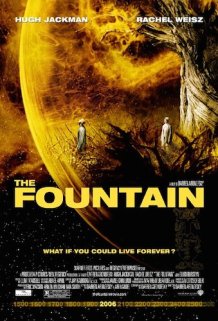
The FountainThe Fountain was one of the more critically divisive films of recent years, eliciting genuine “love it or hate it” reviews all round. I find myself leaning more towards the former. While I can’t claim to fully understand (let alone explain) much of what it means, and while I usually dislike things that can pretentiously be described as “film as poetry” (or similar), there’s something in the qualities of The Fountain that engaged me.

For one thing it looks gorgeous. While the whole film is beautifully shot, it’s hard not to single out the future segments, in which Aronofsky chose to create space with “micro-photography of chemical reactions” rather than the usual CGI. However it was achieved, the important thing is it looks great. Clint Mansell’s score is equally beautiful, both dramatically exciting and romantically tender — sometimes at the same time. Performance-wise, Hugh Jackman is undoubtedly at the centre and is as likeable as ever. It’s only the present-day segments where he really has much to do, in the arguably-clichéd story of a scientist so desperate to find a cure for his wife’s disease he misses out on spending time with her. Rachel Weisz is good as ever as the wife, even if her American accent is occasionally distracting.

Meanwhile, the past segments are essentially an historical adventure movie with some of the plot scenes cut, and the future segments offer near-2001 levels of silent obscurity. By a similar token, the film has an apparently ambiguous finale that, unusually, I’m quite happy to let wash over me. I’m sure there are multiple conclusions a viewer can reach for what it’s ‘about’ — the eternity of love, the repetition of life, or simply a sci-fi/fantasy quest for immortality — but I find myself happy to accept that it may mean one, all, or none of those things and just leave it be. It’s an odd way to feel at the end of a film — not caring about what it meant, but in a good way.

I can only apologise that, a bit like the film, this review is relatively brief, a tad dreamy, and somewhat inconclusive. I can see why some dislike this film, and I think I’d normally be one of them, but in this case something about it captured me. I look forward to seeing it again and, maybe, getting a better idea what it was.

4 out of 5