Alice in Wonderland [3D] (2010)

2010 #38
Tim Burton | 108 mins | cinema | PG / PG
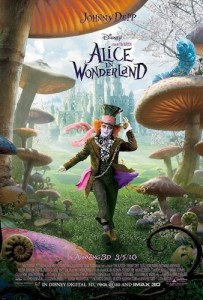
I believe Tim Burton coined the now-ubiquitous term “reimagine” when he remade — I mean, reimagined (sorry Tim!) — Planet of the Apes almost a decade ago. Now, he turns his re-imagination to a new version of The Mad Hatter — sorry, posters/ad campaign/DVD art confused me, I mean Alice in Wonderland — which receives its controversially speedy (remember all that fuss with Odeon?) DVD/BD release tomorrow.

This time, rather than starting from scratch, Burton has created a sort of “Alice 2”, crafting a new plot from the novels’ elements. It’s set 13 years after Alice’s first trip down the rabbit hole, which presumably occurred in the classic Disney animation (as opposed to her two trips in the original novels, or any of the other numerous screen versions there have been). Maybe this is for the best — with Alice committed to film so many times before, one might well argue there’s no need to see the exact same tale done again.

Consequently, this new Alice positions itself freshly in two ways: one, as “Burton’s version”, and two, by following in the footsteps of the specific side of the filmic fantasy genre started by Peter Jackson’s Lord of the Rings, which has since encompassed the likes of two Narnia adaptations, The Golden Compass, and probably several more that I’m forgetting. Although it uses the original’s most famous elements, the film’s narrative and structure is familiar from those recent films more than 19th Century literature, particularly a final epic (well, epic-ish) battle in which our unlikely heroine emerges as the long-prophesised One Who’ll Win It For The Good Guys.The One Who’ll Win It For The Good Guys It’s a moderately interesting cycle to attach it to, one it seems has been missed by its pigeon-holing as “a Tim Burton film” and “another Alice adaptation”.
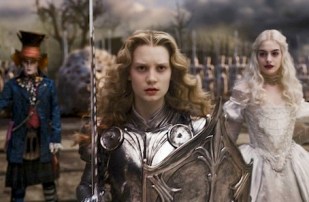
So, talking of Burton, Alice falls into the same ballpark as Charlie and the Chocolate Factory and the supposedly-forthcoming Addams Family remake: they’re the kind of films one expects Burton to be interested in making, and consequently there’s a sense of ticking-boxes about the results. Like Charlie, Alice offers no real surprises from either Burton or their shared star, Johnny Depp. Both do good work, certainly — the former is visually imaginative, the latter suitably barmy — but neither produce anything you don’t expect. True, one might not have been able to predict the exact elements they wheel out — particular Depp’s random use of a Scottish accent — but it nonetheless never feels unexpected.

Mia Wasikowska is something of a revelation as Alice. She’s a newcomer, so say reviews — the kind of newcomer who’s been in a dozen other things of various size — and presents an almost-knowingly naive Alice, which seems an entirely appropriate characterisation. She’ll next be seen as another titular character in a classic novel adaptation — the BBC’s new Jane Eyre (as if the one they did four years ago wasn’t good enough). (It was.) — which is neither here nor there when it comes to this film, really. I’m sure she’ll do fine.
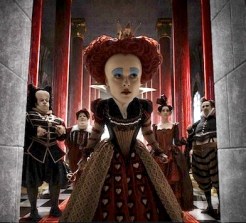
Speech impedimentedAmong the rest of the cast, Helena Bonham Carter does a speech-impedimented Red Queen that feels as familiar was Burton and Depp’s work; Anne Hathaway’s White Queen is amusingly floaty, her hands permanently raised in a faux-delicate gesture; Crispin Glover is under-characterised and marred by some dodgy CGI (quite what’s been done to him I don’t know, but his movement is frequently jerky), but otherwise a decent enough henchman. In the all-Brit voice/mo-cap cast, Matt Lucas is best as Tweedles Dum and Dee — sadly, there’s not enough of him… um, them… — while Alan Rickman is Alan Rickman as the Caterpillar; Stephen Fry has little important to do as a less-scary-than-usual Cheshire Cat; and others — like Michael Sheen, Paul Whitehouse and Timothy Spall — blend into the background with competent but unremarkable work.

The post-production 3D proves (as far as I’m concerned) that James Cameron is being falsely elitist and some reviewers are too easily led: it is very rarely less convincing than what we saw in Avatar. True, Burton doesn’t show it off quite as much as Cameron did — this is a normal film that’s been put into 3D (even the stuff-flying-at-the-camera shots feel like they would’ve remained in a 2D-only version), not one designed to make you go “woah, look at that world! In 3D! I’m, like, so immersed”, the driving factor behind 90% of Avatar’s visuals. I suspect Roger Ebert’s correct that Burton’s visuals would pop more in 2D, away from the sunglass effect of polarised specs, and the added depth adds little of significance to one’s enjoyment of the story or even the visuals… other than 3D sometimes looks nicer, what with all that depth. Well, maybe.

faux-delicateThe funny thing about Burton’s Alice is that — despite the ultimately needless 3D, the familiar fantasy-epic storyline grafted onto Carroll’s characters, and the apparent lack of inspiration from either the director or his cast — it’s still quite enjoyable. It’s not going to do much to engage your emotions or your brain, it won’t give you any hearty laughs or edge-of-your-seat thrills, and it may occasionally make you wish it would get a move on — all of which means that, by the end, it can feel a tad slight. Valid criticism abounds on the web, but… well, I enjoyed it. Maybe I’m just too forgiving.

4 out of 5

Alice in Wonderland is available on DVD and Blu-ray (2D only) now in the US and from Friday in the UK.
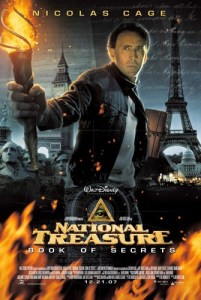
National Treasure: Book of Secrets (2007)

2010 #56
2007 | Jon Turteltaub | 119 mins | DVD | PG / PG

I enjoyed the first National Treasure. There, I said it. I’ve wound up seeing it several times, somehow, and each time appreciated it as a fun romp. It’s not a fashionable film to like by any means, and it’s certainly derivative of all kinds of other things, not least The Da Vinci Code, but it’s an entertaining and consummate minor blockbuster.

National Treasure 2 (that’s this one, in case you didn’t know) essentially offers more of the same. That’s often levelled as a criticism, but in this instance it’s absolutely fine: Book of Secrets isn’t a rehash — there’s a new mystery with new puzzles — but is another adventure in the same vein, with clue-hunting and the occasional action sequence. Things are different, but it’s rather swings and roundabouts. For example, Ed Harris isn’t as fun a villain as Sean Bean, but he’s also suitably different, while on the other hand the London car chase bests any action sequence in the first film.

There’s also the usual sequel escalation: never mind just getting the Declaration of Independence, here Gates & co not only break into the Queen’s office in Buckingham Palace, they also kidnap the President of the United States (briefly. Sort of.) Yes, it’s wildly improbable, not only in the clue-laden treasure hunt but also the feats this three-person team pull off. But that’s half the fun. It doesn’t claim to be real — OK, it uses historical facts, but they’re to embellish its tale, in the same way many higher-class films have — it’s just an entertaining ride, with some exciting action, intriguing clues, and the odd bit of humour.
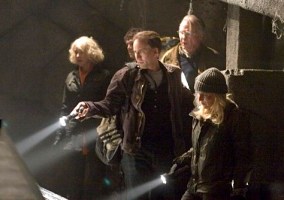
The cast are fine. The unforgiving will find Justin Bartha’s Riley irritating, but by making him a tad down on his luck and a little devoted to Gates he may endear himself to others. Aside from Ed Harris, Helen Mirren is the biggest addition, though both make little more than a cameo when there are so many other characters and plot points flying around. The main attraction of her role is pondering her accent — is it meant to be American? I wasn’t sure. Perhaps she was doing a very good job of being A Brit Who’s Lived In America For A Long Time, but that’s a mite too subtle for all the noise and bluster in a fast-paced conspiracy adventure-thriller.

There are plot holes and logic gaps and it rather leads you by the hand through it all, but none of these undermine what it’s really all about. Either that or I was in a particularly forgiving mood — even the thoroughly daft bit with the traffic camera didn’t bother me too much. It’s not the highest class of blockbuster, it won’t be remembered as fondly as Indiana Jones, or even the Pirates series, but there are worse ways to spend a couple of hours, particularly if all you want is a bit of well-made light entertainment.

If you enjoyed the original, I see little reason why you wouldn’t enjoy the sequel; conversely, if you didn’t like the first one… I’m sure you can finish that sentence. It’s the kind of film that would probably sit quite well on, say, a Bank Holiday afternoon. Which is a stroke of luck.

4 out of 5

The UK TV premiere of National Treasure: Book of Secrets is on BBC One tomorrow, Bank Holiday Monday, at 4:35pm.

Coraline (2009)

2010 #53
Henry Selick | 100 mins | Blu-ray | PG / PG

I’ve only ever read one thing by Neil Gaiman. It’s not fan-favourite Neverwhere, nor the previously-adapted Stardust. It’s not Hugo-winners American Gods or The Graveyard Book, nor the Hugo-withdrawn Anansi Boys. It’s not any of Sandman. It’s not even Whatever Happened to the Caped Crusader?, his take on Batman.
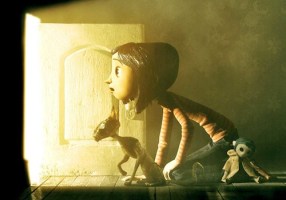
And it’s not Coraline either.

Which is a shame, because either that or “I’ve never read anything by Neil Gaiman” would have made much better introductions. Indeed, the latter was my original plan, but honesty overcame me — I’ve read his graphic novel/miniseries Marvel 1602. And I just remembered that I’ve also read Good Omens, the novel he co-wrote with Terry Pratchett. So much for my neat little introduction.

But regardless of one’s familiarity with Gaiman, his work comes recommended. Coraline alone won a Hugo, Nebula and Stoker, while the film adaptation was Oscar-nominated (naturally it lost to whichever Pixar film was eligible) and widely well reviewed (an 89% Tomatometer). All of which seems to set it up for a fall. But like, say, The Dark Knight*, it manages to fulfil its promise — Coraline, in short, is excellent.

Where to begin? Well, Coraline is a fairytale, really, albeit a modern one — it doesn’t come at you with princesses or witches or talking animals, but Volkswagens and new homes and stairlifts (all or none of those may be significant to the plot). The fact it’s a fairytale is perhaps neither here nor there, though I do think it pushes aside some logic complaints I’ve seen levelled against the film — do we need a villain’s origins, for example? No, not here. I’m not saying Coraline uses its fairytale basis as an excuse to toss aside narrative sense, just that, if viewed through the prism of “fairytale story rules” rather than “real-world fantasy story rules” some viewers may have been more forgiving. Also, I’m digressing into a critical blind alley.
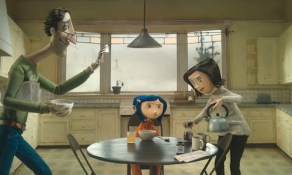
It’s also a Proper fairytale, by which I mean two things: one, it has a moral message; two, it’s scary. Very scary, in places. For much of the film there’s a beautiful creepy atmosphere, enhanced by drifting fog and skewed camera angles, but towards the end — when (I write while trying not to spoil too much) the full truth of the Other Mother is revealed — it’s not just kids who are likely to be freaked out. Dark themes and situations abound, though the full implications of some are pared back or glossed past, probably with good reason. Coraline is a “kid’s film” but, like writer/director Henry Selick’s previous The Nightmare Before Christmas or much of Pixar’s output, it’s as least as enjoyable for adults.

And as for the moral subtext… well, it may be very familiar — “be careful what you wish for” and/or “you don’t know what you’ve got till it’s gone” — but Gaiman and Selick certainly have a new, fantastical, mythical spin on it. Some critics say the story is arranged from plot points seen elsewhere and lacks originality, but then critics of everything say that because every story has roots in another. Coraline’s telling displays more than enough originality to keep it going, thankyouverymuch.

The animation, however, is an undeniable triumph. Set and character designs are gorgeous; the stop-motion movement is fluid, nuanced and detailed; the numerous technical accomplishments impressive. Sequence after sequence dazzles, each more magical — or frightening — than the last. Even if you want to criticise the story or characters, I find it hard to believe anyone could watch this and not enjoy much or all of it on a visual level. And if you don’t — honestly, are you sure you like films?

Only occasionally is one reminded that Coraline was filmed in 3D, when things poke out towards the screen or sink deep into it; but it’s not gratuitous, and if you didn’t know it was designed for 3D you might not even notice. The flattened sets and awkward perspective of the real world, versus the depth and beauty of the Other one, are still conveyed well in 2D. (I’ve had a brief look at the 3D version contained on the Blu-ray disc and will report my views on that another time, when I’ve attempted to watch it in full.)

Much like the animation, Bruno Coulais’ score is hauntingly beautiful. OK, it’s undoubtedly Elfman-esque, but it fits the film to a tee. Also in the audio realm (yes, this is a tenuous link to join two brief comments in a single paragraph), the voice cast are all spot-on, from seasoned pros like French and Saunders to bright young thing Dakota Fanning. Some may take issue with her vocal, or the character, but… well, allow me to employ a longer paragraph:

Reading some other reviews and their comments, it becomes apparent that one’s opinion of the film may depend a little on one’s opinion of Coraline herself. Roger Ebert, for example, considers her to be “not a nice little girl… unpleasant, complains, has an attitude and makes friends reluctantly”, though he notes that “it’s fine with me that Coraline is an unpleasant little girl. It would be cruelty to send Pippi Longstocking down that tunnel, but Coraline deserves it. Maybe she’ll learn a lesson.” For me, however, Coraline is an independent and strong-willed individual with good reason for most of her grievances. Does she need to learn a lesson? Undoubtedly. This is a fairytale, after all, and lesson-learning is more-or-less the point. Perhaps if you think Coraline is unlikeable and deserves the woes heaped upon her you’ll like the film less (I should add that Ebert gave it three-out-of-four, however); but if you get on with the character — and I’m certain many among the film’s supposed target audience, kids, would — then she’s a likeable companion to learn the story’s lesson with.
In general, I’m unconvinced by the criticisms I’ve read. Even those who assert it’s too scary for children tend to have shown it to kids who were too young — please, think about what Parental Guidance actually means before you go showing a PG to a three-year-old. All I can end with is a reiteration of my earlier comment: Coraline, in short, is excellent.

5 out of 5

* I’m well aware I could choose any number of classic films whose reputation precedes them. The Dark Knight, however, is similar to Coraline in that it’s a recent release where we’re looking at a year or two of praise & rewards rather than decades of considered thought. Ergo, it’s a better point of reference.

Coraline begins on Sky Movies Premiere today at 10am and 5:30pm, and is on every day at various times until Thursday 10th June.

It placed 6th on my list of The Ten Best Films I Saw For the First Time in 2010, which can be read in full here.

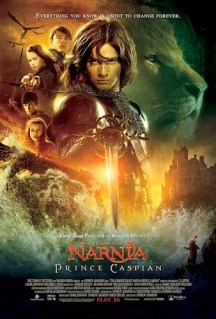
The Chronicles of Narnia: Prince Caspian (2008)

2010 #47
Andrew Adamson | 150 mins | Blu-ray | PG / PG

The Chronicles of Narnia: Prince CaspianThe Pevensie children return to Narnia, but hundreds of years later, in Disney’s last adaptation from C.S. Lewis’ series (don’t worry, Fox have taken it over). For those keeping track, this is both the second book and second film, but fourth chronicle chronologically. Which is fine for now, but I wonder what they’ll do come those earlier-set ones…
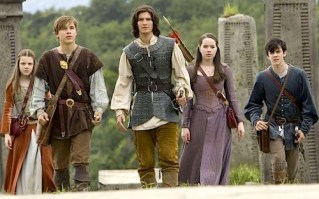
This time out, the world of Narnia has a harder edge. We’re still in PG territory — just — but everything’s turned a bit nasty, with a race of humans having wiped out the fantastical Narnians. Or (naturally) so they thought. Throw in some moderate political intrigue and you’ve got a more grown-up feel, if only slightly. It also makes for a slightly more cohesive tale — there are no odd elements leaking through from our world, like lampposts or Father Christmas, though one can well argue this removes something of Narnia’s unique magic.

It’s perhaps overlong, with numerous places trims could be made without denting the overall story. A half hour could surely have been saved without too much exertion. The first hour in particular is a tad slow, though the sometimes-wordy plot, based around some light court intrigue, adds depth beyond what might otherwise be a series of humans-on-magical-creatures punch-ups. I can’t comment on faithfulness here because it’s an awfully long time since I read the books. Besides, that running time is distorted by a whopping 12 minutes of end credits. I vaguely recall that, a few years ago, the second Matrix filmHeroes held the record for the longest closing credits at 10 minutes. I don’t really know what’s common these days but 12 minutes is nonetheless 8% of the film.
Once the human squabbling is passed — or by-passed, depending on your point of view — the human-Narnian war/one big battle really kicks off. Indeed, action sequences are frequent and fantastic throughout. The raid on the castle is tense, exciting and ultimately devastating — the troops left behind to certain slaughter is an incredibly dark moment in a PG-rated kids’ film. Later, a climactic sword fight is well staged, making excellent use of point-of-view shots, something I don’t recall seeing in a sword fight before.

The epic final battle comes as close to rivalling Helm’s Deep as anything I can think of, albeit — in typical Narnia style — in broad daylight on a big field. It has a real story to it, with specific moves being made by each side in the name of an overall strategy, rather than just A Lot Of Good Guys charging at A Lot Of Bad Guys and hacking away ’til one side wins, the apparent battle tactic in most other such large encounters on film.

The child actors aren’t going to set the world alight but are perfectly decent. I’m still not fully sold on Liam Neeson as Aslan, though I suppose the contrast of boom and gentility may be the point. Eddie Izzard is sadly underused as the excellent Reepicheep, who comes across as Narnia’s answer to Shrek 2’s Puss in Boots. Everyone else is fine — if nothing stands out, there is at least humour and an appropriate level of villainy provided.

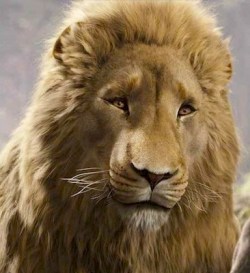
Perhaps shortages such as this make the film a rather empty experience, as some have claimed. Not even titular new boy Caspian is treated to a huge amount of characterisation, and what little there is elsewhere depends wholly on knowledge of the first film. In fact, while the primary story largely stands alone, a proper understanding of it relies on the viewer remembering the previous instalment — at no point does anyone bother to explicitly explain that these kids we’ve just followed into Narnia are siblings, never mind that they were there before for decades as Kings and Queens. Maybe this is respecting your audience’s intelligence,Aslan or maybe it’s just counting on their memory a bit too much. With only limited characterisation and basic political complications, Prince Caspian really boils down to a series of fights and battles. Nicely done fights and battles, I’d argue, but still, no one’s coming away from this particularly enriched.

I was quite disappointed with the first Narnia in the end. It was entertaining and at times fun, but the primary-coloured bloodless climax in particular made it feel like Lord of the Rings Lite. I know I’m not alone in this — with the teaser poster for the next film, The Voyage of the Dawn Treader, coming out last week, I noticed a number of sites commenting that they’d not bothered with the second film after disliking the first; box office numbers were down too (though it’s still the 108th highest grossing film ever). Loyalty to a series I enjoyed as a child ensures my return (albeit two years after the theatrical release) but it’s a shame others chose to pass it by, because Prince Caspian is a step-up from The Lion, the Witch and the Wardrobe in pure entertainment stakes. Hopefully this tone continues into Dawn Treader and, fingers crossed, the four chronicles beyond.

4 out of 5

Speed Racer (2008)

2010 #21
The Wachowski Brothers | 135 mins | Blu-ray | PG / PG

Speed Racer feels like an unfair place to kick off these half-arsed efforts because, despite the critical and commercial apathy it found on release, I really enjoyed it. This close to giving it 5 stars, I was. Still, it’s my oldest unreviewed film (from this year), so…

Firstly, it’s visually astounding. Speed Racer’s blocks of vibrant colour and computer whizzery are a natural fit for the modern digital experience. Action sequences are mind-meltingly fast, but also incredibly thrilling. When CGI is blatantly used in an attempt to fake something real it can leave an action sequence hollow; but here, everything is pushed to the limit — and, probably, beyond — and so it works.

The plot doesn’t have many twists or turns — at least, not any that are genuinely surprising — and yet it rarely feels boring or stale. It’s buoyed by the crazy action sequences, the likeable characters, the unabashed sense of fun that’s poured into every sequence. Little flourishes mark the film out: the Hallelujah moment with the sweets on the plane; Racer X’s delivery of a simple punch amongst a bevy of complex car stunts; numerous others lost to my memory.

Even some of the performances stand out, not something you’d expect from such a (for want of a better word) lightweight tale. Of particular note are Susan Sarandon as Mom and Christina Ricci’s Trixie, whose huge eyes help render her perhaps one of the most perfect live-action versions of an anime character ever seen. Yes, the characters mostly exist to service their place in the plot, but the odd scene or glance or line delivery adds some subtlety here and there.

The mediocre-to-bad reviews Speed Racer received on its initial release seek to chastise you if you happen to like it — look, Ebert’s already informed us why we’re wrong should we even attempt claims of artistic integrity in the Wachowskis’ work. Maybe he’s right — he can list a whole load of commercial tie-ins at the end, after all. Then again, this is the man who gave Phantom Menace half-a-star shy of full marks, a film that was only a little about story and quite a bit about tie-in merchandise if ever there was one (he awarded Revenge of the Sith the same, incidentally, and has included the granddaddy of all film-tie-in-tat, Star Wars itself, in his Great Movies series). And, to specifically rubbish his opinions here, Phantom Menace is praised for being “made to be looked at more than listened to… filled with wonderful visuals” and condemns Speed Racer because “whatever information that passes from your retinas to your brain is conveyed through optical design and not so much through more traditional devices such as dialogue, narrative, performance or characterization… you could look at it with the sound off and it wouldn’t matter.” Not that Film’s unique factor (over novels or radio or what have you) is its visual sense, and a silent film that can be told through image alone, devoid of any intertitles, was once a lofty aim. I’m sure Ebert could readily explain why Phantom Menace’s visual splendour is a good thing and why Speed Racer’s is so terrible, but, on the other hand… pot, meet kettle.

(For a point of clarity, I normally like and agree with Ebert — I’m sure some previous reviews where I’ve cited him will attest to this — which is why I pick on his pair of opinions here rather than those of some lesser critic who can’t be expected to maintain a critical ideology from one film to the next, never mind two that sit almost a decade apart.)

Back to Speed Racer. In every respect it’s like a living cartoon, and it’s the Wachowskis’ commitment to this aesthetic in every single respect that makes it work where others have floundered. It’s not perfect, I suppose. It may run a little long at two-and-a-quarter hours; but then, it so rarely lets up that I didn’t mind a jot. And the kid is often annoying; but then, as annoying little kids in films go, I’ve seen worse. At times I even liked him.
But, all things considered, when the chips are down, with all said and done, and any other clichés you feel like listing for no particular reason, I found this to be a candy-coloured masterpiece.

4 out of 5

The UK TV premiere of Speed Racer is on Channel 5 today, Sunday 26th October 2014, at 6:20pm.

Star Wars: The Clone Wars (2008)

2010 #16
Dave Filoni | 98 mins | Blu-ray | PG / PG

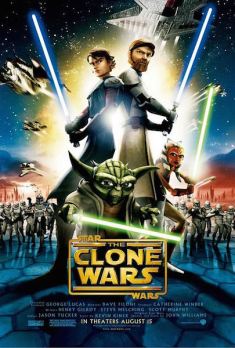
Star Wars: The Clone WarsThe Clone Wars can boast an awful lot of firsts within the Star Wars franchise: the first animated Star Wars in cinemas, the first not to feature Frank Oz as Yoda, the first not to open in May, the first not to have a text-crawl intro… It’s also the first not to open at number one at the box office. None of these facts are likely to endear itself to die-hard Star Wars fans. I’m not one, but it did little to endear itself to me either.

Things go wrong immediately. For fans, the Warner Bros. logo is horrendously incongruous (so I’m told — the original six films were all released by Fox), but for even the casual viewer there’s something seriously odd within minutes: no opening text crawl! This is meant to be Star Wars? Instead, a chunk of exposition — which sounds exactly like the opening crawl would, and so has clearly been designed to replace it — is read over a montage of the events it describes. Do they think children can’t read? In fairness, I’ve been to Star Wars screenings where there were children young enough that parents were having to read the crawl to their kids… but considering the live action films are “kids’ movies” too (as Lucas was so keen to remind us when everyone hated the prequels), surely what’s good enough for them is good enough for this?

Omissions such as this could be forgiven if more important aspects went well. But they don’t. The script is so good it could’ve been written by George Lucas himself. There are too many weak dialogue exchanges to even consider listing them, but Ahsoka’s habit of calling R2-D2 “Artooey” is memorably grating. Much of the voice acting is just as bad, with James Arnold Taylor’s Obi Wan accent particularly off-centre. Catherine Taber’s Padmé impression is probably the most convincing of the lot and, coincidentally sharing the same scenes, Corey Burton’s Truman Capote impression as Ziro the Hutt is entertainingly obvious. Count Dooku doesn’t particularly benefit from the involvement of Christopher Lee, but at least Samuel L. Jackson is vaguely recognisable lending his actual voice to Mace Windu. Most of the cast deliver the kind of performance you typically find in kids’ cartoons — i.e. not all that good, no doubt due to the pressures of producing as many episodes as possible as cheaply as possible. Dubious line readings abound, though in fairness this may be down to the awkward lines they’re forced to deliver.
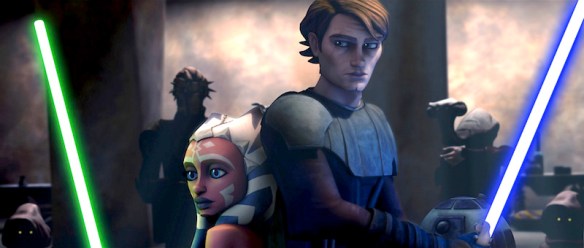
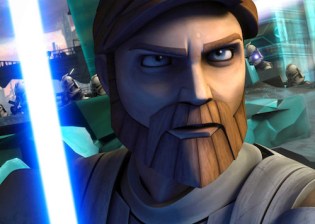
In between the poor dialogue there are plenty of action sequences. The first battle is a bit dull: masses of troops just firing at each other, until the bad guys suddenly decide that actually they ought to retreat because of the cannons — cannons that have been firing on them throughout. At least the repeat performance ten minutes later features some tactics and diversions. Later fights are better, though not by a huge amount. There are certainly a fair few, though there’s little real variation between them. The big battles and space dogfights are adequate, if lacking in focus, but the lightsaber duels miss the heft of their live-action equivalents, animation robbing them of the physical skill involved in a real sword fight (even if those in the prequels involve a fair degree of CGI themselves). The much-trumpeted vertical battle is a great idea that’s competently executed, but the change in perspective is too little used — apart from the odd moment or shot, they may as well be progressing slowly on a horizontal plane.

All of these sequences are scored by stock-sounding ‘epic action music’. Kevin Kiner’s music is nothing like as original or distinctive as John Williams’ work on the main series. Other than re-using some of Williams’ themes, it’s a rather generic action score — perfectly pleasant for what it is, but not particularly memorable. A slight remix of the main Star Wars theme gives the opening a distinctive air… as if the Warner Bros. logo, war talk over the Lucasfilm logo, and lack of text crawl didn’t do the job by themselves.

The animation itself is certainly stylised, which annoys some, but then it’s not billed as an Avatar-esque “it’s real, honest” style, or even the lower level achieved (if one can call it an achievement) by Beowulf. It’s surely a sensible decision — look how far from real Beowulf turned out to be on a feature budget and timescale, and when you’re churning out a weekly series (as this was always intended to be) such aspirations as photo-real CGI are far too lofty, not to mention expensive. Personally, I quite like the style. The painterly textures are slightly odd, but probably preferable to flat slabs of colour, while the cartoonisation of the cast (allegedly inspired by Thunderbirds) fits the lightweight tone and keeps things visually interesting. Besides, as noted, the visual style is the least of the film’s problems.

It may sound like a piece of trivia that this was originally conceived as three episodes of the TV series that now follows it, but where the breaks would fall is disappointingly clear — note, for example, that at around 25 minutes the first battle is won, Anakin resolves himself to teach the Padawan he previously objected to, and Yoda arrives to kick off the next part of the story. It could only be more like the end of an episode if credits rolled. It’s also the apparent need to fit two or three action sequences per episode that keeps them coming at regular intervals in a film which sticks three back-to-back.

There’s an overarching plot, thank goodness, which is immediately established… before being put on hold for half-an-hour while the events of what-would-have-been-episode-one play out: a battle that isn’t particularly significant in itself and has absolutely no relevance to the rest of the story, immediately betraying the three-episode origins. After that’s done the main plot resumes in two clearly-divisible chunks — the precise moment of the second transition isn’t as obvious as the first, but which subplots belong to which half is. Maybe the story joins are invisible to those who don’t know the production’s history or something of narrative structure (i.e. normal people), but they were blatant to me. It particularly shows in the final act/third episode, as the story switches from epic battle sequences to some out-of-nowhere political wrangling and lower-key lightsaber-based confrontations.

Although it has high-quality animation, a largely cinematic scale, particularly in the battles, and direction that isn’t as obviously TV-only as some TV-bound productions, The Clone Wars still feels like watching a compilation of TV episodes rather than a film in its own right. It’s partly the episode structures that remain unconcealed, partly the shortage of real voice talent indicating a lower budget, partly the relative insignificance of the story — it just doesn’t have the epic quality that imbued all the other Star Wars films. Not every film has to be an epic, even ones set within the same universe/storyline, but by wheeling out all the main characters and then showing them complete just one moderately low-key mission, The Clone Wars does feel like a single instalment of a TV series and not an appropriately-scaled cinematic experience.

This might’ve made a pretty strong set of opening episodes to a half-hour TV show, and I hear the series has gotten quite good as its first season progressed. If that’s true, it’s a shame such a weak beginning will have put so many off giving it a go, because as a standalone film The Clone Wars falls far short.

3 out of 5

Elektra (2005)

2010 #19
Rob Bowman | 93 mins | TV (HD) | 12 / PG-13

I think that — along with SFX magazine — I may be the only person in the world who quite liked the Daredevil movie (which reminds me that I still need to see the (supposedly better) director’s cut). This sequel/spin-off received even poorer reviews than its progenitor however, which means even I have spent the last five years (and 25 days, to be precise) not bothering to watch it. But when something’s available for free on TV, and in HD at that… well, it’d be rude to refuse. Though a little bit of me wishes I had.

So it goes without saying that most of Elektra’s reviews were right. The plot starts out as sub-Leon assassin nonsense, before turning into sub-X-Men superhero nonsense. The connection to Daredevil is actually minimal: vague flashbacks show Elektra being brought back to life, but the only signifier that this was the same death she suffered in Daredevil is the costume she wears. Said outfit has changed here, as she reverts (occasionally) to a bright red get-up that’s slightly more reminiscent of the comics. “It builds the legend,” she semi-explains. What legend? And how can said legend be built if everyone who sees her in it is promptly killed?

But beyond such surface modifications, the film adopts a different tone entirely. Daredevil took place in an almost-real version of the Marvel universe — ‘real’ if you could accept Matt Murdock’s amazing gymnastic abilities and whatnot were possible, anyway. Elektra starts off in this kind of world, but quickly there’s talk of mystical powers that bring back the dead and let you see a teeny bit into the future, shortly before some baddies explode in puffs of green smoke and some more baddies are revealed to have full-on superpowers. Where did these come from? No idea. The film offers no explanation, be it mutant gene or radioactive exposure or plain old training, instead just assuming viewers will accept that this is the real world… oh, but some people have these cool powers.
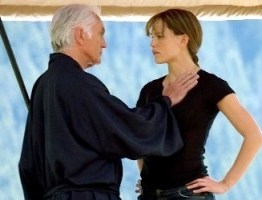
The plot is slight, early on padded with childhood flashbacks that the climax pretends to solve but really offers no adequate explanation for. Again. Characters die and we’re meant to care, only no one bothered to make them characters rather than plot-furtherers. Others do things that are almost logical, but not quite. One senses a couple more rewrites might have improved some of this, but then it might’ve been ‘improved’ by adding more explanatory dialogue and no one wants that — there are already enough clanging infodumps here, never mind the generally low standard of the rest. The less said about the performances the better. Terence Stamp plays at being blind quite well. Moving on…

The action sequences aren’t up to much either, their brevity and over reliance on slow-mo belying a too-small budget. Or maybe the budget was fine and they just blew it all on CGI, because that at least looks quite good. If they’d managed to produce something worthy of our attention here there might at least be a reason to keep watching, but the weak action is just icing on the cake of the clichéd story and bland characters. Director Rob Bowman claims he made an R-rated film which he was forced to cut to PG-13, the implication being that neutered the whole thing. Maybe that’s where all the action went, though on the evidence of what’s left I’m not sure I believe him.
That said, IMDb informs me that Elektra also has a director’s cut, though at just a three-minute increase it sounds nothing like as fundamental as Daredevil’s. And I do still want to see the Daredevil director’s cut, even if I should find that, after seven years, I no longer like the film; but I think it’s safe to say that Elektra’s definitely won’t be worth the hassle.

2 out of 5

Elektra featured on my list of The Five Worst Films I Saw in 2010, which can be read in full here.

Batman (1966)

2009 #47
Leslie H. Martinson | 100 mins | TV (HD) | U / PG

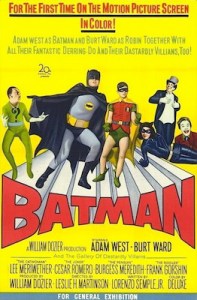
Batman (1966)Having only recently subjected myself to the full horror of Batman & Robin (though, based on the lack of review, it was before this blog began — that “recently” to me means “within the past four years” probably indicates why seeing ‘just’ 100 films in a year is a challenge), this spin-off from the ’60s Batman TV series remains the only significant cinematic outing for the Dark Knight to have escaped my scrutiny (well, unless you count Mask of the Phantasm, which we probably should). Except that’s (still) not entirely true: I once tried to watch it and gave up because it was dreadful. But the desire to be a completist — and an HD showing from Channel 4 — have led me to try again. Thank God I did, because it’s actually brilliant.
Some Bat-fans are immediately wondering what I’m on now, but I can assure you I watched it entirely sober. Batman has more than his fair share of over-serious fans and this film is anathema to them — it’s mad, camp, illogical, hilarious, vibrant, comic, comical… but all deliberately so. It perhaps goes on too long, perhaps pushes it too far at times… but then, if you’re on board with the concept and style, it’s pretty hard to criticise — it’s so ridiculous, and so aware that it’s ridiculous, that it goes beyond criticism.

In every respect, it has a real feel for what comics were like at the time — the vibrant colours, silliness, larger-than-life characters, nonsensical plots, plus there’s a nice line in risque humour, keeping the adults happy in what’s really a kid-focused film. The effect is akin to what Joel Schumacher wanted to do, only done with more rule-breaking conviction and, therefore, more success. It saves the series’ most famous element — the visual sound effects — for the climax, a submarine-set free-for-all to rival any other climactic mess/fight as Batman, Robin, the major villains and a bunch of sailors all end up floundering in the sea.

Talking of the series, was it this barmy? I don’t remember it being so ridiculous, but then I was young when I last watched it. There’s every chance kids young enough would take this completely seriously, and unquestionably enjoy it in that frame of mind, whereas those of us old enough to realise what’s going on — and, more importantly, old enough to get past the fact that it’s taken the moodiest, broodiest, angsty-teenager-friendly of superheroes and turned him into perhaps the campest ever — can enjoy it on all the levels the makers had in mind.

Batman is so many different things. These days it’s generally accepted that he’s The Dark Knight, a moody crimefighter lurking in the night to battle gangsters and unhinged supercriminals. But in the past he’s been so many other things, and this is just one facet. Those who dismiss it as missing the point of Batman, or any other such criticism of it not being Dark and Serious, are too caught up in our present perception of the character to see that it’s just another of his many sides. Is it a better film than The Dark Knight? No, of course it isn’t; and nor is it better than either of Burton’s Batman outings, nor Batman Begins… but then again, that’s personal preference.

Perhaps this demonstrates better than anything why Batman is one of the most enduringly popular superheroes, has one of the widest fanbases, has more graphic novels available than any other character ever: because, across all his forms, he has been treated in so many different ways by so many different people and for so many different people. You can’t really reconcile this as the same Batman and Joker who fought their way to the top end of the all-time box office pile 18 months ago, but nor were those the same characters who battled it out in 1989, or in thousands of pages of comics. In an age where we’re more obsessed with ‘canon’ and ‘continuity’ than ever (indeed, such concepts probably didn’t exist back when this Batman was being conceived), it’s oddly beautiful and so very freeing to imagine a character so unrestrained. It’s a glorious thing.

If you disagree — if you think Batman must always be dark, moody and deadly serious — well, fine; and you’ll be well catered for, because I doubt the film franchise is giving up that way any time soon (if ever). But as far as I’m concerned, to ignore the mad, frivolous and zany sides of the character — not to mention all the various other ones that could be described with equally unusual adjectives — is your loss.

4 out of 5

(Originally posted on 26th February 2010.)

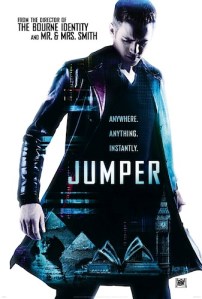
Jumper (2008)

2009 #76
Doug Liman | 88 mins | Blu-ray | 12 / PG-13

JumperIn honour of Jumper’s central conceit — that certain people can instantaneously transport themselves to any other point on the planet — I will conduct this review by jumping about through paragraphs I wrote without bothering to link them properly. (Also done in honour of my laziness.)
Jamie Bell’s character, Griffin, is much more interesting than Hayden Christensen’s lead, but he’s also amoral — from a storytelling point of view (at least, a mainstream one) he needs a controlling influence, which is why he’s reduced to supporting and he’s-a-bad-boy-honest Christensen is the film’s focus point.

Acting wise, everyone’s just fine. Christensen is perhaps not the most convincing rebellious hero ever, but that’s as much the script’s fault as his and he’s a heck of a lot better than in either Star Wars prequel. Jackson could be a decent villain in his sleep, though Roland could perhaps do with a little more menace to live up to his reputation, while Rachel Bilson is a likable (read: pretty) enough love interest. But it’s Jamie Bell who — once again — really stands out. Why he isn’t heading up his own franchise yet is a mystery. (Oh, wait.)

The beginning is at times a little dull. Considering the film barely crosses the 80 minute mark before the credits roll, early on it feels like there could be a little more excitement and drive. The second half almost makes up for it. Budget is plastered across the screen in incredible action sequences that show off the promise of the concept to good effect. Griffin jumping a double decker bus at Roland is a particular highlight. The jumping car chase, on the other hand, is visually neat and a good idea, but also entirely pointless — for one thing, it’s not actually a chase (no one’s pursuing them), and they do it for no reason other than the sheer hell of it. It’s a shame, because it would’ve been even better given a proper place in the story.

The rules of jumping and the world they exist in seem incompletely thought-out; or, at best, inadequately explained. They go on about having ‘jump points’ or something, but then seem to be able to jump about at will, so what are these points? What’s their significance? Their use? How are they established?

Liman also blows a potential twist — that David isn’t the only one who has these abilities — too early in an attempt to flesh out Jackson’s villain. It’s a good scene in its own right and does serve a purpose, but story-wise it would play better after Bell shows himself to David. As it is, his ability to mysteriously follow David around is not so mysterious, his reveal more “and?” than “oh!”

Bourne-esque final scene… except more Supremacy than Identity, so while Liman is copying, it’s unfortunately not from himself.

Jumper is promising rather than accomplished. In the same way many view X-Men as necessary character introduction and setup for X2, so Jumper appears intended as a primer for the sequels Liman and co have (had?) planned. It may reduce you to thumb-twiddling at times, but there’s enough on offer to make a follow-up desirable.

3 out of 5

(Originally posted on 8th February 2010.)

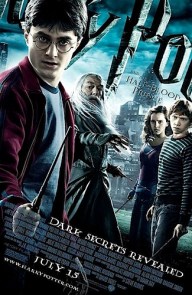
Harry Potter and the Half-Blood Prince (2009)

2009 #84
David Yates | 153 mins | Blu-ray | 12 / PG

Harry Potter and the Half-Blood PrinceBy this point I imagine everyone has a pretty clear idea what they think of Harry Potter, and this latest film certainly isn’t going to change that. That’s not to say it’s bad — in fact, it’s rather good — but Harry Potter is what it is, and nothing’s going to change that, least of all these thoroughly faithful adaptations.

This particular entry is well adapted from its huge source. I remember the novel as being somewhat turgid, a 600-page slab of flashbacks and exposition provided so one could understand the events of Deathly Hallows (for the uninitiated, that’s the final book, arriving as two films in 2010 and 2011). Thankfully, returning screenwriter Steve Kloves (who has adapted every Potter bar the previous one) and director David Yates liven it up considerably.

Adapting a 600-plus-page book is always a gargantuan task, something the Potter series has struggled with before (at times, Order of the Phoenix felt like an hour-long highlights montage), but Kloves manages to keep the thrust of the dark primary plot while peppering it with humour- and romance-based asides. (Calling it ‘romance’ may be a little generous — ‘teenage snogfest’ seems to be the preferred term by critics. And it is that, really. But ‘snog’ is such an ugly word, so I shall stick to ‘romance’.) The film could have been all Dark and Grim — and people doubtless expected, and probably would have accepted, that — but the sizable amounts of humour and romance keep the tone more appropriate to the series’ kid-centred roots, as well as adding light to the shade in a way that should please everyone. The titular Prince, however, is barely a subplot, but that’s a flaw of the novel rather than Kloves’ work.

Yates pitches the humour right, though the romance is occasionally overbearing for my taste, but the action sequences are well handled. Unfortunately, while entertaining in their own right, the majority are an aside to the main plot, which is perhaps where the two-and-a-half-hour running time comes from. The return of Quidditch is welcome to some fans, but would surely have been dropped without the fan pressure. That said, it feeds into both the Luck potion and romantic subplots, as well as providing its own doses of humour and action. Still, it’s a missed opportunity to further establish the character of Katie Bell, who has a moderately significant part to play a bit later on.

Worse is the opening bridge attack, which feels fairly pointless. Again, in itself it’s a dramatic event, expanded from a passing reference in the novel, but it bears little relation to the rest of the plot. In the novel it has a point — the wizarding world is finally impacting on the normal one — but that thread remains unexplored by the rest of the film, rendering the opening a visually exciting but empty sequence.

The still-young cast are intermittently believable. Rupert Grint still has a talent for comedy — enough to fulfill his role here, anyway — while Tom Felton is finally treated to a decent part as Draco. Formerly just an irritating bully, here he has a larger and more complex part to play, allowing Felton room to become one of the few child actors who can still live up to their part now. The adults are excellent as ever, particularly Jim Broadbent in a guest-star-level part and, naturally, Alan Rickman, who remains underused but may yet be treated to some material worthy of his talents in the final films. Additionally, Julie Walters conveys more with one expression in her brief cameo than some actresses can manage with half a dozen scenes.

With numerous plot elements left brazenly gaping ready for the next instalment (just as in the novel, of course) — including at least one thrown into the mix in the closing seconds — and Yates’ promise of an ‘urban thriller’ style for at least Part I (a genre he mastered in the outstanding State of Play), the two-part Deathly Hallows is a relatively tantalising prospect. Just eleven months to go…

4 out of 5