Captain America: Civil War (2016)

2016 #92
Anthony & Joe Russo | 147 mins | cinema | 2.35:1 | USA / English, German, Russian, Xhosa & Romanian | 12A / PG-13

This review contains spoilers.
(because, at this point, I’m not sure there’d be much point writing about it otherwise)

We’re now on to the 13th film in the Marvel Cinematic Universe, and while you don’t need to have seen all 12 preceding movies to follow the events of Civil War, you do need at least four — and, to get everything, a further four or five beyond that. (Don’t worry about the four TV series — it’s increasingly clear that they’re only notionally connected to the movies.) So the Marvel model for a “shared universe” is not discrete stories that take place in the same world, but a series of ever-more-connected narratives. It’s working for them, though, as the continually stellar box office totals prove.

Ostensibly the third Captain America movie, Civil War is as much a sequel to Avengers: Age of Ultron as it is to The Winter Soldier: it throws us straight in to action with the new Avengers line-up established at the end of Ultron, as they battle what turns out to be a villain from Winter Soldier. As I said, ever-more-connected. This particular mission goes disastrously wrong, bringing to a head plans that the governments of the world had been cooking up for a while: the Sokovia Accords, a way to control the Avengers and give them some accountability. Team leader Steve Rogers / Captain America (Chris Evans) isn’t keen — he’s worried political interests will conflict with the Avengers’ ability to do good. Bankroller Tony Stark / Iron Man (Robert Downey Jr.) is on board, however — spooked by having created Ultron, and after being confronted by the mother of an American lad who died in Sokovia (because the Sokovian deaths didn’t matter enough, I guess), he thinks the Avengers need reining in. The burgeoning conflict is clarified when Rogers’ childhood friend Bucky Barnes, aka Soviet agent the Winter Soldier (Sebastian Stan), emerges from hiding to attack the signing of the Accords — Rogers wants to save him; Stark needs to bring him in, dead or alive. As most of the other heroes we’ve met in the preceding 12 movies (not to mention a couple of new ones) pick sides, battle lines are drawn for an almighty clash.

As complicated as the plot sounds once you start trying to succinctly summarise it, Civil War is easy to follow as it unfurls. In fact, it’s to its credit that it can’t be readily summarised in any more detail than “Cap and Iron Man disagree; fight” without really getting into it. Screenwriters Christopher Markus and Stephen McFeely have followed up the political thriller of Winter Soldier with another global thriller storyline, again bringing different genre textures to the superheroics that are nonetheless present and correct. The film’s style mixes in just the right amount of realism — no one’s pretending this isn’t a comic book movie, with some elements of comic book logic and a casual acceptance of people having world-changing powers; but if such people did exist, this is the kind of way they would be handled by the authorities.

So while Civil War does work as a popcorn-guzzling action spectacular, the themes it raises — primarily of how we oversee and control those who claim to protect us — are relevant to real life, if you want them to be. The film attempts to make it a genuine debate by placing Cap and Stark as the figureheads of each side. Sure, that’s borrowed from the original comic book storyline that inspired the film, but it works perfectly for the movies: Iron Man is the basis around which the whole MCU was originally built, while Captain America is almost its break out star, emerging from the mess of The First Avenger to become one of the shining lights of every film he’s starred in since, at least two of which commonly compete for the crown of the MCU’s best movie. So who better to place at the heart of the conflict? Who better to present viewers with a genuine choice?

Well, maybe. But the debate is partially stalled by the fact this is a Captain America movie rather than an Avengers one. Yeah, you can side with Tony Stark & co, but you know Cap’s going to come out to the good, one way or another. As it pans out, it’s not a total victory (Team Cap are all now fugitives, presumably until Infinity War), but, morally, Cap wins, and even Tony knows it. Would it have been better to frame the political/thematic issues in an Avengers movie, to make it a genuine contest? Maybe. It’s almost hard to imagine it divorced of this context now, and a lot of that context is Cap-based. The rest of the cast of The Avengers may be hanging around, but the narrative drive comes back to Steve and Bucky, a throughline that belongs to the Captain America trilogy. You can’t doubt that this is a Captain America film — tonally, it fits better with The Winter Soldier than Age of Ultron — even as it is, really, also an Avengers one.

If we’re talking about hero-vs-hero conflicts and movies that give you something to think about, it’s only fair that we drag this year’s other big silver screen superhero battle into the fray. There’s little doubt that Civil War is a more readily entertaining film than Batman v Superman, and clearly a more popular one, but it left me with less to think about. That’s not to say there isn’t thematic weight here — I’ve just spent a couple of paragraphs referring to its attempts to engage with such debates, after all — but I felt like the film kinda covers what there is to say. Maybe Batman v Superman leaves its issues more open; or maybe they’re less well conveyed; or maybe we struggle to read them into it because they’re not actually there. Whatever the truth, I came out of Zack Snyder’s movie with lots going on in my mind and wrote 2,500 words about it that contained half or less of my thoughts. I came out of Civil War thinking, “well that was fun.”

On that visceral level, there are a couple of stunning action sequences. The car/foot chase between Cap, Bucky and Black Panther is fantastic, casually throwing in cool moments like the way Bucky steals a motorbike. The climactic two-on-one fight is also a sight, throwing in strong choreography and seamless effects work to create a battle that has a real ebb and flow, a back and forth over who has the upper hand. And the centrepiece of it all, of course, is the two teams facing off at the airport. For fans of superheroes, this is pretty much the ultimate expression of the genre yet brought to live-action moviemaking. For my money, the antics of Ant-Man — and Giant-Man — are by and large (pun very much intended) the best bit of it, but maybe I’m just a little biased. Certainly, that everyone’s favourite webslinger is in the mix is the icing on the cake, and Tom Holland seems to have quickly nailed Spidey. Personally, I still find it a bit odd him turning up, especially in such a minor role. There’s still a slight sense that the MCU is made up of second/third-string heroes, who needed that shared universe to kickstart their big-screen life. Spidey most certainly does not need that… or didn’t before Sony effed it up with the last two movies, anyway. Maybe he does now.

And while I’m talking about Spider-Man, let’s talk about those post-credits scenes. Peter Parker is the star of the second one, and it’s Marvel Studio’s usual kind of tease, though perhaps less teasing than normal — “hey, remember that kid who was Spider-Man? He’s Spider-Man!” Thanks, guys. Before that, though, the mid-credits scene is a mid-credits scene for the sake of a mid-credits scene. By establishing where Bucky ends up, it’s surely an essential part of the overall narrative. Okay, it has the requisite teaser properties, hinting at where we might find Team Cap come the start of Avengers 3; and it teases Black Panther too, but only very, very mildly — like the Spidey scene, it’s basically saying, “hey, remember that foreign prince who was Black Panther? He lives in a foreign country… where he’s Black Panther!” Other than that, it’s kinda important to answer the question of “hey, what happened to Bucky?” next time Cap turns up. So why isn’t the scene just in the film? Well, it is in the film — just after a few of the credits — so what does it matter, right?

As I was saying — there’s plenty more action in the movie. Sadly, much of it falls foul of the dreaded ShakyCam. Watching Civil War just days after The Raid 2 made that especially frustrating. With all the time and effort they put into training actors these days, plus all the effects technology they have at their disposal to paint out wires or replace faces (something they’ve been able to do unnoticeably since Jurassic Park, for pity’s sake!), you’d think a $250 million movie could manage better. (If you’re wondering what they did spend $250 million on, it was stuff like, “eh, we may as well just use CGI for the close-ups, too”.)

One thing the film definitely gets right, in my view, is its villain. So central is the Cap/Iron Man conflict that it seemed any villain would be an afterthought, at best; and it doesn’t help that the MCU is renowned for having weak antagonists. Indeed, for most of the movie Zemo seems like the expected nonentity; a villain for the sake of a villain, who’s being seeded earlier in the film just so he doesn’t come completely out of nowhere at the climax. But then, when his whole story and plan is revealed, it turns out that all along he may have been one of the most interesting villains the MCU has yet offered. His motivation is simple but effective; his methodology cunning and almost successful — even after the heroes know what he was trying to get them to do, they do it anyway! His final scene with Black Panther may be the best part of the entire movie. Nice work, Daniel Brühl.

In the end, Civil War leaves plenty open for future Marvel movies. Well, of course it does — half the time MCU movies are feature-length trailers for the next MCU movie. Where Civil War is really clever, however, is that it does that stage-setting while also feeling conclusory. As the third part in the Captain America trilogy, it actually makes a pretty satisfying end to that narrative. As the third part in the “trilogy in five parts” that is The Avengers trilogy, well, it’s clearly not the end, but it’s a fairly discrete segment.

It may well also be the best MCU movie so far, too. There aren’t many 13th films that can say that.

4 out of 5

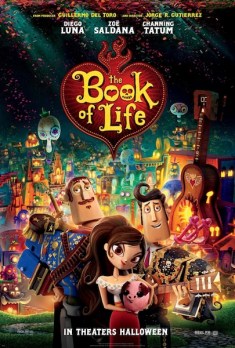
The Book of Life (2014)

2016 #50
Jorge R. Gutierrez | 92 mins | streaming (HD) | 2.35:1 | USA / English | U / PG

A myth-like animated musical adventure based around Mexico’s Day of the Dead, most notable for its unique art style that presents gorgeous visuals throughout.
Otherwise, it has the right ingredients but in disappointing proportions. The story is good, but too long in the telling. The humour isn’t consistently amusing. The songs are mostly re-appropriated pop tracks, plus two new compositions. The latter are more effective, though shoehorning a rendition of Radiohead’s Creep into a kids’ movie is memorable for the wrong reasons.

Some viewers may lose patience with it, but I thought enough was likeable to keep it ticking over.

3 out of 5

For more quick reviews like this, look here.

Galaxy Quest (1999)

100 Films’ 100 Favourites #33

The show was cancelled…
but the adventure has only begun.

Country: USA
Language: English
Runtime: 102 minutes
BBFC: PG
MPAA: PG

Original Release: 25th December 1999 (USA)
UK Release: 28th April 2000
First Seen: DVD, c.2001

Stars
Tim Allen (The Santa Clause, Christmas with the Kranks)
Sigourney Weaver (Alien, Avatar)
Alan Rickman (Dogma, Harry Potter and the Philosopher’s Stone)
Tony Shaloub (Men in Black, Pain & Gain)
Sam Rockwell (Confessions of a Dangerous Mind, Moon)

Director
Dean Parisot (Fun with Dick and Jane, RED 2)

Screenwriters
David Howard
Robert Gordon (Addicted to Love, Lemony Snicket’s A Series of Unfortunate Events)

Story by
David Howard

The Story
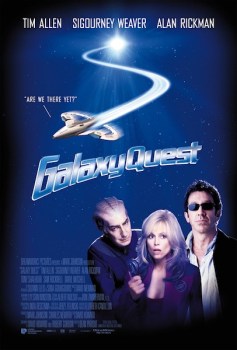
The cast of ’70s sci-fi series Galaxy Quest have been reduced to convention appearances and mall openings since their show was cancelled; but when a group of aliens, who believe the series was an historical document and have built the show’s spaceship for real, ask for the crew’s help to defeat a genocidal general, the actors must endeavour to become their characters for real.

Our Heroes
A ragtag gang of washed-up actors who used to star on a space opera TV series, now co-opted into being real heroes. They’re all based on the cast and characters of Star Trek, of course: Tim Allen’s Jason Nesmith, the ship’s captain, is obviously William Shatner/James T. Kirk; Sigourney Weaver’s Gwen Demarco, the token female, is Nichelle Nichols/Uhuru; Alan Rickman’s Alexander Dane, the classically-trained actor playing an alien science officer, is a combination of Leonard Nimoy/Spock and Patrick Stewart; Tony Shaloub’s Fred Kwan, a fake-foreign engineer, is a mixture of James Doohan/Scotty and Walter Koenig/Chekov; and Daryl Mitchell’s Tommy Webber, a young helmsman from an ethnic minority, is a mixture of George Takei/Sulu and Wil Wheaton/Wesley Crusher.

Our Villain
General Sarris, a reptilian warlord waging war against the kindly Thermians. No discredit to Robin “Ethan Rayne off Buffy” Sachs, but he’s kind of beside the point, really.

Best Supporting Character
Enrico Colantoni (Veronica Mars, Person of Interest) plays the leader of the friendly aliens, Mathesar, a naïve soul who speaks in a sing-song monotone.

Memorable Quote
“By Grabthar’s hammer, by the suns of Worvan, you shall be avenged.” — Sir Alexander Dane

Memorable Scene
Our heroes arrive in the bowels of their screen-faithful ship to find “a bunch of chompy, crushy things” impeding their path — for absolutely no reason. “We shouldn’t have to do this, it makes no logical sense, why is it here?… This episode was badly written!”

Making of
In cinemas, the film began with a 4:3 aspect ratio for clips from the old TV series, then widened to 1.85:1 for the Earth-based scenes, before widening again to a highly cinematic 2.35:1 once Tim Allen’s character realises he’s on a real spaceship. It was decided to ditch the middle stage for the home video releases, which I suppose makes sense, but is a lot less fun.

Previously on…
Galaxy Quest is an original creation, but it’s heavily inspired by the Star Trek franchise and its fans.

Next time…
A reboot TV series was supposedly in the works at Amazon, though comments made by co-star Sam Rockwell just last month suggest the project had developed into a direct sequel, which was then sadly scuppered by the untimely death of Alan Rickman.

Awards
1 Saturn Award (Actor (Tim Allen))
9 Saturn nominations (Science Fiction Film, Actress (Sigourney Weaver), Supporting Actor (Alan Rickman), Performance by a Younger Actor/Actress (Justin Long), Director, Music, Costumes, Make-Up, Special Effects)
Won the Hugo Award for Best Dramatic Presentation

What the Critics Said
“Whether you love Star Trek or laugh at it, your starship is about to come in, docking in the form of Galaxy Quest, an amiable comedy that simultaneously manages to spoof these popular futuristic space adventures and replicate the very elements that have made them so durable. […] If Galaxy Quest never attains consistently giddy heights as it plays out its combination of knowing satire and heroic adventure, it nevertheless keeps its tongue firmly in its cheek, offers a few genuine laughs, moves swiftly, if not at warp speed, and is led by a talented cast.” — Lawrence Van Gelder, The New York Times

Score: 90%

What the Public Say
“As a fan of the various science fiction classic series, like Star Trek and Star Wars, I’ve met most of the people parodied in Galaxy Quest – from the overzealous fans to the has-been and bitter celebrities making a living off a series’ memories. A movie like Galaxy Quest manages to poke fun at a wide range of people but still be loveable and sympathetic at the same time.” — Kevin Carr, 7M Pictures

What the Trekkies Say
In 2013, just after Star Trek Into Darkness came out, a massive convention of Trekkies decided to vote on the best Trek movies. Galaxy Quest muscled its way in to 7th place, besting six real Trek flicks. (Infamously, Into Darkness came dead last.)

Verdict

Managing to satirise both classic sci-fi TV shows and their (shall we say) enthusiastic fanbase, while remaining relatively respectful to both, is quite a feat, and is surely one reason Galaxy Quest has proven so popular. Another is its accessibility: you don’t need to be a Trekkie to get all the gags. Combine those two and you have a film for fans and non-fans alike. To really cement the issue, it’s a solid adventure movie as well as a funny comedy.

#34 will be… what you get for the man who has everything.

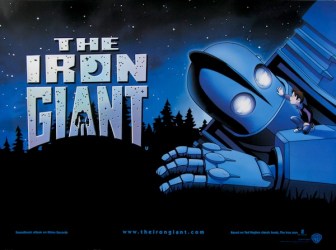
The Iron Giant (1999)

2016 #86
Brad Bird | 83 mins | DVD | 2.35:1 | USA / English | U / PG

Adapted (loosely) from Ted Hughes’ children’s novel The Iron Man, the feature debut of director Brad Bird (The Incredibles, Ratatouille, now live-action stuff) relocates the book’s story to ’50s America and mixes in some Cold War elements. The film was somewhat verboten in our household when it came out, because the book was beloved and the film looked so different, but its reputation has only grown in the ensuing decade-and-a-half — and Hughes approved of it anyway.
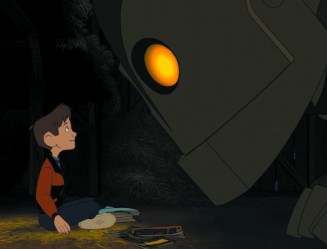
This version sees the titular robot (voiced by Vin Diesel) crash to Earth near Maine in late 1957, the home of nine-year-old Hogarth Hughes (Eli Marienthal) and his mom Annie (Jennifer Aniston). After the giant eats the Hughes’ TV aerial, Hogarth tracks it to take a photo, and ends up saving it from electrocution when it tries to eat a power station. As the giant sneaks around the countryside eating cars and causing train crashes, it attracts the attention of government agent Fox Mulder from the FBI’s X Files Kent Mansley from the Bureau of Unexplained Phenomena (Christopher McDonald), who’s intent on uncovering and destroying the giant. Hogarth tries to hide the friendly creature with the help of artist Dean (Harry Connick Jr.), but could it be Mansley isn’t so wrong about the threat it poses?

The story, as reconstructed by Bird and screenwriter Tim McCanlies, integrates influences from ’50s B-movies (very apt for a giant robot ‘monster’) and Cold War/Space Race paranoia for a potent storyline that has a different emphasis from the novel’s “world peace” finale, but nonetheless is promoting understanding of alien/foreign powers and, y’know, deep stuff like that. Alternatively — or, rather, concurrently — it’s an E.T.-esque tale of a boy and his quirky alien friend. Bird was keen to emphasise character over action and mindless spectacle, and that’s really where the film’s strengths lie.

Well, that and the technical aspects. The animation is stunningly well done, exhibiting exceptional fluidity and detail in its character animation, in particular. That’s in spite of the film having a reduced budget and time schedule thanks to the box office failure of previous animations by the studio — in Bird’s words, they had “one-third of the money of a Disney or DreamWorks film, and half of the production schedule”, but that meant greater production freedom (so long as they managed that budget). I guess that’s why the film’s ended up only growing in stature since its first release — because it’s able to be committed to its creators’ vision, rather than being battered into homogeneity by a studio desperate for a return on considerable investment.

Beautifully animated and affectingly told, with a style that nicely homages classic sci-fi movies, The Iron Giant is a film that deserves the reputation it has gradually amassed — and which only continues to grow, I think. Last year saw the release of an extended Signature Edition, with a couple of short scenes added, which comes to US Blu-ray (alongside the original version) later this year. Just from reading about those new scenes, I’m not convinced they’ll improve the experience, but it’ll certainly be worth finding out.

5 out of 5

The Iron Giant was viewed as part of my What Do You Mean You Haven’t Seen…? 2016 project, which you can read more about here.

This review is also part of 1999 Week.

From Russia with Love (1963)

100 Films’ 100 Favourites #32

James Bond is back!
His new incredible women!
His new incredible enemies!
His new incredible adventures!

Country: UK
Language: English, Russian, Turkish & Romany
Runtime: 115 minutes
BBFC: A (1963) | PG (1987)
MPAA: GP (1971) | PG (1994)

Original Release: 11th October 1963 (UK)
US Release: 8th April 1964
First Seen: TV, c.1995

Stars
Sean Connery (Darby O’Gill and the Little People, Zardoz)
Daniela Bianchi (Special Mission Lady Chaplin, Operation Kid Brother)
Pedro Armendariz (Fort Apache, 3 Godfathers)
Lotte Lenya (The Threepenny Opera, The Roman Spring of Mrs. Stone)
Robert Shaw (A Man for All Seasons, Jaws)

Director
Terence Young (Dr. No, Wait Until Dark)

Screenwriter
Richard Maibaum (Bigger Than Life, Licence to Kill)

Adapted by
Johanna Harwood (Dr. No, Call Me Bwana)

Based on
From Russia with Love, the fifth James Bond novel by Ian Fleming — one of John F. Kennedy’s favourite novels.

The Story
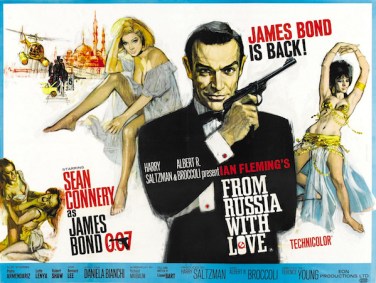
When Soviet consulate clerk Tatiana Romanova offers to defect, she has one condition: that she is extracted by James Bond. Although M smells a trap, as collateral Tatiana offers a Lektor, a decoding machine MI6 have wanted for years. Bond travels to Istanbul to steal the Lektor, unaware he’s being manipulated by the criminal organisation SPECTRE…

Our Hero
The name’s Bond, James Bond. In only his second big-screen outing, so Connery is still establishing the character here — considering all the ‘fun’ antics that came since, Bond is quite a hard bastard in Dr. No and From Russia with Love (which is only appropriate for a government-sponsored killer, of course).

Our Villains
They may not be as grandiose as the volcano-dwelling types that came later in the series, but From Russia with Love has two of Bond’s most memorable adversaries: the hard former KGB officer Rosa Klebb, with her deadly shoe (well, it sounds silly when you put it like that), and assassin Red Grant, who may not know what wine to have with fish but could certainly gut you like one. A fish, that is. Not wine. You can’t gut wine.

Best Supporting Character
Kerim Bey, British Intelligence’s man in Turkey. An affable, witty soul, he’s also an invaluable ally during Bond’s time in Istanbul.

Memorable Quote
Tatiana: “I think my mouth is too big.”
Bond: “I think it’s a very lovely mouth. It’s just the right size… for me, anyway.”

Memorable Scene
On the Orient Express, SPECTRE assassin Red Grant manages to corner Bond in his compartment. Although he has Bond at gunpoint, Grant is distracted by the offer of gold coins hidden in Bond’s case. Bond tricks Grant into setting off the case’s booby trap, allowing Bond to tackle him. A rough close-quarters fight ensues.

Write the Theme Tune…
Having arranged and performed Monty Norman’s James Bond Theme for Dr. No (for which he didn’t receive a credit), John Barry was the main composer for Bond’s second adventure. However, the producers tapped Lionel Bart — then popular from Oliver! — to write the title song. Barry didn’t like that Bart’s lyrics had nothing to do with the film’s story, a point he set out to rectify when given full control of the soundtrack to Goldfinger.

Sing the Theme Tune…
A good answer if you’re ever faced with a trivia question about James Bond theme singers, Matt Monro was — so Wikipedia tells me — known as “The Man With The Golden Voice” and “became one of the most popular entertainers on the international music scene during the 1960s and 1970s.” With the Bond formula not yet fully established, a snippet of his song is heard on a radio early in the film, but not played in full until the end credits. (The title credits are scored with an instrumental version of the song, plus the James Bond Theme.)

Technical Wizardry
Projecting the title credits on writhing half-naked girls? It’ll never catch on.

Making of
Although Red Grant is presented as a physically-imposing male specimen, including showing off his half-naked physique the first time he appears, in reality actor Robert Shaw had to stand on a box when opposite Sean Connery because he was so much shorter than the Scot. (4 inches shorter, according to CelebHeights.com. Yes, that’s a real website.)

Previously on…
This is the second film about the adventures of James Bond, after the previous year’s Dr. No.

Next time…
The next film, Goldfinger, set the template for much of the rest of the Bond series. To date, that has encompassed a further 22 canonical movies, with the series’ 25th already in development. From Russia with Love was adapted for radio in 2012, the third of (to date) five Bond radio adaptations starring Toby Stephens as 007.

Awards
1 BAFTA nomination (British Cinematography (Colour))

What the Critics Said
“Don’t miss it! This is to say, don’t miss it if you can still get the least bit of fun out of lurid adventure fiction and pseudo-realistic fantasy. For this mad melodramatization of a desperate adventure of Bond with sinister characters in Istanbul and on the Orient Express is fictional exaggeration on a grand scale and in a dashing style, thoroughly illogical and improbable, but with tongue blithely wedged in cheek.” — Bosley Crowther, The New York Times

Score: 96%

What the Public Say
From Russia with Love turned out to be amongst the best of the Bonds. Distinctly low key, and relying on the strength of its cast over the spectacular thrills and gadgetry that would come to define the series, it’s a great couple of hours’ cinema that may delight viewers who come to it expecting the same old nonsense from 007.” — Mike, Films on the Box

Elsewhere on 100 Films
I reviewed From Russia with Love as part of a retrospective on Connery’s Bond back in 2012, when I noted it was “a very faithful rendition of the book. That makes it a Cold War spy thriller, albeit one with fantastical touches […] Mostly, though, it feels remarkably plausible. Sequences like the theft of a decoding machine from the Russian consulate, or the famous confined train carriage fight with Red Grant, have real-world heft rather than typical Bond action sequence fantasticism.”

Verdict

It’s only the second Bond movie, so there’s no template yet, but in retrospect From Russia with Love is an oddity among the Bond flicks of the ’60s and ’70s. Although it has many of the series’ regular trappings — exciting action, exotic locations, beautiful women, grotesque villains, nifty gadgets — it also functions as a straight-up ’60s Cold War spy thriller, with few of the fantastical touches the Bond films would become known for. Such atypicality means anyone looking for a “Bond formula” movie will be disappointed, but otherwise it’s an accomplished thriller, and one of the series’ finest instalments.

The first rule of #29 is… don’t talk about #29.

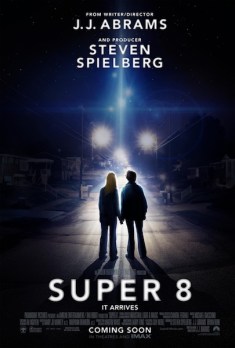
Super 8 (2011)

2016 #7
J.J. Abrams | 112 mins | streaming (HD) | 2.35:1 | USA / English | 12 / PG-13

Before he started star warring and between bouts of star trekking, director J.J. Abrams teamed up with producer Steven Spielberg for this homage to the kind of movies Spielberg produced in the ’80s. Those films have endured down the decades; I’m not sure Super 8 endured as far as Abrams’ next lens flare showcase film. Which is a little bit of a shame because, by being Abrams’ most personal film, it may also be his best.
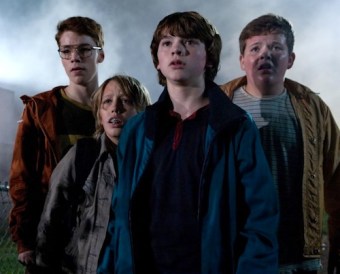
Set in the summer of 1979, the film follows a group of teenage boys making a zombie film, in particular Joe (Joel Courtney), whose mother died a couple of months earlier in an industrial accident. For their film’s love interest, the guys enlist Alice (Elle Fanning) and Joe begins to grow close to her, despite his dad (Kyle Chandler) blaming her dad for the death of Joe’s mother. While shooting a scene late at night, the kids witness a massive train crash, caused by their science teacher. With his dying words he warns them not to tell anyone what they witnessed. As the military descend on the wreckage and odd things begin to happen around the town, it becomes clear the train was transporting something very strange…

How much all this achieves Abrams’ goal of feeling like a genuine Amblin movie, I’m not sure. On the surface, not that much: the visual style is all too modern, not to mention the CGI. But, tonally, there is something there, which has somehow survived being filtered through the filmmaking process and made its way into the finished product — it’s a bit of that spirit of adventure; the kind of storyline and characters; and, actually, the way it holds back a little on the effects work. Several people cite The Goonies when talking about it, which just reminds me that I really ought to get round to seeing that. (The fact it’s absolutely loved by some, while increasingly I hear people bravely sticking their heads over the parapet to say, “it’s not really that good, you know”, intrigues me rather.)

Unfortunately, the longer the film goes on the more it runs away with itself, as characters dash back and forth all over the place, sometimes in credibility-stretching fashion (we never do see how a group of kids manage to escape a heavily-guarded military base and drive back to an evacuated and blockaded town). The adults stumble through the story to little dramatic effect; Joe’s dad even has to be secretly locked up for a good chunk of the film (with no other characters noticing his disappearance) so that his storyline can be paused until he’s wheeled out for his part in the climax. The grown-ups do serve a role — giving us a perspective on events that the kids lack, and being tied to the emotional arcs of the leads — but it wouldn’t have harmed anything to limit them to those functions, rather than trying to half-heartedly give them stories of their own.
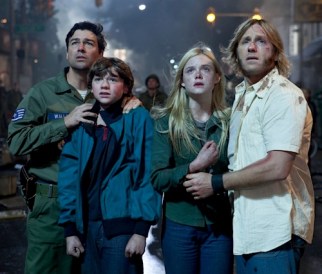
The kids are quite likeable in their way, especially Courtney and Fanning, who have enough chemistry to keep their interactions the most engaging aspect of the film. In fact, if Abrams wasn’t the kind of filmmaker he is, an indie-ish real-world take on Super 8’s dramatic storyline (a bunch of friends making a short film over the summer holidays, also with all the other grounded emotional aspects of the movie) might’ve made for an even more effective, enjoyable film. (Somewhat ironically, it seems this was Abrams’ original intention: according to IMDb, his two ideas for a follow-up to Mission: Impossible III were a coming-of-age story or an alien-on-the-loose adventure. Presumably getting sidetracked into Star Trek gave him the time to decide to combine them.)

In some respects, the kids’ short film (which plays during the end credits) encapsulates the whole movie: a semi-thought-through SF/F plot, a tacked on emotional arc, the apexes of both tied together in the climax, and a couple of sometimes-shoehorned effects set pieces along the way. Yet for all that, it does enough right that I’d quite like to see Abrams attempt more work along these lines.

4 out of 5

J.J. Abrams’ most recent film, a little movie you’ve probably not heard of about something-or-other waking up (I forget the details), is out on DVD & Blu-ray in the UK today.

Flash Gordon (1980)

100 Films’ 100 Favourites #30

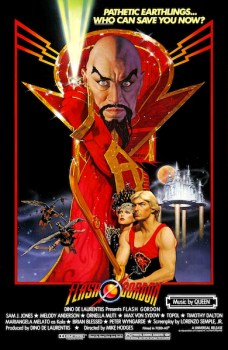
Pathetic earthlings…
Who can save you now?

Country: UK & USA
Language: English
Runtime: 115 minutes
BBFC: A (1980) | PG (1987)
MPAA: PG

Original Release: 5th December 1980 (USA)
UK Release: 11th December 1980
First Seen: c.1995

Stars
Sam J. Jones (10, Ted)
Melody Anderson (Dead & Buried, Firewalker)
Max von Sydow (The Seventh Seal, The Exorcist)
Topol (Fiddler on the Roof, For Your Eyes Only)
Ornella Muti (The Last Woman, Tales of Ordinary Madness)

Director
Mike Hodges (Get Carter, Croupier)

Screenwriter
Lorenzo Semple Jr. (Batman: The Movie, Three Days of the Condor)

Adaptation by
Michael Allin (Enter the Dragon, I’ll Be Home for Christmas)

Based on
Flash Gordon, a newspaper comic strip created by Alex Raymond.

The Story
American football player Flash Gordon and journalist Dale Arden accidentally end up on the spaceship of scientist Dr Zarkov, which transports them to the planet Mongo. There, they learn the planet’s evil Emperor, Ming the Merciless, is subjecting Earth to natural disasters in a bid to destroy it. Flash must unite the warring factions on Mongo to defeat Ming and save the Earth.

Our Hero
He’s a miracle, king of the impossible. Just a man, with a man’s courage, but he can never fail. He’ll save every one of us. Flash! Ah-ah!

Our Villains
Max von Sydow is deliciously villainous as evil emperor Ming the Merciless. There’s a handful of similarly entertaining underlings, too, like scheming right-hand-man Klytus, who gets a great death, and right-hand-woman Kala, who gets some of the very best lines.

Best Supporting Character
Prince Vultan may be culturally iconic for one two-word exclamation, but it kind of encapsulates the presence he brings throughout the film.

Memorable Quote
Zogi: “Do you, Ming the Merciless, Ruler of the Universe, take this Earthling Dale Arden, to be your Empress of the Hour?”
Ming: “Of the hour, yes.”
Zogi: “Do you promise to use her as you will?”
Ming: “Certainly!”
Zogi: “Not to blast her into space? …uh, until such time as you grow weary of her.”
Ming: “I do.”

Quote Most Likely To Be Used in Everyday Conversation
“Gordon’s alive?!” — Prince Vultan
(Not that it’s likely to be appropriate in everyday conversation, but you’re still going to hear it said — especially if you’re ever around Brian Blessed.)

Memorable Scene
In Ming’s harem, Flash’s love interest Dale and Ming’s rebellious daughter Aura end up wrestling on a giant bed. Kinky! But it’s knowingly directed, with cutaways to sniggering servants indicating a deliberate commentary on such gratuitous girl-on-girl spectacles in other films.

Write the Theme Tune…
“Dum dum dum dum dum dum dum dum FLASH! Ah-ah! Saviour of the universe!” Rock group Queen composed the entire score for Flash Gordon, and their unmistakeable sound is a significant part of the film. Best of all is that main theme, surely one of the most memorable and hummable pop themes for a movie ever recorded. If you’re interested in the making of the soundtrack, there’s a detailed article on Queen’s official site.

Technical Wizardry
The design work is great. The sets, costumes, and spaceships are all huge, vibrant, retro, often ridiculous, and wonderful.

Truly Special Effect
Skies full of swirling rainbow colours, rainbow clouds for the spaceships to float through, platforms that tilt over a rainbow vortex… OK, there’s a lot of rainbows, but it’s unique and looks great.

Letting the Side Down
There is so little that’s bad about Flash Gordon that I’ve left this section in just to point out that there is nothing bad about Flash Gordon.

Previously on…
The most famous earlier version of Flash Gordon must be the three cinema serials starring Buster Crabbe that were produced between 1936 and 1940. They’re great fun (I nearly made space for one of them on this list, but… not quite). There was also a live-action TV series in the ’50s and an animated one in 1979.

Next time…
An animated TV movie followed that last TV series in 1982. Flash was part of the Defenders of the Earth animated series in the mid ’80s, alongside other heroes such as the Phantom. Another animated series came along in 1996, while a live-action reboot was attempted in 2007. It looked terrible, and I’ve heard it’s one of the worst TV shows ever made. Reports of a new film being in development come along now and then, with Kingsman’s Matthew Vaughn being the most recently attached director. Until that rolls around, Flash’s main claim to current pop culture relevance comes courtesy of Ted and its sequel.

Awards
3 BAFTA nominations (Music (because Queen), Costume Design, Production Design/Art Direction)
3 Saturn nominations (Science Fiction Film, Supporting Actor (Max von Sydow), Costumes)
1 Razzie nomination (Worst Actor (Sam J. Jones))
Nominated for the Hugo for Best Dramatic Presentation

What the Critics Said
Flash Gordon is played for laughs, and wisely so. It is no more sophisticated than the comic strip it’s based on, and that takes the curse off of material that was old before it was born. This is space opera, a genre invented by Edgar Rice Burroughs and Hugo Gernsback and other men of unlimited imagination harnessed to definitely limited skills. It’s fun to see it done with energy and love and without the pseudo-meaningful apparatus of the Force and Trekkie Power.” — Roger Ebert

Score: 82%

What the Public Say
Star Wars was squarely heterosexual, but Flash Gordon could only have emerged from the same pop-culture closet that birthed David Bowie, Elton John, Mick Jagger, and Freddie Mercury […] As for the empty-headed dialogue and the puerile plot, isn’t it obvious those are both part of the point? Everyone involved (well, except maybe Sam J. Jones) knows precisely what this is and performs accordingly, with a straight face but with a small gleam in the eye. […] I don’t know if I’d want to know anyone who couldn’t love this movie, or at least enjoy it on some level.” — Rob Gonsalves, eFilmCritic.com

Elsewhere on 100 Films
In 2009 I said that Flash Gordon was better than Star Wars. Well, I mean, I don’t know if I exactly stand by that, but I’m also not going to contradict it — Flash Gordon is awesome.

Verdict

Once reviled for being a laughably silly Star Wars cash in, the world has gradually begun to realise the truth: that Flash Gordon was always in on the joke. And it’s so obviously in on the joke, it makes a lot of the old reviews criticising it look embarrassingly tin-eared. It’s not meant to be a serious sci-fi adventure, like its big-screen Trek and Wars contemporaries. It’s designed to be camp, colourful, over-the-top, driven by cliffhangers and wackiness. It’s funny, it’s fun — it’s Flash! Ah-ah!

#31 will be… slightly more expensive.

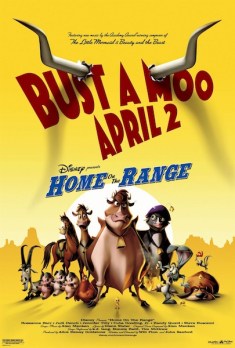
Home on the Range (2004)

2016 #32
Will Finn & John Sanford | 73 mins | streaming (HD) | 1.78:1 | USA / English | U / PG

I have many goals within my film viewing, quite apart from trying to watch 100 films every year. Some I’ve completed (the Rathbone Holmes series), others are almost done (every Spielberg film), others not so much (every Hitchcock film), and others I’ve barely begun (the Zatoichi series). One of these goals is to watch every Disney Animated Classic, their canon of feature animations that currently sits at 55 titles (with another scheduled for later this year, in the US at least). I did a pretty good job on the real classics while growing up, and have since filled the gaps of the modern classics, so I’m left ploughing through their lesser periods: the content they pumped out in the war-affected ’40s, and the post-Renaissance pre-Lasseter clusterfrack that was their ’00s produce. My best hope is to uncover a hidden gem while I mop up this dross.
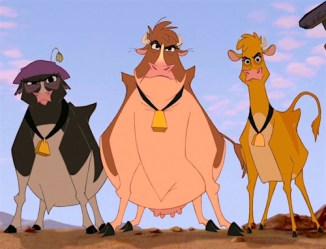
Home on the Range is not a hidden gem.

The plot, such as it is, locates us in the Old West, where a trio of singing cows hunt for an outlaw in order to save the farm they live on. The early ’00s box office was not a great place for musicals, Westerns, or traditional animations, so one does have to wonder what inspired Disney to make their 45th Animated Classic a traditionally-animated musical Western.

Still, box office failure does not equate to a lack of quality. No, the film achieves that all by itself. There’s a plodding, familiar, poorly-structured story, with dull characters, who spout flat dialogue, which does nothing to help their unoriginal relationships. The voice acting is irritating, with the exception of one or two over-qualified performers (Dame Judi Dench?!) The songs are weedy, repetitious, and unmemorable. The villain’s number is the best of a bad bunch, but only because it has a moderately amusing reveal in the middle of it. The animation is unremarkable, besides some terrible CG intrusions. It seems to be under the impression that “hog” is a word for “cow”, based on the number of puns. A couple of gags do land — I even laughed out loud once, though I’ve forgotten why — but the majority is resolutely uninspired.
It’s actually not the worst of Disney’s canon (as I mentioned, there’s the odd flash of enjoyment, which is more than can be said for Chicken Little), but it’s still one for aficionados — or completists — only.

2 out of 5

The Empire Strikes Back (1980)

100 Films’ 100 Favourites #27

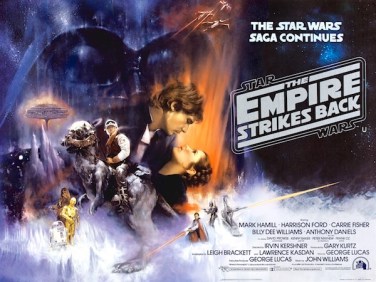
The Star Wars Saga Continues

Also Known As: Star Wars: Episode V – The Empire Strikes Back

(I may be a young whippersnapper, but I’m old enough that, when I was a kid, we still called it just The Empire Strikes Back. I thought that would be a nicer place for it among my 100 Favourites, therefore.)

Country: USA
Language: English
Runtime: 124 minutes | 127 minutes (special edition)
BBFC: U
MPAA: PG

Original Release: 21st May 1980 (UK)
US Release: 20th June 1980
First Seen: VHS, c.1990

Stars
Mark Hamill (Star Wars, The Big Red One)
Harrison Ford (Raiders of the Lost Ark, Air Force One)
Carrie Fisher (Star Wars, Hannah and Her Sisters)
Billy Dee Williams (Mahogany, Batman)
Frank Oz (The Muppet Movie, Monsters, Inc.)

Director
Irvin Kershner (Never Say Never Again, RoboCop 2)

Screenwriters
Leigh Brackett (The Big Sleep, The Long Goodbye)
Lawrence Kasdan (Raiders of the Lost Ark, Wyatt Earp)

Story by
George Lucas (Raiders of the Lost Ark, Willow)

The Story
After the evil Galactic Empire uncovers the Rebel Alliance base on Hoth, our heroes flee for the stars. Guided by a message from beyond the grave, Luke heads to meet an old Jedi master. Meanwhile, Han, Leia, Chewie, and the droids hide for a bit, then go to meet the only black man in the galaxy…

Our Heroes
Luke Skywalker: ace pilot; Jedi in training.
Han Solo: reformed criminal.
Princess Leia: wait, hold on, her planet was destroyed — surely now she’s either Queen Leia or, y’know, nothing?

Our Villain
Darth Vader: daddy issues personified.

Best Supporting Character
R2-D2 is the best supporting character in every Star Wars film, but in this one we are introduced to Yoda. Looks like a Muppet, as cheeky as a Muppet, much wiser than a Muppet. Probably. It’s hard to be certain.

Memorable Quote
“Try not. Do, or do not. There is no try.” — Yoda

Quote Most Likely To Be Used in Everyday Conversation
Leia: “I love you.”
Han: “I know.”

Memorable Scene
After a dramatic lightsaber duel, Darth Vader lops off Luke’s hand, his weapon disappearing with it. As Luke dangles over an endless fall to Certain Death, Vader decides this is the perfect moment to impart a big secret…

Memorable Music
The Star Wars Main Theme is all well and good, but here regular composer John Williams introduces us to arguably an even more iconic tune — it certainly gets played outside of the films more often, as a universal signifier of evil. That’s right, it’s the Imperial March! All together now: dum dum dum dum-duhdum dum-duhdum…

Truly Special Effect
To animate the tauntauns, Phil Tippett and ILM pioneered the use of go motion, a version of stop-motion animation that moves the puppet while the frame is being exposed so as to create motion blur, thereby making the effects more realistic. (It purposefully wasn’t used for the AT-AT walkers, to emphasise their mechanical movement by keeping it slightly jerky.) Go motion would go on to be used on films including Dragonslayer, E.T., RoboCop, and Willow. It was going to be used for the dinosaurs in Jurassic Park, but then someone had another idea…

Letting the Side Down
Lucas’ Special Edition fiddling isn’t as prevalent in Empire as in its original trilogy compatriots. If anything, the big windows in Cloud City are a nice touch.

Making of
The crew took crates of simulated snow from the Hoth set to the shoot in Norway, in case there wasn’t enough real snow on location. Somewhat ironic, then, that the location was hit by a snowstorm, coating the region so thoroughly that some of the scenes set in Hoth’s wilderness were filmed right outside the crew’s hotel.

Previously on…
The story begins, of course, in Star Wars. There’s tonnes of other material set before Empire, not least the infamous prequel trilogy.

Next time…
The Star Wars universe is immense, so don’t expect me to even attempt a summation of it. At the most essential, Return of the Jedi picks up the dangling threads of Empire and completes the trilogy, while last year’s The Force Awakens continues the narrative decades later, with more instalments to come in 2017 and 2019.

Awards
2 Oscars (Sound, Special Achievement in Visual Effects)
2 Oscar nominations (Score, Art Direction-Set Decoration)
1 BAFTA (Music)
2 BAFTA nominations (Production Design, Sound)
4 Saturn Awards (Science Fiction Film, Actor (Mark Hamill), Director, Special Effects)
4 Saturn nominations (Supporting Actor (Billy Dee Williams), Writing, Music, Costumes)
Won the Hugo for Best Dramatic Presentation
1 WGA Award nomination (Best Comedy Adapted from Another Medium — yes, really)

What the Critics Said
“It’s almost too much to expect that a sequel can ever top the success of the original, and I suspect that this will prove the case with The Empire Strikes Back […] While Empire doesn’t quite measure up to Star Wars in the freshness and originality of its script, and the plethora of space operas that has been jamming the screens ever since Star Wars has somewhat lessened the novelty of city-sized ships sailing the stratosphere, nevertheless this 20th Century-Fox release remains a rattling good entertainment, a worthy successor to the original — and far and away the best of its kind since Star Wars itself.” — Arthur Knight, The Hollywood Reporter (This original 1980 review also mixes up Yoda and Boba Fett. Fun.)

Score: 94%

What the Public Say
“the movie suffers from as uneven a vibe as its forebear, with, especially, the midsection lacking in elements designed to wholeheartedly sustain one’s interest. This proves to be especially true of Luke Skywalker’s ongoing (and less-than-captivating) training at the hands of Frank Oz’s Yoda, as such interludes suffer from a lack of momentum that bring the proceedings to a dead stop at each and every turn. […] an erratically-paced yet consistently entertaining installment in a not-quite-great sci-fi series.” — David Nusair, Reel Film Reviews (This site gives Episodes III, IV, V and VI a rating of 3/4, but Force Awakens a full 4/4. Just so you know.)

Elsewhere on 100 Films
I’ve written about the original Star Wars trilogy twice before, both times back in 2007. Of The Empire Strikes Back’s modified DVD version, I said that “the big change comes in dubbing both Boba Fett and the Emperor with appropriate actors from the prequel trilogy […] Other than shunning the poor original actors in such a way, Empire is much the same as ever.” Then, treating the film as the fifth part of the saga, I wrote that “a variety of elements […] have a very different impact in light of what we’ve experienced in the first trilogy. The most obvious is the revelation that Vader is Luke’s father: it’s no longer a twist, of course, but the emotional impact on Luke still makes it an important moment. Yoda […] seems to have gone a little loopy after several decades alone on Dagobah”.

Verdict

What more is there to say about The Empire Strikes Back, really? According to some polls, it’s the greatest movie of all time; even if you don’t go that far, it’s a masterpiece of blockbuster science-fantasy adventure. Every moment is tuned to tickle the thrill-glands; every special effect a labour of love that, with their inventiveness and genuine physicality, remains largely impressive today. And it’s so well paced that most people completely overlook that the storyline is chronologically challenged (Luke travels to Dagobah, meets Yoda, learns a bunch of tricky Jedi skills, and heads off to Cloud City, all while the rest of the characters hide in an asteroid field and are locked up for about five minutes). Plus it has the audacity to end on an almighty cliffhanger/revelation double-header! And in that spirit: it’s not even my favourite Star Wars movie. But I’ll tell you about that another time.

#28 will star… Travolta/Cage.

Batman v Superman: Dawn of Justice (2016)

2016 #65
Zack Snyder | 151 mins | cinema | 2.35:1 | USA / English | 12A / PG-13

With Warner Bros’ universe-launching superhero epic now in its second weekend (unless you live in Myanmar or Poland, anyway), you’ve probably more than had your fill of spoilerphobic reviews. So allow me to provide a spoiler-filled one. (There are a fair few of those around too, of course, but not all reviews can be beautiful or unique snowflakes.)
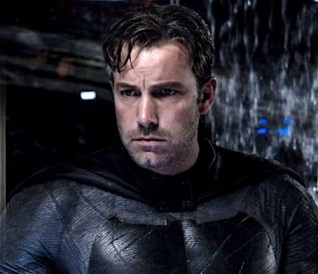
Despite being a sequel to Man of Steel and featuring a Superman-heavy supporting cast (from Batman’s world we have Alfred; from Superman’s we have Lois Lane, Jimmy Olsen, Perry White, Lex Luthor, Martha Kent, and (spoiler for something that was in the trailer) Doomsday), Batman v Superman is really a Batman movie. It begins with the latest recap of his origin story — pretty much a prerequisite for any new big-screen incarnation of the Dark Knight. But don’t give up on the film within the opening minutes, because BvS is actually going somewhere with this — the Bat’s backstory has a role to play in the climax. Anyway, after that we get a recap of the end of Man of Steel: as Zod and Supes turn Metropolis into rubble and slaughter untold thousands in the process, we see Bruce Wayne driving and running through the collapsing city streets, heading for a Wayne Financial building where he does superhero-y stuff like save a little girl’s life, and fix the flying Kryptonians with a glare that says, “you are my new enemies.” Central conflict, right there.

I say this is a Batman movie, but in many respects it’s actually a Bruce Wayne movie. Is there a difference? I suppose you could argue not, what with Bruce being the man inside the Batsuit, but I would say a “Batman movie” concentrates on what he gets up to in that suit — fighting crazy villains, essentially — while a “Bruce Wayne movie” would be more about the man, his decisions, his emotions. Now, I’m not about to claim BvS is big on its characters’ inner lives, but if it really taps into the thoughts and feelings of anyone, it’s Bruce. This is a Batman who has perhaps lost his way, scarred by too many tragedies in his life. There are unmissable references to his 20-year crimefighting career; to good people turning bad; the Joker-graffitied Robin suit… This isn’t fan-pleasing/teasing background detail, it speaks to Bruce’s mindset. He’s become the kind of person who believes lines like, “if there’s a 1% chance he’s our enemy, we must take it as an absolute certainty.” He’s a bit of a right-wing nut, basically. If you want to find a character or emotional throughline to the movie, it’s Bruce learning to be a better hero again.

Of course, this being a Zack Snyder film, it often does a muddled job of presenting this kind of material to us. There’s also a heavy vein of what it means to be a hero, with Superman under constant scrutiny for his actions, with questions being asked about what rights he has to act the way he does, and whether methods are needed to stop him. These are potentially interesting themes to tackle, provided you buy into the whole superhero genre in the first place — they don’t really have any real-life equivalent, if that’s what interests you in movies; they’re predicated in the thought process of, “if Superman was real, what would it be like?”

So assuming we consider these as valid things to dig into, it’s a shame the film does a muddled job of it. There’s some grandstanding and speechmaking, and some heavily portentous dialogue, but what is it really saying? Good luck finding out. Maybe repeat viewings and some proper consideration will reveal more depth tucked away there. Certainly, I’ve been a bit annoyed with some of the glib online criticism of the dialogue and the ideas presented through it; commentary that chooses to focus on one sentence that comes at the end of a discussion, so the clever-clever internet person can laugh at the silliness of that line’s question or observation, ignoring the fact that there was a whole range of dialogue before that one line, and in that dialogue the idea was more fully considered or explained. But no, it’s easier to take a soundbite and analyse it as, “lolz, shit dialogue, dude.” I’m not saying BvS has a script of Oscar-worthy, polished, believable, insightful dialogue, but it’s not that poor, either.

But if we are criticising the screenplay, let’s turn our attention to the story and its structure, which leaves something to be desired. This isn’t just the writers’ fault, of course, because myriad things affect a film once the screenplay is signed off. In the case of story structure, editing seems a likely culprit — not the actual cutting together of individual shots to craft a sequence or scene, which is as good here as in any action blockbuster, but in terms of storytelling. Frankly, that’s a bit of a mess. Or a lot of a mess, maybe. Whole scenes serve literally no purpose or are clearly in the wrong place — the bit where Perry wanders up to Clark Kent’s desk and wonders if he’s clicked his heels and disappeared back to Kansas, for example. What purpose does it serve? None. But where it might have a role is where it clearly belongs: a couple of minutes later, right before the scene where Superman is in Kansas, chatting to his mom. Why is it not right before that scene? It’s like someone accidentally dragged it out of place on their computer editing timeline and never noticed. Sure, this is a minor point in the grand scope of the film, but it belies a sloppiness to the entire storytelling.
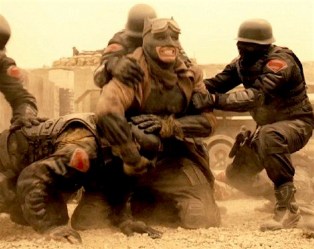
That extends all over the place. Someone clearly thought the movie was short on action — it has a lot of plot to get through, and whereas once upon a time it would’ve just got on with that plot and happily let all the action sit at the end, that’s not allowed these days. So, unable to find a combat or chase within the real narrative, Bruce has visions of a possible future where Batman wears some kind of dusty trench-coat and battles Superman-symbol-emblazoned soldiers in a Mad Max-esque landscape. In itself it’s a neat, fanboy-pleasing “alternate world” idea, and it’s an exciting sequence with some excellent action choreography, and it certainly looked good in the trailers, but in the film it’s a total aside from anything.

The only purpose it might serve is teasing the future — what is the giant Omega symbol? What are those flying devil-creatures? DC fans know that’s all related to alien supervillain Darkseid, and late in the film Lex Luthor makes a veiled reference to imply that some such alien badass is on the way. Yep, it’s Marvel-style foreshadowing, where every film is just a stepping stone to the next. Except BvS does it even more heavy-handedly than Marvel. As I said, the dream/vision is utterly unnecessary; Lex’s line is nonsensical (how does he know?); and the way other members of the Justice League are teased… You know, I don’t even want to discuss it. It’s a bad Marvel post-credit scene shoehorned into the middle of the movie. It feels like someone accidentally cut a teaser trailer into the actual print of the film. It’s not even so bad it’s good, it’s just tacky. And, I have to say, though I’m not the biggest fan of The CW’s Flash TV show (I think it’s been massively overpraised by some of superhero fandom), Cheery TV Barry Allen seems a much more likeable, comics-accurate version of the character than the movies’ Hipster Beard Barry Allen. Maybe it’s just the beard, I don’t know; but even if it is just the beard, it’s a hipster beard, and it’s wrong.
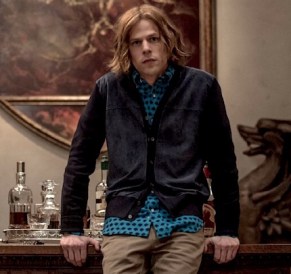
For a movie that critics stuck it to*, there’s an awful lot to say about BvS — genuine stuff, not just facile observations on hipster beards. This is not a film that needs an extra 30 minutes in an Ultimate Edition. It does need scenes re-arranging; it does need focusing in on its various plots — because there is actually a throughline here; a story that connects all the disparate strands together. Some people will miss it because those strands are so varied and so haphazardly put together, but there is a character who has an overarching plan and has engineered a lot of what’s going on — and as this is a spoilersome review, I can say that character is Lex. It surprised me a little that there was method to the madness; that someone had been orchestrating all these disparate elements. Surprise is good; surprise that makes you rethink the film even better — but you’re meant to rethink to look for clues you missed, not rethink to see if that even fits with everything we’ve seen. That’s because even if you do latch on to the almost-throwaway sliver of dialogue that indicates Lex put all of this together, the way it’s presented in this cut makes it come a little out of nowhere. However, I believe it’s a plausible explanation of events (within the realms of the version of the genre these films are in), and would tie the whole thing together neatly, were it just a little clearer.
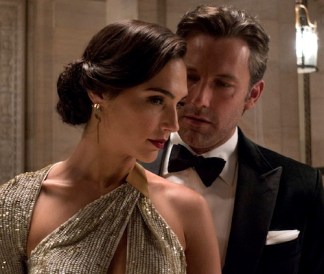
So, saying “there’s an awful lot to say about BvS” and then not saying it is a cop-out, but we’re 1500 words deep into this review and I haven’t mentioned: the role of Lois Lane; the role of Wonder Woman; the role of Alfred; how good Ben Affleck is; how wasted Henry Cavill is; Jesse Eisenberg’s performance, for good or ill; what, if anything, the film is saying about government oversight and/or domestic terrorism; the car chase (purely as an action sequence, I liked it); the presence of Doomsday; the battle with Doomsday; the death of Superman and its almost-immediate sort-of-retraction, and whether that was a good idea or not, or if it even matters; why the “Dawn of Justice” subtitle is an accurate addition to the title, but also a pain in the ass to the “Batman v Superman” part; heck, I’ve said nothing of that titular duel itself. When it comes, the fight is inspired by — but not completely adapted from — Frank Miller’s The Dark Knight Returns, which should surprise precisely no one as, a) Snyder is an avowed Miller fan, and b) if you’re doing a Batman vs. Superman smackdown, that’s the one to do.

(I also wanted to write something about the film’s lack of attentiveness to cityscapes, because that’s something that interests me and I’ve not seen anyone else discuss it; but I’ve only remembered this after the entire review is finished, illustrated, and scheduled for posting, so it’s quite late at night to get my brain in gear and add it. But if anyone’s actually interested, there’s always the comments section.)

As to those other points… look, I don’t want to get too off-topic, but there’s a rant to be had about discussions of films stopping at opening weekend. “It was cool” / “it wasn’t cool”; “it was fun” / “it wasn’t fun”; “it was an irredeemable piece of crap and I hope it kills off the franchise” / “I can’t wait for Wonder Woman” — followed by, “done now, when’s Civil War out?” Hey, hang around for a minute! There’s stuff here. I know critics just want to barrel on to what’s next because they didn’t like it, but maybe if they stopped to discuss it they’d find there’s more to unpack than they’d like to think? Because yeah, you can see the movie as one long mess before Batman and Superman finally fight, at which point it degenerates into a mess of CGI and aural bombast (seriously, there’s too much noise during the climax), and ends with characters stood around having conversations where the pre-first-draft filler dialogue said, “Give audience an idea what future film(s) will be about while saying absolutely nothing concrete about what future film(s) will be about.” But in that mess (the mess I mentioned at the start of that last really long sentence, remember? OK,) there is stuff going on; there are ideas the filmmakers want to put across, possibly with the intention that they’ll actually be thought about.
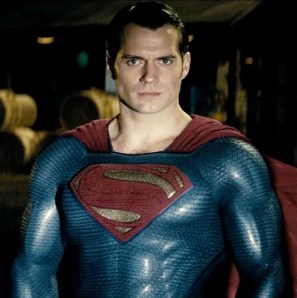
And I know it’s just a superhero movie, and I know they’re just ideas about superheroes, and I know if you get into discussions of its representation of women or the legal/political system or any other real-world-connected points then you’re getting into a minefield that the film may not have fully-considered ideas about… but for all his faults as a filmmaker — for all his focus on visual Cool — Zack Snyder has now made at least three films where, buried beneath all that surface noise (both visual and aural), there are things to think about, but because that surface is so polished that it suggests the film must only be skin-deep, the ideas get ignored. The other two films, for what it’s worth, are Watchmen (where, yes, he’s given a leg-up by Alan Moore and Dave Gibbons’ uncommonly thoughtful graphic novel) and Sucker Punch — a movie even more dismissed than BvS has been, but which I maintain has a lot going on.

I’ve even lost myself at this point, so I’ll call it a day. Batman v Superman is a long way from being a perfect movie, and anyone who likes the lightweight fun of the Marvel Cinematic Universe is going to be ill-served here. (Oh man, there’s a whole other semi-off-topic discussion. Ten to fifteen years ago, the only things that could be Cool were dark-and-moody, self-serious, po-faced, grim-and-gritty films/games/whatever; nowadays, you do that and you get lambasted for not being colourful and humorous. Back then, I was miffed that everything had to be the former and when anyone did the latter it got shat on, and now I’m miffed that everything has to be the latter and when anyone does the former it gets shat on. I’m not contrary, I just think we can have, can enjoy, and can accept, both.)

As I was saying: not a perfect movie, but one with a lot of material to provoke thought about both the inherent concepts of superheroes and, external to that, the genre itself, especially the way it’s presented in cinema. I’m not going to slag off the Marvel movies, because they are fun, but the entirety of the big-screen MCU** put together hasn’t given us even a fraction of as much stuff to consider, dissect, analyse, and process as this one bold, messy, controversial movie. I kinda love it for that.

4 out of 5

Batman v Superman: Dawn of Justice is still on release everywhere. The 30-minutes-longer Ultimate Edition is scheduled to be part of the DVD/Blu-ray release, probably in July.


* I won’t trot them all out here, but there are interesting (if you’re into that kind of thing) stats about its critical drubbing vs. its box office performance — essentially, it’s far and away the worst-reviewed super-high-grossing movie ever, as if some omniscient power felt the point really needed ramming home that critics no longer matter to franchises that have what-they-call “pre-awareness”. ^

** “Big-screen” because, in fairness, Daredevil and Jessica Jones are a whole different kettle of fish. ^