Snakes on a Plane (2006)

2008 #94
David R. Ellis | 101 mins | DVD | 15 / R

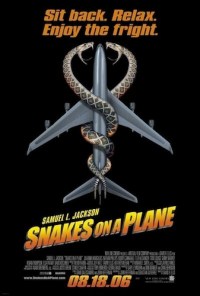
Snakes on a PlaneYou don’t get much more high-concept than “snakes on a plane”, a mission statement of a title if ever there was one. It certainly captured the imagination of online geekdom, who knew everything they wanted just from those four words and famously launched a viral marketing campaign for a film they’d not seen. Ultimately, it’s for that reason it will be remembered, because without the evocative title and the reaction it provoked this would be forgotten quicker than Samuel L. Jackson can utter his Oedipal expletive-laden catchphrase.

The best thing one can say about Snakes… is that it lives up to its B-movie title. Once it gets going it throws lots of gory fun at the audience, like a snake in a microwave, or entirely gratuitous shots of people trampled in panic (which sounds distasteful, but in the context of the film is more amusingly squelchy). It even manages the horror movie’s obligatory gratuitous sex/nudity — courtesy of the Mile High Club, naturally. That’s not to mention the plot, in which a gang release snakes onto a plane (did you guess?) in order to kill an FBI-escorted witness. As assassination plans go, it may just be the barmiest ever, and delightfully so.

However, the plan is flawed — in storytelling terms at least — because snakes don’t actually do much. They drop from ceilings, they slither, they bite… and then you’re pretty much done. When the legless beasties eventually turn up it’s quite good… for a couple of minutes. But a couple of minutes do not a feature film make, so every length-inflating trick is whipped out to boost the running time. The first crime is an irritatingly long opening: a seemingly endless preamble reveals what crime the witness witnessed, why he’s being transported, and how villainous the villain is — but all the average audience member wants is to get on that plane!

But when they finally board there’s a series of establishing scenes to get through. There’s even a full version of the safety demonstration — no one likes the safety demo normally, never mind in a film! This bit at least serves to introduce an array of characters ready to be killed, but as few of their stories go anywhere most should have remained faceless victims. These scenes on the plane feel like the opening, and may have been less interminable if they weren’t preceded by all that needless preamble. It’s especially pointless because, by the time the plane inevitably lands, the makers seem to have forgotten they introduced a villain in the first place.

In between, those snake ideas (drop! slither! bite!) run their course sharpish, so the viewer is treated to an array of stock Plane Disaster Movie scenarios. An investigation on the ground! Something needs fixing in the hold! A non-pilot has to land the plane! Chopping 10 to 20 minutes wouldn’t hurt any — it should be short and efficient — or, instead, putting the same screen time to better use by bringing a resolution to the villain. Normally the plane landing would be a perfect point to end — you want snake-based slaughter, and then you want out — but after the persistence in setting other stories in motion those really ought to be finished.

Snakes on a Plane is as much of a B-movie as the title implies. This seems to be what disappointed some when it was finally released, yet at the same time is clearly the vibe the makers were going for all along. Perhaps a greater problem is that it still sounds like such a good — snakes released on a plane to kill someone? That’s utterly loopy! It should be crazy and great! But it’s treated with too much seriousness, as if the makers are struggling to convince us this is actually a plausible notion in the real world — which it patently isn’t.

Nowhere near bad enough for the infamous “so bad it’s good” classification, nor good enough to rise up on genuine merits, it is instead largely unremarkable though passably entertaining. Perhaps it should’ve been left as just a title.

3 out of 5

Channel 4 are premiering Snakes on a Plane tonight at 10pm (hence why it rises above the eight other still-unreviewed films from 2008 today).

(Originally posted on 17th January 2009.)

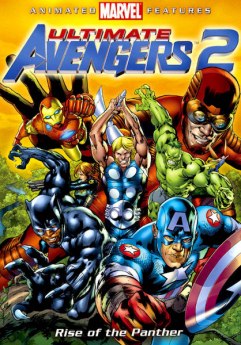
Ultimate Avengers II (2006)

aka Ultimate Avengers 2: Rise of the Panther

2008 #83
Will Meugniot & Richard Sebast | 70 mins | DVD | 12 / PG-13

Ultimate Avengers IISome things in life baffle me. Form dictates I now list a couple of humorous examples, but we’ll skip that and get to the point: why would you make a direct-to-DVD movie that has a subtitle on the box but not on the film itself? I can understand why titles get tweaked on cinema-release posters and/or subsequent DVD releases — for marketing purposes, say; or clarity — but why, when your title is going direct to the DVD stage, do the titles not match? And why does the box add the subtitle rather than remove it for on-shelf simplicity? I have no answers — it baffles me, remember — but this is the sort of thing I sometimes muse about. The sort of thing that most other people don’t even notice, never mind care about.

Insignificant title issues aside, the fact that (as of writing) 2,365 people have bothered to rate the first Ultimate Avengers on IMDb, while only 1,325 have bothered to rate this second, suggests many were so disappointed by the initial film they didn’t bother with the sequel. Which is something of a shame, because it’s a lot better. Problematically, it’s heavily grounded in the first, picking up several threads that were left hanging — enough so as to make that weak franchise opener required viewing, sadly.

Why’s it better? We’ll get the obvious out of the way: yes, it’s a modern genre sequel, so yes, it’s ‘darker’. In this case that means “more adult”, touching on issues you might not expect in superhero animation with such a low certificate — marital problems, survivor’s guilt, political isolationism, even vague allusions to alcoholism. None are dealt with in any great depth I should add, but it will likely please adult fans wishing for something more “grown-up”. There’s also a greater amount of violence, though much of it is implied, or just off screen, or against bug-like aliens. The animation still isn’t great, though at times seems improved. Equally, while both script and story are better — there’s no pace issue this time — there’s still plenty of clanging dialogue, and the adult subplots aren’t exactly subtly executed.

The climax also has its share of flaws. While most of the story is nicely balanced, it’s over-efficient in wrapping up, in the way that only animation seems allowed to be — for whatever reason, this exact story would comfortably fill a two-hour live-action version. The worst effect of this is that some points aren’t treated with their deserved weight — the death of a major character is so hasty and glossed over that I didn’t even realise it had happened until a brief shot of a memorial in the closing scene. On a less pressing note, the giant alien robots of the final battle leave the film just one leg (per robot) away from becoming a total War of the Worlds rip-off. But this tale is of American origin, so the aliens are defeated not by a clever plot twist, but by brute force.

Despite my attention to the film’s weak points there’s actually plenty to enjoy here, provided animated superhero movies are your thing. There’s more action than the first instalment, a more interesting story, more character development… Even if it’s done at quite a basic level it’s still adequately entertaining, enough that you might wish there was a third. An improvement then, if still flawed, but — ultimately — enjoyable.

4 out of 5

For my review of the first Ultimate Avengers, please look here. Live-action sequel Avengers: Age of Ultron is in UK cinemas from this Thursday, 23rd April 2015.

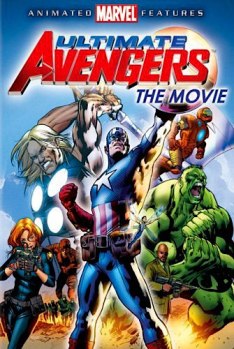
Ultimate Avengers (2006)

2008 #82
Curt Geda & Steven E. Gordon | 68 mins | DVD | PG / PG-13

Ultimate AvengersWith the big-screen live-action Avengers movie on its way in just two-and-a-half years — once we’ve had a variety of tie-ins to lead into it, of course — now seemed as good a time as any to check out this direct-to-DVD animated version (and its sequel).

I won’t say too much about the plot because, if the rumours are true, the live action film may follow it fairly closely — indeed, the first 15 minutes of Ultimate Avengers presents a roll call of elements already introduced in this summer’s Iron Man and The Incredible Hulk: the Avengers Initiative, a super solider serum, a black Nick Fury, Captain America frozen in ice (OK, so that was only in a deleted scene…) But to follow this story wouldn’t necessarily be a bad thing… as long as there were some tweaks.

The primary problem is balance. Ultimate Avengers spends the entire first half assembling the team, the story crawling along at a snail’s pace; consequently, there’s nothing like enough time to do the remaining plot justice, leaving much of it to feel rushed. However, the tale itself retains an appropriately comic-book feel — no surprise considering it’s adapted from a specific storyline — while still containing just about enough information to keep newcomers covered. Were it properly paced, and bolstered by the main characters being introduced in their own films, there’s no real reason this wouldn’t suffice in live action.

On the other hand, in its current incarnation it’s very much Captain America’s story — possibly a problem for the 2011 version, as it will follow Cap’s debut feature by just two months. If his solo outing isn’t a success — particularly if whoever plays him is no good — it would likely sink an Avengers movie that was as focused on him as this. Not encumbered with such problems here it works fine, though it’s disappointing how little we see of other major players — Tony Stark/Iron Man barely features and there’s even less of Thor. That said, Bruce Banner/Hulk gets a key subplot which could be even better if fully developed.

Dodging further predictive comparisons for a moment, the animation quality is variable. Some is very good — mainly the opening World War II-set action sequence — but most is no better than you’d expect from a kid’s TV cartoon (unless they’ve got even worse recently). It does the job adequately, but there’s little exemplary. If there’s a theme emerging it’s this: promise is shown, but not fully realised. That’s not the fault of the medium of course, but rather the brief running time and unbalanced structure.

When the live-action Avengers reaches our screens, I suspect this animated outing will be of greater interest — an intriguing point of comparison between a direct-to-DVD fan-aimed version and a Summer Blockbuster mass audience version of (possibly) the same story. Of course, by that point, Ultimate Avengers will be half a decade old and no longer such a contemporary — or memorable — example.

3 out of 5

Ultimate Avengers II will be reviewed tomorrow, Tuesday 21st April 2015. Live-action sequel Avengers: Age of Ultron is in UK cinemas from Thursday 23rd.

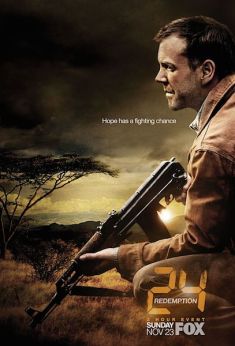
24: Redemption (2008)

Extended Edition

2008 #86
Jon Cassar | 98 mins | DVD | 15

24: RedemptionRemember the ubiquitous Writer’s Strike in the US? It must be about a year ago now, but its effects are still being felt — Dr Horrible’s Sing-Along Blog, Joss Whedon’s rule-breaing internet musical, made during the strike, is about to hit region-free DVD in the US (albeit on DVD-R and only from Amazon.com); plenty of second-year shows are getting canned, probably because their truncated first years didn’t allow time to get decent audiences (that’s one excuse anyway); and 24’s seventh season, kicking off in January 2009, is a year late. Which allowed them to make this in the meantime.

The setup is simple: Jack Bauer’s trekking round the world, currently holed up with an ex-army buddy (played by the ever-excellent Robert Carlyle) in the African nation of Sangal where said buddy has set up a school. Yes, Jack Bauer is living a life of peace. But then Bad Men turn up wanting the kids for child soldiers, and within the hour they’re attempting a military coup — this is still 24 remember, the action all takes place “in real time”. What’s Jack to do? Why, return to his old One Man Army self, of course — if he can’t stop the coup, he sure as hell can save those kids! Meanwhile, it’s inauguration day for America’s new female (black? 24’s been there and done that — twice) President…

For a Fox action series, off screens for almost 18 months and undoubtedly designed as a starting point for new viewers, Redemption (not that that title’s seen on screen) has a surprisingly slow build up. That’s no bad thing — this is a story after all, not a 90-minute shoot-out — but there are times when one feels it should get a wriggle on. This is likely where most, if not all, of this extended version’s new material was added. There’s almost 15 minutes added to the running time here, though some is surely due to a 5-minute credit crawl that must be much longer than the TV version’s. Having not seen the broadcast edit I can’t comment on what new scenes, shots or lines are added, but there’s no greater violence or thematic density than 24 usually produces so I imagine what was cut was cut for time alone.

That said, Redemption certainly tackles its fair share of issues — primarily, the use of child soldiers, and the US involvement (or lack of) in African genocides. It’s certainly admirable and worthwhile for such a popular series to bring these important issues to the attention of a mass audience who might otherwise ignore, or at least not be aware, of them, but they’re still included in a “mainstream American action series” way — that’s to say, they’re ultimately a reason for a shoot-out. There’s also some subtle political commentary, such as the UN Peacekeeper stationed at the school being a coward who runs away at the first sign of violence… and then betrays them to boot! Of course, just because it’s unsubtle doesn’t make it wrong, but Blood Diamond this is not. Whatever the politics, the action sequences — and, once things get going, there are a few — are all carried out with 24’s usual panache.

Is this a suitable jumping-on point for newcomers? Yes, quite simply. It’s several years since the last season and Jack’s in a very new part of this life. Some old faces crop up and there are some backstory references, but these are more nods for returning fans than anything important. Everything you need to know for this story is contained herein, and fortunately that doesn’t involve great slabs of exposition about previous seasons. On the other hand, it fails as a standalone movie. While the main plot — Jack defends school — is kicked off and wrapped up in the space between the title and the credits, there are several US-based plot threads that aren’t even close to being resolved. These are clearly designed to flow on into season seven — presumably they’re either elements bumped from the early episodes up into the movie, or a fleshing out of information that would’ve just been exposition before.

It’s hard not to conclude that Redemption would’ve been better without the US scenes. They add nothing to the main action in Africa and they’re all quite flatly directed, forcibly reminding you that this is just a TV movie by being worse than most TV these days. Their one true benefit is an ending that juxtaposes the new President’s inauguration speech with the civil war beginning in Sangal, which, consciously or not, underlines the hypocrisy at the heart of America.

As a standard season-opening episode of 24, coming on the back of the weakest-yet sixth season, it may well have earned itself an extra star. Judged as a standalone film, however, I fear it has to be just

3 out of 5

Thinking “but that’s not a film”? Then please have a read of this.

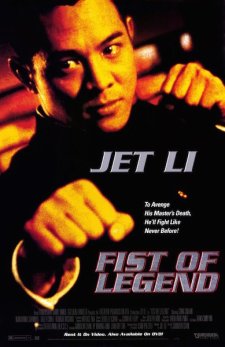
Fist of Legend (1994)

aka Jing wu ying xiong

2008 #77
Gordon Chan | 99 mins | TV | 18 / R

Fist of LegendI found myself watching Fist of Legend unintentionally following this year’s Children in Need appeal. The significance of this piece of trivia is that I watched it on TV, which means I had to watch it dubbed. Apparently, “it is regarded as one of the best martial arts films of all time, and almost universally viewed as Jet Li’s best” (thank you Wikipedia), but the dub does its utmost to obscure this.

Putting the audio aside (for the moment), the film has a lot to recommend it — primarily, the fights. At 2am, after seven hours of near-solid TV watching, it was these that drew me in. I’m no expert on martial arts, but I do like a good fight (on film) and Fist of Legend serves up plenty of those. In fact, there’s approximately one every five minutes, an impressively high ratio that consciously — and very pleasingly — fulfills what you want from this kind of film. This quantity doesn’t seem to have damaged quality either: all are generally impressive, but there are some particularly good ideas floating about too, such as a long fight where both participants are blindfolded.

There’s a plot too, which includes a few surprisingly surprising twists and an interesting undercurrent of Japanese/Chinese racial tensions thanks to the setting (1937, during a Japanese occupation of Shanghai). This adds an extra level to what could otherwise be a stock revenge plot.

So, that just leaves the soundtrack. The English audio is at least as bad as you’d imagine, and a reminder — if one were needed — about why dubbing foreign language films is so hated. Whatever the qualities of the film itself, the clichéd dub script and flat voiceover performances, awkwardly delivered to fit the actor’s mouth movements, make the film look cheap and poorly done. On the bright side, the main villain has an amusingly gravelly “I am playing a villain!” voice.

If you can look past the rubbish dub (which I should imagine is even easier on DVD, what with turning it off), Fist of Legend is very enjoyable. However, with the action being the primary source of pleasure, those who don’t like martial arts movies may want to imagine a lower score.

4 out of 5

Quantum of Solace (2008)

2008 #73
Marc Forster | 106 mins | cinema | 12A / PG-13

This review contains spoilers.
For a spoiler-free view, see my initial thoughts.

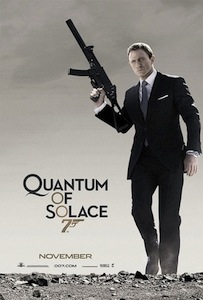
Quantum of SolaceQuantum of Solace is to Casino Royale what Tomorrow Never Dies was to GoldenEye: it’s the second film of a new Bond, tasked with revitalising a flagging franchise (this time creatively rather than monetarily); it’s been promoted as shorter (though by 38 minutes, not TND’s mere 11) and more action-packed; and it’s got to follow a huge success, both critically (94% on Rotten Tomatoes) and commercially ($588m worldwide). It’s a tall order — one many believe TND failed to live up to (personally, I’ve always liked it). Does QoS do any better?

Well, it’s certainly action-packed. Bond hurtles from budget-blowing sequence to budget-blowing sequence with alarming fervour, the camera literally struggling to keep up. It’s this zoomed-in, over-cut, handheld style that most grates with me during these sequences. I quite like it in the Bourne films — it’s part of their style; it fits — but I was incredibly glad to not find it in Casino Royale, and therefore disappointed to see it showing up here. Compare Royale’s early free running chase to the early rooftop one in QoS and you’ll quickly see not only which is better staged, but which is better shot. There are some good moments action-wise — for every disappointing boat or plane battle there’s an effective duel (swinging from scaffolding) or a destructive car chase — but I do wish someone would put the camera on a tripod. The frequency of such sequences, plus an abundance of other common action/spy movie tropes (a rogue agent, shadowy organisations, moles — in fact, trust has never been more of an issue), suggest that this is very much the Action Movie on director Marc Forster’s increasingly eclectic CV. His true strengths show up elsewhere however, as the most memorable parts of the film aren’t the headache-inducing punch-ups, but any scene that involved Bond and M or Bond and Mathis.

The acting, you see, is of a high standard, certainly above the requirements of the genre. While Craig may be lumbered with a very focussed, almost one-note Bond, the flashes of drama and dark humour allow him the odd chance to stretch. He may not get the variety that Casino Royale offered in this department, but he does enough with what’s there. Never more so than in the scenes with Giancarlo Giannini’s Mathis — the action pauses for breath when Bond seeks him out, and we’re treated to some of the film’s very best bits. Some fans wondered how the character could be brought back after Casino Royale, and the trick is to transform his role: what was previously a minor part designed to facilitate the plot here becomes one of unique significance, an injection of emotion and humour that makes his unfortunate death the film’s most heartbreaking moment — in fact, I might go so far as to argue it’s the saddest moment in a Bond film since the end of On Her Majesty’s Secret Service. It’s these scenes that allow Forster’s dramatic directorial abilities to come to the fore, confirming that this is where his true talent lies.

Best of all is Dame Judi Dench, unsurprisingly excellent as ever. She’s aided considerably by M having a much bigger part this time out — not in an obvious The World Is Not Enough-style “have her kidnapped” kind of way, but just by giving her a lot more to do as James’ boss. In the old days the boss sending an agent out into the field and not hearing from him again until the mission was over may have made sense, but in our world of easy telecommunication it would be ridiculous if M wasn’t closely monitoring and commanding Bond every step of the way. So she does, and it’s great for the viewer to be treated to so much of Dench and her relationship with Craig. Not only that, but M has a spot of governmental and inter-agency politics to deal with too, increasing her role still further. If they retain any element of QoS for Bond 23, I hope it’s this.

As for the other Bond girls, Olga Kurylenko is fine but unmemorable, perhaps most significant for being the only major Bond girl who doesn’t sleep with our hero. (Incidentally, this is the third action film in two years in which Kurylenko plays a major part and doesn’t sleep with the hero. That’s quite a niche to be carving.) Back-up girl Gemma Arterton is disappointingly underused, existing primarily for the sake of being another girl in an otherwise masculine film. Her Goldfinger-tribute death, a nice nod in a franchise that has almost entirely excised its past, is an effective touch in and of itself (aficionados will surely note that, this time, there’s no conveniently-placed cushion), but considering the substance at stake turns out to be water rather than oil, it’s either Quantum playing some misplaced guessing game or an ill-considered plot hole. More annoying is her name, however. I don’t care that she’s named Strawberry Fields — it’s either an appropriately silly Bond girl name or, in this day and age, depressingly believable — but much is made of her first name going unrevealed, only to be rewarded with no pay-off. It’s not revealed on screen (only in the end credits), and Bond doesn’t even have an (admittedly clichéd) “I never even knew her first name” line on finding her body. Only a minor misstep, to be sure, but a nagging one.

As the scheming villain-by-proxy, Dominic Greene, Mathieu Amalric feels underused. He’s not as non-present as some Bond villains (The Spy Who Loved Me comes to mind, where Bond shares all of three lines with his nemesis before shooting him), but there’s a definite sense that the military coup/water hoarding storyline is a perfunctory element around Bond’s hunt for the men behind Vesper, in the process establishing Quantum so they can be dealt with in a later film. While I like having a Big Bad Organisation to cross over the films, much as SPECTRE did in the early days, the downside to their first real appearance here is that this particular scheme — a coup in a relatively inconsequential country, it must be said — is a bit lightweight for such a powerful, important organisation. This, plus Greene being more of a civil servant-type figure than an evil megalomaniac, leaves the climax feeling rather anticlimactic, lacking both the grandeur of the old Bond and the emotional weight of Casino Royale (as if a sinking building wasn’t quite grand!) It’s been touted in interviews that Greene’s fighting style is that of “a man who can’t fight”, but that’s no reasonable excuse for his final duel with Bond being so brief. Try harder next time.

Which, it seems, has been the closing impression of QoS for many fans. In this vein, placing the famous gunbarrel at the film’s close is surely highly symbolic, in the same way that saving the equally famous theme music for the end of Casino Royale was: Bond has now completed his evolution, excised his Vesper-demons, and is now the character we all know. Where at the start of the film he merrily kills everyone he comes across, at the end, face to face with the man mostly directly responsible for Vesper’s suicide, who he’s spent most of the film tracking down, he questions him before handing him over to MI6. For all those who dislike QoS’s style, this closing gunbarrel is hopefully an indication that, come 2011, the Bond they know will be back.

So does QoS do any better than Tomorrow Never Dies? Critically, yes, actually — although it’s received mixed reviews, they’ve been positive overall. At the box office, very much so, including the franchise’s best-ever US opening weekend (in this case topping the widely-disliked Die Another Day, something Casino Royale didn’t even manage). As for me, the opinion that opened my initial thoughts on the film still stands: it’s not as good as Casino Royale, but that was a far above average piece of entertainment. QoS isn’t a great Bond film, and it certainly doesn’t have the cross-fandom appeal that Brosnan at his best managed — and it certainly does have more than its fair share of detractors — but it’s a solid entry in the series. When the preceding instalment was possibly the best the franchise has produced in its 46-year history, that can make things seem worse than they are.

4 out of 5

My initial thoughts also offer additional comments on the level of humour, the title sequence, and more.

Casino Royale (2006)

2008 #72a
Martin Campbell | 139 mins | DVD | 12 / PG-13

Casino RoyaleI’ve seen Casino Royale four times in the two years since its release (twice on opening weekend, in fact), which is an unusually high number of viewings for me. Normally I’ll see a film once and, even if I really like it, might not bother again for years; even films I’d name among my most-favourites fall into this category.

The reason I share this upsettingly trivial bit of information about my film watching habits is because, after two years and four viewings, I don’t really have much to say about Casino Royale. It’s a damn fine Bond film, returning to Fleming and resetting the character without losing anything truly essential about the franchise. The action sequences are great because they’re not only exciting but also drive the plot forward and reveal character — when Bond runs through the wall at the building site is a prime example of this.

In Daniel Craig and Eva Green the franchise has probably the best two leads it’s ever had, in terms of acting ability, and they put it to good use. There are many more pitch-perfect things about this film — not least making a poker game engrossing — and, yes, a few flaws, though for me they’re so minor as to not matter; but I don’t feel the need to expound on them a great deal because the film really speaks for itself. And, looking at the UK box office and DVD/Blu-ray sales, I’m not sure there’s anyone who hasn’t seen it.

In summary, Casino Royale is possibly the best Bond film of all time — though when you have a series that has encompassed so many disparate styles (directly compare From Russia With Love to Moonraker and one might even struggle to believe they’re from the same series), it makes for an incredibly hard selection to pick a sole winner from. Still, this one’s up there with the very best, not just of Bond but of action-spy-thrillers in general.

Now, I just wonder what happened next…

5 out of 5

Hitman: Unrated (2007)

2008 #70
Xavier Gens | 94 mins | download | 15

HitmanVideo games have been fertile ground for filmmakers over the past couple of decades — or, rather, for film financiers, because while they almost invariably garner poor reviews they do insist on making them. What marks Hitman out from the crowd? Well, nothing.
In fact, Hitman seems to be doing its best to blend in and go unnoticed — much like a good hired assassin would do, you’d imagine. Except in this film, all the assassins are bald and have barcodes tattooed on the back of their head — not at all conspicuous. The story begins at the end, as is the fashion for most films these days, and as usual there’s absolutely no reason why it should. After that, you’ve got a series of ideas and scenes recycled from the likes of The Bourne Identity — and by “from the likes of” I really mean “from” — that don’t add up to anything particularly new. The majority of the plot is easily guessed within the first half-hour; those guesses that don’t pan out aren’t because the film has anything surprising to do, but instead because it seemingly can’t be bothered to resolve certain plot threads. Equally, the plentiful leaps in logic appear to be the result of lazy filmmaking, not caring to fill in the gaps between two cliched plot beats.

Characters suffer from poor performances — disappointing in the case of lead Timothy Olyphant, who was pretty good in Deadwood — but are also let down by a lack of technical ability, featuring a copious amount of clearly dubbed dialogue. They shouldn’t’ve bothered, because it’s all atrocious. Behind the dialogue, the rest of the writing isn’t any better. Agent 47’s characterisation is all over the place. He’s clearly supposed to be calm and robotic, and at times he is, with an appropriate lack of understanding about life and women; but then there are moments where he’s shouty, or humourous, or eye-rollingly knowing. It’s like the screenwriter’s copied the scene from another film (usually The Bourne Identity) and forgotten to put his characters into it. As for the rest of the cast, Dougray Scott and current Bond girl Olga Kurylenko are also let down by poor material. Also worthy of note is a Russian General toward the end, who is a spectacularly bad actor.

Believe it or not, Hitman does have the odd moment that’s almost worthwhile. There’s some wit with the sex (or, rather, “lack of sex”) scenes, and I quite liked the (derivative, it must be said) score. And then there’s the action, of course, which is naturally the main point of a film like Hitman. It’s fairly extreme, considering, and appropriately bloody — exploding heads from snipers, many spurting wounds from SMGs, and so on. This is the ‘benefit’ of the unrated cut, which is barely any longer than the theatrical one but does have plenty of extra blood CG’d in. For a full list of differences — as well as that blood, there’s a few extra shots in fights and of ‘controversial things’ like drug-taking — have a look at this page (translated from German). Most of the action scenes are passable but with nothing to mark them out, the one exception being a four-way blade fight in a disused train carriage between Agent 47 and three other bald assassins. It’s a good idea fairly well executed, but suffers from a nagging question: where did the other three come from and, more importantly, why were they there?

I’ve made it this far without mentioning Leon, the gold standard against which all other assassin movies will inevitably be compared. It feels almost cruel to mention it though, because Hitman’s aims are nothing so lofty. Style and content-wise, films such as Wanted and Shoot ‘Em Up are much closer relations, as well as the film it so often imitates, The Bourne Identity. Hitman is not as original nor as fun as any of these, which makes it all rather pointless.

2 out of 5

Quantum of Solace: Initial Thoughts (no spoilers)

Quantum of SolaceQuantum of Solace isn’t as good as Casino Royale; though I should immediately qualify that statement by saying that the previous Bond movie is not only one of my favourites of the series, but also one of the best action-thrillers ever made. It would’ve been some feat indeed for QoS to top it.

As it is, director Marc Forster doesn’t really try. Casino Royale was about a poker game; QoS is about bringing down a significant player in a worldwide Secret Evil Organisation — but it’s the former that’s more epic. Bond rattles around the world, from action sequence to action sequence, at a rate of knots. There’s a sense that Forster, who has never made an action film before and was initially reluctant to take this one on, has treated this as the time he tried an Action/Spy Movie and so thrown everything at it. There’s a car chase, a bike chase, a roof-top chase, a foot chase, a plane chase/fight, gunfights, fist fights, knife fights, sneaking around, going in all guns blazing, betrayals, reversals, having to be a maverick agent because Bond’s right while his superiors refuse to trust him… And all this squeezed into the shortest Bond film yet made.

In truth, the running time isn’t really a problem. The film doesn’t come up for air until quite far in, but if one pays attention (and can remember Casino Royale — this really is a direct sequel) the plot can be followed well enough and you’re not likely to get bored. It’s a tad ironic that Forster was chosen because of his Oscar-nominated ability to do Character Drama and the like, and yet has wound up crafting such a relentlessly action-packed entry in the series. QoS is perhaps at its best when getting stuck into the meatier scenes between Bond and M, or Bond and Camille, or Bond and a returning character from the last film. The action scenes occasionally had too much of a Bourne vibe for my taste. I love the Bourne films, but the Bond films are different, and I don’t want a handheld camera shoved so close you can barely see anything, and even when you can the next cut is only 0.4 seconds away.

There are other flaws. I don’t mind Bond being light on humour, and it does at least mean when the jokes come they’re all the more welcome, but I think Casino Royale‘s torture scene exemplified the overall mix the rebooted Bond should aim at: dark, gritty, nasty, real… but the scene also got the biggest laughs of any part when I saw it at the cinema. Bond doesn’t need the campness of Moore or Brosnan, or even as much humour as Connery injected, but I think it could do with more than Dalton had, and The Craig Era has now reached that level of humour-dearth. On the flipside of that argument, this is a darker story all round… but I’ll have to save the end of that argument for my spoilery review at a later date.

My other main complaint is probably the title sequence. I like the song, personally, but MK12’s titles are bland, generic, and too colourful for either the film or the song. They’d look fine on a tie-in video game (in fact, they do — I saw it on YouTube), but in the film itself I almost began to wonder what they were thinking. I may have some residual distaste for the dropping of Daniel Kleinman here — certainly, I haven’t seen anyone else write about them; but then Proper Critics tend to have other things on their mind — especially after he created one of the best main titles ever for Casino Royale, but I sincerely hope they bring him back for the next film.

As for the next film, I think QoS will leave some with a feeling of, “well that’s that out of the way — next!” In truth, it’s not that bad. It suffers by following the exceptional quality of Casino Royale, and also being so tied to the former’s story, but despite that pulls a well-above-average action-thriller out of the bag. I expect it will continue to receive a mixed response from critics and audiences, which is more due to people’s expectations than the film’s inherent quality, but that’s the way things go. As far as I’m concerned, Bond’s back, and that’s always a good thing.

A fuller review of Quantum of Solace — I have a lot more to say! — will appear as #73 in the next few weeks, following my reviews of After the Sunset, Stay, The Diving Bell and the Butterfly, Hitman, St. Trinian’s, The Invasion, and Casino Royale.

Shoot ‘Em Up (2007)

2008 #66
Michael Davis | 83 mins | DVD | 18 / R

Shoot Em UpShoot ‘Em Up is the film Wanted wants to be. It’s packed to bursting with utterly ludicrous — but, consequently, ludicrously cool — action sequences. It’s fast-paced, witty, and endlessly inventive. As the action genre goes, this is pure entertainment.

The plot, such as it is, is borderline nonsensical — some craziness to do with a baby factory (which is, believe it or not, the morally acceptable part), political coups, and goodness knows what else. If you want to follow it you might need to engage your brain at times, but so long as you can tell who’s bad and who’s good — and you can, easily — then all is well. This might sound like a criticism, but by pushing the implausibility of an action-thriller plot as far as it can, the story becomes another element in the whole film’s spoof-homage aesthetic. Everyone involved is clearly having fun with this, though none more so than Paul Giamatti. His wonderful villain is cunningly evil but constantly interrupted by domestic phonecalls from his beloved wife. Luckily this enjoyment is conveyed to the viewer, lending the one-liners and sundry other gags more humour than they might otherwise deserve.

Some quarters have criticised Shoot ‘Em Up for being cheesy and clichéd. My favourites are those that label it “so daft at least I enjoyed it on that level”. I’m sure these people feel very clever for spotting all the poor stereotypes of an action flick, from the unbelievable plot to the literally impossible feats of action. Unfortunately for those oh-so-clever people, they’ve entirely missed the point — even those daft-lovers. The clue’s in the title, a simple statement of genre that blatantly acknowledges the film’s aim in a way that genuine crap-because-they’re-crap action flicks don’t. Shoot ‘Em Up is an homage and spoof of its genre, pushing everything to the limit. If it took itself seriously the above might be valid criticisms, but it’s meant to be this way.

And if you know that, it works, navigating a successful path between spoof and homage — it’s not Action Movie, a film which must be inevitable by this point — and packed with inventive stunts and shoot outs. For every impressively-inventive-but-physically-implausible stunt in Wanted, this produces half a dozen. And they weren’t all in the trailer either. Silly, fun, and easily better than that over-promoted comic adaptation, in these respects Shoot ‘Em Up deserves much wider recognition.

4 out of 5