2011 #72
Zack Snyder | 128 mins | Blu-ray | 2.40:1 | USA / English | 12 / R
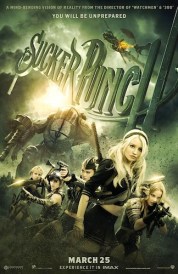 Zack Snyder’s fifth venture in the director’s chair is his first not to be based on someone else’s pre-existing material; or, to put it another way, the first wholly original story from the director of 300 and Watchmen. On the strength of its critical and box office reception, he may be relegated from the chance of doing such original work in future (his next effort, as I’m sure you know, will be a reboot of Superman).
I read a good summary of the critical reaction to Sucker Punch somewhere: that critics (and viewers) split into two types, one who thinks it’s a shallow story-free brain-dead over-indulged video game of a movie, the other who think it has hidden depths and themes worthy of exploration. And both sides are likely to call the other stupid, one for not being bright enough to spot the subtext(s), the other for bothering to read stuff that isn’t there. I side with the group that thinks there’s something more to the film, which, as the minority, I guess makes this review a defence.
I’m going to start by discussing the difference between the theatrical cut and this Extended Cut, because for once I think it makes a notable difference. Indeed, why this isn’t called the Director’s Cut is unclear: Snyder reportedly had to submit the film to the MPAA five times before they were satisfied to give it a PG-13; the R-rated Extended Cut restores all that, so surely it’s the Director’s Preferred Version rather than Version With Extra Stuff Bunged In? Some of it is significant in terms of clarifying the film’s story, themes and real-world/dream-world juxtapositions. 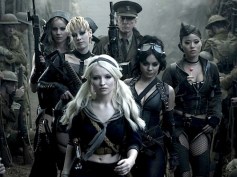 If you hated the film in its theatrically released form they’d likely struggle to change your mind, but for those seeking extra clarity they may help.
From what I’ve read, there are lots of changes here and there, but it strikes me there are four major omissions or additions:
- An extended Orc fight in the fantasy/dragon world. Fine.
- The dance number to Love is a Drug. I’d wondered why it got replayed over the end credits! Presumably it was cut because it was a bit too much like a musical, which is an understandable (people don’t like musicals allegedly) but disappointing decision. It adds to the film though, not just in terms of being Something Different, but also showing us what the club/brothel is like during working hours. It’s a great sequence.
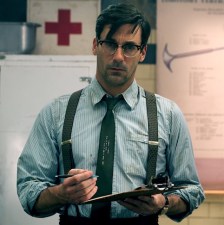
- A climactic scene with Jon Hamm’s High Roller and Babydoll. I can only imagine how baffling it was for cinema audiences to see the Mad Men star turn up for one half-arsed scene (namely the scene which now follows the High Roller one, which had to be gutted to make sense in the theatrical version). It’s a tense, uncomfortable, challenging scene that adds a lot to chew over — especially in context of:
- The smallest cut in length, but perhaps the most significant: when the Priest first brings Babydoll to the club, it’s discussed that she’s there to sell her virginity to the High Roller. Cut (like everything else) to get a PG-13 and because of the connection to that High Roller scene, it might sound like a minor omission, but restoring it clarifies both character motivation and some of the film’s themes, while juxtaposing the real world and dream world with, respectively, lobotomy and loss of virginity.
This is where the film is better than some would give it credit for: it’s not just a muddled excuse for some action sequences, it’s a dream-logic battle by a girl poised to lose her mind… or, maybe, already has. While her stepfather is taking Babydoll to the asylum for nefarious purposes, there’s little doubt in my mind that she’s already suffering serious mental health problems —  PTSD, quite probably, seeing as she accidentally murdered the little sister she was trying to protect after almost being raped by the evil stepfather her dead mother has left them to. If you know anything of the crazy, fractured dreams/hallucinations someone with a damaged mind can have, and apply that to this film, it begins to make more sense as a story.
(Major spoilers in the next two paragraphs.) That doesn’t mean it isn’t a problematic depiction of this. Is the ending really saying a lobotomy is a great solution to mental health problems? It allows Babydoll to escape her guilt and remorse for killing her sister, but that’s hardly empowering — giving in to it is, thematically, tantamount to suicide. This is supposedly offset by the escape of total-innocent Sweetpea, which wouldn’t have happened without Babydoll, but that seems scant consolation. And Babydoll’s stepfather escapes unpunished, apparently! Oh dear.
That it was Sweetpea’s story all along is also an interesting conceit. Snyder does contribute to this — Abbie Cornish gives the opening voiceover, we first see Sweetpea in a stage-set like the one Babydoll was on at the film’s open, and when we enter the (first) dream world it’s Sweetpea rather than Babydoll who emerges from the rotating transition shot. But is that enough? Because we’re undoubtedly in Babydoll’s head throughout the film, the only exceptions being the real-world bookends in which we only follow her. (We do see the result of Sweetpea’s escape, but the visual style makes it clear it’s Babydoll’s imagining of what happened.) 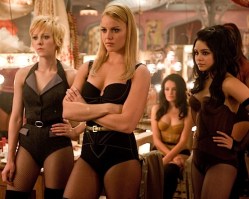 Maybe this is Snyder’s ultimate aim: it’s someone’s story told from the perspective of a (particularly interesting) supporting character. A little like the end of Super, actually.
This isn’t the end of Sucker Punch’s thematic implications though. Some say it’s a deeply misogynistic film dressed up as a female empowerment movie — look at the hyper-sexy outfits, the ultra-action, the fact it’s set in a brothel… Others probably argue it’s about female empowerment despite all that, but one of the more convincing arguments I’ve read says it’s about female oppression: these characters think they’re independent and fending for/defending themselves, but everywhere they turn there’s a man in control. Even in the dreams-within-a-dream where the action sequences take place, the girls are given orders by a male commander and they follow them unquestioningly. I suppose it’s all down to your personal perspective whether you see this as evidence of misogyny or of a deeper, more thoughtful approach. Let’s be kind and see the latter, I think — it makes the film more interesting, more thought-provoking, and therefore more enjoyable. And enjoyable is good — if you’re setting out to hate a film for the sake of hating it then… oh, then just sod off.*
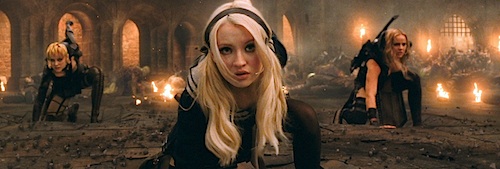
A far wiser man than I once theorised that any work of art, once completed and released, belongs to the viewing public rather than the artist.** (This is a lesson I feel someone needs to put to George Lucas.) Part of what this means is, if one reads something into the work — a thematic discourse, a moral message, whatever — then it is there, whether the author intended it or not. And if the author intended a certain message and you get the opposite, well, that’s right too (heck, even if you subscribe to the notion the work still belongs to the artist and only their intentions are valid, clearly they mucked up their delivery if you got the opposite). So, in other words, it doesn’t matter whether Snyder wrote and directed his film to ponder or convey certain points or ideas, or whether he just set out to create something that was “effin’ cool maaan, with, like, action and hot chicks and stuff, dude” — what I (and other critics) have read into it is still valid. So there.
 Like the rest of the film, the soundtrack is divisive. Some think it contains weak re-workings of excellent classic tracks, others that it contains interesting and appropriate re-workings of excellent classic tracks. I must again side with the latter. For instance, there’s a Queen/rap mash-up that I actually quite liked, and this is from someone who thinks the Wyclef Jean bastardisation of Another One Bites the Dust on Greatest Hits III is an offensive waste of disc space. The standout is probably the opening sequence, five minutes of dialogue-free brilliance with near-perfect visual storytelling (albeit aided by familiar imagery of abuse), set to a haunting rendition of Sweet Dreams (darkly, thematically apt for the entire film) sung by star Emily Browning herself.
Really, Sucker Punch is a musical. No, most of it isn’t sung, but every action sequence is accompanied by a cover song specially designed to fit with it, many (or all) of which in some way comment on or add to what’s happening. Not a traditional musical by any means, obviously, but the way it’s constructed around these musical/action interludes belies the truth.
Said action sequences are all inventive, but they began to feel a bit samey to me. There’s just too many, and though they should feel drastically different thanks to the variety of settings, Snyder’s style links them too well: they’re all shot in the same brown/sepia hue and our heroes all use current-day weapons and vehicles, 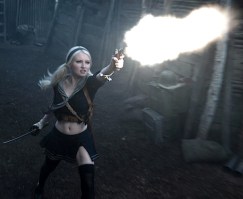 blurring what should be a clear difference between World War I with steam-powered Germans, an Orc-riddled fantasy castle, and a robot-guarded train on a distant planet. They sound incredibly distinct on paper, but on screen it’s confusing whether they’re meant to be the same world or not. The last of these, a single-shot running gun battle along a train, should be a balletic triumph, but by this point the action’s beginning to wear. I love an action film, and especially a creatively-rendered sequence, and Sucker Punch does have a ton of originality, but there’s perhaps too much of an onslaught. Maybe it’s less battering on later viewings — another reason they cut back on it in the theatrical version, perhaps.
All of the dream levels (we go at least two deep) invite comparisons to Inception, though they’re radically different films. I’m sure there’s an argument to be made along the lines of Inception being a product of a very organised, methodical mind — all steel city blocks and precise Escher paintings made real — while Sucker Punch comes from a crazed creative place — a random grab-bag of ideas and concepts. For all those who complained that Inception’s real-world-influenced dreamscape lacked the creativity and madness of real dreams, Sucker Punch should be a marvellous experience.
 Part of me wonders if, had I seen Sucker Punch in cinemas, would I feel the same way I do now? Would those big omissions have obscured the thematic depth I believe is there? To put it another way, how much do the changes really add? You or I will never know for certain. But I do think Sucker Punch has been underrated. It’s not the masterpiece I hoped it might turn out to be when I first began to notice the themes I think Snyder was (consciously or not) tapping in to, but I do think it’s a lot better and more interesting than most gave it credit for.
* This is not the same as disliking a film that merits disliking. But that’s a whole other discussion. ^
** The man in question where I encountered this theory was Russell T Davies, writing in his and Benjamin Cook’s book Doctor Who: The Writer’s Tale. A completely unrelated article that I just happened to stumble across later reminded me that credit for the concept “that once a work of art exists, it no longer matters what the author intended” more properly goes to Roland Barthes. ^

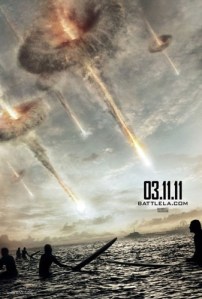 Battle Los Angeles (on screen; Battle: Los Angeles on posters — c’mon, let’s have some consistency with punctuation! Punctuation matters) seemed to come in for a wall of criticism when it hit cinemas way back whenever. For my money, though, it wasn’t that bad.
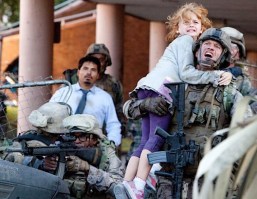 This kind of gung-ho militarism is laid on too thick. It seems fine for much of the film, but then as it heads into the second half and, especially, the third act, we have to suffer all manner of speeches and Emotional Moments that lack weight due to characterisation issues. The latter is badly handled for all kinds of reasons. All of the marines are entirely clichéd; so too are their story arcs; too much time is wasted trying to make us care about them — there are too many and they’re too shallowly drawn; things are worsened when a couple of civilians are added to the mix, who suffer from all the same problems… except they’re perhaps under- rather than over-developed. As we reach the third act, anything approaching plausible characterisation is jettisoned. Like the small-scale focus, what begins as naturalistic ends up with Big Speeches and all manner of Emotional Moments.
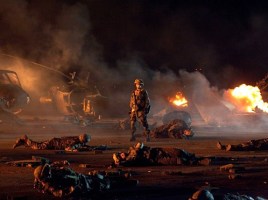 evoking the likes of the aforementioned as well as Black Hawk Down and The Hurt Locker in terms of conveyed realism. As I said, this is very effective for an alien invasion movie.
 They may take a little while to get to, but they’re relatively worth the wait.
 It never seems to have been fashionable to admit to liking
  being set in medieval/dark ages times, this has a very different, more traditional feel than the urban original film… albeit with lashings of CGI.
 In the director’s chair for the first (and, to date, last) time is special effects whizz Patrick Tatopoulos, who does a fine job of producing an action-fantasy film. There’s nothing remarkable about it but it largely works, though it’s a little bit on the dark side at times. I don’t know why so many films do this, incidentally — we’ve reached an era where people are mostly watching films in cinemas where the bulbs are under-lit to save money, or at home in probably less-than-ideal conditions, with various lights on and a screen left on factory settings. I wouldn’t mind if these dark movies looked fine once you were properly calibrated, but most of them are still ever so dark. Why do they think this is a good idea? Especially when you flick into 3D (which, fortunately, this film was just ahead of.)
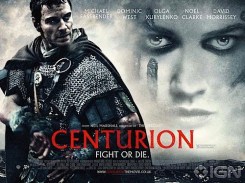 The fourth feature from writer/director Neil Marshall (despite owning his first three on DVD, this BD rental is the first I’ve actually watched — story of my life) is a bit of a departure: where the first three were horror (or at least horror-leaning) flicks, Centurion is an action-adventure crossed with something a little more artsy. Only a little, mind. Think
  Regular readers may know that I have an ever-growing dislike for films that begin at or near the end for no good reason (and most of those that do have no good reason to do so). Centurion’s opening line notes that “this is neither the beginning nor the end” of the lead character’s story. Oh dear, thought I; though perhaps “nor the end” signifies we might reach this point suitably distant from the credits, maybe. Not meaning to spoil it, but we’re there just 10 minutes later. Nice work Mr Marshall.
 The cast is packed with people who, even if you don’t know their names, there’s a fair chance you’ll know the faces (assuming you watch your share of British drama): in addition to Fassbender and Morrissey there’s Dominic West, JJ Field, Lee Ross, Paul Freeman, Liam Cunningham, Noel Clarke, Riz Ahmed, Imogen Poots, Rachael Stirling, Peter Guinness… not to mention Film Star Olga Kurylenko. Recognisability doesn’t guarantee quality, of course, but that’s a pretty good list.
 I really enjoyed Centurion, appreciating its mix between brutally real action and stunning scenery, with a slightly more thoughtful side emerging in the final act. It’s also always pleasant to see a film that runs the length it wants to at a reasonable speed, rather than padding itself to reach two or even two-and-a-half hours. Splendid.
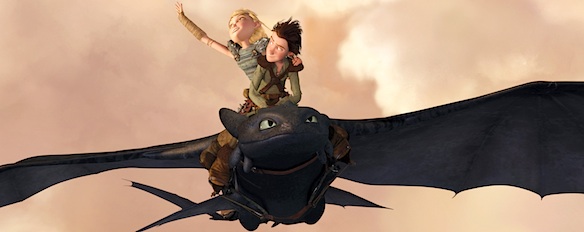
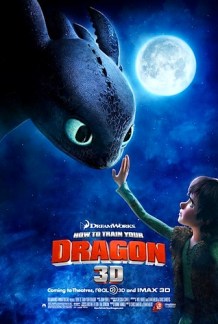 I saw a trailer for How to Train Your Dragon at the cinema a few months before its release. Having never heard anything of it, I thought it looked to have basic animation and a too daft tone. I wrote it off, expecting the kind of animated movie that would be slagged off as a Pixar-wannabe… and probably still land an Oscar nomination because there never seem to be many contenders for the animated feature award. Imagine my surprise, then, when it garnered endless positive reviews and a huge box office. What?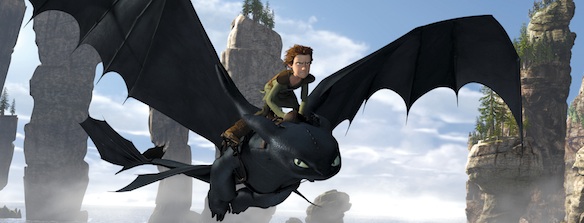
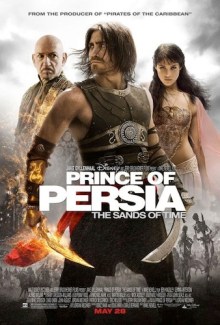 Disney’s attempt to launch a second franchise in the mould of
  There are some good action beats, but there’s also plenty of disorientatingly-edited, CGI-enhanced sequences, as per usual for the genre these days. For the former, see for instance Dastan’s climb up the wall into Alamut (or whatever it was called), or the knife-thrower-on-knife-thrower battle near the end. For explosions of CGI, see the massive logic-shattering ‘sand surfing’ sequence in the climax. Visually they’re clearly trying to evoke
 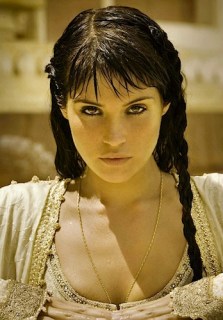 has the role Keira Knightley would’ve played five years ago. I think she’s meant to be a Strong Independent Princess but, much like Dastan, we’re told we should be inferring it rather than seeing any evidence of it.
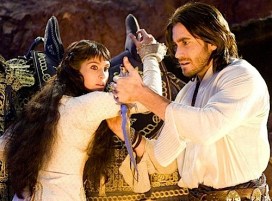 Plus, the sword-and-sandals milieu makes a bit of a change. I know we’ve had plenty of swords-and-sandals-flavoured movies in the wake of
  The thoroughly blockbusterised remake of
 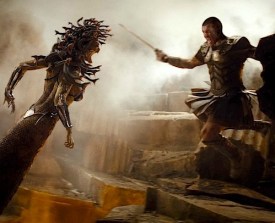 What the film is built to do is provide action sequences, though these are passable and rarely more. They’re fine while they’re happening, but pretty much forgotten after — none of it shows a great deal of inspiration. The history of film is littered with far worse examples, but that’s about the best I can say. I can see why it would be painful in 3D too: quite aside from the use of always-criticised post-conversion, and the apparent rush job on that, Letterier favours the modern action style of handheld jiggly shots and fast cuts, neither of which lend themselves to the 3D experience. Heck, even Michael Bay acquiesced to adapt his similar style when shooting
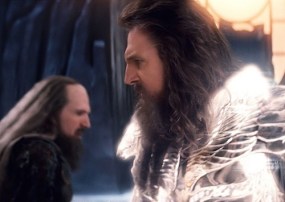
 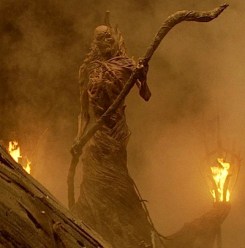 Design is probably the film’s strong point, particularly sequences that feature the three witches and the ferryman. Clearly these dark, borderline-horror-film settings are the design team’s strongpoint. Elsewhere, the gods have an appealingly retro lens-flared-silver-armour look about them — I don’t remember the ’80s original very well, but one could imagine this iteration of the gods being dropped in without anyone noticing.
 some plot elements could do with greater clarity, most of the characters could do with some depth.
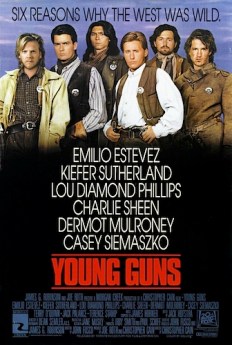 Way back in March, the ever-excellent Colin at
 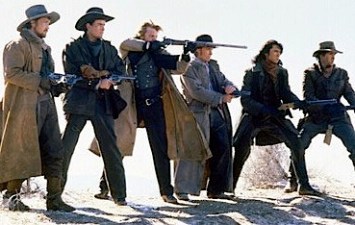 Though if someone was planning to use Young Guns to research the real-life facts of these events, more fool them in the first place. Wikipedia says (without citation) that “historian Dr. Paul Hutton has called Young Guns the most historically accurate of all prior Billy the Kid films”. We’ll leave it at that for now.
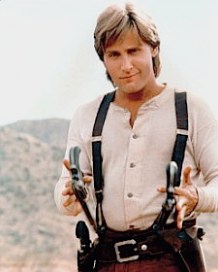 And that’s without mentioning the overuse of dated slow-motion that descends upon its eventual climax.
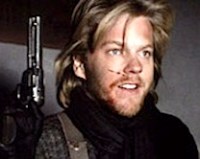 Young Guns is not a particularly likeable film, managing to miss both its potential target audiences: it’s not serious-minded enough for Western enthusiasts, let down by the Brat Pack cast and (it seems) historical accuracy; but it’s surely not fun or modernised enough to appeal to a younger (or younger-minded) crowd. Though clearly it did well enough as it spawned a sequel two years later. I didn’t hate it, I just didn’t particularly like it.
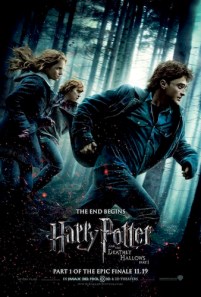 While the final Harry Potter film continues to obliterate records at box offices around the world, I finally caught up on the penultimate instalment in the phenomenal fantasy series. It’s Part 1 of
 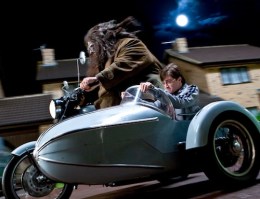 of having seven books each covering a school year, but hush, let’s overlook that (everyone else seems to).
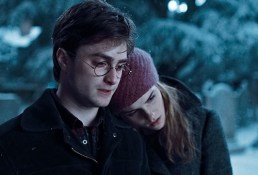 Talking of exceptional sequences, the animated one can’t go unmentioned. It’s wonderfully done, inspired by old silhouette animations, though achieved in 3D animation here, which is a pity. It’s still beautiful to look at, and it’s very fluid, but I can’t help but feel it would’ve been even more effective if they’d gone all out and done it in 2D.
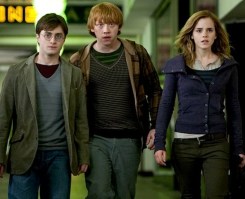 Themes of Nazi/Stalinist-style oppression are played up in the story (trials of those whose “blood status” is in doubt; listening to the radio for news of loved ones; Bellatrix’s torture of Hermione) and production design (the muggle-crushing new statue in the Ministry; the art style of anti-mudblood propaganda leaflets; the uniforms of the Ministry guards), but it’s subtle enough that it doesn’t batter you around the head.
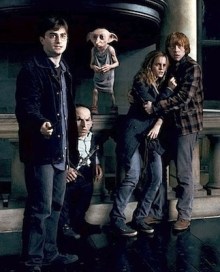 And so, the ending — which isn’t, because we’re in the middle of the book. So how well does it work as, y’know, an ending? Quite well, as it turns out — indeed, one might even compare it to something like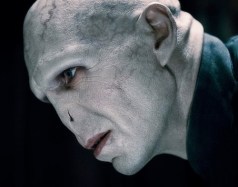
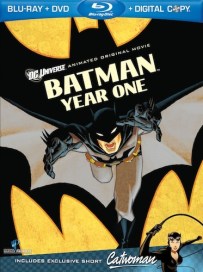 DC Comics’ latest direct-to-DVD animated movie is an adaptation of Frank Miller and David Mazzucchelli’s seminal 1987 Batman story, acclaimed as one of the greatest graphic novels of all time, and one of those that is often credited with helping the comic book medium grow up in the late ’80s.
 As with the comic, this is a very down-to-Earth version of the Batman story. It’s even less sci-fi-y than Chris Nolan’s much-praised realistic films, in fact. There’s no Batmobile, no Batcave, no Bat signal, only a few gadgets (and those that are used are fully plausible), no cartoonish super-villains… This Gotham is a city where crime comes from gangsters, drug dealers, muggers and a thoroughly corrupt police force, and that’s what Batman sets out to fight. As in the Nolan films, the costumed foes will come later, a response to the Bat himself. It’s not afraid to take its time telling this story either. Especially at the start, the pace is very measured — there’s no rush to action or to Batman, but instead a slow build of character and drama. Some may see this as a flaw — those after a Batman Action Movie, largely — but it sets the tone for what is a more character-driven tale.
 Cranston, given easily the fullest character, gives the best performance too. Star of
 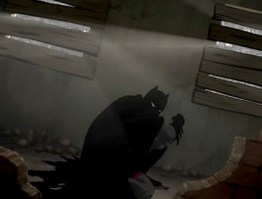 Indeed, you can tell Nolan cherry-picked most of Year One’s best scenes for his version, because they’re generally speaking the ones that shine here too. (It makes me want to watch Begins again to see just how much of this made it in there.)
 Unfortunately Batman: Year One has arrived at the party a bit too late to be the definitive screen telling of Batman’s origin — by taking the best bits of Miller & Mazzucchelli’s tale and expanding it with some work of their own, Chris Nolan & friends take that title. But as a film in its own right, Year One is largely successful. Children (or childish fans) seeking animated Batman thrills may be disappointed by its slower pace and focus on character, because this is solid adult-focused entertainment.
 100Films.co.uk