
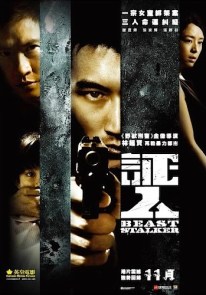
 While in pursuit of an accused murderer, a cop (Nicholas Tse) accidentally kills the daughter of said murderer’s prosecutor (Jingchu Zhang). Three months later, just days before his trial, the accused has the prosecutor’s other daughter kidnapped, to persuade her to destroy the evidence proving his guilt. Despite having spent the intervening time in reclusive self doubt, the cop sets out to rescue the kidnapped little girl.
The Beast Stalker is the kind of thriller that’s far less convoluted when you actually sit down to watch it, even if it does contain flashbacks that some other reviewers found confusing. Personally I had no trouble spotting them, but then thanks to those other reviews I was looking out for them, so who knows? Do note that the title is absolutely meaningless. Even if you read it as the “beast” being some kind of human, none of the characters are specifically a “beast stalker”. Maybe its meaning got lost in translation.
As a Hong Kong-produced thriller, you’d expect the focus here to actually be on the action sequences, but that’s not the case — there’s a real effort to look at the characters and the investigative side of the story. It’s by no means a procedural, and the character drama isn’t as deep as it might like to be, but the intentions are good. When HK’s famed action does turn up, it’s quite fleetingly and entirely plot-driven. The pivotal opening car chase is a nice one, topped by a crash realised (I presume) through seamless CGI. It reoccurs in flashbacks, each time with equal visual awe. Other punch-ups arise from the story rather than action-movie-necessity, 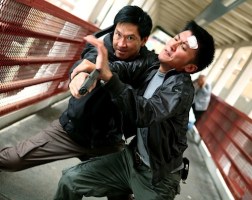 making them a little perfunctory — the real meat actually lies in the plot’s twists and turns. This is more one for fans of thrillers than beat-’em-ups.
That said, it’s not an overly surprise-laden plot — following the heroes and villains throughout sees to that — but that doesn’t leave it without tension or surprise. In the final reel, however, it tries to have its cake and eat it, first with a Shocking Moment it retreats back from, then with a final twist that ties everything up in a neat little bow; the kind of narrative trick which feels satisfying when you write it but comes over as too pat to an audience. It doesn’t ruin the film, it’s just a bit of a cheap “ta-dah!”, and perhaps with some more groundwork it could’ve been made to make sense.
In the lead role, Nicholas Tse fails to bring much more than standard action movie heroism to his character. There’s the occasional scene where he’s clearly been instructed to convey self doubt, but it isn’t pervasive. His best emoting comes courtesy of a nosebleed. Left to his own devices, his performance consists of business-like heroism, massively OTT shouting, or wails of crying sorrow. But that nosebleed… that works.
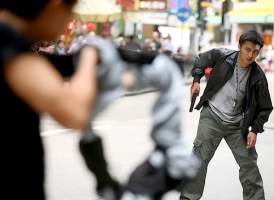 The top performance comes from Nick Cheung as a for-hire kidnapper with the Bondian trait of being blinded in one eye while the other only has black-and-white vision. He gets added complexity thanks to an invalided wife he tenderly cares for — he’s only in this life of crime to pay off his debts and medical bills, y’know. Cheung’s largely silent turn manages a fine balance of menace and sympathy. He won a couple of HK awards for it, according to Wikipedia, which seems deserved to me.
No other roles offer quite so much, scuppered by subplots that either go nowhere or are too familiar to care about. There’s the prosecutor’s failed marriage which may have led to the death of her child, or the cocky bossy cop who has a crisis of ability after an accidental killing, and so on. The theoretical main villain barely even features, which is refreshing in a way — it’s not that he’s underplayed, just that he’s not that relevant. Plus there’s the odd completely misjudged bit, like Tse’s cop stalking the sister of the little girl he accidentally killed, sketching her and offering her sweets. Creepy.
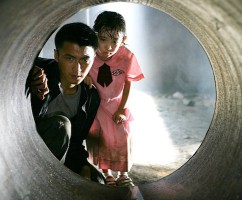 A brief couple of scenes with a bullied colleague play out nicely, though unfortunately they contrast with a painfully written bit in which another colleague tells Tse’s character what people think of him. “They said you were horrible, but I like working for you,” she tells him (I paraphrase), for no discernible reason. It doesn’t even matter that we’re told that, because we’ve already seen it. I just don’t get it.
As a straightforward thriller, The Beast Stalker ticks boxes admirably. As something with more meaningful depth, it manages to pull off a couple of threads, but is left wanting in other areas. The foundations are there, but the script needs a re-write to build on it.

* I watched it on Film4 HD, though it wasn’t listed as being in HD. Still looks a helluva lot better than regular-quality digital TV though. ^
 Bond is back, and you’ve surely seen the torrent of 4- and 5-star reviews (and the insignificant handful of dissenting voices). I’m pleased to report that the consensus is correct: Skyfall is Bond at his best.
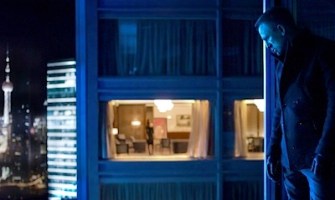 Technically speaking, the film looks gorgeous thanks to Roger Deakins’ cinematography. Best looking Bond ever? There’s little I can think of to dispute that. Obviously it could be said to lack some of that ’60s glamour, but from a purely photographic perspective, it shines. (Incidentally, this shot isn’t actually in the film.) I’m less sold on Thomas Newman’s score. While in no way bad, and with undoubted sparing but precise use of the Bond theme, it didn’t always click for me. The fact I at times felt like I was listening to cues from
  honestly, there perhaps aren’t as many twists as you might expect in that department, but the ways they’ve nodded to the franchise’s history are sublime.
  James Mangold is one of those filmmakers with a thoroughly eclectic CV, taking in crime thriller
  Knight and Day is nothing deep or revelatory or groundbreaking, but if you were expecting it to be then more fool you. If you can’t abide Cruise or Diaz (and I know some people really can’t) then it should certainly be avoided, but those caveats aside I thought it was good fun. No classic, and far from destined to be a standout on Mangold’s multi-Oscar-winning filmography, but an appropriately entertaining couple of hours.
 Following the surprise success of
  Hitler (aka Bruno Ganz) and a cool exit; a really good car chase; and a couple of solid punch-ups, including a particularly good one at the climax.
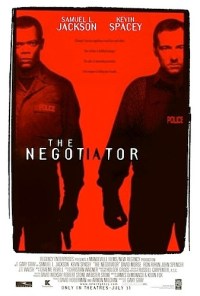 As premises go, “hostage negotiator turns hostage taker” is a doozy. You can immediately imagine all the drama to be had from pitting The Best Negotiator In The World (because it’s a movie — it’s going to be the best one that goes rogue, isn’t it) against The Second Best Negotiator In The World — he’ll know all the techniques! He’ll… well, mainly the techniques one. But also his colleagues will be working against him — will they be on his side? Or against him? It practically writes itself.
 but before that it sets up the characters and gets them on the bus, and the third act goes off-bus for a climax. Similarly, The Negotiator‘s first act gives us a day-in-the-life case for maverick negotiator Jackson, before putting him in his predicament; it toddles along, extending the hostage situation part with some tense and/or exciting sequences; and then the third act sees our hero set off to find the proof he needs.
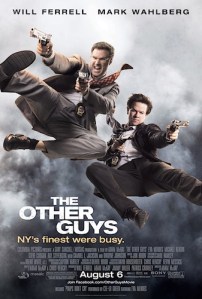 The Other Guys sounded like a great concept; so great I overlooked the fact it’s from the director of the massively over-rated
 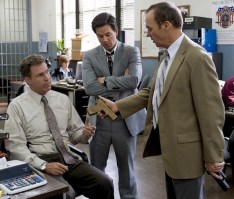 Everyone loves The Rock and Jackson; no one likes Ferrell and Wahlberg; and they’re not assigned the case, they stumble upon it. Wouldn’t it have been more fun if everyone actually hated The Big Damn Heroes who make it hard for the regular guys to do their job? If a pair of normal detectives were assigned The Big Case and had to prove themselves worthy? Maybe even put the Super Pair in the shade, rather than killing them off in the first act?
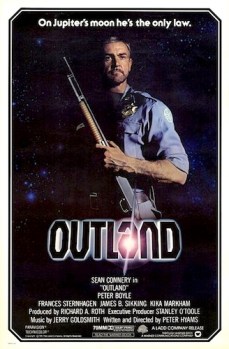 I first encountered Outland in a similar context to a lot of people, I think, based on reviews and whatnot I’ve read; that is, as “
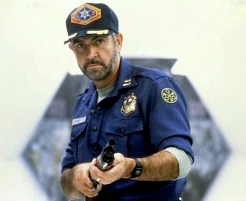 It works as well in space as it does anywhere else.
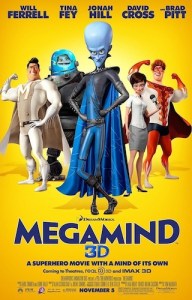 From the co-director of
 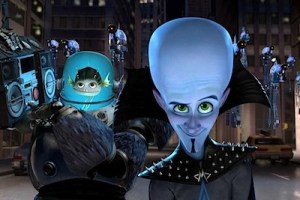 There’s a starry voice cast behind the characters, and fortunately they never overwhelm their roles. Which is good, because I’m not really a fan of Will Ferrell and he’s the lead. There’s also the likes of Brad Pitt, Tina Fey, Jonah Hill and Ben Stiller rounding out proceedings — not that it matters because, as I say, the voices fit their roles seamlessly.
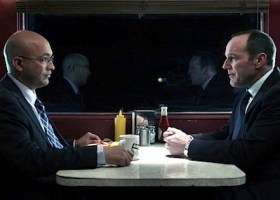 Despite that aim, these aren’t glaring holes that desperately need a fix. Rather they’re join-the-dots enterprises; the thing most people won’t have noticed at all, that fans may have wondered about, that it’s more fun to connect up than strictly necessary. It makes this piece resolutely fan-only — while it’s quite good, it’s more admin than a story in its own right, showing how various films connect together in the lead-up to
  It’s a standalone piece, and though it’s brief (under three minutes before the credits role), it still manages to add quite a lot to the character of Agent Coulson, who in the main films to this point has been a minor (albeit increasingly major) supporting role. I suppose it’s fitting that Clark Gregg has been the star of these connecting shorts, as he’s one of the main links across the films (he appears in
 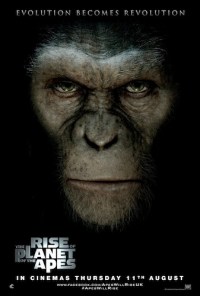 Prequels are far from a new concept (there are examples in ancient Greek literature; the OED dates the first use in print to 1958, though I swear I’ve heard mention of it being used even earlier), but in the past ten years or so they really seem to have come to prevalence in the movies. Perhaps we can trace this phenomenon back to
 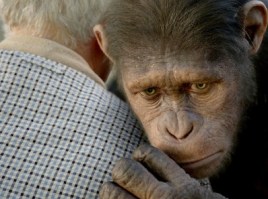 The screenwriters in question, Rick Jaffa and Amanda Silver (also producers), are due a lot of thanks for the quality of the final product. The story — about the son of a lab-tested chimpanzee, raised at home by a US scientist, who ultimately turns on humanity — was inspired by news stories of pet chimps attacking their owners, plus research into genetic modification. By taking these themes and issues and running with them, Jaffa and Silver have crafted a blockbuster that is both plausible and intelligent — a rare thing these days.
 As with many prequels, the story itself may seem needless: we know where it ends up, and as various balls are put in play we can see their ultimate destination. But the important thing is that you can’t always see their trajectory, and as someone famous once said, sometimes the pleasure’s in the journey not the destination. Here we become invested in the characters, so we care about what will happen to them in the broader sweep of the Apes story, not to mention the intricacies of how things go from the opening status quo to the conclusion. Plus, with a prequel set so far before the original as this one is, one can always ponder the question of just how far they’ll go in this story (it doesn’t connect up to the start of Planet of the Apes, for instance).
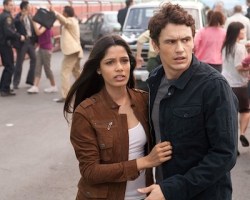 The rest of the cast are adequate but hardly register. James Franco is a solid lead but rarely called on to do much — Caesar is the protagonist, Franco’s human scientist just facilitates that. Frieda Pinto’s role is underwritten. Considering the film barely hits 100 minutes in an era when many blockbusters bloat to 140+, there’s room for her character to get a subplot objecting to the lab treatment of the apes. She’s awfully accepting of Franco’s line of work. As I noted though, perhaps they were trying to avoid being heavy-handed. Overall, John Lithgow is served best, his character slipping in and out of Alzheimer’s as Franco tries to develop a cure. It’s another in a line of recent fine supporting performances from him.
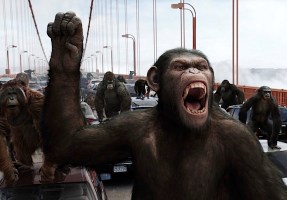 but there’s unquestionably still more that could come. There’s the newly intelligent apes, not yet ruling the planet; but also a mid-credit sequence that continues a significant subplot that’s clearly left hanging, closing the movie with a slight Part One-y tang. Still, I believe that if there wasn’t a sequel coming it would function satisfyingly as a standalone film.
 100Films.co.uk