Underworld Awakening (2012)

2013 #1
Mårlind & Stein | 89 mins | Blu-ray | 2.35:1 | USA / English | 18 / R
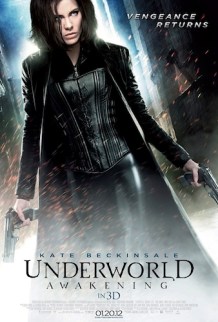
Underworld AwakeningJust when you think the Underworld series is dead, it suddenly lurches back to life with a new instalment. Fitting for a series all about vampires & that, I suppose.

Having diverted to a prequel telling us a story we largely already knew, here we rejoin Selene (Kate Beckinsale), last seen six years ago (real world time) in Underworld Evolution, which was very much Part 2 to the original film’s Part 1. They told a pretty complete tale, actually, so rather than try to find something there, Awakening launches into something new. Following a two minute recap of the first two movies (it’s so long ago that this is actually very handy), a quick-cut prologue-y bit tells us that the long-secret war between vampires and Lycans (aka werewolves) was discovered by humans, who set about wiping them out. Trying to escape, Selene’s crossbreed lover Michael (Scott Speedman) is killed and she gets frozen… only to wake up however-many-years later into a changed world… And so on and so forth. Escapes, shooting, action-y-business all ensues.

Said violence is very bloody and brutal, much more like the second film — I swear the first (especially) and third weren’t anything like as gory. Evolution well earnt its 18 certificate, after a very 15 first film, and quite surprised me at the time. This isn’t as extreme as that, but still. The main drama and attraction in the Underworld series lies in the vampires-vs-werewolves-with-modern-tech concept, not in ripping off limbs or spurting blood or whatever. Or maybe that’s just me.

Whose daughter might she be...By taking such a bold move with the plot, meanwhile, the story pushes the series’ mythology in new and relatively interesting ways. It’s becoming a bit dense and fan-only (unless you let it wash over you and just enjoy the punching), but at least they’re not regurgitating the same old stuff. It manages a few twists along the way too, which is always nice. The plot seems to have been half worked around Speedman’s non-involvement, leading me to wonder why — he’s not too busy, surely? Perhaps he’d just had enough? But no, apparently it was genuinely just written this way. I guess he couldn’t be bothered to turn up for some cameo shots, because the stand-in is really obvious.

Also glaringly obvious is the set-up for a sequel. Not so much as the first film, which had such an End of Part One feel (including a direct cliffhanger) that the sequel picked up mere hours later. But this is still a story obviously incomplete (again, there’s a sort of cliffhanger), but at least it has the courtesy to… actually, no, it’s only as complete as the first film. The main narrative drive is resolved, but other bits are blatantly open.

But it didn’t seem to go down too well, so what are the chances of us seeing it continued? Well, as we’ve learnt, you can never write the Underworld series off. And its niche fanbase, semi-independent production, and relatively long three-year gap between sequels There's still lots of shootingmeans the next one will probably turn up out of the blue with little hype, much as Awakening did last year. Plus, though this is the most expensive film to date (double the budget of the preceding one!), it’s also the most financially successful: $160.1 million worldwide, beating number two’s $111.3 million. Assuming Beckinsale still feels up for it, I imagine 2015 will bring us a continuation — and, hopefully, a conclusion.

The higher budget and higher gross I mentioned are surely both down to one thing: 3D. Shooting in proper 3D (as opposed to the ever-so-popular post-conversion) costs a fortune, as a producer reveals in the BD’s bonus features, but it can also net you more money at the box office thanks to that 3D premium. Such a gamble hasn’t paid off for everyone (Dredd), but it clearly did here (how the hell did Underworld 4 make four-and-a-half times as much money as Dredd?!) Watching in 2D, it’s clear that some sequences were designed with 3D in mind — not in the way that, say, Saw 3D or The Final Destination sometimes only make sense with added depth, but in ways where 3D would (I imagine) enhance the visuals. There are some instances of stuff flying at the camera, a popular sticking point for the anti-3D crowd, but that’s actually been part and parcel of Underworld’s style since the start (just watch a trailer for the first film — there was a shot of it used prominently in most of the marketing).

New-style evolved LycanAlso worthy of commendation: new-style ‘evolved’ Lycans; a small role for Charles Dance (always worth seeing); the evocative near-future setting; good quality action sequences; some nice steel-blue cinematography/grading. Some of it was shot at 120fps on brand-new pre-alpha never-used RED cameras — take that Peter Jackson, eh. Plus it’s only a little over 1 hour and 18 minutes long without credits. Some would bemoan such brevity, but it has its positives.

I’ve always quite liked the Underworld series, even if the first one is still clearly the best. Awakening gets most kudos for taking things in a new direction, even if, as a film in itself, it’s only OK.

3 out of 5

Akira (1988)

2013 #61a
Katsuhiro Otomo | 124 mins | Blu-ray | 16:9 | Japan / Japanese | 15 / R

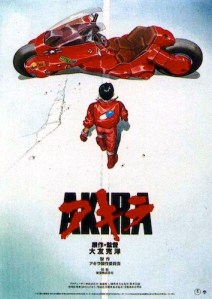
AkiraFor many Westerners of a certain generation, Akira was their first (conscious) exposure to anime. Not so me: a step or two down, Ghost in the Shell was my first (ignoring the odd glimpse of Pokémon or what have you) — it was one of my earliest DVD acquisitions, before we even had a DVD player, when I had to watch discs on my computer, where GitS’s menu just showed up as a black screen and I had to click around randomly to find ‘play’. Ah, memories.
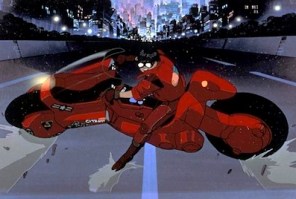
Anyway, I came to Akira slightly later, and I confess I didn’t much care for it. I thought it looked great, especially the bike chases, but I lost track of the plot pretty quickly and found the ending a bit much — a bit too bizarre and kinda sickening. So I haven’t revisited the film for something like a decade, but always felt I should. I bought Manga’s Blu-ray release a few years ago, but it was the mention of this year being the film’s 25th anniversary that led me to finally pop it in.

Firstly, I watched it in Japanese this time, which is why it qualifies for coverage here (not that I need a reason to review a re-view these days, but that’s a different point of order). I had a quick listen to the English dub before viewing and it sounds a bit clunky with typically poor voice performances, so I went with the subbed version, where it’s pretty impossible to tell whether the acting’s any good or not (or at least, I always find it so. I go back and forth whether to watch anime dubbed or subbed, but that’s a discussion for another time). Having to read subtitles all the time does intrude on appreciating the visuals at points, but it’s workable.

Akira stillThe visuals remain something to be savoured; they’re probably the film’s strongest point, in my opinion. Akira was an expensive production and it pays off on screen. It’s not just the bike chases that I appreciated either, while an extra decade of experience made the ending a bit less freakish! The other strong point is the audio. The BD’s booklet goes on about “hypersonic” sound. I’ve no idea if that worked on my system, but it sounded fantastic regardless.
I don’t think the plot was as hard to follow as I previously felt (possibly thanks to an idea about where it was going), though the exact happenings at the climax are still unclear.

I liked Akira a good deal more this time round. Theoretically the only differences were HD, which is pretty but doesn’t fundamentally alter one’s opinion of a film’s content, and the Japanese soundtrack, which wasn’t my problem in the first place. The other big change, of course, is not in the film but in me — perhaps I’m just better positioned to appreciate it now. It’s not at the point where I’d number it among my personal favourites, but I now see some of what others get out of it.

4 out of 5

Broken Arrow (1996)

In the interests of completing my ever-growing backlog, I decided to post ‘drabble reviews’ of some films. One day I may update with a longer piece, but at least there’s something here for posterity.

For those unfamiliar with the concept, a drabble is a complete piece of writing exactly 100 words long.

2013 #35
John Woo | 104 mins | TV | 2.35:1 | USA / English | 15 / R

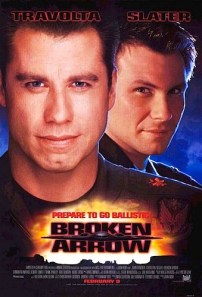
Broken ArrowUS Air Force pilot Jon Travolta crashes a plane, steals a nuke, and former friend and colleague Christian Slater must stop his dastardly plan in this ever so ’90s actioner.
In his second Hollywood outing, Hong Kong action maestro John Woo (over-)directs his little heart out: there’s an endless array of slightly hilarious slow-mo, crash zooms, etc. Plus, it has the honour of featuring possibly the most gloriously OTT villain death in the history of cinema.

It all seems quite cheesy now, but still quite fun. Perhaps best suited to those nostalgic for a style of movie now gone by.

3 out of 5

Battleship (2012)

2013 #26
Peter Berg | 126 mins | TV | 2.35:1 | USA / English | 12 / PG-13

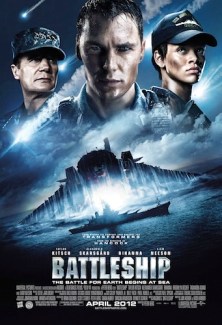
BattleshipBattleship never sounded like a good idea. An adaptation of a board game that in no plausible way resembles real life? At least Clue was aping a board game that aped Agatha Christie mysteries, and turned it into a farce at that; and a theme park ride adaptation like Pirates of the Caribbean could take the basics of the ride (which is really just a series of piratey tableaus) and thread them into a new story. And then someone mentioned Battleship was going to involve aliens, and it really all went to hell.
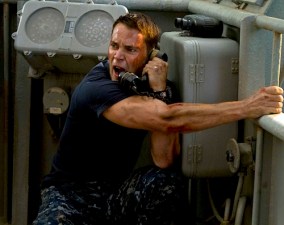
Unsurprisingly, Battleship the film is nothing like the game… except for one sequence where, for reasons I can’t remember in the slightest, the crew of the titular vessel have to try to shell the aliens without the usual modern gadgety shebang, and so it’s a bit like the board game. It’s shoehorned in but it’s still one of the more memorable bits.

Around this is a bunch of absolute codswallop that I don’t care to remember. It’s something to do with an alien invasion and they do it at sea and there’s only one ship that can stop them but the only person who can command it is the young loudmouth playboy recruit who has so much potential but never fully realises it… until now! Honestly, it’s that clichéd, and it would seem unashamedly so. Everything else about the film is Transformers-at-sea — huge robots, big punch-ups, shoot-outs, explosions, all the rest.

As if aware of how awful it is, the film attempts to make it wash with something sure to appeal to the American public and be uncriticisable: “aren’t veterans great!” Battleship fetishises the American armed forces in a way rarely seen — and that’s saying something. The ground resistance is led by an Iraq vet with no legs, still in physio, America, fuck yeah!hobbling up a mountain on prosthetics to realise he’s still worth something as he saves the day. America, fuck yeah! And when the main battleship is ruined, our plucky heroes have no choice but to co-opt the museum piece (literally) WWII ship; and because most of their crew is dead, the museum guides — all of them septuagenarian WWII vets — have to man their ship once again. To defeat those invading scum, just like before! AMERICA, FUCK YEAH!

Ugh.

Oh, and Liam Neeson is in it. Barely. And he phones it in. And not a cool phone call like he’s famous for. All things considered, we can forgive that man some of his movie choices in the past few years, but this one must’ve been about the payday alone. Same goes for Rihanna. You’ve probably seen that article listing all her lines. As it suggests, she’s basically a glorified extra, and a poor one at that. Stick to getting your tits out in Irish fields, love.

You’ll notice I haven’t given Battleship the ignominy of a single star. Thing is, for all its awfulness, some of the action is OK, there are some (unearned) triumphant moments, and though the film’s veteran-worship is as transparent as its clear blue Hawaiian seas, it sometimes works. Kinda.

2 out of 5

Battleship featured on my list of The Five Worst Films I Saw in 2013, which can be read in full here.

Underdog (2007)

2013 #5
Frederik Du Chau | 74 mins | TV | 16:9 | USA / English | U / PG

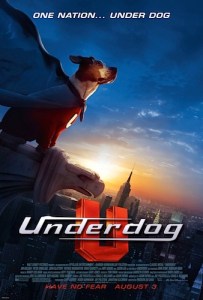
UnderdogIn this big screen live-action version of some old US cartoon, a dog gets superpowers and, naturally, becomes a superhero. That’s pretty much it.
The film is widely disliked, it seems, with a very low rating on IMDb; but I thought it was actually good fun. It’s not Citizen Kane, but it’s not trying to be — it’s a kids’ comedy-adventure, and kids will get the most out of it, but it also has enough wit and charm to see it through for some older viewers.

And there’s Peter Dinklage as the raving villain — you know that’s got to be good.

3 out of 5

In the interests of completing my ever-growing backlog, I decided to post ‘drabble reviews’ of some films. One day I may update with a longer piece, but at least there’s something here for posterity.

For those unfamiliar with the concept, a drabble is a complete piece of writing exactly 100 words long.

The Amazing Spider-Man (2012)

2013 #44
Marc Webb | 136 mins | Blu-ray | 2.40:1 | USA / English | 12 / PG-13

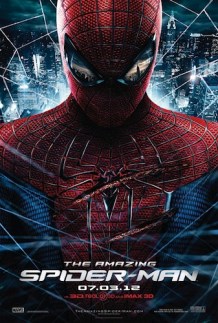
The Amazing Spider-ManAndrew Garfield dons the webbed onesie for an unwarranted reboot of the only-one-decade-old Spider-Man film franchise, retelling his origins… but with a twist! Cos, y’know, the last version was only out about 10 minutes ago.

Director Marc Webb’s only previous feature credit is hipster rom-com (500) Days of Summer. Presumably he was chosen, not for his surname, but because half of Amazing is a hipster rom-com. Peter Parker is no longer a socially inept geek, but a mumbling hipster who easily attracts the attention of his longed-for girl (and maybe one or two others) because he’s hipster-cool.

This is just the first of many mistakes. There’s the ditching of the famous “with great power” motto, just Because; and he does grow webbing naturally, as per the controversial decision in the Sam Raimi-helmed trilogy, but now he develops artificial wrist-based web-shooters too, because That’s In The Comic Goddammit; and then there’s some kind of conspiracy backstory with his parents because That’d Be Different.

Essentially, everything is geared towards making sure this isn’t just a rehash of the previous series-starting film, because, as we established, that only happened just a minute ago. In the process, various bits get bungled, rejigged and rearranged to try and convince viewers that you haven’t seen all of this origin story before, when really you have… and done better, too.

The film isn’t without merit. Some of the done-for-real web-swinging is nice; Garfield is good when not affectedly stuttering; love interest Emma Stone is pretty until she opens her mouth; Mask off, as per usualsome of the action sequences are alright. Mercifully, the much-trailed first-person segments are cut down to a minimum; kind of a “we made this so we ought to use it, but we’ve realised everyone was going to hate it”.

But supporting characters get short shrift. Denis Leary doesn’t turn up until halfway through and gets a half-arsed arc that jumps from one end to the other. Rhys Ifans gets off to a good start as sympathetic villain-to-be Dr. Curt Connors, but then his story too is jumped forward when someone clearly realised the running time was running away from them.

Spider-Man’s mask seems to come off every 10 seconds. Attempts at “aren’t New Yorkers all wonderful” patriotism come off as cheesy and literally laughable (the aligned cranes!), whereas in Raimi’s films they kinda felt good even though you knew you should find them horrid. Gone is the humour or colourfulness of those previous films. I know the latter wasn’t to everyone’s taste, but it nailed the intended tone of Spidey much better than this Nolan-inspired grim real-world style.

Someone mentioned Twilight in the run up to release. Disappointingly, they seem to have taken this to heart, focusing on the romance at least as much as the superhero antics. I don’t know how they divide up in terms of screen time, but it feels like the romance received more time and effort from the makers. Superheroes for TwihardsNot that it pays off — instead it just feels like the action scenes were bunged together because, hey, some of the fans want that stuff, right?

Plus, remember how everyone disliked Spider-Man 3 so it did less box office than either of its predecessors? This did even less again. While I’d like to say they’ve listened to fans for the sequel, I think it’s superficial: the suit’s had a major redesign to make it look even more like the comics than either previous version (bigger whiter eyes!), but it will feature at least two, probably three, and possibly four major villains. Such multiplicity was 3’s undoing, and as Webb & co couldn’t find the room to do even one villain properly in this film, I dread to think how they’ll handle several.

The Amazing Spider-Man isn’t a disaster — I’ve given it three stars for a reason — but Raimi got it right in his first two films, and by being different for the sake of it they’ve thrown away a lot of what worked and emphasised many of the things that didn’t. I’m sure there are plenty of single adjectives people would use to describe this iteration of Spider-Man, but “amazing” isn’t one of them.

3 out of 5

The Bourne Legacy (2012)

2013 #55
Tony Gilroy | 135 mins | Blu-ray | 2.40:1 | USA / English | 12 / PG-13

The Bourne LegacyAs Jason Bourne flits around London and New York making trouble for what’s left of Treadstone, a group of shady men go about safeguarding their own secretive activities. When Bourne exposes Treadstone, a series of convoluted join-the-dots links means it could bring them down too, so they set about destroying their risky initiatives, including killing a bunch of medically-enhanced operatives. What they didn’t count on was one surviving…
That basic setup covers roughly the first 30-40 minutes of The Bourne Legacy. Normally I’d hate to describe so much of a film, but it’s not my fault that co-writer, director and Bourne series veteran Tony Gilroy takes that long to get his story up and running. And it’s another 20 minutes before the real meat-and-potatoes of the tale begins.

And it feels it, too. About 52 minutes in I paused it and went to the kitchen. Not for any particular reason; I just needed a break. There, I saw a slug crawling into my dog’s water bowl, drinking the water or something, I don’t know. I’d never seen that before. I ended up watching that slug slowly edge around the bowl for 15 minutes or more rather than go back to the film. It’s that engrossing.

Gilroy has written or co-written every Bourne film to date, so you’d think he knows his way around the franchise — and he does, but perhaps too well. Each Bourne sequel has basically relied on the same formula: “the conspiracy was bigger than you thought, and now the next level up want Bourne dead”. That was fine in Supremacy — indeed, it took characters left dangling from Identity and wrapped up their roles. Cross by name, cross by natureFor my money, Ultimatum felt like it re-hashed this storyline, bringing in new characters to force a new level of backstory and hierarchy. (Clearly most viewers didn’t mind, as it’s widely regarded as the best Bourne film.)

And Legacy recycles this idea for a third time. Now, Treadstone and Blackbriar are just two of many such programmes run by the CIA and/or some shadowy higher organisation I’m not sure is real. On the bright side, they’re not after Bourne, but new escapee Aaron Cross. Not that it makes a huge amount of difference.

If such a repetitious story wasn’t bad enough, Gilroy spends a ludicrous amount of time setting it up. The beginning of Legacy overlaps with the end of Ultimatum, showing us in dully intricate detail what the numerous new CIA characters were doing during that time. And intercut with that we have our new hero wandering by himself across Alaska. For half an hour. This isn’t an art film meditation on isolation, it’s an action thriller — get a bloody move on!

What did Gilroy lose between Ultimatum and this? Well, co-creators. He co-wrote Identity and Ultimatum, and had two different directors across the first three films. Here he’s responsible for the story, co-writing (with his younger brother), and directing. He undoubtedly has some degree of talent, but maybe the other voices were essential to honing it. The other thing a fresh perspective could bring is fresh ideas. If Gilroy has rehashed the same basic plot three times now, surely they need someone with a new story to offer?

Ah, Rachel WeiszPerhaps also, after four films, he’s too close. Clearly that has advantages for remembering the intricacies of the timeline and continuity, especially with the trilogy’s increasingly complex web of conspiracies and conspirators; but maybe Gilroy has become too deeply embroiled in that. After all, he thinks it’s OK to spend the first half hour of the film connecting up the dots between the previous story and his new plot — who really wants that? That’s for geeky fans to do later.

And yet, for all that, the timeline doesn’t quite make sense. If we assume Identity is set in 2002, because that’s when it was released, then Supremacy is two years later, in 2004. Ultimatum is six weeks after that, so late 2004 or early 2005, and Legacy is immediately after that (as I said, the start overlaps). So, it’s set seven years ago? But a character finds a moderately key plot point on YouTube as if it’s the most natural thing in the world… but the very first YouTube video wasn’t uploaded until April 2005. I guess the films operate on a sliding timeline now, much like long-running superhero comics or the Bond films. That or The Bourne Identity is really a sci-fi film set in the Future Year of 2009. Considering the ‘science’ brought to bear in Legacy, perhaps that is the idea.

This is also the first Bourne film that leaves its storyline truly open. The other sequels had threads to pick up on, obviously, but if the series had stopped after either Identity or Supremacy, you’d have still had a complete tale (or Ultimatum, of course). It’s ironic, because this is also the first time I’ve been left with no desire to see a follow-up. The ending reminded me a bit of Saw IV, actually. For those who don’t know their Saw films, that takes place concurrently to Saw III, following different characters and a different storyline. Requisite Bourne movie car chase, with a bikeAt the end, the two films come together, adding a few seconds more story to what we saw at the end of IV, and ready to move on with unified purpose (well, sort of) in Saw V. Legacy feels like it concludes the same way: we’ve been introduced to new bad guys and a new hero, and the events that ended Ultimatum have been given a few seconds more development with a new twist; so now all is ready to rejoin where we left Bourne himself and continue afresh. Except Matt Damon seems to have ruled out that idea already. And, like I said, do we really want more of these characters and their increasingly ludicrous levels of conspiracy?

Legacy isn’t all bad. When it finally moves up to second gear (after a whole hour) there’s the occasional good action sequence. The requisite Bourne car chase is replaced by a bike chase, but I’d happily argue it’s at least the equal of any of the series’ other road chases — the only part of the film that can stand up to its predecessors, because the other fights and foot chases don’t have the same edge. Indeed, a rooftop/alleyway chase in Manila is just a rehash of Ultimatum’s Tangier sequence, but not as exciting. And through all that, the story remains resolutely uninvolving.

And don’t get me started on the cast. Jeremy Renner is fine as an action man but doesn’t deliver any other significant likeable qualities here (and I don’t think that’s his fault). Rachel Weisz is normally brilliant, but here is reduced to a snivelling plot piece. They’ve made her character a Clever Scientist, which is presumably supposed to make her a Strong Female Character too, but that’s not how it’s played at all. Edward Norton Starring Edward Norton staringis wasted staring at monitors; Albert Finney is literally wasted, his one meaningful moment relegated to the Blu-ray’s deleted scenes section; Zeljko Ivanek gets a pivotal character but is underdeveloped and so his talents are wasted; and some actors from previous Bourne movies appear to be credited merely for use of their photos, until they turn up for ten-second cameos near the end that you’d rather weren’t there because it means someone is planning on a Bourne 5.
After the muted reception Legacy got on release I was expecting it to be mediocre — or perhaps, if I was lucky, underrated — but I thought it was mostly just boring, worse than I’d heard, and not even close to any of the previous Bourne films. They’re exceptional examples of the action-thriller, of course, but this isn’t even good as a routine genre entry, because it’s quite spectacularly dull. I do believe they could have continued this series without the character of Jason Bourne — there’s potential in some of the ideas here. But this version just doesn’t work, as a compelling film or worthy successor.

2 out of 5

The Bourne Legacy is on Sky Movies Premiere at 4pm and 8pm every day for the next week.

It featured on my list of The Five Worst Films I Saw in 2013, which can be read in full here.

May 2013 + 5 Greatest Car Chases

It’s a bumper crop of things to discuss in this month’s update!

  • The return (as it were) of What Do You Mean You Haven’t Seen…?
  • New films in the double figures — but just how many?
  • (Over-)analysis of what this means! (Not much.)
  • The completion of my Harry Potter re-watch…
  • …and a look at the results of my Harry Potter poll!
  • A top five… but of what? (Oh, it’s in the title, isn’t it?)
  • And the usual pointless “next time” bit that I ought to do away with but keep including just because it’s there in the template!
  • It’s only the biggest*, bestest** 100 Films update ever!

    So, as Graham Norton might say, jump on it!

    No, er, I mean — let’s start the show post!

    [Imagine a 100 Films title sequence here. Or don’t, whatever.]


    What Do You Mean You Haven’t Seen…?

    The path to not-quite-making-it-to-100-films is paved with good intentions (as is the path to making-it-to-100-films-or-more, but the failure path has more paves), and my plan to watch two WDYMYHS films this month is now another slab in said path. So I bump that idea to next month, because, hey, I did watch one. And that one was…

    Ingmar Bergman’s The Seventh Seal, aka Det sjunde inseglet if you speak Swedish or want to be one of those people who always uses the original title regardless.

    Despite owning Tartan’s impressive Bergman Collection DVD set for a number of years, this is actually my first experience of Bergman. Once, I noted how many significant directors have been new to me in the course of 100 Films. I thought I’d done it on an individual year, but it was in my review of The Great Dictator. I don’t believe I’ve ever done the former, probably because it’s never actually been noteworthy. However, it’s felt like there have been a few this year, so that’s something I may add to the end-of-year stats.

    But that’s still seven months away. You want to know what I’ve been watching in the past 31 days, right? Right?


    May’s films

    Django Unchained#44 The Amazing Spider-Man (2012)
    #45 The Fast and the Furious: Tokyo Drift (2006)
    #45a Harry Potter and the Order of the Phoenix (2007)
    #46 Tintin and the Mystery of the Golden Fleece, aka Tintin et le mystère de la Toison d’Or (1961)
    #47 The Naked Gun: From the Files of Police Squad! (1988)
    #47a Harry Potter and the Half-Blood Prince (2009)
    #48 Django Unchained (2012)
    Ray Harryhausen: Special Effects Titan#48a Harry Potter and the Deathly Hallows: Part 1 (2010)
    #49 On Dangerous Ground (1952)
    #50 Les Misérables (2012)
    #51 And Now for Something Completely Different (1971)
    #52 Shane (1953)
    #52a Harry Potter and the Deathly Hallows: Part 2 (2011)
    #53 Ray Harryhausen: Special Effects Titan (2012)
    #54 The Seventh Seal, aka Det sjunde inseglet (1957)


    Analysis

    This month’s tally of new films rests at 11, more than double what I achieved last year and drawing equal with May of 2011.

    It’s also an anniversary, because May 2010 was my first of these regular monthly progress reports. Three years! My my, time flies. Back then I managed 16 new films, at the time my joint-second highest month ever. Show off month.

    Back in 2013, May is my joint second highest of the year — behind March (which is the current second highest month ever) and tied with February. That’s a pretty solid start to the year — more so than last year, and while 2011 and 2010 show a similar shape (double-figure Januarys, Februarys, Marchs and Mays with a relatively weak April), I’ve reached #54 this year, while in 2011 it was… oh, #58. Well, in 2010 it was… oh, #57.

    Hey, you can’t win ’em all.

    In terms of the films themselves, there’s an uncommonly high number from the ’50s this month — three, whereas my year-to-date only featured one other. There’s no particular reason for that, it’s just one of those coincidences. There’s also four films from 2012 alone, which is more to be expected as I continue to catch up on last year’s cinematic releases. There’ll definitely be more of that next month.


    Potter poll!

    For most of this month I’ve been running a poll on readers’ favourite Harry Potter films (you may have noticed it — it’s sat on the left of the front page). It’s been interesting to see how many votes I’d attract, especially with near-relentless badgering about it on Twitter at some points. As it turned out, better than I’d feared. That’s what bombarding Twitter can do.

    Well, I’m not closing the poll, but as it hasn’t received any new votes in weeks, let’s look at what my tiny sample thought.

    Everything Will ChangeThe clear victor is the Alfonso Cuarón-helmed franchise-revitalising third film, Prisoner of Azkaban, which scooped exactly 50% of the vote. Its supremacy in this poll was never in doubt, lingering around that percentage throughout. There’s a three-way tie for second, though, the result of low voter numbers. Mike Newell’s pivotal and well-liked Goblet of Fire is an unsurprising feature so high, but the incessant climax-readying info-dump of David Yates’ Half-Blood Prince is more uncommon; as is the series’ opener, Philosopher’s Stone, as the Chris Columbus films are often held in the lowest regard.
    That said, there’s also a three-way tie for last place, and the other Columbus film — sophomore entry Chamber of Secrets — finds itself among them. It’s not that bad, but it’s never been widely loved. More surprising are its two companions: both halves of Deathly Hallows. Considering the unrelenting acclaim that the latter half in particular received on its theatrical release, I was a little surprised to see these pick up 0 votes. That said, Part 2 is almost all climax, so perhaps they would fare better if taken as a single four-and-a-half-hour film?

    That just leaves Yates’ debut film, Order of the Phoenix, sitting almost slap-bang in the middle, on its lonesome in fifth place. Each to their own.

    So that’s that. As you can see from the links scattered above, I’ve already reviewed all eight films, but (as promised) I’ll have something to say about Yates’ four films when considered as a job lot, to be posted in the next week or two.


    And finally…

    5 Greatest Car Chases

    Inspired by watching Tokyo Drift, and the most recent Fast & Furious storming cinemas. And by “car chase” I really mean “action sequence involving a road vehicle”.

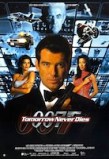
    1. Tomorrow Never Dies
      Tomorrow Never DiesYou can’t have a list of great car chases without including at least one Bond. Indeed, I could easily fill this top five with that series alone. TND wins because of two stand-out sequences: Bond driving a BMW saloon around a car park in Germany, which sounds dull as dishwater… except he does it via remote control and the car is stacked with gadgets; and a motorbike vs helicopter chase on the streets — and rooftops — of Saigon.
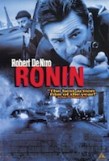
    2. Ronin
      RoninTo bring extra swish and excitement, the Fast & Furious films often use CGI in their car chases. Ronin, however, does it all for real — often with the actual actors in the cars. There are several chases in Ronin, but the extended climax through the tunnels of Paris is of course the best. The film used 300 stunt drivers and they wrecked 80 cars, but the exhilaration provided is entirely worth it.
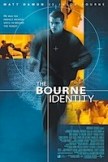
    3. The Bourne Identity
      The Bourne IdentityMany times, a great sequence is born out of an idea to innovate or do something different (to go back to Tomorrow Never Dies, the bike chase was a deliberate counterpoint to GoldenEye’s tank chase), and the first Jason Bourne film is no exception: he’s in a Mini! Americans always find small cars striking (see also: Da Vinci Code’s Smart car), but at least it’s put to good use — he drives it down some stairs!

    4. The Matrix Reloaded
      The Matrix ReloadedFor sheer throw-everything-at-the-screen bombast, you can’t beat the car sequence in the first Matrix sequel — it was so big, they had to build their own stretch of freeway! Of course, it’s as much about the fighting going on in and around the cars as it is the chase, and there are bikes and lorries and stuff involved too — including a spectacular head-on collision — but it’s all road-based, so it counts.
    5. Quantum of Solace
      Quantum of SolaceI wanted to avoid having two Bond films, and I tried, but I couldn’t think of anything significantly better than the opening minutes of 2008’s widely maligned Bond adventure. Cut like lightning, almost intuitive and impressionistic rather than classically clear, and viscerally destructive throughout, it demands your attention — and indicates the kind of pace the rest of the film will move at. Then the reveal at the end makes it all the sweeter.
    And two I’ve never seen…

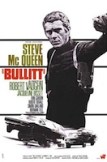
      Bullitt & The French Connection
      BullittRead most lists of the greatest car chases and one of these will be at the top, usually with the other in second place. They’re iconic for different reasons: there’s The French Connection’s frantic illicitly-filmed chase between Gene Hackman and Brooklyn’s elevated railway; and there’s Bullitt’s eleven-minute pursuit around the streets of San Francisco, with Steve McQueen and co gaining plenty of in-car air-time on those famous stepped hills. So iconic, I know this much without having seen either.

    Those are a few of my favourites, but what have I missed? And are there are any so bad I should’ve made room to decry them?


    Next month on 100 Films in a Year…

    It’s June! It’s halfway! But I’ve already passed 50!

    Will June’s total, doubled, indicate my final tally? Well, it hasn’t yet, so probably not. But a man can dream…


    * Probably. ^
    ** Subjectively. ^

    The Last Boy Scout (1991)

    2013 #39
    Tony Scott | 101 mins | TV | 16:9 | USA / English | 18 / R

    The Last Boy ScoutBruce Willis stars as a down-on-his-luck PI who stumbles into a sport/politics conspiracy in this early-’90s action-thriller from screenwriter Shane Black (Lethal Weapon, Kiss Kiss Bang Bang, Iron Man 3) and director Tony Scott (you know what Tony Scott’s directed). I think it’s seen as a fairly minor work in all of the primary participants’ CVs (and Halle Berry’s, who has a small supporting role), but is such ignored status deserved? Well…
    The movie has two big points in its favour. The first is Black’s screenplay, packed with his usual sparky dialogue and flair for plot developments that you might not expect. He has a real way for working in familiar genres with a unique voice and Last Boy Scout is no exception. It’s considerably better than Lethal Weapon, which I really didn’t take to, if not quite as good as Kiss Kiss Bang Bang, which I adored.

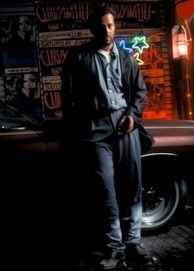
    Second is the wonderful noir feel that permeates through much of the film. This is thanks in part to Black — a private dick we first meet sleeping in his car who gets caught up in a conspiracy much bigger than him? What’s not noir about that? — but also to Scott and cinematographer Ward Russell. Technically this is neo-noir, but it makes you want to call it “neon-noir”Neon noir — pitch black frames punctuated by glowing coloured lights. On the whole, it looks gorgeous.

    It’s this noir edge that appeals most about the film for me. The occasional action theatrics are fine, but there’s nothing innovative or exciting enough in that field that hasn’t been done better or more memorably elsewhere. It’s the story and tone that work most to the movie’s benefit. It’s a shame, then, that the third act ditches much of that mood in favour of a race-against-time OTT-action finale. In my opinion, it pushes things too far, and nearly dragged down my rating an entire star.

    But that, too, would be taking it too far. The Last Boy Scout isn’t the best film starring Bruce Willis, or the best film written by Shane Black, or the best film directed by Tony Scott; but the fingerprints of all three are unmistakably plastered right across it, and it’s a long way from being anyone’s worst work.

    4 out of 5

    The Fast and the Furious: Tokyo Drift (2006)

    2013 #45
    Justin Lin | 100 mins | TV | 16:9 * | USA & Germany / English | 12 / PG-13

    The Fast and the Furious: Tokyo Drift2001’s car racing actioner The Fast and the Furious seemed, to me, to meet with a mixed reception; the kind of thing where some critics disliked it and some enjoyed it for what it was, and audiences were more the latter but only passingly so. It must’ve done well though, because in 2003 we were treated to a sequel.

    For 2 Fast 2 Furious the studio backed the wrong horse, signing up the first film’s uninteresting hero, Paul Walker, and leaving its more entertaining villain, Vin Diesel, to his skyrocketing action star career. The main talking point seemed to be the title, out of which the piss was relentlessly taken… and has been ever since.

    Come 2006, there seemed to be some kind of last-ditch attempt at saving what someone thought was a good idea. The third film in the series ditches a number for a subtitle; ditches the US settings for Japan; and ditches every character from the earlier films in favour of a fresh start. What remains is the tone and the content. The plot is the usual mix of street racing and gangster posturing, though at least the “woohoo hot chicks!” and rap culture business has been toned down from last time.

    The plot, such as it is, sees a rebellious US high school student (target audience cypher, check!) sent away to his father in Japan instead of going to prison (I’m sure there’s some logic there…) and ordered never to go near a car again. Which he promptly does, of course. Racing is different in Japan, though: rather than drag-style muscle with the odd inconvenient corner, here it’s all about drifting — sliding round corners with style. Goaded into a race, said high school student (I can’t remember his name. Who could?) loses miserably. And then he sets out to learn how to drift and there’s some stuff with a girl who’s with the bad guy and there’s some gangster-types and you know the drill, I’m sure.

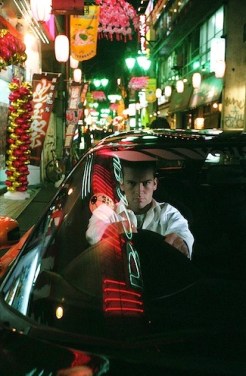
    Tokyo drifterIf I sound dismissive, it’s slightly affected: Tokyo Drift is surprisingly decent. Surprisingly decent for a Fast and Furious film, that is. In my review of 2F2F I described it as “junk food” — you know it’s bad for you, but sometimes it hits the spot. Tokyo Drift is the same kind of film, all fat and sugar and no substance, but kinda tasty at the right time. And at least it provides something different to the previous films. Not so much the new characters, who are predictably bland; or the plot, which is samey; but the move to Tokyo, which lends proceedings a different flavour and style, not least the emphasis on drifting — most/all of which was performed for real by stunt drivers, rather than the often computer-enhanced car action of the previous films.

    Despite this looking like a desperate grab that would leave The Fast and the Furious series as a trilogy in technicalities only, somehow the franchise has since revitalised itself. More on that next time, but it does have a bearing here: as later films brought returning characters and on-going plots, so Tokyo Drift slipped away as an anomaly; an aside, perhaps even a mistake, that has no place in the series’ primary narrative. While that last point may or may not be true, as a film in itself, Tokyo Drift is as passingly entertaining as anything else the F&F series has yet offered me.

    3 out of 5

    * The original aspect ratio is 2.35:1, but this was on ITV and they’re less respectful than Channel 4 or (sometimes) the Beeb. The cropping was rarely noticeable, however. ^