
Robert Rodriguez & Frank Miller | 102 mins | Blu-ray | 1.85:1 | USA & Cyprus / English | 18 / R
 Belated sequels can be a Terminator 2, but more often they’re a Terminator 3 — that is to say, they can be brilliant, but often it seems they’re a poor idea, a too-late money-grabbing re-hash. Mooted since before the first Sin City was even released back in 2005, this long-anticipated sequel finally appeared at the tail end of the summer, a nine-year wait, and met with poor critical reception and even poorer box office. Considering the first film isn’t just a fanboy favourite but also fairly well regarded (it still sits on the IMDb Top 250, which I know some disregard out of hand but does mean something), that’s quite a painful fall from grace. Having watched the original the night before, I rather fail to see why.
As with its predecessor, A Dame to Kill For is a collection of hyper-noir short stories, connected by location and overlapping characters, that flits between time periods with abandon — this is both a prequel and sequel to the first film, revealing both the story of how Dwight (Josh Brolin) came to change his face (to become Clive Owen in the original film), and what Nancy (Jessica Alba) did after the death of Hartigan (Bruce Willis, returning in a more spiritual form). There’s also the story of a cocky gambler, Johnny (Joseph Gordon-Levitt), taking on the city’s power-players, and a short pre-titles tale starring breakout character Marv (Mickey Rourke).
If the first film was noir with a comic book mentality, then the second is a comic book with a noir mentality. The plots are still hard-boiled, the extensive voiceovers overwritten to the point they wash over you meaninglessly, the characters a mix of downtrodden toughs (for the men) and whores (for the women), and there’s still no hope for anyone in a city which drags everyone down. Naturally the visual style is the same: high-contrast monochrome with dramatic splashes of colour, and the occasional artistic lapse into literal black-and-white.
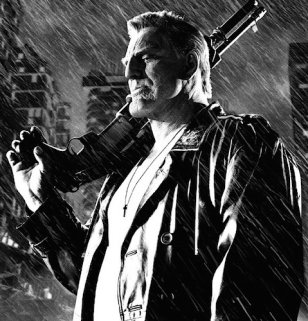 But the comic-book-ness of the first film — moments of almost metaphorical visual representation rather than literal reality, including physically-impossible action beats — has been ramped up. The value of the first film was never in its action, so the sequel’s lengthy punch-ups, crossbow-based guard-slaying, and all the rest, get boring fast. When it slips into this needless excess, A Dame to Kill For loses its way. When it sticks to what it does best — hard-boiled fatalistic crime tales with striking comic book-inspired cinematography — it does as well as the concept ever did.
The best story is probably the titular one, which makes up the bulk of the middle of the film. It’s the most traditionally noir-ish, with a killer performance from a perfectly-cast Eva Green as the eponymous dame. She also spends most of her screentime starkers, which — coupled with the ludicrous dialogue and increased action — does lend credence to accusations that this is a film made by 13-year-old boys. Enjoy the results or not, it’s a hard point to argue against.
As Nancy, Jessica Alba was somewhere on the spectrum from mediocre to awful in the first film, but she’s another of the best things in this sequel. It’s not just that she’s given a meatier role, but that she seems to know how to act better fullstop. For all the criticisms that the film is misogynistic, with its women all strippers or whores or manipulative bitches, it’s the actresses who get the best parts and deliver the best performances. Brolin is unremarkable, for instance, while Marv, undoubtedly the original film’s breakout character, is now shoehorned into every story. Sometimes it works, sometimes it feels forced.
 The intervening decade has lessened the impact of the first film’s sick ultra-violence, but there’s nothing even that extreme here, aside perhaps from one eyeball-related moment. On the other hand, nearly a decade of tech development means it looks better than the last one, both in terms of the CGI’s quality and the camerawork more generally — it’s less flatly shot; more filmic than the first one’s sometimes-webseries-y composition.
Rodriguez once said he hoped to film all of Miller’s Sin City stories, and across the two films they’ve got through six (plus two new ones), which leaves two more full-length tales and nine shorts. Based on the poor performance and reception of this instalment, a third go-round looks unlikely. But then, if there’s one filmmaker who seems to keep on producing even when no one expects more it’s… Uwe Boll. But if there’s another, it’s Robert Rodriguez. That said, the box office really was shockingly awful (just shy of $40 million worldwide; I read the budget was $60 million), so maybe even Rodriguez can’t save this project.
Many critics, even those who rate the first Sin City highly, slaughtered this sequel. I don’t really see why — on balance, I think it’s of a piece with the first one. To love the first and hate the second seems predicated on the notion that the original was innovative and groundbreaking, whereas the follow-up is the same thing again. Well, what did you expect? It promises more stories in the visual and thematic style of  its predecessor, and that’s exactly what it delivers. I suspect the first benefits from nostalgia because, watching them virtually back to back, I found I liked Sin City less than I remembered, but enjoyed A Dame to Kill For just as much. It’s flawed in several aspects, but for honest-to-themselves fans of the first movie, I think it’s a “more of what you liked”-style success.

This review is part of the 100 Films Advent Calendar 2014. Read more here.
 I think I’ve previously discussed my life-long love of the X-Men franchise, so I shan’t go into detail again, but suffice to say Days of Future Past has been one of my most-anticipated movies ever since the title (which is that of a classic and influential story from the comics) was announced. Thank goodness, then, that the final result doesn’t disappoint.
 Beyond that, there’s the characters: the younger versions are having to deal with the fall-out from
  Not everyone gets to shine in a cast this big, although pretty much everyone gets a moment. The future-set cast have the least to do, people like Halle Berry turning up to do little more than show their face, though Stewart and McKellen get a moment or two worthy of their talents. After he was the focus of the last film, Fassbender is slightly shortchanged here; but after McAvoy gave him essential support in First Class, Fassbender plays the same service here, informing Charles’ journey. Of the new additions, Evan Peters as Quicksilver (that’s the one who’ll also be played by Aaron Taylor-Johnson in
  Later, there’s the aforementioned ‘slow-mo’ sequence, and the grand climax, which offers more “fly something big around” antics a la First Class’ submarine, only considerably grander. Yet for all the spectacle, the final moments once again come down to character: what is Magneto prepared to do? What is Mystique prepared to do? Will anyone listen to Charles? And so on. Even the much-vaunted Marvel Studios movies tend to base their climaxes in slabs of ‘epic’ CGI crashing into each other; Days of Future Past does that for a bit, then brings the characters back into focus for the real final beats.
 (Jennifer Lawrence being the third pillar of the past triumvirate, as they’ve already focused on Xavier and Magneto). While Days of Future Past does wrap up the majority of its threads (the open-ended ones are answered by previous films, if you want them to be), there’s plenty there to play with in the next film (and, perhaps, ones beyond that) if they want to… which they do.
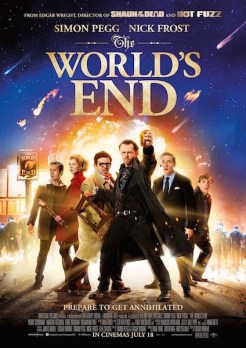
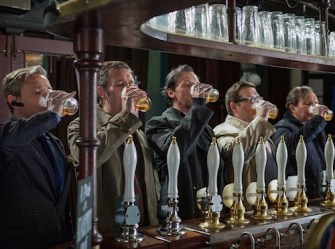 “zombie movie” or “Hollywood action movie”, and occasionally co-writers Pegg and Wright have substituted character development and thematic points for send-up. It may not play to the genre-loving fan-audience that the trio’s previous work has accumulated (demonstrably so, based on many a viewer review), but it does make for a more grown-up film.
 It will definitely reward multiple viewings: it’s littered with signs, omens and portents (in fairness, a good few can be grasped on an attentive first go). There’s a featurette on the BD (but not the DVD) which helps point out any major ones you may’ve missed; though I have to say, even at seven minutes long, and even with it pointing out some that felt too obvious to be worth mentioning, I swear it left some stuff out. That could be a deliberate decision of course, to leave some things for people to just spot.
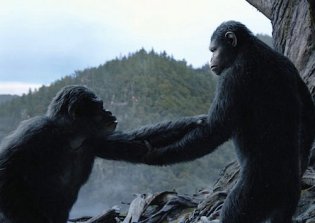 A heady mix of solid writing from Mark Bomback, Rick Jaffa and Amanda Silver, peerless motion-captured performances from the likes of Serkis and Toby Kebbell, and first-rate CG magic from Weta, brings us a set of characters who are compelling and believable. Here is a society trying to define what it wants to be, battling old prejudices in the hope of a peaceful, secure, happy future. If you want to draw analogies to almost any real-world political situation, I’m sure you could.
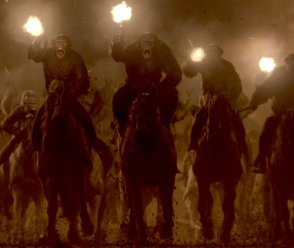 Lest you get the wrong impression, the film isn’t all talk. For various spoiler-y reasons, the fragile relationship between Man and Ape breaks down, and the apes stage an attack on humanity. Here we get perhaps one of the best siege action sequences I can think of, with mankind holed up in a half-constructed skyscraper that sits conveniently at the end of a long street for the apes to charge down. Reeves’ direction is virtuosic here, crafting an epic and exciting sequence even when most of the film’s major players are busy elsewhere. And it’s not even the climax.
 thanks to some surprisingly small-scale narrative choices (the whole thing with the dam doesn’t feel nearly as vital as it should) and Reeves’ direction sometimes being a little straightforward and almost TV-ish. I know I’ve said I hate when people use that as a derogatory comment nowadays, but some repeated locations and shot choices make the film feel cheaper than it was.
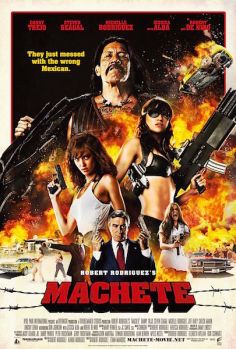 Multi-hyphenate Robert Rodriguez takes his
  to fleetingly include something that ‘needs’ to be there purely because it was in that trailer.
 Comic book creator Frank Miller brings what he learnt co-directing
 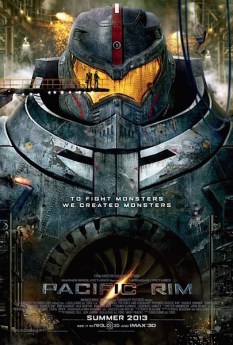 The names writers choose for their characters can sometimes tell you a lot about a movie. Pacific Rim is the kind of film that has characters called Raleigh Becket, Stacker Pentecost, and Hannibal Chau.
 — it was the 3D that added depth and height, and without that (or, as I said, an adjustment of focus to compensate) it’s all a bit… not flat, but not big either. That aside, it is beautifully shot, with excellent lighting.
 Of late there seems to have been a glut of sci-fi films with highly generic, near-meaningless titles —
 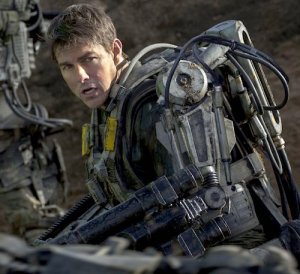 suitably exciting, surprisingly funny, and actually quite clever. It’s also boldly standalone. OK, so it’s an adaptation, but the book is hardly a
  Reflect too heavily and some bits may begin to crumble more but, for me, not too severely.
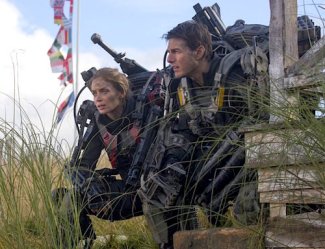 Edge of Tomorrow isn’t an unqualified success, but more than enough of it works to make for a well-above-average modern blockbuster. Excellent action sequences, plenty of amusing asides, and a couple of solid sci-fi concepts to chew on combine to render it quality entertainment. Bonus points for being a true original in a sea of remakes, sequels and spin-offs.
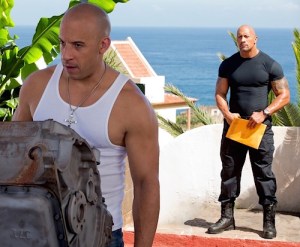 For all the intent of this being “Part 2 of 2”, there’s a post-credits tease which sets up
 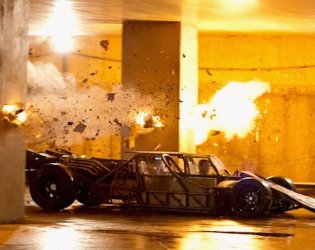 There’s plenty of backstreet, underground, grim-and-gritty bits on display here — entirely appropriate given the characters’ street-racing roots and criminal know-how. Still, these are little more than cosmetic bonuses.
 Despite the fact that
  Then we have the much-maligned backstory about just what Peter Parker’s parents did all those years ago, before they abandoned him with Uncle Ben and Aunt May. There are pros and cons to this: it’s all new, which at least makes it interesting and unpredictable because it has no forebear in comics or films; but it’s also a pretty stock set of circumstances. Worse still, it robs Spidey of a major defining trait: Peter Parker is bitten by a spider by accident — it could’ve been anyone. In this version, it could only have been him. Boo. Sony clearly want an arc plot they can run across a trilogy (or more), so presumably this thread will rumble on… though whisperings that they’re considering some kind of soft-reboot may see it cut short. I wouldn’t complain.
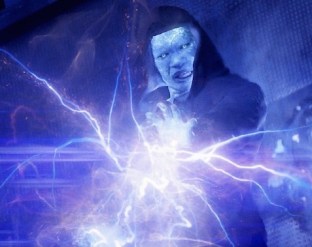 but it’s more textured, at least. Then there’s Electro, who (as mentioned) may have a familiar story, but is nonetheless perfectly pitched by Foxx. His powers lead to some excellent sequences, including but not limited to the aforementioned Times Square duel. He also contributes to the music, in a way, as Electro’s whispered/sung thoughts ‘bleed out’ into the score. It’s creepy, especially as it’s so subtle in the mix — I wondered what the hell was going on at first. I thought it was a fantastic score all round, in fact, bringing in a modern music element that fits the notion of Spidey as a young character perfectly.
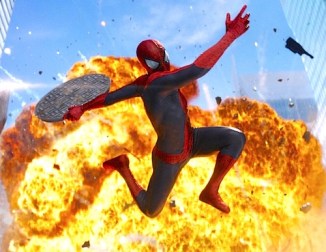 It lacks the confidence, heart and flair that mark out Spider-Man 2, and the bold originality and clarity of purpose that define
  100Films.co.uk