2015 #181
Peyton Reed | 117 mins | Blu-ray | 1.85:1 | USA / English | 12 / PG-13
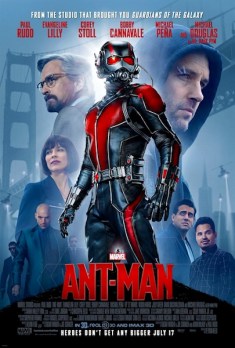 The final film in ‘Phase Two’ of the Marvel Cinematic Universe is perhaps the most fun Marvel movie since Iron Man kicked off the whole shebang seven years ago.
It’s the story of a burglar, Scott Lang (Paul “he’ll always be Mike from Friends to me” Rudd), who is enlisted by ageing genius Hank Pym (Michael Douglas) to pilfer something from Pym’s old company, now controlled by his former protégé and villain-in-waiting Darren Cross (Corey Stoll). Pym discovered/created something called the Pym Particle, which changes the distance between atoms and allows objects and people to shrink or increase in size. He hid his dangerous technology from the world, but now Cross has developed his own version and is seeking to sell a weaponised version to the highest bidder — which naturally includes some very nefarious characters.
Marvel are currently fond of mixing “superhero” with “another genre” to produce their movies — which makes sense, given the standard two-or-three superhero narratives were already becoming played out by the time Iron Man came along, never mind in the raft of movies Marvel Studios have released since. Here, “superhero” is mixed with “heist movie”; more specifically, “heist comedy”. It’s superheroes by way of Ocean’s Eleven, basically. In the key position, you’ve got Lang in the Ant-Man suit, able to shrink, infiltrate places, and control ants to help him; but then he’s got a whole support team: Pym planning and overseeing; Pym’s daughter, Hope (Evangeline Lilly), the inside woman; and a gaggle of Lang’s criminal friends (Michael Peña, David Dastmalchian, Tip ‘T.I.’ Harris), brought in to help them hack security ‘n’ that.
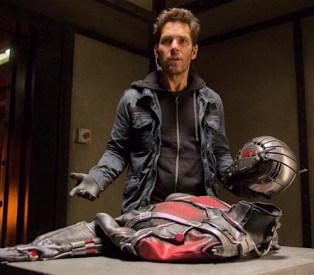 Nonetheless, some have criticised the film for not being especially original. I mean, originality’s good ‘n’ all, but c’mon, what do you expect when you sit down to a superhero movie from the primary purveyor of superhero movies? Ant-Man may blend elements from a few other genres into the superhero mix, but, yeah, it’s a superhero movie that, at times, plays like a superhero movie — just like everything else Marvel Studios has produced (with the possible exception of Guardians of the Galaxy). If that’s not your thing, fine, but there’s nothing so spectacularly rote or generic about Ant-Man when compared to the rest of Marvel’s output that it deserves to be singled out. In fact, if anything, it has a higher dose of originality than its peers. And it doesn’t climax with a giant flying thing crashing to Earth, the first Marvel movie you can say that about for years.
Where the film really succeeds, however, is in being — as noted — fun. Sometimes the structure is a little wonky, sometimes the dialogue is a little off, sometimes it’s a little heavy on the exposition, sometimes this and sometimes that, but it never stops moving at a decent clip, is never too far away from a good laugh, and offers some strong action sequences too. The very nature of the titular heroes’ powers offers us something new. Okay, there have been plenty of shrinking movies before, but not like his. Macro photography and CGI have been used to great effect to bring us into his world, and the fact he can shrink and grow at will adds a real kick to fight scenes.
 It remains tough to talk about Ant-Man without referencing The Edgar Wright Situation. I mean, you could ignore it, but then it becomes the elephant in the room. If you somehow missed it: writer-director Edgar Wright pitched Ant-Man to Marvel as a movie before Marvel Studios even existed, back in 2003, and had been developing it on and off ever since. The ideas he brought to the table — an action-adventure-comedy style, being a special effects extravaganza but with a lighthearted tone — influenced how the studio approached Iron Man and, consequently, the whole MCU. Nonetheless, Ant-Man wound up positioned as the 12th film in the studio’s slate, finally going into production after a decade of prep. Wright had a script almost finalised, he’d cast the film, a release date was set… and then he left due to “creative differences”. And the internet was on his side because Edgar Wright has made Spaced and Shaun of the Dead and Hot Fuzz and Marvel are a studio and studios are always wrong.
The full extent of what these creative differences were hasn’t emerged yet, because it wasn’t that long ago (inevitably, they will one day), but it must’ve been pretty major to walk away from a project you’d been working on for so long and were so close to finally realising. Some reports say Wright wanted the film to be completely standalone, with absolutely no ties to the wider Marvel universe. I kind of hope there’s more to it than that, because while the final version of Ant-Man isn’t completely standalone, it’s one of Marvel’s less connected efforts. Okay, it references S.H.I.E.L.D., Hydra, and the Avengers, and there are cameo appearances by characters from other parts of the universe (including Lang having to fight an Avenger), but its story doesn’t feed directly from a previous MCU film, nor does it make setting up another one an inherent part of the plot. In short, it’s nicely connected — it’s definitely part of the universe — but you don’t need to know a great deal to enjoy it on its own.
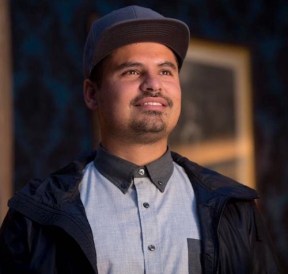 After Wright left, the screenplay was rewritten by a host of scribes (far more than the two extra writers ultimately credited). Other things they’re responsible for include bulking up the supporting characters, especially Hope, which works pretty well, and Lang’s friend Luis (Michael Peña), which we should all be thankful for: Peña’s Luis is one of the best things in the movie, an enthusiastic motormouth who’s consistently entertaining whenever he’s on screen. He’s the standout from an ensemble that is generally strong, with Rudd proving a likeable lead and Douglas committing to the material in a way you wouldn’t necessarily expect an older actor to with ‘just a comic book movie’.
Would Edgar Wright’s Ant-Man have been better than Peyton Reed’s? We’ll never know. Well, one day we’ll have a good guess, because one day what changed will all come out. Wright still has a story and co-writer credit, so obviously a lot of his material survived. Nonetheless, the movie we’ve ended up with doesn’t feel like a compromised, homogenised, studio-controlled disaster. Chances are Wright could’ve brought greater visual and storytelling flair to proceedings, but Reed doesn’t do a bad job, especially when it comes to sequences in miniature. The final fight takes place on a children’s playset, doesn’t involve giant things falling epically out of the sky (is it the only Phase Two film to avoid that trope?), and is one of the best climaxes in the entire Marvel canon. Sometimes less really is more. Especially when “less” includes Thomas the Tank Engine. Whoever thought you’d see Thomas the Tank Engine in a Marvel movie?
I hope Ant-Man will be an important touchstone in what Marvel Studios do going forward. It proves smaller-scale adventures can work — not in the sense that it’s about a hero who shrinks to a few centimetres tall, but in that it’s a story focused on a couple of characters trying to steal something from a building and defeat one guy, not about saving an entire city or an entire planet. 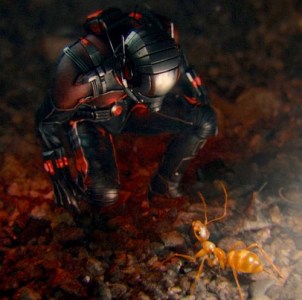 That doesn’t mean it’s a story that doesn’t have stakes, they’re just different stakes. It’s a refreshing change of pace at this point. It’s also pretty much standalone, with nice nods to the shared universe but without being dependent on other films (either before or to come) for its story. Guardians of the Galaxy did that too, but how many other recent Marvel movies is it true of? Even the highly-praised Winter Soldier is a long, long way from being immune to that fault.
Still, I doubt many people are going to call Ant-Man their favourite Marvel movie, although I think it might be the most pure fun I’ve had watching an MCU film since… well, ever. And I like fun.
Ant-Man is available on DVD and Blu-ray in the UK now, and in the US from next week.
It placed 20th on my list of The 20 Best Films I Saw For the First Time in 2015, which can be read in full here.
This review is part of the 100 Films Advent Calendar 2015. Read more here.

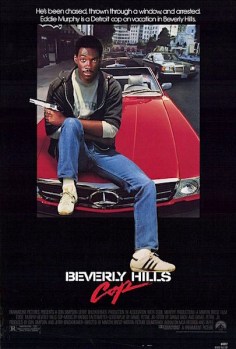 The last time I watched the first entry in a once-popular ’80s comedy cop movie series, it didn’t end well. And that was directed by Richard Donner, of Superman and The Omen fame — Beverly Hills Cop, on the other hand, was helmed by the man who would go on to give us “worst film of all time” contender Gigli. Oh dear. Truth be told, my main reason for watching Beverly Hills Cop is so that I can one day watch Beverly Hills Cop II, directed by Tony Scott, and Beverly Hills Cop III, directed by John Landis. So, I didn’t expect to care for this all that much…
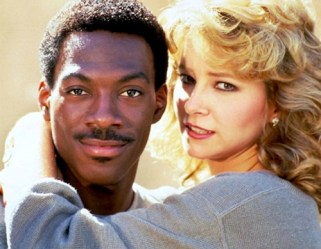 Murphy’s not the only good thing, though. Judge Reinhold and John Ashton make an excellent double act as the pair of cops assigned to keep an eye on Foley in Beverly Hills; Ronny Cox is their amenable boss; Steven Berkoff pretty much just has to turn up to be an excellent villain; Lisa Eilbacher is decent as the girl (presumably changed from being a love interest after they cast a black guy). Her part doesn’t exactly call for a great deal, but she’s fine enough in it; as good as anyone ever is in such a limited role.
 the mystery is non-existent (even if it wasn’t obvious Berkoff would be the villain, the henchman who did the deed is shown to be in his employ the first time we meet him); Brest’s direction is unremarkably static… you could probably go on. But thanks to Eddie Murphy and the rest of the cast, Beverly Hills Cop winds up a highly watchable, very likeable spot of entertainment.
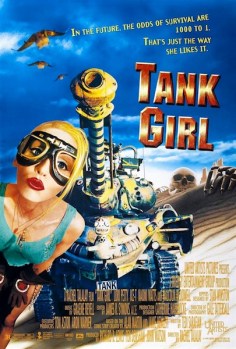 Critically derided, this anarchic adaptation of the rebellious comic has become a cult fave. You can see why: a ramshackle plot allows for plenty of outré zaniness, including a big musical number to a punky Cole Porter cover, and surely no one predicted the bizarre truth about the Rippers!
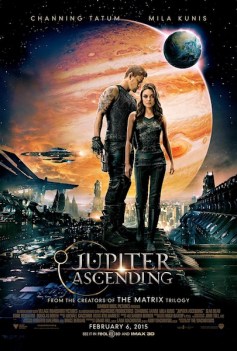 Ah, the Wachowskis. They made
  The plot… oh, do I have to explain the plot? It’s some rubbish about a cleaner (Mila Kunis) getting attacked by aliens and some alien crossbreed in magic flying shoes (Channing Tatum) coming to her rescue, and taking her to a half-bee man (Sean Bean — there has to be a “Sean Bee-n” joke here…), and then into space, because she’s… nope, not the Chosen One (makes a change, at least) but a reincarnation of someone important, and her surviving family members (Douglas Booth, Tuppence Middleton, Eddie Redmayne) have a vested interest in her — which may or not be that they want her dead (again).
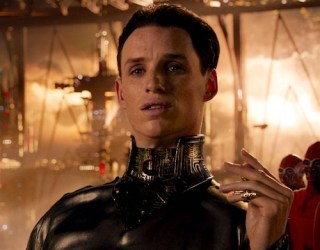 I guess it works for some people, but while it’s not bad, it also didn’t do much for me. And every time something almost works, something else undermines it, like Tatum’s make-up, or his flying boots, or Redmayne’s bizarre, affected performance. Though, to be honest, I think he’s so bad he’s good, a phrase you often hear bandied around but rarely see actually happen.
 The BBC’s long-running spy thriller series
 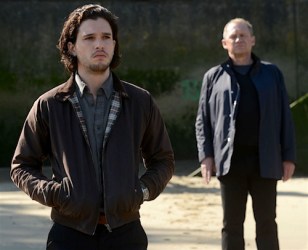 Early seasons focused at least as much on things like the mundanity of spycraft, or how one went about having a personal life while also being a sometimes-undercover agent, as they did on the exciting action of counterespionage — as evoked in the memorable tagline “MI5 not 9 to 5”, of course. As the years rolled on, things got increasingly outlandish and grandiose, just as almost every spy series that starts out “grounded” is wont to do. In season three, an entire episode was spent on the moral dilemma of whether it was acceptable to assassinate someone; a couple of years later, assassinations would just be a halfway-through-an-episode plot development. The one constant through all this was section chief Harry Pearce (Peter Firth), the M figure to a rotating roster of “James Bond”s, including Matthew “
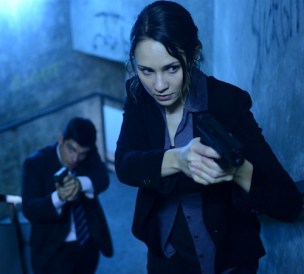 But I’m getting ahead of myself. The story begins with Harry running an op that goes wrong, during which terrorist Adam Qasim (Elyes Gabel) is sprung from custody just before being handed over to the CIA. Cue international incident. Naturally the blame is pinned on Harry, who consequently throws himself off a bridge. Except no one buys that, so they drag in Will Holloway (Kit Harington), a disenchanted one-time protégé of Harry’s (i.e. the series’ latest “younger man who can do the running around”). He knows nothing about it (
 The trailers attempt to promise some of that kind of action, but they’re a bit of a cheat: what adrenaline the film has is mostly released in tiny bursts, scattered throughout. That strategy is fine if you’ve got the money to make each little burst a solid sequence, but when the entirety of some sequences is “jumping through a window” or “climbing a wall to get into a flat”, well… Sure, it looks good in the trailer — it promises lots of action in different places at different times — but that’s also a promise the movie can’t fulfil. The Greater Good certainly isn’t just a low-rent action movie — it’s driven by its plot — but if they’d saved up the filmmaking time, effort, and expense afforded to those single-dose action moments and poured it all into one sequence (in addition to the two or three fully-realised action sequences that the film does have), it might’ve paid dividends.
 The second release in Warner Premiere’s series of direct-to-video DC Universe Animated Original Movies (which now stretches to
 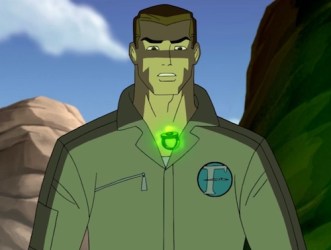 However, there are definitely bits that could’ve been sacrificed or abridged further (the Flash’s two early action sequences, for instance) to make more room to tell the story in full.
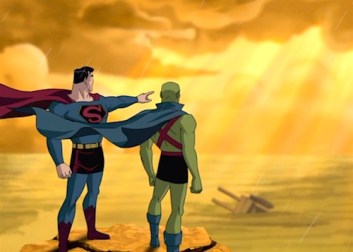 I really wanted to like The New Frontier, for all sorts of reasons. It does start well, with moments of promise sparkling here and there, but the longer it spends juggling so many balls, the fewer it can keep flying smoothly. (Do balls “fly” when juggled? Anyway, you get my point.) Considered as a whole, the overall result is fairly disappointing.
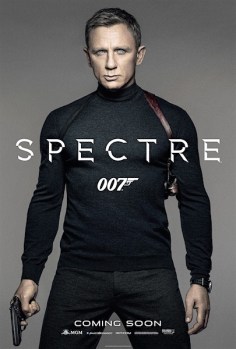 It’s been quite the year for spies on the big screen: mega-success for
 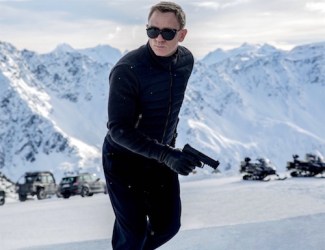 or, “they’ve merely brought back the classic Bond formula, albeit in the Craig-era style — what a regression”. You only have to look at the
  Craig’s films have stuck to the older formula of casting a respected/famous European: Dane Mads Mikkelsen, Frenchman Mathieu Amalric, Spaniard Javier Bardem, and now German “European actor du jour” Christoph Waltz. The double Oscar winner is on fine form at times, but there aren’t quite enough of those times. Again, without aiming to spoil anything, I’d say he’s not so much underused as misused.
 Well, I did too. Now I want a cake. And if you’d like to watch someone eat a Madeleine, check out
 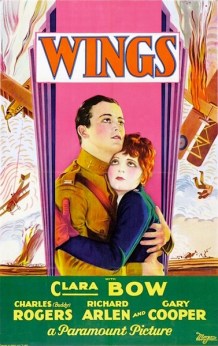 Students of the Oscars well know that, technically speaking, there wasn’t a single “Best Picture” award at the inaugural Academy Awards ceremony in 1929. Instead, there were two awards that covered that ground, seen (at the time) as being of equal significance. One was for “Unique and Artistic Production” — which I’d argue is more or less what most people think Best Picture represents today. That was given to F.W. Murnau’s
  he learnt to fly just for the film), and, mid-flight, had to film their own close-ups by switching on battery-operated cameras mounted in front of them. You wouldn’t know it from watching the film itself, though: even today, the action sequences carry a palpable air of excitement, aided (perhaps even created) by the knowledge that it was all done for real — including the crashes.
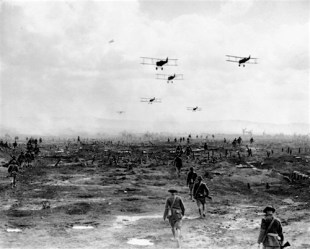 bomb-pockmarked battlefield. Those bomb craters were, in fact, genuine: the military spent a few days before filming using the location for target practice. The climactic battle that occurred on this site was filmed with up to 19 cameras at once, including some mounted on four towers, the highest of which reached 100ft. I know this is a review, not a catalogue of production numbers, but it’s quite incredible.
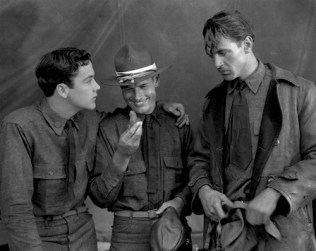 How much these factors affect the film’s quality seems to be very much a personal matter. Wings set the stall for many a Best Picture winner to follow by being not that well regarded by critics; indeed, more time and praise is given to its top-award compatriot, Sunrise. For the most part, I found the personal dramas passable enough, with a few outstanding scenes — David’s farewell to his stoical parents; Cooper’s scene; the bubbles (at first). However, the combat sequences, and in particular the aerial photography, are stunning; so impressive as to easily offset whatever doubts the other elements may engender.
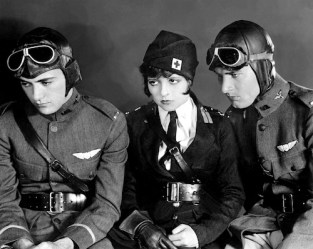 But I digress. Wings is a film that deserves to be remembered as more than a mere footnote. It’s not just a trivia answer to “what was the first Best Picture?”, but a worthy winner of that prize; a movie that, almost 90 years after it was produced, still has the power to elicit excitement and awe. Wellman’s picture may not have been deemed unique or artistic, even though it’s definitely the former and possibly the latter, but it was deemed outstanding, and it’s definitely that.
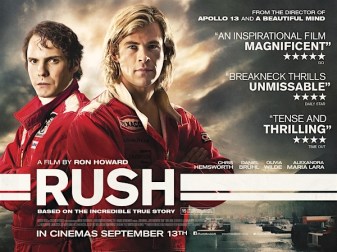 Screenwriter Peter Morgan (of
 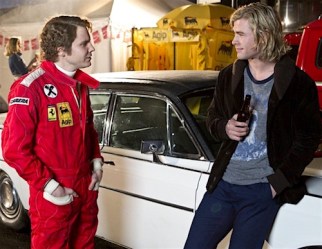 I presume the point of engaging with their personal lives away from the track was to add depth; to make sure it was a two-hander, rather than just about one or other of the drivers, and to ensure Hunt wasn’t just two-dimensional. However, without any growth on his part, or even some kind of active change, he’s just as flat, only now the star of some pointless scenes.
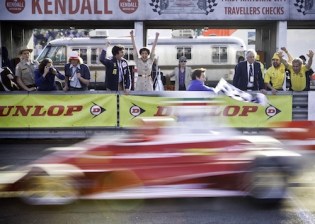 If that narrative fits snuggly into familiar plot beats, what are you meant to do? Change the truth to make it less like fiction? That’d be a first. Saying that, I’m taking it on faith (based on comments in the making-of) that the true story was so perfect you wouldn’t believe it if it had been fiction. Maybe they did streamline it. But assuming it’s real… well, it’s not the filmmakers’ fault if life imitates art.
 All in all, I’m a little surprised how well-liked Rush is. I mean, as of posting it’s at #162 on
 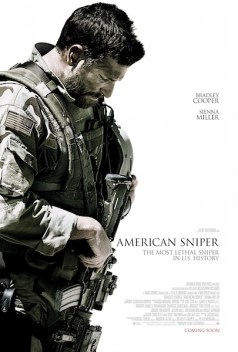 Politics aside, American Sniper is an adequately-made film. Eastwood’s direction is at best workmanlike, at worst laughably clichéd. Jason Hall’s screenplay rehashes better movies’ insights into the mental effects of war on combatants. Neither elicit much excitement from a half-arsed sniper-vs-sniper storyline. The film belongs to a bulked-up Bradley Cooper, who
  100Films.co.uk