
J.J. Abrams | 135 mins | cinema (3D) | 2.35:1 | USA / English | 12A / PG-13
 2016 Academy Awards
5 nominations
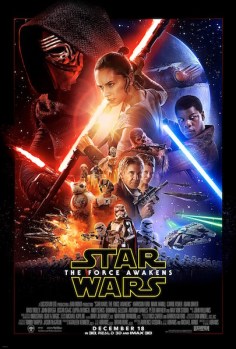 Star Wars: The Force Awakens is not the best film of 2015. Not according to the Academy of Motion Picture Arts and Sciences, anyway, who didn’t see fit to nominate it for Best Picture at tomorrow’s Oscars. Many fans disagree, some vociferously, but was it really a surprise? The Force Awakens is a blockbuster entertainment of the kind the Academy rarely recognise. Okay, sci-fi actioner Mad Max: Fury Road is among this year’s nominees, but with its hyper-saturated cinematography and stylised editing, it is action-extravaganza as art-film, further evidenced by some people’s utter bafflement at how anyone can like a film so devoid of story or character. (It isn’t, of course — those people are wrong.)
I’m sure the makers of Star Wars can rest easy, though, what with it being the highest grossing film ever at the US box office (at $924m and counting, it’s the first movie to take over $800m, never mind $900m), and third-ever worldwide (behind only Titanic and Avatar, both of which had re-releases to compound their tallies). Its reception has been largely positive too, with many fans proclaiming it the third or fourth best Star Wars movie — which doesn’t sound so hot, but when two of those previous films are unimpeachable all-time favourites, being third is an achievement. There are many dissenting voices though, disappointed thanks to their perception that it’s just a rehash of A New Hope, and that it’s a movie short on original ideas but long on modern-blockbuster bluster and noise.
I think, at this point, one or two other people on the internet have written the odd word about The Force Awakens — you have to really go looking, but trust me, there are some articles out there. (Of course, by “one or two other people” I really mean “everybody else”, and by “the odd word” I mean “hundreds of thousands of millions of words”. And by “have” I mean “has”, for grammatical accuracy in this completely-revised sentence).
 I too could talk about the likeable new heroes; the triumphant return of old favourites; the underuse of other old favourites; Daisy Ridley’s performance; John Boyega’s performance; the relationship between Rey and Finn; the relationship between Finn and Poe; the success of Kylo Ren and General Hux as villains (well, I thought they were good); the terrible CGI of Supreme Leader Snoke; the ridiculous overreaction to the alleged underuse of Captain Phasma; that awesome fight between the stormtrooper with that lightning stick thing and Finn with the lightsaber; the mystery of Rey’s parentage; the mystery of who Max von Sydow was meant to be (and if we’ll ever find out); some elaborate theory about why Ben wasn’t called Jacen (there must be one — elaborate theories that will never be canon are what fandoms are good for); the way it accurately emulates the classic trilogy’s tone; the way it’s basically a remake of A New Hope; the way it isn’t that much of a remake of A New Hope; why ring theory and parallelism makes all this OK anyway; all of its nods to the rest of the saga; that death scene; that ending; those voices in that vision; and the single greatest part of the entire movie: BB-8 giving a thumbs up.
But I won’t talk about any of that. Not now, anyway. Instead, for an angle of moderate uniqueness, I’ll talk about the five elements of the film that have been singled out for recognition by the Academy of Motion Picture Arts and Sciences.

Editing
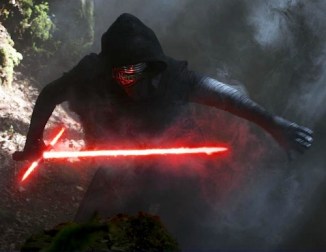 J.J. Abrams seems to have tricked some people into thinking he’s a great director with The Force Awakens (rather than just a helmer of workmanlike adequacy (when he’s not indulging his lens flare obsession, at which point he’s not workmanlike but is inadequate)), and I think that’s partly because it’s quite classically made. Yeah, it’s in 3D, but the style of shots used and — of most relevance right now — the pace of the editing help it feel in line with the previous Star Wars movies. Some of the more outrageous shots (often during action sequences) stand out precisely because they’re outside this norm. Perhaps we take for granted that Abrams delivered a movie in keeping with the rest of the series, because that’s The Right Thing To Do, but that doesn’t mean he had to do it. And the transitional wipes are there too, of course.
Score
Ah, John Williams — 83 years old and still going strong. Or still going, at any rate. I’m not the most musically-minded viewer, unless something really stands out to me. I don’t remember anything in Williams’ Force Awakens score standing out. Not that there’s anything wrong with it per se, but I didn’t notice anything new that has the impact of The Imperial March or Duel of the Fates (for all of the prequels’ faults, they at least gave us that). In Oscar terms, it’s apparently not looking so hot for Williams either: his return to a galaxy far, far away is being trumped by Ennio Morricone’s return to the West.
Sound Mixing & Sound Editing
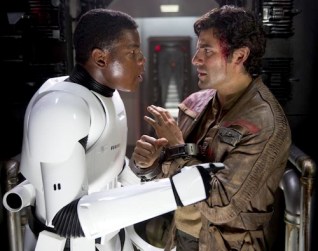 No one knows what the difference is between these two categories. I’m not even sure that people who work in the industry know. As a layperson, it’s also the kind of thing you tend to only notice when it’s been done badly. The Force Awakens’ sound was not bad. It all sounded suitably Star Wars-y, as far as I could tell. That’s about all I could say for it. It feels like these are categories that get won either, a) on a sweep, or b) on a whim, so who knows who’ll take them on the night?
Visual Effects
CGI is everywhere nowadays, and at the top end of the game it seems like it’s much-for-muchness in the photorealism department. So what dictates the best of the best, the most award-worthy? Well, innovations are still being made, they’re just less apparent in the end product, it would seem: reportedly there are a load of workflow-type innovations behind the scenes on Star Wars, which improved consistency, as well as some better ways of achieving things that were already achievable.
Nonetheless, for a franchise with which they have a long, close history, it’s understandable that ILM pulled out all their tricks here — fairly literally: they even used forced perspective to extend some sets, rather than the now-standard digital set extension (green screen + CG background). Most notably, a lot of BB-8 was done with working models and puppetry. Of course that’s still computer aided, be it with wire and rod removal or some bits of animation, but it still lends the droid greater presence and physicality. That kind of grounded, make-it-real mindset pervades — the effects team exercised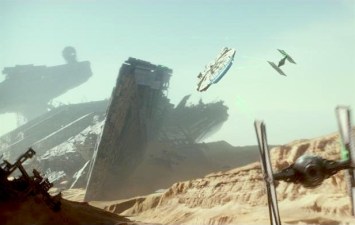 “restraint […] applying the basic filmmaking lessons of the first trilogy,” according to this article from Thompson on Hollywood. Effects supervisor Roger Guyett says that attitude was about being “very specific about what the shot was about. And making it feel like you were photographing something that was happening.”
In terms of whether it will win or not, well, take your pick of the predictors. Some say Fury Road will sweep the technical categories, presumably in lieu of it winning any of the big-ticket prizes. Star Wars was the big winner at the Visual Effects Society awards though, which have predicted the Oscar on nine of the past 13 occasions. The times it’s failed have generally been prestige films that happen to have effects kicking blockbusters off their pedestal, like Hugo beating Dawn of the Planet of the Apes, or Interstellar beating Rise of the Planet of the Apes (the Academy clearly hates those damned dirty apes). With The Revenant taking secondary honours at VES, perhaps that’ll be an unlikely Oscar victor.
In truth, I don’t think any of those are the best things about The Force Awakens. What really works for it are the characters, the relationships, the pace of the story (rehashed or not), the overall tone. It was never going to get major awards in the categories that recognise those achievements (acting, writing, directing), and, frankly, 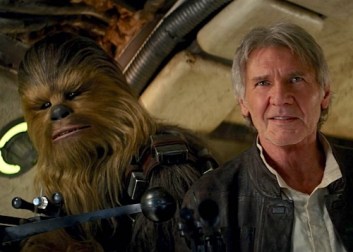 those elements aren’t gone about in an awards-grabbing fashion anyway. In the name of blockbuster entertainment, however, they’re all highly accomplished.
With the good ship Star Wars relaunched under a sure hand and with a surfeit of familiarity to help steady the ride, hopefully future Episodes can really push the boat out.

Star Wars: The Force Awakens placed 9th on my list of The Ten Best Films I Saw For the First Time in 2015, which can be read in full here.
 The 24th official James Bond movie had a funny old ride on its cinema release a few months ago. It started well, with near-universal praise from UK critics; audience reaction was more mixed but erred towards the positive; then US critics tore into it, and US audiences (as usual) followed suit. The latter seems to have become the more accepted view, with the consensus seemingly that it’s decent enough, but a definite step down from the high of
  Spectre, to put it bluntly, pulls a
 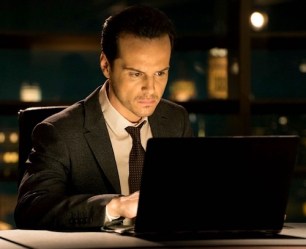 retaining the same general thrust. I still don’t think it works. There’s too much of M, Q and Moneypenny sat in an office trying to stop a man typing something into a computer (more on this in a minute), while Bond is busy running around a building and shooting at a helicopter. Personally, I’d’ve thrown it out and started again, but I guess they’d run out of time, and maybe it was better than the alternative.
 No, of course it isn’t, and it never was; but the point of Bond has never been realism. And besides, the reason you cast quality actors in minor roles is so they can pop in for a day or two and make their one scene exceptionally good. Bulk their part up if you’ve got a story to tell, by all means, but don’t shoehorn them in just because you’ve got them. For my money, Spectre is too much doing the latter.
 Or perhaps they’re just planning to go
 Score:



 So says Peter Jackson in the special features accompanying this extended cut of his trilogy-closing saga-ending sixth Middle-earth movie, as
  Most obvious, and most discussed, is the dwarves’ war chariot action scene, whose bloody decapitations saw the film earn an R in the US and 15 over here. A seven-minute action sequence in the middle of the battle, it’s by far the largest single addition, and is mainly notable for all that blood and its use of the word “jambags”. Somewhat ironically, the sequence was a last-minute addition (the physical chariot was the last thing built for the films), which even as they’re shooting it Jackson acknowledges is an indulgence, and then of course it got bumped to the extended edition for being just that.
 Not a sausage, unless I missed something. It didn’t bother me too much because, quite frankly, I can’t quite remember what it was all about; but when I inevitably watch the extended trilogy back to back one day, it may do then. That said, I can’t imagine it’s a major fault, but again highlights the built-on-the-fly, ill-thought-through state of expanding The Hobbit 2 into The Hobbit 2 and 3.



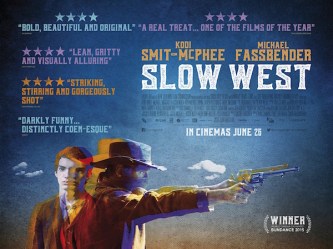 The Coens and Wes Anderson are common reference points in reviews of this slightly quirky Western, which sees Michael Fassbender’s experienced outlaw-type help wet-behind-the-ears Scotsman Kodi Smit-McPhee track the girl he loves, who emigrated for mysterious reasons, also known by the bounty hunters on their trail.

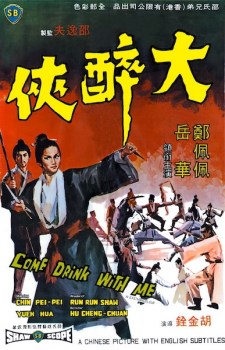 The first wuxia film directed by King Hu (King Chuan, that’s Hu! #MildlyRacistHomophoneJoke), the success of which allowed him to make his next even-more-significant movies in the genre, Come Drink with Me sees a gang kidnap the governor’s son to use him as leverage to release their leader. Instead, the governor sends his daughter, Golden Swallow (Cheng Pei-pei), to rescue her brother. She receives some help from local drunkard Fan Da-Pei (Yueh Hua), who may be more than he’s letting on…
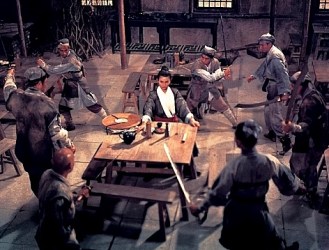 But this is a structural niggle, really. There’s so much else to enjoy — not just the action, but some amusing scenes, engaging characters, strikingly brutal villains (they not only kill a child (you wouldn’t get that in most movies) but they do it for no particular reason), and beautiful widescreen Technicolor cinematography — that it doesn’t grate too much.
 Hated by Americans and loved (well, ok, “liked”) by everyone else (well, ok, “by lots, but by no means all, of people who reside outside America”), Disney’s attempt to pull a
  I know some people complain about simplistic stories that are used to just string action sequences together, and that’s a perfectly valid thing to get annoyed about, but The Lone Ranger swings to the other extreme and uses an over-complicated story to string together its action sequences. All it actually needs is a little streamlining, because the film is allowed to swing off into too many sideplots. This makes the middle of the film a slog, and you feel every minute of its excessive two-and-a-half-hour running time.
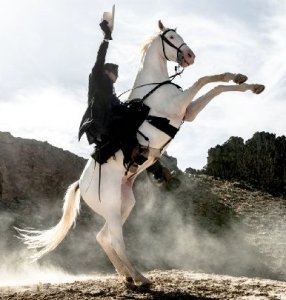 a recurring problem for Disney at the minute. To be frank, I’m not convinced anyone made a truly concerted effort to stem the overspend. When a gaggle of CG rabbits hopped on screen, all I could think was, “who allowed this?!” You’ve got a massively over-budgeted film that the studio want cut back, and one reason for that is CG bunnies that have almost no bearing on anything whatsoever! The amount of time and effort that must’ve gone into creating those fairly-realistic rabbits for such a short amount of screen time… it cost millions, surely. Millions that could’ve been saved with a simple snip during the writing stage if only someone had said, “well, those bunnies don’t add anything and they’ll be bloody expensive, so let’s lose them.”
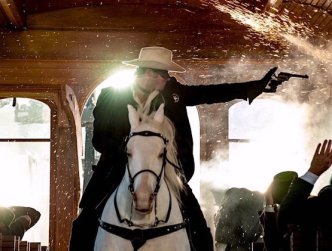 I’m not quite as effusive as Hughes, but The Lone Ranger is worth the time of anyone who enjoys an action-adventure blockbuster. It’s a three-star adventure-comedy bookended by a pair of five-star railroad action sequences, which make the trudge through the film’s middle hour-or-so feel worthwhile. There was a better movie to be made here — one that was half-an-hour shorter, more focused, and probably several tens of millions of dollars cheaper to make — but that doesn’t mean the one we got is meritless.
 Adapted from the classic young adult sci-fi novel by Orson Scott “bigoted idiot” Card, Ender’s Game is the story of Andrew “Ender” Wiggin (Asa Butterfield), who displays uncommon aptitude in a military programme to train children to fight against an alien race that attacked Earth decades earlier. Sent to a training centre in space, Ender must battle his fellow candidates to prove their worth to their hardened commander, Colonel Hyrum Graff (Harrison Ford), ready for the real battle to come.
 It tips its hat to things like drone warfare, child soldiers, and understanding our enemy, but that’s all it does: acknowledge those parallels exist, then refuse to explore them. Conversely, the music is too heavy-handed, taking on the burden of providing emotion that’s lacking from the screenplay.
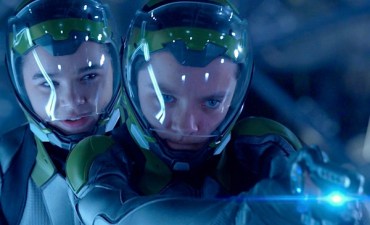 Sadly, after all that training fun, once the cadets jet off to the other side of the galaxy for a rushed third act, interest evaporates speedily. It even has to work hard to sell its own twist as a twist! (Spoilers follow in this paragraph.) In a simulation for a war, Ender does what he’d do to win that war. Then he’s told it wasn’t a simulation, it was the actual war… and he’s all cross. I mean, okay, the fella kinda has a point when he gets angry afterwards: they’ve lied to him, and maybe he would’ve behaved differently if he’d known. But the point of the training was to teach them what they needed to do to win, and it taught them that, and he did it. Maybe this twist works in the book, but in the film it felt somehow unearned.
 100Films.co.uk