The Lord of the Rings: The Return of the King (2003)

100 Films’ 100 Favourites #55

The Journey Ends.

Country: New Zealand & USA
Language: English & Sindarin
Runtime: 253 minutes (extended edition)* | 201 minutes (theatrical version)
BBFC: 12A
MPAA: PG-13
* 263 minutes with the interminable fan club credits.

Original Release: 17th December 2003 (UK, USA & others)
First Seen: cinema, December 2003

Stars
Liv Tyler (Armageddon, The Incredible Hulk)
Miranda Otto (Love Serenade, War of the Worlds)
Cate Blanchett (Elizabeth, Blue Jasmine)
John Noble (The Monkey’s Mask, Risen)
Ian Holm (Alien, Hamlet)

Director
Peter Jackson (The Frighteners, The Hobbit: An Unexpected Journey)

Screenwriters
Fran Walsh (Heavenly Creatures, King Kong)
Philippa Boyens (The Lovely Bones, The Hobbit: The Battle of the Five Armies)
Peter Jackson (Braindead, The Hobbit: The Desolation of Smaug)

Based on
The Lord of the Rings, a trilogy of novels by J.R.R. Tolkien.

The Story
The Ring’s evil influence over Frodo intensifies as he and Sam allow Gollum to lead them on a difficult path into Mordor. Meanwhile, Aragorn and Gandalf try to unite the world of men against Sauron’s forces, hoping to at least buy Frodo and Sam the time they need…

Our Heroes
It’s an ensemble cast so there are heroes aplenty, but this is the film where Sam really comes to the fore. Although wronged by Frodo, whose Ring-induced confusion allows him to be convinced by the machinations of Gollum, Sam repeatedly comes through to rescue his friend. “I can’t carry it for you… but I can carry you!”

Our Villains
With Saruman out of the picture, the focus falls back on the Big Bad big eye, Sauron. In the extended cut we’re also treated to his rather disgusting Mouth. Special mention also for the Witch-King of Angmar, who reckons he can be killed by no man. Of course, despite Tolkien’s reputation, not every character is a man…

Best Supporting Character
Women get short shrift in Tolkien’s world on the whole, but Miranda Otto’s Éowyn gets a relatively strong role through Two Towers and Return of the King, here riding into battle (in disguise) and (spoiler alert!) avenging the murder of her uncle, the king.

Memorable Quote
“My friends, you bow to no one.” — Aragorn, to the Hobbits.

Quote Most Likely To Be Used in Everyday Conversation
“Fool of a Took!” — Gandalf

Memorable Scene
With the Ring destroyed and Sauron defeated, the film takes the necessary time to walk us through the ultimate fates of the surviving characters. For the conclusion of an eleven-hour story, The Return of the King has a proportionally appropriate number of endings. Stop bloody whinging.

Memorable Music
Howard Shore completes his fantastic score. This time, memorable moments include The Realm of Gondor (in Ascension), heard best as Gandalf rides into and up the city of Minas Tirith; and The Edge of Night, sung by Pippin (Billy Boyd) as Faramir leads a futile charge on Osgiliath (another strong contender for Memorable Scene, that).

Technical Wizardry
The Fellowship of the Ring was one of the films that pioneered digital grading, a process which pretty quickly became standard (and now is fundamentally unavoidable, what with digital photography being the primary movie production format). Return of the King demonstrates the full power of the form, however: After the final battle, Pippin finds Merry on the battlefield. In the theatrical cut, the scene takes place during the day; in the extended cut, new and rearranged scenes means it takes place at night. It’s the same footage, graded differently, and it works seamlessly in either cut.

Truly Special Effect
Creating the trilogy’s many epic battle sequences required the ability to computer generate hundreds of thousands of soldiers fighting, a gargantuan task and a problem that hadn’t had to be solved in filmmaking before. This is what led to the creation of MASSIVE — short for Multiple Agent Simulation System In Virtual Environment — a computer program which creates thousands of characters who are capable of acting as individuals, responding to their surroundings through the use of pre-programmed actions and animations. The kit has been used in many sci-fi/fantasy films since, including Avatar.

Letting the Side Down
I’ve never really bought all the stuff with the ghost army, and apparently Peter Jackson agrees. Although he hated it because it was so unbelievable, he kept it in so as not to disappoint fans of the novel.

Making of
Although most of the trilogy was filmed as part of one massive shoot before the first film was even released, pick-ups and additional filming were later done for both parts two and three. Ultimately, the final day of filming for the trilogy (to get one additional shot for the extended edition of Return of the King) actually occurred not only after the final film had already been released, but after it had swept the board at the 2004 Academy Awards, too. Apparently it amused Peter Jackson to be shooting footage for a movie that had already won the Best Picture Oscar.

Previously on…
The story began in The Fellowship of the Ring and continued in The Two Towers, of course.

Next time…
Jackson and co returned to Middle-earth to adapt prequel tale The Hobbit in three parts, which has a framing device that places it… before Fellowship. So this remains the chronological end of the line.

Awards
11 Oscars (Picture, Director, Adapted Screenplay, Editing, Art Direction-Set Decoration, Costume Design, Makeup, Score, Song, Sound Mixing, Visual Effects)
5 BAFTAs (Film, Adapted Screenplay, Cinematography, Visual Effects, Audience Award)
8 BAFTA nominations (Supporting Actor, Director, Music, Editing, Production Design, Costume Design, Sound, Make Up/Hair)
9 Saturn Awards (Fantasy Film, Actor (Elijah Wood), Supporting Actor (Sean Astin), Director, Writing, Music, Make Up, Special Effects, DVD Special Edition Release (for the extended cut))
5 Saturn nominations (Actor (Viggo Mortensen), Supporting Actor (both Ian McKellen and Andy Serkis), Supporting Actress (Miranda Otto), Costumes)
7 Teen Choice Award nominations (including Choice Movie Liar and Choice Movie Sleazebag (both for Gollum))
Won the Hugo for Best Dramatic Presentation Long Form

What the Critics Said
“the invisible wizard Peter Jackson makes use of every scene to show us the meaning of magnificence. Never has a filmmaker aimed higher, or achieved more. The third and last installment of the screen epic based on J.R.R. Tolkien’s literary classic redefines — steeply upward — the very notion of a major motion picture. […] To write about this culminating chapter of The Lord of the Rings is to risk gushing in a public place. Still, I’ve never seen a movie like it, or been so struck by a filmmaker’s generosity and the prodigality of what he has done. Yes, the running time is long, and yes, those many endings in a slow, dreamy coda left me feeling spent — better spent than I can ever remember.” — Joe Morgenstern, The Wall Street Journal

Score: 95%

What the Public Say
“When I talk about any of the Middle Earth films, I’m referring to the extended edition because, despite Jackson’s dissembling, they’re the movies he always intended to release and are uniformly better than the theatrical cuts. Nowhere is this more true than with The Return of the King which, despite winning Best Picture, was made infinitely better by its extended cut, which does clock in at a whopping four and a half hours. It’s a wonderful end to one of the most epic tales in all of fiction (and if I hear anything about the “five million endings” I’ll reach through your screen and slap you unless you can tell me how you would have ended an 11 hour film better).” — David Yaeger, Killing Time

Verdict

Return of the King is widely regarded as the best Lord of the Rings film, which is an opinion I can’t agree with. At its simplest: there’s nothing I’d change about Fellowship to improve it, whereas RotK could stand to lose the Army of the Dead and (were it not for the fact it comes from Tolkien) no one would mind. Still, that element aside, this is a fantastic conclusion to Tolkien/Jackson’s epic saga, bringing numerous plots and characters to their conclusion, and rounding out one of the most impressive feats of filmmaking we will likely ever see. There are very few things I could imagine watching for 12 hours straight (without it feeling like a chore, anyway), but The Lord of the Rings is certainly foremost among them.

#56 will be… ロストイントランスレーション。

Superman Returns (2006)

2016 #117
Bryan Singer | 154 mins | DVD | 2.35:1 | USA / English | 12 / PG-13

The same summer that Christopher Nolan revitalised the Dark Knight with the critically acclaimed and commercially successful Batman Begins, one of the men who’d helped kickstart the current superhero resurgence, X-Men director Bryan Singer, attempted the same with DC Comics’ other major hero, Superman, only to be met with critical derision and commercial failure.
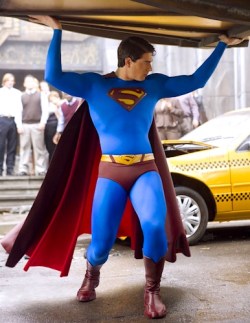
Except that’s not actually what happened, despite what many have come to believe since. Superman Returns was actually pretty popular with critics: 76% on Rotten Tomatoes, enough to gain a Certified Fresh classification; and if you hone that to just top critics, it scores 68% versus Batman Begins’ 65%. Returns also outgrossed Begins that summer, taking $391 million worldwide to the Bat’s $374 million. These are all small margins, but even just being on the same level as each other demonstrates something about how perception and accepted narratives can distort what actually happened.

Of course, even this is a slight distortion, because while Batman Begins cost $150 million, Superman Returns’ budget was $204 million — at the time, one of the most expensive movies ever made. Lump in the development costs of previous aborted Superman films (which Hollywood accounting does) and you get closer to $270 million — a figure that, even today, would put it in the top five most expensive movies ever made.

All of that was ten years ago now, since when plans for a sequel have been abandoned, the character has had a reboot, and kicked off a shared universe with a Batman co-starring sequel, too. With all that behind us, is Superman Returns’ poor reputation actually deserved? I’ve never got round to seeing it, so had no horse in the “it’s misunderstood” / “it’s deservedly derided” race; but today is the 10th anniversary of the film’s UK release, so what better time to finally join the debate?

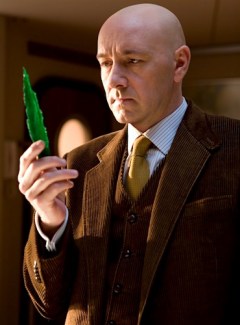
The film begins in media res, with Clark Kent / Superman (Brandon Routh) returning home after five years away. The world has moved on: hot-shot reporter and Supes love interest Lois Lane (Kate Bosworth) has a fiancé (James Marsden) and a young son, and worst of all has penned an award-winning article called “Why the World Doesn’t Need Superman”. Meanwhile, criminal mastermind Lex Luthor (Kevin Spacey) has escaped a jail sentence and is secretly setting about a nefarious plan…

Sitting down to Superman Returns cold, it feels like you’re watching a sequel — and in many respects, that’s what it is. Singer loves the Christopher Reeve Superman movies, quite rightly, and when offered the chance to make a new movie with the character essentially set out to make Superman III. Yes, Superman III already exists — and Superman IV, too — but no one likes them, so Singer’s decision to just completely ignore them wasn’t so daft. What was daft was making a sequel to a 26-year-old movie and assuming that the audience would be instantly familiar with the whole setup. Most cinemagoers won’t have done their homework and re-watched the older films before heading to the movies (because why would they?), so no wonder people felt confused and disappointed by what they were seeing. People nowadays complain about too many reboots and retellings of origin stories, often for good reason, but (a) sometimes a new telling is the right way to go, and (b) if you’re going to pick up a character mid-life, you still need to treat it as a new and standalone story if its immediate predecessor was released decades ago.

Really, Returns is one massive tribute to those ’70s and ’80s Superman films. Brandon Routh is essentially stuck doing a Christopher Reeve impression, both as bumbling Clark Kent and the Big Blue Boy Scout. Kevin Spacey is similarly in Gene Hackman mode, though as the film goes on he seems to increasingly relish the absurdity of what they’re doing. Old footage of Marlon Brando is resurrected to play Supes’ dad; the aesthetic is nostalgic, with a bright red-and-blue costume, classically-inspired sets, and sepia-tinged cinematography; there’s a focus on drama, with a sparing use of action sequences (at least until the climax); even the opening titles emulate the iconic whooshing blue names of the 1978 film. Maybe watched as part of a series with the earlier films it works as an homage or addendum, but as a work in its own right, viewed in isolation, it feels… misjudged.

That’s not helped by some aspects simply not working. I have nothing against Kate Bosworth, but she’s horribly miscast as Lois; so wrong it’s even hard to pin down exactly why it doesn’t work. The pace is wonky, with a long, slow start before a surfeit of action sequences blow in, at least one of them a complete aside from anything that’s going on, presumably just to gather some cool shots for the trailer (the bullet bouncing off Superman’s eye, for example). If the movie had begun with the airplane rescue scene — which is actually a great sequence, quite possibly the best Superman-related action scene ever filmed — perhaps it would’ve earnt the time to indulge in the Reeve-related posturing that actually takes up the first half-hour-or-so. I can imagine an edit of the movie that begins on that plane: just a bunch of journalists observing the press demonstration of the new shuttle technology, when suddenly, inexplicably, it fails — they’re all going to die — then Superman turns up completely out of nowhere and saves them. Then you have the credits, which are immediately followed by Lex’s whole journey to the Fortress of Solitude, and only then do you get in to the stuff with Superman only having just returned, wondering what his places is now, and so on. Maybe lose the scene of him basically stalking Lois’ new family, though.
You can see what Singer was going for with Superman Returns — a respectful, lightly modernised homage to some classic, beloved movies — but the benefit of hindsight makes it clear that really wasn’t a good idea. That said, it could’ve worked. If they’d put a little more effort into making it work as a semi-reboot rather than as a straight-up continuation, which is how it comes across, then maybe it would’ve been friendlier to newcomers. There are some excellent things in here — the tone mixes drama, humour, and life-or-death stakes in a way some blockbusters are losing sight of; Lex’s scheme is unusual and therefore interesting; the action scenes are thrilling; attempting to bring some character to the characters, rather than merely using them as pawns in those action sequences, almost lends the film additional depth — and I think it would’ve been a lot better liked if people felt they could get on board with it; if it wasn’t trying so hard to be something it’s not, which is a Superman movie starring Christopher Reeve made in 1983. For all Man of Steel’s faults, at least it tried to reintroduce the character, rather than pick up where it left off.

The final thing this all makes me think of is the forthcoming Marvel Spidey movie, Spider-Man: Homecoming. One wonders if Sony were inspired by Superman Returns’ perceived failure when they chose to reboot Spidey in 2012’s The Amazing Spider-Man, rather than make Spider-Man 4 with a new cast and crew. That reboot decision was not popular, to say the least, with audiences thinking ten years (since the ‘first’ Spider-Man movie) was too little time to warrant retelling a familiar story. With that universe abandoned after an even-less-popular sequel, the next Spider-Man movie has to start again — but they’ve learnt their lesson and aren’t retelling the origin, instead diving in with Spider-Man already established as a hero. In media res again, then, but also (one hopes) with an awareness that this is to be the first movie in a series, not pretend to be the third or fourth. Another, better lesson learnt from Superman Returns, perhaps? Wouldn’t it be nice if Hollywood could learn from its mistakes more often…

3 out of 5

The Lord of the Rings: The Two Towers (2002)

100 Films’ 100 Favourites #54

The Journey Continues

Country: New Zealand & USA
Language: English & Sindarin
Runtime: 224 minutes (extended edition)* | 179 minutes (theatrical version)
BBFC: 12A
MPAA: PG-13
* 235 minutes with the interminable fan club credits.

Original Release: 18th December 2002 (UK, USA & others)
First Seen: cinema, December 2002

Stars
Andy Serkis (Burke & Hare, Rise of the Planet of the Apes)
Bernard Hill (Titanic, Franklyn)
Christopher Lee (Dracula, The Wicker Man)
Hugo Weaving (The Matrix, V for Vendetta)
David Wenham (The Crocodile Hunter: Collision Course, 300)

Director
Peter Jackson (Heavenly Creatures, The Lovely Bones)

Screenwriters
Fran Walsh (The Frighteners, The Lovely Bones)
Philippa Boyens (The Lord of the Rings: The Fellowship of the Ring, The Hobbit: An Unexpected Journey)
Stephen Sinclair (Meet the Feebles, Braindead)
Peter Jackson (Bad Taste, King Kong)

Based on
The Lord of the Rings, a trilogy of novels by J.R.R. Tolkien.

The Story
Frodo and Sam continue on their way towards Mordor, guided by the duplicitous Gollum. Meanwhile, the surviving members of the Fellowship attempt to bring the kingdom of Rohan into the fight against the hordes of orcs Saruman is assembling.

Our Heroes
As the Fellowship go their separate ways, you could argue that The Two Towers is where Aragorn really comes into his own: the self-exiled royal unveils his leadership qualities as he persuades the people of Rohan to abandon Edoras for the safe haven of Helm’s Deep, and leads the defence of that stronghold.

Our Villain
Once-good wizard Saruman is lent villainous credence by Christopher Lee — really, who else could it be? In one of Jackson’s few missteps, he deleted Saruman’s defeat from the theatrical cut of Return of the King… but the extended cut restores it, so that’s alright then.

Best Supporting Character
Although he’s covered by CGI in the final film, it’s Andy Serkis that really brings Gollum — and his alter ego, Sméagol — to life. It may have led to Serkis becoming the go-to expert in performance capture, but it’s also a great acting performance, full of light and shade, and creating sympathy for an ultimately villainous character. (See also: Truly Special Effect.)

Memorable Quote
“Where is the horse and the rider? Where is the horn that was blowing? They have passed like rain on the mountain, like wind in the meadow. The days have gone down in the West behind the hills into shadow. How did it come to this?” — Theoden

Quote Most Likely To Be Used in Everyday Conversation #1
“Po-tay-toes! Boil ’em, mash ’em, stick ’em in a stew.” — Sam

Quote Most Likely To Be Used in Everyday Conversation #2
“My precious…” — Gollum

Memorable Scene
The climactic battle of Helm’s Deep is surely one of the greatest battles ever put on screen, as thousands of orcs attempt to storm a fortress defended by a small force of soldiers supported by a ragtag gaggle of old men and boys. Like the ninth episode of a season of Game of Thrones, it plays out over about an hour, but doesn’t flag because it’s so well realised.

Memorable Music
Howard Shore’s excellent score continues to evolve and develop, with the stand-out theme this time being for the realm of Rohan. Also of note is the track that plays over the credits, Gollum’s Song, hauntingly sung by Emilíana Torrini.

Technical Wizardry
Although Lord of the Rings features expanses of excellent CGI, much of it was also created with miniatures — or “Bigatures”, as production nicknamed them, due to the massive scale of some that they built (the largest was 9 metres tall). It lends the final images a physicality and realism that demonstrates why a combination of multiple techniques is often the best way to create a superb end result.

Truly Special Effect
Just a couple of years after The Phantom Menace featured the first major all-CGI character, Weta perfected the form with Gollum, a fully believable creature and an essential part of the narrative. (See also: Best Supporting Character.)

Letting the Side Down
The problem with being the middle part of a series is the story can lack a beginning or an end. Two Towers handily makes up for the latter with the epic battle of Helm’s Deep and the Ents conquering Isengard, but the former is an issue — the film takes a while to get up to speed.

Making of
The prop gate of Helm’s Deep was so well built that a real battering ram failed to knock it down. The door had to be weakened to get the required shots. On the film’s commentary track, Peter Jackson notes that if he ever had to defend a castle he’d want Weta Workshop to build the door.

Previously on…
The story began in The Fellowship of the Ring.

Next time…
The story ends in The Return of the King.

Awards
2 Oscars (Sound Editing, Visual Effects)
4 Oscar nominations (Picture, Editing, Art Direction-Set Decoration, Sound)
3 BAFTAs (Costume Design, Visual Effects, Audience Award)
7 BAFTA nominations (Film, Director, Cinematography, Production Design, Editing, Sound, Make Up/Hair)
4 Saturn Awards (Fantasy Film, Supporting Actor (Andy Serkis), Costumes (tied with Star Wars: Episode II), Make-Up)
6 Saturn nominations (Actor (Viggo Mortensen), Younger Actor (Elijah Wood), Director, Writing, Music, Special Effects)
1 Broadcast Film Critics Association Award (Best Digital Acting Performance (Andy Serkis, obv.))
4 MTV Movie Awards (including Best Virtual Performance (Gollum, obv.), Best Action Sequence (Helm’s Deep))
1 Kids’ Choice Award nomination (Favorite Male Butt Kicker)
Won the Hugo for Best Dramatic Presentation Long Form

What the Critics Said
“Gollum is a wonderful creation: voiced by Andy Serkis, and given the most heartbreakingly expressive face, he’s far more than a digital effect: he’s really there, taking up space, displacing air (part of the impact comes from the meticulous care with which all the creatures of Middle Earth are scaled relative to one another). Gollum is a vile mixture of servility and malice, yet watching him being beaten, throttled, kicked by almost everyone he encounters is as distressing as watching a child being hit. Frodo, for all his faults, is kind to Gollum, seeing in him his own disturbing likeness; Sam, for all his virtues, is cruel.” — Suzi Feay, The Independent

Score: 96%

What the Public Say
“The tricky thing with being the second film in a trilogy is that there is no beginning and end. It is almost as if the entire story arc is getting sidetracked by some other battles and new creatures and characters to be met. The film is a intense adventure film but the emotional pull of the two main characters and their journey is out on hold. What makes the Fellowship of the Ring one of the most completely amazing films is because there is a both an emotional and a physical journey the characters take. In the Two Towers we are constantly being told by an assortment of characters that a real war is coming and what they are experiencing are just small skirmishes. Are the filmmakers deliberately teasing us with the excitement of the next film or attempting to do the story its rightful justice?” — Brian Baumann, brianbaumannmoviereviews

Verdict

I was less than impressed by much of The Two Towers when I first saw it — the first hour or so drags, and the intercutting of the deathly dull Entmoot slightly hampers the momentum of Helm’s Deep. Nonetheless, there’s an awful lot to commend it, and the pace becomes less jarring with multiple revisits (when the Extended Edition first came out I even watched both cuts back to back on the same day, which is very unlike me). Some of the trilogy’s best characters first appear here, bringing with them plenty of plot developments that make my notion it was all almost done at the end of Fellowship seem suitably foolish. And, of course, the Battle of Helm’s Deep can’t be beat.

A day may come when the courage of men fails, when we forsake our friends and break all bonds of fellowship… but it is not in #55.

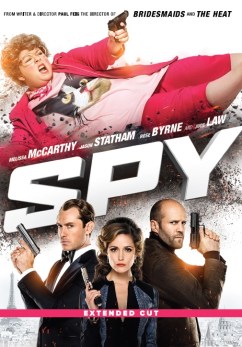
Spy: Extended Cut (2015)

2016 #106
Paul Feig | 125 mins | streaming (HD) | 2.35:1 | USA / English | 15

The cinema was blessed — or, depending on your point of view, blighted — by an abundance of espionage-related movies last year (see: the intro to my initial thoughts on Spectre for more on that), and even writer-director/star team Paul Feig and Melissa McCarthy got in on the act with this comedy.

McCarthy is Susan Cooper, a CIA agent who provides desk-bound support for Bond-esque super-spy Bradley Fine (Jude Law). When Fine is killed while investigating the villainous Rayna Boyanov (Rose Byrne), Cooper insists she go into the field to finish what he started. This doesn’t impress experienced agent Rick Ford (Jason Statham), who goes rogue to deal with Boyanov himself.

Technically speaking, Spy is a spy comedy rather than a spy spoof — a perhaps subtle distinction, but one that does inform the kind of comedy you’re getting; i.e. rather than a send-up that relies on you knowing the material being parodied to get the jokes, this is almost a workplace comedy… just one where the workplace is international espionage. Put another way, less Naked Gun or Austin Powers, more Kingsman with the comedy dialled up higher in the mix.

This is perhaps why it’s sporadically amusing rather than regularly hilarious; on the bright side, it only occasionally slides too far into dull toilet/gross-out ‘humour’. Similarly, it means that there are a handful of fun and/or exciting action beats scattered throughout the film, which you might not expect. They’re typically brief, but — even more surprisingly — there’s a fight between McCarthy and a henchwoman in a kitchen which is a genuinely good action sequence. It’s also surprisingly gruesome. Yes, it’s R-rated, but in the world of comedy that usually just means an overabundance of the F-word. Here we have at least one clear headshot, a dissolving throat, a knife through a hand, and more photos of a henchman’s penis than you ever needed to see. (That last one’s only describable as “gruesome” depending on your personal predilections, of course.)
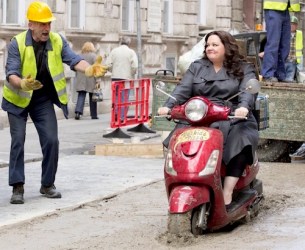
Apparently Feig is a fan of James Bond and developed, wrote, produced, and directed Spy because he knew no one would ever let him do a real Bond movie. I guess that explains why some of it does work passably well as a genuine action/thriller. Composer Theodore Shapiro does an equally good job of evoking Bond’s musical stylings throughout his score. In my experience most comedies don’t show such consistent commitment in their music. Talking of music: as I mentioned in my June monthly update, there’s a random cameo by Verka Serdyuchka, Ukraine’s Eurovision entry from 2007. That gets the film some bonus points in my book.

The quality of the cast’s performances are variable in ways I didn’t expect. Statham almost steals the film, playing essentially himself — but exaggerated, I’m sure. McCarthy is a solid lead, at her best when sparking off Rose Byrne, who makes anything more watchable. Miranda Hart has a large supporting role as McCarthy’s CIA colleague, but I’m not sure that her strengths are wholly played to. I guess if you like her you’ll like her here (and if you don’t…) Peter Serafinowicz’s lecherous Italian is disappointingly overplayed, however, and I’m not sure why you’d cast ever-so-British Jude Law as a James Bond type and then give him an American accent.

The extended (aka unrated) cut contains almost 10 minutes of extra material, detailed here. Reading that list really demonstrates how some bits were tightened up for the theatrical release. I’d even wager that some parts are the result of improvising to find one good line, but in the extended cut they’ve strung half a dozen of the options together. I don’t think any casual viewer would miss much by sticking to the theatrical cut. That said, despite it running to two hours, I didn’t find it to be too long. It still wouldn’t hurt if it was tighter in places, but I didn’t get that “oh dear God why is this longer than 90 minutes?!” feeling you can get from 120-minute comedies.

Amusing rather than hilarious, but with a pleasing commitment to its genre, Spy isn’t going to tap into the zeitgeist in the way Austin Powers did almost 20 years ago(!), but it does provide a largely entertaining couple of hours.

3 out of 5

Feig and McCartney’s latest collaboration, the Ghostbusters reboot, is in UK cinemas from today, and launches around the world over the coming weeks.

The Lord of the Rings: The Fellowship of the Ring (2001)

100 Films’ 100 Favourites #53

One Ring To Rule Them All

Country: New Zealand & USA
Language: English & Sindarin
Runtime: 208 minutes (extended edition)* | 178 minutes (theatrical version)
BBFC: PG (“Battle violence and fantasy horror may not be suitable for under 8’s”)
MPAA: PG-13
* 228 minutes with the interminable fan club credits.

Original Release: 19th December 2001 (UK, USA & others)
First Seen: cinema, December 2001

Stars
Elijah Wood (The Ice Storm, Eternal Sunshine of the Spotless Mind)
Ian McKellen (Richard III, X-Men)
Viggo Mortensen (G.I. Jane, Eastern Promises)
Sean Bean (GoldenEye, Black Death)
John Rhys-Davies (Raiders of the Lost Ark, In the Name of the King: A Dungeon Siege Tale)
Orlando Bloom (Pirates of the Caribbean: The Curse of the Black Pearl, Kingdom of Heaven)
Sean Astin (The Goonies, The Colour of Magic)
Dominic Monaghan (I Sell the Dead, X-Men Origins: Wolverine)
Billy Boyd (Urban Ghost Story, Master and Commander: The Far Side of the World)

Director
Peter Jackson (Bad Taste, King Kong)

Screenwriters
Fran Walsh (Meet the Feebles, The Hobbit: An Unexpected Journey)
Philippa Boyens (King Kong, The Hobbit: The Desolation of Smaug)
Peter Jackson (Heavenly Creatures, The Hobbit: The Battle of the Five Armies)

Based on
The Lord of the Rings, a trilogy of novels by J.R.R. Tolkien.

The Story
Legend tells of a ring, created by an ancient evil that gave its wearer the power to enslave the world. Believed lost for centuries, it has now been found… in the possession of one Frodo Baggins, a Hobbit of the Shire. With an evil force thought long-defeated on the rise, and hunting for the Ring to cement his power, Frodo will do what few of his kind have ever done: venture beyond the confines of their homeland. Joined by eight companions, they must travel across Middle-earth to destroy the One Ring once and for all.

Our Heroes
Frodo Baggins lives a quiet life in the countryside idyll of the Shire, where the greatest drama is stopping his relatives from stealing the cutlery. When a dangerous artefact is found to be in his possession, however, the honest and good nature of his people comes to the fore. On his quest, he has eight friends and protectors: his best friend / bodyguard / gardener, Samwise Gamgee; two rambunctious but pure-hearted Hobbits, Merry and Pippin; the powerful wizard Gandalf the Grey; a mysterious ranger from the North, Strider, aka Aragorn; from the world of Men, warrior Boromir; elf Legolas, a skilled archer; and an axe-wielding dwarf, Gimli.

Our Villains
The Dark Lord Sauron is an almost intangible threat, though his manifestation as a giant flaming eye atop an imposing tower is pretty freaky. Of more immediate danger to our heroes are his armies of orcs, as well as former allies who may have been converted…

Best Supporting Character
In many ways the strongest character arc of this first film belongs to Boromir. From the kingdom of Gondor, who are on the front lines defending the world from Sauron’s forces, Boromir is understandably frustrated by the lack of support his people have received, and is eager to use the Ring — a power he is denied, because it is too dangerous. But the Ring’s temptation is hard to resist… At one point a threat from within, which ultimately tears the fellowship asunder, Boromir comes through in the end with a helluva death scene. (He’s played by Sean Bean, of course he dies.)

Memorable Quote
“One ring to rule them all. One ring to find them. One ring to bring them all, and in the darkness bind them.”

Quote Most Likely To Be Used in Everyday Conversation #1
“Keep it secret. Keep it safe.” — Gandalf

Quote Most Likely To Be Used in Everyday Conversation #2
“He is seeking it, seeking it, all his thought is bent on it.” — Gandalf (well, I use it all the time…)

Memorable Scene
In the Elven city of Rivendell, representatives from Middle-earth’s various kingdoms and races gather for a council to decide what to do with the Ring. Concluding it must be destroyed, they bicker over who will make the dangerous journey into Mordor to do so. As the arguments grow louder and more heated, a small voice pipes up: to Gandalf’s dismay, but not surprise, Frodo offers to carry the Ring.

Memorable Music
Howard Shore’s score across the trilogy is incredible, a well-considered and developed work of art that he’s even turned into a symphony. There’s at least one memorable motif in each film, but the first has the best of all: “The Fellowship” theme, which naturally resurfaces regularly throughout the film, is (for my money) one of the greatest pieces of film music ever composed. (For more information on the score, try this dedicated Wikipedia article.)

Technical Wizardry
The production’s dedication to creating the world of Middle-earth is extraordinary. It’s not just the faultless design work, which perfectly imagined the locations, costumes, weaponry, creatures, and so on, but the amount of effort that then went into realising those designs: they produced over 19,000 costumes, including linking 12.5 million plastic rings by hand to create all the chainmail; 48,000 swords, axes, shields, and other pieces of armour; 500 bows and 10,000 arrows… the numbers go on. Also, because Hobbits walk around barefoot, shoe-like fake feet were created for the actors — of which they got through 1,800 pairs.

Truly Special Effect
One of the biggest challenges for realising The Lord of the Rings on screen are the heights of the various races — Hobbits are under 4-foot tall, dwarves are a little taller, and men are… well, man-sized. Jackson and co achieved this by employing various techniques, including forced perspective, body doubles, and split screen, which of course necessitated building two versions of some sets, one of which had to be a precisely scaled up/down version of the other. Fortunately, all of the Hobbit actors were quite short and Gimli actor John Rhys-Davies is quite tall, so they were able to lump the Hobbits and Gimli together as being the same scale. On screen, the results are seamless.

Making of
Viggo Mortensen Method-ed his way through playing Aragorn, including living in his costume outside of filming, insisting on doing his own stunts and using a real steel sword instead of the significantly lighter aluminium and rubber duplicates, bonding with the horses before filming, and having the script revised so that more of Aragorn’s lines were in Elvish.

Previously on…
The Lord of the Rings was adapted as an animated movie in 1978, which I think has its fans but generally isn’t that well regarded. For various reasons it didn’t tell the whole story, either, leading to a TV movie adaptation of The Return of the King being produced in 1980. On radio, it was adapted by the BBC in 1955-6, in the US in the ’60s and again in the ’70s, and, most notably, by the BBC again in 1981. That last adaptation was so acclaimed that Jackson has said it was an influence on his film version.

Next time…
The Two Towers and The Return of the King complete the story. A decade later, cast and crew returned to adapt Tolkien’s preceding novel, The Hobbit, as a prequel trilogy. There are other Middle-earth books, but their film rights reside with people who aren’t fans of Jackson’s films, so that’s probably that for Middle-earth on the big screen.

Awards
4 Oscars (Cinematography, Score, Makeup, Visual Effects)
9 Oscar nominations (Picture, Supporting Actor (Ian McKellen), Director, Adapted Screenplay, Art Direction-Set Decoration, Costume Design, Editing, Song, Sound)
5 BAFTAs (Film, Director, Visual Effects, Make Up/Hair, Audience Award)
8 BAFTA nominations (Actor (Ian McKellen), Adapted Screenplay, Cinematography, Editing, Music, Production Design, Costume Design, Sound)
3 Saturn Awards (Fantasy Film, Supporting Actor (Ian McKellen), Director)
6 Saturn nominations (Writing, Music, Costumes, Make-Up, Special Effects, Cinescape Genre Face of the Future Male (Orlando Bloom))
Won the Hugo for Best Dramatic Presentation

What the Critics Said
“Jackson has given himself a mountain to climb in tackling Tolkien’s obsessively multi-layered fantasy (intricate back-stories, made-up languages and all). On the whole he copes beautifully. The Fellowship of the Ring honours the text without being enslaved by it. The explanatory dialogue may creak on occasion, but the action scenes have a snap and pace that suggests a film-maker not scared to bring his own touch to the material. Physically, too, the film is a triumph: an art-department’s dream during its lovely interior sequences and a potent advert for the New Zealand tourist board when it heads into the great outdoors. […] Jackson’s serious, high-minded approach looks defiantly out-of-fashion; worlds away from kid-friendly Harry Potter (the season’s other big fantasy film about wizards). Instead, The Fellowship of the Ring boasts some more unlikely influences. At times, Jackson’s film could almost pass for the Anglo-Saxon cousin of Crouching Tiger, Hidden Dragon; lacking the dark, liquid exoticism of Ang Lee’s Chinese-language epic, but compensating with old-school blood-and-thunder and a rash of fairytale monsters.” — Xan Brooks, The Guardian

Score: 91%

What the Public Say
“everything about the film is of the highest quality. Both the visuals and audio blend together so well, to create an incredible onscreen world. The set designers did a wonderful job; iconic locations from the book became iconic film locations, such as the rolling green hills of The Shire, pulling you in like a dream, or the mystic and elegant Rivendell or the deep dark of Moria. All of these places and more truly are another world, and no matter what you think of the film the images of these places will stick with you forever.” — Ben Foster, BFFRAP

Verdict

Now that it’s fêted as one of the greatest film trilogies ever made, it’s easy to forget what a gamble a three-film, $300 million adaptation of J.R.R. Tolkien’s unfilmable novel seemed back when production started in the late ’90s; especially as it was to be made by a director whose track record was low-budget horror films, with a cast mostly without star names, filmed on the other side of the planet, where little news leaked out to the wider world, and with all three films shot at once — no backing out if the first flopped. Then it was released and became an instant global phenomenon.

Watching it for the first time, unfamiliar with the story in all but the broadest sense, was an incredible experience. I remember it ending and having no idea how there could be two more films — it felt like Frodo and Sam were almost at Mount Doom already! Oh, how naïve I was. Anyway, for me Fellowship remains the strongest of the trilogy; the only one that feels like a complete work in its own right — even though it’s clearly nowhere near the end of the overall narrative, an awful lot of the plots and themes reach suitable climaxes. Finiteness aside, the quality of the work is unquestionable: this is exciting, funny, emotional, transportive, epic filmmaking of the highest order.

Next… nobody tosses #54.

Ghosts of Mars (2001)

2016 #76
John Carpenter | 98 mins | streaming (HD) | 2.35:1 | USA / English | 15 / R

There are a good number of well-regarded John Carpenter films I’ve not seen that I could spend my time on, but I chose to expend it on this critically-mauled sci-fi-horror-Western from the first year of the current millennium. But sometimes watching poorly-regarded films pays off, because while Ghosts of Mars is no classic, it is actually pretty entertaining.

Set in a future where Mars has been almost completely terraformed, a group of police officers are dispatched to a remote mining outpost to escort a dangerous prisoner. On arrival they find the town mysteriously deserted, but soon discover the inhabitants have been possessed and basically turned into Reavers (…wait, did Joss Whedon just rip off Ghosts of Mars?!) Holed up in the jail, police and criminals must join forces to fend off their attackers. Yes, it’s basically Assault on Space Precinct 13.

It’s not just the plot that recalls older films: although the film was released in 2001, the quality of the acting, photography, sets, and effects are all like something made 15 years earlier. (In these technical aspects it reminded me a lot of Total Recall, and not just because it’s set on Mars.) It’s almost hard to equate it with other films made around the same time, and maybe that’s part of why it was so poorly received on release: it felt dated. Watched with 15 years distance, however, it’s an Old Film, so it’s as easy to mentally lump it in with stuff made 30 years ago as with stuff made 15 years ago. That doesn’t magically wipe out its other faults, but it does make me think about the level of forgiveness people are willing to apply to films based on extra-filmic knowledge of when they were made, etc. If people thought this had been made in the ’80s, would they view it as kindly as they do some ’80s genre-classics that are just as bad and/or dated?
I mean, I’m not saying it stands up to something like The Thing, which by comparison is a classy movie (bet no one in 1982 ever thought The Thing would get called “classy”!), but I don’t think it’s any less accomplished (at least in technical categories) than, say, Big Trouble in Little China. However, it’s swapped out some of the kooky fun of that film for a sci-fi-horror milieu, and maybe that’s why it doesn’t wash as well — it doesn’t have the comicalness to let the weaker aspects slide.

Conversely, if you made it today it would probably be seen as a throwback/homage and everyone would do backflips over it. They’d have a similar reaction to its diverse cast: a female lead hero, a black co-lead who’s also the cast’s biggest name (at the time), a lesbian commanding officer… If they could manage that in a studio picture 15 years ago, why does it seem to be such a big problem nowadays?

Anyway, it’s not “good”, but it is cheesily fun — and I reckon if it had been made 15 years earlier, exactly as it is, it would have a lot more fans.

3 out of 5

Independence Day: Special Edition (1996/1998)

2016 #102a
Roland Emmerich | 154 mins | Blu-ray | 2.39:1 | USA / English | 12 / PG-13

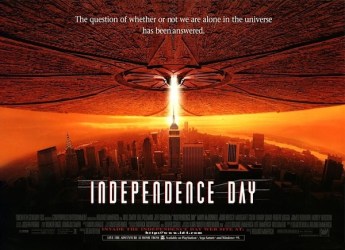
I’m not sure when I last watched ID4 (as it was so often branded and marketed, for only semi-clear reasons — sure, US Independence Day is July 4th, but other than that the “4” has nothing to do with anything), but it’s been a damn long time — my DVD copy, which I know I never watched (I have the shiny new remastered Blu-ray now), has a postcard inside advertising the forthcoming Planet of the Apes remake, in cinemas Summer 2001. The time I best remember seeing it was in cinemas on its initial release. Independence Day was a phenomenally huge deal back in 1996: it felt like that shot of the White House being destroyed was on TV on loop; there were making-of TV specials (I remember the behind-the-scenes footage of how they did those incredible, much-discussed effects as clearly as I remember anything from the film itself); I listened to the Radio 1 Independence Day UK audio drama on tape (it was… so-so), read the tie-in comic book adaptation, and also the tie-in novelisation — which was the first book I ever gave up on without finishing because I thought it was so badly written. Ten-year-old badblokebob, literary critic. The film itself was also the first 12-rated movie I went to see in the cinema, so it was even more of a big deal for me.
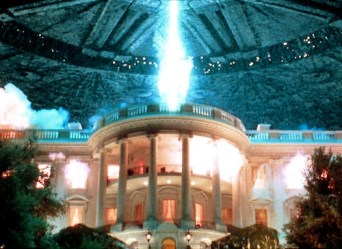
Revisiting it 20 years later, with a sequel imminent, ID4 obviously no longer has that attendant hype, but it does hold up pretty well in its own right as a blockbuster disaster epic. At least, it did for me — I read a review on Letterboxd from someone who watched it for the first time this January, saying that, in the age of the modern spectacle-based blockbuster, Independence Day doesn’t compete. Which feels weird, because it was all about the spectacle when it came out; but of course, things date, and what counted as sheer cinematic spectacle in 1996 is (it would seem) underwhelmingly run-of-the-mill in 2016. It’s fair to say that not all of the model effects still hold up, but there’s a physicality to them that really works. The best ones are still among the best movie effects ever.
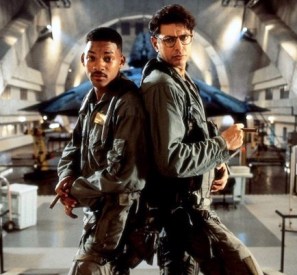
The film’s first half is superior to its second. Co-writer/director Roland Emmerich and co-writer/producer Dean Devlin conceived the film off the idea of 14-mile-wide spaceships just appearing one morning, and the realisation of that concept (and the ensuing destruction) is where the film really shines. That’s not to say there’s not good stuff after the aliens unleash their devastating destructive power — the famous presidential speech comes just before the climax, for one — but it’s from the midpoint on that some things begin to get a tad muddled, some subplots are rushed along, and other events get needlessly elongated. That said, it’s all relative: the 2016 version of this story with this many characters would surely run for five hours as it endeavoured to give them all a starring-role-level storyline and turn every effects-fuelled alien encounter into a 20-minute action sequence.

One area it really succeeds is humour. It doesn’t lose the scale or seriousness of the events, but it keeps the tone entertaining. That feels like a skill a lot of blockbusters used to have that’s gone awry in recent years, though you could use the tone of Marvel Studios’ movies to counterpoint that. Those Marvel films are definitely subject to a different criticism of modern blockbusters, however, which is their mindless destruction of whole cities. It’s a just criticism, and some of the blame for it can surely be traced back to the popularity of ID4. However, here the destruction isn’t so unfeeling: the morning after the aliens’ famous landmark obliteration, President Whitmore mulls over how many people died and how many didn’t have to if he’d made different choices. Both Marvel and DC have had to make that kind of reflection a plot point in sequels to retrospectively justify it happening in the first place.
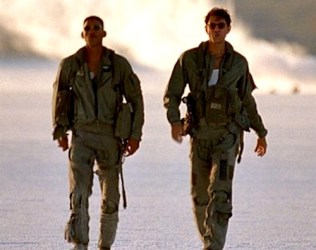
This was the first time I’d watched Independence Day’s extended Special Edition cut, and I’d advise not bothering. It adds around 8½ minutes of new material, but the scenes don’t add all that much, and some of them are so awkwardly rammed in that it’s almost irritating — for instance, several are inserted in the middle of an existing music cue by merely fading out the score immediately before the new scene, then fading it back in afterwards! They’re deleted scenes that have been shoved into the movie, with the score often fudged to make room and stuff like that, rather than it being a genuine “extended cut”. People seem to love extended cuts on disc, but sometimes a nice deleted scenes section is preferable.

With the way things are nowadays — every hit sequelised; old IPs regularly dragged up for new moneymaking opportunities — it was kind of inevitable we’d get ID4 2 eventually. I’m looking forward to it, but not insanely hyped up. It probably benefits from the 20-year wait story-wise, allowing for a drastically new status quo on Earth when the aliens return, but with blockbusters released all year round now, and CGI meaning every one is overloaded with effects shots that are far more epic than ID4 had, there’s little doubt that the sequel won’t have the same enduring impact on the blockbuster firmament. For its faults, you can’t deny ID4 that.

4 out of 5

Independence Day: Resurgence is in UK cinemas now, and is released in the US tomorrow.

Kill Bill: Vol. 1 (2003)

100 Films’ 100 Favourites #48

A Roaring Rampage of Revenge

Also Known As: Kill Bill: Volume 1

Country: USA
Language: English, Japanese & French
Runtime: 111 minutes
BBFC: 18
MPAA: R

Original Release: 10th October 2003 (USA)
UK Release: 17th October 2003
First Seen: cinema, October 2003

Stars
Uma Thurman (Pulp Fiction, My Super Ex-Girlfriend)
Lucy Liu (Charlie’s Angels, The Man with the Iron Fists)
Vivica A. Fox (Independence Day, Sharknado 2: The Second One)
Daryl Hannah (Splash, Wall Street)
David Carradine (Death Race 2000, Q: The Winged Serpent)

Director
Quentin Tarantino (Pulp Fiction, Inglourious Basterds)

Screenwriter
Quentin Tarantino (True Romance, Django Unchained)

The Story
Left for dead by her former teammates, highly-skilled martial artist the Bride awakes from her coma with one thing on her mind: to hunt down her would-be assassins in a roaring rampage of revenge.

Our Hero
The Bride, aka Black Mamba, aka [bleep], is a deadly assassin out for revenge against the gang of former associates who tried to murder her, in particular their leader, Dave. No, wait, that’s not right. What was his name? Anyway…

Our Villains
The five former members of the Deadly Viper Assassination Squad who were involved in the Bride’s ‘murder’. In this film, that amounts to Veronica Green (aka Copperhead), who has settled down as a suburban mom, and O-Ren Ishii (aka Cottonmouth) who is now the leader of the yakuza, commanding a veritable army of ninjas. You’ll have to wait ’til the next film for the other three members to turn up properly, including their leader, Bob. No, wait, that’s not right. What was his name?

Best Supporting Character
O-Ren Ishii’s ultra-violent head bodyguard, teenage schoolgirl Gogo Yubari. Proficient with a weapon that I’ve just learnt is called a meteor hammer. How awesome is that?

Memorable Quote
“That woman deserves her revenge and we deserve to die.” — Budd

Memorable Scene
The House of Blue Leaves: after calling out O-Ren Ishii, defeating her six bodyguards, and meteor hammer-wielding Gogo, the Bride turns to face O-Ren herself… when the sound of dozens of motorbikes roars outside. “You didn’t think it would be that easy, did you?” In flood O-Ren’s yakuza army, the Crazy 88, surrounding the Bride. The fighting begins, and when our hero bloodily plucks out one of their eyes, the film smash-cuts to black & white to obscure the ensuing bloody bloodbath of bloodletting.

Memorable Music
Tarantino once again raids his record collection to create the film’s eclectic soundscape. The stand-out track is surely Tomoyasu Hotei’s Battle Without Honor or Humanity, the theme from New Battles Without Honor and Humanity (aka Another Battle), which has been co-opted into endless TV montages since it appeared in Bill. Of course, there’s also the cover of Woo Hoo by the 5.6.7.8’s, which contains the immortal lyrics, “woo-hoo woo-hoo-hoo, woo-hoo woo-hoo-hoo / woo-hoo, woo-hoo, woo-hoo woo-hoo-hoo.”

Truly Special Effect
In his quest for authenticity to the ’70s martial arts movies he was homaging, Tarantino forbid the use of either CG blood or modern physical methods. Blood spurts were achieved in the same way the Shaw Brothers movies did decades earlier: condoms full of fake blood that splattered on impact.

Making of
The big battle with the Crazy 88 (see: memorable scene) is in black-and-white everywhere apart from Japan (and in The Whole Bloody Affair single-film cut (see: next time)). This is partly an homage to US TV screenings of kung fu movies in the ’70s and ’80s, when censors insisted scenes of extreme bloodshed be obscured by the removal of colour. However, the scene was meant to be in colour (hence why it still is in Japan), but the MPAA demanded the scene be somehow toned down — hence why Tarantino threw in the old TV technique. So it is an homage, but one brought about for the same reason as the originals.

Next time…
Originally shot as one film, Kill Bill wound up way too long and so was split in half for its initial release, with Vol.2 coming out six months later. Tarantino has long promised a single cut version, known as The Whole Bloody Affair, and since 2011 a version of that has screened a couple of times at the L.A. cinema he co-owns. No luck for the rest of us, though. Rumours persist of a Vol.3, which Tarantino always said he wanted to wait ten to fifteen years to make, so we’re in prime “maybe now?” territory.

Awards
5 BAFTA nominations (Actress (Uma Thurman), Music, Editing, Sound, Visual Effects)
2 Saturn Awards (Action/Adventure/Thriller Film, Actress (Uma Thurman))
5 Saturn nominations (Supporting Actor (Sonny Chiba), Supporting Actress (Lucy Liu), Director, Writing, Cinescape Genre Face of the Future Award – Female (Chiaki Kuriyama))

What the Critics Said
“Quentin Tarantino’s giddy homage to the movies he grew up with at the grind houses — the Hong Kong chop-sockies and spaghetti Westerns and samurai and blaxploitation flicks. […] There is no ironic overlay in Tarantino’s movies, no ‘commenting” on the pop schlock he’s replicating. He simply wants to remake in his own way the kinds of movies he’s always loved, and he’s about as uncynical as a movie geek can be.” — Peter Rainer, New York

Score: 85%

What the Public Say
“post-modernism retains an awareness of the past, and examines how the past can be reshuffled into something new and exciting. The idea is to take pieces, tropes and archetypes from past-movements and to reshape them, deconstruct them and reference them, ultimately, with the goal of transcending them. And Quentin Tarantino, as a director, understands this process. […] Kill Bill is something of a post-modern masterpiece, and whilst it never really goes beyond the surface of its tropes, it remains one of the most impressive and entertaining movies of the 2000s.” — Carl, some films and stuff

Verdict

If Tarantino had pulled his finger out and bothered to release The Whole Bloody Affair in a way most of us could see, I might’ve bent my own rules and allowed that on. As it is, faced with Kill Bill possibly taking up two whole spots on my hotly-contested top 100, I opted to include just the first half. Back when the two parts came out, I might’ve made a case that Vol.2 was better. Perhaps it still is — but Vol.1 is certainly the more iconic.

Last year’s Hateful Eight seemed to provoke a lot of “my personal ranking of Tarantino films” posts, which just proved that everyone has a very different take on the ordering of his movies — Kill Bill came last in its fair share. It’s an interesting step in QT’s career, marking a shift from talky American crime dramas to wild genre homages. Reservoir Dogs and Pulp Fiction may be more innovative, but the style and shape of Bill is a herald for what was to come in Inglourious Basterds and Django Unchained. I like those two even more, but its appropriation of ’70s kung fu styles keeps Bill distinctive and largely enjoyable.

#49 will be… a Black comedy-mystery.

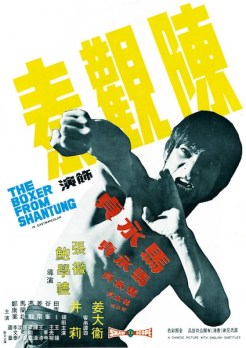
The Boxer from Shantung (1972)

aka Mǎ Yǒng Zhēn

2016 #56
Chang Cheh & Hsueh Li Pao | 125 mins | TV (HD) | 2.35:1 | Hong Kong / Mandarin | 18

The problem with watching so many Shaw Brothers movies so close together, as I have this year, is they begin to blur into one. There’s definitely a house style to the stories, the photography, the sets — everything, really. Even the particularly good ones can fail to lodge in the memory as discrete units.
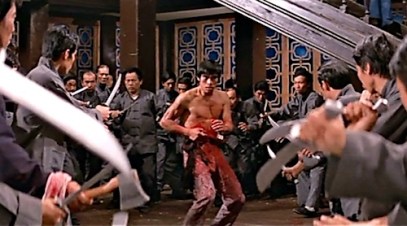
That said, The Boxer from Shantung is a particularly good one. It tells the based-(loosely)-on-a-true-story tale of Ma Yongzhen (Chen Kuan-tai), a small-town guy labouring in Shanghai. After an encounter with gangster Tan Si (David Chiang), Ma decides that’s the life for him, and sets out to climb the crime ladder.

The Boxer from Shantung displays a greater focus on plot and character than is perhaps typical for a Shaw Bros movie, but doesn’t exactly stint on action either — the sequences are a little more spread out than usual, and it results in a just-over-two-hours runtime that isn’t typical for these films. Fortunately, it’s an engrossing enough story that this isn’t a problem, even if the narrative has a rise-and-fall kind of shape that is fairly familiar in the gangster genre.

Nonetheless, where the film really comes to life is in its stonking climax — a massive brawl in which Ma kicks everyone’s ass for quarter of an hour, even with an axe embedded in his stomach. At the end of the day, tightly choreographed and expertly performed action sequences such as this are why we come to these movies; and, at the end of the day, The Boxer from Shantung doesn’t disappoint.

4 out of 5

Jurassic Park (1993)

100 Films’ 100 Favourites #47

An adventure
65 million years in the making.

Country: USA
Language: English
Runtime: 127 minutes
BBFC: PG
MPAA: PG-13

Original Release: 11th June 1993 (USA)
UK Release: 16th July 1993
First Seen: cinema, 1993

Stars
Sam Neill (Dead Calm, Event Horizon)
Laura Dern (Wild at Heart, Inland Empire)
Jeff Goldblum (The Fly, Independence Day)
Richard Attenborough (10 Rillington Place, Miracle on 34th Street)

Director
Steven Spielberg (Jaws, Indiana Jones and the Temple of Doom)

Screenwriters
Michael Crichton (Westworld, Twister)
David Koepp (Death Becomes Her, Panic Room)

Based on
Jurassic Park, a novel by Michael Crichton.

The Story
Invited to a remote island by an eccentric billionaire, a group of scientists, investors, and children discover he’s managed to clone and resurrect dinosaurs, which he intends to exhibit in his theme park: Dinosaur Land!
…not really — it’s called Jurassic Park. As the visitors tour the park looking at the creatures, a nice two-hour nature documentary unfolds.
…not really — the dinosaurs escape and run amok and people die and it’s basically a horror/disaster movie with giant prehistoric lizards as the killer/natural disaster. Good times.

Our Heroes
Dr Alan Grant and Dr Ellie Sattler are palaeontologists invited to Jurassic Park’s test run by enthusiastic grandfatherly billionaire John Hammond. There’s also Dr Ian Malcolm, a sexy mathematician (oxymoron?), and Hammond’s grandkids, siblings Tim and Lex, who Grant is essentially left to babysit. There’s also a handful of other characters who are essentially dinosaur-food… er, I mean, who are totally going to survive to the end of the movie.

Our Villains
It’s a bit mean to call the dinosaurs villains — they’re just behaving as nature intended. Of course, when uber-predators like Tyrannosaurus Rex and Velociraptors are involved, they’re still the main threat. Their impromptu freedom is all the fault of greedy, traitorous tech geek Dennis Nedry, though.

Best Supporting Character
For what may be the only time in movie history, Samuel L. Jackson is in this movie and isn’t the coolest character. That honour goes to Bob Peck as the park’s badass head ranger, Muldoon.

Memorable Quote
“Don’t move! He can’t see us if we don’t move.” — Dr Alan Grant

Quote Most Likely To Be Used in Everyday Conversation
“Clever girl.” — Muldoon

Memorable Scene
As the newly-arrived visitors drive across the island, Hammond whispers to the driver to stop. Dr Grant idly looks off to the side, and his mouth falls open in shock. He pulls off his hat. He stands. He fumbles to take off his sunglasses, not believing his eyes. Dr Sattler is distracted by a leaf that shouldn’t exist. Grant reaches over to grab her head, turns it to face what he sees. Now she looks shocked, standing and pulling off her glasses. Whatever they’re looking at, it’s big. And only then, as John Williams’ music swells, does Spielberg cut to it: towering over them, a Brachiosaurus — a real, living dinosaur.

Write the Theme Tune…
Some chap named John Williams totally lucked out writing the film’s iconic main theme, which is one of music’s best evocations of the feelings of awe and wonder.

Technical Wizardry
It’s easily overlooked among all the visual antics, but the film’s sound design is incredible, too. Spielberg insisted on all-new sounds being captured throughout (rather than using any library effects) to help ensure the dinosaur roars sounded unique. The T-Rex’s roar was a combination of sounds from dogs, tigers, alligators, elephants, and… penguins.

Truly Special Effect
Spielberg thought about using a combination of animatronics and groundbreaking CGI to create the dinosaurs, but they just resurrected some real ones instead. More seriously, there’s actually only 15 minutes of dinosaur footage in the film. Nine minutes of that is animatronics — despite its fame and influence, just six minutes were created with CGI.

Making of
Spielberg came up with the idea for the famous rippling glass of water when he saw the mirror in his car vibrate because of sound. When the effects team tried to replicate that with water, nobody could do it… but they told Spielberg they could. The night before the effect was to be shot, effects supervisor Michael Lantieri placed a glass of water on a guitar, plucked the strings, and got the desired effect. For the film — where the glass is on a car dashboard, not a musical instrument — guitar strings were attached to the underside of the dashboard. These days you know they’d just do all that with CGI, and this is why older movies are better.

Next time…
Spielberg returned to helm first sequel The Lost World: Jurassic Park in 1997, which has its fans, but not that many. Joe Johnston took over for Jurassic Park III, which is less epic than either of is predecessors, and more of a brisk (just 90 minutes long), straightforward action-adventure movie. After many years of aborted plans, the series was revived last year in Colin Trevorrow’s Jurassic World, which met with incredible financial success and a mixed (though generally favourable) reception. A fifth film, directed by The Impossible’s J.A. Bayona, will be a direct sequel to Jurassic World and is slated for release in 2018.

Awards
3 Oscars (Visual Effects, Sound, Sound Effects Editing)
1 BAFTA (Special Effects)
1 BAFTA nomination (Sound)
4 Saturn Awards (Science Fiction Film, Director, Writing, Special Effects)
7 Saturn nominations (Actress (Laura Dern), Supporting Actor (both Jeff Goldblum and Wayne Knight), Performance by a Younger Actor (both Joseph Mazzello and Ariana Richards), Music, Costumes)
3 MTV Movie Awards nominations (including Best Villain — for the dinosaurs? I don’t know.)
Won the Hugo for Best Dramatic Presentation

What the Critics Said
“As he did in Jaws, Spielberg has crafted a man-vs.-nature masterpiece with admirable logic, darkly funny violence and enthralling state-of-the-art special effects. Watching Jurassic Park, one gets the same feeling of wonderment, glee and old-fashioned fright that moviegoers must have felt 60 years ago when King Kong roared out of the jungle and scaled the Empire State Building. […] We ask for two things from big-budget thrillers like this: Make us believe and make us jump. Jurassic Park delivers on both counts; it’s the best gasp-between-the-giggles movie made since a cocky young director and a clunky Bruce the Shark scared the beach out of us 18 summers ago.” — Steve Persall, Tampa Bay Times
(I want to quote so much of this review, because it’s full of good bits, like how it’s “the most intelligent, pro-feminist adventure movie yet made”; or how “a faithful version of Crichton’s tale would have cost at least twice the film’s $60 million price tag” — a film costing $120 million? Unthinkable!)

Score: 93%

What the Public Say
“We’re kept waiting for the first full shot of a dinosaur, and it’s worth the wait, the little jeep carrying Sam Neill and Laura Dern stopping long enough for them to gawp in helpless wonder at the sight of Brachiosaurs eating. It works for two reasons. One is the reactions of the actors, which only adds to the moment’s sense of authenticity and gravitas. The second is the use of CGI. Jurassic Park was like a great leap forward in special effects technology. Before this, the only way to see dinosaurs on film was the stop-motion animated models shot painstakingly by Ray Harryhausen and his peers. Suddenly, all that was consigned to cinema history thanks to digital effects, work that holds up today because Spielberg knew how to use CGI judiciously rather than too often […] The combination of CGI and puppetry to create the dinosaur looks seamless, and whilst it must have been painstaking to develop and film there’s no doubt it’s great to watch” — Mike, Films on the Box

Verdict

For a certain generation, Star Wars is undeniably the defining cinematic experience. For a more recent one, I guess it’s Harry Potter or something. In between, you have my lot — and as became quite clear with the unexpectedly phenomenal response to Jurassic World this time last year, we have Jurassic Park. It was the first film I ever saw at the cinema, and much of it has been lodged in my memory every since.

That it’s beloved shouldn’t be such a surprise, really: it was huge back in 1993, and is one of only ten films that can lay claim to ever having been The Highest Grossing Movie Of All Time. It wasn’t the first film to employ computer-generated special effects, but by featuring them so prominently it paved the way for further effects breakthroughs. The groundbreaking imagery still holds up today — and when you consider that the effects in some movies out last week are already dated, that’s even more impressive.

It’s certainly not just about the effects, though: it’s a fantastic adventure movie, putting its likeable characters through the ringer in a story that is by turns exciting, funny, scary, and genuinely awe-inspiring.

#48 will be… a roaring rampage of revenge.