2022 | Week 26

I’m taking you back over two months here, to the end of June / start of July, for another eclectic batch of films I happened to watch in close proximity to each other…

  • The Flying Deuces (1939)
  • Apollo 10½: A Space Age Childhood (2022)
  • My Name Is Julia Ross (1945)
  • Ambulance (2022)
  • Easy A (2010)


    The Flying Deuces

    (1939)

    A. Edward Sutherland | 68 mins | DVD | 4:3 | USA / English | U

    The Flying Deuces

    I feel like I’m aware of Laurel & Hardy in a way I would say “everyone” is, but I guess that’s probably not true anymore (the kind of stuff I picked up or learnt about by osmosis in my ’80s/’90s childhood is surely very different to what kids got growing up in the ’00s/’10s). But I don’t think I’ve ever actively seen any of their work; certainly none of their feature-length films. The Flying Deuces is “probably their most famous film”, at least according to the blurb on my copy. Certainly, it’s the one you see bandied about the most; but then it’s in the public domain (one of only two Laurel & Hardy films where that’s the case), so it’s inevitably subject to endless cheapo releases. Leaving the quality of the print aside (it was poor; but at least it wasn’t cut, which apparently many are), I can’t say I was too impressed by the quality of the content, either.

    Here’s the rub: it’s a comedy, but it barely made me laugh. The humour operates at a basic level, with gags that are either well-worn or repetitious. “How anyone could be so stupid as to stand there and continually bump their head is beyond me,” one of them says at one point. And yet the other does exactly that, because that’s the level most of the film’s humour operates at. Some might say this is the downside of the duo being popular and their work being old — i.e. it’s been imitated and copied for decades, and we’ve moved on. But I don’t find that to be the case with silent comedians —who were equally, if not even more, popular, and whose work is even older — nor with things like the Road to films — which are far from the height of sophisticated comedy, but tickle my fancy more often.

    Well, there’s your answer, I guess: it’s all a matter of taste. And it seems Laurel and Hardy aren’t to mine.

    2 out of 5

    The Flying Deuces is the 41st film in my 100 Films in a Year Challenge 2022.


    Apollo 10½:
    A Space Age Childhood

    (2022)

    Richard Linklater | 97 mins | digital (HD) | 16:9 | USA / English | 12 / PG-13

    Apollo 10½: A Space Age Childhood

    I guess one of the advantages of being a filmmaker with some degree of clout is you can take your regular-ass childhood and turn it into a movie as if it was somehow special. That’s what the Before trilogy and Boyhood mastermind Richard Linklater has done here, fictionalising his autobiography as the story of ten-year-old Stanley, who lives in Huston, Texas, in the era of the first moon landing. Except, in this version, Stanley is secretly recruited by NASA to secretly train to be a secret astronaut to secretly be the first person on the Moon, in secret. If that sounds like an unusual spin on a traditional nostalgia-driven biopic, don’t get excited: that subplot is moved away from as quickly as it’s introduced, and only pops back up two or three more times, each brief. The film is much more concerned with real memories than imagined ones, and is much less fun for it.

    Often, at Christmas or other such get-togethers, members of my family will end up reminiscing about various childhood recollections. I’m sure many other families do a similar thing. What’s shared on these occasions are the kind of mundane memories that mean the world to us but, if you stopped to think about it, you know no outsider would find of much value. Well, seems Richard Linklater hasn’t stopped to think about it. And I really do mean “mundane”: there’s a sequence about which sibling did which chores and how they made their school lunches. As a commenter on iCM put it, Linklater “name checks every TV show and movie he saw, every game he played, everything in his diary […] for long stretches, it just feels like an itemized list of childhood memories.”

    One part that’s actually rather good is Jack Black’s voiceover narration as the adult Stanley. There’s probably too much of it (again underlining the fact these are nostalgic anecdotes rather than a true narrative), but the actual quality he brings is very nice. It feels calm and understated, neither giving in to Black’s usual mania nor substituting it for the hardcore tweeness you might expect from such a rose-tinted autobiography.

    Maybe Apollo 10½ will be more interesting to young people or future generations, whose technology- and safety-obsessed childhood experiences will be so far removed from what we see here. To them, it’s an historical documentary. I can’t say my childhood was much like this one (especially as it occurred almost 30 years later), but I guess I’ve picked up enough of this kind of nostalgia from other American films and TV series down the years that what Linklater has to share doesn’t feel remarkable enough to be worth sharing.

    3 out of 5

    Apollo 10½: A Space Age Childhood is the 42nd film in my 100 Films in a Year Challenge 2022.


    My Name Is Julia Ross

    (1945)

    Joseph H. Lewis | 65 mins | Blu-ray | 1.37:1 | USA / English | PG

    My Name Is Julia Ross

    Here we have one of those films that commonly gets called a film noir, but isn’t really (or, at least, doesn’t fit well with the standard conception of what noir entails). The blurb for Arrow’s Blu-ray release describes it as a “Gothic-tinged Hitchcockian breakout hit” (apparently it was produced as a B-movie but became so popular they promoted it to “A-feature status”), which struck me as accurate — it’s less standard noir, more a Rebecca-influenced psychological thriller. While it’s clearly no Hitchcock, it’s a very entertaining substitute.

    Nina Foch stars as the eponymous Julia Ross, who takes a job as a live-in secretary for a wealthy widow. But the job is a front: Julia is kidnapped, waking up a prisoner in a Cornish mansion, where the widow (Dame May Whitty) and her son (George Macready) try to convince her she’s actually Marion Hughes, the son’s wife, and she’s having a bit of an episode.

    From the way Arrow described the film, I assumed it was going to play to some degree with the idea that maybe she is actually mad. It would be a neat twist, right? That she is Marion Hughes, and the stuff we saw at the start was part of her delusion. But no, the film doesn’t even vaguely gesture at that route: right after Julia meets her prospective employer, we see that she’s plotting something nefarious — and the film isn’t even seven minutes in. Then, even before we really know that something’s up, Julia’s fancy-man is looking into her disappearance. It’s like the film’s playing all the right notes but in the wrong order.

    But it doesn’t really matter, because the whole thing is suitably entertaining. Rather than relying on the mystery of what’s happening, it’s more about how Julia can get out of the situation. Will she be able to escape her confinement? Can she somehow get out a message for help? Or will the villains succeed in their scheme? Plus, at just 65 minutes, it moves at a whipcrack pace, so you can sit back and enjoy the absurd plot rather than worrying about, well, how absurd it is.

    4 out of 5

    My Name Is Julia Ross is the 43rd film in my 100 Films in a Year Challenge 2022.


    Ambulance

    (2022)

    Michael Bay | 136 mins | Blu-ray (UHD) | 2.35:1 | USA & Japan / English | 15 / R

    Ambulance

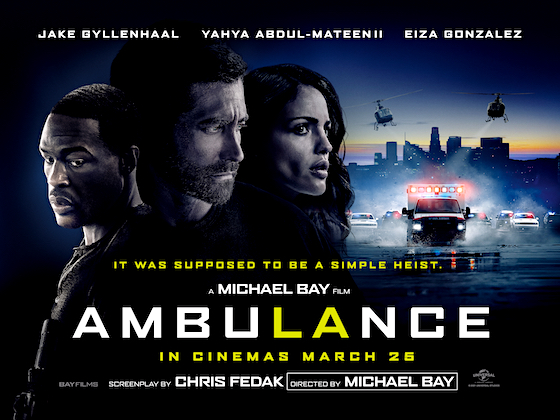
    When their bank heist goes sideways, two brothers (Jake Gyllenhaal and Yahya Abdul-Mateen II) make their getaway in a stolen ambulance — with a policeman they shot and the paramedic working on him (Eiza González) in the back. With the cops immediately on their tail, thus begins an epic car ambulance chase around the streets of LA.

    The setup feels like it should signal the low-/mid-budget debut of a new director showcasing their talents with a 90-minute stripped-back thrill-ride that’s mostly contained to the eponymous setting. But it’s not directed by some newbie — it’s Michael frickin’ Bay, back on the form that gave us action classics like The Rock. And so the 90-minute character-focused thriller is in there (honest it is), but augmented with 40 minutes of big-budget Bayhem.

    Compared to Bay’s other work in the past 15 or so years, Ambulance feels restrained. Compared to almost any other filmmaker, it’s anything but. When I say “restrained”, part of what I mean is the editing. Not that it takes a leisurely approach by any means, but it doesn’t have that “impressionistic jumble of B-roll” style Bay has tended towards on and off ever since Armageddon, and that became his only mode during a couple of the Transformers sequels. Also, I didn’t notice this until I read it on IMDb, but the film contains a literal Chekhov’s gun — that is, a gun that is a “Chekhov’s gun”. That’s so Michael Bay.

    Giving this film 5 stars would be a bit silly… but it was really good. It’s the kind of movie you’d never rate higher than 4, but you love for what it is: magnificent Bayhem.

    4 out of 5

    Ambulance is the 44th film in my 100 Films in a Year Challenge 2022. It placed 9th on my list of The Best Films I Saw in 2022.


    Easy A

    (2010)

    Will Gluck | 92 mins | digital (HD) | 16:9 | USA / English | 15 / PG-13

    Easy A

    When an overheard white lie about losing her virginity makes barely-noticed Olive (Emma Stone) the centre of her high school rumour mill, she decides to manipulate her newfound notoriety for her own amusement.

    As “raunchy teen comedy” plots go, it hits a sweet spot of being neither too prudish nor too lecherous. The dialogue elevates it further in a sharp and witty script by Bert V. Royal (who, it seems, has since only worked on TV shows I’ve never heard of. Shame). In her first lead role, Emma Stone gives a perfectly-pitched, surprisingly nuanced performance. The story really allows her to show off her versatility, believable as both the ‘quiet girl’ and ‘confident slut’. Obviously there’s lots of comedy, but she sells the moments of sincerity too. It’s no wonder she quickly got snapped up for more awards-type work. Plus, there’s Stanley Tucci being what I imagine Stanley Tucci is actually like as a dad, which is perfection.

    The only major downside (and it’s a bit of a spoiler, but also so predictable that it barely counts as a spoiler) is that it would’ve been nice if the guy she eventually ends up with wasn’t so stereotypically hot. We’re meant to buy him as a kinda-goofy sports mascot rather than someone who’d actually be playing The Sport? Yeah right.

    I’m not always a fan of high school movies or teen comedies, but there are definite exceptions, and this is the latest addition to that rarefied list.

    4 out of 5


  • Prey (2022)

    Dan Trachtenberg | 99 mins | digital (UHD) | 2.39:1 | USA / English | NR* / R

    Prey

    In the seemingly-endless cycle of “trying to reboot popular ’70s/’80s sci-fi franchises”, it is once again the turn of Predator, following in the wake of 2018’s disappointingly messy The Predator and 2010’s apparently-disliked Predators (I enjoyed it, but everyone seems to write it off nowadays). Where both of those tried to go bigger — either with more or larger versions of the eponymous aliens — Prey strips things back to basics, as per the one entry in the series everyone can agree is good, the first.

    Set around 300 years ago, when indigenous people still lived freely on the plains of North America, the film introduces us to a member of the Comanche tribe, Naru (Amber Midthunder, who genre fans might recognise from X-Men-adjacent TV series Legion), a young woman who wants to prove herself as a hunter like the tribe’s menfolk, including her exalted brother (Dakota Beavers). Long story short, she’s about to get her chance when an alien Predator rocks up.

    Plot-wise, Prey is pretty straightforward. And therein lies a big part of its success, because what more do we want from a Predator movie than “a hero has to fight a technologically-superior Predator”? If you do want more than that, I think you’ve come to the wrong franchise. Of course, simply rehashing what’s gone before is just another path to failure, and so what Prey does is take those basic bones and dress them up with fresh settings, ideas, and perspectives. In this case, that’s the period setting and Native American heroes. How do you defeat a Predator using weapons no more technologically advanced than bows and arrows? With intelligence, of course, and the film does a nice job of showing Naru gather information and formulate plans without ever needing to spell them out for us.

    The prey becomes the predator

    That it can pull that off is also to the credit of star Amber Midthunder, who conveys so much of Naru’s thought processes through only looks and expressions. All round she makes for an appealing heroine: she’s capable and brave, but not foolishly so, sometimes hanging back to assess the situation, or even running away when the odds aren’t in her favour, rather than diving in mindlessly. As action heroes go, I think that counts as nuance. I saw one critic tweet that she’s so good she needs to be given a Marvel superhero role ASAP, which is more a depressing indication of the state of cinema (appealing action lead? The highest honour would be a Marvel role!) than an indication of Midthunder’s ability (please, Hollywood, don’t just waste her on Marvel filler).

    This may be a straight-up humans vs aliens action movie, but it still treats its audience with a degree of respect. It knows we’re capable of joining dots ourselves, especially when we can see characters doing the same. Naturally, Prey has some developments and moments derived from previous Predator movies — it wouldn’t really be part of the same franchise if it wiped the slate wholly clean — but they feel recontextualised or come into play naturally, rather than the filmmakers over-eagerly forcing them on us as a plea to nostalgia.

    Quite aside from the plot and action, this is a beautifully made film. The first half-hour almost evokes the work of Terence Malick, with its relatively slow pace and photography that showcases nature and gorgeous scenery. This would’ve been a stunner on the big screen. Most big-budget theatrically-released films don’t look this much like A Movie nowadays, never mind streaming churn. I say it only “almost evokes Malick” because it’s not actually Malick-speed slow, but what it’s doing is quite deliberate: establishing the characters, the environment they live in, the things they know and the tools they have access to, and so on — as well as building up the looming threat of the alien hunter — so that we understand the world and the stakes when things kick off later.

    They're going on a bear hunt (no, really, at this point they think it's a bear)

    One thing I sort of want to pull the filmmakers up on is the language(s) used for dialogue. During promotion, they’ve talked about how some of the film is actually in the Comanche language, a selling point because of diversity and inclusion. Well, not much of the dialogue is Comanche — the primary language is unquestionably English — and it’s not subtitled, which means the vast majority of viewers can’t understand it, so they could be saying anything. I don’t think a film is ‘in’ a language if you can’t understand it (it’s why I’ve not listed Comanche as a language at the top of this review, nor the European languages spoken by the settlers who come into the plot, which also aren’t subtitled). That said, there is the option to watch the entire film dubbed in Comanche — a first, apparently. That would be more historically authentic, but it’s also a dub, i.e. not how the film was ‘intended’. Nonetheless, I’ve already seen some argue it’s a better version, so it may well be worth a look.

    That minor point aside (it’s not something I’m holding against the film, just the filmmakers’ boastfulness), Prey is a resounding success at what it sets out to be: an action movie in which humans and Predators have a fight. It’s the Predator film fans have long been waiting for. And it hopefully indicates to the studio bigwigs what the future of this franchise should be: pick a different era, with different technology and/or attitudes to combat, drop a Predator into it, and see how the humans get on against it. Honestly, with the right creatives, you could milk that simple premise for another half-dozen or more enjoyable movies, I reckon.

    4 out of 5

    Prey was the 49th film in my 100 Films in a Year Challenge 2022. It placed 10th on my list of The Best Films I Saw in 2022.

    * There was no certificate listed on the BBFC website at time of review; Disney+ continuing to take advantage of the fact there’s no legal requirement for streaming content to be certified. Some press ads listed the film as 18+, but they’ve gone with 16+ on the service itself. So, it’s either a 15 or an 18. I guess we’ll never know (unless it gets a disc release). ^

    Lupin the Third: Is Lupin Still Burning? (2018)

    aka Rupan sansei: Rupan wa imamo moeteiruka?

    Jun Kawagoe & Monkey Punch | 27 mins | Blu-ray | 16:9 | Japan / Japanese | 15

    Lupin the Third: Is Lupin Still Burning?

    Whether you want to call this a short film or a TV special or something else entirely (it was originally released straight to DVD as a special feature in Japan) is little more than a technicality, really. It’s a sub-40-minute standalone piece, and therefore I’m counting it as a short film (it also has been screened theatrically, so it’s not a totally ridiculous classification).

    What it definitely is is a 50th anniversary special for the Lupin the Third franchise. Best known in the West thanks to Hayao Miyazaki’s debut feature, The Castle of Cagliostro, Lupin III is actually a sprawling franchise. Beginning life in 1967 as a manga written and illustrated by a chap called Monkey Punch (I suspect not his birth name), an anime TV series followed in 1971, since when there have been multiple further series, dozens of films (both theatrical and TV specials), plus a couple of attempts at live-action movies, and a bunch of video games and stuff too.

    Although this short was produced to mark the birthdate of the comics, it takes its cue from the anime series, the first episode of which was called Is Lupin Burning…?! and had the same setup: Lupin is to take part in a car race, but it’s actually a lethal trap set by his enemies. But from there, this version spins off into some wacky time-travel shenanigans — a way to send our hero back into key adventures and moments from his history, handily.

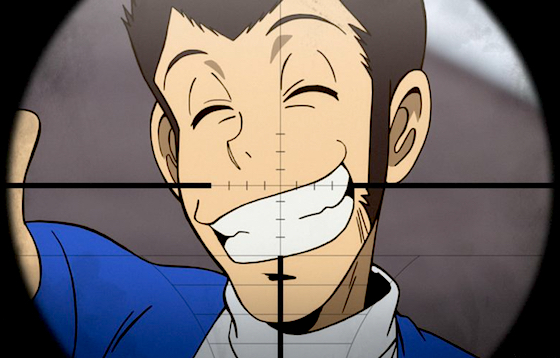
    50 years in the crosshairs

    Appropriately for a 50th anniversary special, Is Lupin Still Burning is loaded with references (both major and minor) for diehard fans to enjoy. As someone who has enjoyed a couple of Lupin’s adventures but is a long way from being well-versed in his world, I could tell a load of stuff was flying over my head — almost everything, in fact — which was unfortunate, but understandable. This is clearly a celebration that’s primarily aimed at dyed-in-the-wool fans rather than pleasing or initiating newcomers. That said, it still just about works as a madcap one-off adventure. It’s particularly enjoyable in the kinetic action sequences, like a destructive car race — being held in Nomaco (work out the ‘pun’ for yourself) — that plays out during the opening credits.

    The franchise’s only regular female cast member, Fujiko Mine, spends most of the film captured by the villains, strapped to a torture table with her clothing mostly torn off, being tickled by robot hands and stuff like that. Your feelings about all this are your own; I describe it merely for context. Put another way, not all of the “fan service” requires prior knowledge to be, er, serviceable.

    I expect if you’re a long-term fan of Lupin III, this fan-service-filled short is deserving of at least 4 stars. As someone without that depth of knowledge, it’s unmistakeable that you’re missing out on plenty. The callbacks aren’t little asides or background nods, but fundamental to the plot of the piece. Nonetheless, I’m giving it a positive score, because it is still enjoyable, even if it’s clearly not really made for the likes of me.

    3 out of 5

    2022 | Week 22

    Maybe I should’ve called this post “Weeks 21–22”, to ensure that the titles of these roundups had a complete run of weeks throughout the year. But I didn’t actually watch anything new in Week 21 (my only film that week was the Challenge-qualifying rewatch of On the Town), so it seemed inaccurate to include it.

    Week 22, on the other hand, was moderately busy, with this lot…

  • This Means War (2012)
  • To Be or Not to Be (1942)
  • An Unsuitable Job for a Woman (1982)
  • The Pajama Game (1957)
  • The Contender (2000)


    This Means War

    (2012)

    McG | 98 mins | digital (HD) | 2.35:1 | United States / English | 12 / PG-13

    This Means War

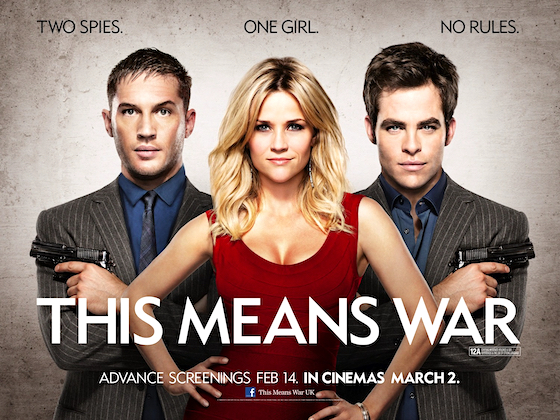
    I bet whoever came up with this thought they were a genius: “spyfi action-adventure + rom-com? It’s the perfect date movie!” Of course, what you actually end up with is a film that struggles to do either part well.

    It stars the unlikely combo of Chris Pratt and Tom Hardy (you definitely can’t imagine Hardy doing a movie like this today) as BFF CIA agents who independently fall for the same woman, played by Reese Witherspoon. Uh-oh. Hilarity ensues as the guys deploy their CIA tricks and tech to influence the relationships. Yeah, it’s the kind of concept that once upon a time sounded like a fun and quirky rom-com, but nowadays seems at best morally dubious, at worst downright creepy. And, indeed, that’s how it plays out, with situation after situation that’s played for laughs but feels a little uncomfortable.

    Of course, the big question is “who ends up with who?” This is one of those films so committed to its storyline, so structured to lead to one correct answer, that… they shot multiple endings so they could decide in post. The one they went with doesn’t feel quite right, but, if you imagine the alternatives, most of them don’t either. Well, I say that: I don’t think it’s really a spoiler to tell you that Witherspoon ends up with one of the guys, when the correct choice would’ve been “neither of them. Run from the stalker-ish CIA agents! Find a normal man!”

    2 out of 5


    To Be or Not to Be

    (1942)

    Ernst Lubitsch | 99 mins | digital (HD) | 1.37:1 | USA / English | U

    To Be or Not to Be

    Ernst Lubitsch’s satire concerns an acting troupe in occupied Poland who become mixed up in a soldier’s efforts to capture a German spy before he can undermine the resistance. Made while World War II was still in full force, the film attracted criticism in some quarters for being a comedy about such tragic and ongoing real-life horrors. Lubitsch defended his work, writing to one critic to say, “What I have satirized in this picture are the Nazis and their ridiculous ideology. I have also satirized the attitude of actors who always remain actors regardless how dangerous the situation might be, which I believe is a true observation.” He’s right, of course; at least about the first part. Ridiculously, such debates about whether you can satirise the Nazis persist to this very day — just look at some of the responses to Jojo Rabbit.

    Lubitsch’s film is subtler than Waititi’s, though still undoubtedly a comedy. I mean, with its plucky resistance members taking occupying Nazis for fools, I couldn’t help but think of this as a classier version of ’Allo ’Allo… but I’ve never actually seen a whole episode of that show, so don’t hold my comparison in too high a regard. Whereas that sitcom is famous for its catchphrases and bawdy gags, To Be or Not to Be is less overt, preferring to paint the Nazis as fundamentally incompetent and derive its humour there.

    Despite the distaste some felt, it obviously works for most people, as it appears on several “great movies” lists, not least both the IMDb and Letterboxd Top 250s. To be honest, I feel like I need to give it another spin to digest it more fully, but these thin thoughts will have to suffice for now.

    4 out of 5

    To Be or Not to Be is the 35th film in my 100 Films in a Year Challenge 2022. It was viewed as part of Blindspot 2022.


    An Unsuitable Job for a Woman

    (1982)

    Christopher Petit | 94 mins | Blu-ray | 1.85:1 | UK / English | 15

    An Unsuitable Job for a Woman

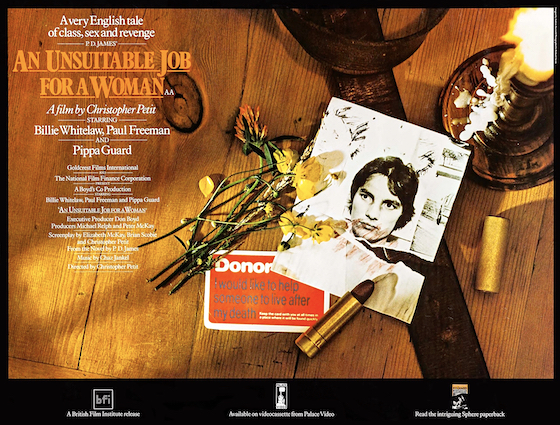
    I’ve never read the P.D. James novel on which this is based, but I’m assured it’s longer and more complex — the film rather lacks for plausible suspects, making the central murder mystery thoroughly guessable.

    That said, I’m not sure co-writer/director Christopher Petit is all that concerned with producing a true whodunnit. Put another way, I think he’s more interested in the characters, who happen to be involved in a mystery, than in the mystery itself. Which is fine, but I’m also not sure the film does as good a job as it could digging into those characters. I mean, the way the kinda-naïve young investigator becomes obsessed with the deceased subject of her inquiries — almost falling in love with him, it seems, like some kind of gender-flipped riff on Laura — is more nodded at than explored.

    In the end, I felt like I wanted to like the film more than it was actually giving me things I needed to really like it. It’s not bad, but perhaps it could have been great.

    3 out of 5


    The Pajama Game

    (1957)

    George Abbott & Stanley Donen | 101 mins | digital (SD) | 4:3 | USA / English | U

    The Pajama Game

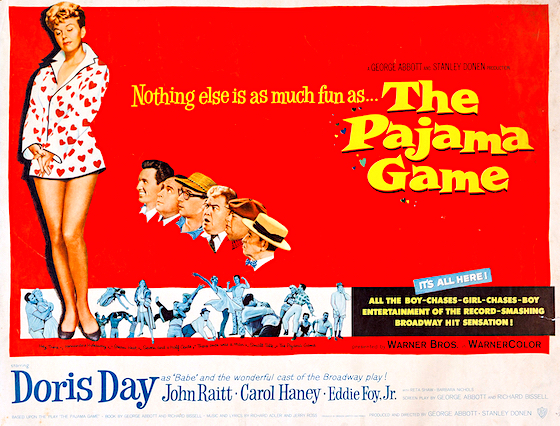
    This minor musical is primarily of note for two things: the original Broadway staging featured the choreography debut of one Bob Fosse; and it features the song Hernando’s Hideway — if you don’t recognise the title, I’m sure you’ll recognise the tune. I had no idea this is where it originated.

    The story is about a pay dispute in a pyjama factory (given the current strikes and arguments here in the UK, you might think I watched this deliberately. Nope, total coincidence). On one side there’s the leader of the union’s grievance committee (Doris Day, one of just a handful of replacements made to the original cast when they transferred the stage production to the screen). On the other, the new superintendent (John Raitt, clearly a success on Broadway but less so on film). Of course, they fall for each other, before the pay conflict tears them apart. Can their love overcome such trials? What do you think?

    I saw someone describe The Pajama Game as an overlooked classic, which is taking things a bit far. It’s mostly likeable and quite fun, but rarely transcends that level. The undoubted highlight is Fosse’s choreography, which gives even the lesser numbers a polished dynamism. There are a couple of decent songs, but nothing really stands out, bar the aforementioned. It gets a bit too farcical in places, with some of the storylines ultimately taking a turn into very broad territory that feels misjudged. One primarily for genre fans only.

    3 out of 5


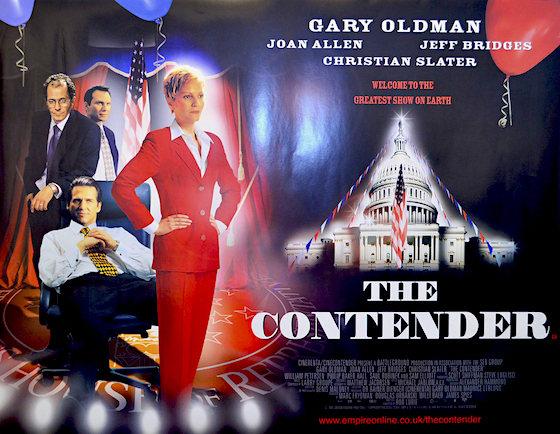
    The Contender

    (2000)

    Rod Lurie | 126 mins | Blu-ray | 16:9 | USA, Germany & UK / English | 15 / R

    The Contender

    I only picked this up on disc because it was part of a bundle of other titles I really wanted, but it also sounded like the kind of thing I’d like. Strange that I’d not heard of it before, then. I guess some films just get lost in movie history, especially when they’re a lesser member of a whole wave of movies. This is a political thriller of the kind they seemed to make quite a few of during the ’90s and into the early ’00s, but don’t really do anymore. I guess they exhausted the well, especially after 156 episodes of The West Wing.

    In this case, the story revolves around Laine Hanson (Joan Allen), the first woman nominated to be Vice President (it only took another two decades for that to happen in real life). There’s the familiar battle between the Democrats to get her confirmed, and the Republicans who’d like to do anything to thwart the Democrats. Amongst the scheming between the two sides, the big revelation is that Laine possibly engaged in a scandalous sex act while in college. She refuses to confirm or deny the rumour — it’s her personal business and shouldn’t affect her appointment. Except, of course, it does.

    Various other allegations come and go throughout the confirmation process, the two sides continuing to go back and forth in their attempts to win. It’s not necessarily the point the film is making, but it’s a reminder that politics is all a game to those involved, even as it can have serious effects on the lives of the rest of us. More overtly, the film tackles the different standards a woman is held to when trying to take public office. Fortunately, it’s not as overbearing with that as it could be. Indeed, all round the film is fairly understated. It’s a solid, unflashy, procedural-based kind of thriller.

    That is until the end, when it throws away the understatement for a grandstanding speech based around a fundamental belief in the greatness and goodness of the American political system. It would be heavy-handed in any circumstance, but the past few years (if not longer) of American politics have shown it for the total lie it always was. It doesn’t wholly undermine what’s gone before, but it does end the film on a sour note.

    4 out of 5


  • Shang-Chi and the Legend of the Ten Rings (2021)

    Destin Daniel Cretton | 132 mins | digital (HD+3D) | 2.39:1 | USA / English & Mandarin | 12 / PG-13

    Shang-Chi and the Legend of the Ten Rings

    Unless you’re a dyed-in-the-wool fan, keeping up with the MCU is beginning to feel more like a chore than entertainment. There’s just so much of it! No wonder it can feel like its fans never watch anything else, because getting through the myriad TV series and movies could conceivably fill most of your free time. That said, it’s obviously not doing the movies any harm (yet) based on the spectacular box office performances of No Way Home ($1.89 billion, the 6th highest grossing film of all time) and Doctor Strange 2 ($935.3 million and counting). And getting round to everything does have its benefits, because occasionally you find a diamond, and it’s not always one the critics or other viewers have flagged up. I mean, most of what I heard about the first Doctor Strange was that it was just the standard superhero origin story over again, but it’s one of my favourite films from the studio’s output, primarily thanks to the stunning visuals and a few other clever developments. Being another iteration of something isn’t always bad, especially if you’ve iterated closer to perfection.

    Shang-Chi is the latest Marvel movie to fall into that camp for me. It is, again, a superhero origin story; but, again, one that’s been refined to a place where the hints of familiarity don’t really matter. It’s about Shaun (Simu Liu), an ordinary guy working as a valet in San Francisco… who it turns out isn’t such an ordinary guy, but is really Shang-Chi, the son of the magically-powered leader of a global crime syndicate known as the Ten Rings. Of course, events conspire to bring Shang back into contact with his estranged family, where he must choose whether to stand against his father’s evil plans.

    The MCU publicity claim that any given film is “not just a superhero movie, it’s a [1970s conspiracy thriller / John Hughes comedy / whatever]” has, rightly, become a bit of a laughing stock. But I think Shang-Chi might be the first time it’s actually true. Yeah, it’s undeniably set in the MCU and, as such, plays by some of those rules (there are Blip references from early on, with the requisite cameos and mid-credit teaser scenes to follow), but the bulk of the movie itself is not really a superhero film as we normally think of them. Rather, it’s a martial arts fantasy-actioner. Now, maybe those are in the same ballpark — people with impossible abilities fighting each other — but I’d argue the style of it in Shang-Chi feels closer to something like Detective Dee or 47 Ronin (except good) than Iron Man or Captain America, or even the other fantasy/magic-based MCU sub-series like Thor or Doctor Strange.

    A sticky situation

    And for that, I loved it. Unfortunately, where it’s most like the MCU is in an ‘epic’ battle finale that, a few show-off moments aside, is mostly realised through CGI that looks like swirling mud. If it weren’t for that disappointment (and, to be clear, it’s not a disaster, just a bit of a let down), I might have given the film an even higher score.

    I was also glad I bothered to track down the 3D version (only released on disc in Japan, I believe. I also believe Japanese imports are expensive. I wouldn’t know from experience, I’ve never bought one). I’m aware that 3D is an ever-dwindling format and that’s why major labels aren’t bothering with disc releases anymore (though it must be worth it at theatrical level, because they’re still shelling out for these post-conversions that cost millions of dollars a pop), but it’s a shame for those of us who enjoy it and still have the kit, because it’s as enjoyable as it ever was when done well. Shang-Chi may not be the height of the format, but lots of it looked nice with the extra dimension. Sadly, unlike many previous Marvel 3D releases, it didn’t have the bonus benefit of a shifting IMAX ratio. There is an “IMAX Enhanced” version of the film (it’s on Disney+), but, like the last two Avengers movies, it presents the entire film in IMAX’s 1.9:1 ratio, so no luck for us 3D fans there (or anyone bar Disney+ viewers, because it’s not included on the film’s 2K or 4K Blu-ray releases either).

    4 out of 5

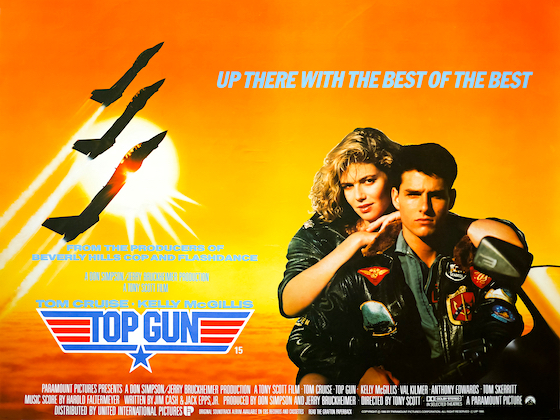
    Top Gun (1986)

    The 100 Films Guide to…

    Top Gun

    Up there with the best of the best

    Country: USA
    Language: English
    Runtime: 110 minutes
    BBFC: 15 (1986) | 12 (cinema, 1989) | 15 (video, 1996) | 12 (video, 2004)
    MPAA: PG

    Original Release: 12th May 1986 (Mexico)
    US Release: 16th May 1986
    UK Release: 3rd October 1986
    Budget: $15 million
    Worldwide Gross: $357.5 million

    Stars
    Tom Cruise (Risky Business, Mission: Impossible)
    Kelly McGillis (Witness, The Accused)
    Val Kilmer (Top Secret!, Batman Forever)
    Anthony Edwards (Revenge of the Nerds, Miracle Mile)

    Director
    Tony Scott (The Hunger, Crimson Tide)

    Screenwriters
    Jim Cash (Turner & Hooch, Anaconda)
    Jack Epps Jr. (Dick Tracy, The Flintstones in Viva Rock Vegas)

    Based on
    Top Guns, a magazine article by Ehud Yonay.

    The Story
    Fighter pilots Maverick and Goose are sent to the US Navy’s elite Fighter Weapons School, aka Top Gun, a combat training academy-cum-competition to establish the Navy’s best pilots.

    Our Hero
    Pete ‘Maverick’ Mitchell is a hotshot pilot who’s prone to bending the rules when he thinks it’s necessary. But that sort of behaviour doesn’t fly with the instructors at Top Gun. Is his daring what gives him the edge, or what makes him a liability?

    Our Villain
    Maverick’s prime rival in the Top Gun competition is Tom ‘Iceman’ Kazansky, whose callsign comes from the his precise, ‘ice cold’ flying style — the antithesis of Maverick. In the real-world, the villains are the MiG fighter jets of a tactfully unnamed foreign power.

    Best Supporting Character
    Maverick’s best mate and RIO (Radar Intercept Officer) is Nick ‘Goose’ Bradshaw. While Maverick seems to rub most people up the wrong way, Goose is widely liked. No idea where his nickname comes from.

    Memorable Quote
    “I feel the need… the need for speed!” — Maverick

    Memorable Scene
    For all the slick flying and whatnot, arguably the film’s most iconic scene comes on the ground, when the pilots relax by playing a game of beach volleyball — mostly shirtless, their sweaty muscles glistening in the sun. If you weren’t already feeling the homoerotic subtext, this kind of rams it home. (It’s a fairly incidental scene, but if you doubt its impact, know that the makes of the sequel felt they had to include a version of it, which led to the cast prepping for months to make sure their bodies were suitably toned.)

    Memorable Music
    Top Gun is blessed with multiple memorable tracks, both original songs and soundtrack cues. Several even won awards (see below). But the one that didn’t is the most iconic, and so catchy that it’s played several times throughout the film: Kenny Loggins’ Danger Zone.

    Making of
    There was a lot of cooperation from the US Navy in the production of the film (it paid off: after release, they saw recruitment skyrocket), but they only authorised two actual missile shots for filming purposes. Both were were shot from multiple angles to generate extra usable footage, but it still wasn’t enough, and so the filmmakers commissioned further shots using miniature planes and rockets. These were done so convincingly that the Navy conducted an investigation into whether any unauthorised missile firings had been performed for the film.

    Next time…
    It took over 35 years (partially thanks to Covid-related delays), but a sequel was finally released this year. But of course you know that: Top Gun: Maverick is probably the most praised blockbuster of the year so far.

    Awards
    1 Oscar (Original Song (Take My Breath Away))
    3 Oscar nominations (Sound, Film Editing, Sound Effects Editing)
    1 People’s Choice Award (Favorite Motion Picture)
    1 Grammy (Pop Instrumental Performance (Top Gun Anthem))
    1 Brit Award (Soundtrack)

    Verdict

    I loved Top Gun as a young kid — though, as is so often the case with movies from my childhood, I don’t actually know how many times I saw it. We weren’t great rewatchers in my household, so I expect I only actually watched it two, maybe three times, max. But my dad and I used to play jet fighter simulator games on our PC, with usernames like Maverick and Iceman, entirely inspired by the film. So, obviously, it comes with a dose of nostalgia for me, even though I hadn’t seen it for a couple of decades (my recent rewatch inspired by, of course, the release of the sequel). Does it hold up? Well, that depends what you want from a movie. It certainly comes with a more-than-healthy does of ’80s cheese and rampant-but-unacknowledged homoeroticism. For some, that makes it either unwatchable or two hours of laughing at the film. But if you’re onboard with its particular style, it’s still good fun; an entertainment-focused blend of fast-paced action in the skies and matey rivalry on the ground, with a dash of romantic melodrama for good measure.

    Spider-Man: No Way Home (2021)

    Jon Watts | 148 mins | Blu-ray (UHD) | 2.39:1 | USA / English | 12 / PG-13

    Spider-Man: No Way Home

    I’m currently both behind and out of sync with my viewing of the Marvel Cinematic Universe. I’ve seen Black Widow, but overleapt Shang-Chi and Eternals to get to this widely-discussed and already-beloved instalment. And that’s without discussing the various canonical TV series there now are, which I think some of us still thought would be treated as ‘side projects’ but seem to be being used to introduce and explore key elements that underpin Phase Four. Which is another way of saying: hopefully this film makes sense without having seen Loki. (It does, assuming you know what a multiverse is — and as that was also discussed in the previous Spidey film, I think we’re good.)

    No Way Home picks up at the exact moment the last Spidey movie, Far from Home, left off: Peter Parker’s identity has been revealed to the public, and he’s accused of murder. Rather than make a whole story from the fallout, No Way Home uses it as a jumping off point. As revealed in the film’s own trailers, Peter asks Dr Strange to magic things back to how they were before, but the spell goes awry and drags in villains from alternate realities. As the trailers didn’t give away — but was, frankly, inevitable (and has been widely used in post-release promos, so I’m not counting it as a spoiler anymore) — it also pulled through alternate Peter Parkers, as played by Tobey Maguire and Andrew Garfield.

    And that’s not the half of it! It feels like they’ve gone out of their way to crossover with everything possible: as well as the two previous Spider-Man film series, there’s something from spinoff Venom, and even the MCU Netflix series, which were previously of dubious canonicity (of course, now they’re on Disney+ so they’re allowed to count again). About all that’s missing is Into the Spider-Verse, and there’s even an oblique reference to that. With all of that in the mix, it plays kinda like Fan Service: The Movie. Normally that would be a criticism, but it does it so entertainingly — and it’s so much the movie’s very raison d’être — that I think it works, in its own way. It feels similar to X-Men: Days of Future Past in the way it mixes different eras and facets of the same franchise together to create an ‘anniversary special’ kind of feel. That also means it doesn’t just feel like “The MCU: Episode 27”, but instead a climax to all the Spider-Man movies. That’s a pleasant change of pace, and one befitting such a storied superhero.

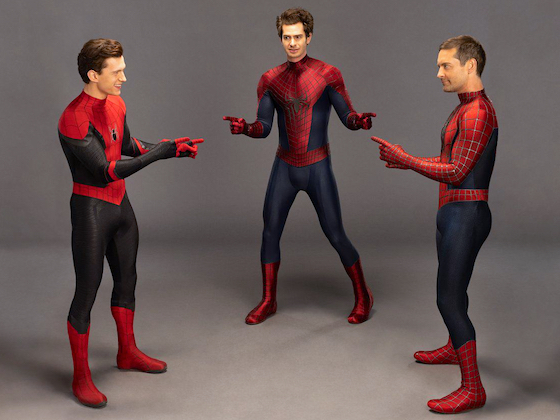
    Your friendly neighbourhood Spider-meme

    Keeping the appearance of the other Spideys out of the marketing may have seemed daft — of course we all knew they’d be in it — but it at least means we hadn’t already seen their best interactions in the trailer(s). How rare is it for a blockbuster nowadays to actually keep some of its biggest thrills for the film itself, rather than blowing them in advance! Indeed, my favourite bit of the whole film was the Spideys just hanging out and chatting while they waited for the villains to show up for the climax. It’s mostly fan service again — their discussion is almost entirely framed in references to previous films — but it’s nice as a moment of calm. And, like all of the film’s fan service, it tickles the nostalgia glands in those of us who get the references.

    It’s notable that each of the Spider-Men has a distinct personality. We’re now familiar with Tom Holland’s childlike, motormouthed take. Garfield brings the earnest, kinda skater/surfer dude feel that he sometimes has in real life — witness the moment he pauses mid action sequence to tell the other two Spideys, quite sincerely, that he loves them. Maguire, on the other hand, is very quiet and still. He only speaks if he needs to, and that doesn’t seem to be too often. It’s an innate calmness — perhaps also maturity — but it goes beyond that. It’s not that you feel he doesn’t want to be there, more like he’d feel exactly the same way if he wasn’t there — whatever; it’s all fine. If that sounds like “laidback” might be the right label, it isn’t. It’s almost that he’s doing… nothing. But that would be a rude thing to say to an actor, because of course he’s not doing nothing. It’s a bit of an odd one; or odd within the context of the hyperactive MCU, at any rate.

    The (literal) cheers that greeted No Way Home on its release have led to it being labelled a Great Movie by some (there was even a campaign to get it Best Picture recognition). Part of that is the regular thing of certain MCU fans apparently not watching anything other than MCU movies and so not having a proper frame of reference. But it’s also how the movie works: it tickles certain pleasure glands in such a way that, for some people, there’s confusion between “this is a lot of fun” and “this is a genuinely superb piece of cinema”. Heck, maybe, for some people, those are the same thing. Not for me. I don’t even think it’s the best Spider-Man film. But let’s not end on a negative, because it is a highly entertaining and, in its way, rewarding couple of hours of entertainment.

    4 out of 5

    2022 | Weeks 12–13

    So, it’s already the 15th — fundamentally halfway through the month — and this is just my ffith post in May. (It would’ve been third, but then my West Side Story and F9 reviews felt like they should have their own posts.) In my mind, I’ve raced this batch out as quickly as possible following my start-of-month posts, but it certainly doesn’t feel very speedy when you look at the dates.

    And, talking about messing with time, this roundup begins by taking us all the way back to March: week 12 ended on the 27th of that month. I might’ve posted sooner, were it not that week 12 seemed too small to run by itself. For what it’s worth, week 13 ended on 3rd April, so I’m still over a month behind now.

    Anyway, here are the rest of the new films I watched that fortnight…

  • Muriel’s Wedding (1994)
  • Cobra (1986)
  • Django & Django (2021)
  • A Man Escaped (1956), aka Un condamné à mort s’est échappé
  • Death on the Nile (2022)


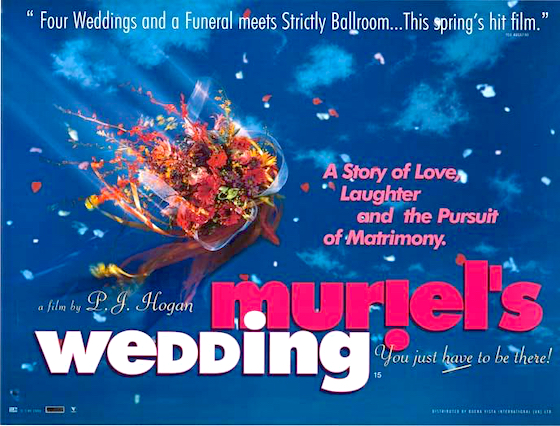
    Muriel’s Wedding

    (1994)

    P.J. Hogan | 101 mins | digital (HD) | 1.85:1 | Australia & France / English | 15 / R

    Muriel's Wedding

    This is one of those films I’ve been sort of aware of forever, but never really paid a huge amount of attention, until suddenly I’m watching it almost on a whim. It’s the story of the misadventures of small-town Australian girl Muriel (a breakout performance from Toni Collette), who doesn’t fit with her family or ‘friends’ and so sets off to the big city for a different life.

    I don’t know what I was expecting from the film, exactly — a kooky Aussie romcom, I guess — but not a surprisingly dark, quirky almost to the point of being twisted, black comedy. Not that that’s a bad thing, but it kind of bamboozled me by being a lot odder and more tonally complex than I’d anticipated. I liked it, but it’s a weird one.

    4 out of 5


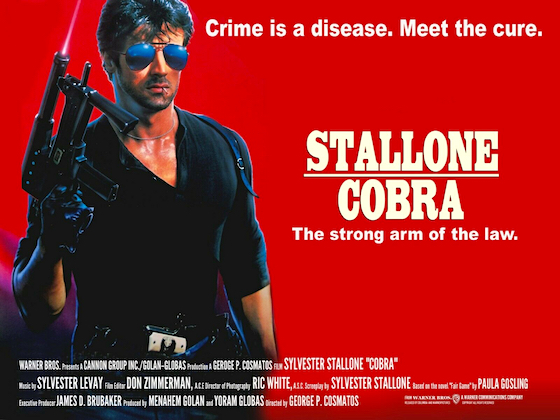
    Cobra

    (1986)

    George P. Cosmatos | 87 mins | digital (HD) | 16:9 | USA & Israel / English | 18 / R

    Cobra

    This is the kind of film I might never have watched were it not for my WDYMYHS challenge. It’s a film I’d heard very little about, and what I had heard wasn’t good, but when it came to selecting the 12 most significant films I hadn’t seen from 1986, it scraped in. I’m glad things like that happen, because while Cobra is far from being a new favourite or something, I did enjoy it.

    Sly Stallone stars as a hot-shot cop on the trail of a serial killer with cult affiliations. That’s about it for the plot. This is a film that’s all style and no substance — though, when you’ve got this much style, maybe that is the substance. It’s so much a stereotypical ’80s macho action fest that it plays like a spoof of itself in places, with over-the-top editing, performances, and one liners that all seem driven by some sense of ‘cool’. I kinda love it for that. Take the car chase at the halfway mark: it’s a ludicrous sequence (one bit barely connects to the next; cars explode when shot; etc), but it’s filmed and cut with style and packed with excitement. It’s epic.

    Remarkably, it’s based on a novel. I say that’s remarkable because novels are devoid of being able to show off flashy visuals or dynamic action sequences, so you think of them as being heavier on things like plot and character — but, as discussed, this has very little plot, and even less character development. The already-brief running time seems to mostly contain music montages and extended action scenes. Reportedly the original cut was around two hours, which was then mercilessly shorn down to the under-90-minute final cut in an attempt to squeeze in more screenings per day. I imagine a lot of what went was the plot, although apparently there was also a lot of graphic violence — and what we’re left with still earnt an 18.

    I guess if a “director’s cut” was going to surface it would’ve done so by now (given all the other films that got them back in the ’00s). It’s something of a shame, because perhaps that version would round out the storyline enough to match the flair that’s all we get from the existing cut. Really, it’s a trashy film, but I rather enjoyed its trashiness. As stated, it’s all style and, at just 87 minutes, all business.

    3 out of 5

    Cobra is the 23rd film in my 100 Films in a Year Challenge 2022. It was viewed as part of “What Do You Mean You Haven’t Seen…?” 2022.


    Django & Django

    (2021)

    Luca Rea | 77 mins | digital (UHD) | 16:9 | Italy / English, Italian & French | 15

    Django & Django

    The work of the “second-best Spaghetti Western director”, Sergio Corbucci, is analysed by admirer Quentin Tarantino, and supplemented with a handful of anecdotes from a couple of people who worked with him. The small number of interviewees means the film is lacking in the depth you get from having multiple perspectives, but it’s a fine overview of Corbucci’s work nonetheless.

    Indeed, the title — implying a focus on two specific films — is a bit of a misnomer. Not only is it about Corbucci’s career as a whole, with Django just one film among many, but there’s only a single clip from Django Unchained, when QT mentions how Corbucci’s style influenced his choice of Southern setting. That’s it for discussion of Tarantino’s own work — barring a lengthy opening aside into the alternate history of Once Upon a Time in Hollywood; a ‘short story’ about Rick Dalton’s time in Italy and his meetings with Corbucci. Tarantino relates these events as if they’re historical fact — the guy really did thoroughly imagine his alternate history!

    3 out of 5

    Django & Django is the 24th film in my 100 Films in a Year Challenge 2022.


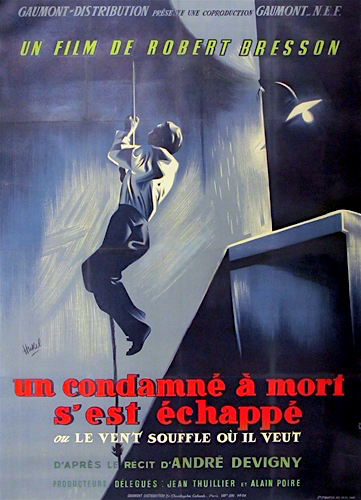
    A Man Escaped

    (1956)

    aka Un condamné à mort s’est échappé ou Le vent souffle où il veut

    Robert Bresson | 101 mins | digital (HD) | 1.33:1 | France / French & German | U

    A Man Escaped

    Most “prisoner of war” movies are about plucky Brits and/or Yanks stuck in jail somewhere behind enemy lines, working out ways to escape almost as a time killer, or at best a matter of honour. A Man Escaped is something different. Based on the memoirs of André Devigny, a member of the French Resistance held in a French prison by the occupying Germans during World War II, and written and directed by Robert Bresson, who was also imprisoned by the Germans as a member of the Resistance, you can’t doubt its pedigree for authenticity. Indeed, Devigny was an adviser on the film, and lent the production the actual ropes and hooks he had used in his escape. More than these points of fact, it’s the film’s overall tone that’s striking — more dour and pessimistic than the usual POW drama, at least as I remember them. Here, the need to escape isn’t a game, it’s literally life or death.

    Bresson certainly knows where he wants his focus to be. The film begins with our hero, Fontaine (François Leterrier), arriving at the prison, although an escape attempt on the way there sees him immediately condemned to solitary confinement. Nonetheless, we remain by his side, never leaving him or his point of view, right until the end, when… well, that would be a spoiler. In terms of background, there’s only what we can pick up along the way; the barest outline of who he is, why he’s there, and what awaits him on the outside. That’s extraneous detail — this is all about his time in prison, his mentality in prison, and how he intends to escape the prison.

    To that end, Bresson spends a lot of time detailing very little. The process by which Fontaine fashions ropes, or chips away at a crack in his door to facilitate a way out, is shown in almost-excruciating detail. It’s all about the prep. When something truly dramatic does happen — like Fontaine gaining a roommate, and the question of whether that man can be trusted — it’s dealt with quickly, confined to a couple of quick scenes. I can only think that’s part of the point: much of the work to escape prison is tedious preparation, but when a spanner gets in the works it has to be dealt with quickly lest it derail the whole enterprise. Such ‘big things’ are a potential threat, but it’s arguably the little things that are even more dangerous. Accidentally drop something noisily, thus alerting the guards to your suspicious activities, and it’s all over.

    As a film, it doesn’t feel as strikingly stylised as the other Bressons I’ve seen, but it definitely has a stripped-back simplicity that’s part of his overall ethos. It’s debatable if we need the semi-monotone voiceover that describes exactly what we can see on screen — I’m no expert, but such an unnecessary and purely cinematic addition seems out of sorts with Bresson’s usual style. That said, at points it adds insight into Fontaine’s thought process, so the narration is not without merit.

    4 out of 5

    A Man Escaped is the 25th film in my 100 Films in a Year Challenge 2022. It was viewed as part of Blindspot 2022.


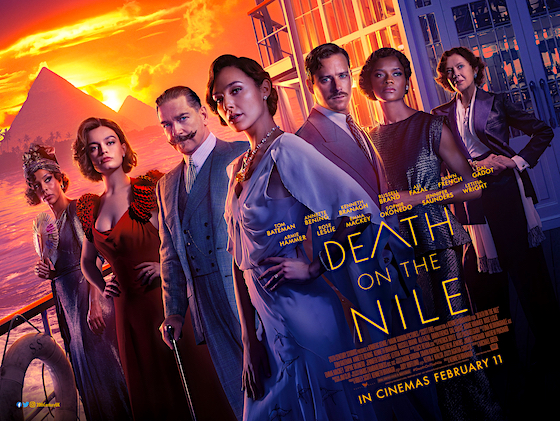
    Death on the Nile

    (2022)

    Kenneth Branagh | 127 mins | digital (UHD) | 2.39:1 | USA & UK / English & French | 12 / PG-13

    Death on the Nile

    Kenneth Branagh returns as both director and star for another Hercule Poirot mystery, after the somewhat-surprising success of his Murder on the Orient Express — “surprising” in the sense that it did better at the box office than I think anyone expected. It performed less well with critics, but I enjoyed it. Sadly, this followup is not its equal… though that’s not necessarily saying it’s bad.

    For me, it was a film of two halves — although, often as not, those two halves occurred simultaneously. For example: there’s an over-reliance on CGI for the Egyptian vistas makes many scenes look disappointingly fake; but then there’s a fantastic, huge set for the boat where much of the film takes place, and the real-life elements are quite handsomely shot on 65mm. Story-wise, there’s been a lot of rejigging (try to line up the cast with who played the roles in previous adaptations, for example, and you’ll soon discover a lot of the characters are amalgamations), but Christie’s typically excellent plotting survives mostly intact. That said, the ratio of buildup to detective work feels off, with the murder seeming to occur quite late in the film and the subsequent investigation feeling rather rushed.

    The motive behind screenwriter Michael Green’s remixing seems to be a serious attempt to make the film All About Love — not just the motive for the crimes, but all the subplots and whatnot too. I guess they were seeking some kind of justification for why this story is being filmed again, and what makes it worthy of the all-star movie treatment, rather than being just a run-of-the-mill, see-it-every-week-on-TV whodunnit. Plus, there’s a bizarre attempt to provide a backstory for Poirot’s moustache. No, seriously.

    Branagh initially seemed miscast as Poirot, but wasn’t bad in Orient Express, and that continues here. His version of the character is rather likeable, imbuing the Belgian with a neat sense of humour that marks his interpretation out from previous incarnations (Ustinov often played it for laughs too, but with less subtlety). There’s the customary all-star supporting cast, but they’re somewhat wasted, with some big names or talented performers left with too little to do. Though, when about half of them are employing dodgy accents, maybe that’s no bad thing.

    A mixed bag, then. It’s far from my favourite Christie adaptation; although it might actually be my favourite Death on the Nile by default, because I don’t think the previous versions (a Ustinov film and Suchet TV episode) are the best their respective series have to offer either. Whatever — I love this kind of stuff, and I’m glad to hear they’re intending to forge ahead with a third outing.

    3 out of 5

    Death on the Nile is the 26th film in my 100 Films in a Year Challenge 2022.


  • Fast & Furious 9 (2021)

    aka F9

    Justin Lin | 137 mins | digital (HD) | 2.39:1 | USA / English | 12 / PG-13

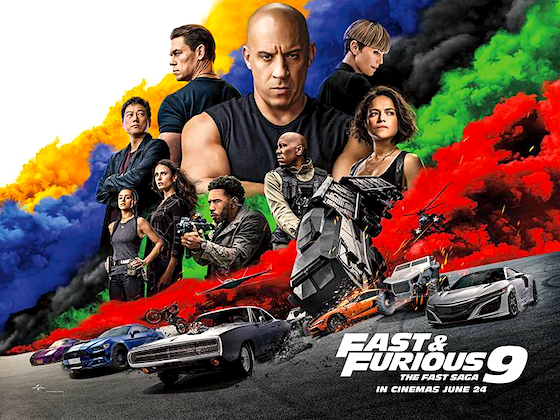
    Fast & Furious 9

    Between spinoffs and Covid-related delays, it’s been four years since the preceding film in what we’re apparently now meant to call “The Fast Saga”. As the series’ storyline has become increasingly serialised, I’m sure I can’t be alone in wishing they’d begin with some kind of “previously on”. That might sound a bit much for a series whose rep is, not undeservedly, “dumb action with cars”; but while that action was revving up, I was left digging around in my memory for where we’d left these characters and why some things were the way they were.

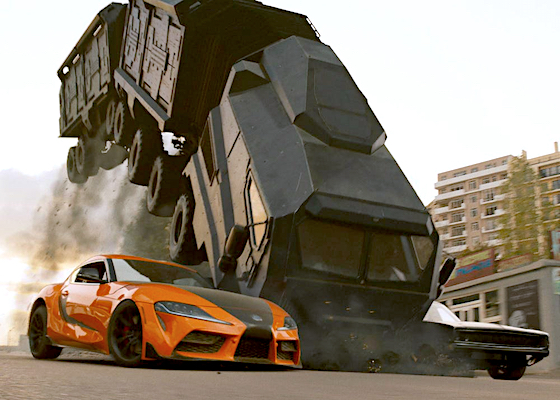
    But, let’s be honest, it doesn’t matter all that much, because before long they were racing around (literally) after one Macguffin or another, plus all the requisite shooting stuff and blowing stuff up and performing physics-defying CGI-aided stunts that have become The Fast Saga’s hallmarks. If that makes it sound a bit tired — just “more of the same” — well, remember, we’ve reached film #9. Now, in fairness, if there’s any franchise that bucks its numbering system, it’s The Fast Saga: it tried on different lead characters and various underlying formulae throughout its first four movies, only settling on one that sang in the fifth film. Nonetheless, that means we’re now on the fifth instalment that’s driven by said formula — sixth, if you count the Hobbs & Shaw spinoff, which we should — and it’s beginning to wear thin.

    Since landing on that magic formula, the series has walked a couple of tightropes: with its action, being outrageous and ridiculous but still exciting and fun; and with its mythology, being unnecessarily complicated but still followable. F9 is where, for me, it finally stumbles, and perhaps even falls off. Who can still remember the ins and outs of what went on with Han and when? Not me! And… rocketing a car into space? Seriously? Well, Top Gear almost did it for real once, so maybe it’s not entirely implausible. But that’s far from the only so-ridiculous-it’s-ridiculous stunt in the film. Fast’s stunts have never carried the same thrill as, say, Tom Cruise’s in the Mission: Impossibles because they’re unquestionably not being done for real. We’re not impressed by what they managed to physically pull off, more amused by what they dreamt up and rendered in a computer. Most of them are implausible. But here, it reaches the tipping point where I went from laughing along with it to just finding it silly.

    Sunday drivers

    What changed? Well, missing from the cast are Jason Statham and The Rock, perhaps the only two actors in the franchise who knew precisely where to pitch their performances to reassure us the filmmakers knew it was all ludicrous but it was ok. But they were only supporting players — does removing them from the equation answer every misstep? Surely not. Perhaps the director? But that’s Justin Lin, the man who saved the franchise in the aforementioned fifth film, continuing the style into the sixth; so he’s only sat out #7 and #8. But perhaps his taste or touch for the material has gone — he did recently abandon production of the series’ forthcoming two-part finale, after all.

    Whatever the root cause, I found F9 lacked the fun of the last four films (five, counting the spinoff). Looking at it another way, five entertaining movies is a good run — they were overdue another dud. As that, it’s certainly not the weakest film the series has to offer.

    3 out of 5

    2022 | Weeks 9–11

    Right, let’s try (again) to get things back on track.

    These compilations were/are meant to keep my reviewing roughly up-to-date with my viewing, but I don’t think stuffing them with too many films at once is the right way to go. I don’t know about anyone else, but I feel like five or six per post is about right (with some leeway, of course — I’m sure four or seven would be fine too). However, dividing like that means getting out of sync with Real Life, so I suppose I should clarify when “weeks 9–11” were: Monday February 28th to Sunday 20th March, to be precise. And back then, I watched…

  • Tintin and the Temple of the Sun (1969), aka Tintin et le temple du soleil
  • Los Olvidados (1950), aka The Young and the Damned
  • The Very Excellent Mr. Dundee (2020)
  • The King’s Man (2021)
  • Dirty Rotten Scoundrels (1988)
  • Nothing Like a Dame (2018)


    Tintin and the Temple of the Sun

    (1969)

    aka Tintin et le temple du soleil / The Adventures of Tintin: The Prisoners of the Sun

    Eddie Lateste* | 75 mins | DVD | 4:3 | Belgium & France / English | U

    Tintin and the Temple of the Sun

    This fourth big-screen outing for the Belgian reporter also continues the popular TV series, Hergé’s Adventures of Tintin, made by Belgian studio Belvision from 1957 to 1962. Having adapted ten of Hergé’s volumes for TV, here they tackled two more: two-parter The Seven Crystal Balls and Prisoners of the Sun. The story sees Tintin and chums head to Peru on the trail of their kidnapped friend, Professor Calculus, and to investigate an Incan curse that has befallen a previous party of archaeologists.

    Trekking up mountains and through jungles, with nefarious agents in pursuit, plus all the to-do with ancient curses and whatnot, this is chock-a-block with good old “Boy’s Own Adventure” stuff. As with so many of those, the joy lies in being swept along with the adventure rather than thinking about it too hard (our heroes are saved at the end because the Captain happens to have a scrap of newspaper that Snowy happens to steal that Tintin happens to fancy having a look at that happens to mention a handy forthcoming event). By the same token, there’s also the unavoidable effects of time: some of it feels a teensy bit racist nowadays; Tintin makes his way through the jungle merrily murdering animals left, right and centre. The animation itself is fine, with designs and an overall visual style that emulate Hergé well, but it does have a certain TV-ness.

    It’s also not available in the greatest of copies, at least to English-language viewers. Reportedly the original version contains two songs, both of which were cut from the UK video release, but only one of which has been restored for the DVD (and, I presume, the version currently available to stream from Apple, etc). Although most of the film is dubbed, the song is in the original French, unsubtitled; and has clearly been edited, because there are digital freeze frames around it. At the start of the film, the title card has been replaced in a similarly awkward fashion. Then there’s the 5.1 remix, which seems to be missing some effects and music cues. You can still enjoy the majority of the film despite these distractions, but it’s disappointing that we still have to put up with such palaver nowadays.

    3 out of 5

    Tintin and the Temple of the Sun is the 19th film in my 100 Films in a Year Challenge 2022.

    * Many (but not all) online sources list Lateste as the director, including IMDb, but the film itself doesn’t actually credit him — the only director-like credit is for “Belvision”. Lateste is credited as one of the screenwriters, at least. ^


    Los Olvidados

    (1950)

    aka The Young and the Damned

    Luis Buñuel | 81 mins | digital (HD) | 1.37:1 | Mexico / Spanish | 12

    Los Olvidados

    Combine the literal translation of the film’s title — The Forgotten Ones — with the US retitling — The Young and the Damned — and you build a sense of what Los Olvidados (as it’s been released in the UK) is about. To be clearly, it’s a socially-realist depiction of life for children in the slums of Mexico City. Although initially condemned (according to IMDb, it only played for three days in Mexico before the “enraged reactions” of the press, government, and upper- and middle-class audiences caused it to be pulled), it’s since been reevaluated as one of the greats of Latin American cinema. Certainly, watching it after films like The 400 Blows (made almost a decade later), City of God (over 50 years later), and Capernaum (almost 70 years later), its influence is felt.

    The downside to that is the film feels somewhat less fresh and more worthy than the later efforts. It’s got an overt anti-poverty message that is admirable but sometimes heavy-handed (a school principal character feels like he’s been inserted just to state the film’s thesis out loud) or naïvely optimistic (the opening voiceover asserts that child poverty will ultimately be solved by progress. Over 70 years later, I don’t think progress is doing a great job…) While much of the movie works at its intended goal, when aspects like these intrude it stops feeling like a realistic depiction of poverty and more like a straightforward polemic about how it should be fixed. On the bright side, it avoids the lure of a pat happy ending — although one was actually discovered in 2002, apparently shot to appease Mexican censors. Clearly they managed to get the film released without having to cave on that point, and it’s better for it.

    4 out of 5

    Los Olvidados is the 20th film in my 100 Films in a Year Challenge 2022. It was viewed as part of Blindspot 2022.


    The Very Excellent Mr. Dundee

    (2020)

    Dean Murphy | 88 mins | digital (HD) | 2.35:1 | Australia & USA / English | 12 / PG-13

    The Very Excellent Mr. Dundee

    Not a fourth Crocodile Dundee film, but rather a depiction of the accidentally-chaotic life of that series’ leading man, Paul Hogan, the archetypal Aussie now living in LA and, reaching his 80s, somewhat bemused by the modern world.

    Even from that quick summary, you can tell it’s not a terribly original premise. Couple that with a clearly small budget and you have a recipe for many dismissing the film out of hand. Personally, I found it to be surprisingly enjoyable, in a laidback, undemanding way. None of it is properly hilarious (though a bizarre musical sequence comes close), but it’s kinda amiable, and almost heartwarming at the end. Discerning viewers should perhaps not apply, but if you have any affection for the second or third Crocodile Dundee films (again, widely maligned instalments that I found passably entertaining), this is worth a punt.

    3 out of 5


    The King’s Man

    (2021)

    Matthew Vaughn | 131 mins | Blu-ray (UHD) | 2.39:1 | UK & USA / English | 15 / R

    The King's Man

    Co-writer/director Matthew Vaughn expands the Kingsman universe with this World War I-era prequel that delves into the backstory of how the eponymous organisation was founded. Unlike so many prequels, this does feel like a story worth telling — we don’t necessarily need it, but it’s not merely an exercise in visualising events we’ve already been told, or coming up with over-elaborate reasons for people’s names or whatever (why couldn’t Han Solo’s birth name have just been Han Solo, hm?)

    The story begins with Europe on the brink of war, and our heroes — led by the Duke of Oxford (Ralph Fiennes) — attempting to stop it. History tells us they fail, and so the narrative unfurls across WWI as they try to bring it to a close. That will see them come up against the manipulations of Rasputin (Rhys Ifans), who’s part of a secret organisation plotting to bring down the great empires.

    Let’s cut to the chase: the Kingsman films have a rep for elaborate fight scenes set to pop music. One of the major villains is Rasputin. You only need a passing familiarity with the disco hits of the ’70s to know what I was looking forward to here. Well, it doesn’t happen. Indeed, that stylistic calling card is more or less entirely abandoned (the fight does happen, of course, but it’s set to Tchaikovsky’s 1812 Overture — kind of like era-appropriate ‘pop’ music, I guess?) Apparently Vaughn did originally intend the sequence to be set to an orchestral version of the song in question, but ultimately felt it didn’t work.

    This, perhaps, speaks to another concern I had going in, which was that Kingsman’s highly irreverent, almost satirical tone might clash with the all-too-real WWI setting. Such an historical tragedy doesn’t feel right to be made light of in that way, even over a century later. So, as if to compensate, Vaughn and co have toned down the humour, making The King’s Man fairly serious… but without fully sacrificing the near-whimsy at other times, because, well, it’s part of the franchise. The result is a little awkward, tonally, swinging back and forth between historical seriousness and franchise-establishing fun. Put another way, it’s hamstrung by being an entry in a series known for its irreverence that feels the need to show due reverence to WWI. That’s a clash of values it struggles with, some might say admirably, but can’t quite reconcile. In short, it’s too serious to be a Kingsman film, but too Kingsman-y to be a standalone WWI-set action-adventure.

    I wouldn’t say it’s a disaster, by any means — but then, I enjoyed The Golden Circle when many lambasted it, so make of that what you will. Nonetheless, I’m looking forward to the next film getting back to Eggsy & co in the present day.

    3 out of 5


    Dirty Rotten Scoundrels

    (1988)

    Frank Oz | 110 mins | digital (HD) | 1.85:1 | USA / English | PG / PG

    Dirty Rotten Scoundrels

    Michael Caine and Steve Martin star as a couple of chalk-and-cheese con men, pilfering the fortunes of wealthy single ladies on the French Riviera, in this fun con caper with a neat sting in its tail.

    Caine hits just the right note as a charming con artist, his manner inspired by David Niven, who played the role in the original, 1964’s Bedtime Story. I was unaware the film was a remake until after watching it, though I did know it was itself subject to a gender-bent do-over in 2019, The Hustle. I don’t know how similar Bedtime Story and Dirty Rotten Scoundrels are, but, based on its trailer, The Hustle seems to be a direct lift from this, albeit peppered with the kind of pratfalling that’s de rigueur in modern big screen comedy.

    Marlon Brando was Niven’s co-lead, whereas here Caine gets Steve Martin as the very embodiment of a brash American — a little too brash, if anything, though reportedly there were bits he actually reined in. The running time could have done with a similar consideration, because it’s a little long for its breezy premise and tone (running 110 minutes, it would be better nearer 90), but that’s a minor complaint — it rarely feels too slow or draggy, just a little long overall.

    4 out of 5

    Dirty Rotten Scoundrels is the 21st film in my 100 Films in a Year Challenge 2022.


    Nothing Like a Dame

    (2018)

    aka Tea with the Dames

    Roger Michell | 77 mins | digital (HD) | 16:9 | UK / English | 12

    Nothing Like a Dame

    Four thespian friends, Dames all — Eileen Atkins, Judi Dench, Joan Plowright, and Maggie Smith — gather for a natter about their careers and lives. That’s it, that’s the film.

    Given the setup, plus the style of advertising and US retitle, you’d be forgiven for expecting a gentle bit of fluff; eavesdropping on a pleasant chinwag with four venerable British actresses. The film is that, in places, but it also has a surprising undercurrent of sadness running throughout, as these ageing ladies reflect on the ups and downs of their careers and personal lives now that they’re (shall we say) closer to the end than the beginning. It rarely bubbles to the surface, but it always feels like it’s there, somehow inescapable.

    If that gives proceedings more texture than you might’ve expected, then the film’s biggest flaw lies elsewhere. For me, it’s that it wasn’t long enough. The conversations are often delightful and occasionally insightful, but you feel like there’s so much more to be gleaned from these women. The film chops about between topics and pairings, always feeling like we’re getting snippets of the full conversation, never the true depth; like we’re watching a highlights reel of what should be a three-hour series, or something like that. I know it’s an old theatrical adage to “leave ’em wanting more”, but I really did want some more.

    4 out of 5