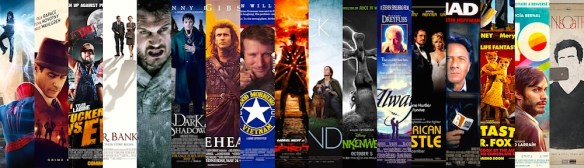
March 2015 + Best Bond Beginnings

We’re a quarter of the way through the year — but with the #25 milestone passed last month, how far ahead have I forged?

Also this month: some quick thoughts on the best James Bond pre-titles sequences. Which is your favourite?


March’s films
Grosse Pointe Blank
#30 Alois Nebel (2011)
#31 Godzilla (2014)
#32 Jack the Giant Slayer (2013)
#33 Midnight in the Garden of Good and Evil (1997)
#34 Violet & Daisy (2011)
#35 The Girl with the Dragon Tattoo (2011)
#35a The Hobbit: The Desolation of Smaug (Extended Edition) (2013/2014)
Mad Max 2#36 The Hobbit: The Battle of the Five Armies (2014)
#37 God Bless America (2011)
#38 Videodrome (1983)
#39 Grosse Pointe Blank (1997)
#40 Looper (2012)
#41 Valkyrie (2008)
#42 Mad Max 2 (1981), aka The Road Warrior
#43 Tarzan (1999)
#44 Empire of the Sun (1987)


Viewing Notes

  • This is the third month in a row where I’ve watched 16 films, all in. Weird.
  • Several I’ve been meaning to get round to for years were ticked off this month: Alois Nebel, The Girl with the Dragon Tattoo, and Looper. All thanks to TV premieres.
  • It’s a complete accident that I left it a year to the month between watching Mad Max and Mad Max 2. Both were on Now TV, which I’m ending my subscription to imminently, so the third may crop up among April’s films.
  • No WDYMYHS film this month. Two in April, then.


Analysis

A grand total of 15 new films watched this month brings with it a few interesting observations. For one, this is the first time (since such records began) that January is the largest of a year’s first three months. That doesn’t really signify anything, just one of those random correlations (which has now been broken).

2015’s is the second largest March ever, and the fifth month in a row to improve on the same period from the year before. Plus it’s the tenth month in a row to have a final tally over ten. Regular readers will know my goal for this year is to have a run of 12 months that each exceed that figure, so I’m 25% of the way there. Meanwhile, the average total for January and February was 14.5, so by just tipping over that in March, the year-to-date average rises to 14.67.

2015 is clearly shaping up well on the whole. #44 is the furthest I’ve ever reached by the end of March, with second place being a three-way tie between 2010, 2011 and 2013 at #38. As ever, all indicators must be taken with a pinch of salt: last year (my highest year ever, lest we forget) I was actually running behind schedule until the last day of March; conversely, in 2012 I’d made it to #34 by the end of March, a full ten ahead of schedule, but still finished the year with just 97 films viewed.

Nonetheless, it’s prediction time! Never say never, but with the halfway point already looming next month, I feel 100 films is a fairly comfortable expectation this year (famous last words…) So, if I ‘merely’ manage to maintain my monthly ambition of ten-a-time from here on out, 2015 would make it to #134. That’d be my second-best year ever, so not to be sniffed at. If the current average (14.67, in case you forgot) holds, that would see me reach #176. Considering my previous best is 136, that’d be quite extraordinary. I live in hope.


This month’s archive reviews

Continuing apace, with 28 reposts this month.


Best James Bond Pre-titles

The past week has brought us both the first trailer for October’s 24th James Bond film, Spectre, as well as the news that it will feature the largest pre-titles sequence the 53-year-old franchise has ever staged. What better time to revive my “list of 5” format and look back at the finest examples of one of 007’s defining features, then?

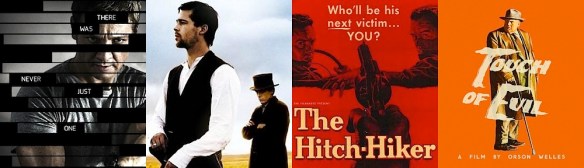
Keeping the British end upExcept, goodness, I couldn’t get it down to just five! From Connery alone you’ve got ‘Bond’ being bested in From Russia with Love, the iconic jetpack in Thunderball, and the trend-setting mini-adventure from Goldfinger. As the series rolls on there’s The Spy Who Loved Me and its parachute, Moonraker’s free-fall fistfight (you couldn’t do that today — everyone would assume it was CGI and it’d have no magic), and the perfectly staged training-exercise-gone-wrong from The Living Daylights. The Brosnan era really kicks in the action, first with another peerless mini-adventure in GoldenEye (and the bungee jump…!), then increasingly expansive and suitably witty openers to both Tomorrow Never Dies and The World is Not Enough. Finally, the Craig era tipped the whole shebang on its head with Casino Royale’s moody black-and-white quickie, and Quantum of Solace’s attention-demanding car battle. Skyfall may have moved back towards the Brosnan mould, but it’s an exceptionally well done one.

That’s 12 and I don’t even know where to start paring back, at least as far as my personal favourites go.

We can all agree A View to a Kill and its use of California Girls is the worst, though, right?


Next month on 100 Films in a Year…

A third of the way through the year… but halfway to my goal?

January 2015

How do you top the most successful year of your blog ever? Well, let’s see …


January’s films

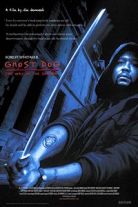
Ghost Dog#1 The Crab with the Golden Claws (1947), aka Le Crabe aux Pinces d’Or
#2 Parker (2013)
#3 Ghost Dog: The Way of the Samurai (1999)
#4 Shadow of the Thin Man (1941)
#5 Machine Gun Preacher (2011)
#6 Last Passenger (2013)
#7 Persona (1966)
#8 The Big Knife (1955)
M:I-4#9 Kingdom of Heaven: Director’s Cut (2005)
#10 The Sugarland Express (1974)
#11 The Thin Man Goes Home (1945)
#12 Hancock (Extended Version) (2008)
#13 Argo (Extended Cut) (2012/2013)
#14 The Hound of the Baskervilles (1981), aka Priklyucheniya Sherloka Kholmsa i doktora Vatsona: Sobaka Baskerviley
#15 Mission: Impossible – Ghost Protocol (2011)
#16 Transcendence (2014)


Viewing Notes

  • Since enjoying Spielberg & Jackson’s Tintin movie at the tail end of 2014, I’ve found myself a bit obsessed this January: I’ve started reading the books (been meaning to for yonks — I bought a complete box set in Amazon’s Black Friday sale several years ago) and acquired all the other films that are available on English-friendly DVDs. Reviewing The Crab with the Golden Claws is just the start of it for 2015, I should imagine.
  • Two more Thin Man films viewed — I’m almost at the end. Hence Thin Man Thursdays.
  • That Hound of the Baskervilles is a Russian TV version from the ’80s, widely acclaimed among Sherlockians. I’ll be reviewing it as part of the Russia in Classic Film Blogathon in early March.
  • Can’t believe it’s taken me this long to get to Ghost Protocol! I really enjoyed it too. With this year’s fifth movie recently moved up to a summer date, there’s every chance that’ll make this year’s list too, even if I wait for the Blu-ray again.


What Do You Mean You Haven’t Seen…?

In case you missed it, earlier this month I wrote a 2,800-word introduction to 2015’s “What Do You Mean You Haven’t Seen…?” — aka WDYMYHS:SoOaHaDotO. (I promise not to call it that again.)

After nearly failing last year by leaving Serious and Heavy films ’til right at the end (Requiem for a Dream wasn’t a very Christmassy film for the end of December, but at least it was a brilliant one), I made a particular effort to start with one of this year’s more difficult films: Ingmar Bergman’s psychological two-hander Persona. Apparently writing about it is to film critics as Everest is to mountaineers, so that should be a fun one to review…


Analysis

To reach 100 films in a year at a steady pace, you need to watch about eight films every month. Having spotted my record-equalling run of double-figure months in December, I’ve decided I’d quite like to have a whole year of the same. Last year is the closest I’ve come to such a thing, with nine out of twelve months having 10+ films.

I’m off to an excellent start to achieve it in 2015, though, with 16 films in January — aka double the requirement for reaching 100. Naturally this means a new record for consecutive double-figure months, now at eight in a row. It also blows away all the possible indicators: January’s average total is 8.7 and 2014’s monthly average was 11.3, so it’s far beyond either of those. In fact, it’s the highest ever January, in the process besting all but one month from 2014.

I’ve explained before that January is absolutely useless as a predictor of the entire year… but where’s the fun in leaving it at that? So if I were to continue at this pace, 2015 would end up on an improbably-high 192 — take that 2014 and your beat-the-record-by-seven 136! It seems unlikely that’ll happen, I agree, especially as January’s tally has not once been close to the year-end average. That said, it’s normally a good-but-not-great kind of month, often bested immediately by February and March — that’s what happened in 2010, 2011, 2012 and 2013, while February topped it in 2008 and March almost doubled it in 2014 — so things may be looking even rosier in a few weeks’ time. Plus, even if I ‘only’ achieve my stated goal of 10 films per month from here on out, I’ll still end up in the 120s, which would put 2015 among the highest-totalling years.


This month’s archive reviews

I’d quite like to get my archive reposts finished during 2015, leaving the slate clean and the site complete for 2016, my tenth year. There’s still a long way to go (just under 170 reviews, plus a load of editorial-type posts), but at this rate I might make it. To kick things off, 20 archive reviews were reposted during January…


Next month on 100 Films in a Year…

Despite being the year’s shortest month, February has twice topped the year for total monthly viewing, and a couple more times has been among the top ‘scorers’. Equally, on three occasions it’s been one of the year’s lowest. The rollercoaster continues in 28 days…

What Do You Mean You Haven’t Seen…? 2015

Six of One & Half a Dozen of the Other


My challenge-within-a-challenge (in which I must attempt to watch 12 renowned films within the next 12 months) returns for a third year, this time with a natty subtitle — or for short, WDYMYHS:SoOaHaDotO.

Yeah, let’s not call it that.

Why the unwieldy subtitle? Well, since its inception (in the distant past of two years ago), WDYMYHS has been torn between recommending critically-acclaimed must-sees and widely-popular must-sees — the first year erred towards the former, in reaction the second year skewed to the latter. This year, I had an epiphany: why make a list that tries and fails to serve two masters, when you could just make two lists?

No, I’m not going to try to watch 24 specific films (I know my own limits. Well, I don’t, but that’s one I know is doomed), but rather two lists of six — one of critically-acclaimed films, one of more populist movies. Hence the Clever subtitle.

As with last year, we’ll get straight to the two lists, and follow it up with not-for-everyone analysis of how they compare to previous years and an overlong explanation of how they were devised.

The Critical List

Raging Bull (1980)
Score: 608
TSPDT #21 | Sight & Sound 2012 #29 | featured on 1001 Movies to See | Academy Awards Best Picture nominee

The Passion of Joan of Arc (1928)
Score: 599
TSPDT #15 | Sight & Sound 2012 #12 | featured on 1001 Movies to See

L’Atalante (1934)
Score: 589
TSPDT #17 | Sight & Sound 2012 #14 | featured on 1001 Movies to See

Persona (1966)
Score: 587
TSPDT #24 | Sight & Sound 2012 #16 | featured on 1001 Movies to See

Le Mépris (1963), aka Contempt
Score: 554
TSPDT #38 | Sight & Sound 2012 #27 | featured on 1001 Movies to See

The General (1926)
Score: 553
TSPDT #36 | Sight & Sound 2012 #43 | featured on 1001 Movies to See


The Populist List

A Clockwork Orange (1971)
Score: 1,116
IMDb #75 | Empire 500 #37 | Empire 301 #54 | iCM Most ✓ed #83 | Reddit #50

City of God (2002)
Score: 782
IMDb #22 | Empire 500 #177 | Empire 301 #132 | Reddit #58

To Kill a Mockingbird (1962)
Score: 587
IMDb #81 | Empire 500 #180 | Empire 301 #132 | Reddit #121

The Thing (1982)
Score: 501
IMDb #167 | Empire 500 #289 | Empire 301 #64 | Reddit #118

Brazil (1985)
Score: 483
Empire 500 #83 | Empire 301 #106 | Reddit #154

Princess Mononoke (1997)
Score: 480
IMDb #72 | Empire 500 #488 | Empire 301 #203 | Reddit #91


(All rankings were correct at the time of compiling and may have changed since.)

Good lists? Bad lists? Please do share any and all opinions. As per normal, my progress will be covered as part of the monthly updates.

Now then:

Stats

I’ll come to how all of that was compiled in a minute, but first a few (well, quite a lot, because you know I like these bits) observations.

First, those scores — pretty meaningless without knowing the method, I know (we’ll come to that, jeez!), but you can’t help but notice how high A Clockwork Orange’s is. Here’s the best I can do for perspective: what I’m calling “the theoretical maximum” for the Populist List is 1,636 points (it’s actually possible to score more, but let’s not get into that). Compared to that, A Clockwork Orange scored 68.2%. Sound low? The film in second place, City of God, comes to 47.8%, while the last included film, Princess Mononoke, has just 29.3%. The world really wants me to watch A Clockwork Orange. The Critical List is much closer: the “theoretical maximum” there is 908, from which Raging Bull has 67%, whereas last-place The General has 60.9%.

Long-time readers will surely have remarked on the inclusion of Raging Bull. It was part of 2013’s inaugural list, but I failed to watch it. It was excluded from re-inclusion in 2014’s, but I intended to watch it of my own accord (as it were)… and failed. I decided a year was long enough to hold out — especially as it topped the Critical List and came second on the Populist List — so it’s back in. I think this will be a new rule going forward: if I fail to watch a film, it has to ‘sit out’ the next year, but is eligible for inclusion the year after.

I have to say, the Populist List didn’t really turn out the kind of films I was expecting — I thought it would be an entire list of movies like The Thing and Brazil. I suppose it proves a point I’ve made in the past: despite their reputation among cineastes, lists like the IMDb Top 250 and Empire’s reader polls aren’t completely stuffed with blockbusters. OK, you’re not getting the depths of arthouse on there (i.e. the stuff the Critical List has selected), but A Clockwork Orange and City of God are hardly Transformers 4. Well, I haven’t seen them, so I suppose maybe they are…

I actually tried to make both lists skew ‘newer’ (not because I dislike older films, but because some of these lists tend to be a bit biased against them — TSPDT admits they ‘punish’ newer films), but it barely came out at all in the final 12: the newest film is 2002’s City of God, which is 13 this year; the next is Princess Mononoke, which is 18. I suppose that’s better than 2013, when the most recent film was from 1984. The effects were felt further down the chart, but that’s of little relevance to me now; though if I’d locked out Raging Bull entirely, 2011’s The Tree of Life would have nipped in. (More on this later.)

For what it’s worth, The General and The Passion of Joan of Arc are the two oldest films to have featured in WDYMYHS, and L’Atalante is fourth (third being City Lights from 2013’s lot). That extreme aside, this year’s list are quite spread around: whereas 50% of 2013’s were from the 1950s and 50% of 2014’s were from the last 20 years, no such pithy evaluation can be made this year. The ’60s and ’80s present three films each; there’s the two from the ’20s already mentioned; and then one apiece from the ’30s, ’70s, ’90s and ’00s. The 76 year gap between the oldest and newest pips 2013’s 53 years and 2014’s 73 years.

It’s also worth noting that there’s a greater variety of languages and countries of production included this year. Non-English films made up three in 2013 and two in 2014, but this year it’s six — half the list! That said, The Passion of Joan of Arc is actually silent, and I may well watch the Neil Gaiman-penned English dub of Princess Mononoke, both of which would take the wind out of these sails a bit.

The countries of origin are undeniably spread, though. Ignoring co-production technicalities, last year only offered two non-American movies, and the year before four (the three foreign language ones plus Lawrence of Arabia, which I’ve got down as a US/UK co-production but am counting as British). This year, the US is still highest, but only with four films — there’s France thrice and the UK twice*, as well as Brazil, Sweden, and Japan.

As for directors, Kubrick’s back again, in the form of A Clockwork Orange (obviously). No surprise there, as it was ranked very highly in each previous year but eliminated under the “no repeat directors” rule. Full Metal Jacket and Barry Lyndon also made their way into the Top 6s (the former for Populist, the latter for Critical), but were similarly eliminated. I guess one will end up on 2016’s list (unless I drastically change how I do this… which I might). After sitting out last year, there’s a return for Bergman, in the shape of Persona. For the first time, no Hitchcock or Charlie Chaplin — they both had multiple entries near the top in previous years, but this time Chaplin managed 18th on the Critical list with The Gold Rush, while Hitchcock’s first appearance is on the same but way down at 70th. 70th! On the Popular list, it’s not until 84th. Have I seen all the great Hitchcock movies already? There’s an awful lot of his films I’ve not seen, and I thought some were well-liked (whither The 39 Steps?**), so I’m quite disappointed about that.

Other noteworthy directors included are John Carpenter, Carl Theodor Dreyer, Terry Gilliam, Jean-Luc Godard, Buster Keaton (taking Chaplin’s place?), Hayao Miyazaki, Martin Scorsese (for the second time… with the same film), and Jean Vigo. The list is rounded out by City of God’s Fernando Meirelles, who made the excellent The Constant Gardner before seeming to slip back into obscurity, and To Kill a Mockingbird’s Robert Mulligan, who I don’t know anything about and (to be frank) doesn’t seem to have helmed anything else noteworthy.

The curious among you may be wondering (by which I mean, I wanted to know so thought I may as well tell you) what other films would have been included if I’d taken all 12 from either list? Well, the next six eligible films on the Critical List would have been, in rank order, Barry Lyndon (re-included because of no Clockwork Orange), The Tree of Life (as mentioned), Ugetsu Monogatari, Shoah, The Wild Bunch, and The Magnificent Ambersons. (Fanny and Alexander and Wild Strawberries also scored enough to qualify, but Persona rules them out.) On the Populist List, what I was saying about “films like The Thing and Brazil” would have been borne out: the extra six would have been Raging Bull (having not been blocked by the Critical List), Drive, Rocky, District 9, The Sting, and Black Swan. (I know those films aren’t like the others, per se, but hopefully you see what I’m driving at.)

Process

This year’s scoring system is heavily based in last year’s, with some tweaks and changes, for various reasons.

The most obvious is that there are two lists, using two completely separate sets of contributing lists. The basic principles are the same for both, though: I took the top 250 entries on each contributing list and those films received a score out of 251 for their position — so #1 would score 251 points, #2 would score 250, and so on down to #250 scoring 2 points. Many of the lists go past 250 entries, however, so any film lower than that (but which came to my attention by being in the top 250 of a different list) received a single bonus point just for appearing.

There was a further 50 point bonus for appearing in the top 250 of more than one list. Last year that was an extra 50 points for each additional list; this year it’s a one-time deal. As with last year, there was an additional bonus based on the number of ‘official lists’ a film appears on at iCheckMovies.com — i.e. A Clockwork Orange is on 30 lists, so got 30 points.

With the basics established, let’s get list-specific:

The Critical List was compiled from:

Finally, to help swing the list further in favour of recent films, the top 100 of the 21st Century’s Most Acclaimed received another 25 points. Fat lot of good it did any of them.
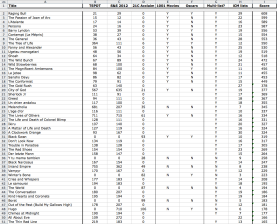
WDYMYHS 2015 Critical Top 50Now, here’s an interesting thing: I very quickly got bored doing the maths on all this. The previous two years, I’ve worked it all out in my head as I went. Year One, very easy (A+B ÷2); Year Two, more complicated, but doable; Year Three, two whole sets of rules and so many films…! So I spent an afternoon learning a bit more about how Excel works and got it to do it all for me. Imagine an evil laugh here.

To work out the scores for the Critical List, then, here’s the code (is it code? It looks like a code. Let’s call it code) that I wrote:

=SUM(IF(B2=0,0,(IF(B2<251,252-B2,1))))+(IF(C2=0,0,(IF(C2<251,252-C2,1))))+(IF(D2=0,0,(IF(D2<251,252-D2,1))))+(IF(E2="Y",50,0))+(IF(F2="Y",25,0))+(IF(G2="Y",50,0))+H2+(IF(D2=0,0,(IF(D2<101,25,0))))

That does everything I just described, automatically, when the correct values are entered in the correct columns — i.e. the ranking for each list, plus Y or N for 1001 Movies and Oscar noms. I’ll be frank, this is one reason there’s only the single multi-list bonus this year — that’s what I wrote into the code, and when I remembered later that it wouldn’t be adding another 50 for the third, fourth, etc, lists, I frankly couldn’t be bothered to work out how to do that. I’d wager it can be done, though.

The Populist List has even more constituent elements — and an even longer (though, technically, less varied) code to work it out. First, the contributing lists were:

  • The IMDb Top 250 — aka the movie list. Well, until TSPDT came along. Now I guess it depends on your personal preference which is more relevant. This changes all the time, so was very much the version hosted by iCM on 5th January 2015.
  • Empire’s The 500 Greatest Movies of All Time, commonly known as the Empire 500. Supposedly “the most ambitious movie poll ever attempted”, it was conducted by Empire magazine in 2008 and features the opinions of “10,000 Empire readers, 150 of Hollywood’s finest and 50 key film critics”.
  • Empire’s The 301 Greatest Movies of All Time, aka the Empire 301. Technically the new version of the above, held last year to mark Empire’s 300th issue. Arguably not as good. As you can see from the numbers up above, some films have moved around a lot.
  • iCheckMovies’ Most Checked, being the movies the greatest number of iCM users have seen. I think one of my most-complete lists, as I’ve seen 209 of the 250.
  • The All-Time Worldwide Box Office chart, not that it had any bearing on the final selection (you’ll note none of them are on it).
  • The Reddit Top 250, in which Reddit users have picked their favourite movies. Constantly updated a la the IMDb version, I believe.

As mentioned before, those were all initially limited to the top 250 entries and weighted equally. Following that, however, there were 25 bonus points to be had for being in IMDb’s top 100, the Empire 301’s top 50, or iCheckMovies Most Checked’s top 50. All of that made the Excel code look like this:

=SUM(IF(B34=0,0,(IF(B34<251,252-B34,1))))+(IF(C34=0,0,(IF(C34<251,252-C34,1))))+(IF(D34=0,0,(IF(D34<251,252-D34,1))))+(IF(E34=0,0,(IF(E34<251,252-E34,1))))+(IF(F34=0,0,(IF(F34<251,252-F34,1))))+(IF(G34=0,0,(IF(G34<251,252-G34,1))))+(IF(H34="Y",50,0))+I34+(IF(B34=0,0,(IF(B34<101,25,0))))+(IF(D34=0,0,(IF(D34<101,25,0))))+(IF(E34=0,0,(IF(E34<101,25,0))))

I don’t expect you to understand or have a use for that, I’m just showing off.
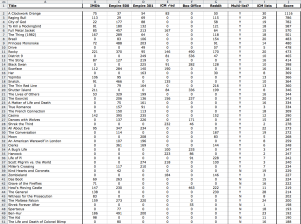
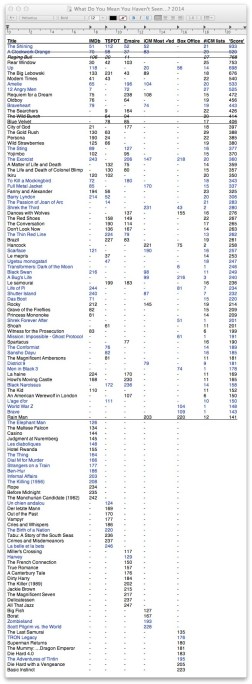
WDYMYHS 2015 Populist Top 50In the end, there were 121 films on the Populist long list and 82 on the Critical one. If you want to have a look at the top 50 of each, as featured in the small pictures earlier and to the right, you can find full-size versions here and here. You’ll note the Critical List isn’t filled out in full. At the end of a long day of list-making and code-writing, I couldn’t be doing with scouring the 1001 Movies and Oscar nominees lists for films that, even with those bonus points, couldn’t make the top 12 (never mind the top 6 that actually mattered). The reason some further down are filled out is because they were done incidentally as I went, for one reason or another. (You’ll also note that the row numbers are out by one from the ranking numbers, which is thanks to the Title row. Sadly I don’t know how to change that, if you even can.)

The End

And so there we have it! It felt less complicated a system than last year to me when I set out, I think because last year I was working out/making up all the rules and this year just tweaking and re-applying them. Making Excel do the heavy lifting for me, though, that was new and tricky, but worth it.

Now all I’ve got to do is actually watch the films…


* These numbers are somewhat debatable. For the record, I’ve counted A Clockwork Orange as British. ^

** I did a quick test to find out, and it should actually be in the mid-50s on the Critical list. Why wasn’t it included? Because the only numbered list it appears on is TSPDT, at 511th, and I only went up to 250th when first compiling from there. Its appearance on 1001 Movies gives it a big points boost after that. This does slightly concern me: how many other films am I missing that would have scored just as well? However, I don’t think it’s possible for anything like that to have cracked the Top 6, so in the end it doesn’t really matter. ^

2014: The Full List

So here we are: as revealed in the December update, 2014 has proven to be the biggest year of 100 Films ever! Now it’s time to look back at the whole shebang and analyse and rank it.

Today’s post is The Big One… until I call the next one The Big One. But really, today’s is a long’un, full of information and fun. Yes, fun: good golly gosh, it’s statistics time! Best bit of the year, right there.

In case you’re not interested in reading it all, or in breaking your scroll wheel as you have to whizz past seemingly never-ending lists, here’s a handy clickable contents:

Without further ado:


As It Happened

One of my favourite things since I moved to WordPress is this incidental pleasure: a month-by-month visual representation of my viewing, derived from the header images on my monthly updates. More usefully, each of the twelve images below links to the relevant monthly update, where you’ll find the numbered list of everything I watched this year, and other fun stuff too.


Now, the main event — the full alphabetical list of my 2014 viewing (with links to reviews, where available):

The List

Alternate Cuts
Other Reviews
Shorts

The Statistics

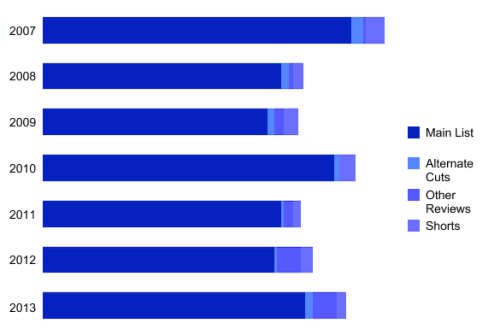
All told, I watched a record-smashing 136 new feature films in 2014. (All are included in the following stats, even if there’s no review yet.) The previous best was my very first year, 2007, with 129. It feels pretty good to finally best that — as five of the intervening six years have finished with 110 or fewer, it’s often felt insurmountable.

I also watched one feature I’d seen before that was extended or altered in some way (well, I watched two, but the other counted on the main list). I also chose to review one other for the fun of it. (All 138 films are included in the statistics that follow, unless otherwise indicated.) It’s worth noting that this tally bests 2007 too, which stood at 135 all-in.

I also watched two shorts… depending on how you count it, because one of those was made up of four shorter-shorts. Either way, none of them shall be counted in any statistics (apart from the one that says it counts them).

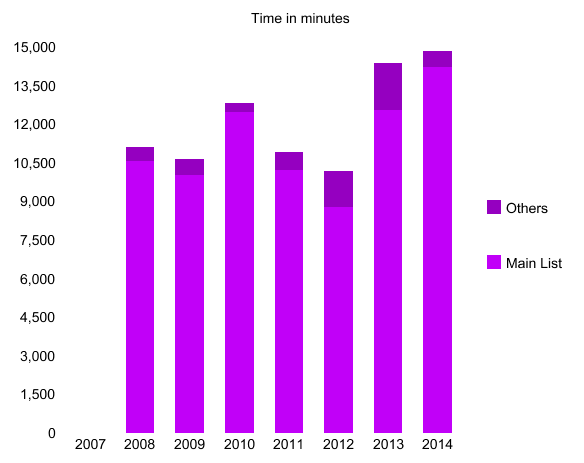
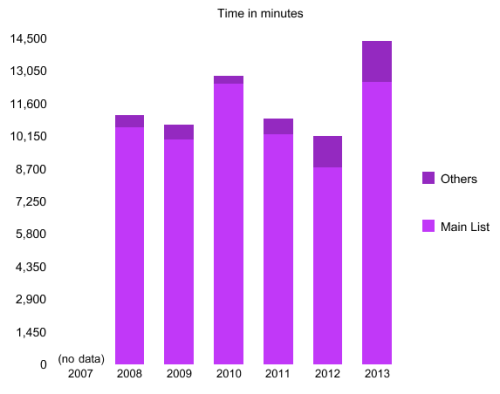
The total running time of new features in 2014 was a stonking 237 hours and 15 minutes. For perspective, last year’s total running time was the highest ever, beating the previous best by 58 minutes. This year now exceeds even that by just over 28 hours.

The total running time of all films (including shorts) was 247 hours and 43 minutes. That’s less of an increase on last year (8 hours and 14 minutes, to be precise), but it still leaves 2014 as the longest year ever. No surprise, really.

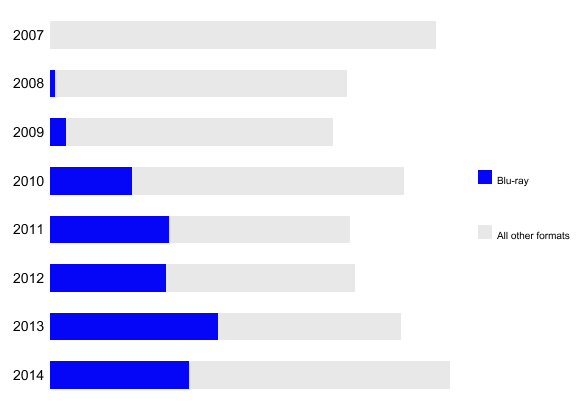
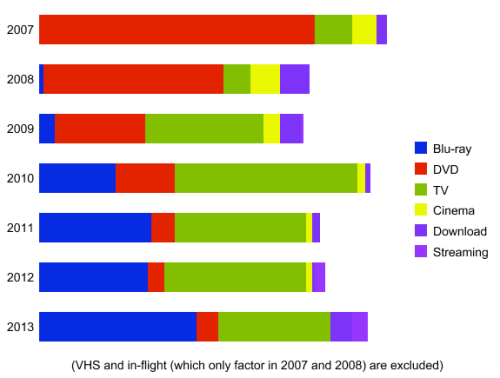
2014’s most prolific format was Blu-ray for the second year in a row, though at 49 films its total is lower than last year. That’s not the first time it’s dropped, but the only other was tiny (from 42 in 2011 to 41 in 2012), so it’s the first significant one. To be honest, that has nothing to say about the state of Blu-ray — I’m still merrily buying lots of them — and more about the fact I cancelled my LOVEFiLM subscription, so there were fewer Blu-ray rentals. That number has been absorbed elsewhere, as we shall see shortly…

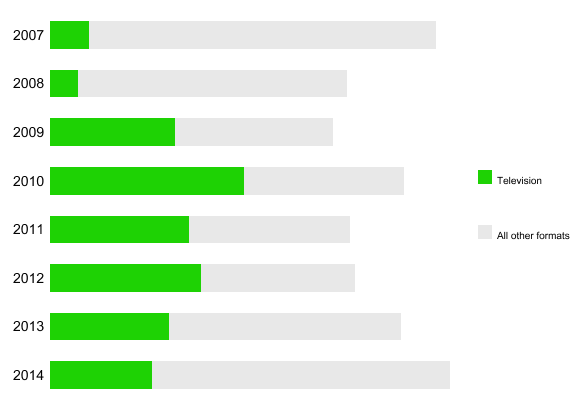
Television came second again, though continued to slide in importance with just 36 watched, none of them in HD. I think I mentioned at the time that my V+ box crashed and had to be reset, creating a shedload of space on its hard drive… which I promptly filled with new, more watchable films (and not in HD, to maximise space). To be frank, were it not for those recordings TV would have disappeared even further — I don’t think I watched a single thing ‘live’ this year.

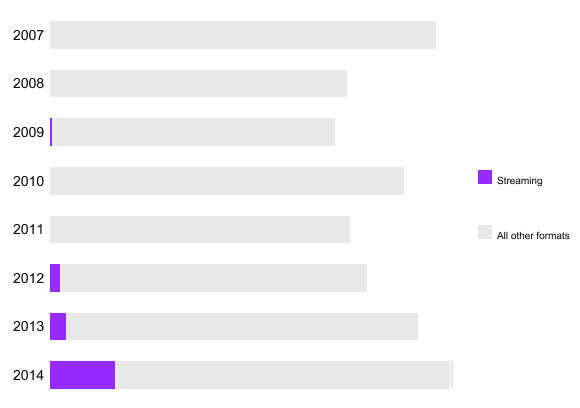
Arguably the biggest news is third place, however. The past two years have seen me increase my use of streaming, with four films in 2012 and six in 2013. This year, it came to 23. A big increase but, mulling on it, still not particularly good value for money: I currently have Now TV, aka Sky Movies, whose service is based around having lots of major recent movies about six months after their DVD release. Dividing the subscription price between what I actually watched works out around the same as it would cost to rent a film in HD from Sky/Virgin/Apple/etc on its DVD/BD release date. That’d be the same spend, same number of films, but they’d be newer. I may need to reconsider my options here…

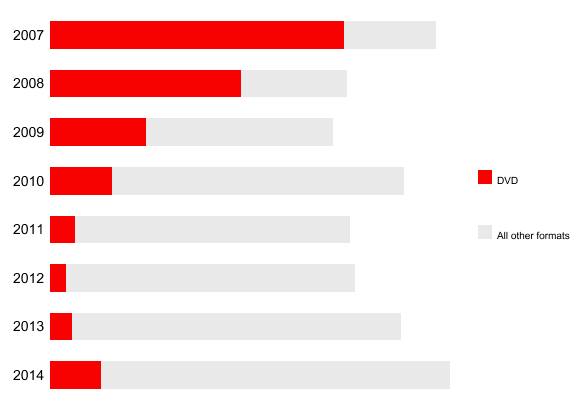
In fourth place was DVD, which reached double figures for the first time since 2010… and then went a bit further, eventually hitting the giddy heights of 18. I still have hundreds of the things unwatched, though.

Finally, downloads accounted for 14 films — another highest-ever total. Not sure why, to be honest. It’s a mix of 99p rentals from iTunes, having to finish films where the LOVEFiLM disc went screwy halfway through (because of that, you’ll find the formats total 140 rather than 138), and just… other stuff, I guess. Hm.

(You may also note that means no films seen at the cinema, for the second year in a row.)

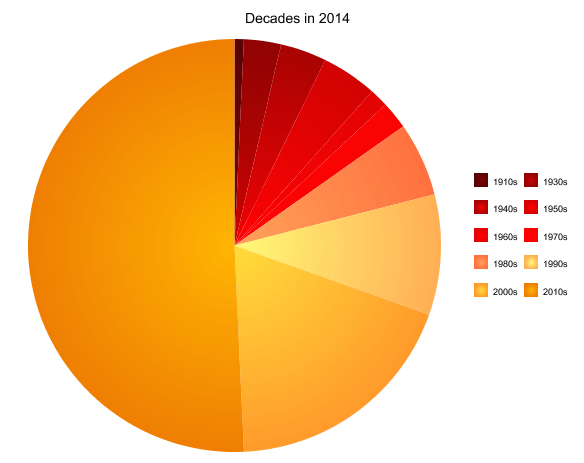
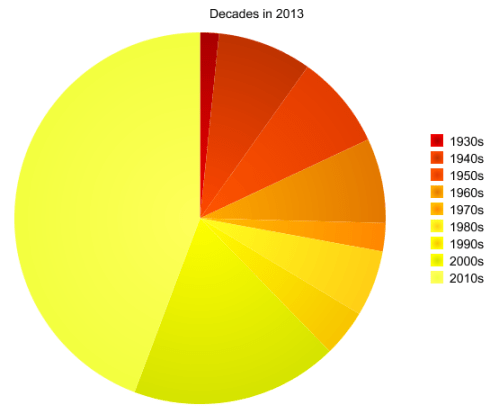
The most-represented decade this year was the 2010s. Only five years old, but it totalled 70 films, or a whopping 50.7%. That’s the first time a single decade has accounted for over half my viewing since 2009 — which makes sense when you think about it. The ’00s are a distant second on 29, which at 18.8% is a slight rise on last year. In third place, there’s a bit of a resurgence for the ’90s. Only 13 films (9.4%), but that’s enough to put it ahead of the pack, whereas last year it was down amongst them.

In fourth place we have the ’80s, with a semi-appropriate eight (5.8%), before the rest descend in size quite neatly: the ’50s are on six (4.3%), the ’40s just behind with five (3.6%), then the ’30s manage four (2.9%), the ’70s clock three (2.2%), the ’60s have two (1.4%), and the 1910s finish us off with one (0.7%). That really just leaves the ’20s, with zero (0.0%).

Moving on from time to space — where were the films I watched in 2014 from? Let’s start with language: as usual, English dominates, with 126 of the 138 films being wholly or significantly in our greatest export. That comes to 91.3% — a continued decrease from last year’s 93.5% and 2012’s 98%. I’m getting gradually Cultured, innit. While no single other language comes close to that (French and Mandarin share second place with three (2.2%) each), the total number of languages heard also continues in the right direction: from four in 2012, to 11 in 2013, to 15 in 2014 (plus one for “silent”). More uncommon ones include Persian (from This is Not a Film) and American Sign Language (from Dawn of the Planet of the Apes).

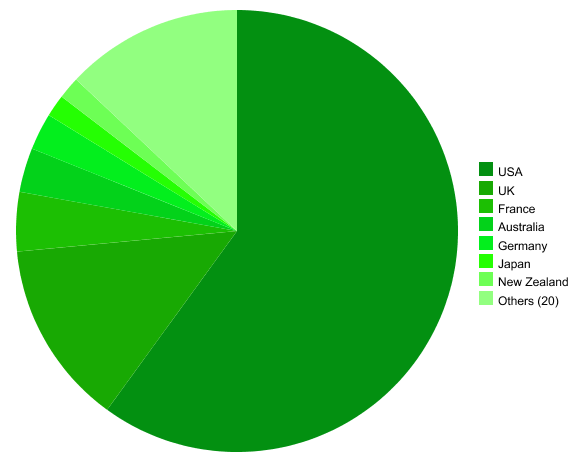
Similar to the English language’s dominance, the USA has a near-stranglehold on my viewing: 111 films were either produced or co-produced in/by the US. Defining a film’s country of origin is always tricky (see: the controversy around Gravity’s Best British Film BAFTA), and in this day and age an awful lot are co-productions anyway — several films you’d define as culturally somewhere-else (e.g. No) contributed to the US’s count; equally, some ‘Hollywood’ blockbusters also give credit to foreign shores (including such uncommon examples as Cyprus and Malta).

Behind the US comes the UK, with 25, which at 18.1% is significantly down on last year’s 29.3%. No idea why. France once again have eight, Australia are a ‘new entry’ with six, right behind them are Germany with five, then on three it’s both New Zealand (all thanks to Peter Jackson) and Japan. A further 20 countries had a hand in one or two films each, with those holding a genuine claim to “country of origin” including (but not necessarily limited to) Chile, Ireland, Hong Kong, and South Korea.

For the second year, I totalled up the BBFC and MPAA certificates of my viewing. Things skew ‘mature’ this year: in 2013, the BBFC’s PG, 12 and 15 certificates were more or less equal, while the MPAA’s meaningless Unrated (not just signifying “too extreme to be classified!” but also “so old it doesn’t need to be reclassified”) came top, closely followed by PG-13. In 2014, however, the 15 certificate (41, 29.7%) edged out the 12 (37, 26.8%), with 18 in third place (21, 15.2%) and PG just behind (18, 13.0%). Technical last place goes to U (15, 10.9%), although six films weren’t BBFC certified at all. “But that’s illegal!” Well, not for internet-distributed films that weren’t specifically released over here.

On the other side of the pond, this year it was R that claimed the top spot (43, 31.2%), pushing Unrated into second place (39, 28.3%) and PG-13 down to third (38, 27.5%). The MPAA’s distaste for lower ratings continued with 14 PGs (10.1%) and just three Gs (2.2%). If you’ve spotted that those add up to 99.3% then… why are you checking my percentages? Don’t you trust me? But also, the 0.7% goes to a sole NC-17 film. As I’ve not posted a review yet, I’ll tell you that’s Requiem for a Dream.

In a stat that’s improved for the second year in a row, 15 of my main list films appear on the IMDb Top 250 at the start of January 2015. Their positions ranges from 7th (12 Angry Men) to 203rd (X-Men: Days of Future Past), and 10 of those 15 are thanks to What Do You Mean You Haven’t Seen (the two not present are The Searchers (yes, really) and Blue Velvet). Ticking off 12 Angry Men also means I’ve finally seen all of the Top 250’s top ten. However, I still have 102 of the Top 250 to see — a lot, but also a nice little improvement from last year’s 114.

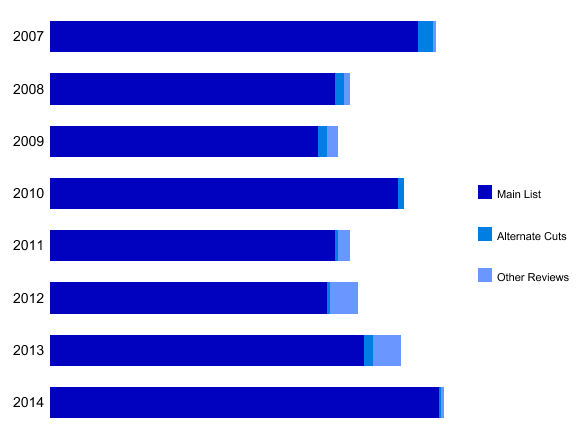
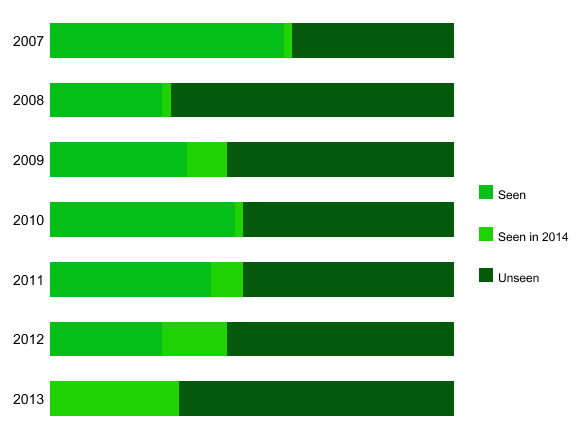
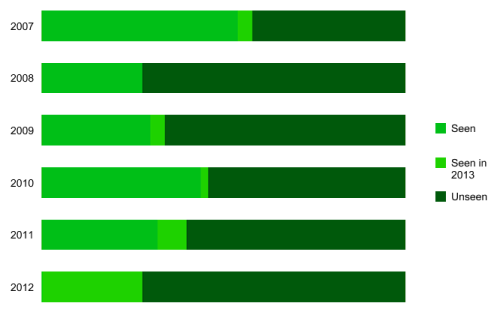
At the end of every previous year-end summary I’ve included a list of 50 notable films I’d missed from that year’s releases, and have since tracked my progress at watching those ‘misses’. In 2014, I’ve seen more movies from every year’s list (worth mentioning because I didn’t last year). Noteworthy points include that, after six years, I’ve still only seen 15 films (30%) from 2008’s list; and although I only watched one apiece from 2007’s, 2008’s, and 2010’s lists, I watched an anomalous five from 2009’s. As with so many things, I’m not sure why that should have happened. Rounding things out, I watched four from 2011’s list and eight from 2012’s. The newcomer is (of course) 2013, and I got off to strong start by catching up on 16 of those 50 — more in one year than I’ve managed in six from 2008. Don’t know what’s wrong with that list (and you can’t find out either, what with FilmJournal being down again. I’ll repost it all someday…)

That graph shows my progress year-by-year, but in total I’ve seen 153 out of 350 ‘missed’ movies, or 43.7%. Of the remaining 197, I own or currently have ready access to around 106. Which is ridiculous. I shall chastise myself.

The count of directors on the list this year is complicated by some mix-and-match directing partnerships. So for starters, there are 112 solo directors… but one of those, Frank Miller, also directed a film with Robert Rodriguez, and another with Rodriguez and Quentin Tarantino; and Rodriguez directed another again, with Ethan Maniquis. Counting all the different combinations as unique, there are 129 directing credits this year… although that doesn’t include the one film that didn’t even have a credited director! I despair. Whichever way you cut it up, it comes out as the most directors ever. I don’t know if that’s good or bad, but there it is.

Aside from Miller and Rodriguez, those with multiple films are headlined by David O. Russell and W.S. Van Dyke with three each. There’s two apiece from Tim Burton, Justin Lin, Roy William Neill, Phillip Noyce, and Steven Spielberg, while Peter Jackson has one main list film (The Hobbit 2) and one extra film (The Hobbit 1 Extended).

Finally, as always, we come to the scores:

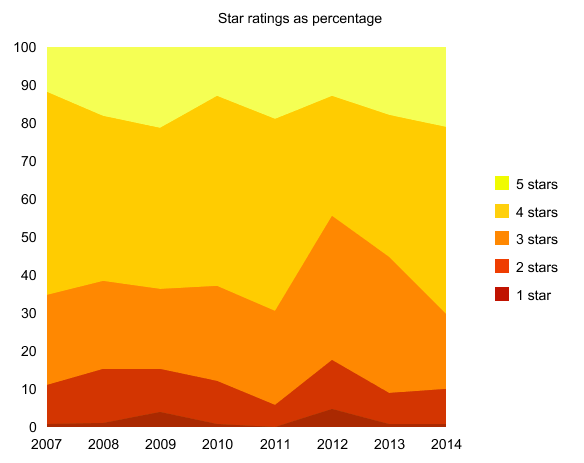
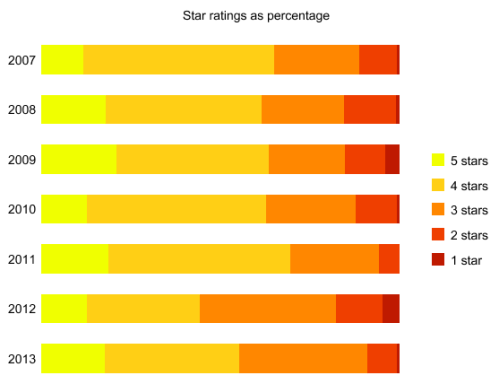
First up, there were a record-high number of five-star films this year: 29. Of course that’s partly due to the sheer volume of films, but at 21.0% of my viewing it’s only just behind 2009’s 21.2% in terms of highest percentages. That makes five-stars the second most-awarded score this year, which has only happened once before (also in 2009), and even then it was tied for second (with three-stars). Have I become more lenient, or have I been watching a higher standard of films this year? Not sure, to be honest — there may have been a couple of occasions when generosity got the better of me; equally, there were a couple where I’d initially thought of giving full marks but pulled back in the end, so I guess it averages out.

The most populous score is, as usual, four-stars, with 68 films. That’s not the highest total ever (that goes to 2007’s 72), nor the highest percentage (several years best it), but it still comes out at 49.3%, which is pretty good going. See above for my thoughts on leniency vs. quality.

There were 27 three-star films, which works out at 19.6%. That’s the lowest percentage ever for this rating. It comes after the two most three-stars-y years ever (38% in 2012 and 35.8% in 2013) — the more of these stats I trot out, the more you can see why I’ve been wondering if I’m going soft.

The lowest two rankings remain within their usual parameters, however. There were 13 two-star films, which is darn close to the 2007-2013 average of 12. Finally, there was just one one-star films, which is the same as four of the previous seven years. I’ve always been toughest when it comes to rating films just a single star — something has to be pretty irredeemable to get to that point, as proven by the fact that neither G.I. Joe: Retaliation nor Transformers: Dark of the Moon sunk so low. Maybe I am getting lenient…

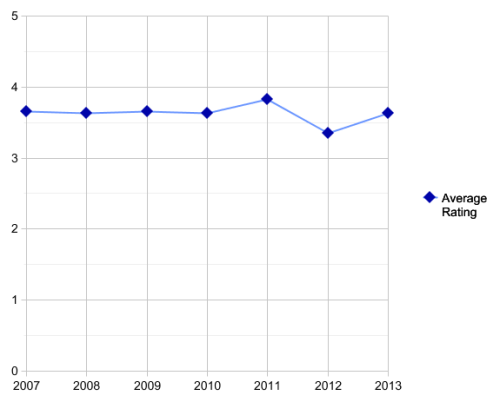
Last of all, the average score. As you’d expect from those numbers, it’s a high one: 3.8. To be precise, it’s 3.804, just behind 2011’s 3.829 but (in percentage terms) notably above third-place 2009’s 3.657. (If I scored in percentages, that would make this year’s average 76.1%, with 2011’s high as 76.6% and 2009’s third as 73.1%; 2012’s lowest-ever of 3.352 would be 67.0%.)

And that’s your lot!


Coming soon…

(“Soon” as in “soon as I can decide what they are and write up 15 mini-blurbs”, that is.)

My Top 10! And all the other bits that always come in that post!

And then we can finally move on to 2015, I promise.

2014 in Review, Part 1

It’s that time of year again, dear readers, when we look back at all that has occurred over the past 12 months.

Coming soon: my final monthly summary of 2014, about December (obv.); the full list of my 2014 viewing, with all the exciting statistics; and my summary of the highs (top ten!), lows (bottom five!) and in betweens (50 films I missed!)

But first, the now-traditional WordPress-provided summary of how many people bothered to visit my blog and which pages they bothered to visit:

Here's an excerpt:

The concert hall at the Sydney Opera House holds 2,700 people. This blog was viewed about 21,000 times in 2014. If it were a concert at Sydney Opera House, it would take about 8 sold-out performances for that many people to see it.

Click here to see the complete report.

Notes:

  • It wasn’t just new posts that grew the archive of the blog: 145 reposts from 2007-2011 helped increase the tally from last year’s 552.
  • My Harry Potter 1&2 reviews remain dominant, and I think will for all time.
  • I like that new “posting patterns” bit, even if it does show up how rarely I posted reviews for a good chunk of the year.

Tomorrow: my December summary.

September 2014

“Did you sept emb ‘er?”
“No, I oct obe ‘er!”

(Don’t worry, it doesn’t make any sense. Let’s move on…)


What Do You Mean You Haven’t Seen…?

This month’s WDYMYHS film was the massively appropriate Braveheart. I also watched a film actually about a public vote on the future of their country, No. About a nation seeking to get rid of a nefarious ruler who had reigned over them with malicious intent for far too long, the Scottish referendum is what connects these two movies. (Ho-ho!)

On the topic of WDYMYHS, I also finally posted a review for one of last year’s movies, Touch of Evil. I’ve still got Seven Samurai and The Night of the Hunter to go, as well as one other review, and then I’ll finally be done with 2013. (I’ve been exceptionally tardy with that, haven’t I?)


But back to 2014:

September’s films in full
The Amazing Spider-Man 2
#81 The Amazing Spider-Man 2 (2014)
#82 Crimes of Passion: Death of a Loved One (2013), aka Mördaren ljuger inte ensam
#83 Tucker and Dale vs Evil (2010)
#84 Saving Mr. Banks (2013)
#85 The Grey (2011)
#86 Dark Shadows (2012)
#87 Braveheart (1995)
#88 Good Morning, Vietnam (1987)

Frankenweenie#89 The Spirit (2008)
#90 The Wall (2012), aka Die Wand
#91 Frankenweenie (2012)
#92 Always (1989)
#93 American Hustle (2013)
#94 Mad City (1997)
#95 Fantastic Mr. Fox (2009)
#96 No (2012)
#97 This is Not a Film (2011), aka In film nist


Analysis

At the start of the year, there’s rarely very much to say in these sections; by this point… oh, there are so many ways to look at the data! September is where that really kicks in, because it’s a month in which I’ve twice reached #100, the earliest I’ve ever managed it. That means “how near is #100?” becomes a very viable proposition; plus, I tend to get very watch-y as the big target nears — when it’s only a few films away, why not squeeze in a couple more than normal and get there sooner?

On that last point, it’s perhaps interesting to start with previous Septembers. Last year was my best-ever tally for the ninth month, by some 23% as well… and yet I didn’t reach #100 until two months later. In part that was just the aforementioned pushing on to get closer to the end — the same thing happened in October, and after I actually reached #100 (in early November) I only watched a couple more films. This September, meanwhile, is 31% higher than last year’s — or, to put it another way, 55% better than the best-before-2013 was. And yet I still haven’t reached #100…

What viewing 17 films this month does mean, however, is that it’s my joint-second highest month ever — hurrah! That’s tied with March 2013; it would’ve needed only one more to be outright-second (oh well), two more to be joint-first (looking right back to December 2008 for that), and (obviously now) three more — i.e. have reached #100 — to set a new record.

What does having reached #97 mean for the rest of the year? Well, it’s the furthest I’ve ever gotten by September without reaching 100. Next nearest was last year, when I was at #84. From there, I went on to #110, which is another 26 films — if I do the same this year, I’d reach #123, which would become my second-highest total ever (behind 2007’s 129 and just ahead of 2010’s 122). Widening the parameters to include all previous years, my average total for the year’s final three months is 27 — making last year the most average of the lot, in fact.

That might be the most accurate predictor of where I’ll end up (though still prone to wild variation: I may’ve watched 26 more last year, but the year before that it was only 16, and in 2009 it was up at 40), but let’s use the rest of the 2014 to make some wild assertions anyway. So, my year-to-date average suggests I’ll reach #129, which (as mentioned) would put 2014 equal-best with 2007; pushing a tiny bit harder would leave me with a record-setting 130 films. The most recent months bode well for that: if I maintain my average viewing from the last three months, I’ll reach #139; if I keep up the average of the last two months, however, I’d make it all the way to #145; and if I kept pace with September, I’d make it all the way to #148!

Will any of that happen? Probably not (never say never!), but it’d be nice to end up in the 120s at least.


Slipping…

A side effect of the higher-than-average viewing is that the extent of my backlog has worsened. You may have noticed the number of new reviews step up a little in the past few weeks to try to stave it off, but in the end I had to relent: having kept the “coming soon” list at no more than 49 films ever since July 2012, it slipped to 50 this month. Ah well. Efforts will continue to stop it growing any longer.


This month’s archive reviews

A bit of a lax start to the month means just 17 archive re-posts this time…

Also this month, the two bookend posts from my 2011 David Fincher Week. Most of the reviews featured therein have already been brought over to this blog, but Fight Club and Panic Room will round them out tomorrow and Friday.

(You may have noticed my Se7en review appeared here before this post, but as that’s technically the archive repost for October 1st it’ll be in next month’s update. I am nothing if not precise about these things that don’t really matter.)


5… what?

This is the second month in a row without a “list of five”, but they have not necessarily gone the way of the dodo — last month I couldn’t think of anything worth doing; this month I’ve run out of time.

I was considering “5 favourite Tim Burton films”, because I finally caught up on both Dark Shadows and Frankenweenie this month. My list would probably have included Batman Returns, Edward Scissorhands, Corpse Bride and Sleepy Hollow (along with a fifth, obviously), and definitely would have left out Planet of the Apes, Mars Attacks and Beetlejuice. (Lest you judge my selections harshly, bear in mind I still haven’t got round to Ed Wood or Big Fish. Or Pee-wee’s Big Adventure.)

What about you, dear reader?


Next month on 100 Films in a Year…

98…
99…
100!

101?

August 2014

As summer comes to an end (hurrah!) it’s time to look back on what’s been my most productive month of the year (hurrah!)


What Do You Mean You Haven’t Seen…?

First up, this month’s WDYMYHS film is the list’s #1 contender, the points tally that got it here some 24% higher than that for second place. It’s Stanley Kubrick’s acclaimed film, adapted from Stephen King’s acclaimed novel, the “masterpiece of modern horror”, The Shining.

God it’s scary, isn’t it? But brilliant.

I’m two for four on Kubrick films I’ve enjoyed (though one of the ‘fails’ is 2001, which I last saw in full when I was rather young, so it deserves a third go — the second having been in my teens, when it sent me to sleep. (In fairness, it was about 3am.) But I digress…) I own most of the rest of the man’s oeuvre on disc (except Fear and Desire which, considering there’s a Masters of Cinema release, I ought to pick up) — so, as that’s only nine films, I should make more of an effort to watch them. (By now we all know how that’s likely to turn out, right?)


August’s films in full

American Movie#66 The Expendables 2 (2012)
#67 Clear and Present Danger (1994)
#67a Cloudy 2: Extra Toppings (2013)
#68 Inseparable (2011)
#69 After Earth (2013)
#70 Thor: The Dark World (2013)
#70a Marvel One-Shot: All Hail the King (2014)
#71 The Battle of the Somme (1916)
#72 The Forbidden Kingdom (2008)
The Kings of Summer#73 American Movie (1999)

#74 St. Trinian’s: The Legend of Fritton’s Gold (2007),
aka St. Trinian’s 2
#75 Local Hero (1983)
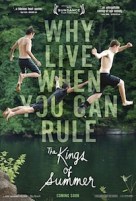
#76 The Kings of Summer (2013)
#77 Safe (2012)
#78 Wrath of the Titans (2012)
#79 The Man with the Iron Fists (2012)
#80 The Shining (1980)


Analysis

As I said at the start, August has been 2014’s best month so far: the list up there totals 15 new features, besting the previous high of 12 from March. It’s also well clear of the year-to-date average, which was 9.3 — indeed, August alone pulls that up to a round 10.

August’s closing position of #80 puts 2014 in a very nice position. It’s the highest I’ve been at this point since 2010 (when I’d made it to #89), and the only other year that went better was 2007 (when I was well into the 90s by now). It turns around a gradual slide over the last few years, from 77 in 2011, to 73 in 2012, to 71 in 2013. Those are all good results, though, because the target for August is #66.

In terms of using August’s numbers to predict December’s final tally… well, it’s a fool’s game. In 2009, for instance, August’s total suggested I’d watch just 22 films during the year’s final third; in fact, I watched 50. Conversely, in 2011 the numbers suggested 39 more films, but I only watched 23. Last year was closest: a prediction of 36 ended up with 39 films watched. The only observable pattern is: if the prediction is 36 or under, I’ll surpass it; if the prediction is 37 or over, I’ll watch less. This August offers a prediction of 40 more films (for a total of 120), so the unlikely-to-be-maintained rule suggests I’ll watch a non-specific number of films that’s less than that. Which, actually, I completely believe.

My average viewing for the September-to-December period is 35 films, so if I reach #115 by year’s end then I’ll be conforming to history in every respect.


This month’s archive reviews

My re-post project continues apace: despite missing a week due to time-consuming redecorating, I still re-posted 24 reviews from my old blog. Just 246 to go…


Next month on 100 Films in a Year…

I’ve twice reached #100 in September, but to do that this year it’ll be my best month ever. Let’s hope for something in the 90s then, eh.

What Do You Mean You Haven’t Seen…? 2014

My challenge-within-a-challenge is back, with 12 fresh films to squeeze in to my 2014 viewing.

The odd up-and-down aside, I feel WDYMYHS worked well last year; but for its second outing I wanted to make some changes. Though the top 12 that last year’s simple formula resulted in were all films I definitely needed to see — and several were ones I’d been looking forward to for so long I was actively put off by the level of expectation — I wanted to try something different. Last year’s 12 were, for want of a better word, a little “worthy”: 75% were black & white, 50% were from the 1950s, the most recent was 30 years old… I have nothing against any of those factors individually, but it began to feel rather dominant.

The question was, how to change it while also making the list a ‘random’ selection dictated by Best Of lists, others’ ratings, and the like? Well, it got complicated… but just in case anyone’s interested, I’ll explain it all anyway. Though for the sake of those who don’t care but are nonetheless curious what 12 films the system chucked out, I’ll do my explaining after the list itself. (That said, it’s only in the long explanation that you’ll learn what the string of letters and numbers under each title actually mean.)

So, in the order they were generated (from ‘best’ to ‘not-as-best’), this year’s 12 are:


The Shining
Score: 933
IMDb #51 | TSPDT #112 | Empire #52 | iCM Most ✓ed #52

Rear Window
Score: 753
IMDb #30 | TSPDT #42 | Empire #103

Up
Score: 698
IMDb #118 | iCM Most ✓ed #20 | Box Office #56

The Big Lebowski
Score: 676
IMDb #133 | TSPDT #231 | Empire #43 | iCM Most ✓ed #89

Modern Times
Score: 540
IMDb #41 | TSPDT #43

Amélie
Score: 533
IMDb #65 | TSPDT #800 | Empire #196 | iCM Most ✓ed #104

12 Angry Men
Score: 525
IMDb #7 | TSPDT #531 | Empire #72

Requiem for a Dream
Score: 472
IMDb #75 | TSPDT #672 | Empire #238 | iCM Most ✓ed #108

Oldboy
Score: 456
IMDb #76 | TSPDT #845 | Empire #64

Braveheart
Score: 443
IMDb #79 | Empire #320 | iCM Most ✓ed #74

The Searchers
Score: 426
TSPDT #9 | Empire #164

Blue Velvet
Score: 406
TSPDT #78 | Empire #85


(All rankings were correct at the time of compiling and may have changed since.)

So, good list? Bad list? Feel free to share any and all opinions. And as per last year, my progress will be covered as part of the monthly updates.

Now, the long bit:


Stats

As you can see, the new selection process has created a fundamentally different set of films. Last year, 50% came from the 1950s and there was nothing from the last 30 years; this year, 50% come from the last 20 years. Last year, 75% of the films were in black & white; this year, 83% are in colour. Last year, three of the films were over three hours long; this year, only two of them even cross the two-hour mark. Even the completely incidental matter of how many I have on Blu-ray and how many on DVD has been turned on its head, with last year’s 7:5 ratio becoming 5:7 this year. About the only thing that remains the same (not identical, but near enough) is the proportion of non-English language films: last year there were three, this year there are two.

Other similarities come in the presence of certain directors: there’s another film each from Chaplin, Hitchcock and Kubrick, all of whom (as you may remember) I had to reject multiple films by last year to meet my “no repetition” rule. In Hitch’s case, it’s the film I would’ve watched in 2013 were it not for my old “Blu-ray trumps DVD” rule; in Chaplin’s case, it was the film of his that ranked second last year; and for Kubrick, it was his third film last year but is now #1 under the new rules. No repeat appearance for Bergman, however, who had multiple entries at the top of last year’s long list, but this time only reached #18.

I’m not short of notable directors among the other nine, however, with a film each from: the Coen brothers, John Ford, David Lynch, Sidney Lumet, and what will be my first encounter with Darren Aronofsky. Depending on your point of view, the remainder don’t stint either: Mel Gibson, Jean-Pierre Jeunet, Park Chan-wook, and Pete Docter Of Pixar.


Process

So, how exactly did I concoct this duodectet of acclaimed classics?

First, a quick reminder of the comparatively simple way I did it last year: I went through IMDb’s Top 250 and the top 250 entries in They Shoot Pictures, Don’t They?’s 1,000 Greatest Films and noted down every film I owned, then eliminated any that weren’t on both lists, then split the difference between their placement on each list to produce some kind of average. Then, allowing only one film per director and allowing films I owned on Blu-ray to earn a place above those I owned on DVD, the top 12 (ultimately culled from the top 18) became my final selections.

That’s far simpler than where we’re going this year.

So, as expressed, I wanted to make the list a little more (shall we say) populist. The best way to do this, I reasoned, was to include more lists. In the end I used five, and they were:

  • IMDb’s Top 250, which guarantees a wide viewership and high ranking; it’s often seen as an incredibly mainstream list, but in places (especially a little lower down) it’s less so than you might expect;
  • They Shoot Pictures, Don’t They?’s The 1,000 Greatest Films, which is compiled from an extraordinary number of ballots from critics, filmmakers, and more, weighted and analysed to produce a very academic list. To say it strives to be anti-mainstream is unfair, but it’s certainly not concerned with being populist;
  • Empire’s 500 Greatest Movies of All Time, which is Empire magazine’s huge poll of readers, journalists and filmmakers from 2008. Much like the IMDb list, it skews mainstream, but even if it’s from “a mainstream film magazine” that’s still “a film magazine”, so the mid- to lower-levels produce interesting films;
  • iCheckMovies’ Most Checked, which should see the inclusion of the kind of movies ‘everyone’ has seen but I haven’t;
  • All-Time Worldwide Box Office, for essentially the same reason as above. (The version I used is linked to, though it seems to have numerous little differences to the one at my normal go-to site for box office numbers.)

For parity with the IMDb list, all were limited to the top 250 entries. For the record, all positions were collated from the iCheckMovies versions of the lists on 5th January.

As you can see, that’s a list of lists that errs much more toward the mainest of mainstreams than last year’s. However, I’ll repeat my caveats from above: the IMDb and Empire lists aren’t as unrelentingly populist as certain cinephiles would have you believe; and even where they are, I’ve already seen most of those films anyway. Additionally, with so many lists I removed the requirement for films to appear on all of them, which led to the following in my final 12:

  • Two films don’t appear on the IMDb Top 250;
  • Six films don’t appear in the TSPDT 1000’s top 250;
  • Three films don’t appear in the Empire 500’s top 250;
  • Six films don’t appear on iCheckMovies’ Most Checked;
  • Eleven films don’t appear in the All-Time Worldwide Box Office top 250.

In all, 117 films I own appeared in the top 250 of at least one list, but only 48 of those appeared in the top 250 of two or more lists.

So how do all these lists come together to form my list? I can’t simply split the difference this time! Short answer is, I used a points system. For each list, a film received 251 points minus its position on the list; so the #1 film would get 250 points, the #2 film 249, and so on. If a film was outside the top 250, it scored 0 points for that list.

This produced a chart that was interesting in a number of ways, but one was that it didn’t take account of how many lists a film was on. For instance, The Exorcist appears on four of the five lists, but is quite low on all of them, so its score was 188; The Passion of Joan of Arc, however, only appears on one list, but at #14, so its score was 237. That didn’t seem quite fair. To balance this, I awarded 50 points for every additional list a film was on beyond its first. So, to use the same two films, Joan of Arc got no bonus points, while The Exorcist got 150. These are two of the more extreme examples, but it certainly made huge changes — The Exorcist jumped up literally dozens of places.

I felt some more tweaking was in order. It was all well and good rewarding appearances on multiple lists, but some films were in the upper echelons of one list but just scraping in to another. I decided to weight the results further in the favour of films that were at the top of particular lists. Essentially, this gives a slight edge to the importance of certain lists — which is fine, because I didn’t necessarily want all five lists to be of equal weight. So, 25 bonus points were award for being in: the IMDb top 100, the TSPDT top 50, and the iCM Most Checked top 50. (By this point I was just looking at numbers, so I’ve no idea what actual difference this made to rankings.)

I briefly considered awarding bonus points for an appearance on any list outside of its top 250 — IMDb and iCM Most Checked stop at that number, but the others go on much higher (the size is mostly in their names, but the box office chart goes to 500-and-something too). I was thinking of something like 25 or 50 points, until I realised this would mean a film could get more for being 251st on a list than it could for being 250th, or even 200th potentially. I could’ve raised all the films’ totals by the bonus amount (i.e. instead of scoring 250, #1 would score 300, and so on down), but, to be frank, I couldn’t be bothered.

One final points booster I did add, however, was again from iCheckMovies. That site has many, many official lists for films to appear on, and obviously the more lists it’s on the more acclaimed a film is. So, each film got the number of lists it was on as bonus points — e.g. The Shining appears on 21 lists, so it got 21 points; A Clockwork Orange appears on 29 lists, so it got 29 points — still not enough to reclaim last year’s spot above its Kubrick stablemate, though. In fact, I don’t think this had any impact on the final 12. Although the number of lists they’re on ranges from 14 to 29, at this point those kind of points were’t enough to see any of them booted out, or even rejigged within the 12 itself.

With the final points awarded, all that remained was to institute my other rules. Firstly, no repeat directors — bye bye A Clockwork Orange, which actually finished second overall. I also decided to eliminate Raging Bull — it didn’t feel right it being on the list two years in a row. That had finished third. The next repetition isn’t until #16, a second Chaplin-directed film, but this year that fell beyond the reach of the final 12. I did make one more change, however: I eliminated #14, The Wild Bunch, which would otherwise have been the final film of the 12. Why? Well, this is one that could be contentious…

I say that as if I anyone cares or my rules weren’t arbitrarily cooked up! But what I mean is, there isn’t any rule that counts it out. Yes, with this year’s selection I was aiming for a wide variety of tones, styles, eras, content and so on, and The Wild Bunch is a Western just like the film immediately before it (The Searchers) — but there are plenty of thrillers and a couple of comedies on the list, so why not repeat the Western too? Especially as I get the impression these two aren’t that similar. The real reason, though, is that I wanted to include #15, Blue Velvet. Were I to give the films a personal rating — of “have been waiting to see”-ness, say — the Lynch would come out on top of those two. As they were quite close in points anyway (414 vs 406), I decided to just make the swap, rather than continue to fiddle in the blatant hope of making Blue Velvet’s score rise.


And so, with my underhandedness factored in, I finally had my final 12.

That was fun, wasn’t it?

(The tall picture on the right is the final version of my long list. If you want, you can click here for a legible version, on which you can play “spot the French title spellcheck ‘corrected'”.)


And finally…

The level of my wit is on full display with the inclusion of “Alfred Hitchcock’s Rear” in the top image. Teeheehee.

2013: The Full List

Here we are for the seventh time, dear readers: a new year begun, meaning it’s time to look at the one just passed.

2013 was an above-average year for 100 Films in purely numerical terms: I watched 110 films that were new to me, a number higher than I managed in four of the blog’s six previous years. There are a whole host of ways I’ll be (over-)analysing that viewing, both throughout this post and another in a few days’ time — perversely, this is one of my favourite bits of the year.

Anyway, because there’s a lot of long lists stretching out this post, let’s begin with a list of handy links, enabling you to jump down to whichever bit interests you:

So without further ado:


2013 As It Happened

Below is a graphical representation of my viewing, month by month. More importantly, each of the twelve images links to their relevant monthly update, meaning this is where you can find a numbered list of every qualifying film I watched in 2013.


The List

Alternate Cuts
Other Reviews
Shorts

The Statistics

As I expect you know by this point, I watched 110 new (to me) feature films in 2013. (All are included in the stats that follow, even if I’ve not posted a review yet.) This makes 2013 my third best year ever, behind 2007’s 129 and 2010’s 122.

I also watched three features I’d seen before but were now extended or altered in some way. I also chose to review ten others for the fun of it. Between those two groups there’s all eight Harry Potters, watched and reviews as part of my thorough retrospective. All 123 films are included in the statistics that follow (except where indicated).

I also watched four shorts this year (which shan’t be counted in any statistics… except for the one that says they are). That’s one fewer than last year and one more than the year before, but as I own literally hundreds on DVD, I really should be doing a lot better.

The total running time of new features this year was 209 hours and 10 minutes, a huge increase on last year; indeed, it’s the highest ever (by 58 minutes), over a year that had about a dozen more films. Lots of long ‘uns this year. The total running time of all films (and this is the one that does include shorts) was 239 hours and 29 minutes — which, as you can see in the graph below, makes this year the longest by some way; in fact, new features alone definitively tops the entirety of viewing from all but one previous year!

This year’s most prolific viewing format was, for the first time, Blu-ray. HD discs accounted for 59 of films watched, which is also the format’s highest tally to date. Second was television, bumped off the top spot for the first time since 2008 (when it finished fourth). I watched 42 films on the gogglebox (just four of them in HD), which is also its lowest total since 2008 (when it accounted for just 10!) Also-rans include DVD with eight (considering my vast collection, I ought to invest a bit more time in them) and downloads, also with eight (mostly Falcon films nabbed from iPlayer, but also two others in HD).

Finally, after ‘storming’ from nowhere to a massive four films last year, streaming continued its (minor) resurgence with six. Last year it was thanks to Netflix and LOVEFiLM, this year it’s Now TV (which also means they were all in HD, something the other two services didn’t offer through my Wii). To be honest, I’m surprised that number’s so low — I really ought to have made better use of the service. Maybe in the early months of 2014.

For the first time since this blog began — indeed, for perhaps the first time in almost 20 years — I didn’t make a single trip to the cinema this year. Put that down to personal laziness as much as apathy with the current state of the cinematic experience. Sad in a way, but so often I find it such a palaver, and an expensive one at that: when you can get a new release Blu-ray for little more than the total cost of a solo cinema trip (and these days, if I cared enough to go to the cinema for it, I’m almost certain to want the Blu-ray too), it makes financial sense.
This year’s closest temptations were The Wolverine (now the first X-Men film I’ve skipped theatrically), Doctor Who’s 50th anniversary special (I was going to catch an encore but, of all things, a broken boiler got in the way), and Gravity (“see it in 3D on the biggest screen you can find,” they wailed. I forgot.) Maybe next year I’ll be tempted to make the arduous shift from my sofa to a cinema seat by the likes of X-Men: Days of Future Past and… um… well, I’m sure there’s something else to look forward to…

The most popular decade in 2013 was the 2010s, with 54 films. Unsurprisingly, 2013 itself accounted for a goodly chunk of that. At 43.9% of my total, the ’10s are also up a fraction on last year. Continuing that pattern, the ’00s finish second again, with 22 films (17.9%) — numbers close to 2012’s.

In all, my viewing spanned eight decades — as with last year, every decade since the 1930s is covered (I really must make an effort with my silent film DVD/BD collection). With post-millennial years taking the top two places, it falls to the last millennium to round out the list: the ’40s and ’50s come joint third with 10 (8.1%) apiece, while the ’60s are just behind on nine (7.3%). In descending order, the ’80s claim seven (5.7%), the ’90s account for five (4.1%), the ’70s manage three (2.4%), and the ’30s have just two (1.6%). Finally, if I included shorts in these things the 1900s would also feature, thanks to 1902’s A Trip to the Moon.

Last year, 106 of the 108 films I watched were wholly or significantly in English. Poor. This year, it was 115 out of 123 — still not great if you’re looking to take in the vastness of world cinema, but 93.5% vs. last year’s 98% is clearly an improvement. A distant second was Japanese with four (3.3%), and there were two apiece containing significant amounts (or being wholly in) French, Italian and Mandarin. Still, as last year’s complete list of languages was “English, German, Cantonese and Mandarin”, the total of 11 this year (plus “silent”, if you count that) is a step in the right direction. Others of note include Sioux (thanks to Shanghai Knights) and Klingon (guess). OK, maybe I shouldn’t count the last one. Call it 10 languages, then.
Moving on to countries of production, the USA is similarly dominant, producing or co-producing 102 films. At 82.9% of my viewing, that’s actually marginally up on last year. Second place again belongs to Britain with 36 films (29.3%), also upping its share from 2012. A mixture of co-productions obscure the true numbers for country-of-origin, but other numerical highlights include France (8), Germany (6, all co-productions if I remember rightly), Canada (5), Italy (4), Japan (3, none of them co-prods), and South Africa (3, an increasingly popular co-production destination I believe). A further 12 countries have one or two productions to their name, although I think only Sweden’s sole entry was entirely their ‘own work’.

This year I also totted up the BBFC and MPAA certificates of films I watched. From the BBFC, the PG, 12 and 15 certificates were all pretty well balanced, with 31, 34 and 33 films respectively. Of the outliers, 12 were rated U and nine were 18s, leaving four that somehow weren’t BBFC certified at all.

The MPAA are a funnier lot: the top certificate from them is “Not Rated”, with a total of 39. That’s because they don’t insist on reclassifying old titles, plus a few “unrated cut”s. The highest genuine rating was just behind: the ubiquitous PG-13, with 37. Elsewhere, R-rated films totalled 27, there were 18 at PG (compare to the BBFC’s 31), the surprisingly-rare G put in one appearance, and there was even an NC-17! Feel free to go hunt that one out.

(I was going to include a graph here, but it didn’t really show anything the numbers don’t. That is to say, the BBFC are more reasonable.)

After just three of 2012’s films appeared on the IMDb Top 250 — the lowest number ever — this year has seen a resurgence. As of New Year’s Day 2014, 13 films from 2013’s main list appear upon that hallowed chart; one of my higher totals, though not a patch on 2007’s 21. This year’s lot is made up of the 11 I saw from What Do You Mean You Haven’t Seen…? (which had to be on the IMDb Top 250 to qualify), plus Django Unchained (53rd) and It Happened One Night (135th). The positions range from 18th (Seven Samurai) to 197th (The Night of the Hunter). For all that, I still have some 114 Top 250 films to see.

At the end of all six previous years’ final summaries, I’ve included a list of 50 notable films I’d missed from that year’s releases. Taking into account 2013’s viewing, I’ve managed to see (deep breath) two more from 2007’s list (bringing the total for that 50 to 29), no more from 2008’s (leaving it at 14), two more from 2009’s (bringing it to 17), one more from 2010’s (bringing it to 23), and four more from 2011’s (bringing it to 20). It’s now a year since I published 2012’s 50 (obviously), and in that time I’ve managed to see 14 of them. A solid start, but as I own or have access to over 20 more, I could do a lot better.

A total of 96 solo directors and three directing partnerships appear on the main list this year. Foremost among these numerically is George A. Romero with six films, while there are two each for William Clemens, Justin Lin, John Madden, Orson Welles and David Zucker. Elsewhere, Jay Oliva appears once on the main list and once in the additional films. The latter also gives us four films for David Yates, two each for Chris Columbus and Gordon Flemyng, and two shorts for Louis D’Esposito. Most of those multiples are thanks to franchises: “the Dead” (Romero), the Falcon (Clemens), Fast & Furious (Lin), Naked Gun (Zucker), Batman (Oliva), Harry Potter (Yates, Columbus), Doctor Who (Flemyng), and Marvel (D’Esposito).

I noted previously that there seemed to be an uncommonly high number of noteworthy directors who I was encountering for the first time this year. They include Ingmar Bergman (The Seventh Seal), Frank Capra (It Happened One Night), John Cassavetes (The Killing of a Chinese Bookie), Vittorio De Sica (Bicycle Thieves), Georges Méliès (A Trip to the Moon), Nicholas Ray (On Dangerous Ground), and George A. Romero (Dawn of the Dead, and the rest). There could be said to be more (Andrew Dominik, Richard Fleischer, Charles Laughton, Ben Wheatley…), but your mileage may vary.

Lastly, the scores. 2013 ushered in 22 five-star films (the most ever!) and just one one-star film. 2012 saw three-star films top the tally for the first time; 2013 saw the highest number of three-star films ever, at 44… but they were nonetheless bested (just), by the 46 four-star films. Hurrah for quality! Last but not least (literally), there were 10 two-star films.

To be frank, I expected the number of films I awarded three stars to have again exceeded the number given four. Last year I wondered if I was being harsher or just watching poorer films; this year, I’d felt certain I was doing the former, with multiple movies that would previously have benefitted from my benevolence being cruelly stripped back to that middle rank. And I only felt a little bit bad about it. In fact, the only thing that ever gives me pause is that there are archive four-star reviews which, for parity’s sake, ought now to be three-stars. I guess I’ll just have to live with that.

Finally, then: after last year’s record-low average score, this year saw it rise back into regular territory, finishing up at 3.6. Hurrah again!


Coming next…

It’s time to definitively wave goodbye to 2013 with my final summary post. My bottom five are already chosen, my top ten currently has fifteen entries, and the long list for my “50 unseen from 2013” stands at 113… but fear not, dear reader: choices will be made, and all will be revealed this weekend.

2013 in Review, Part 1

It’s the end, dear readers, but the moment has been prepared for…

…by WordPress, that is, who have produced my annual report. It’s just the beginning of my regular array of posts that look back at the year just passed, so keep your eyes peeled (also, open) for three further review-of-the-year posts in the next few days. Those ones I actually wrote myself!

Here’s an excerpt from WordPress’ report:

The concert hall at the Sydney Opera House holds 2,700 people. This blog was viewed about 17,000 times in 2013. If it were a concert at Sydney Opera House, it would take about 6 sold-out performances for that many people to see it.

Click here to see the complete report.

Once you’ve read that, the following will make sense:

  • It wasn’t just new posts that grew the archive of the blog: 141 reposts from 2007-2011 helped increase the tally from last year’s 249.
  • Those Harry Potter reviews…! They remain my most-viewed posts most days.
  • The Batman one got a lot of visits from people wanting to know when it was out in the UK; I pushed Adèle Blanc-Sec like mad on Twitter when it premiered on Film4, so that paid off; the last one I can’t really explain.
  • Particular thanks to ghostof82, filmhipster, Colin and Mike.

Next up in my review of the year: a look back at December 2013.