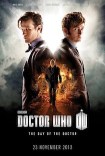
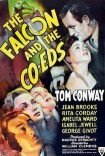
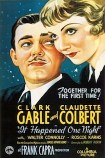
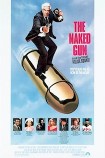
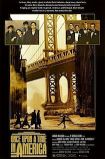
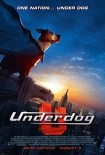
What Do You Mean You Haven’t Seen…? 2014

My challenge-within-a-challenge is back, with 12 fresh films to squeeze in to my 2014 viewing.

The odd up-and-down aside, I feel WDYMYHS worked well last year; but for its second outing I wanted to make some changes. Though the top 12 that last year’s simple formula resulted in were all films I definitely needed to see — and several were ones I’d been looking forward to for so long I was actively put off by the level of expectation — I wanted to try something different. Last year’s 12 were, for want of a better word, a little “worthy”: 75% were black & white, 50% were from the 1950s, the most recent was 30 years old… I have nothing against any of those factors individually, but it began to feel rather dominant.

The question was, how to change it while also making the list a ‘random’ selection dictated by Best Of lists, others’ ratings, and the like? Well, it got complicated… but just in case anyone’s interested, I’ll explain it all anyway. Though for the sake of those who don’t care but are nonetheless curious what 12 films the system chucked out, I’ll do my explaining after the list itself. (That said, it’s only in the long explanation that you’ll learn what the string of letters and numbers under each title actually mean.)

So, in the order they were generated (from ‘best’ to ‘not-as-best’), this year’s 12 are:


The Shining
Score: 933
IMDb #51 | TSPDT #112 | Empire #52 | iCM Most ✓ed #52

Rear Window
Score: 753
IMDb #30 | TSPDT #42 | Empire #103

Up
Score: 698
IMDb #118 | iCM Most ✓ed #20 | Box Office #56

The Big Lebowski
Score: 676
IMDb #133 | TSPDT #231 | Empire #43 | iCM Most ✓ed #89

Modern Times
Score: 540
IMDb #41 | TSPDT #43

Amélie
Score: 533
IMDb #65 | TSPDT #800 | Empire #196 | iCM Most ✓ed #104

12 Angry Men
Score: 525
IMDb #7 | TSPDT #531 | Empire #72

Requiem for a Dream
Score: 472
IMDb #75 | TSPDT #672 | Empire #238 | iCM Most ✓ed #108

Oldboy
Score: 456
IMDb #76 | TSPDT #845 | Empire #64

Braveheart
Score: 443
IMDb #79 | Empire #320 | iCM Most ✓ed #74

The Searchers
Score: 426
TSPDT #9 | Empire #164

Blue Velvet
Score: 406
TSPDT #78 | Empire #85


(All rankings were correct at the time of compiling and may have changed since.)

So, good list? Bad list? Feel free to share any and all opinions. And as per last year, my progress will be covered as part of the monthly updates.

Now, the long bit:


Stats

As you can see, the new selection process has created a fundamentally different set of films. Last year, 50% came from the 1950s and there was nothing from the last 30 years; this year, 50% come from the last 20 years. Last year, 75% of the films were in black & white; this year, 83% are in colour. Last year, three of the films were over three hours long; this year, only two of them even cross the two-hour mark. Even the completely incidental matter of how many I have on Blu-ray and how many on DVD has been turned on its head, with last year’s 7:5 ratio becoming 5:7 this year. About the only thing that remains the same (not identical, but near enough) is the proportion of non-English language films: last year there were three, this year there are two.

Other similarities come in the presence of certain directors: there’s another film each from Chaplin, Hitchcock and Kubrick, all of whom (as you may remember) I had to reject multiple films by last year to meet my “no repetition” rule. In Hitch’s case, it’s the film I would’ve watched in 2013 were it not for my old “Blu-ray trumps DVD” rule; in Chaplin’s case, it was the film of his that ranked second last year; and for Kubrick, it was his third film last year but is now #1 under the new rules. No repeat appearance for Bergman, however, who had multiple entries at the top of last year’s long list, but this time only reached #18.

I’m not short of notable directors among the other nine, however, with a film each from: the Coen brothers, John Ford, David Lynch, Sidney Lumet, and what will be my first encounter with Darren Aronofsky. Depending on your point of view, the remainder don’t stint either: Mel Gibson, Jean-Pierre Jeunet, Park Chan-wook, and Pete Docter Of Pixar.


Process

So, how exactly did I concoct this duodectet of acclaimed classics?

First, a quick reminder of the comparatively simple way I did it last year: I went through IMDb’s Top 250 and the top 250 entries in They Shoot Pictures, Don’t They?’s 1,000 Greatest Films and noted down every film I owned, then eliminated any that weren’t on both lists, then split the difference between their placement on each list to produce some kind of average. Then, allowing only one film per director and allowing films I owned on Blu-ray to earn a place above those I owned on DVD, the top 12 (ultimately culled from the top 18) became my final selections.

That’s far simpler than where we’re going this year.

So, as expressed, I wanted to make the list a little more (shall we say) populist. The best way to do this, I reasoned, was to include more lists. In the end I used five, and they were:

  • IMDb’s Top 250, which guarantees a wide viewership and high ranking; it’s often seen as an incredibly mainstream list, but in places (especially a little lower down) it’s less so than you might expect;
  • They Shoot Pictures, Don’t They?’s The 1,000 Greatest Films, which is compiled from an extraordinary number of ballots from critics, filmmakers, and more, weighted and analysed to produce a very academic list. To say it strives to be anti-mainstream is unfair, but it’s certainly not concerned with being populist;
  • Empire’s 500 Greatest Movies of All Time, which is Empire magazine’s huge poll of readers, journalists and filmmakers from 2008. Much like the IMDb list, it skews mainstream, but even if it’s from “a mainstream film magazine” that’s still “a film magazine”, so the mid- to lower-levels produce interesting films;
  • iCheckMovies’ Most Checked, which should see the inclusion of the kind of movies ‘everyone’ has seen but I haven’t;
  • All-Time Worldwide Box Office, for essentially the same reason as above. (The version I used is linked to, though it seems to have numerous little differences to the one at my normal go-to site for box office numbers.)

For parity with the IMDb list, all were limited to the top 250 entries. For the record, all positions were collated from the iCheckMovies versions of the lists on 5th January.

As you can see, that’s a list of lists that errs much more toward the mainest of mainstreams than last year’s. However, I’ll repeat my caveats from above: the IMDb and Empire lists aren’t as unrelentingly populist as certain cinephiles would have you believe; and even where they are, I’ve already seen most of those films anyway. Additionally, with so many lists I removed the requirement for films to appear on all of them, which led to the following in my final 12:

  • Two films don’t appear on the IMDb Top 250;
  • Six films don’t appear in the TSPDT 1000’s top 250;
  • Three films don’t appear in the Empire 500’s top 250;
  • Six films don’t appear on iCheckMovies’ Most Checked;
  • Eleven films don’t appear in the All-Time Worldwide Box Office top 250.

In all, 117 films I own appeared in the top 250 of at least one list, but only 48 of those appeared in the top 250 of two or more lists.

So how do all these lists come together to form my list? I can’t simply split the difference this time! Short answer is, I used a points system. For each list, a film received 251 points minus its position on the list; so the #1 film would get 250 points, the #2 film 249, and so on. If a film was outside the top 250, it scored 0 points for that list.

This produced a chart that was interesting in a number of ways, but one was that it didn’t take account of how many lists a film was on. For instance, The Exorcist appears on four of the five lists, but is quite low on all of them, so its score was 188; The Passion of Joan of Arc, however, only appears on one list, but at #14, so its score was 237. That didn’t seem quite fair. To balance this, I awarded 50 points for every additional list a film was on beyond its first. So, to use the same two films, Joan of Arc got no bonus points, while The Exorcist got 150. These are two of the more extreme examples, but it certainly made huge changes — The Exorcist jumped up literally dozens of places.

I felt some more tweaking was in order. It was all well and good rewarding appearances on multiple lists, but some films were in the upper echelons of one list but just scraping in to another. I decided to weight the results further in the favour of films that were at the top of particular lists. Essentially, this gives a slight edge to the importance of certain lists — which is fine, because I didn’t necessarily want all five lists to be of equal weight. So, 25 bonus points were award for being in: the IMDb top 100, the TSPDT top 50, and the iCM Most Checked top 50. (By this point I was just looking at numbers, so I’ve no idea what actual difference this made to rankings.)

I briefly considered awarding bonus points for an appearance on any list outside of its top 250 — IMDb and iCM Most Checked stop at that number, but the others go on much higher (the size is mostly in their names, but the box office chart goes to 500-and-something too). I was thinking of something like 25 or 50 points, until I realised this would mean a film could get more for being 251st on a list than it could for being 250th, or even 200th potentially. I could’ve raised all the films’ totals by the bonus amount (i.e. instead of scoring 250, #1 would score 300, and so on down), but, to be frank, I couldn’t be bothered.

One final points booster I did add, however, was again from iCheckMovies. That site has many, many official lists for films to appear on, and obviously the more lists it’s on the more acclaimed a film is. So, each film got the number of lists it was on as bonus points — e.g. The Shining appears on 21 lists, so it got 21 points; A Clockwork Orange appears on 29 lists, so it got 29 points — still not enough to reclaim last year’s spot above its Kubrick stablemate, though. In fact, I don’t think this had any impact on the final 12. Although the number of lists they’re on ranges from 14 to 29, at this point those kind of points were’t enough to see any of them booted out, or even rejigged within the 12 itself.

With the final points awarded, all that remained was to institute my other rules. Firstly, no repeat directors — bye bye A Clockwork Orange, which actually finished second overall. I also decided to eliminate Raging Bull — it didn’t feel right it being on the list two years in a row. That had finished third. The next repetition isn’t until #16, a second Chaplin-directed film, but this year that fell beyond the reach of the final 12. I did make one more change, however: I eliminated #14, The Wild Bunch, which would otherwise have been the final film of the 12. Why? Well, this is one that could be contentious…
I say that as if I anyone cares or my rules weren’t arbitrarily cooked up! But what I mean is, there isn’t any rule that counts it out. Yes, with this year’s selection I was aiming for a wide variety of tones, styles, eras, content and so on, and The Wild Bunch is a Western just like the film immediately before it (The Searchers) — but there are plenty of thrillers and a couple of comedies on the list, so why not repeat the Western too? Especially as I get the impression these two aren’t that similar. The real reason, though, is that I wanted to include #15, Blue Velvet. Were I to give the films a personal rating — of “have been waiting to see”-ness, say — the Lynch would come out on top of those two. As they were quite close in points anyway (414 vs 406), I decided to just make the swap, rather than continue to fiddle in the blatant hope of making Blue Velvet’s score rise.

And so, with my underhandedness factored in, I finally had my final 12.

That was fun, wasn’t it?

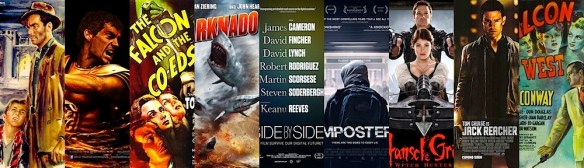
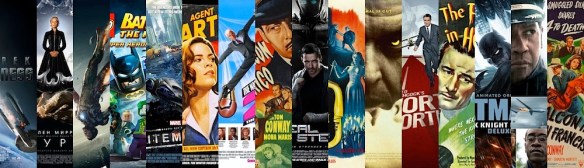
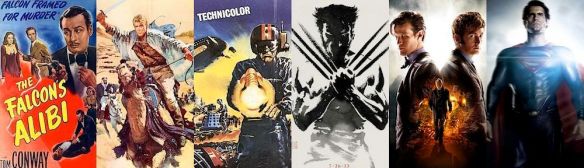
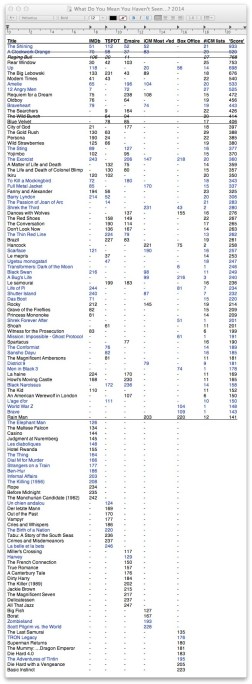
(The tall picture on the right is the final version of my long list. If you want, you can click here for a legible version, on which you can play “spot the French title spellcheck ‘corrected'”.)


And finally…

The level of my wit is on full display with the inclusion of “Alfred Hitchcock’s Rear” in the top image. Teeheehee.
2013 In Retrospect

With 2013 completed, listed, and analysed, all that remains is a final bit of reflection: of the 110 films I watched, which were the best? Which were the worst? And what new releases did I miss?

Plus, this year you can vote for your favourite of my top ten.

Before we begin, one last thing to mull: in just the last few days it’s come to my attention that every previous 100 Films year-end #1 has been a film either released that year, or from the previous year that had only just come to DVD/Blu-ray. For all the classics I’ve watched down the years, not one has ever managed to best a new release in my annual affections. That certainly wasn’t deliberate — as I said, I’ve literally just noticed the pattern this week. But with the introduction of What Do You Mean You Haven’t Seen…?, and a summer cinema season that seems to have had a largely mediocre reception, will 2013 be the year to break the mould? Read on…


The Five Worst Films I Saw For the First Time in 2013

In alphabetical order…

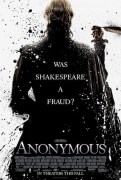
Anonymous
The theory that Shakespeare didn’t write the works of Shakespeare is largely nonsense, but good films have been made of worse. So a period drama — perhaps, at a stretch, some kind of thriller — based around that isn’t doomed… except Anonymous has the misfortune to be helmed by blockbuster maestro Roland Emmerich. The result is a scrappy mess which primarily leaves you irritated that someone might consider it to be historically accurate.

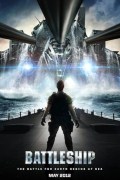
Battleship
Who’d’ve thunk a movie based on a board game would be a poor idea, eh? I think the success of Pirates of the Caribbean has led certain elements in Hollywood to think you can make a film out of almost any recognisable property, ignoring the fact that there were multiple other attempts by Disney to turn theme park attractions into film franchises that flopped. Battleship begins — and, hopefully, ends — a similar list for board games.

The Bourne Legacy
How the mighty have fallen. It might not seem like the Bourne franchise was dependent on its star (nothing against Matt Damon, but he didn’t ‘make’ the films in the way Depp does Pirates or Downey Jr does Iron Man, for example), but without him it flounders. It’s not Jeremy Renner’s fault — he’s lumbered with a weak continuation/reboot that’s frustratingly naval-gazing when it comes to continuity and lacking in the series’ trademark thrills.

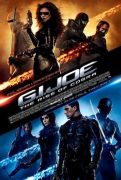
G.I. Joe: The Rise of Cobra
Some people love The Rise of Cobra. This baffles me. I don’t mind a dumbed-down spectacle-focused action/adventure movie, but there are ways in which those can exemplify quality, and G.I. Joe has none. Overcooked action scenes offer no respite from first-draft dialogue, cut-and-paste backstory, and poorer acting than you’d get from a 2×4. I enjoyed The Mummy when I was younger, but Sommers’ post-millennial work makes me fear my memory has deceived.

Sharknado
“So bad it’s good” by numbers — which is not how that rarified experience should work: you don’t create “so bad it’s good”, you happen to be it. From the title down this is a cynical exercise in geekdom-baiting, and sadly it seems to have worked. It’s Snakes on a Plane all over again — the final product doesn’t matter, it’s the concept of it that gets a certain kind of person salivating. It doesn’t deserve such success, because Sharknado is uninspired and unfun.


The Ten Best Films I Saw For the First Time in 2013

A quirky French take on the period adventure movie, this is like Indiana Jones crossed with a children’s farce. The resultant mix is not going to be for everybody — the po-faced certainly need not apply — but as a daft runaround, as much concerned with having copious amounts of fun as providing adventuresome antics, it’s all-out entertainment.

For me, this is the watermark that Zack Snyder’s Batman vs Superman will have to live up to. Good luck, mate. Picking up threads from Part I, Batman must engage in an all-or-nothing battle with a revived Joker, before the American government send the Man of Steel himself after the Caped Crusader. Cue the superhero smackdown to end ’em all. This faces stiff competition to be counted among the best Batman films but, much like Bats vs Supes, its viscerally exciting fight sequences and underlying intelligence (inherited from the original graphic novel) mean it’s up to the challenge.

A low-budget ’60s shocker sounds like exactly the kind of thing that should have faded with time — but quality endures, and George A. Romero’s sub-genre-creating film has that in spades. While some sequences are indeed out-and-out horror, in many respects it’s the strongly-drawn characters who make the film so compelling. The scale of its influence is hard to fathom, both in creating our modern concept of zombies and its demonstrably-replicable claustrophobic stylings; but more than that, it remains remarkably watchable in itself.

Darker than a long night of the soul, Charles Laughton’s sole directorial effort nonetheless appears on lists of films children should definitely see. That’s because this is a Depression-era fairy tale, with all the scariness and cruelty that is inherent to true examples of the form. The story of a ‘preacher’ who duplicitously stalks a dead man’s wife and children in search of hidden wealth, it comes with captivating performances and grim imagery that sears itself into your mind, this is a classic for all ages.

After the Sly Stallone vehicle bungled it back in the ’90s, I doubt anyone thought we’d see a decent screen iteration of 2000 AD’s long-running lawman, Judge Dredd. But here it is. While it may lack the visual faithfulness that the Stallone film actually got right, it more than makes up for it by nailing the tone. This is a sharp, efficient sci-fi action movie, laying the groundwork for a world begging to be explored in sequels, but also an entertaining burst of adrenaline in its own right.

Inviting comparisons with Luc Besson’s classic Leon, the titular Hanna is a teenage girl trained by her father to be a Bourne-level assassin, who he then pits against his former employers. Although the setup may suggest mainstream spy thrills, director Joe Wright instead delivers a left-field coming-of-age movie… just one with hard-hitting action sequences, surreal imagery, long single takes, beautiful cinematography, and a pulsating Chemical Brothers soundtrack. Considered as a thriller it’s relentlessly idiosyncratic, but that’s what makes it so refreshing and wonderful.

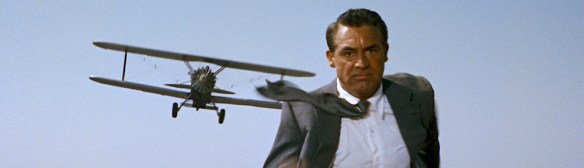
One of Alfred Hitchcock’s most acclaimed films, featuring arguably the most iconic image from his oeuvre that doesn’t involve a shower, North by Northwest is 136 minutes packed full of almost everything you could want from a movie. A story of mistaken identity, murder and spying, it contains sequences of pure tension, of action, of humour; it’s a mystery, a thriller; there’s a dash of romance, even. The whole is unadulterated entertainment. If you wanted one film to demonstrate almost the entire gamut of Hitch’s considerable genius, this is it.

It’s not just one of the most striking and memorable titles of recent years (perhaps of all time) — Andrew Dominik’s Western is striking and memorable in just about every regard. Greatest of all is Roger Deakins’ cinematography, some of the best work from a master of his field; but there’s also the considered and immersive pace, the enthralling and complex performances, and a narrative that’s not only historically accurate but also epic and intimate. Completely overshadowed by There Will Be Blood and No Country for Old Men back in 2007, I judge it to be easily superior to either. An under-recognised masterpiece.

It’s almost a second-place tie between two Westerns this year, with Quentin Tarantino’s “Southern” taking this spot by a nose because of pure entertainment value. This is a film where a not-inconsiderable running time flies by thanks to a wealth of sharp dialogue, emotionally satisfying violence, hilarious asides, and the skill of a filmmaker who by rights should be getting stale and predictable but somehow remains refreshed and invigorated. Jesse James is a sophisticated and classy Western; Django Unchained is its intelligently impudent counterpoint.

Three-and-a-half-hour black-and-white Japanese movies are not the kind of thing the unpretentious are meant to fall for, and yet Seven Samurai has a fanbase beyond the art house crowd. A case in point for not judging a book by its cover, then, because Kurosawa’s much-imitated classic (everything from individual shots to the entire story has been recycled by others) is an enthralling, gorgeous, vital movie. It takes its time (the feature-length first half is spent merely assembling the titular team), but amply rewards the investment — the final battles are extraordinary examples of old-fashioned action filmmaking.


Poll

This year, I invite your opinion on my top ten — well, I always invite your opinion on my top ten (that’s what the comments section is for) — but this year, I invite your opinion through the simple voting mechanism of a poll. I think how that works is pretty self-explanatory…

If you feel I’ve made an unforgivable oversight, feel free to berate me in the comments below.


Honourable Mentions

Thanks to specifically watching 11 highly-acclaimed classics this year, films that might otherwise have made the top ten found themselves squeezed out. So spare a thought for Iron Man 3, easily the best film I’ve yet seen from Summer 2013; Cloudy with a Chance of Meatballs, a surprisingly entertaining bit of nonsense; and The Hobbit: An Unexpected Journey, which isn’t quite The Lord of the Rings but is the next best thing. Plus, from said 11 classics, Lawrence of Arabia and Touch of Evil were both films I admired but wasn’t sure how much I loved, and so found themselves slipping out of consideration.

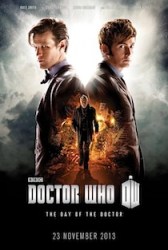
Honourable mentions too for Tintin and the Mystery of the Golden Fleece, whose cult-favourite-ish charms almost saw it become the first three-star film in one of my top tens; and Doctor Who: The Day of the Doctor, which I’ve counted as a film but is a TV programme really (shh, don’t tell anyone!) Part of me wanted to stick to my convictions (the ones that got it listed in the first place) and include it, but when I had 16 films to fit into 10 spaces, it was easier to just let it go.

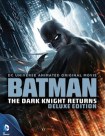
Finally, I must mention the films that earned themselves full marks, especially this year: with a record high of 23 five-star films across all lists, it was literally impossible for every one to make the top ten (even before my predilection for including four-star films). However, an almost-unbeatable nine did make it in — normally I list them again here, but to put it bluntly: everything except Adèle Blanc-Sec. There were, however, another 11 five-star films on the main list, those being The Artist, Dawn of the Dead, Doctor Who: The Day of the Doctor, The Hobbit: An Unexpected Journey, It Happened One Night, Lawrence of Arabia, My Week with Marilyn, On the Waterfront, Side by Side, Touch of Evil, and Waking Sleeping Beauty. Finally, there was one five-star film apiece for each of my other ‘categories’: from the shorts, A Trip to the Moon; from the alternate cuts, Batman: The Dark Knight Returns (Deluxe Edition); and from repeat viewing, You Only Live Twice.


The Films I Didn’t See

As is inevitably the case, there were a large number of noteworthy releases this year that I didn’t get to see. So as is my tradition, here’s an alphabetical list of 50 films I missed in 2013. They’re selected for a variety of reasons, be that box office success, critical acclaim, or simple notoriety — though I do err more towards ones I might actually see at some point rather than, say, the 10th highest-grossing film of the year.

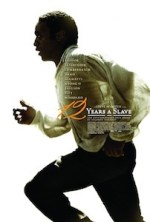
12 Years a Slave
Alan Partridge: Alpha Papa
American Hustle
Before Midnight
Behind the Candelabra
Blackfish
Blue Is the Warmest Colour
Blue Jasmine
The Butler
Captain Phillips
Cloudy with a Chance of Meatballs 2
Despicable Me 2
Elysium
Ender’s Game
Fast & Furious 6
The Fifth Estate
Frozen
Fruitvale Station
A Good Day to Die Hard
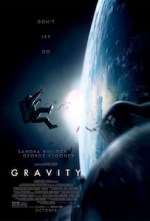
Gravity
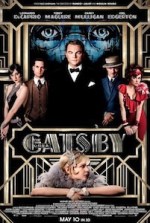
The Great Gatsby
Her
The Hobbit: The Desolation of Smaug
The Hunger Games: Catching Fire
Jack the Giant Slayer
The Lone Ranger
Mandela: Long Walk to Freedom
Monsters University
Much Ado About Nothing
Now You See Me
Oblivion
Oldboy
Olympus Has Fallen
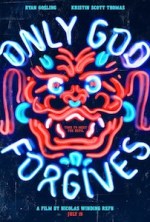
Only God Forgives
Oz the Great and Powerful
Pacific Rim
Pain and Gain
Philomena
Prisoners
RED 2
Riddick
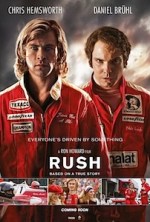
Rush
Saving Mr. Banks
Thor: The Dark World
Trance
Upstream Color
White House Down
The Wolf of Wall Street
World War Z
The World’s End


A Final Thought

And so another year is over (except for the twenty reviews I still have to post, that is). It’s always sad to say goodbye, but 2013 has been a strong year for 100 Films and, quite frankly, that makes me happy.

Fingers crossed for another good one in 2014 — and for all of your film viewing endeavours too, dear reader.

2013: The Full List

Here we are for the seventh time, dear readers: a new year begun, meaning it’s time to look at the one just passed.

2013 was an above-average year for 100 Films in purely numerical terms: I watched 110 films that were new to me, a number higher than I managed in four of the blog’s six previous years. There are a whole host of ways I’ll be (over-)analysing that viewing, both throughout this post and another in a few days’ time — perversely, this is one of my favourite bits of the year.

Anyway, because there’s a lot of long lists stretching out this post, let’s begin with a list of handy links, enabling you to jump down to whichever bit interests you:

So without further ado:


2013 As It Happened

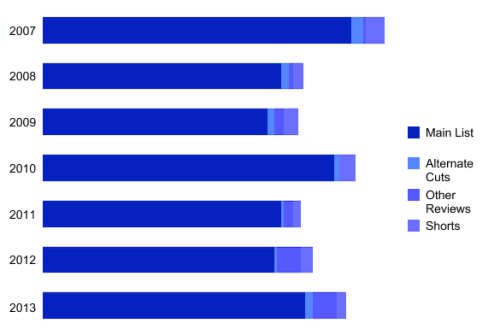
Below is a graphical representation of my viewing, month by month. More importantly, each of the twelve images links to their relevant monthly update, meaning this is where you can find a numbered list of every qualifying film I watched in 2013.


The List

Alternate Cuts
Other Reviews
Shorts

The Statistics

As I expect you know by this point, I watched 110 new (to me) feature films in 2013. (All are included in the stats that follow, even if I’ve not posted a review yet.) This makes 2013 my third best year ever, behind 2007’s 129 and 2010’s 122.

I also watched three features I’d seen before but were now extended or altered in some way. I also chose to review ten others for the fun of it. Between those two groups there’s all eight Harry Potters, watched and reviews as part of my thorough retrospective. All 123 films are included in the statistics that follow (except where indicated).

I also watched four shorts this year (which shan’t be counted in any statistics… except for the one that says they are). That’s one fewer than last year and one more than the year before, but as I own literally hundreds on DVD, I really should be doing a lot better.

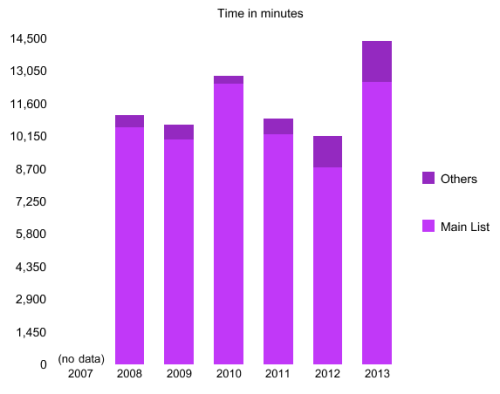
The total running time of new features this year was 209 hours and 10 minutes, a huge increase on last year; indeed, it’s the highest ever (by 58 minutes), over a year that had about a dozen more films. Lots of long ‘uns this year. The total running time of all films (and this is the one that does include shorts) was 239 hours and 29 minutes — which, as you can see in the graph below, makes this year the longest by some way; in fact, new features alone definitively tops the entirety of viewing from all but one previous year!

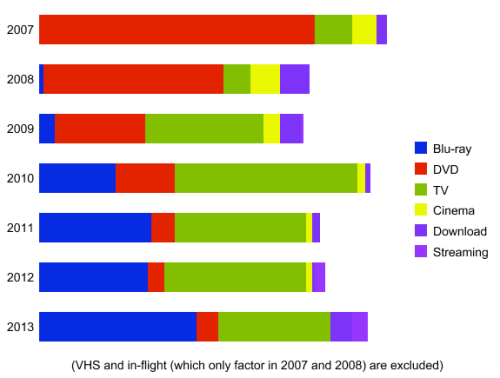
This year’s most prolific viewing format was, for the first time, Blu-ray. HD discs accounted for 59 of films watched, which is also the format’s highest tally to date. Second was television, bumped off the top spot for the first time since 2008 (when it finished fourth). I watched 42 films on the gogglebox (just four of them in HD), which is also its lowest total since 2008 (when it accounted for just 10!) Also-rans include DVD with eight (considering my vast collection, I ought to invest a bit more time in them) and downloads, also with eight (mostly Falcon films nabbed from iPlayer, but also two others in HD).

Finally, after ‘storming’ from nowhere to a massive four films last year, streaming continued its (minor) resurgence with six. Last year it was thanks to Netflix and LOVEFiLM, this year it’s Now TV (which also means they were all in HD, something the other two services didn’t offer through my Wii). To be honest, I’m surprised that number’s so low — I really ought to have made better use of the service. Maybe in the early months of 2014.

For the first time since this blog began — indeed, for perhaps the first time in almost 20 years — I didn’t make a single trip to the cinema this year. Put that down to personal laziness as much as apathy with the current state of the cinematic experience. Sad in a way, but so often I find it such a palaver, and an expensive one at that: when you can get a new release Blu-ray for little more than the total cost of a solo cinema trip (and these days, if I cared enough to go to the cinema for it, I’m almost certain to want the Blu-ray too), it makes financial sense.

This year’s closest temptations were The Wolverine (now the first X-Men film I’ve skipped theatrically), Doctor Who’s 50th anniversary special (I was going to catch an encore but, of all things, a broken boiler got in the way), and Gravity (“see it in 3D on the biggest screen you can find,” they wailed. I forgot.) Maybe next year I’ll be tempted to make the arduous shift from my sofa to a cinema seat by the likes of X-Men: Days of Future Past and… um… well, I’m sure there’s something else to look forward to…

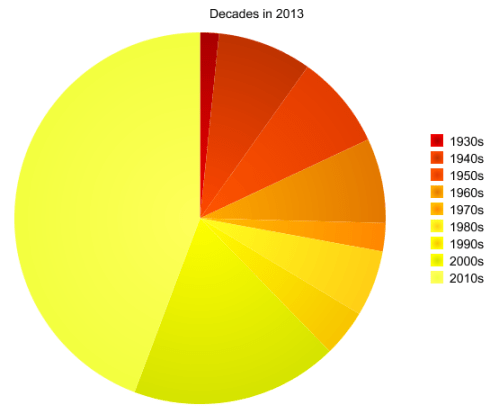
The most popular decade in 2013 was the 2010s, with 54 films. Unsurprisingly, 2013 itself accounted for a goodly chunk of that. At 43.9% of my total, the ’10s are also up a fraction on last year. Continuing that pattern, the ’00s finish second again, with 22 films (17.9%) — numbers close to 2012’s.

In all, my viewing spanned eight decades — as with last year, every decade since the 1930s is covered (I really must make an effort with my silent film DVD/BD collection). With post-millennial years taking the top two places, it falls to the last millennium to round out the list: the ’40s and ’50s come joint third with 10 (8.1%) apiece, while the ’60s are just behind on nine (7.3%). In descending order, the ’80s claim seven (5.7%), the ’90s account for five (4.1%), the ’70s manage three (2.4%), and the ’30s have just two (1.6%). Finally, if I included shorts in these things the 1900s would also feature, thanks to 1902’s A Trip to the Moon.

Last year, 106 of the 108 films I watched were wholly or significantly in English. Poor. This year, it was 115 out of 123 — still not great if you’re looking to take in the vastness of world cinema, but 93.5% vs. last year’s 98% is clearly an improvement. A distant second was Japanese with four (3.3%), and there were two apiece containing significant amounts (or being wholly in) French, Italian and Mandarin. Still, as last year’s complete list of languages was “English, German, Cantonese and Mandarin”, the total of 11 this year (plus “silent”, if you count that) is a step in the right direction. Others of note include Sioux (thanks to Shanghai Knights) and Klingon (guess). OK, maybe I shouldn’t count the last one. Call it 10 languages, then.

Moving on to countries of production, the USA is similarly dominant, producing or co-producing 102 films. At 82.9% of my viewing, that’s actually marginally up on last year. Second place again belongs to Britain with 36 films (29.3%), also upping its share from 2012. A mixture of co-productions obscure the true numbers for country-of-origin, but other numerical highlights include France (8), Germany (6, all co-productions if I remember rightly), Canada (5), Italy (4), Japan (3, none of them co-prods), and South Africa (3, an increasingly popular co-production destination I believe). A further 12 countries have one or two productions to their name, although I think only Sweden’s sole entry was entirely their ‘own work’.

This year I also totted up the BBFC and MPAA certificates of films I watched. From the BBFC, the PG, 12 and 15 certificates were all pretty well balanced, with 31, 34 and 33 films respectively. Of the outliers, 12 were rated U and nine were 18s, leaving four that somehow weren’t BBFC certified at all.

The MPAA are a funnier lot: the top certificate from them is “Not Rated”, with a total of 39. That’s because they don’t insist on reclassifying old titles, plus a few “unrated cut”s. The highest genuine rating was just behind: the ubiquitous PG-13, with 37. Elsewhere, R-rated films totalled 27, there were 18 at PG (compare to the BBFC’s 31), the surprisingly-rare G put in one appearance, and there was even an NC-17! Feel free to go hunt that one out.

(I was going to include a graph here, but it didn’t really show anything the numbers don’t. That is to say, the BBFC are more reasonable.)

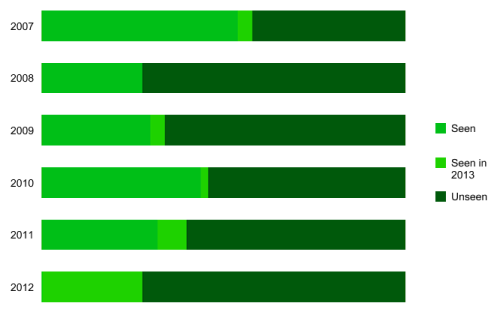
After just three of 2012’s films appeared on the IMDb Top 250 — the lowest number ever — this year has seen a resurgence. As of New Year’s Day 2014, 13 films from 2013’s main list appear upon that hallowed chart; one of my higher totals, though not a patch on 2007’s 21. This year’s lot is made up of the 11 I saw from What Do You Mean You Haven’t Seen…? (which had to be on the IMDb Top 250 to qualify), plus Django Unchained (53rd) and It Happened One Night (135th). The positions range from 18th (Seven Samurai) to 197th (The Night of the Hunter). For all that, I still have some 114 Top 250 films to see.

At the end of all six previous years’ final summaries, I’ve included a list of 50 notable films I’d missed from that year’s releases. Taking into account 2013’s viewing, I’ve managed to see (deep breath) two more from 2007’s list (bringing the total for that 50 to 29), no more from 2008’s (leaving it at 14), two more from 2009’s (bringing it to 17), one more from 2010’s (bringing it to 23), and four more from 2011’s (bringing it to 20). It’s now a year since I published 2012’s 50 (obviously), and in that time I’ve managed to see 14 of them. A solid start, but as I own or have access to over 20 more, I could do a lot better.

A total of 96 solo directors and three directing partnerships appear on the main list this year. Foremost among these numerically is George A. Romero with six films, while there are two each for William Clemens, Justin Lin, John Madden, Orson Welles and David Zucker. Elsewhere, Jay Oliva appears once on the main list and once in the additional films. The latter also gives us four films for David Yates, two each for Chris Columbus and Gordon Flemyng, and two shorts for Louis D’Esposito. Most of those multiples are thanks to franchises: “the Dead” (Romero), the Falcon (Clemens), Fast & Furious (Lin), Naked Gun (Zucker), Batman (Oliva), Harry Potter (Yates, Columbus), Doctor Who (Flemyng), and Marvel (D’Esposito).

I noted previously that there seemed to be an uncommonly high number of noteworthy directors who I was encountering for the first time this year. They include Ingmar Bergman (The Seventh Seal), Frank Capra (It Happened One Night), John Cassavetes (The Killing of a Chinese Bookie), Vittorio De Sica (Bicycle Thieves), Georges Méliès (A Trip to the Moon), Nicholas Ray (On Dangerous Ground), and George A. Romero (Dawn of the Dead, and the rest). There could be said to be more (Andrew Dominik, Richard Fleischer, Charles Laughton, Ben Wheatley…), but your mileage may vary.

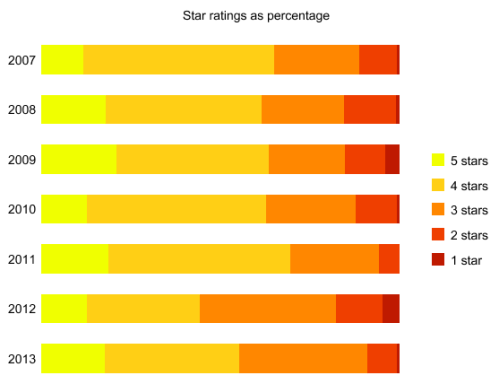
Lastly, the scores. 2013 ushered in 22 five-star films (the most ever!) and just one one-star film. 2012 saw three-star films top the tally for the first time; 2013 saw the highest number of three-star films ever, at 44… but they were nonetheless bested (just), by the 46 four-star films. Hurrah for quality! Last but not least (literally), there were 10 two-star films.

To be frank, I expected the number of films I awarded three stars to have again exceeded the number given four. Last year I wondered if I was being harsher or just watching poorer films; this year, I’d felt certain I was doing the former, with multiple movies that would previously have benefitted from my benevolence being cruelly stripped back to that middle rank. And I only felt a little bit bad about it. In fact, the only thing that ever gives me pause is that there are archive four-star reviews which, for parity’s sake, ought now to be three-stars. I guess I’ll just have to live with that.

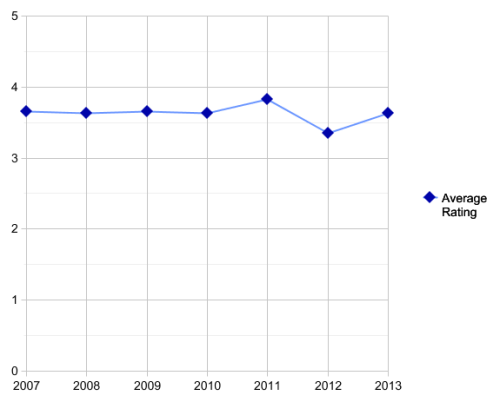
Finally, then: after last year’s record-low average score, this year saw it rise back into regular territory, finishing up at 3.6. Hurrah again!


Coming next…

It’s time to definitively wave goodbye to 2013 with my final summary post. My bottom five are already chosen, my top ten currently has fifteen entries, and the long list for my “50 unseen from 2013” stands at 113… but fear not, dear reader: choices will be made, and all will be revealed this weekend.

December 2013

Merry New Year to you, dearest reader. Before I get really stuck in to reviewing the year as a whole, there’s one final month to look at individually.

That said, we begin proceedings with how things went for my new-this-year challenge-within-a-challenge…


WDYMYHS 2013What Do You Mean You Haven’t Seen…?

Having set out with the goal of watching one super-acclaimed film per month, I somehow ended up with three to get through come December. That didn’t quite go to plan then. Undeterred, I shall be attempting this again in 2014… even though I wound up only seeing 11 of the 12 films I was supposed to.

So what were the final two? Well, both were from the 1950s — somewhat unsurprisingly, considering that decade made up half the starting list. More precisely, they were Elia Kazan’s On the Waterfront, and a film I’ve been meaning to see for so long I can’t even remember how long that is — and, indeed, one that inspired this very project — Akira Kurosawa’s Seven Samurai.

What got missed? Martin Scorsese’s Raging Bull. Hey, I don’t like boxing movies. It won’t roll on to 2014’s WDYMYHS (unless it qualifies again under whatever new rules I cook up — yes, there will be a modified selection process), but I still intend to try to squeeze it in during January.


Seven SamuraiDecember’s films in full

#104 On the Waterfront (1954)
#105 Arthur Christmas (2011)
#106 Hanna (2011)
#107 Kick-Ass 2 (2013)
#108 Waking Sleeping Beauty (2009)
#109 Wreck-It Ralph (2012)
#110 Seven Samurai, aka Shichinin no samurai (1954)


Analysis

110! A nice strong number, I’d say. Also, the first time I’ve ever finished in the 110s (after two 90s, two 100s, and two 120s).

The total for December 2013 (seven films) is pretty much in line with the same month from the last few years: in 2012 it was six, in 2011 it was eight, and in 2010 it was seven. Quite a different tale to the early years: it was double that in 2009 at 14, and 2008 was the infamous “race to the finish” year that saw me churn through 19 films (still the highest ever single month in the blog’s history).

I won’t share too much more analysis on how December fits into the year as a whole, because that’s what the big stats thing in the next year-end summary is for. If I were to rank the months of 2013, though, it would come 8th, which is the lower end of the middle.


The Advent Calendar

Last year’s inaugural 100 Films Advent Calendar wound up only managing 23 of the intended 25 reviews… though it was still a great success, both in reducing my backlog and producing views: December 2012’s hits were up 41% on November 2012’s.

This year, it’s a similar story: I managed to get in all 25 reviews, reducing the backlog once again, and the views for December 2013 were up 18% from November 2013 — and up 74% from December 2012! Rest assured, unless I manage the unlikely feat of keeping on top of my reviews, it’ll be back in 2014.


Next on 100 Films in a Year…

No “list of five” this month because, quite frankly, I’ll be chucking enough other lists your way soon enough: there’s the full list of 2013 viewing, my bottom five, my top ten, and the 50 I missed, not to mention all the lovely stats.

And then it all begins again, for the eighth year. Octastic!

2013 in Review, Part 1

It’s the end, dear readers, but the moment has been prepared for…

…by WordPress, that is, who have produced my annual report. It’s just the beginning of my regular array of posts that look back at the year just passed, so keep your eyes peeled (also, open) for three further review-of-the-year posts in the next few days. Those ones I actually wrote myself!

Here’s an excerpt from WordPress’ report:

The concert hall at the Sydney Opera House holds 2,700 people. This blog was viewed about 17,000 times in 2013. If it were a concert at Sydney Opera House, it would take about 6 sold-out performances for that many people to see it.

Click here to see the complete report.
Once you’ve read that, the following will make sense:

  • It wasn’t just new posts that grew the archive of the blog: 141 reposts from 2007-2011 helped increase the tally from last year’s 249.
  • Those Harry Potter reviews…! They remain my most-viewed posts most days.
  • The Batman one got a lot of visits from people wanting to know when it was out in the UK; I pushed Adèle Blanc-Sec like mad on Twitter when it premiered on Film4, so that paid off; the last one I can’t really explain.
  • Particular thanks to ghostof82, filmhipster, Colin and Mike.

Next up in my review of the year: a look back at December 2013.
November 2013 + 5 Number 100s

November: the month with Men in its posters!

(I was going to open this post by ‘singing’ Europe’s The Final Countdown. Then I realised I did exactly that in November 2011. I’m nothing if not unoriginal.)


Ooooooone-huuuuuundred!

Yes, for the first time in 23 months, 100 Films in a Year has a #100! And for the first time in the history of ever, I’ve made it to #100 in a month that isn’t called “September” or “December”.

There’s a more detailed history of this blog’s #100s further down, but an analysis-like bit first: in the previous six years, I’ve made to 100 films a total of four times. Two of those were reached in September, two on December 31st. November now joins those illustrious ranks, completely ruining any patterns you thought you might’ve been able to see. But that’s good, because it breaks a cycle that only led to expectations, and expectations are always awkward.

More about November’s total and the usual analysis in a bit. First:


What Do You Mean You Haven’t Seen…?

I always intended each year’s #100 to be a film that was significant in some way. That hasn’t always panned out (missing it twice and “squeezing in anything I can” two other times have seen to that), but with a more leisurely arrival this year I was able to plan it out. And what could be more appropriate than one of my WDYMYHS films, supposedly the greatest examples of the cinematic art that I’ve yet to see?

And so, #100 was also my latest WDYMYHS conquest, and it was… David Lean’s acclaimed and beloved epic Lawrence of Arabia. That was one of the films that inspired me to start WDYMYHS in the first place, so it seemed only fitting.

I tried to squeeze one more in before the end of the month, but no doing. That leaves three to get through in December, which wasn’t the plan in the slightest. We’ll see how that goes.


Lawrence of ArabiaNovember’s films in full

#99 The Falcon’s Alibi (1946)
#100 Lawrence of Arabia (1962)
#100a Daleks’ Invasion Earth 2150 A.D. (1965)
#101 The Wolverine: Extended Cut (2013)
#102 Doctor Who: The Day of the Doctor (2013)
#103 Man of Steel (2013)


Analysis

I meant to post my review of The Day of the Doctor by now, in which I will explain/defend why an episode of TV counts as a film; but as I haven’t got round to that yet, let’s quickly run through it here as well: it was simultaneously released in cinemas; it’s feature-length. That’s good enough for me. Oh, and it did huge business and cracked into the charts both here and in the US — that’s not “oh, and it’s in cinemas too”, is it? No. Good.

Moving on to November itself, then. The past three years (i.e. 2010, 2011 and 2012) I’ve watched exactly four films in November, so it’s good to break another cycle of expectation with this month’s five. That also means it’s not 2013’s worst month (a two-way tie between June and July), but instead equals April’s five.
Having reached #103, November sits in a unique place in the history of Totals Reached By The End Of November. In the two years I’d reached #100 in September, I was in the 110s or 120s by now; in 2008 and 2009 I was at #81 and #80 respectively; and in 2011 and 2012 I was at #92 and #91 respectively. If you really want to dig into it there’s almost some kind of pattern there, but I think it’s best I leave well enough alone.

With just one month to go, I’ve averaged 9.36 films per month in 2013, on which basis I should end the year having watched 112 or 113 films. But considering said average includes months with viewing as low as four and as high as 17, my final tally could theoretically be anywhere from 107 to 120. My money says closer to the former than the latter.


5 Number 100s

In seven years of 100 Films, I’ve made it to the titular goal five times. Here are those films that received the glorious honour of being #100…

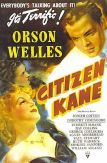
  1. Citizen Kane
    Citizen KaneUpon reaching my goal the first time, I decided (quite rightly, I think) that #100 should be An Important Occasion — and what can be more important than The Greatest Film Ever Made™? Many viewers these days seem to struggle with Kane’s reputation, or it just leads them to dismiss the film out of hand, but I thought it was genuinely exceptional and deserving of its acclaim.
  2. Swing Time
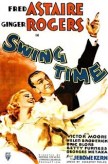
    Swing TimeCome the second year, and watching Something Significant went out the window as I scrabbled through 11 films in 6 days to make it to 100, and this Fred Astaire/Ginger Rogers picture happened to be the last of them. That said, Swing Time is hardly a poor movie — while not my favourite Astaire/Rogers movie (not that I’ve seen many, but the honour goes to Top Hat), their dancing is nonetheless sublime.
  3. The Hurt LockerThe Hurt Locker
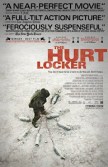
    Having failed in 2009, 2010 was a return to form. Whether its #100 is a classic for the ages remains to be seen, but at the time it was the most recent Best Picture winner. How much insight it casts on the broad scope of recent conflicts is debatable, but it’s an interesting — and certainly tense — depiction of modern warriors’ mentality.
  4. The A-TeamThe A-Team
    Though not as much of a rush as 2008, in 2011 I only just made it to 100 again — and, again, it was less a special choice more something fit-in-able. That said, I liked The A-Team: it sets out to be a funny, entertaining action movie and, by and large, it achieves that goal. Not for those who like Serious Movies, or for those who take their movies too seriously.
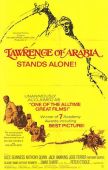
  5. Lawrence of Arabia
    Lawrence of ArabiaAnd so, after missing it again in 2012, we come to this year. The alternation continues, with arguably the most acclaimed and beloved film that I’d never seen earning the spot of my fifth #100. As a double bonus, it’s one of my WDYMYHS films too (OK, that’s not an accident). That status, and the film’s sheer size (its length! its scope!), makes it a little tricky to get your head around. But wow, it looks incredible on Blu-ray.


And also…

    Failure.
    What of the other two years? Well, in 2009 I fell well short at 94. #94 itself was the 1974 Murder on the Orient Express, directed by Sidney Lumet and starring an Oscar-nominated Albert Finney as Poirot.Failures

    And then last year, when I made it even closer with 97, but couldn’t quite reach those final three films. #97 itself was cult favourite comedy The Plank, which I didn’t really connect with and is the lowest-scored of these seven films.

What will the next #100 be, I wonder? Hopefully we won’t have to wait another 23 months to find out…


P.S.

For December, my 100 Films Advent Calendar is starting up again. The introduction is here; reviews commence in the morning.


Next month on 100 Films in a Year…

Join me on New Year’s Day (you’ve got nothing better to do, right?) for the first of my usual array of retrospectives on the year just passed.

The 100 Films Advent Calendar 2013

It’s that time of year again, dearest readers. Where does it go, eh? It feels like mere weeks since I was churning out reviews daily for my last advent calendar.

Yes, at the risk of starting some kind of tradition, it’s back — 25 days of chocolatey goodness. Except without the chocolate. And possibly without the goodness. I can guarantee some “y”s though. Or maybe “why?!”s.

I don’t know if last year’s ‘calendar’ was a big hit with readers or anything, but it was a big hit with me: my review backlog was considerably less engorged by the end. It really needs deflating once again this year, so that’s grand. And if you want an idea about some of the reviews that might be materialising over the next few weeks, do have a look.

In case it’s not obvious, then: I’ll present a shiny new review every day up until Christmas, and then one on the day itself too, in case you fancy avoiding the festive frivolities. Or you could just read it on Boxing Day. Or indeed any other day after that. I don’t have anything as momentous as last year’s Skyfall epic planned for the big day, but you never know, there’s still time.

Below, you can once again see a big pile of unopened links. If you so desire, you can check this post regularly over the next three-and-a-half weeks as those generic Christmassy images turn into exciting images that are all clickable. Or you can just see the new reviews appear on the front page. Or in your email inbox (if you already follow this blog with a WordPress account, you can change email notification settings here). Or follow me on Twitter. Always worthwhile.

And so without further ado, the festivities begin… in the morning…


December 1st

December 2nd

December 3rd

December 4th

December 5th

December 6th

December 7th

December 8th

December 9th

December 10th

December 11th

December 12th

December 13th

December 14th

December 15th

December 16th

December 17th

December 18th

December 19th

December 20th

December 21st

December 22nd

December 23rd

December 24th

December 25th

Merry Christmas!

Make/Remake: The Daleks’ Invasions of Earth

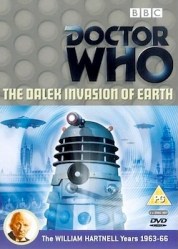
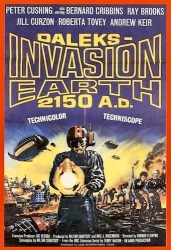
Doctor Who: The Dalek Invasion of EarthDaleks' Invasion Earth 2150 A.D.

Doctor Who:
The Dalek Invasion of Earth

and
Daleks’ Invasion Earth 2150 A.D.


Doctor Who: The Dalek Invasion of Earth
1964 | Richard Martin | 149 mins | DVD | 4:3 | UK / English | PG

Daleks’ Invasion Earth 2150 A.D.
1966 | Gordon Flemyng | 84 mins | Blu-ray | 2.35:1 | UK / English | U


Daleks! On Earth!In a week’s time, on the 23rd of November 2013, Doctor Who will celebrate its golden anniversary — 50 years to the day since the premiere broadcast of its first episode, An Unearthly Child. (As part of the celebrations, BBC Four are showing that initial four-parter at 10:30pm on Thursday 21st. I heartily recommend it.) The programme’s success was cemented several weeks later, however, with the appearance of the Daleks — a race of xenophobic mutants hidden in metal machines from the planet Skaro. A wave of Dalekmania followed, leading to a boom in merchandising and, naturally, a sequel serial for the TV series, one year later.

It also led to a film adaptation, which I discussed last week. When that was a box office success, a sequel was greenlit. As with the first film, rather than construct an original tale starring the Daleks, the filmmakers turned to the TV series and adapted the aforementioned TV sequel. The story is set hundreds of years in the future (perhaps 10 years after 2164 in the TV series; 2150 in the film), when the Daleks have somehow left their homeworld and their city (which previously they’d needed to survive) and found their way to Earth. But this isn’t a Hollywood-style alien invasion battle: the Daleks have already occupied the planet, and Britain in particular (of course). The Doctor and his friends stumble into this situation and resolve to stop the evil invaders.

There’s little doubting that The Dalek Invasion of Earth is a minor epic. Where The Daleks struggled a bit to fill its seven-episode order, in six instalments writer Terry Nation takes us from an occupied, bomb-blasted London, to an attack on the Dalek spaceship, to a mine in Bedfordshire that’s digging to the centre of the Earth. Although made on Doctor Who’s typically tiny budget, the TV serial shines. Models vs CGIThere are some fantastic sets, bolstered by peerless location filming of a deserted London (simply achieved by shooting very early in the morning), and the usual array of quality performances from the series’ regulars and guest cast. It’s only let down by the special effects. The Daleks are as great as ever, and a weird monster that turns up for a few minutes is passable (if you’re being kind), but shots of the Dalek saucer flying over London look like a pair of foil pie cases on some string in front of a photo. Even by the standards of the era it’s bad. The DVD release includes the option to watch the story with new (in 2003) CG effects in place of these sequences, and for once I’d actually recommend that.

The story once again trades on the Daleks’ clear Nazi undertones. Here they’ve occupied a bomb-blasted country where a small band of rebel fighters hold out against them, attempting small-scale attacks while trying to work out a bigger plan. It can only be deliberate that these parts — hidden workshops, missions in enemy uniform, even the fighter’s casual clothes — all trade on familiar imagery from World War 2 resistance movies. Here, at least, collaborators are men rendered brain-dead by Dalek machinery, controlled via radio waves directly into their heads, rather than those who have chosen to betray their people.

That said, this is not a cheery view of the world. We can see that right from the opening shot: a derelict stretch of urban river bank, overgrown and decrepit, and the caption “World’s End”. Don't try suicideA man stumbles towards the steps, he screams in agony, battling with the strange machinery on his head. And then he hurls himself into the river, where he floats face down — dead. Beginning a kids’ programme with suicide? You wouldn’t do that today! We later learn that he’s a Roboman, controlled by the Daleks, essentially dead already… but it’s a bit late by then. Later, we meet unscrupulous country folk: a black marketeer who won’t give over food to the enslaved mine workers without payment, and won’t escort Ian out of the camp without payment either; and two women, employed by the Daleks to mend the workers’ clothes, who betray Barbara to get more food. There are heroes here, certainly — men and women who fight the Daleks, and some who give their lives for the cause — but not everyone’s doing the honourable thing.
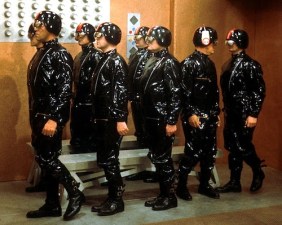
The film is a bit less bleak in its outlook for humanity. The black marketeer remains, more treacherous than ever: he actively betrays the Doctor to the Daleks, though is killed for his troubles; the two women are there, too; but there’s no suicidal Roboman, and indeed the climax suggests the Robomen are able to return to being human just by taking their helmets off. Robo-farceSo that’s nice for them. There’s also some significant additions of humour, like when Tom is pretending to be a Roboman to stow away on the Dalek saucer and ends up in a mime act as he attempts to mimic a group of the real thing while they have lunch. Bless Bernard Cribbins. There aren’t too many of these almost-farcical bits, but the few there are lighten the general tone.
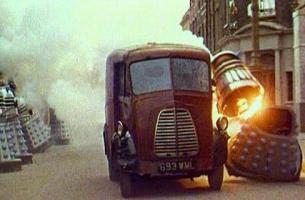
Overall, however, Daleks’ Invasion Earth 2150 A.D. (aka Daleks – Invasion Earth: 2150 A.D., and many other such punctuation-based variations, thanks to inconsistent spelling on posters and trailers) is, much like the the previous film, a strikingly faithful adaptation… at first. The running time is again a clue: while the TV serial takes two-and-a-half hours on its story (albeit with some subtractions for six sets of titles and five recaps), the movie rattles through it in 84 minutes. That’s with a new bookend sequence designed to establish the new character of PC Tom Campbell (Bernard Cribbins), leaving the film 75 minutes in which to condense Nation’s epic. Nonetheless, it’s scene-for-scene faithful, just picking the pace up with key actions and lines of dialogue rather than the comparatively-luxurious speed of the original.

As it goes on, though, things begin to diverge quite rapidly. Significant characters have been cut for time, while legacy changes from the first film also alter the plot — Dalek vs vanno burgeoning romance for Susan, here a small girl rather than TV’s young woman. Both stories split our leads into three groups following the assault on the Dalek saucer, but while the film retains the outline of these subplots, it rearranges which characters take which route. It’s a slightly bizarre turn of events, to be honest, and doesn’t always pay off: whereas the TV series manages to plausibly pace the various characters’ journeys from London to Bedfordshire, in the film the Doctor and his chum walk there in the same time it takes the Dalek saucer to fly it. Either that saucer’s underpowered or they’re impressive hikers.

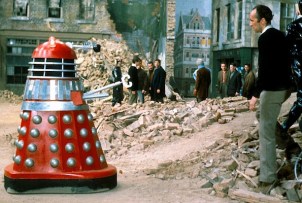
Even with all these changes, the general shape of the story remains the same; yet the film feels less epic than the TV serial. It’s not just the length, but the sense of time passing: on TV the Doctor and co seem to be stuck on Earth for several days, while in the film it’s practically an afternoon’s work. And though the movie’s special effects are better (immeasurably so, in fact, because the model work in the film is fantastic), and there’s some great stunts too, the bigger-budget big-screen outing lacks the TV version’s London location filming. This makes a startling difference to the relative effectiveness of the story. On TV, you really feel like the Daleks have conquered Earth; in the film, it feels a little like they’ve conquered some expansive studio sets and impressive matte paintings. The famous image(Incidentally, perhaps the most striking thing about the serial’s location sequences are that they don’t include the iconic shot of the Daleks rolling across Westminster Bridge. That bit is in there, but it was filmed from an entirely different angle; I guess the famous image was just a unit photograph.)
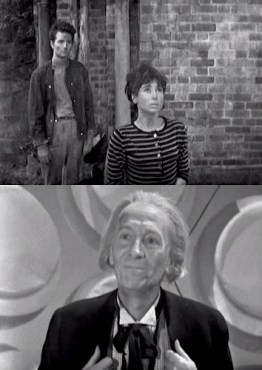
There are other bits that work less well on film. Dortmun’s sacrifice on TV makes sense, a bold character moment; in the film, he seems to do it for the hell of it. On TV, the Doctor commits himself to stopping the Daleks (in one of the series’ clunkiest bits of dialogue, to be honest), whereas in the film he just stumbles into things — which, funnily, is more like the Doctor of the time. Ian and Barbara have been replaced by the aforementioned PC Tom and the Doctor’s niece, Louise, because Dr. Who and the Daleks actors Roy Castle and Jennie Linden were unavailable. Not that it matters much — Bernard Cribbins is just as adept in the comedy role, and Jill Curzon’s Louise is just Barbara by any other name. Then there’s the music, which is often jauntily comedic rather than action-packed; and the ever-so-’60s main theme, as with the first film replacing the TV series’ iconic, groundbreaking, electronic howl with something altogether more forgettable. What the film most benefits from losing, however, is a couple of hilariously of-the-time lines from the Doctor — particularly one when he tells Susan she needs “a jolly good smacked bottom”!

That aside, perhaps the film’s biggest loss is in the age of Susan. Nothing against Roberta “One-Take” Tovey, who is fortunately much less irritating than your average child actor, Go forward in all your beliefsbut the TV serial has a real advantage in this department. The original companion, this was Susan’s final story — the first companion departure in the series’ history. It handles it marvellously: rather than the final-minutes cut-and-run so many companions suffer, Susan’s growing sense of departure is built throughout the story… and then it’s the Doctor who realises it’s time for her to go, not her, and he leaves her behind. The speech he gives is one of the finest in the series’ history, beautifully and poignantly delivered by William Hartnell, and with a nicely under-played reaction from Carole Ann Ford. Doctor Who has had countless companion exits now, but this one still takes some beating.

Each version of The Dalek Invasion of Earth does something better than the other, but on balance the TV series is the clear victor. That said, the film is probably more entertaining than its big-screen predecessor; but that’s just the story itself, I guess, which I think is a more effective use of the villains. You could argue it ties into the fairly-modern idea of the first encounter being an establisher and the sequel a bigger, bolder, deeper, more exciting, experience. Both versions are certainly that.

Despite the enduring popularity of the titular villains, Daleks’ Invasion Earth 2150 A.D. wasn’t as much of a box office success as its predecessor. Combined with an overrunning schedule that led to a higher budget, its profitability was clearly lower. Production company AARU had the option to make a third film (presumably to be based on the third Dalek story, 1965’s The Chase), but the money-men passed. Awesome.Most Doctor Who fans won’t lament that (especially as The Chase isn’t the most well-loved of Dalek adventures either), but, even though the TV series remains the superior product, I think the Dalek movies have their own merits and charm. I’m not suggesting we should be finding a way to write them into Doctor Who canon, but as an alternative to the norm, they’re a good bit of fun.
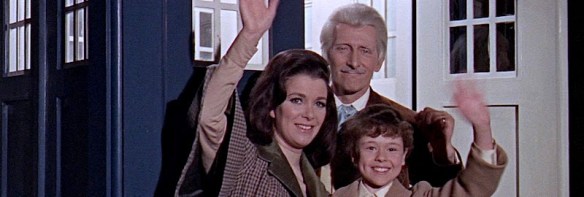

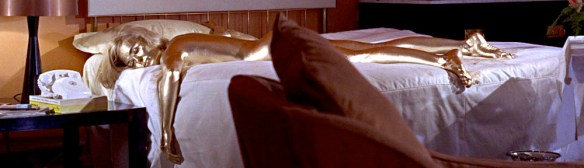
Tied in with Doctor Who’s 50th anniversary celebrations, Channel 5 are screening the Dalek movies next weekend. Dr. Who and the Daleks can be seen on the anniversary itself, Saturday 23rd November, at 10:05am. Daleks’ Invasion Earth 2150 A.D. is on Sunday 24th at 10am.

Cheery-bye!

Sean Connery as James Bond, Part 1

Preface
or: how I learned to stop worrying and post these damn reviews

(jump to Introduction)

My recent Week of the Living Dead has been the cause of a bit of personal reflection here at 100 Films Towers (I don’t know where I acquired a tower, but let’s just go with it). While I enjoyed all the films individually, I found the actual experience of watching one every night, reviewing it the next day, posting it that evening (you’d be surprised how much time I put into those photos), then repeat — times six — to be quite wearing. I know I didn’t have to do it — I could have delayed or spread out the viewing, and the same with the reviews, because it’s not as if anyone was depending or even anticipating them — but there’s an element of personal pride in setting out to do something and then doing it well… or if not well, then at least doing it right.

It’s a personal thing, too — I’m not one of those people who merrily watches a film every single day (or more, some people). I can barely stomach a double bill, unless it’s a not-very-long or single-story duology/trilogy watched back-to-back for good reason. That’s why watching 100 films in a year is a challenge to me. The fact I’ve not even managed it a third of the time attests to that. When I first started I got a few comments along the lines of, “but that’s only two a week? Not hard!” Well, clearly it is, so ner.

Anyway, one thing this means is I’m unlikely to attempt another Week of the Living Dead-style week of viewing and reviewing. I’ve managed them before (Silent Lubitsch; David Fincher), and part of the key is variety — for all that Romero pumps into his films, they’re still one zombie film after another; and I actually got a bit sick of silent films by the end of that Lubitsch week, so it’s not unprecedented. Watching one type of thing so intensively makes you want a change.

And that’s how we arrive at Bond. When the Bond 50 Blu-ray set came out, I set about watching them all from the start. The aim was one or two a week, then post reviews in decade-long clumps, in part to see the Bond films in a different way than sorted by actor (in reality, that’s not that great an idea: it’s the change of leading man that sparks changes in the series, not the change of decade; and actually, when you do cut it up by decade, you more or less get Connery in the ’60s, Moore in the ’70s and ’80s, Brosnan in the ’90s, and Craig in the ’00s, with only the odd scrap crossing over or other guy jumping in). This isn’t the first time I’ve tried it, but I always run out of steam at some point. I love Bond, but they get samey if you pack them too close together… and also, as we’ve seen, I’m just not cut out for that kind of scheduled viewing (I don’t even watch TV on schedule anymore — yay PVRs and iPlayer and box sets and piracy!)

But what I did manage during the viewing I did do was to write reviews; and because I happened to falter just before On Her Majesty’s Secret Service (no fault of that film, it’s one of my favourites), I have a neat Connery-shaped load to share. And because they’ve been sat on my hard drive for (in some cases) over a year now, I thought I’d share them. They were meant to be very short pieces that I’d share in one big long post (like, say, my Batman one), but they’re actually quite a bit longer and the whole thing seemed massively unwieldily (I think the Batman one’s awkward, and these reviews total about 1,000 words more), so I’ve separated them off.

With all that waffled through, let’s begin:


Introduction

Sean Connery was, of course, the first actor to play James Bond. Except he wasn’t: there was Barry Nelson on the telly (technically playing American agent Jimmy Bond), Bob Holness on the radio (in a live South African production), and stuntman Bob Simmons in the gun barrel opening sequence of the first Bond movie (the one pictured above is Connery, though). But Connery was the first to be noticed — and he really was noticed. With him as the star, what were a couple of relatively low-budget British spy movies somehow transformed into a global-box-office-dominating, decades-spanning, culture-influencing, mega-franchise. (It used to be the highest-grossing film series of all time. It’s been surpassed by the likes of Harry Potter now, but that will change: other series end, Bond keeps on going, probably forever.)

Connery starred in a total of five Bond films before he’d had enough… well, he starred in four before he’d had enough, but then he had to do a fifth anyway. He was recast, but when the new guy got too big for his boots, Connery was lured back… for one more film. Twelve years after that, he was lured back again, this time for an ‘unofficial’ rival Bond movie series… which managed one film.

Leaving those later returns to (possible) future reviews, here are the five initial Connery Bonds…


James Bond will return.

Make/Remake: Doctor Who and the Daleks

Doctor Who: The DaleksDr. Who and the Daleks

Doctor Who:
The Daleks

and

Dr. Who and
the Daleks


Doctor Who: The Daleks
1963-4 | Christopher Barry & Richard Martin | 172 mins | DVD | 4:3 | UK / English | U

Dr. Who and the Daleks
1965 | Gordon Flemyng | 83 mins | Blu-ray | 2.35:1 | UK / English | U


In a fortnight’s time, on the 23rd of November 2013, Doctor Who will celebrate its golden anniversary — 50 years to the day since the premiere broadcast of its first episode, An Unearthly Child. Those 25 minutes of 1960s TV drama still stand up to viewing today. OK, you couldn’t show them on primetime BBC One anymore; but the writing, acting, even the direction, and certainly the sheer volume of ideas squeezed into such a short space of time, are all extraordinary. It is, genuinely, one of the best episodes of television ever produced.

But that’s not why Doctor Who is still here half a century later. It may be the strength of that opening episode, the ideas and concepts it introduced, that has actually sustained the programme through 26 original series, a 16-year break, and 8 years (and counting) of revived mainstream importance; A Dalek's first appearancebut that’s not what secured the chance to prove the series’ longevity. That would come a few weeks after the premiere, in the weeks before and after Christmas 1963, when producer Verity Lambert went against her boss’ specific orders and allowed “bug-eyed monsters” into the programme — in the shape of the Daleks.

Something about those pepperpot-shaped apparently-robotic villains clicked with the British public, and Dalekmania was born. Toys and merchandise flowed forth. The series soon began to include serials featuring the Daleks on a regular basis. And, naturally, someone snapped up the movie rights.

Rather than an original storyline, the ensuing film was an adaptation of the TV series’ first Dalek serial. These days you probably wouldn’t bother with such a thing, thanks to the abundance of DVD/Blu-ray/download releases and repeats by both the original broadcaster and channels like Watch; but back then, when TV was rarely repeated and there certainly wasn’t any way to own it, retelling the Daleks’ fabled origins on the big screen probably made sense. Nonetheless, there was an awareness that the filmmakers were asking people to pay for something they could get — or, indeed, had had — for free on the telly. Hence why the film is in super-wide widescreen and glorious colour, both elements emphasised in the advertising. The film is big and bold, whereas the TV series, by comparison, is perhaps a little small, in black & white on that tiny screen in the corner of your living room…

But, really, that was never the point. Doctor Who has always thrived on its stories rather than its spectacle (even today, when there’s notably more spectacle, it’s those episodes that offer original ideas or an emotional impact that endure in fans’ (and regular viewers’) memories). The plot of The Daleks is, by and large, a good’un, and certainly relevant to its ’60s origins — blatant Nazi analogyits inspiration comes both from the Nazis, not yet 20 years passed, and the threat of nuclear annihilation, at a time when the Cold War was at its peak. The film adaptation is so unremittingly faithful (little details have changed, but not the main sweep) that these themes remain, all be it subsumed by the COLOUR and ADVENTURE of the big-screen rendition.

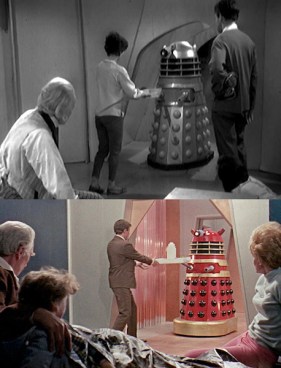
The Daleks were, are, and probably always will be, a pretty blatant Nazi analogy. There’s not anything wrong with that, though its debatable how much there is to learn from it. Where it perhaps becomes interesting is the actions of the other characters. Here we’re on the Daleks’ homeworld, Skaro, which is also populated by a race of humanoids, the Thals. They are pacifists and, when they learn the Daleks want to kill them all, decide it would be best to just leave rather than fight back. The Doctor’s companion Ian has other ideas, goading them into standing up for themselves. These days the idea that our heroes would take a pacifist race and turn them into warmongers strikes a bum note; but this is a serial made by a generation who remember the war, perhaps even some who fought in it, and naturally that colours your perception of both warfare and what’s worth fighting for. The Daleks aren’t just some distasteful-to-us foreign regime that maybe we should leave be unless they threaten us directly — they’re Nazis; they’re coming to get us; they must be stopped.

irradiated wasteland

On the other hand, this is contrasted with Skaro itself — an irradiated wasteland, the only plant and animal life petrified, with the Thals and our time-travelling heroes requiring medication to survive. This is a Bad Thing… but this is where war has led, isn’t it? This is why the Thals are pacifists — because they don’t want this to happen again. And then they go and have a fight. Perhaps we shouldn’t be digging so deeply into the themes after all. It’s not that a “children’s series” like Doctor Who is incapable of sustaining their weight, it’s that writer and Dalek creator Terry Nation is really more of an adventure storyteller. That said, he did go on to create terrorists-are-the-good-guys saga Blake’s 7 and how-does-society-survive-post-apocalypse thriller Survivors, so maybe I’m doing him a disservice.

Delivery within 30 minutes or free Dalek breadIf the film’s rendering of the story and consequent themes is near-identical to its TV counterpart, plenty of other elements aren’t. The most obvious, in terms of adaptation, is that its 90 minutes shorter — roughly half the length. That’s not even the whole story, though: the film is newbie friendly, meaning it spends the first seven minutes introducing the Doctor and his friends. When we take out credits too, it spends 75 minutes on its actual adaption — or a little over 10 minutes for each of the original 25-minute episodes. And yet, I don’t think anything significant is cut. Even the three-episode trek across the planet that makes up so much of the serial’s back half is adapted in full, the only change being one character lives instead of dies (a change as weak as it sounds, in my view).

The funny thing is, even at such a short length it can feel pretty long. It’s that trek again, as Ian, Barbara and some of the Thals make their way to the back of the Dalek city to mount the climactic assault. It feels like padding to delay the climax, and some say it is: reportedly Nation struggled to fill the seven-episode slot he was given, hence the meandering. When it came to the film, Nation insisted Doctor Who’s script editor David Whittaker was hired to write the screenplay (apparently the trade-off was that producer Milton Subotsky got a credit for it too), which perhaps explains the faithfulness. It’s a shame in a way that Whittaker just produced an abridgement, because a restructured and re-written version for the massively-shorter running time might have paced it up a bit.

Open up!The most obvious change — the one that gets the fans’ goat, and why so many dislike the film to this day — comes in those opening seven minutes. On TV, the Doctor (as he is known) is a mysterious alien time traveller, his mid-teen granddaughter Susan is also a bit odd, and Ian and Barbara are a pair of caring teachers who he kidnaps to maintain his own safety. In the film, the title character is Dr. Who — that’s the human Mr. Who with a doctorate — who has a pair of granddaughters, pre-teen Susan and twenty-ish Barbara, while Ian is the latter’s clumsy fancyman. They visit the time machine that Dr. Who has knocked up in his backyard, where clumsy old Ian sends them hurtling off to an alien world. In many respects this is once again the difference between TV and film: the former is an intriguing setup that takes time to explain and will play out over a long time (decades, as it’s turned out — the Doctor is still a mysterious figure, even if we know a helluva lot more about him now than we did at the start of The Daleks), while the latter gives us a quick sketch of some people for 80 minutes of entertainment. Plus, making Ian a bumbler adds some quick comedy, ‘essential’ for a kids’ film.

Even more different is Peter Cushing’s portrayal of the Doctor. At the start of the TV series, William Hartnell’s rendition of the titular character is spiky, manipulative, tricksy, and in many respects unlikeable. In the first serial he even considers killing someone in order to aid his escape! Not the Doctor we know today. As time went on Hartnell softened, becoming a loveable grandfather figure. It’s this version that Cushing adopts in the film, with a sort of waddly walk and little glasses, looking and behaving completely differently to his roles in all those Hammer horrors. If proof were needed of Cushing’s talent, just put this side by side with one of those films. But this was at a time when Hartnell was the Doctor — with ten men ‘officially’ having replaced him in the TV seriesCushty Cushing (not to mention Peter Capaldi to come, a recast Hartnell in The Five Doctors, and various others on stage, audio, fan films, and so on), it’s easy to forget that Cushing taking over must have been a bit weird. It certainly put Hartnell’s nose out of joint. And for all Cushing’s niceness and versatility across his career, Hartnell’s Doctor is a more varied, nuanced, and interesting character.
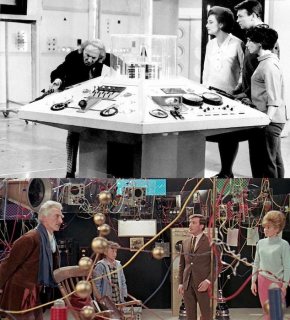
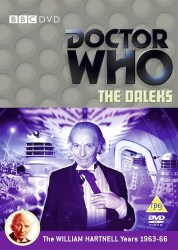
You can see why fans don’t like it — it’s not proper Doctor Who. I think that’s not helped by the film’s prominence in the minds of ordinary folk. During the ’90s, when Who was out of favour at the BBC (except with Enterprises/Worldwide, for whom it’s always made a fortune), the main way to see it was with repeats of the films on TV. Even before that, I’m sure the films have been screened much more regularly than the serials that inspired them. Plus the general public don’t understand that Cushing isn’t a real Doctor (even now, you see people asking why he isn’t in the trailers for the 50th anniversary, and so on), which just rubs it in. But if you let that baggage go (which you really should), Dr. Who and the Daleks is an entertaining version of the TV serial.

And yet… it isn’t as good. The widescreen colour looks good, sure, and the Daleks’ tall ‘ears’ are an improvement (hence why they were adopted for TV in the 2005 revival), but other than that the design is lacking. Bigger on the TVThe console room in the TARDIS is another iconic piece of design, the six-sided central console and roundel-decorated walls having endured in one form or another throughout the show’s life (even if some of it’s become increasingly obscured in the iterations since the 1996 TV movie). In the film, however, it’s just… a messy room. There are control units and chairs and stuff bunged around, with a mess of wires draped about the place. On TV it looks like a slick futuristic spaceship; on film it looks like a junkyard. Oh dear.

Then there’s the Dalek city. The film’s version is more grand, with lengthy corridors rather than the faked photo-backdrops used on TV; but that’s besides the point, because that very grandness undermines its impact. The Daleks’ corridors on TV feel truly alien — they’re the same height as the Daleks, which is about a foot smaller than most of our leads, meaning they’re constantly having to duck through doorways. It’s perfectly thought-through design, led by how the place would actually have been built rather than making it convenient for the cast. The film’s city is the opposite, with big doorways and rooms. It’s a minor point perhaps, but it can leave an impression.

Ridley Scott is, by and large, a great film director, and is responsible for at least two of the all-time greatest science-fiction movies; but I doubt even his 26-year-old self, then a BBC staff designer originally assigned to work on Doctor Who’s second serial, could have come up with a more iconic look for the Daleks than Raymond P. Cusick. With the exception of the ‘ears’ and the colour scheme, his design is rendered faithfully from TV to film, because it’s so good. Why does it work? I have no idea. Perhaps because it’s genuinely alien — they’re not in any way the same shape or size as a human. Of course, it sort of is: the design is based around being able to fit a man sitting down, in order to control it — but it doesn’t look like that. The Doctor and Susan meet the DaleksThen there’s the way they glide, the screechy voice, the sink-plunger instead of some kind of hand or claw… It’s a triumph, and it works just as well in gaudy colours on film as it does in simple black and white.
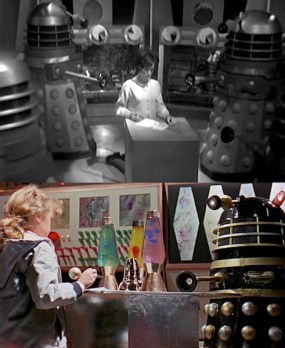
Thanks to being just on contract, Cusick’s contribution to the Daleks and Doctor Who can be overlooked. Even after the creatures became a phenomenal success, the most he managed to get was a £100 bonus and a gold Blue Peter badge; though as the latter is practically a knighthood, it could be worse. Nation, meanwhile, reaped the rewards (though no gold badge), to the extent that today his estate control whether the Daleks can appear in Doctor Who or not. Nation gets a credit every time they appear; Cusick doesn’t. Obviously Nation is owed much of this, but Cusick is too: without that design, the Daleks would have been nothing. Thankfully, the making of Doctor Who is probably the most thoroughly researched and documented TV production of all time, and even if he doesn’t get an onscreen credit on new episodes or any financial rewards for his family, Cusick’s name is well-known in fan circles — the outpouring of appreciation when he passed away last February was equal to that received by many of the programme’s leading actors (always a more obvious object of adulation).

I think the Dalek films aren’t given the credit they’re due by many Doctor Who fans. There’s a reason for that, but those reasons are past. The original stories have been available on VHS and then DVD for decades now, meaning the films aren’t the only way to experience these adventures any more. Plus, as the relaunched show has established Doctor Who as a contemporary popular TV series, so the general populace sees it as a franchise that has had three leading men; or, for the better-informed masses, eleven. Daleks' little helperWhenever the series brings up past Doctors (and that’s surprisingly often, considering the “come on in, it’s brand new!” tone in 2005), Cushing isn’t among them. While he may once have been a prominent face associated with the show to non-fans, the ‘war’ has been ‘won’ — he’s become a footnote.

Maybe it will take a while for fans to stop being so stuck in their ways, but I hope they do and can embrace the Dalek movies as fun alternatives — they don’t replace the originals, but should stand proudly alongside them as symbols of Doctor Who’s success.


Next time… the Daleks invade Earth twice, as I compare the second Dalek serial to its big screen remake.

Destruction!