2013 #102
Nick Hurran | 77 mins | TV (HD) | 16:9 | UK / English | PG
The longest-running science-fiction TV show in the history of the world ever marked its 50th birthday with a feature-length cinema-released one-off special — I think we can count that as a film, right? Good.
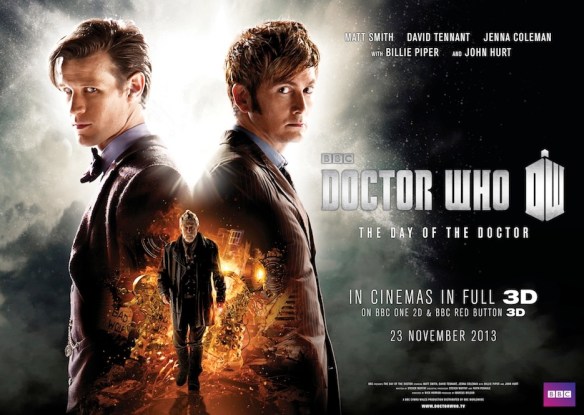
The pressure on showrunner/writer Steven Moffat when it came to this special must have been immeasurable. To distill over 30 seasons of television and 50 years of memories into a relatively-short burst of entertainment that would satisfy not only fans, both hardcore and casual, but also Who’s ever-widening mainstream audience. Not only that, but to produce it in 3D, preferably in such a way that the 3D wasn’t pointless, but also that played fine in 2D; and to make it of a scale suitable for a cinema release, but for only a BBC budget; plus, the weight of an unprecedented (indeed, record-shattering) global TV simulcast audience. And all that in the wake of years of griping and disappointment about the direction he’d led the show in, not least the less-than-usual number of episodes being released during the 50th anniversary year as a whole. Yeah, no pressure…
That The Day of the Doctor delivers — and how — is part miracle and part relief, and all joy for the viewer. Well, most viewers — you’ll never please everyone, especially on a show as long-running, diverse, and indeed divisive, as Doctor Who has become. But for the majority it wasn’t just a success, it was a triumph. Evidence? There was that record-breaking global audience; it was the most-watched drama in the UK in 2013; its theatrical release reached #2 at the US box office, despite being on limited screens two days after it aired on TV  (and it made more than double per screen what The Hunger Games 2 took that night); it recently won the audience-voted Radio Times BAFTA for last year’s best TV programme; and, last week, a poll of Doctor Who Magazine readers asserted it was better than the 240 other Who TV stories to crown it the greatest ever made.
Phew.
As we well know, popularity in no way dictates quality, especially when it comes to TV viewing figures or opening-weekend box office takings… but those audience polls tell a different story, don’t they? The story of something that managed to satisfy millions of people who it seemed impossible to please.
There are many individual successes in The Day of the Doctor, which come together to make something that is, at the very least, the sum of its parts. The star of the show, however, is Moffat’s screenplay. Eschewing the “standard” Whoniversary format of bringing back all the past Doctors and a slew of their friends for an almighty stand off with a huge array of popular enemies (so “standard” it was only actually done once), he instead opts to tell a different kind of story: the series is never about the Doctor, just the adventures he has, so what could be more special than shifting that focus? And with the backstory previous showrunner Russell T Davies had created for the revived show in 2005 — the Time War, and the Doctor’s role in ending it — Moffat had the perfect canvas to tap in to our hero.
 The Doctor’s role in the Time War has not only dominated many of his actions and personalities since it happened, but it also stands awkwardly with his persona as a whole. Here’s the man who always does the right thing, always avoids violence, always finds another way, even when there is no other way… and this man wiped out all of his people and all of the Daleks? The same man who, in his fourth incarnation, stared at two wires that could erase the Daleks from history and pondered, “do I have the right?”, before concluding that he didn’t? Doesn’t really make sense, does it?
So Moffat crafts a story that shows a little of how the Doctor came to make that decision… and then, thanks to this past Doctor getting to see a little of how his future selves reacted to it, the chance to make a different one after all. If that sounds a little bit Christmas Carol-esque, it shouldn’t be a surprise: it’s a favourite form of Moffat’s. Indeed, for a series about time travel, very few pre-2005 Doctor Who stories involve it as a plot point (merely as a mechanism to deliver the main characters into that week’s plot), whereas Moffat has frequently tapped into the whys and hows of that science-fictional ability. In these regards — and others, like the sublime structure where things are established in passing, or for one use, and then resurface unexpectedly later with a wholly different point — The Day of the Doctor is inescapably a Moffat story, albeit one without some of his other, less favourable, predilections that have coloured the series of late.
 I think some fans would have preferred a big party history mash-up; they certainly would have liked to see their favourite faces from the past. But let’s be honest: from the classic era, only Paul McGann could pass muster as still being the Doctor he once was (and he got his own, fantastic, mini-episode to prove it); and how the hell do you construct a story with a dozen leading men? It’s clearly enough of a struggle with three. The Doctor is always the cleverest person in the room, so what do you do with multiples of him? Moffat finds ways to make all of the Doctors here (that’d be David Tennant’s 10th, Matt Smith’s 11th, and John Hurt’s newly-created ‘War Doctor’) have something to do, something to say, and something to contribute — because really, the oldest (i.e newest) Doctor should be the most experienced and have all the ideas, right? There are ways round that, but only so many.
No, instead Moffat treats us to a proper story, rather than an aimless ‘party’… and then serves up a final five or ten minutes that deliver fan-centric treat after treat, without undermining what’s gone before. I guess a lot of that is meaningless to the casual viewer, or is at least unintrusive, but to fans there are moments that provoke cheers and tears — often at the same time. All the Doctors flying in to save the day! Capaldi’s eyes! Tom Baker — as the fourth Doctor, or a future Doctor? Doesn’t matter! And then the final shot, with them all proudly lined up! It’s an array of effective, emotional surprises that far surpasses what could have been achieved if the whole episode had been executed in this style.
 Along the way, Moffat nails so many other things. The dialogue and situations sparkle, and frequently gets to have its cake and eat it: familiar catchphrases and behavioural ticks of the 10th and 11th Doctors are trotted out to a fan-pleasing extent, and then Hurt’s aged, grumpier, old-fashioned Doctor gets to criticise their ludicrousness, speaking for a whole generation of fans who hate “timey-wimey” and “allons-y” and all the rest. I think it’s this self-awareness that helps so much with selling the episode to everyone, both calling back to well-known elements of the series that many love, and pillorying their expectedness for those that aren’t so keen. Well, it would be a pretty awful party if you had a cake but couldn’t eat it, right?
Tasked with delivering all this, the cast are uniformly excellent, to the point where it’s difficult to pick a stand out. Hurt makes for a creditable ‘new’ Doctor in a relatively brief amount of screen time, while Tennant slips back into the role as comfortably as he does his suit. Special praise should be reserved for Billie Piper, though, having a whale of a time as the quirky Bad Wolf-inspired interface to The Moment. She could’ve been an excuse for exposition and plot generation, two roles her character does fulfil, but if you think that’s all she was then I suggest you watch again: there’s more complexity at play there; a weapon not only with sentience, but with a conscience too. She’s not Rose Tyler, but perhaps she has a part of her…
 Smith and Jenna Coleman are on form too, of course, but as the series’ regular cast members that feels less remarkable. That’s not intended to sell them short, however, as they hold their own against actors who are arguably more, shall we say, established. If there’s one weak link it may be Joanna Page’s eyebrows, possibly the side effect of duelling with an English accent. (Complete aside: I’m rewatching Gavin & Stacey as I write this, and feel horrible even going near criticism of such a lovely person.)
They’re backed up by a cornucopia of technical excellence. Yes, OK, it’s a TV episode really — but gosh darn, it looks like a movie. I’m sure some would dig in to criticism of the direction (don’t get me started on the increasingly-regular internet commenter’s cry of “the direction was made-for-TV quality”, but suffice to say I generally don’t hold with that as a complaint), but Nick Hurran’s work is suitably slick. The battle of Arcadia is a sequence any modestly-budgeted big screen extravaganza would be proud to contain, and all achieved on a tighter-than-most-people-realise BBC budget. It won a BAFTA Craft award for special effects, which is more than deserved. Combining full-scale effects, CGI, and even model work (personally, I didn’t even realise there were models involved until I read so in an article months later), it looks incredible, with a scale that’s completely appropriate for a major battle in the war to end all wars. Elsewhere there are a few slip-ups, like a bit of heroic slow-mo undermined by not being recorded at a higher frame rate, but these are few and far between.
 Credit too to editor Liana Del Giudice, not only for crafting cinematic action sequences, but for stitching together a narrative that is often told with imagery and flashbacks, rather than people stood around chatting. Look at the sequence just after the Doctor sees the painting for the first time as just one clear example. That sequence may be dialogue-driven, but the faded-in and intercut flashbacks and glimpses of other events are what’s really conveying information. This is first-class visual storytelling, not just when compared to the rest of British TV, or international TV, or cinema, but the whole shebang.
Perhaps (as in “it isn’t, but let’s see what some people think”) the editing is even too snappy. In the run up to the special’s release, some fans moaned about its length: an hour-and-a-quarter wasn’t enough to do justice to 50 years, they said; it should be at least 90 minutes. Which is exactly the kind of ludicrous small-minded pettiness some fanbases talk themselves into these days. Moffat commented in an interview somewhere that his scripts for The Snowmen (the 2012 Doctor Who Christmas special) and A Scandal in Belgravia (the first episode of Sherlock season two) had exactly the same page count, and yet, when shot and edited, one episode was an hour long and the other 90 minutes. Screenwriting is an inexact science like that. I seriously doubt anyone at the BBC commissioned a 75- or 80-minute Doctor Who special; instead, I would imagine Moffat wrote a roughly-feature-length script that seemed achievable within Who’s limited-despite-what-the-Daily-Mail-think budget, then it was filmed, edited, and it ended up being the length it is. Indeed, the scheduler-unfriendly final running time of 77 minutes is merely further indication of such a notion.
 Still, you can’t please all of the people all of the time, and not everyone liked The Day of the Doctor: it may’ve topped DWM’s poll, but there were voters who scored it just one out of ten. But then, that’s true of 239 of the series’ 241 stories; and almost 60% of voters gave it a full ten out of ten — that’s a pretty clear consensus. I didn’t get round to voting myself, but I would’ve been amongst them. There are undoubtedly some weak spots that I haven’t flagged up, but conversely, there are myriad other successes — both minor (the opening! The dozens of sly callbacks!) and major (the use of the Zygons! Murray Gold’s music!) — that I haven’t mentioned either.
Even if The Day of the Doctor isn’t flawless, as a Doctor Who story — and certainly as a great big anniversary celebration — it is perfect.

 #45 Ghost Rider (2007)
 #49 Elysium (2013)
 The General
 The Gold Rush
 The Passion of Joan of Arc
 Intolerance
 Empire readers considered this the 399th best film ever. TSPDT treated it more kindly, slipping into the top 100 at #94; the Top 300 Silents rank it among their top ten, however, at #10. The original (now lost) cut ran eight hours; the version released was merely two. In 1999 a four-hour version was created using stills from the deleted scenes, which seems to be the only one readily available, though I’ve heard the shorter cut is superior.
 May’s films in full
 #39 A Beautiful Mind (2001)
 The original screen incarnation of the detective, Lassgård starred in a run of TV movies and miniseries made between 1994 and 2007 that directly adapted all of Mankell’s novels up to that point, ending with a version of short story collection The Pyramid. Only some of these have made it to British TV, and not in the right sequence, so I think it’s a little hard for British fans to get an accurate handle on his portrayal. On the evidence available, it seems to be a more hulking, womanising take than other versions.
 The connoisseur’s Kurt, at least as far as British fans are concerned, Henriksson has filled the role from 2005 to 2013 across three series totalling 32 feature-length mostly-original tales. Despite a diversity of release styles (some in cinemas (hence my
  Filmed in Sweden but made specifically for British TV (well, and those American outlets that actually co-produce most British drama), this 2008-initiated BBC series also adapts Mankell’s novels. Branagh’s Wallander is a little hazier than the others, prone to staring into space or having a little cry. The series as a whole seems based in a very British concept of Scandinavia — desaturated close-ups of wheat gently swaying in the breeze, that kind of thing. It has its own charms. A final run adapting the last two novels is due whenever Branagh gets round to it.
 The final Lassgård film, The Pyramid, features flashbacks to a case Kurt was involved with when he was a young uniformed policeman. His 24-year-old self (“Wallander 24” in the credits, as if there’d been a lot more than five of the guys) is played by Mr Skarsgård. Surname seem familiar? He’s the son of actor Stellan, brother to fellow actors Alexander, Bill and Valter. He’s currently starring in History / Amazon Prime Instant Video’s
  Here’s where we get really obscure, then. In 2003 Wallander’s creator, Henning Mankell, co-wrote a crime miniseries called
  OK, he didn’t play Wallander — but he probably has a lot to thank it for. The first two series of the British version feature Hiddleston as a member of Kurt’s team, a stroppy little whatsit called Martinsson. It was after this that Branagh cast him as Loki in Thor, which as we know has brought the guy all kinds of success and adoration. Seems kinda unlikely Branagh didn’t remember him from their Wallander days when he was casting his Marvel movie…

 #25
#25  #29 The Sweeney (2012)
 One of my all-time favourite movies. It should be laughably awful, really — not least the accents — and I’m sure to some people it is; but I think it’s immensely fun, and you can tell the setup is a good’un thanks to its legs: four sequels, a six-season TV series, a spin-off series, an animated series, an anime movie, and
  Top Gun
 Little Shop of Horrors
 For some people, whether Alien or Aliens is the better film is a huge debate. For others, there’s no question which is superior — and those people can be divided into those who think it’s Alien and those who think it’s Aliens. I lean more towards Ridley Scott’s original, but James Cameron’s sequel has its own merits — not least the fact that, instead of dully repeating the original, it shifts the franchise into a wholly different genre.
 Crocodile Dundee
 There’s a good handful of well-regarded films from 1986 that I’ve never seen (also, Howard the Duck), but this is the highest I’ve not seen on
  #13 Gravity (2013)
 #18 Space Battleship Yamato (2010)
 The recently-released inspiration for this list. An underrated series from the late ’00s, its creator and stars have tried to get a movie made ever since it was ditched. With traditional options failing, they famously turned to Kickstarter — and fans coughed up almost $6 million. Relatively strong limited-release box office and VOD chart positions suggest their wish for a sequel may be granted. Unlike:
 The modern marker of true TV success — DVD sales (they also led to a return for series like Family Guy) — saw Joss Whedon’s short-lived, beloved space Western revived for a lap of honour. Sadly it struggled to find a big enough audience there either, dashing hopes of a sequel. But at least we got one movie. One big damn movie. One day, I’ll tell you all about how I think it’s better than Star Wars…
 Sci-fi fandoms lend themselves to this kind of list. Now that it’s a massive multimedia franchise, spanning half a dozen long-running TV series and twice as many movies, it’s easy to forget the original Star Trek was cancelled after just three years. The post-Star Wars movie world saw it rescued for the big screen. A bit like what J.J. Abrams is doing now, one might argue.
 The what now, you might ask? Police Squad lasted just six episodes in the early ’80s, but then they spun it off onto the big screen as The Naked Gun (hence that first film’s ludicrous subtitle) — which was obviously a success, because it spawned two sequels and people still go on about it. Apparently “many gags from the show were recycled for all three films,” which I guess is fair enough if no one watched your show.
 Twin Peaks was a cultural phenomenon, and is widely attributed with revolutionising US network television thanks to its filmic style and long-running storylines. Too long-running, as it turned out, when audiences abandoned it after things got weird (the fact it was masterminded by David Lynch should’ve been a clue) and the driving mystery was kinda-solved. A prequel movie did little to clarify things. (Apparently. I’ve still only seen season one.)
 Sure, the first X Files movie came mid-series, but the second was a considerable time after the show left our screens. And after the TV series ended on a cliffhanger, what better than to return to the big screen so you can tell… a completely standalone and unrelated story with a TV-friendly small scale. Oops. Hopes for a third movie that would deal with the hanging plot threads were basically killed right there.
 Braveheart
 Up
Up Amélie
 Rear Window
 12 Angry Men
 Blue Velvet and Requiem for a Dream
 Not only was Kubrick’s acclaimed horror movie not nominated for any Oscars, it found itself in contention for two Razzies. Shelley Duvall was one of the ten Worst Actresses (Brooke Shields in The Blue Lagoon was deemed worst of all), while the sainted Stanley Kubrick was declared one of the year’s Worst Directors (he ‘lost’ to Robert Greenwald for Xanadu). And there you were thinking everyone always loved it.
 January’s films
 “Cruise. Spielberg.” So read the poster and/or trailer for this ’00s-set reimagining of H.G. Wells’ classic novel of alien invasion and domination. Despite the updating, and the sickeningly twee ending, it’s actually a damn good film. Post-9/11, US films were more positive than ever about how all Americans would band together in a crisis. Not so here.



 100Films.co.uk