
Joe Wright | 111 mins | streaming (HD) | 2.35:1 | USA, UK & Australia / English | PG / PG
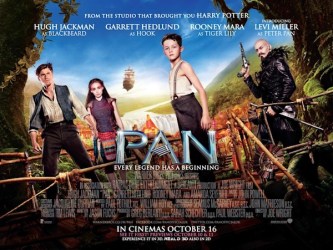 12-year-old Peter (Levi Miller) lives in an orphanage in World War 2 London… until the night pirates bungee in through the ceiling and kidnap a bunch of boys onto their flying galleon. Yes, really. From there it’s second star to the right and straight on ’til morning as the pirates take their new charges to Neverland, where they’re forced into the Mad Max-esque mining operator of Blackbeard (Hugh Jackman). When it turns out Peter can fly, a friendly chap by the name of Hook (Garrett Hedlund) helps him escape, and they head off to find Peter’s destiny, etc — he’s some kind of prophesied Chosen One, because of course he is.
For me, that overripe “Chosen One” arc is the weakest element of Pan. Even then, it’s by no means the worst example in fiction, and it’s executed with a degree of fun and commitment that keeps it entertaining. Otherwise, this is an exciting and enjoyable fantasy adventure, best commended for its inventive, well-realised visuals and colourful design, which when it really clicks can be quite incredible. I suppose that might not be enough to overcome a familiar plot for some viewers, but it eases the way in this particular example. And even if the general arc is a bit rote, there are some quite clever spots of construction and/or references to the original. For instance, Peter can’t read (because Wendy will later teach him), but that also pays off within the film when it turns out he can read the fairy language. On the downside, it doesn’t actually directly connect up to Peter Pan, suggesting someone hoped there’d be sequels — because centring a live-action franchise around a boy who doesn’t age is a great idea.
 As said boy, Levi Miller manages to make Peter not intensely irritating, which is an achievement compared to other adaptations. Some of that is surely inherited from the writing and directing, but Miller gives a strong performance too. Hugh Jackman hams it up magnificently as Blackbeard, clearly having a riot. Rooney Mara may be miscast due to the colour of her skin (for all the complaints about whitewashing, her tribe is shown to be mixed race… which doesn’t necessarily excuse it), but her actual performance is very good. I felt like Garrett Hedlund was doing an impersonation of someone but I never quite got a handle on who (the character’s definitely written to be Han Solo, but the actor’s not copying Harrison Ford). Adele Akhtar brings comedy as Hook’s chum, Sam ‘Smee’ Smiegel, there are cameos of varying purpose from Amanda Seyfried and Kathy Burke, and Nonso Anozie is always a welcome presence, here playing Blackbeard’s henchman. Cara Delevingne doesn’t act so much as provide a human reference for the CGI.
I also really liked the score, by John Powell of How to Train Your Dragon. It’s probably not groundbreaking or anything, but it’s suitably adventurous and epic-y. That said, there have been some very odd choices in the music department, like the massive Smells Like Teen Spirit sing-along. Because it’s entirely out of context (as noted, the film is set during World War 2) it plays like a Moulin Rouge rip-off. It’s also not a consistently-executed notion: there are nods at other songs, but they’re not as famous (the Ramones’ Blitzkrieg Bop, for instance, which I only know thanks to the end credits) so they don’t stick out quite as incongruously.
 Having found Pan to be a very likeable fantasy adventure, I confess to being slightly confused by the response that saw it soundly trounced by most critics and viewers. The review on Blu-ray.com makes the assertion that “today’s movie audience has become so instinctively sophisticated when it comes to CGI-enhanced action sequences that no one can predict what they’ll like”, which I thought was pretty insightful — when does “amazing spectacle” tip over into “oh my God it’s just more CGI”? I think there’s a definite bias based on what people expect of a film. Indeed, a commenter on Letterboxd asserted that most of Pan “consists of the sort of spectacle-as-sleep-inducer set-pieces you find tacked onto the end of Marvel superhero movies”, which at least criticises the sainted Marvel movies for once, but I didn’t think it made up “most of the movie”, nor did I find it sleep-inducing. In fact, I thought Pan had some of the better CGI-driven-spectacle action sequences I’ve seen in our modern overloaded-with-CGI-driven-spectacle era. It is, however, one of those films that must have been genuinely made with its 3D release in mind — as is often the case with those, it’s not the stuff poking out at you that gives it away, but the in-focus backgrounds, which can be especially awkward to navigate in fast-moving action scenes. As Blu-ray.com’s review of the 3D disc notes, “the chaos of the final battle is easier to follow when the action occurs in recognizably separate planes in space.”
Perhaps another aspect of Pan’s reception is some audience members’ devotion to the original story, which may influence how much you can buy into all the changes and adjustments made here. In many aspects it’s not terribly faithful, and if you love the original — especially a particular version, like, say, the Disney one — this might seem like sacrilege. I have no such attachment (though I’ve nothing against Barrie’s work,  or Disney’s, aside from my aforementioned aversion to the eponymous hero), so I was perhaps more open to this Epic Fantasy reimagining. (In that last respect, it definitely falls into the same bracket as Tim Burton’s Alice in Wonderland, which I wrote about in my review: classics of children’s fantasy adapted and reconfigured with a post-Potter/Rings mindset.)
So boo to the trouncers: with a bit of an open mind to its changes, and a bit of allowance for some of the ideas that don’t actually work, Pan is a colourful, inventive, fun, family-friendly adventure movie. And I’d definitely have watched a sequel.

Pan is available on Sky Cinema from today, including on Now TV.


 Neill Blomkamp seems to be on M. Night Shyamalan’s career path: a massively-praised Oscar-nominated breakthrough genre movie, followed by a series of increasingly maligned follow-ups.
 How the mighty have fallen. The great Michael Mann, who once helmed genre-defining crime movies with expertly-directed sequences, here delivers a movie that looks like an amateur cheapie by a film student who’s watched too many Paul Greengrass movies without learning anything meaningful from them.
 After years producing movies in the

 Score:



 British Academy Film Awards 2016
 Adapted from Colm Tóibín’s award-winning 2009 novel by novelist-turned-screenwriter Nick Hornby and director John Crowley (
 Guiding us through this, the film’s heart in every respect, is Saoirse Ronan’s leading performance. I will watch Ronan in essentially anything at this point, both because she seems to choose good material and because, even when she doesn’t, she’s great in it. This is probably her first really mature performance, convincing as a somewhat shy young woman who makes her way out into the world, in the process realising all the confidence she should have in herself. It’s the kind of character and performance that works by accumulation; it’s about the journey, not heavy-handed emoting in a scene or two.
 John Crowley’s direction is largely unobtrusive, but that is a very different kettle of fish to lacking quality. The subtle changes in framing, lighting, and colour palette as the film moves through its locations and stages helps emphasise how Eilis is changing, and how the world changes in her perceptions, too. It makes the story’s times and places look beautiful without quite slipping into picture-postcard rose-tinted-memories territory.
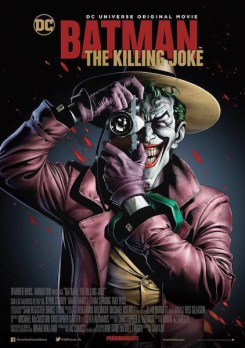 Alan Moore and Brian Bolland’s 1988 graphic novel The Killing Joke is one of the seminal works of superhero comic books’ move into seriousness in the ’80s, sitting just behind the likes of Watchmen, The Dark Knight Returns, and Batman: Year One in terms of significance. It’s also seen by many as the definitive story about Batman’s nemesis, the Joker, and has influenced the live-action interpretations of both Jack Nicholson & Tim Burton and Heath Ledger & Christopher Nolan. It is not without controversy, however, thanks in large part to its treatment of Barbara Gordon / Batgirl; and Moore has since semi-disowned it, saying it has no intrinsic value because it has nothing to say about real human beings, only commenting on the comic-book-y relationship between Batman and the Joker.
 we get to the familiar meat of the story, where the Joker (Mark Hamill) decides to prove a point — in a violent and twisted fashion, naturally.
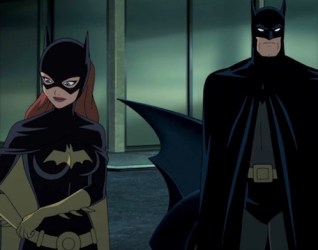 To say the least, this doesn’t seem like the best way to go about making her an independent, rounded human being — it comes off like fan service. No, worse: fan fiction. A scene earlier on where she explains her Bat-infatuation to her gay best friend is presumably meant to suggest a genuine motivation for the eventual sexy times, but it all comes across as a great big excuse.
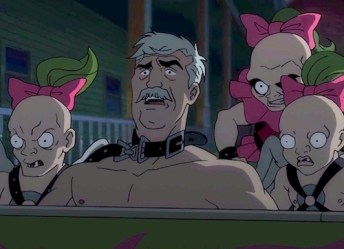 which brings its own problems to the story. But while he is a familiar figure in the Batman mythology, and so by extension to anyone who’s likely to watch this film, it’s also a standalone movie, not part of a series, and so it would be beneficial to establish his character somewhat before the Joker’s plan for him gets underway.
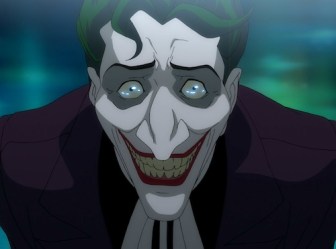 (It’s somewhat ironic, then, that (as ever) Alan Moore doesn’t receive an onscreen credit while Bolland does.) There are a handful of effective visuals here (the Joker’s gleeful face as he turns on the amusement park, its lights twinkling in his eyes), but they’re the exception to work which is adequate — good for what it is, even — but unremarkable.



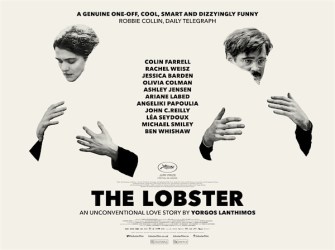 The first English language feature from Greek writer-director Yorgos Lanthimos (of
  Even if you accept these goals, Lanthimos’ film eventually goes off the rails. Without meaning to spoil too much, David eventually falls in with the loners, who have their own very specific social rules designed to inhibit partnering up. Revelation: the outsiders are fundamentally the same, just with different rules! That’s about the extent of what I got from this portion of the film; unfortunately, it goes on for a really, really long time. Among this group David meets ‘Short Sighted Woman’ (everyone aside from David is similarly named) and falls in love with her — I mean, of course he does, she’s played by Rachel Weisz. They develop a secret mode of communicating, but will be harshly punished if caught. This storyline is what the film uses to occupy its remaining time, but what it lacks in the offbeat humour of the time in The Hotel it makes up for with… nothing.
 100Films.co.uk