Passengers (2016)

2017 #156
Morten Tyldum | 116 mins | download (HD+3D) | 2.39:1 | USA / English | 12 / PG-13
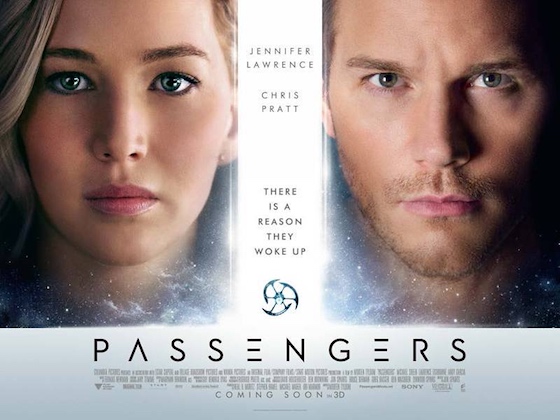
Passengers

This review contains major spoilers.

I got the distinct impression everyone hated Passengers when it came out 18 months ago — it has a lowly 31% on Rotten Tomatoes, and most of the think-pieces penned in its wake seemed to be about how terrible one particular aspect was (I’ll come to that, hence the spoiler warning). It has a 7.0 on IMDb though, which might not sound great, but anything north of 7 isn’t bad on IMDb — there are plenty of popular movies languishing in the 6s. Personally, I rather enjoyed it.

Sometime in the future, shortly after mankind has begun to colonise other worlds, the spaceship Avalon is on a 120-year journey to a new planet with thousands of colonist-to-be in hibernation onboard. Just 30 years into the trip, the Avalon strikes an asteroid field, causing a malfunction that wakes up just two passengers: Jim (Chris Pratt), a mechanical engineer, and Aurora (Jennifer Lawrence), a journalist. Faced with the prospect of never reaching the destination they’d set out for, the pair begin to develop a relationship.

Or so the trailer would have you believe (and this is where the spoilers come). In fact, the malfunction only awakens Jim. After a year alone on the ship, with his only company being a robot bartender called Arthur (the always excellent Michael Sheen), a suicidal Jim comes across Aurora’s pod. Smitten, he watches her video diary, struggles with the morality of awakening her… and eventually does, claiming her pod must’ve malfunctioned too. What a bastard, right? Eventually Aurora finds out and hates Jim for robbing her of the life she’d intended, but this is a romance movie so…

I C You

Obviously, this is the aspect that generated all those digital column inches. Having read some of them, I get the impression that the reason so many people were annoyed by Jim’s dick move is either, a) it wasn’t hinted at by the trailer (therefore people were too busy trying to read the film as a straight-up romance, because that’s what the ads promised, and didn’t consider the actual story it was telling), or b) people seem to really struggle with movies where the lead character makes bad decisions that are either unlikeable or amoral. That’s a general observation I have about audiences, but it seems applicable here. See the numerous “Star Lord is the real villain of Infinity War” hot takes for a similar Chris Pratt-related example.

One of the reasons people being angry about the film’s ethics bug me is that at no point does the movie try to argue that Jim waking up Aurora was a good decision — everyone knows it was a bad, selfish idea. What the film does do is try to make you see why he would make that choice (it takes him over a year to do it, remember), and then shows how everyone eventually deals with the fallout (which is just life — shit you don’t want happens and you have to find a way to handle it). In fact, buried underneath all the romancing and effects whizz-bangery of the film’s climax, maybe there are some decent life/moral lessons, about the need for forgiveness, and accepting, and making the most out of things we can’t change.

No! Bad Jim! Bad!

A lot of people seemed to jump on the idea the film would be better if acts one and two were flipped — if we woke up alongside Aurora, only later learning of Jim’s betrayal. It would certainly have been different. Better? I don’t know. It would shift the emphasis around a lot. Maybe it would’ve made him romancing her more palatable for those who found it objectionable to their core, because while watching it you wouldn’t know what he’d done — but it wouldn’t change what he did, just how you were presented with it. In some ways, then, the movie we have got is the more interesting version: we know what he did throughout their courtship and have to accept that fact.

Moral questionability aside, the romantic plot is actually traditionally shaped: there’s the meet-cute (it’s just a sci-fi’d-up one), the falling for each other, the disagreement and separation, and eventual reconciliation. Maybe such familiarity is fine when it’s being dressed up in shiny new sci-fi surroundings; maybe it was the problem, too: the massive betrayal at the film’s core gets in the way of a traditional happy-sappy arc; if you wanted to go all gooey over their burgeoning romance, it gets in your way. But it’s a more interesting story because of it. In real life, such a horrid act might prompt a definite “walk away and never see him again” response. Things aren’t so straightforward aboard the Avalon. If you wanted them to be… well, so did Aurora, and she didn’t have a choice either. Perhaps the film could’ve spent more time digging into the emotional impact and decision-making of that rather than faffing with a sci-fi-cum-disaster-movie action-packed climax, but when your movie’s this expensive (as much to do with the no-doubt-ginormous salaries of the two stars as it is the CGI, I expect) you need some money shots and jeopardy to draw the blokes in.
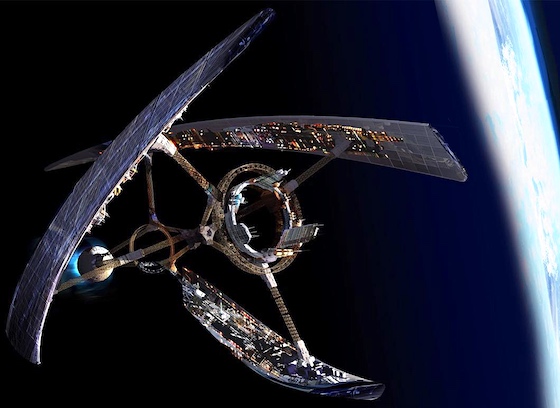
Sci-fi money shot

Taken as a sci-fi movie, I really liked it. The concepts are well considered and played out, from the big ideas of how colonisation might work to little touches of how the tech functions. Much of the ship and its interfaces are beautifully designed and realised — I don’t know how much of it was built for real, but I suspect a fair chunk of the main locations are practical, and I do love a big set. I liked Arthur too, partly because I like Michael Sheen, but also because of how he functions as a robot designed to be kind of your mate.

On the whole, I suspect the negative reaction to Passengers is more a case of mismanaged expectations for some audience members rather than it being an objectively bad movie. I guess a lot of critical viewers put themselves in Aurora’s position, but Jim’s dilemma is just as relatable — I mean, not in a literal sense (none of us are ever likely to wind up in such a situation), but in a “what would I do?” way. Clearly, everyone thinks he did the wrong thing, but can you blame him? Would you be able to withstand a life of total loneliness? Maybe you would. Maybe you think you would. Nonetheless, the romance plot is inevitable (because that’s how movie plots work, especially in expensive Hollywood blockbusters), so the time bomb of What He Did adds an uncommon frisson. And the big action climax isn’t bad for what it is.
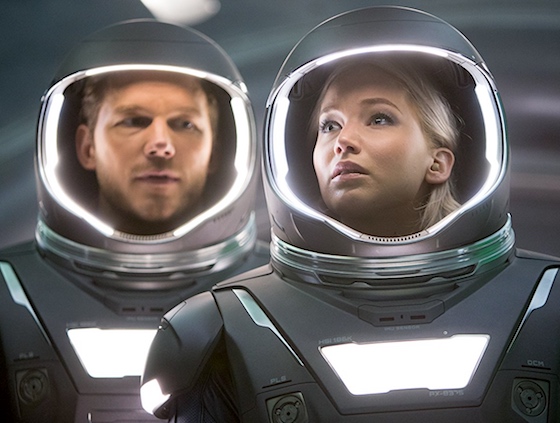
It's full of stars!

That said, the more you think about it, the more you can dream up variations that would’ve been of even greater interest. Like, what if Jim wasn’t physically attractive? Would Aurora still have fallen in love with an ugly bloke just because he was the only fella there? Or what if he’d died, leaving her to face the same dilemma he had — would she in fact wake someone up too? But those kinds of alternatives are far too challenging for a Hollywood romantic blockbuster. Like, the only way you’d get a physically unattractive leading man would be if it was a comedy and he was funny, and then she’d fall for him in spite of his looks because he made her laugh. But hey, it’s Hollywood entertainment behaving like Hollywood entertainment — should we be surprised?

4 out of 5

Manchester by the Sea (2016)

2017 #134
Kenneth Lonergan | 137 mins | streaming (HD) | 1.85:1 | USA / English | 15 / R

Manchester by the Sea

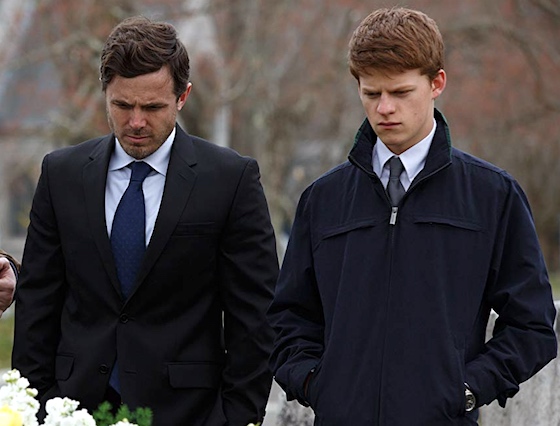
One of the frontrunners of the 2016-17 awards season, Manchester by the Sea centres around Lee (Casey Affleck), a taciturn sort who’s called back to the eponymous hometown (which he’d left behind for reasons that are initially kept a mystery to us viewers) when his brother dies, naming Lee as the guardian of his teenage son (Lucas Hedges). As Lee attempts to figure out his new role, he’s plagued by the memories and emotions from why he left Manchester in the first place.

Manchester by the Sea is not a plot-driven movie. Even the mystery I alluded to above doesn’t play by ‘the rules’, with the answers being revealed about halfway through rather than near the end. There’s still a story, obviously (see above), but it’s more of a character study about people coping with grief — not in the wailing, all-consuming way you might typically associate with grief being depicted on screen, but in a more subdued, naturalistic manner. In harmony with that, there’s an element to it which is, not irreverent, but certainly mundane — like making calls to funeral directors over breakfast, for instance — and scattered with darkly comic realities, like paramedics struggling to get a bed into an ambulance. Indeed, for a film about such grim subjects, it’s surprisingly funny. But, as I’ve said in many reviews before, that’s life: the world is still funny, and we often still laugh, even when tragedy is all around.

Funereal

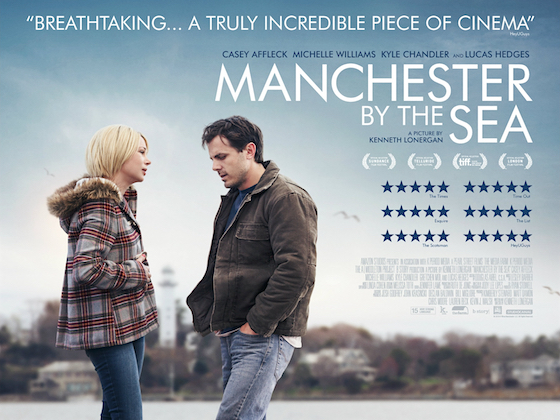
Given all that, it’s not surprising it was Casey Affleck’s performance that attracted most attention and won most of the awards. That’s not undeserved — he’s the core of the film, and it’s a powerful but understated performance — but Lucas Hedges is also brilliant in a part that could’ve been given short shrift. In fairness, if we’re talking about awards, he got plenty of nominations too. So too Michelle Williams, playing Lee’s ex-wife. She’s not bad, but her awards recognition is all really for that one scene — you know, the one they always played as the film’s clip, and that’s alluded to on the poster. Indeed, it’s interesting how prominent she is in the marketing — her role is central to the state Lee’s in, but the actress herself isn’t on screen very much. Her absence is more felt than her presence, even.

It’s understandable that one scene became such a focus — it’s a powerful moment of great importance to the characters (and, more cynically, is virtually the only major sequence with the two name lead actors). In some respects, however, I think the film’s most powerful moment comes at the other end of the film’s timeline: when we learn about what happened in the past, it ends with ‘the morning after’, when Lee faces what he has done and looks for the punishment he feels he deserves; instead he finds only understanding, so he attempts to punish himself. (This scene also got a fair bit of awards play, but lacked context. Or perhaps that was just me? I didn’t really get what was going on until i saw it in the film proper.) That’s a key part of what’s going on with his character, I think: he hasn’t just been trying to escape what happened, he’s also punishing himself. Other people aren’t always so understanding — some do judge him; one person quietly refuses to employ him, presumably because of what happened — but no one judges him as harshly as he judges himself.

The Scene

An aspect I don’t recall being remarked upon much was the cinematography, but I thought it was a surprisingly good-looking film. DP Jody Lee Lipes’ work here isn’t flashy, maintaining the understated and naturalistic tone of the entire movie, but it’s very crisp, befitting both the freezing cold weather and raw emotions. On the other hand, if I had one criticism to level it might be that the film’s too long. Its events and emotions unfold at a measured pace, which is fine, but some of what we see is less necessary than the film seems to think it is (for one example, the opening sequence, where we watch Lee as he does various day-to-day janitorial jobs, feels like it goes on for ages and contributes little).

But I’m nitpicking at this point, really. Manchester by the Sea derives itself from such everyday moments, accumulating them into a subtle, realistic, quietly powerful character portrait.

5 out of 5

Dudes & Dragons (2015)

aka Dragon Warriors

2018 #145
Maclain Nelson & Stephen Shimek | 113 mins | Blu-ray | 16:9 | USA / English | 12

Dragon Warriors

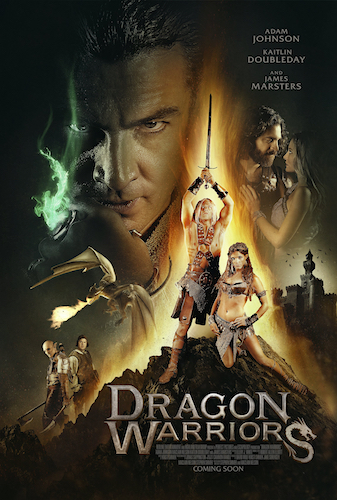
Back in 2014, when it felt like I was contributing to Kickstarters for film projects left, right and centre (including a variety of short films I still haven’t got round to watching and several projects which never amounted to anything, which is why I’ve largely stopped), I helped fund a fantasy comedy called Dragon Warriors. To cut to the quick, it was eventually released as Dudes & Dragons, the title changed presumably to better indicate its comedic tone, and apparently at the end of last week it popped up on Prime Video UK — so, naturally, that made me finally get round to watching my Blu-ray copy.

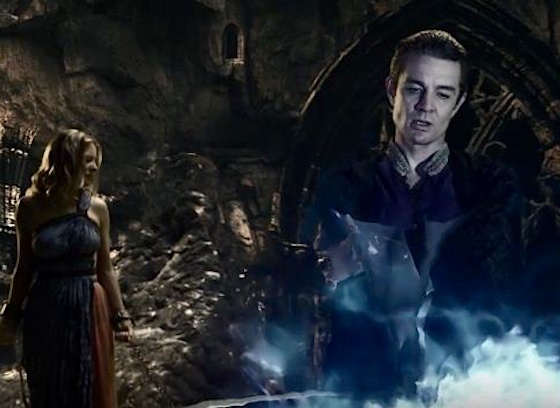
In a Dungeons & Dragons-y world, no one can show signs of love lest they be torched by the fearsome dragon Dolvarnög (the pronunciation of which is one of the film’s better recurring jokes). In fact, the dragon is commanded by evil sorcerer Lord Tensley (James Marsters, of Buffy and Angel fame), whose personal experiences with love have left him bitter. The dragon is just one threat to the relationship between human Camilan (Maclain Nelson) and elf Larec (Clare Niederpruem), and so he teams up with his mercenary brother Ramicus (Adam Johnson) — plus Camilan’s stable boy, Samton (Jake Van Wagoner), and Ramicus’ lodger, orc Shokdor (Erik Denton) — to save the world, etc.

Comedy!

As I said, and as the title surely implies, Dudes & Dragons is ostensibly a comedy — though not the kind of comedy the re-titling implies, I don’t think. I guess the lead characters are “dudes”, but they’re not, like, “dude” dudes… if you know what I mean. Setting that aside, potential hilarity is undercut by the film being overburdened with plot. My summary didn’t even mention the object of Tensley’s affections, his cousin Ennogard (Kaitlin Doubleday), who summons our heroes on their mission; or that Camilan’s parents forbid his marriage to Larec because of some stuff to do with laws of succession or something — this is meant to be a comedy, fellas! Who wrote it, Phantom Menace-era George Lucas? This necessitates rather too many scenes of exposition, especially early on, meaning it’s a while before the gags really begin to flow.

Well, “flow” is a generous descriptor — the gag rate is alarmingly low. The exposition scenes are balanced on a knife edge where you can’t tell if the actors are playing it tongue-in-cheek because it’s supposed to be humorous, or if it’s because they’re reaching for a florid style that they think is correct for a serious High Fantasy movie. (“High” fantasy is probably what you expect from a movie called Dudes & Dragons, actually, isn’t it?) Put another way: take those joke-less scenes out of context and you might think they were just am-dram Fantasy. James Marsters is probably best equipped to navigate this, giving a sterling go at being both villainous and comic, though the uneven tone means he’s never allowed to be properly menacing nor properly hilarious, a balance we know he can strike thanks to the aforementioned Whedon series. The rest of the cast actually aren’t bad — when the script gives them some decent material, there are laughs to be had. The weakest link is a cameo from Luke Perry, who’s worse than most of the non-famous cast.

Buffy flashbacks

Production-wise, this is a very low-budget effort and it shows, but if you give it the benefit of bearing those cheap-and-cheerful roots in mind, it doesn’t look half bad. Well, mostly. I mean, some of the costumes are a bit cosplay, but the creature prosthetics are pretty good; and the CGI monsters are alright considering the next-to-no-budget; and it’s decently shot, especially some sequences that spoof the oeuvre of Zack Snyder, though it’s sometimes distracting that it was all done on green screen — were there no real forests nearby they could’ve popped down to?

There’s some enjoyment to be had in Dudes & Dragons for the more forgiving viewer. It would’ve been helped immeasurably by a more streamlined plot, a higher preponderance of genuine gags, and probably by being a good 20 or 30 minutes shorter, too. As it is, most people after some fantasy-based laughs are going to want to look elsewhere.

2 out of 5

Call Me by Your Name (2017)

2018 #80
Luca Guadagnino | 132 mins | streaming (HD) | 1.85:1 | Italy, France, Brazil & USA / English, Italian, French, German & Hebrew | 15 / R

Call Me by Your Name

Call Me by Your Name was the lowest grossing film among 2017’s Oscar Best Picture nominees, but it felt like it was one of the most talked about films on the ballot — though, being part of a list that also includes Get Out and “the fish sex movie”, obviously there’s stiff competition.

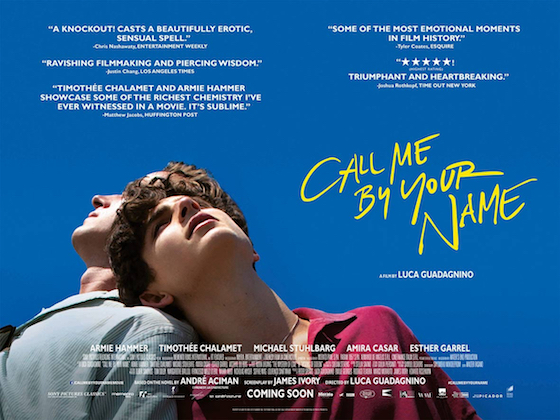
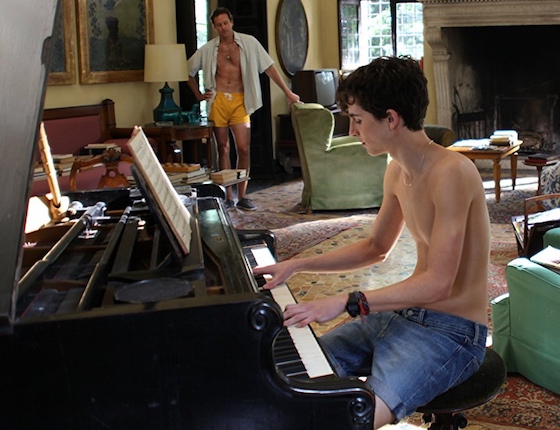
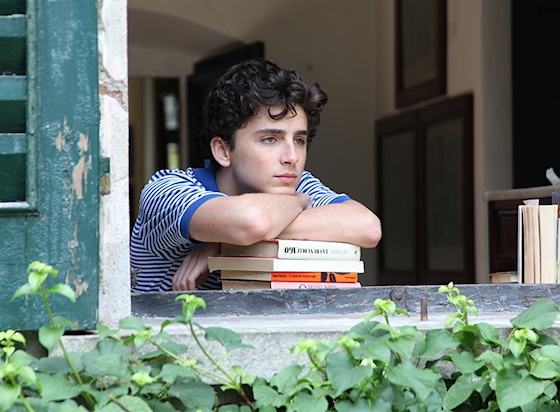
Set in Italy during the summer of 1983, it centres around 17-year-old Elio (Timothée Chalamet), the son of a pair of well-to-do intellectuals (Michael Stuhlbarg and Amira Casar) who spends his days lazing around their countryside villa — reading books, noodling about on the piano, and flirting with the local girls — and his evenings chasing skirt. He’s smart and talented, but still young and developing. Into his life comes Oliver (Armie Hammer), an American grad student who’s to be his professor father’s annual research assistant. Initially Elio is standoffish around the free-spirited Oliver, and yet seems fascinated by him. As they begin to spend more time together, a mutual attraction tentatively develops into a passionate love affair, a new experience for them both.

Sorry to rush you through the plot like that, but the gay romance between Elio and Oliver is what the film’s, y’know, about. It’s an effective and truthful depiction of young love — falteringly, unassured, but driven by powerful emotions and burning lust. Although Oliver initially seems hyper-confident, as he opens up to Elio it becomes clear that this is new for him too, and of course Elio’s only young, inexperienced even with girls at the film’s start, so of course love is a new thing to him. So, in some respects it doesn’t matter that the film’s about a gay relationship — the feeling it conjures of young love is universal. Of course, there are many reasons why it matters immensely that it’s about a gay relationship, but those concerns are largely external to the film itself. They intrude only in the sense that Elio and Oliver keep their affair a secret, though given Elio’s bohemian-ish family, he eventually finds more support than he might’ve expected.

Flesh

It’s not all sweetness and uncertainty, mind. I used the word “lust” for a reason: there’s some fairly sexually explicit stuff, so be warned if you’re of a sensitive disposition, or are particularly fond of peaches. Well, I say that — if you’re really fond of peaches, this will be your new favourite film. It’s not Stranger by the Lake graphic, despite what screenwriter James Ivory had in mind (i.e. there’s no explicit male nudity; Elio’s girlfriend gets her kit off though, which could spark a whole other debate about gender equality), but there’s still no doubting what the young couple get up to.

Talking of which, there was apparently some controversy about Elio and Oliver’s ages in regards to their relationship — Elio, as I said, is 17, and Oliver is 24. Some Americans seem to have a monomaniacal obsession with the age of consent being 18, which they then apply universally. I mean, it’s not even close to universal in the US (it’s 16 in 31 states and 18 in only 11), never mind worldwide. So, some people apparently have a major problem with that age difference between Elio and Oliver, whereas others won’t even think about it. For what it’s worth, the age of consent in Italy is 14 — imagine the reaction if they’d made Elio that young! For another perspective, in the UK in 1983 the age of consent for heterosexual couples was 16, but for gay people it was 21 — so, what, if this was set in the UK and Elio was female it would be okay, but because he’s male we’d have to be appalled? I guess my point is: think this shit through, and stop being “outraged” that people under the legal age of consent have romantic and sexual feelings.

Pining

But I guess there are fans of the film who’d know all about that, considering pretty young Timothée Chalamet has apparently become a favourite of the Tumblr crowd (who I’m basically assuming are all kids, which I’m sure is unfair). He’s not just young and beautiful though, but an extraordinarily competent actor too, all unearned confidence undercut by youthful vulnerability. His Oscar nomination was deserved. Armie Hammer went overlooked, but he gives a more nuanced performance than you might expect. From the supporting cast, the reliably excellent Michael Stuhlbarg stands out. Initially just an amiable dad, the film gradually peels back the layers to reveal what a fantastic father he is, including one heart-to-heart scene that alone (and even more than Hammer) should’ve seen him scooping awards.

The film was also overlooked in the cinematography category, which is a shame too. Shot on 35mm with a single lens by DP Sayombhu Mukdeeprom, it ably recreates the hazy feel of a long-ago summer. That sensation extends across Guadagnino’s direction, the gentle pacing reminiscent of a time when six weeks was forever, when the world was full of possibilities and there was time enough to explore them all and still have some left over.

Call Me by Your Name manages to resolve a striking array of contrasts — it’s both universal and specific, nostalgic and timely, powerful and gentle. The sum is a beautiful film in most every respect.

5 out of 5

Call Me by Your Name is available on Sky Cinema from midnight tonight.

It placed 18th on my list of The 26 Best Films I Saw For the First Time in 2018.

The Snowman (2017)

2018 #84
Tomas Alfredson | 119 mins | streaming (UHD) | 1.85:1 | UK, USA & Sweden / English | 15 / R

The Snowman

I read a comment somewhere that said Tommy Wiseau’s notorious film The Room is like a movie made by someone who’s never seen one but has had the concept thoroughly explained. The Snowman is like that but with crime thrillers.

Michael Fassbender stars as Norwegian detective Harry Hole — I presume there’s been some kind of fault of culture or translation there because, in English, that’s pretty much the worst name for a detective ever conceived without deliberately trying to be awful. He’s kind of washed up, with a terrible private life, but he’s also an unassailably brilliant detective — oh yeah, the originality keeps on coming. Anyway, after a woman disappears, an ominous snowman built near the crime sets Hole and a younger cop (Rebecca Ferguson) on the trail of a serial killer who’s been active for decades.

All of which should make for at least a solid crime thriller, but it just doesn’t quite work. It’s like the whole thing has been almost-correctly-but-not-quite translated from another language. I’m not just talking about the dialogue (though that’s sometimes that way too), but the very essence of the movie — the character arcs, the storylines, even the construction of individual scenes. Like many a Google Translate offering, you can kinda tell what it’s meant to be, but it doesn’t actually make sense in itself. According to the director, around 15% of the screenplay was never even filmed due to a rushed production schedule, which perhaps explains some of these problems.

Mr and Ms Police

Said director is Tomas Alfredson, the man who gave us Let the Right One In and Tinker Tailor Soldier Spy, so you’d expect a lot better of him. Even the technical elements are mixed: there’s some stunning photography and scenery, contrasted with occasional bad green screen; and all of Val Kilmer’s lines had to be dubbed (due to his tongue being swollen from cancer, apparently), but it sounds like it. His performance on the whole is weird, just one more part of the film that doesn’t sit right. It all builds to a massively stupid, unremittingly nonsensical finale. It’s during the final act where things finally goes overboard from “not very good” to “irredeemably bad”.

Indeed, some of the The Snowman is so shockingly awful that I considered if it merited my rare one-star rating. It’s close, but a lot of the film is fine — it actually toddles along at a reasonable three-star level most of the time, before falling apart entirely towards the end. “It could be worse” may be the faintest of praise, but it certainly doesn’t deserve any more.

2 out of 5

The Snowman is available on Sky Cinema from midnight tonight.

Journey to the Center of the Earth 3D (2008)

2017 #139
Eric Brevig | 93 mins | download (HD) | 1.78:1 | USA / English | PG / PG

Journey to the Center of the Earth 3D

Journey to the Center of the Earth 3D (as it’s actually titled on screen, a rarity for 3D movies) is a very loose (very, very loose) adaptation of Jules Verne’s classic fantasy novel — indeed, you could say it’s more of a sequel, as the characters’ adventure is inspired by the belief that Verne’s novel is actually an account of real events. It turns out they’re right, of course, because otherwise this would just be a movie about a man and his nephew trekking up a mountain to find nothing — which sounds like a film someone would make, but not an effects-driven summer blockbuster.

I remember Journey 3D (as the title card indecisively morphs into before finally moving on) going down quite poorly on its release a decade ago, but, looking up sources to cite for that now, I’m not wholly correct: it has 61% on Rotten Tomatoes, which isn’t great but is still considered ‘fresh’, and grossed a respectable $242 million (off a budget of just $60 million). Nonetheless, I expected little of it (I watched it mainly because it’s on my 50 Unseen from 2008, a notoriously under-completed list) but wound up pleasantly surprised… in some respects, anyway.

They're all right

The key to my enjoyment was watching it in 3D, in which it plays more like a theme park attraction than a movie: from the very beginning it has loads of those “sticking stuff out into the audience” hijinks that no one bothers with anymore (indeed, after watching a dozen other 3D movies on my TV, I don’t think I’ve seen anything poke out before). Gimmicky and in your face (literally) though it may be, the effect works, it’s uncomplicatedly fun, and it makes the movie better just because it’s trying. Relatedly, this was the first film released in 4DX, the South Korean-developed theatrical format which features “tilting seats to convey motion, wind, sprays of water and sharp air, probe lights to mimic lightning, fog, scents, and other theatrical special effects”. I imagine all that palaver suits the film really well — as I said, it’s more like a theme park attraction than a regular movie anyhow.

However, that’s just one of the reasons why I imagine it would be nearly unwatchable in 2D. All the stuff that’s kinda fun in 3D would seem pointless in 2D, and the at-the-camera things would be horrendously blatant (I mean, they are in 3D, of course, but at least their purpose is retained). And as for the rest of the movie, the direction feels very TV-ish; or, again, like a theme park attraction — it’s a bit basic, basically. Some moments push towards achieving wonder. I’m not sure they quite get there, but I’ve seen worse. (Director Eric Brevig is a visual effects guy by trade, with credits ranging from The Abyss and Total Recall up through Men in Black and The Day After Tomorrow to John Carter and The Maze Runner, and many more besides. His second film as director was the Yogi Bear movie (you know, the one with that poster), which is probably why he’s not directed anything since.)

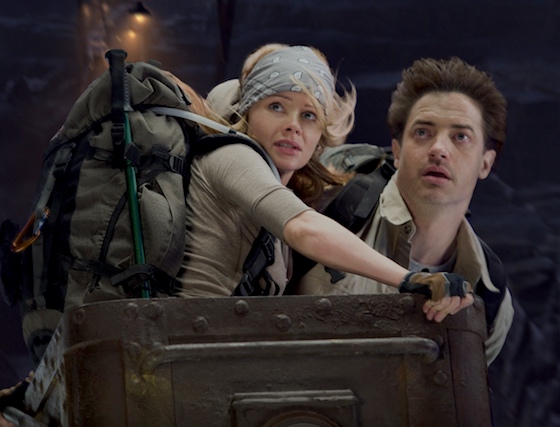
Remember when Hollywood thought Brendan Fraser was Harrison Ford?

Let’s not just reserve our criticism for the direction, though: the dialogue is terrible too, including what may be the single worst (or best — it’s so bad it’s good) exchange in the entire history of movies:

Trevor: Max was right. He was right! [shouting] Max! Was! Right! Ha ha! [to Sean] Your dad was right. He was right.
Sean: Hannah, your dad was right too.
Trevor: They both believed in something that everyone told them was impossible. He was right! [echoing:] He was right!

But hey, at least it makes an effort to do that screenwriting thing of eventually paying off every single thing we learnt about earlier… except for a yo-yo, the thing with the most “this is setup for later” introduction. Maybe the scene where they needed to do some hunting got cut… There’s added incidental amusement watching it a decade on thanks to the surprisingly old-fashioned technology on display: computer monitors are still CRTs; cool kids’ mobiles are still flip phones; being able to Google while on a plane is a wonder… It’s like the film is self consciously showing off how much technology has changed in the last decade — which it isn’t, obviously, because it couldn’t’ve known. And hey, if you don’t laugh at it you’ll cry because it’ll make you feel old.

Really, Journey 3D is cheesy, tacky, and kinda terrible… but I also enjoyed myself. Yes, a big part of that was the 3D. I’d never claim it was a good film, and I don’t think that I’d even recommend it, but I wouldn’t write off watching it again someday.

2 out of 5

Perfect Sense (2011)

2017 #131
David Mackenzie | 89 mins | streaming | 2.35:1 | UK, Sweden, Denmark & Ireland / English | 15 / R

Perfect Sense

It’s funny, sometimes, the journeys we take to watch a movie. I distinctly remember Ewan McGregor appearing on a chat show to promote this back in 2011. I thought it sounded like a good setup for a story, so the film’s existence lodged itself somewhere in the back of my memory. Clearly the film itself didn’t have much impact, and so, with no one talking about it, and no releases or TV screenings or whatever that were high-profile enough for me to notice, it went on the back burner. Until last year, when I noticed it was available to rent on Amazon Video.*

Anyway, the aforementioned setup is a global epidemic that causes people to have an intense emotional outburst followed by losing one of their senses — for example, the first stage is an uncontrollable bout of crying followed by losing the ability to smell. Over a short period everyone experiences the same thing, then the world learns to adapt… until it happens again, losing another sense. While this is going on, we follow the relationship of Michael (McGregor), a chef, and Susan (Eva Green), a member of a team trying to find a cure for the disease. Obviously, this provides our human connection to events, with the grand world-changing stuff providing more of a backdrop.

Life goes on...

It’s ironic, then — or at least counterintuitive — that there’s more emotional power in the montages about senses and what was being lost — the ideas-y stuff — than there is in the character- and relationship-based bits. Those are actually surprisingly clunky at first, with even McGregor and Green — both actors I like a good deal — struggling to make them work. Things do smooth out in that regard, but the romance plot proceeds to conform to a pretty standard shape. Was the sci-fi crisis meant to reflect the relationship, or is the relationship a down-to-earth framework on which to hang a big sci-fi story? I suspect the latter, because it’s the end-of-the-world theatrics that prove more interesting.

Those are kept grounded and plausible: despite the ever-worsening situation, people keep getting used to the new status quo and going on as normal — until the sensory deprivation goes too far to ignore, of course. There are lots of neatly observed and imagined little bits in how this unfolds, like how after taste is lost the rituals of going out to restaurants remains, with focus moved to the sounds and physical sensations of the environment and the food; and newspaper critics still review places for this, naturally. This “life goes on” thing feels very much like how we as a society genuinely react to big changes or threats.

...until it doesn't.

So, it’s not a perfect film, but Jesus, the negative reviews I sampled (chosen at ‘random’, where “random” means “the top results on Google”) were shitty pieces of criticism. Their points include things like it’s preposterous (well, the plot is propelled by an unexplained virus — it’s less preposterous than, say, Spider-Man), or the characters fall in love while the world falls apart (because no one ever seeks comfort in others during times of stress or tragedy), or the screenwriter has kind of a funny name (seriously — a supposedly professional review dedicated some of its limited word count to basically going, “lol, foreigner’s got name that looks funny!”) It annoys me that some people get paid to write bollocks like that.

As I said at the start, no one ever really talks about Perfect Sense, even after its director has gone on to bigger things (Starred Up attracted a lot of praise and Hell or High Water earnt Oscar nominations), but it’s worth a look for anyone interested in broadly-plausible end-of-the-world dramas.

4 out of 5

* Having rented it, I was surprised to see it begin with a BBC Films logo, because most BBC Films productions end up on BBC Two within a year or two. So I checked, and it turned out it had been on TV, just once, in November 2012. (You’d think they’d’ve shown it more than that in the five-and-a-half years since — I mean, they’ve shown The Ides of March six times in four years.) Worse than that, though, was when I checked my iPlayer downloads and found I had actually downloaded it, so paying for the rental was a waste of money. Well, at least it was only £1.99, and I paid with vouchers anyway. But the colour grading of the two was completely different, which was just odd. Anyway, back to the review: ^

Game Night (2018)

2018 #111
John Francis Daley & Jonathan Goldstein | 100 mins | download (HD) | 2.39:1 | USA / English | 15 / R

Game Night

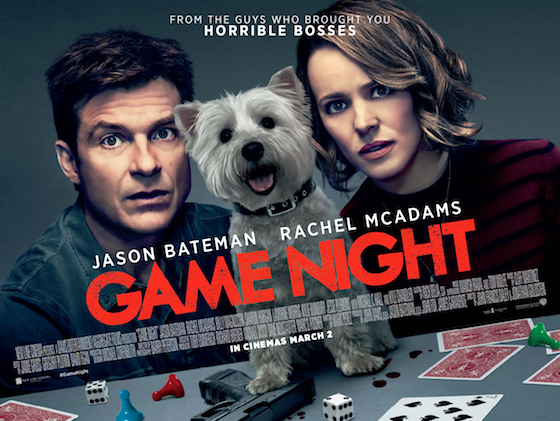
Despite what the poster suggests, the cute dog is not in fact one of the three leads.

1 out of 5

Okay, okay — let’s put the Westie-based bait-and-switch advertising aside and give the film a fair hearing, because it’s actually surprisingly brilliant.

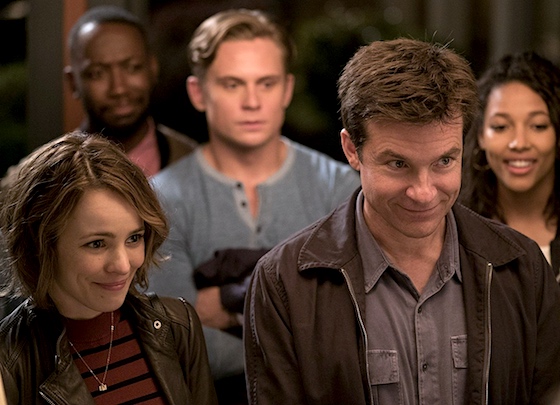
The other poster stars, Jason Bateman and Rachel McAdams, play hyper-competitive couple Max and Annie, who love nothing more than the weekly game night they host with their best friends, from which they exclude their odd next-door neighbour, Westie-loving cop Gary (Jesse Plemons). One week, Max’s super-successful older brother Brooks (Kyle Chandler) unexpectedly shows up and gatecrashes game night, then offers to host an even better one. For that he arranges a real-life mystery game, where he gets kidnapped and the others have to track him down… except then he gets kidnapped for real, and they only have the rest of the night to rescue him.

If you’ve ever wondered “what if someone reimagined David Fincher’s The Game as a comedy?”, Game Night is probably the answer. Personally, I’ve never wondered that, but I’m up for it. That said, I was all prepared to let it wait until it popped up on Netflix or something, until the film’s home release in the US a couple of months back prompted a wave of praise from critics I follow on Twitter. Now I’m adding my small voice to those urging you to check this movie out.

Wanna play a game?

It’s the kind of film where I don’t want to say much more than I already have, because obviously the joy lies in the jokes (and jokes are a lot less funny if you spoil them) and the plot developments. At the risk of just reeling off a list of superlatives, I’ll say that what unfolds is fast, inventive, clever (after you’ve seen the film, check out this spoilersome bit of trivia. I mean, that’s superb!), and, above all, hilariously funny. There are more laughs in its opening montage than many modern comedies manage in a whole film. Jesse Plemons transcends the “budget Matt Damon” jibes (but, c’mon, he really looks like an own-brand Matt Damon) to all but steal the film with his hysterical straight-faced supporting role. I only say “all but” because everyone else is firing on all cylinders too: it’s a cast full of likeable, well-performed characters, not least Max and Annie. McAdams, in particular, gets to give a line delivery that’s an all-timer. If there’s a criticism in this regard it’s that, with so many characters competing for screen time, I’m not sure how well their individual arcs really work, but that’s a minor distraction.

One other thing I will criticise — which is nothing to do with the quality of the film itself, but bugged me enough that here’s a whole paragraph about it — is the scarcity of extras on the Blu-ray, which total just ten minutes. Seriously? Put some effort in! All the praise from American Twitter led me to acquire the film via Alternative Means, but, being the good honest film consumer I am, I was going to rent it when it came out here as retrospective payment. But then I loved it so much I thought I’d just go ahead and buy the disc. But a full-price new release of a film I’ve already seen with a grand total of ten minutes of special features? You’re having a laugh. Were there no deleted scenes? Could they not stump up for a commentary? Surely they filmed longer interviews than that just for the EPK? But no, all we get is a 6½-minute gag reel and a 3½-minute “featurette” (I’m being kind — at that length it can’t be much more than a trailer). I’m going to buy it eventually, in a sale, because I enjoyed the film enough to add it to my collection, but you cost yourself a day-one purchase there, Warners. I don’t know how much the general film-viewing populace still care about special features, but us aficionados do, and I know I’m not alone in feeling this way about this particular title. Anyway, rant over.

Who's stealing the film now, eh?

For pure enjoyment, I came very close to giving Game Night the full five stars — when it works, it absolutely sings — but there are just a few bits, here and there, that fell a little short. Nonetheless, it’s certainly the kind of film I loved in spite of its flaws. If only the adorable dog had been in it more, maybe this’d be a five anyway…

4 out of 5

Game Night is available to own digitally in the UK from today, and on that disappointing DVD & Blu-ray from next week.

It placed 15th on my list of The 26 Best Films I Saw For the First Time in 2018.

Rocky II (1979)

2018 #131
Sylvester Stallone | 119 mins | Blu-ray | 1.85:1 | USA / English | PG / PG

Rocky II

This first sequel could fairly have been titled Rocky Part II: picking up where the first film left off (literally — the first six minutes are just a replay of Rocky’s final fight), it goes on to detail what happens next for both Rocky (Sylvester Stallone) and his world-champion opponent, Apollo Creed (Carl Weathers). For the former, his childlike naïveté and heart of gold sees him carelessly burn through his newfound wealth as he tries to give the love of his life (Talia Shire) everything he thinks she wants. For the latter, it means an ongoing niggle that he didn’t really win the fight, so he tries to goad Rocky into a rematch.

Like the first movie, a lot of Rocky II is more of a character-based drama than a sport-driven movie, this time about someone who had a taste of the big time struggling to re-adapt to normal life. It’s not that Rocky’s ego has outgrown his means — he doesn’t seem to mind going back to working menial jobs when the money runs out — but his overestimation of his success means that he does indeed find himself in that position. It’s not bad as a dramatic work — it’s got the same writer as the first movie, after all, here also stepping up to direct (and did you know he wrote a novelisation too?) — but we know where it’s all headed, and so the second half is better than the first.

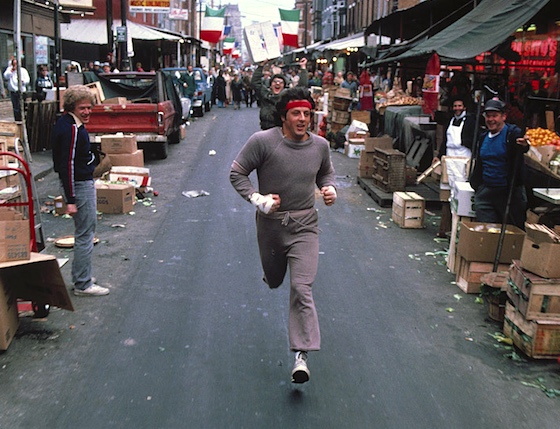
Run, Rocky, run!

Again, Stallone doesn’t lose sight of keeping events moderately grounded: Rocky struggles to focus on his training regime, and it begins to look like Creed may be right that his success in their first bout was all fluke. Of course, this is as much an underdog fairytale as the first movie was, and so events transpire to finally give Rocky his motivation, culminating in a triumphant revisit to the first film’s famous running-up-the-steps bit. The finale is, naturally, the big boxing rematch, where Stallone really shows off his directing chops: it’s a tense, drag-out duel that easily exceeds the first film’s for visceral impact.

On the whole, I wouldn’t say Rocky II is better than its predecessor — indeed, maybe it’s not quite as good — but I enjoyed it about the same; maybe even slightly more by the end. The Rocky sequels have a collectively poor rep, but I think this is a worthy follow-up.

4 out of 5

The UK network TV premiere of the latest Rocky sequel, Creed, is on ITV tonight at 9:30pm.

Victoria & Abdul (2017)

2018 #52
Stephen Frears | 112 mins | streaming (HD) | 2.35:1 | UK & USA / English, Urdu & Hindi | 12 / PG-13

Victoria & Abdul

Returning to the role that earnt her first Oscar nomination, Dame Judi Dench stars as an even older Queen Victoria, who once again gets involved in a friendship with a foreign servant to the exasperation of those around her. If it wasn’t based on a true story, the similarities to Mrs Brown would make Victoria & Abdul look like a slipshod copycat sequel. Okay, this isn’t technically a sequel, but the similarities can’t be ignored.

Where the earlier film aimed for dramatic weight as a portrait of a grieving and isolated monarch finding human connection again, here the goal seems to be more comedic. Perhaps. I mean, if often shoots for funny, but it’s not funny enough to be an outright comedy. At other times it’s more straightforwardly dramatic, especially as it gets towards the end, but there’s a nagging sensation that the facts have been bent to fit the expected shape of the narrative. The film begins with a card that says it’s “based on real events… mostly”, which feels a little too comical for a heritage drama such as this, and was perhaps more intended it as a “get out of jail free” card for its historical accuracy. (I don’t know what the facts are, mind, so I can’t vouch for or condemn the film’s faithfulness to them.)

Turns out we are very much amused

Dench is very good, as you’d expect. The rest of the cast don’t get to deliver as much range, but they’re a quality bunch of performers and so are easily up to what they’re given. It’s also as pretty a production as you’d expect, with Oscar-nominated makeup and costumes, plus opulent production design and grand location choices, all shown off by Danny Cohen’s pleasant cinematography.

I read someone else assess that it’s not as good as its individual parts, and I think that’s fair. Most of the scenes, moments, and performances are strong — there are notably funny bits, dramatic bits, emotional bits; even unexpected complications in how it handles some of the characters — but when it’s all put together, it doesn’t quite coalesce. If you think you’re the kind of person who’d enjoy this movie, there’s every chance it will please you no end. Otherwise, while it does have definite qualities, it doesn’t do quite enough to transcend its trappings.

3 out of 5

Victoria & Abdul is available on Sky Cinema from today.