
Woody Allen | 92 mins | DVD | 15 / R
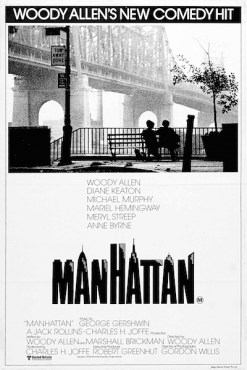 Drama (though it does include some very funny bits) focusing on the interrelationships of a handful of 40-something New Yorkers.
Allen fails to convince as a bit of a womaniser, even if he is notably less neurotic than usual; however, once the viewer gets over that little fantasy of his, I believe there’s a lot to be had here. It’s a much more traditional film than Annie Hall — events occur in chronological order, with no unusual comedic breaks, or monologues to camera — and, as a drama, it’s all the better for this.
The black & white photography is gorgeous throughout, helping the city to shine far brighter than any of the characters — for me, the best bit of the entire film is the opening three-and-a-half minutes, in which the beautiful images, Allen’s narration and Gershwin’s music combine in a tribute to what must be the most genuinely loved of all cities.
(A 5-star rating system only allows minimal delineation, so for the sake of clarity I’d like to point out that I personally preferred this to Annie Hall, though it falls just off attaining a full five.)

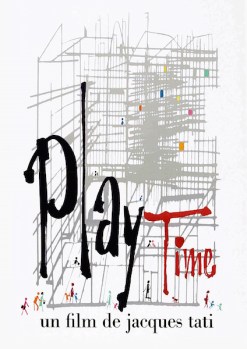 I know some people love the work of Tati, just like there’s always someone who loves everything; personally, I find his films largely dull. His character, Monsieur Hulot, is like Mr Bean but less funny (don’t worry, I know Hulot comes first by a good few decades). There are some laughs to be had in Play Time, but they’re a long way in and not necessarily worth waiting for.
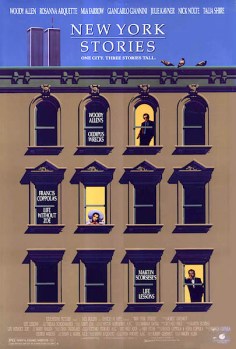 Anthology of three shorts, connected only by the New York setting (which, incidentally, may as well be anywhere in all but the last segment).
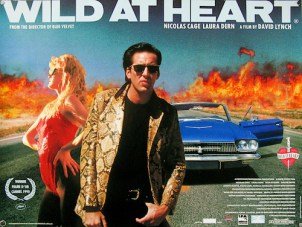 My experience of David Lynch’s work has so far been limited to
 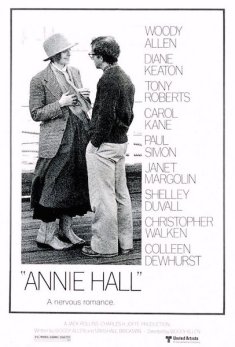 Widely considered to be Woody Allen’s breakthrough movie and winner of four of the ‘Big Five’ Oscars. One might call it a romantic comedy, but it’s very much an indie comedy-drama (for one thing, it utilises the ever-popular tactic of not taking place in chronological order), rather than the mainstream cliché-fest that first springs to mind whenever “rom-com” is mentioned.
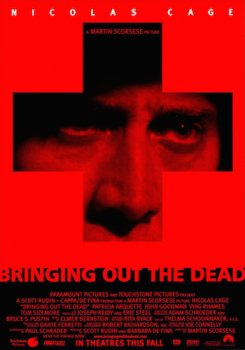 It’s hard to know what to make of this, because by the end it all seems a little pointless. The storyline, which follows Nicolas Cage’s paramedic across three nights in New York, is a mixture of short episodic medical incidents with longer threads that continue throughout. These connect and fall apart, feeling as episodic as the rest, and most of them don’t really lead anywhere.
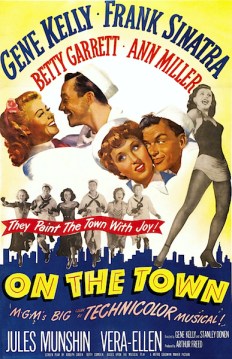 Gene Kelly and Frank Sinatra lead the cast in this musical comedy about three sailors who have 24 hours of shore leave in New York. The plot is sometimes predictable, but at least it’s not as standardised as many. Equally, none of the songs are truly memorable but most are fun while they last.
 The first of the silent Fantômas films (I reviewed the second
 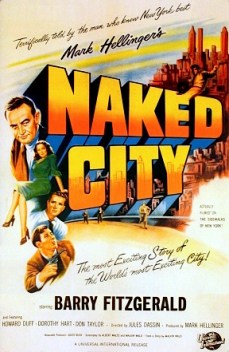 Police procedural film noir, shot entirely on location in New York (unusual at the time).
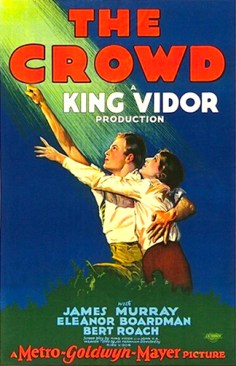 Late silent-era drama — though you’d be forgiven for thinking it was a comedy until halfway, when the light antics of a young couple in ’20s New York give way to some increasingly dark drama (interesting trivia: seven endings were shot for distributors to choose from, some happy and some sad; all chose sad ones. However, the copy we saw (taped from an ’80s TV showing) had a happy ending).
 100Films.co.uk