Casino Royale (2006)

2008 #72a
Martin Campbell | 139 mins | DVD | 12 / PG-13

Casino RoyaleI’ve seen Casino Royale four times in the two years since its release (twice on opening weekend, in fact), which is an unusually high number of viewings for me. Normally I’ll see a film once and, even if I really like it, might not bother again for years; even films I’d name among my most-favourites fall into this category.

The reason I share this upsettingly trivial bit of information about my film watching habits is because, after two years and four viewings, I don’t really have much to say about Casino Royale. It’s a damn fine Bond film, returning to Fleming and resetting the character without losing anything truly essential about the franchise. The action sequences are great because they’re not only exciting but also drive the plot forward and reveal character — when Bond runs through the wall at the building site is a prime example of this.

In Daniel Craig and Eva Green the franchise has probably the best two leads it’s ever had, in terms of acting ability, and they put it to good use. There are many more pitch-perfect things about this film — not least making a poker game engrossing — and, yes, a few flaws, though for me they’re so minor as to not matter; but I don’t feel the need to expound on them a great deal because the film really speaks for itself. And, looking at the UK box office and DVD/Blu-ray sales, I’m not sure there’s anyone who hasn’t seen it.

In summary, Casino Royale is possibly the best Bond film of all time — though when you have a series that has encompassed so many disparate styles (directly compare From Russia With Love to Moonraker and one might even struggle to believe they’re from the same series), it makes for an incredibly hard selection to pick a sole winner from. Still, this one’s up there with the very best, not just of Bond but of action-spy-thrillers in general.

Now, I just wonder what happened next…

5 out of 5

The Invasion (2007)

2008 #72
Oliver Hirschbiegel | 99 mins | download | 15 / PG-13

The InvasionThe Invasion is a modern thriller aimed at a mainstream audience, which naturally means it begins at the end. Is there a reason for this? As is too often the case these days, no. The only explanation I could come up with is that such an opening suggests there’ll eventually be some some actual scares in this sci-fi/horror, and so is designed to help the viewer persevere through the distinctly lacking film that follows.

Things go sharply down hill from the lacklustre opening ending opening: Jeremy Northam accidentally stabs himself with an Evil Alien Parasite Thing in a blatant genre convention that seems to have moved from the “necessary to get on with the plot” to the “badly obvious cliché”. The order of scenes that follow seems to be a random mess — for example, Nicole Kidman’s kid, Olly, begins to have nightmares again; a few scenes later, his dad (Northam, now taken over by the Evil Alien Parasite Thing) phones wanting to see him after a long absence; a few scenes later, Kidman tells a friend that Olly’s nightmares restarted after he was told he was going to see his dad. This is not an isolated example.

Much of the dialogue is on the level of bad exposition, but, to rub salt in the wound, it explains things we’ve already been shown. Normally reliable actors turn in flat performances with such an awkward script, which ponderously works its way through a plot that’s far too slow-moving considering how obvious it is. We know it’s an Evil Alien Parasite Thing within the opening minutes and even a passing familiarity with the genre will let you know how things are going to end up (as if opening with the ending didn’t give you a hint), but we’re still treated to near-endless scenes of our luckily-immune heroes trying to work out why everyone else is behaving oddly. It takes a full 36 minutes for Kidman to finally realise what we’ve all known from the start, but just in case you’ve missed the bleeding obvious there’s a pile of handy flashbacks. More to the point, how come only two people in the entire world (the other being Daniel Craig) have noticed what’s going on? The possessed have all the subtlety of a Jeremy Clarkson joke, walking around in a permanent mechanical daze.

A lot of articles have noted that the studio disliked how the film ended and so brought in other writers and director(s) to re-shoot the final act, aiming to bolster the action. Thank goodness they did, because it’s at this point that there’s finally something worth watching. The aliens’ dominance is a near-inevitable and obvious eventuality from very early on, and so structurally speaking should have been reached sooner. Unfortunately, when it does arrive, the weak early scenes mean we don’t care about the characters, so while some of the more action-packed scenes are well staged they have little genuine impact. Some good moments sneak through though, like a couple’s very public suicide, or… No, that was the only one I noted.

In this structural imbalance The Invasion is reminiscent of I Am Legend: a ponderous dramatic first half turns into an all-action assault as the only uninfected people are relentlessly pursued by the infected majority. In an inversion of the disappointing (but not dreadful) Will Smith vehicle, The Invasion‘s first half is dire while the second at least has some excitement and jeopardy. In Legend it was a shame that they couldn’t keep the first half running for the rest of the film; here you’re glad the studio intervened and forced some actual events on the film. It would be quite interesting to see how it was all meant to turn out originally, but I doubt it would be entertaining in the slightest.

Once it’s all over there’s a truly dreadful info-dump that explains what happened next. Besides making you cringe and wonder how a piece of exposition so blatant could ever have been greenlit, all it achieves is the delivery of a killer blow — not by blatantly stating the film’s subtext (which it does — not so ‘sub’ then), but with what that subtext actually is: when humanity is taken over by aliens, war stops; ergo, war is what makes us human. Lovely.

2 out of 5

The Invasion featured on my list of The Five Worst Films I Saw in 2008, which can be read in full here.

St. Trinian’s (2007)

2008 #71
Oliver Parker & Barnaby Thompson | 97 mins | download | 12

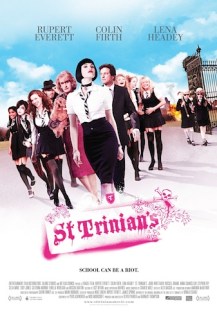
St. Trinian'sI really didn’t think I was going to like St. Trinian’s. It seemed to be aimed squarely at teens whose quality barometer is fixed at Girls Aloud being the best music artists of all time and aren’t old enough to have seen There’s Something About Mary. Certainly, some of the film lives up to these expectations, but other bits are surprisingly good.

For one thing, it has a pleasantly wicked sense of humour, which must be pushing that 12 certificate on moral grounds — 10-year-olds producing black market vodka, for just one example. There’s a number of good, brief, visual gags too, such as the RE department having a Practical Study of the Easter Story with a girl strung up like Jesus on the cross (Christian bating is always funny). On the other hand, it merrily includes some ancient gags too — a dog shags someone’s leg! Hilarity! But then again, it makes no bones about being aimed at a relatively young audience, and for them this probably seems wonderfully fresh and naughty. Thankfully it’s not all down on this level — it has an even better line in Colin Firth spoofing than the Bridget Jones movies, and while some of these references may fly over the heads of that intended audience, they should at least keep any adult viewers amused. My personal favourite was the two 10-year-old girls who keep quoting famous movie lines. Simple, but effective.

A fair number of people seem to have considered the moral vacancy of St. Trinian’s’ style of comedy a bad thing, claiming impressionable girls will copy the characters’ actions or at least be influenced by their anarchic attitude. Not likely, I say — the school is such a fantasy-mess that I think even the very young would struggle to believe it as a potential reality. In fact, I’d go so far as to say that most of it is relatively harmless fun — if only some of The Youth Of Today would copy this lot rather than getting stupidly drunk, pregnant as soon as they’re able, and knifing each other every evening, then we might not be in the state we’re in. But anyway…

Through any weak patches, affairs are buoyed by a rather wonderful cast. The likes of Colin Firth and Rupert Everett are clearly having a ball, the young (though most not as young as their characters) cast all do a good job, with Gemma Arterton standing out in particular, and anything featuring Stephen Fry is at least worth a look. Yes, he’s only playing himself (literally) on a version of University Challenge that no doubt owes something to QI (even if it is just Fry hosting), but luckily he’s given a smidgen more to do than just read out cue cards. In spite of which names may be above the title or which characters get introduced first, it’s decidedly an ensemble piece — every time you think a lead is emerging another takes centre stage. In that respect it might be seen as a bit messy, but each one gets a decent enough through-line.

Incidentally, it’s incredibly British — not just in its setting and style, but also the very current cultural references — which might explain why it still hasn’t had a US release. It wouldn’t look out of place premiering on TV, probably at Christmas considering the scale of it, and I wouldn’t be surprised if the budget had been TV-sized. It’s also got a posh girl played by that girl who plays a posh girl in everything on TV (namely, Lucy Punch). That doesn’t really signify much, but my God she’s done well out of playing essentially the same role in numerous productions.

Despite my preconceptions when starting out, which were all supported by the opening few minutes, I ultimately found St. Trinian’s quite enjoyable. It’s far from perfect, and every time I began to truly warm to it — I even found myself laughing at a final beat for the leg-shagging dog cribbed from a decade-old comedy (I believe I already mentioned it…) — there was another recycled or immature joke to make me despair. In spite of that, the overall impression was adequate enough.

3 out of 5

Hitman: Unrated (2007)

2008 #70
Xavier Gens | 94 mins | download | 15

HitmanVideo games have been fertile ground for filmmakers over the past couple of decades — or, rather, for film financiers, because while they almost invariably garner poor reviews they do insist on making them. What marks Hitman out from the crowd? Well, nothing.

In fact, Hitman seems to be doing its best to blend in and go unnoticed — much like a good hired assassin would do, you’d imagine. Except in this film, all the assassins are bald and have barcodes tattooed on the back of their head — not at all conspicuous. The story begins at the end, as is the fashion for most films these days, and as usual there’s absolutely no reason why it should. After that, you’ve got a series of ideas and scenes recycled from the likes of The Bourne Identity — and by “from the likes of” I really mean “from” — that don’t add up to anything particularly new. The majority of the plot is easily guessed within the first half-hour; those guesses that don’t pan out aren’t because the film has anything surprising to do, but instead because it seemingly can’t be bothered to resolve certain plot threads. Equally, the plentiful leaps in logic appear to be the result of lazy filmmaking, not caring to fill in the gaps between two cliched plot beats.

Characters suffer from poor performances — disappointing in the case of lead Timothy Olyphant, who was pretty good in Deadwood — but are also let down by a lack of technical ability, featuring a copious amount of clearly dubbed dialogue. They shouldn’t’ve bothered, because it’s all atrocious. Behind the dialogue, the rest of the writing isn’t any better. Agent 47’s characterisation is all over the place. He’s clearly supposed to be calm and robotic, and at times he is, with an appropriate lack of understanding about life and women; but then there are moments where he’s shouty, or humourous, or eye-rollingly knowing. It’s like the screenwriter’s copied the scene from another film (usually The Bourne Identity) and forgotten to put his characters into it. As for the rest of the cast, Dougray Scott and current Bond girl Olga Kurylenko are also let down by poor material. Also worthy of note is a Russian General toward the end, who is a spectacularly bad actor.

Believe it or not, Hitman does have the odd moment that’s almost worthwhile. There’s some wit with the sex (or, rather, “lack of sex”) scenes, and I quite liked the (derivative, it must be said) score. And then there’s the action, of course, which is naturally the main point of a film like Hitman. It’s fairly extreme, considering, and appropriately bloody — exploding heads from snipers, many spurting wounds from SMGs, and so on. This is the ‘benefit’ of the unrated cut, which is barely any longer than the theatrical one but does have plenty of extra blood CG’d in. For a full list of differences — as well as that blood, there’s a few extra shots in fights and of ‘controversial things’ like drug-taking — have a look at this page (translated from German). Most of the action scenes are passable but with nothing to mark them out, the one exception being a four-way blade fight in a disused train carriage between Agent 47 and three other bald assassins. It’s a good idea fairly well executed, but suffers from a nagging question: where did the other three come from and, more importantly, why were they there?

I’ve made it this far without mentioning Leon, the gold standard against which all other assassin movies will inevitably be compared. It feels almost cruel to mention it though, because Hitman’s aims are nothing so lofty. Style and content-wise, films such as Wanted and Shoot ‘Em Up are much closer relations, as well as the film it so often imitates, The Bourne Identity. Hitman is not as original nor as fun as any of these, which makes it all rather pointless.

2 out of 5

The Diving Bell and the Butterfly (2007)

2008 #69
Julian Schnabel | 112 mins | download | 12A / PG-13
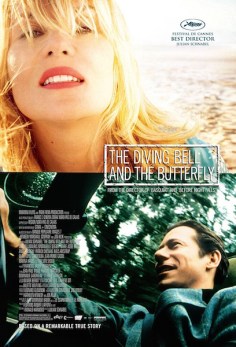
The Diving Bell and the ButterflyLe Scaphandre et le Papillon, as it’s titled in its original French, has until now been on my (unwritten) ‘List of Films to Avoid’, alongside the likes of Ichi the Killer, Hostel, Caligula, and Salo. Strange company for an Oscar-nominated drama I know, but whereas those others have visceral horror that I have no real desire to deal with, the situation of Diving Bell’s central character, Jean-Dominique Bauby, which is exacerbated by it being a true story, seemed too horrendous to bear. In a similar way to how one might struggle to think about death if one doesn’t believe in an afterlife, the idea of being paralysed but for one eye is an almost unimaginably tortuous fate. Nonetheless, in the wake of a huge amount of praise — and in the name of finding a film starring Mathieu Amalric for My Quantum of Solace Film Season — I resolved myself and hoped for the best.

The most striking thing about the film is that, for about the first 40 minutes, it takes place almost entirely within the head of Jean-Do, as Bauby is affectionately known. From the opening shot we literally see through his his eyes, blurry and limited as that is, and hear his thoughts, which brings us a lot closer to him than any character in the film can be as we soon realise he can’t speak. During this first third the film only ventures outside Jean-Do’s immediate vision for memories or imaginings — although the viewer might perceive them as breaks from the prison of his mind due to the change in imagery, we’re actually still stuck inside his head, just as he is. One begins to wonder if the whole film will be told this way, or, if it does break free, how Schnabel and writer Ronald Harwood are going to find a cinematically plausible way to achieve this after so long. (Pleasingly, when do they it doesn’t feel like a contrivance.)

Jean-Do’s situation is obviously far from everyday, so this device makes for a highly effective — and, indeed, affective — form of identification. As we can see all he sees and hear all he hears, and as he can’t feel anything, we’re being given access to his entire sensory experience and, through his voice over, we even have access to his thoughts. (I say “his entire sensory experience” — it’s never mentioned whether he can taste or smell; but as his paralysed mouth means he’s unable to eat I presume the former isn’t much of a consideration at least.) This style also creates some exceptionally uncomfortable moments, such as when Jean-Do’s right eye has to be sewn up so as it doesn’t dry out, even though it still works at the time. As we see from his vision, we see the eyelid being half-closed and the needle pushing through as if it were our own. Again, it brings the viewer a lot closer to his experience than watching the act objectively from a third-person perspective would.

It’s not just the effect on Jean-Do that we’re privy to, however. As the story progresses we encounter his family: an estranged wife, three children, a mistress, and a house-bound father. The pain these relatives feel is both varied and palpable, as is the added pain for Jean-Do. He can’t play with his kids, or even really communicate with them, and his mistress is too afraid to visit — in one scene, his disability means they have to communicate uncomfortably through his wife. Arguably most affecting of all is his father. Played by Max von Sydow, the couple of scenes featuring him are beautifully understated in both direction and performance, but it’s their attempt at a phone conversation, using only the awkward blinking system developed by Jean-Do’s speech therapist, that is absolutely heartbreaking.

Incidentally, the scenes where Jean-Do uses this method — which, put simply, involves him choosing one letter at a time — are quite odd to watch for an English viewer. Obviously the word is being spelt in French, but the subtitles unsurprisingly spell the word in English. It’s the only sensible way to convey the point, but it makes for an especially odd disjunct between original dialogue and the subtitle translation. It’s not so much a flaw as something that distracted me at times, but I can’t come up with a better solution.

As Jean-Do, Amalric is required to give a rather unusual performance — not just because he’s stuck with only the use of one eye, but because for much of the film Jean-Do is omnipresent while Amalric is nowhere to be seen. This in-his-head style means that the direction, cinematography, editing and sound design are as much part of the character as the work Amalric does. He rarely actually narrates anything — it’s sort of a half voiceover, with snippets of thoughts and the like. That said, it’s to the credit of his work with this slight material, and to those on the technical side, that when he does actually appear on screen it doesn’t seem unusual or disconnected.

I’m not sure where I got the notion that The Diving Bell and the Butterfly would be truly excruciating to watch, but, as anyone who has seen the film will surely be aware, it isn’t. Schnabel and Harwood employ a variety of techniques to make you understand the real-life horror of Jean-Do’s situation, but these don’t tip the film into sensationalism or terror. In fact, despite the measures taken to enable the viewer to identify with Jean-Do and make his a very personal drama, I found it was primarily interesting on a documentary level — understanding the hard, slow, awkward processes of recovery (as much as he can) and coping (to a degree); how it might feel to be in that situation, or stuck in similar aspects of human experience, such as in the visit from a former Beirut hostage.

In fact, if the film had a message it would surely be, “live every day as if it’s your last”. That might sound a bit corny — something which I certainly wouldn’t accuse the film of being — but it’s never been presented so starkly. Never mind dying, thereby having no chance to realise what you didn’t do — Jean-Do is a prisoner, tortured with all the things he never did or didn’t do enough, and the knowledge that he will never be able to do them again.

4 out of 5

Stay (2005)

2008 #68
Marc Forster | 95 mins | DVD | 18 / R

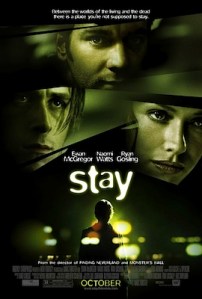
StayI’m sure some viewers didn’t bother to stay until the end of Stay, baffled by an increasingly bizarre plot — which, at times, seems to be doing its best to stay still too — and put off by apparently pointless scenes. If only they had stayed, they could’ve discovered that they had indeed wasted an hour and a half of their lives on a story with a deceptively unoriginal conclusion.

The main problem with Stay is that it thinks it’s cleverer than it is. At its heart is a mystery, or set of mysteries, which the conclusion of can be too easily guessed right from the start. That’s not to say you can piece it together from the clues given, but you can certainly guess at it. This is because much of the film, and its clues, are apparently meaningless. Either there’s supposed to be some deeper, unrevealed significance to things like never-ending staircases and a blind man’s vision being restored, or it’s all there just to look significant and help hide/complicate the final revelation. The climax is consequently disappointing: it’s too obvious, it doesn’t bother to tie everything in, nor does it seem to allow room for the viewer to retrospectively tie things up. To rub salt in the wound, a brief epilogue is twee, one of those ideas that might sound like a neat tweak on what we’ve seen but should actually have been cut.

There are some positives, mostly in the direction. Forster has proved himself excellent with visuals — look at the fantasy scenes in Finding Neverland or the HUD-like graphics in Stranger Than Fiction — and there’s plenty to add to that list. The intriguing scene transitions are the stand-out. While they may initially seem pointlessly flashy, the ending, however flat it may be, does suggest they were done for a reason. Throughout, the film is well shot and well edited, but, perhaps, too well — or, rather, ‘too obviously’. By deliberately ignoring several standard editing rules (I won’t reveal which here), the film-literate viewer may find that too much is given away too early on.

Clearly someone liked Stay, as writer David Benioff sold the screenplay for $1.5 million, and it would be nice to agree with that buyer — there’s a good cast, a good director, some good ideas — but ultimately it’s 85 minutes that seem retrospectively pointless when the final ten do so little with them. There’s no final “oh, that’s what it was about!” twist, just “well, I’d guessed that much” coupled with “and I’ve seen that before”. Some qualities (Forster’s visuals, the likable cast) almost earned it an extra star, but the ending took it back off them.

2 out of 5

After the Sunset (2004)

2008 #67
Brett Ratner | 93 mins | TV | 12 / PG-13

After the SunsetI’ve never had as much of a problem with Brett Ratner as some others. I quite enjoyed the first two Rush Hour films (though, admittedly, I was relatively young) and also liked Red Dragon (though, at the time, I hadn’t seen Silence of the Lambs), and would lay the blame for X-Men: The Last Stand at the feet of the producers who decided to save all the Wolverine backstory stuff for a spin-off, in the process disconnecting the threequel from the Wolverine-obsessed first two — what was left was pretty decent, if you ask me. After the Sunset, on the other hand, is like Woody Harrelson’s character: not much cop.
The story concerns a retired jewel thief goaded into performing one last job by the FBI officer who never caught him (that’s Harrelson’s character — you see, he’s not much of a cop! Geddit?) A decent enough premise, suggesting something Ocean’s Eleven-like; but someone didn’t think this was enough story — or, perhaps, couldn’t come up with a complex-enough security system for the jewel — and so tacked on a buddy comedy. It’s a pretty illogical one as well: the two men hate each other, so why would they spend so much time together? It feels like padding around the heist plot, but takes up more screen time. Other subplots, like Don Cheadle as the unspecified Caribbean island’s resident gangster, who wants the jewel to fund something or other, also don’t go anywhere.

Each of these plots seem to have originated in different films — some serious, some light, some thoroughly comedic. When stuck together they make for a constantly varying tone, and it’s difficult to work out which was the intended one. By the end there’s so much going on (though, barely) that the ending goes on forever, wrapping up its various near-unrelated threads in as drawn-out a manner as possible, apparently just to make the film hit a decent length. The final twist is almost good, but remains a bit underdeveloped and consequently isn’t clever enough to be worthwhile — it winds up as just another pointless extension.

Despite all this it does have its moments, thanks primarily to a skilled cast… not that I can remember any specific good bits now. It does at least mean that, if you can put the tonal and structural oddities to one side, it can be a moderately pleasant way to pass an hour and a half.

3 out of 5

Quantum of Solace: Initial Thoughts (no spoilers)

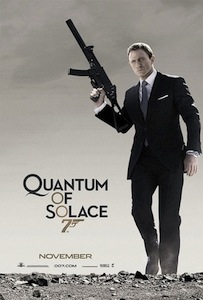
Quantum of SolaceQuantum of Solace isn’t as good as Casino Royale; though I should immediately qualify that statement by saying that the previous Bond movie is not only one of my favourites of the series, but also one of the best action-thrillers ever made. It would’ve been some feat indeed for QoS to top it.

As it is, director Marc Forster doesn’t really try. Casino Royale was about a poker game; QoS is about bringing down a significant player in a worldwide Secret Evil Organisation — but it’s the former that’s more epic. Bond rattles around the world, from action sequence to action sequence, at a rate of knots. There’s a sense that Forster, who has never made an action film before and was initially reluctant to take this one on, has treated this as the time he tried an Action/Spy Movie and so thrown everything at it. There’s a car chase, a bike chase, a roof-top chase, a foot chase, a plane chase/fight, gunfights, fist fights, knife fights, sneaking around, going in all guns blazing, betrayals, reversals, having to be a maverick agent because Bond’s right while his superiors refuse to trust him… And all this squeezed into the shortest Bond film yet made.

In truth, the running time isn’t really a problem. The film doesn’t come up for air until quite far in, but if one pays attention (and can remember Casino Royale — this really is a direct sequel) the plot can be followed well enough and you’re not likely to get bored. It’s a tad ironic that Forster was chosen because of his Oscar-nominated ability to do Character Drama and the like, and yet has wound up crafting such a relentlessly action-packed entry in the series. QoS is perhaps at its best when getting stuck into the meatier scenes between Bond and M, or Bond and Camille, or Bond and a returning character from the last film. The action scenes occasionally had too much of a Bourne vibe for my taste. I love the Bourne films, but the Bond films are different, and I don’t want a handheld camera shoved so close you can barely see anything, and even when you can the next cut is only 0.4 seconds away.

There are other flaws. I don’t mind Bond being light on humour, and it does at least mean when the jokes come they’re all the more welcome, but I think Casino Royale‘s torture scene exemplified the overall mix the rebooted Bond should aim at: dark, gritty, nasty, real… but the scene also got the biggest laughs of any part when I saw it at the cinema. Bond doesn’t need the campness of Moore or Brosnan, or even as much humour as Connery injected, but I think it could do with more than Dalton had, and The Craig Era has now reached that level of humour-dearth. On the flipside of that argument, this is a darker story all round… but I’ll have to save the end of that argument for my spoilery review at a later date.

My other main complaint is probably the title sequence. I like the song, personally, but MK12’s titles are bland, generic, and too colourful for either the film or the song. They’d look fine on a tie-in video game (in fact, they do — I saw it on YouTube), but in the film itself I almost began to wonder what they were thinking. I may have some residual distaste for the dropping of Daniel Kleinman here — certainly, I haven’t seen anyone else write about them; but then Proper Critics tend to have other things on their mind — especially after he created one of the best main titles ever for Casino Royale, but I sincerely hope they bring him back for the next film.

As for the next film, I think QoS will leave some with a feeling of, “well that’s that out of the way — next!” In truth, it’s not that bad. It suffers by following the exceptional quality of Casino Royale, and also being so tied to the former’s story, but despite that pulls a well-above-average action-thriller out of the bag. I expect it will continue to receive a mixed response from critics and audiences, which is more due to people’s expectations than the film’s inherent quality, but that’s the way things go. As far as I’m concerned, Bond’s back, and that’s always a good thing.

A fuller review of Quantum of Solace — I have a lot more to say! — will appear as #73 in the next few weeks, following my reviews of After the Sunset, Stay, The Diving Bell and the Butterfly, Hitman, St. Trinian’s, The Invasion, and Casino Royale.

Inside-Out (1999)

2008 #66a
Tom & Charles Guard | 7 mins | DVD | 12

This charming little short stars Simon McBurney as a hapless market researcher on a busy London street, failing to get a single passerby to complete his survey — perhaps the film’s greatest achievement is making a market researcher sympathetic. Anyway, he’s quietly observed by a woman, played by Lena Headey (yup, Mrs. Leonidas and the new Sarah Connor [and now Cersei Lannister, of course]), who’s dressing the window of a clothing/department store on the street. She notices his failed attempts, which amuse her; he notices her laughing, and begins to muck around to entertain her.

It’s a simple premise, but one that’s executed with comedic flair and a surprising amount of emotion. The music and lack of dialogue evoke an old-ish French mime comedy, making a nice contrast with the modern-day London setting, but it’s the relationship that silently develops between the two characters that provides the heart around the humour. And the ending, as carefully constructed as any moment of humour in the short, is painfully heartbreaking.

However many times you might want to re-watch this — and I think you would want to — you’ll always wish for the same outcome, and always be let down. It’s a sweet kind of pain and longing that, in spite of that French style, is very British.

4 out of 5

This short is available on the Cinema16: British Short Films DVD, and online free at Total Short Films or YouTube.

Shoot ‘Em Up (2007)

2008 #66
Michael Davis | 83 mins | DVD | 18 / R

Shoot Em UpShoot ‘Em Up is the film Wanted wants to be. It’s packed to bursting with utterly ludicrous — but, consequently, ludicrously cool — action sequences. It’s fast-paced, witty, and endlessly inventive. As the action genre goes, this is pure entertainment.

The plot, such as it is, is borderline nonsensical — some craziness to do with a baby factory (which is, believe it or not, the morally acceptable part), political coups, and goodness knows what else. If you want to follow it you might need to engage your brain at times, but so long as you can tell who’s bad and who’s good — and you can, easily — then all is well. This might sound like a criticism, but by pushing the implausibility of an action-thriller plot as far as it can, the story becomes another element in the whole film’s spoof-homage aesthetic. Everyone involved is clearly having fun with this, though none more so than Paul Giamatti. His wonderful villain is cunningly evil but constantly interrupted by domestic phonecalls from his beloved wife. Luckily this enjoyment is conveyed to the viewer, lending the one-liners and sundry other gags more humour than they might otherwise deserve.

Some quarters have criticised Shoot ‘Em Up for being cheesy and clichéd. My favourites are those that label it “so daft at least I enjoyed it on that level”. I’m sure these people feel very clever for spotting all the poor stereotypes of an action flick, from the unbelievable plot to the literally impossible feats of action. Unfortunately for those oh-so-clever people, they’ve entirely missed the point — even those daft-lovers. The clue’s in the title, a simple statement of genre that blatantly acknowledges the film’s aim in a way that genuine crap-because-they’re-crap action flicks don’t. Shoot ‘Em Up is an homage and spoof of its genre, pushing everything to the limit. If it took itself seriously the above might be valid criticisms, but it’s meant to be this way.

And if you know that, it works, navigating a successful path between spoof and homage — it’s not Action Movie, a film which must be inevitable by this point — and packed with inventive stunts and shoot outs. For every impressively-inventive-but-physically-implausible stunt in Wanted, this produces half a dozen. And they weren’t all in the trailer either. Silly, fun, and easily better than that over-promoted comic adaptation, in these respects Shoot ‘Em Up deserves much wider recognition.

4 out of 5