
manlly Wilder | 101 mins | Blu-ray | 1.37:1 | USA / English | PG
 Directed by the inestimable Billy Wilder, winner of the Grand Prix (forerunner to the Palme d’Or) at the first Cannes, winner of the Best Picture Oscar in 1946, and also Best Actor, Director, and Screenplay, it’s a wonder that The Lost Weekend isn’t better known. I don’t think I’d even heard of it until Masters of Cinema announced their Blu-ray release back in January 2012, and comments I’ve seen around the internet express a similar experience of prior unawareness. Thank goodness for MoC, then, because this isn’t a film that deserves to be forgotten.
Adapted from the novel by Charles R. Jackson, the entire film takes place across one particularly eventful weekend (well, that plus flashbacks), in which should-be-recovering alcoholic Don Birnam (Ray Milland) tries desperately to fall back off the wagon.
The plot may smack of a worthy social drama (perhaps why it’s been forgotten), but most every sequence is loaded with more tension than a thriller. This is Wilder’s skill as both co-writer and director: he gets us on Birnam’s side early on, so that we follow him through the almost-self-induced hell that follows; and he keeps us on the edge of our seat, as desperate for it to work out as Birnam himself is. But, right from the very first scene, hardly a one of his plans does work out; 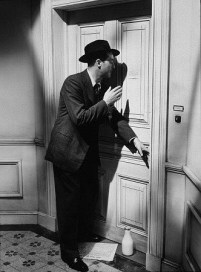 all of them thwarted at the last possible moment, when victory seems assured. The film isn’t preachy, but if it does teach us a lesson then this is how it does it.
Wilder’s direction is excellent throughout, with innumerable striking compositions, perfectly paced scenes, and the aforementioned tension ratcheted up to maximum. There are other very good directors who would’ve made a hash of a film like this — made one that screams “meaningful movie about An Issue” — but the way Wilder handles affairs means it’s more than that. It explores its issue, it exposes us to the facets of it so that we might learn something, but it does so under the auspices of a drama about a man we come to care about. It’s not an “alcohol is bad” sermon, it’s a “can this man survive it?” thriller.
Equally, the flashback structure could scupper the film, but instead it raises it, with two of the best sequences coming here. There’s the exceptional La Traviata scene — it’s very obviously a bit of Good Direction, but while you could call it showy, it works — and the scene where Wick tries to cover for his brother to his new girl, which lends weight and backstory to the opening scene where he seems ready to (and, indeed, does) callously abandon him.
 Milland is astounding. The film rides on him and he really carries it. It’s easy to play a comic drunk, but Milland doesn’t sink to that. Indeed he doesn’t do one type of drunk at all, swaying back and forth across various levels of inebriation as required. I often find films of this era contain performances we assess as great, but if you put them in a film today no one would buy it; they’d find it stagey and fake. Milland’s transcends that — it fits the era, but I wouldn’t be surprised to find it would play just as potently today. I think it’s fair to say that Milland is not widely known today, but with every film of his I become more convinced that history has been unkind.
Also worthy of praise is Frank Faylen as Bim. In his featurette on the MoC release, Alex Cox says he’s the second best character in the film, and he’s probably right. Cox notes that at least one review at the time really laid in to Bim, painting him as an evil sadist. Today, I don’t think we have that perspective at all. Bim tells Birnam the truth, painting his illness like it really is. Whereas his other friends and relations all try to do their best for him, but wind up enabling his addiction to continue, Bim’s experience and detachedness means he can be blunt and truthful. Birnam may not realise the good it’s done him, but good it does ultimately do.
 There’s also able support from Howard Da Silva as barman Nat and Doris Dowling as Gloria (is she a whore of some kind? Just an escort? A bar-crawler? Did I miss something?), whose slang is oddly infectious. No offence to Jane Wyman, but her lovelorn-but-strong girlfriend character only seems to really come alive in the closing minutes, when she considers abandoning Birnam to his fate.
The Oscar-nominated score by Miklós Rózsa at first seems highly unusual, a warbling horror movie score, but it quickly comes to fit very well, and not just the nightmarish daydream sequence near the film’s climax. The movie was also nominated for John F. Seitz’s cinematography and Doane Harrison’s editing. They lost to The Picture of Dorian Gray and National Velvet respectively, neither of which I’ve seen, but they must have something special to outclass the work on show here.
I think the same can be said of the whole film. Issue-focused movies from the past are often badly dated, even if we can still admire the filmmaking techniques involved. That’s not their fault — it’s the cultural climate of the time, or the shifts in understanding that have come since. I’ll admit I know next to nothing about alcoholism so can’t comment definitively on the film’s enduring accuracy, 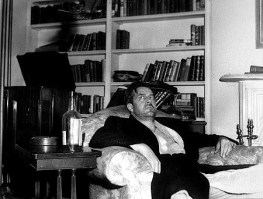 but from what I do know of other conditions of addiction and mental health, this feels as if it’s still thoroughly relevant.
Even if you don’t care about The Issue, there’s an engrossing, thrilling drama for everyone to enjoy. If The Lost Weekend is indeed forgotten, then it merits widespread rediscovery.

That concludes my reviews from 2012.
 Bruce Willis stars as a down-on-his-luck PI who stumbles into a sport/politics conspiracy in this early-’90s action-thriller from screenwriter Shane Black (
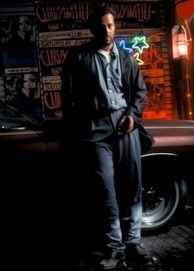 — pitch black frames punctuated by glowing coloured lights. On the whole, it looks gorgeous.
 2001’s car racing actioner
 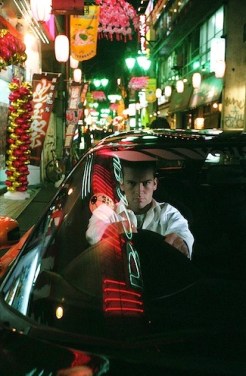 If I sound dismissive, it’s slightly affected: Tokyo Drift is surprisingly decent. Surprisingly decent for a Fast and Furious film, that is. In
 Quentin Tarantino made his name in the ’90s with a series of dialogue-heavy gangster thrillers that provoked a storm of imitators. Since the turn of the millennium, however, he’s contented himself with a series of extravagant hyper-cinephilic genre homage/parodies. After tackling Japanese action movies in
  It’s fair to say Django Unchained sprawls. But, unlike the chapterised character-flitting antics of Kill Bill and Inglourious Basterds, it has a straight throughline it follows from beginning to end, with only a few asides. In terms of length and scope, it’s perhaps not too much of a reach to evoke
  Or how about those action sequences? Months of work training real horses to do things never before seen pays off (and Tarantino proudly displays the “no animals were harmed” notice right at the top of the credits), while the blood-drenched Candyland shoot-out is arguably one of the best pure action scenes in years. Those are amongst myriad other sequences, from the small and transitory to the epic and vital.
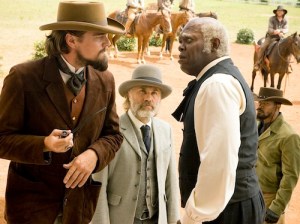 Still, best served — and, perhaps, more deserving of the Supporting Actor nod — are villainous duo Leonardo DiCaprio and Samuel L. Jackson. For starters, has Leo ever played a villain before? He’s on stonking form here as Southern gent Monsieur Candie (who can’t speak French), a sinisterly welcoming fellow with a dark side that’s on constant display. He’s all smiles and all lingering threat and menace. Indeed, scenes are often at their most tense when he’s at his nicest. I think there’s an argument for him to go down as one of the great screen villains — he even has the obligatory cool dispatch. “I couldn’t resist” indeed.
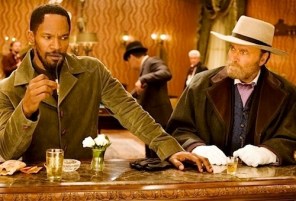 It does make you wonder if some of these people had bigger roles that got cut… or maybe there are just
 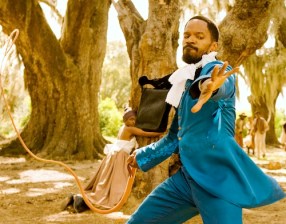 Tosh and piffle, I say. One of the best ways to skewer many an evil institution is to make them a laughing-stock, to take the piss out of them, and that’s exactly what Tarantino is doing. These aren’t likeable, funny people who are Klan members; they’re incompetent fools because they’re Klan members. The resulting scene is hilarious and deservedly one of the movie’s most memorable moments.
 After
After 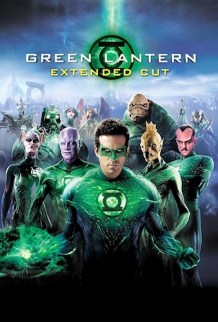 “Hype” has to be one of the biggest factors in how we view films these days. Technically it’s defined as “extravagant or intensive publicity”, I suppose thereby meaning something to “positive expectation”, but I think it also works the other way: if you’ve heard nothing but awful things about a film, its weakness has been ‘hyped’. It’s this latter point that applies to Green Lantern, which has an almost insurmountable degree of negative expectation attached. To summarise the headline points, it’s got a woeful rating of
 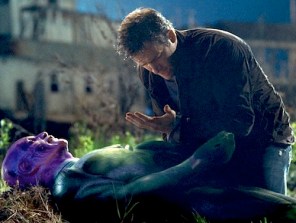 But I digress. Cocky jocky Hal is whisked off to the other side of the galaxy to learn how to be a Hero and use his ‘magic’ ring, which can conjure stuff up, then returns to Earth to save it from some menace(s). As superhero origin stories go, at least it’s got a couple of differences.
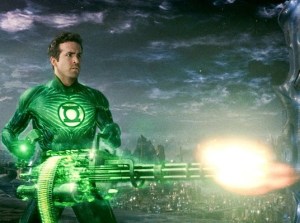 There are positives. The action sequences are good, which is a definite plus in this kind of film. The inventiveness with what the ring can do is fun. There’s a lack of relation to the sketchily-drawn characters that stands in the way of us truly engaging with them, and there’s a certain brevity and lack of scale that undersells the alleged threat to Earth (it’s a giant evil space-cloud that can barely cover a few city blocks, let alone the entire planet) — but, that aside, they’re entertaining enough. That said, much as the film pulls its punches with characterisation and threat, so it does with awe and spectacle. The Lanterns’ planet Oa doesn’t have the same impact as Asgard in
  Indeed, I’d say the Extended Cut doesn’t go far enough, with some of the disc’s deleted scenes meriting inclusion. However, the main one occurs on Oa, meaning an effects-heavy scene that hasn’t had CG work done or all the voices recorded, so couldn’t just be dropped back into the finished film as-is. I imagine that’s why it wasn’t. That said, even if they’d done such work, those scenes are minor points, not game-changers.
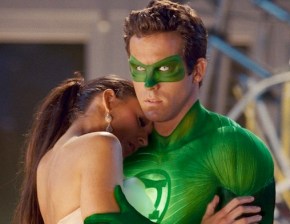 Still, I think there’s a better film lurking in Green Lantern, and it’s a shame it didn’t get the screenwriter(s) or director(s) required to bring it out. It’s even more of a shame that worse films than this have received a kinder critical consensus or huge box office. That leaves some suit feeling vindicated and churning out the same rubbish again, whereas with a bit more effort Green Lantern 2 could’ve been worthwhile.
 The fourth Harry Potter film is the pivot around which the series revolves, in oh so many ways. Most obviously, it’s book 4 of 7 — the halfway point. It’s also where the books switch from short ‘children’s novel’ lengths to the huge tomes they eventually became. More importantly, it’s the instalment on which the overarching plot of the entire series hangs. Although each previous entry in the Potter canon contributed something to the mythology (even if sometimes its significance wouldn’t become apparent until much later), they’re still viewable as discrete adventures. So too is Goblet of Fire, for the most part — the exception being its final act, which kicks off the story that will consume the rest of the series.
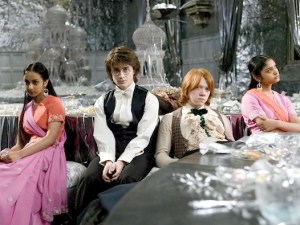 It makes sense: at this point the series was moving beyond your stock franchise length of “trilogy” and into less frequently charted waters, amid speculation that the leads would be recast. With Goblet of Fire being the last point you could reasonably pull that off, I imagine it paid to emphasise that these were the same kids — that we see a cast age in more-or-less real time throughout their childhood, including many small supporting roles as well as the leads, is one of the Potter films’ more unique highlights.
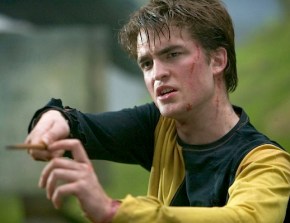 I can’t remember if Diggory’s meant to be a nice guy or an irritating jock, but here he’s played by Robert Pattinson, proving it’s not only his involvement with
 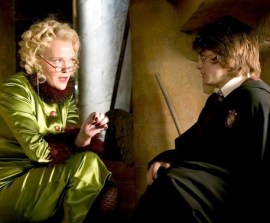 but her Quick-Quotes Quill — which, essentially, just makes stuff up — is present and correct. The next tale,
 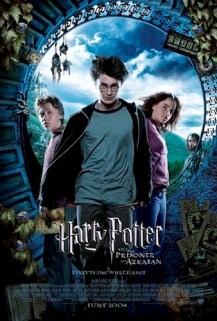 Prisoner of Azkaban marks a significant turning point for the Harry Potter film series. Viewed now, it’s easy to see it as just Episode 3 of 8; a saga still getting underway. At the time, coming off the back of two incredibly successful films, it felt like a grand shake-up of an established formula.
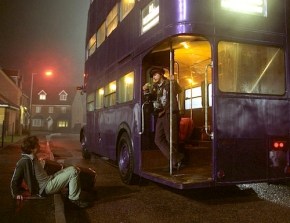 Cuarón and screenwriter Steve Kloves (who would pen every Potter film bar
 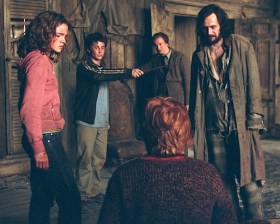 The film series doesn’t treat either of them particularly well compared to the books, but then supporting characters and subplots are the first things to go (quite rightly).
  The first film from Seth MacFarlane, creator of
 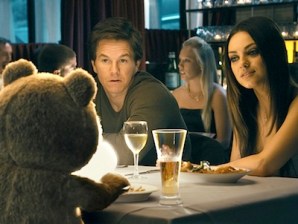 but then they’ve been known to get sidetracked into some smutty laughs on occasion, so that may not be the best example.
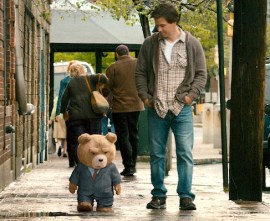 Wahlberg performances swing between excellent (
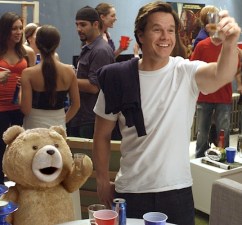 Ted is pretty much a walking talking definition of “not for everyone” — which is fine. If you like Family Guy, it’s definitely one to try (LOVEFiLM has plenty of “I love Family Guy but hated this grrr!” reviews too); if you dislike Family Guy, probably one to avoid; if you’ve never seen Family Guy, what can I say, that’s the standard reviewer’s barometer here. It is rude, is crude, and is mostly very funny. But, whatever you decide, don’t leave the kids with the movie about the talking teddy.
 100Films.co.uk