
Zack Snyder | 128 mins | Blu-ray | 2.40:1 | USA / English | 12 / R
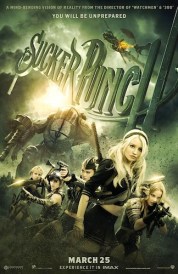 Zack Snyder’s fifth venture in the director’s chair is his first not to be based on someone else’s pre-existing material; or, to put it another way, the first wholly original story from the director of 300 and Watchmen. On the strength of its critical and box office reception, he may be relegated from the chance of doing such original work in future (his next effort, as I’m sure you know, will be a reboot of Superman).
I read a good summary of the critical reaction to Sucker Punch somewhere: that critics (and viewers) split into two types, one who thinks it’s a shallow story-free brain-dead over-indulged video game of a movie, the other who think it has hidden depths and themes worthy of exploration. And both sides are likely to call the other stupid, one for not being bright enough to spot the subtext(s), the other for bothering to read stuff that isn’t there. I side with the group that thinks there’s something more to the film, which, as the minority, I guess makes this review a defence.
I’m going to start by discussing the difference between the theatrical cut and this Extended Cut, because for once I think it makes a notable difference. Indeed, why this isn’t called the Director’s Cut is unclear: Snyder reportedly had to submit the film to the MPAA five times before they were satisfied to give it a PG-13; the R-rated Extended Cut restores all that, so surely it’s the Director’s Preferred Version rather than Version With Extra Stuff Bunged In? Some of it is significant in terms of clarifying the film’s story, themes and real-world/dream-world juxtapositions. 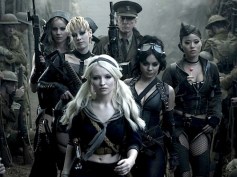 If you hated the film in its theatrically released form they’d likely struggle to change your mind, but for those seeking extra clarity they may help.
From what I’ve read, there are lots of changes here and there, but it strikes me there are four major omissions or additions:
- An extended Orc fight in the fantasy/dragon world. Fine.
- The dance number to Love is a Drug. I’d wondered why it got replayed over the end credits! Presumably it was cut because it was a bit too much like a musical, which is an understandable (people don’t like musicals allegedly) but disappointing decision. It adds to the film though, not just in terms of being Something Different, but also showing us what the club/brothel is like during working hours. It’s a great sequence.
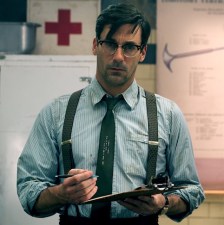
- A climactic scene with Jon Hamm’s High Roller and Babydoll. I can only imagine how baffling it was for cinema audiences to see the Mad Men star turn up for one half-arsed scene (namely the scene which now follows the High Roller one, which had to be gutted to make sense in the theatrical version). It’s a tense, uncomfortable, challenging scene that adds a lot to chew over — especially in context of:
- The smallest cut in length, but perhaps the most significant: when the Priest first brings Babydoll to the club, it’s discussed that she’s there to sell her virginity to the High Roller. Cut (like everything else) to get a PG-13 and because of the connection to that High Roller scene, it might sound like a minor omission, but restoring it clarifies both character motivation and some of the film’s themes, while juxtaposing the real world and dream world with, respectively, lobotomy and loss of virginity.
This is where the film is better than some would give it credit for: it’s not just a muddled excuse for some action sequences, it’s a dream-logic battle by a girl poised to lose her mind… or, maybe, already has. While her stepfather is taking Babydoll to the asylum for nefarious purposes, there’s little doubt in my mind that she’s already suffering serious mental health problems —  PTSD, quite probably, seeing as she accidentally murdered the little sister she was trying to protect after almost being raped by the evil stepfather her dead mother has left them to. If you know anything of the crazy, fractured dreams/hallucinations someone with a damaged mind can have, and apply that to this film, it begins to make more sense as a story.
(Major spoilers in the next two paragraphs.) That doesn’t mean it isn’t a problematic depiction of this. Is the ending really saying a lobotomy is a great solution to mental health problems? It allows Babydoll to escape her guilt and remorse for killing her sister, but that’s hardly empowering — giving in to it is, thematically, tantamount to suicide. This is supposedly offset by the escape of total-innocent Sweetpea, which wouldn’t have happened without Babydoll, but that seems scant consolation. And Babydoll’s stepfather escapes unpunished, apparently! Oh dear.
That it was Sweetpea’s story all along is also an interesting conceit. Snyder does contribute to this — Abbie Cornish gives the opening voiceover, we first see Sweetpea in a stage-set like the one Babydoll was on at the film’s open, and when we enter the (first) dream world it’s Sweetpea rather than Babydoll who emerges from the rotating transition shot. But is that enough? Because we’re undoubtedly in Babydoll’s head throughout the film, the only exceptions being the real-world bookends in which we only follow her. (We do see the result of Sweetpea’s escape, but the visual style makes it clear it’s Babydoll’s imagining of what happened.) 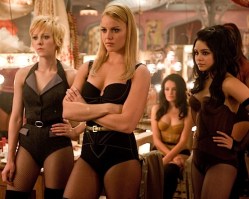 Maybe this is Snyder’s ultimate aim: it’s someone’s story told from the perspective of a (particularly interesting) supporting character. A little like the end of Super, actually.
This isn’t the end of Sucker Punch’s thematic implications though. Some say it’s a deeply misogynistic film dressed up as a female empowerment movie — look at the hyper-sexy outfits, the ultra-action, the fact it’s set in a brothel… Others probably argue it’s about female empowerment despite all that, but one of the more convincing arguments I’ve read says it’s about female oppression: these characters think they’re independent and fending for/defending themselves, but everywhere they turn there’s a man in control. Even in the dreams-within-a-dream where the action sequences take place, the girls are given orders by a male commander and they follow them unquestioningly. I suppose it’s all down to your personal perspective whether you see this as evidence of misogyny or of a deeper, more thoughtful approach. Let’s be kind and see the latter, I think — it makes the film more interesting, more thought-provoking, and therefore more enjoyable. And enjoyable is good — if you’re setting out to hate a film for the sake of hating it then… oh, then just sod off.*

A far wiser man than I once theorised that any work of art, once completed and released, belongs to the viewing public rather than the artist.** (This is a lesson I feel someone needs to put to George Lucas.) Part of what this means is, if one reads something into the work — a thematic discourse, a moral message, whatever — then it is there, whether the author intended it or not. And if the author intended a certain message and you get the opposite, well, that’s right too (heck, even if you subscribe to the notion the work still belongs to the artist and only their intentions are valid, clearly they mucked up their delivery if you got the opposite). So, in other words, it doesn’t matter whether Snyder wrote and directed his film to ponder or convey certain points or ideas, or whether he just set out to create something that was “effin’ cool maaan, with, like, action and hot chicks and stuff, dude” — what I (and other critics) have read into it is still valid. So there.
 Like the rest of the film, the soundtrack is divisive. Some think it contains weak re-workings of excellent classic tracks, others that it contains interesting and appropriate re-workings of excellent classic tracks. I must again side with the latter. For instance, there’s a Queen/rap mash-up that I actually quite liked, and this is from someone who thinks the Wyclef Jean bastardisation of Another One Bites the Dust on Greatest Hits III is an offensive waste of disc space. The standout is probably the opening sequence, five minutes of dialogue-free brilliance with near-perfect visual storytelling (albeit aided by familiar imagery of abuse), set to a haunting rendition of Sweet Dreams (darkly, thematically apt for the entire film) sung by star Emily Browning herself.
Really, Sucker Punch is a musical. No, most of it isn’t sung, but every action sequence is accompanied by a cover song specially designed to fit with it, many (or all) of which in some way comment on or add to what’s happening. Not a traditional musical by any means, obviously, but the way it’s constructed around these musical/action interludes belies the truth.
Said action sequences are all inventive, but they began to feel a bit samey to me. There’s just too many, and though they should feel drastically different thanks to the variety of settings, Snyder’s style links them too well: they’re all shot in the same brown/sepia hue and our heroes all use current-day weapons and vehicles, 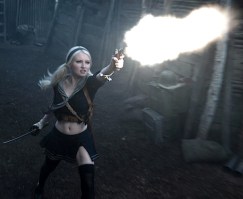 blurring what should be a clear difference between World War I with steam-powered Germans, an Orc-riddled fantasy castle, and a robot-guarded train on a distant planet. They sound incredibly distinct on paper, but on screen it’s confusing whether they’re meant to be the same world or not. The last of these, a single-shot running gun battle along a train, should be a balletic triumph, but by this point the action’s beginning to wear. I love an action film, and especially a creatively-rendered sequence, and Sucker Punch does have a ton of originality, but there’s perhaps too much of an onslaught. Maybe it’s less battering on later viewings — another reason they cut back on it in the theatrical version, perhaps.
All of the dream levels (we go at least two deep) invite comparisons to Inception, though they’re radically different films. I’m sure there’s an argument to be made along the lines of Inception being a product of a very organised, methodical mind — all steel city blocks and precise Escher paintings made real — while Sucker Punch comes from a crazed creative place — a random grab-bag of ideas and concepts. For all those who complained that Inception’s real-world-influenced dreamscape lacked the creativity and madness of real dreams, Sucker Punch should be a marvellous experience.
 Part of me wonders if, had I seen Sucker Punch in cinemas, would I feel the same way I do now? Would those big omissions have obscured the thematic depth I believe is there? To put it another way, how much do the changes really add? You or I will never know for certain. But I do think Sucker Punch has been underrated. It’s not the masterpiece I hoped it might turn out to be when I first began to notice the themes I think Snyder was (consciously or not) tapping in to, but I do think it’s a lot better and more interesting than most gave it credit for.

* This is not the same as disliking a film that merits disliking. But that’s a whole other discussion. ^
** The man in question where I encountered this theory was Russell T Davies, writing in his and Benjamin Cook’s book Doctor Who: The Writer’s Tale. A completely unrelated article that I just happened to stumble across later reminded me that credit for the concept “that once a work of art exists, it no longer matters what the author intended” more properly goes to Roland Barthes. ^
 It’s quite understandable if you haven’t heard of Browncoats: Redemption (well, other than for
  The characters are, thankfully, not carbon copies of Firefly’s cast — some effort has clearly been made to differentiate the line-up, and that goes beyond inverting most of the genders. They’re surely cut from the same cloth though, but that’s understandable: this isn’t trying to be radical with Whedon’s ‘verse, it’s trying to emulate it for the fans, and the fans like what they’ve already seen. Ironically, despite being the most obviously gender-swapped, it’s Redemption’s female captain who’s most like her Serenity counterpart: Laura is, to be blunt, Mal with breasts. Her backstory is at least completely different, but the end result — the character we meet in the film — is more or less the same. When your leads are too similar it can override how different the rest of the cast may be.
 The rest of Browncoats’s direction is a typical fan film minefield. Dougherty’s work is awkwardly flat: it’s all master shots and few close-ups; some sets are shot from the same two angles (and no more) in every scene; it ignores basic rules, like the 180 degree line; the camera is handheld or mounted indiscriminately; it’s loosely framed and poorly lit. And it’s loosely edited too, with some bits allowed to run indulgently long. There may be some places where it’s not so bad, but generally this is the work of someone who knows how to point a camera and press record, rather than direct.
 I’ve seen many people online flat-out slag Browncoats off, which is patently unfair. Maybe it’s a generational thing: having been a
  If I scored films for effort, or for heart-in-the-right-place-ness, then this would be an easy 5/5. I just hope no one involved is hoping they can launch a career in ‘real’ film or TV off the back of it, because it doesn’t make that grade. (They’re trying the same thing again, at least, this time with an original zombie movie (because there aren’t enough of those) called
 No one had high hopes for
  It still cost $250m, mind, and the fact that’s what’s considered a cutback arguably shows.
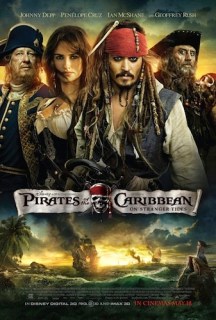
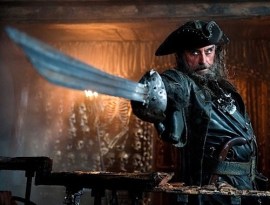
 The love story between a missionary and a mermaid barely factors. Word was this pair would be the series’ new Orlando Bloom and Keira Knightley, but whereas Elizabeth Swann and Will Turner were central to the plot of all the previous films (appearing before even Captain Jack in the first, if I recall), these two turn up late in the day and never have a chance to go anywhere. There’s also a surfeit of villains, meaning they either barely appear (the Spanish) or aren’t given close to enough screen time (Ian McShane’s Blackbeard). Every introduction is rushed, every subplot underdeveloped, every ending unsatisfactory. There’s too much, even for a movie that still runs over two hours.
 (much-heralded work like
 The second directorial outing from BAFTA-winning Brit Duncan Jones (after
  because Source Code is hardly groundbreaking. It’s certainly a solid, dual-pronged, science-fiction mystery — dual-pronged because not only is Stevens working to find the bomber, but also fighting amnesia to discover what the source code is and how he wound up there — but not an especially deep or complex work. There’s nothing wrong with something being little more than an exciting, engrossing thriller, it’s just not revelatory.
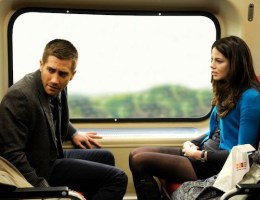 The other side of the plot is not only where the heart is, but also where the real twists and mysteries lie — I guessed the bomber the first time I saw the character; even if you don’t, it ultimately matters little. Vital to the finale are the subplots like Stevens’ relationship with his father and his growing affection for the passenger his alter ego was travelling with — but who he can’t save, of course, because the source code isn’t time travel.
 Did he create a new parallel world every time he entered the source code, or only the last time? I’m not sure that’s relevant. This is, though: at the end, he seems to remain in Sean’s body. So if he’s in a parallel world, he’s just stolen another man’s life? And Stevens — at least, the Stevens of that reality — is still lying, mutilated, half dead, in some government research facility? Hardly a cheery resolution.
 Still, problems aside, Source Code remains an exciting, taut, puzzling sci-fi thriller. On a train — there’s a whole long line of movies and connections to be explored there. Many reviews have noted the Hitchcock connection and I’m sure that’s an interesting route to look down, so maybe there is a bit more to Source Code after all… but even if there isn’t, it’s a fun ride.
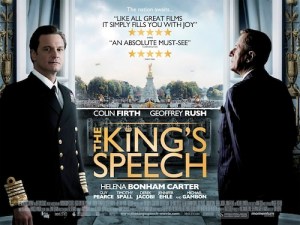 Britain seems to be having a grand time of it at the Oscars of late — following
  And if the authors of the book missed out on an on-screen credit, at least they’ve had plenty of tie-in promotion (including a featurette on the Blu-ray).
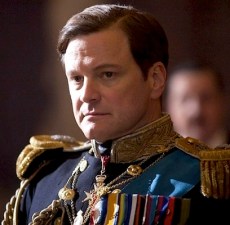 but Firth presents a much more convincing stammerer than you usually see (I have this on good authority from someone who knows several stammerers). It’s not just the Oscar bait element he nails though, as he also brings truth and gravitas to the rest of the role. It’s a complex part — he’s a man who has the throne unexpectedly thrust upon him, at a transitional time for the monarchy, as the nation is launched into one of its most difficult periods.
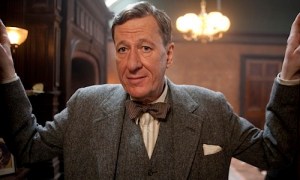 Guy Pearce as the youthful, playboy-ish David / King Edward VIII; Timothy Spall doing a decent Churchill impersonation, which sparks one nice moment just before the titular speech; plus
 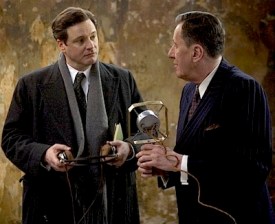 It looks odd, and to be honest I’m struggling to place my finger on what exactly is odd about it, but it’s slightly off-normal, slightly stylised, and I quite like it… but considering Momentum seem to have ballsed up the transfer to at least some degree, I’m not sure how much the oddness is a choice of Hooper and DoP Danny Cohen and how much a dodgy transfer/compression. Screen-grabs of the US release (which is at least 1080p, but not wholly praised in other areas, it seems) don’t help much. But as I said, I’m no real expert on Blu-ray quality, so don’t take my word as gospel by any means.
 Catfish is a documentary (probably — we’ll come to that) in which 20-something Nev falls in love with a girl somewhere else in America over the internet. He and his friends become suspicious that she’s not who she claims and set off to find out The Truth.
 Before I get spoilersome, then, let me say this: you will probably guess where it’s going. Even if you’ve not had it in some way revealed (however little of it) before you watch, early scenes will lead to the obvious conclusion: why am I being shown this if it doesn’t go somewhere? And what’s the obvious place it’s going to go? I think most viewers must guess. But I think many — probably even most — will not guess precisely where it ends up; the exact nature of the truth it finds. So this is not as much of a Thriller as it’s been sold in some quarters. It has suspense, certainly, and it has mysteries that have answers… but there’s not some dark secret at the heart of it all; instead, there’s a painful emotional situation. Already I’m saying too much.
 and/or satire, I still think most people fundamentally believe what they see in a documentary (or they read in a newspaper) to be the truth.
 The allegation that it can’t be real because they happened to film everything that happened is nonsense.
 (it’s still on track as the best film I’ve seen in 2011), Catfish probably has more to say about the actual impact of Facebook on our lives than Fincher/Sorkin’s biopic does.
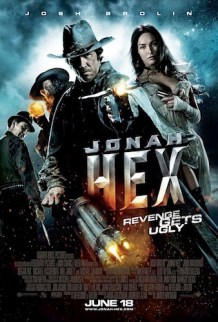 Jonah Hex is not a good film. Let’s just establish that, before I start being nice about it.
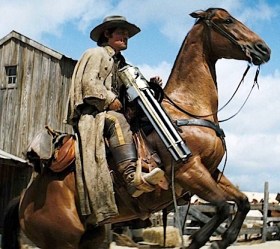 Much of the film rattles on in this way. And rattle it does: 73 minutes before credits. As blockbuster running times spiral out of control, such brevity is almost welcome. It doesn’t feel exceptionally short, mind, except for when the plot occasionally jumps forward.
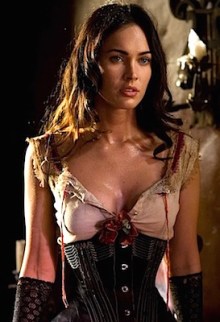 — usually improbably — or generally be a female. By “female” I mean “cleavage delivery device”. Considering her acting ability, her lack of presence is no real shame.
 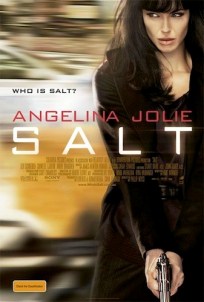 Angelina Jolie takes on a role originally earmarked for Tom Cruise in this Bourne-ish spy thriller from screenwriter Kurt Wimmer (
 This is Salt’s mystery, and this is one of its strong points. The plot developments are well-paced throughout, developing and shifting our expectations rather than stretching it all for a glut of final act reveals. In this regard it goes places you might not expect from a mainstream Hollywood thriller. For starters, you expect the funeral-set assassination to eventually be the film’s climax, no doubt revealing our heroine isn’t a Russian spy as she unmasks the real killer. But that occurs at the halfway point, spinning the film off in new directions. To say more would spoil one of the film’s strongest elements: that, as I said, it has twists and follows storylines you wouldn’t expect in a Hollywood summer blockbuster.
 The three cuts, then, are: Theatrical (100 minutes — this was trimmed for the UK to make 12A, but is apparently uncut on disc); Director’s Cut (the one I viewed, this is 4 minutes 5 seconds longer); and an Extended Cut (1 minute 5 seconds longer than the Theatrical). The latter is based on the Director’s Cut and I’ll come to it in a minute. The differences between the Theatrical and Director’s cuts are numerous, but mainly amount to some extra character beats (including more flashbacks to Salt’s childhood) and violence — more blood; seeing people get hit rather than just seeing Salt firing; the President is killed rather than just knocked out; plus a very different death for Salt’s husband (again, more on this in a moment). Plus there’s a voiceover ending too, which in my opinion sets up the sequel even more than the Theatrical version does, with a blatant cliffhanger and suggested plot direction. My regular comparison site
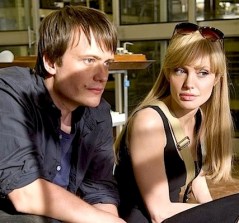 She has to control her emotions so as not to give herself away. In the other versions, however, she’s presented with him in a chamber and given a choice to save him — except trying to save him would give her away, so she’s forced to watch, blank-faced, as he slowly drowns. Salt sacrifices him for the greater good; he dies seeing her cold emotionless face. Ouch. By comparison, the theatrical cut’s blunt gunshot is much softer.
 if the filmmakers considered another option, now we can see it, and in cases like this choose our preference. Though it seems clear, by its inclusion in both the theatrical and director’s cuts, that Noyce preferred the instant-revenge option.
 is a decently dramatic way of drawing out and considering these issues. In my opinion, it works; at least, works well enough.
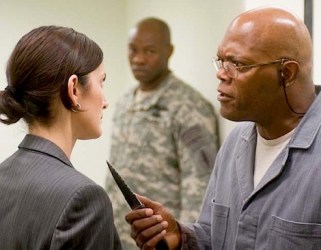 which I don’t think Unthinkable is — I think it argues both for and against torture. Perhaps if the viewer is firmly entrenched in one viewpoint then the film will seem to support it to a polemical level; or perhaps they’d read it the other way, and see it as a polemic against their viewpoint. I don’t know which, though, because I don’t think it comes down hard on either side.
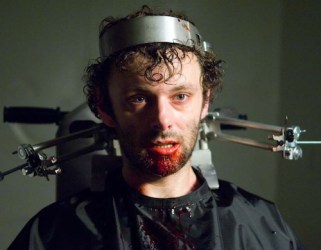 but Unthinkable is not a torture porn film. Yes, it contains torture, and some of it is shown in some degree of detail, but it does not depict it as brutally as it could, and it does not revel in it. This isn’t torture for the audience’s enjoyment, this is torture as a point for debate — “is it allowable to do this to another human being to get results?”, etc. Which brings us to:
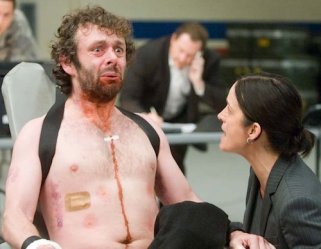 It’s much more important than simply answering a lingering question — it unequivocally presents the ultimate outcome of the characters’ actions. Like the rest of the film, it doesn’t seek to tell you whether this is right or wrong, but shows you where such decisions lead. Moralising is left up to the viewer. (Apologies if this is vague, but I don’t want to spoil it.)
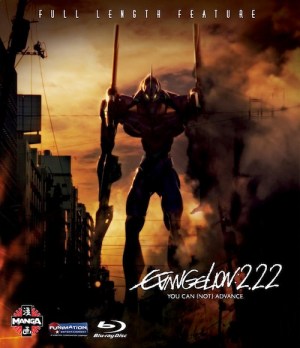 Just over a year since the
  For my money, the first 40 minutes or so of the film are (by and large) the best bits. It opens with a barnstorming action sequence, a great scene for newbies and fans alike as we’re introduced to Eva pilot Mari, who didn’t appear in the TV series. That she then disappears for most of the film, only to make a thoroughly mysterious return later, is one of those explanation-lacking flaws. I’m sure it won’t look so bad once the next two films provide us with answers. Well, I hope not.
 Then the gang take a trip to a scientific installation which is trying to preserve the oceans and their wildlife. It feels like animation shouldn’t be as effective for such a sequence as, say, the footage in a David Attenborough documentary, but nonetheless it feels extraordinary, in its own way. It also marks itself out with the interaction of the characters on a fun day out rather than their usual high-pressure monster-fighting world. And then it’s back to that world for another impressive three-on-one Angel attack.
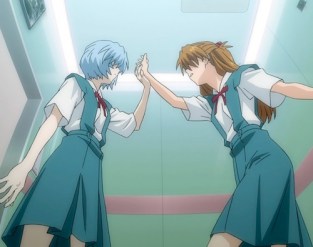 But it’s all building somewhere. For one, there’s another of the film’s best sequences — certainly, its most shocking, which readily earns the 15 certificate. I don’t want to spoil it for anyone yet to see the film, because it’s one of the plot points that differs from the TV series, but it involves the death of a main character in a brutal, deranged way. I say “death” — they pop up in the third film trailer that runs after the end credits, so there’s more to this yet…
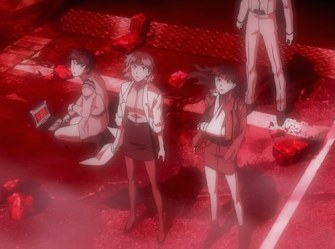 And then, after the end credits, there’s a brief scene that throws another spanner in the works! Double-cliffhanger-tastic… one might say…
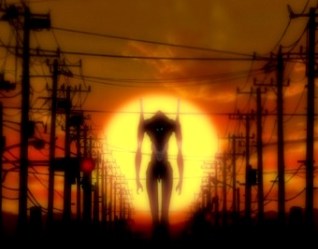 In short, if you’ve always liked Evangelion then you won’t be waiting for me to tell you this is a must-see reimagining; if
  100Films.co.uk