Battle Los Angeles (2011)

aka Battle: Los Angeles

2011 #86
Jonathan Liebesman | 116 mins | Blu-ray | 2.40:1 | USA / English | 12 / PG-13
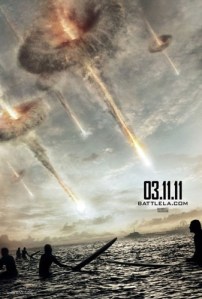
Battle Los AngelesBattle Los Angeles (on screen; Battle: Los Angeles on posters — c’mon, let’s have some consistency with punctuation! Punctuation matters) seemed to come in for a wall of criticism when it hit cinemas way back whenever. For my money, though, it wasn’t that bad.

Others have described it as “Independence Day meets Black Hawk Down”, and for once that formulaic “X meets Y” description is bang-on. Like ID4, there’s a worldwide alien invasion in progress by a superior species that dominates Earth’s forces pretty quickly. Unlike ID4 (and therefore more like Black Hawk Down) there’s no multiple perspectives or look at the command level; we just follow a small band of men on a very particular mission — head to a police station and extract civilians before the US Airforce bombs the area in three hours’ time — with only snatched glimpses of the wider conflict on news reports, Cloverfield style. It’s a different way of handling a military-focused big alien invasion movie, so that works.

For the most part, anyway. It’s thrown away at the end as our particular band of heroes wind up the only military presence left in LA and happen across the command & control centre of the enemy, promptly setting out to destroy it with laser-targeted missiles. Small scale “one force in a much larger battle” drama is exchanged for world-saving grandeur. Ah, America.

Somebody please think of the childrenThis kind of gung-ho militarism is laid on too thick. It seems fine for much of the film, but then as it heads into the second half and, especially, the third act, we have to suffer all manner of speeches and Emotional Moments that lack weight due to characterisation issues. The latter is badly handled for all kinds of reasons. All of the marines are entirely clichéd; so too are their story arcs; too much time is wasted trying to make us care about them — there are too many and they’re too shallowly drawn; things are worsened when a couple of civilians are added to the mix, who suffer from all the same problems… except they’re perhaps under- rather than over-developed. As we reach the third act, anything approaching plausible characterisation is jettisoned. Like the small-scale focus, what begins as naturalistic ends up with Big Speeches and all manner of Emotional Moments.

Where the film excels, however, is the other side of gung-ho militarism: action. I don’t hold with the criticism some levelled that it’s too reliant on ShakyCam, confusing the action to the point of incomprehensibility. Maybe that happened on the big screen, I couldn’t say, but while these aren’t the greatest or most clear sequences I’ve ever seen, they’re certainly not hard to follow. The film uses its gritty, handheld, Saving Private Ryan-borrowed style to good effect for much of its running time, Keep the home fires burningevoking the likes of the aforementioned as well as Black Hawk Down and The Hurt Locker in terms of conveyed realism. As I said, this is very effective for an alien invasion movie.
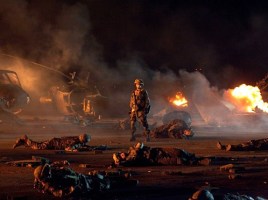
But, much like the early focus and characterisation, as things progress towards the climax this is slowly abandoned, showing a lack of the commitment to its world and story that Cloverfield or Monsters exhibited. There’s an increasing number of shots from the enemy’s perspective; the climax seems to abandon the earlier handheld style almost entirely for the sake of a grandstanding finale.

There is an even better film tucked away inside Battle Los Angeles. One brief dialogue scene discusses the similarities between the human soldiers and alien grunts, but the intriguing idea that they’re intelligent beings following orders just like us is sadly not built upon. There are obvious parallels with the invasions of Afghanistan and Iraq, but aside from the audience spotting shots that are reminiscent of news footage, the threads aren’t drawn out or commented on. Instead Battle LA does two things: military sycophancy, which is typically American and typically tiring or laughable (depending on your mood), and some stonkingly decent action sequences. The ending... and also the posterThey may take a little while to get to, but they’re relatively worth the wait.

What could have been a thought-provoking brain-switched-on commentary-on-the-world sci-fi film is instead a brain-switched-off gung-ho sci-fi action flick. I’ve seen better, I’ve seen worse, but treated as blokey weekend-evening entertainment this is fine.

3 out of 5

Centurion (2010)

2011 #82
Neil Marshall | 97 mins | Blu-ray | 2.35:1 | UK / English | 15 / R

Last week, as I’m sure you’re aware, I posted the top ten films I’d watched in 2011. Among them were three I’ve yet to post a review for… so what better way to begin finishing off my 2011 reviews than with those. So here’s the lowest, #9…

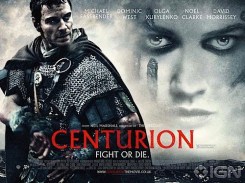
CenturionThe fourth feature from writer/director Neil Marshall (despite owning his first three on DVD, this BD rental is the first I’ve actually watched — story of my life) is a bit of a departure: where the first three were horror (or at least horror-leaning) flicks, Centurion is an action-adventure crossed with something a little more artsy. Only a little, mind. Think Seraphim Falls.

The story involves a Roman legion (a real one, in fact — the story is based in historical fact) venturing into Scotland to take on the natives. They get massacred, the survivors try to get home alive. The story moves quickly, keeping the momentum up. Indeed, at times it moves so fast that some characters seem to be given short shrift. There’s a “who will survive?” element to the plot — Marshall’s horror roots showing through, perhaps — but you can largely guess which order they’ll be shuffled off in based on, a) how much screen time the character has, and b) the good old deciding factor of “which actors are most recognisable”. Predictability doesn’t really matter though, because there are (perhaps) a couple of surprises in store, and it’s only one element of the story.

Run, Fassbender, runRegular readers may know that I have an ever-growing dislike for films that begin at or near the end for no good reason (and most of those that do have no good reason to do so). Centurion’s opening line notes that “this is neither the beginning nor the end” of the lead character’s story. Oh dear, thought I; though perhaps “nor the end” signifies we might reach this point suitably distant from the credits, maybe. Not meaning to spoil it, but we’re there just 10 minutes later. Nice work Mr Marshall.

And with the mention of credits, allow me to note that both the opening and closing credits are wonderful, reminiscent of Panic Room’s much-exalted titles without being a clone.

The characters who do get screen time are well built. Most of them conform to regular men-on-a-mission types, but in the hands of actors like Michael Fassbender and David Morrissey that doesn’t matter. This seems like an appropriate enough point to note that Fassbender is fast becoming, if he isn’t already, an actor where it’s worth watching something with him in even if it doesn’t otherwise appeal. His mixed choices of blockbusters/mainstream-skewing movies and acclaimed artier fare suggest pretty impeccable taste. (Or, at least, tastes that match my own.) Olga the ScotThe cast is packed with people who, even if you don’t know their names, there’s a fair chance you’ll know the faces (assuming you watch your share of British drama): in addition to Fassbender and Morrissey there’s Dominic West, JJ Field, Lee Ross, Paul Freeman, Liam Cunningham, Noel Clarke, Riz Ahmed, Imogen Poots, Rachael Stirling, Peter Guinness… not to mention Film Star Olga Kurylenko. Recognisability doesn’t guarantee quality, of course, but that’s a pretty good list.

On the action side, there’s a selection of excellently choreographed fights. Lots of blood and gore, but surprisingly not gratuitous considering we have all manner of limbs being lopped off, decapitations, heads being shorn in two, and so on. It’s unquestionably graphic, but it doesn’t linger — the battles are hectic, fast, a blur… but in a good way: you can see what’s going on, but it feels appropriately chaotic.

On the artsy side, the Scottish scenery is extraordinarily stunning. Helicopter shots are put to marvellous use. Think Lord of the Rings, only this was shot on our own fair island. The filmmakers went to extremes to achieve this — it’s entirely real location work, beyond the back of beyond in the depths of a snow-covered Scottish winter; no green screen, no CG enhancement — and their effort has paid off. It looks thoroughly gorgeous. I fear I’m overemphasising the point, but… nah.

Stunning sceneryI really enjoyed Centurion, appreciating its mix between brutally real action and stunning scenery, with a slightly more thoughtful side emerging in the final act. It’s also always pleasant to see a film that runs the length it wants to at a reasonable speed, rather than padding itself to reach two or even two-and-a-half hours. Splendid.
4 out of 5

Centurion placed 9th on my list of The Ten Best Films I Saw For the First Time in 2011, which can be read in full here.

How to Train Your Dragon (2010)

2011 #80
Dean DeBlois & Chris Sanders | 98 mins | Blu-ray | 2.35:1 | USA / English | PG / PG

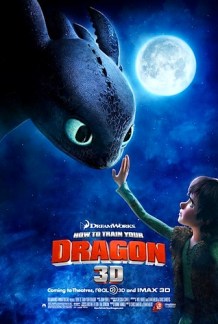
How to Train Your DragonI saw a trailer for How to Train Your Dragon at the cinema a few months before its release. Having never heard anything of it, I thought it looked to have basic animation and a too daft tone. I wrote it off, expecting the kind of animated movie that would be slagged off as a Pixar-wannabe… and probably still land an Oscar nomination because there never seem to be many contenders for the animated feature award. Imagine my surprise, then, when it garnered endless positive reviews and a huge box office. What?
My impression from the trailer was massively wrong. How to Train Your Dragon is, as everyone else has likely already impressed upon you, brilliant.

For one thing, it quickly becomes apparent that it’s magnificently animated and designed. What might appear smooth and simplistic at first glance actually has a lot of detail in full motion. A wonderful world is evoked with the design and the detail, of the humans’ lives and of all the different dragons. Even better is the cinematography (do you call it that in an animated film?) It’s genuinely beautifully shot. Roger Deakins — the Coen brothers’ regular cinematographer, not to mention all his other work and nine Oscar nominations — is credited as “visual consultant” and I guess that paid off.

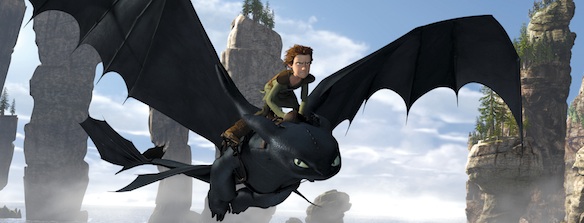
Numerous action sequences are properly exciting, and well spaced throughout the film — it dives in at the very start and doesn’t let up. Intelligently, they’re used to build and reveal character rather than just provide an adrenaline boost. That applies to the supporting cast and the dragons as much as our hero. The flying sequences are particularly brilliant. This is one of the few made-for-3D films I’ve seen in 2D where I actually wished I’d seen it in 3D.

Dragon flying 1

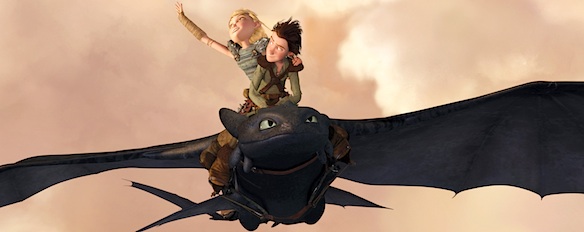
As noted, it skilfully finds room for characterisation and humour amongst all the battling and flying. While most of the story focuses on the relationships between Hiccup and his dragon Toothless, and Hiccup and his father, it deftly and quickly sketches in all the major supporting roles. That’s a sure hand in writing and direction, able to build whole characters and pay off their role with only a couple of lines or actions here and there. Plus, making you genuinely fond of and care for a cartoon computer-rendered fictional creature is no mean feat, and Toothless has all the personality to achieve it. Avatar wasn’t close to managing that.

Some plot beats and relationships are familiar and therefore predictable, but despite that they’re carried off with such emotion and humour that it really doesn’t matter. If you pause to think then you know how pretty much everything will pan out (though it may manage one or two surprises), but when you care about and like the characters, as I think you will here, that all becomes the stuff you hoped would happen rather than the stuff you roll your eyes at.

Dragon flying 2

One thing, though: Scottish Vikings? And how did all the kids end up with American accents? There’s certainly some American Kids’ Movie Logic at work in the voice casting.

In the end, then, How to Train Your Dragon is the antithesis of my initial impression: gloriously animated and filmed (rendered?), with a perfectly pitched tone that manages humour, exciting action, soaring flight sequences and an emotional connection to its characters, both human and dragon. This would thoroughly deserve to beat most Pixar films to that Oscar, so what a shame it was up against the equally glorious Toy Story 3.

4 out of 5

How to Train Your Dragon merited an honourable mention on my list of The Best Films I Saw For the First Time in 2011, which can be read in full here.

Prince of Persia: The Sands of Time (2010)

2011 #81
Mike Newell | 116 mins | Blu-ray | 2.40:1 | USA / English | 12 / PG-13

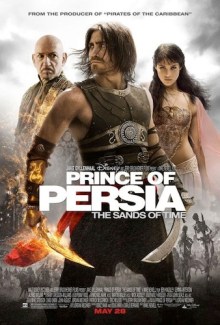
Prince of Persia The Sands of TimeDisney’s attempt to launch a second franchise in the mould of Pirates of the Caribbean, this time based on a long-running series of computer games, seemed to sink without trace last summer. Despite that failure, it’s not all bad.

To give a quick idea of its quality, Prince of Persia is analogous to an average entry in the Pirates series, only without the craziness and humour provided by Johnny Depp’s Captain Jack Sparrow. This probably explains Persia’s relative lack of success: Pirates began with an exceptionally good blockbuster flick, and has since coasted on goodwill and affection for Depp’s character; Persia has neither of these benefits.

There’s not much to get excited about here, however. Like On Stranger Tides, it suffers from a surfeit of ideas that are equally undeveloped. Even though this shares no writing credits with that film, it’s what it most reminded me of. There’s an adventure story that wants to reach an Indiana Jones-esque style but fumbles it. It often feels like the genuinely important bits of plot and character development are quickly brushed over, instead spending inexplicably long stretches on barely-relevant asides. It jumps about like a loon too, feeling like a lot of linking scenes or establishing shots have been excised for whatever reason.

Fiiight!There are some good action beats, but there’s also plenty of disorientatingly-edited, CGI-enhanced sequences, as per usual for the genre these days. For the former, see for instance Dastan’s climb up the wall into Alamut (or whatever it was called), or the knife-thrower-on-knife-thrower battle near the end. For explosions of CGI, see the massive logic-shattering ‘sand surfing’ sequence in the climax. Visually they’re clearly trying to evoke 300, but without going quite so far in the stylization stakes. Also worthy of note is the opening, the latest CGI-enhanced rendition of the opening sequence from The Thief of Bagdad and Aladdin: Westernised Middle Eastern streetchild-thief chased acrobatically through streets of Middle Eastern Town by Middle Eastern Guards. (None of the above pictured.)
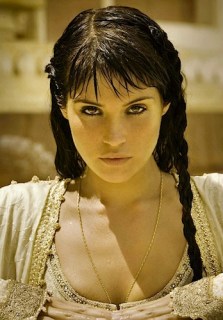
As this is a Hollywood version of the ancient Middle East, naturally everyone is a Westerner with deeply tanned skin who speaks with an English accent. Everyone in the past had an English accent. Jake Gyllenhaal’s accent is actually very good, in my opinion; Gemma Arterton’s voice doesn’t grate as much as it seemed to in the trailer (I have no problem with her in any other film, but there was something about the Persia trailer that made her sound… weird). That’s probably the best that can be said for either of their performances. They’re not bad, just not in anyway endearing. Dastan makes a fairly bland hero — I think he’s meant to be something of a cheeky chappy, but they didn’t get close to achieving that — whereas ArtertonNot Keira Knightley has the role Keira Knightley would’ve played five years ago. I think she’s meant to be a Strong Independent Princess but, much like Dastan, we’re told we should be inferring it rather than seeing any evidence of it.
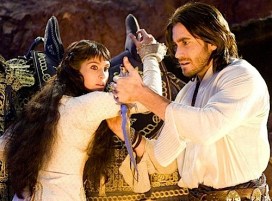
Alfred Molina has the best shot at creating a likeable supporting role, but it’s a part that resurfaces for no good reason, acts inconsistently, and all his best elements are cribbed from better films. Like most of the film, then. An attempt is made to conceal that Ben Kingsley is the villain, and it might have worked if anyone else was in the role — heck, I almost believed it even with him… but only “almost”. Like most of the story, it’s all a bit stock-in-trade. It’s good to take inspiration from other action-adventure classics, but it also means that it all feels very familiar. The time travelling dagger, the film’s truly unique point, is too powerful as a plot point, meaning rules have to be established that limit its use… which means that the one unique element doesn’t actually turn up very often.

Prince of Persia is riddled with flaws, it would seem. Its characters are unmemorable, their relationships unbelievable; its plot is disjointed and, while always followable, still half nonsensical; the other half is by-the-numbers predictable; its action sequences occasionally shine, but are largely whizzily edited or CGI burnished (though, in fairness, they’re far from the worst example of either problem). I should probably dislike it quite a lot, yet while part of me says I should rank it lower than even the Pirates sequels (owing to the lack of charming characters or any trace of humour), looking back I kind of liked it. It’s not Good, but it is sort of Fine, and it’s by no means bad enough to inspire genuine hatred.

Glowing daggerPlus, the sword-and-sandals milieu makes a bit of a change. I know we’ve had plenty of swords-and-sandals-flavoured movies in the wake of Gladiator, suggesting this is hardly unique, but whereas they’ve all unsurprisingly shot at the Gladiator mould, Persia is aiming for the PG-13 adventure-blockbusters style. It’s a shame that it’s not better, because said milieu and some of the talent involved could have produced a film in the vein of quality of, say, The Mummy, if we’d been lucky.

If you’re less forgiving than me, knock a star off. Or if you think you’d like the Pirates films better without Depp’s silly captain, maybe leave that star on.

3 out of 5

Clash of the Titans (2010)

2011 #23
Louis Leterrier | 102 mins | TV (HD) | 2.40:1 | USA / English | 12 / PG-13

Clash of the TitansThe thoroughly blockbusterised remake of ’80s fantasy favourite Clash of the Titans came in for a sound critical drubbing on its release last year, much of it focused on the post-production cash-in 3D applied to the film. I didn’t watch it in 3D so won’t have much to say about that, but I found the film itself to be passably enjoyable.
Firstly, it’s brief — little more than 90 minutes before the credits roll. That can feel stingy in cinemas these days, where we have to pay so much for a ticket getting your money’s worth is important, but at home especially it’s suited for a quick bit of fun. Still, Titans could’ve done with more length to allow characters to grow — at times it feels like a genuinely epic tale reduced to a lengthy plot summary, speeding over the fine details in search of the next big plot beat.

There’s a fairly impressive cast — nearly everyone is famous or at least recognisable — and all of them are massively underused. Perseus’ team are dispatched in various fashions, but we don’t really care because their group dynamic has only been built a tiny bit. And I wanted to care, because there were actors I like and characters who had potential — even if most were built from band-of-warriors stereotypes — but the film didn’t do enough to allow me to. Every time it produces a good bit, it throws in some groan-inducing sentiment or cheesily pompous dialogue.

FiiightWhat the film is built to do is provide action sequences, though these are passable and rarely more. They’re fine while they’re happening, but pretty much forgotten after — none of it shows a great deal of inspiration. The history of film is littered with far worse examples, but that’s about the best I can say. I can see why it would be painful in 3D too: quite aside from the use of always-criticised post-conversion, and the apparent rush job on that, Letterier favours the modern action style of handheld jiggly shots and fast cuts, neither of which lend themselves to the 3D experience. Heck, even Michael Bay acquiesced to adapt his similar style when shooting Transformers 3 in 3D, so you know it must be true.
In fact, the action sequences would probably benefit from the expansion of character I mentioned before: caring about them would add jeopardy when their lives are in danger and some emotional impact when they snuff it. As it stands, Titans is an emotionally empty experience, much more so than, say, Inception, which was frequently criticised for similar shortcomings. In fairness, this is probably because critics thought Inception might deliver in such respects, while no one expected a pre-summer blockbuster like Titans to bother. And they were right to an extent, but while it’s never going to be an affecting human drama, it should bother more than it does.

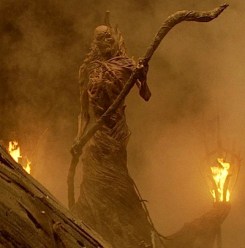
The FerrymanDesign is probably the film’s strong point, particularly sequences that feature the three witches and the ferryman. Clearly these dark, borderline-horror-film settings are the design team’s strongpoint. Elsewhere, the gods have an appealingly retro lens-flared-silver-armour look about them — I don’t remember the ’80s original very well, but one could imagine this iteration of the gods being dropped in without anyone noticing.
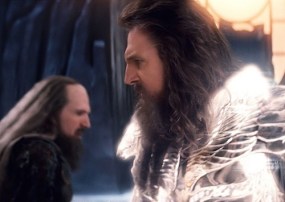
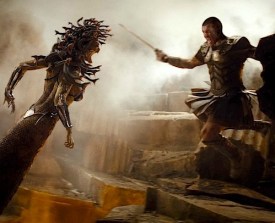
The CGI is complaint free, as with most well-budgeted modern flicks, apart from one glaring exception: Medusa looks almost as fake as the Rock’s Scorpion King from The Mummy Returns, which you may remember was lambasted even at the time — “the time” now being ten years ago. Oh dear. Maybe the passing years and abundance of CGI has affected my critical faculties here — that is to say, maybe side by side this Medusa would look a lot better than the decade-old Scorpion King — but, in the context of the rest of the film, that level of distracting fake-ness sprang to mind.

I’m laying into it almost as much as anyone now, but in spite of all that I sort of quite liked Clash of the Titans. It’s massively flawed in many areas, but good bits occasionally shine through. Unlike most blockbusters of the past few years, which tend to be bloated affairs in need of a good chop down, it would actual benefit from being a bit longer — Dear Godssome plot elements could do with greater clarity, most of the characters could do with some depth.
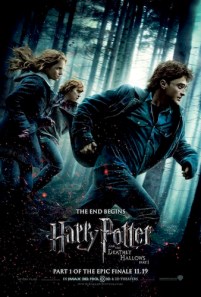
It’s probably all the studio’s fault for forcing major last-minute changes and reshoots. While I wound up enjoying what we got, the other version — as detailed by CHUD.com — does sound more interesting.

3 out of 5

Harry Potter and the Deathly Hallows: Part 1 (2010)

2011 #70
David Yates | 146 mins | Blu-ray | 2.40:1 | UK & USA / English | 12 / PG-13

Harry Potter and the Deathly Hallows Part 1While the final Harry Potter film continues to obliterate records at box offices around the world, I finally caught up on the penultimate instalment in the phenomenal fantasy series. It’s Part 1 of 2 at the end of a series that’s become increasingly serial, rather making this the Two Towers of Harry Potter films: it doesn’t begin, and it doesn’t end either.
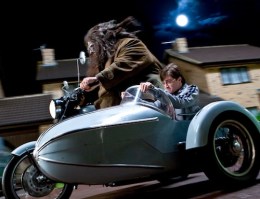
Indeed, at times Deathly Hallows Part 1 is too heavily reliant on knowledge of the previous films, or even, for full detail, the novels. It’s understandable — you’d be a fool to take this as your first Potter film — but at times it could work a bit harder for those who don’t live & breathe Harry Potter; it could help along those viewers who could do with a little memory jog here and there. The pay off, however, comes in lots of neat or resonant callbacks across the films — Harry reminding Umbridge it’s wrong to lie, for instance — as well as within the film itself — Hermione obliviating both her parents and some Death Eaters.

Despite the series knowledge required, the well-established Potter team have created one of the series’ best instalments here. Long gone is the cartoonish frivolity of Chris Colombus’ opening pair of Children’s Films — this is Potter at his darkest, and not just in terms of the cinematography. Film franchises have come under fire for incessantly describing each new entry as “darker”, and none more so than Potter, but at least it’s deserved: this is a grim, oppressive world, where our trio of heroes are completely removed from the safety of school and on the run as fugitives. It rather negates author J.K. Rowling’s original conceitAction of having seven books each covering a school year, but hush, let’s overlook that (everyone else seems to).
Technically the film is well executed. Harry Potter films have had action sequences before, but few stand comparison to the bevy we’re treated to here: an in-flight fight/chase as a gang of heroes escape Privet Drive; a fast and claustrophobic duel in a cafe; the much-trailed run through a forest (interestingly realised without any score). It’s not quite an Action Movie, but if any Potter were to lay claim to that genre it could well be this one.

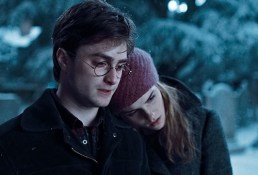
Elsewhere, several deftly constructed montages set the scene for what’s going on in the wider wizarding world while Harry, Ron & Hermione are on the run in secrecy. Similarly, the film massively cuts down on the novel’s interminable sequences of the trio wandering around Britain pondering things endlessly. Consequently the halfway point of the novel — Harry and Hermione visiting Godric’s Hollow at Christmas (if I recall correctly) — occurs under two hours into this 4½-hour adaptation. It’s one of the film’s best sequences though, the snow-coated village setting and almost dream-like pace evocative of both the magic and melancholy of Christmastime; its ultimately nightmarish events reminiscent of wintry fireside horror tales.

Have yourself a melancholy little ChristmasTalking of exceptional sequences, the animated one can’t go unmentioned. It’s wonderfully done, inspired by old silhouette animations, though achieved in 3D animation here, which is a pity. It’s still beautiful to look at, and it’s very fluid, but I can’t help but feel it would’ve been even more effective if they’d gone all out and done it in 2D.
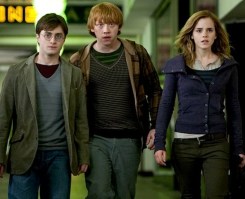
Visually the whole thing is, of course, dark and gritty. I was always glad the films went for a ‘real world’ aesthetic rather than the ‘Saturday morning cartoon’ stylings of the books’ jacket illustrations, but the first couple of films still had quite a bright, primary-coloured palette. As I said earlier, everyone’s talked about each film bring thematically darker to the point that it’s become a cliché, but it’s true of the production design and cinematography too. There were a couple of scenes here where I literally couldn’t see what was going on.

Yates spoke of making this one like an “urban thriller” — and, having helmed the original State of Play, he’d know — and I think they have, more or less, in a mainstream fantasy movie way, achieved that feel. There are abandoned and decrepit industrial sites and burnt-out trailer parks to really push the feel, but it bleeds out into all the fantasy settings too. It’s cold, grey, bleak, tough — all appropriate for the dark times the characters find themselves in, if not so much for the pre-teen audience the initial books and films were suitable for. Urban thrillerThemes of Nazi/Stalinist-style oppression are played up in the story (trials of those whose “blood status” is in doubt; listening to the radio for news of loved ones; Bellatrix’s torture of Hermione) and production design (the muggle-crushing new statue in the Ministry; the art style of anti-mudblood propaganda leaflets; the uniforms of the Ministry guards), but it’s subtle enough that it doesn’t batter you around the head.
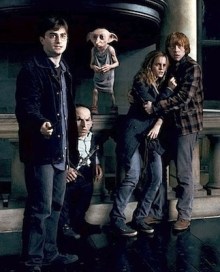
The cast are, as ever, really just pawns in a bigger game. There are nonetheless some nice character beats — the dancing scene, for instance, which uses a Nick Cave song (in a kid’s film! Excellent). Anyone in the cast under the age of about 25 struggles to convince at one point or another, but the adult cast are as exceptional as their pedigree would suggest, even in their brief cameo-sized roles. Most impressive is CG character Dobby: Deathly Hallows takes him from being the most irritating all-CG character since Jar Jar Binks, to one who has a heroic and moving death at the climax of this film. That said, it was — much like the death of Sirius Black in Goblet of Fire — more effective in the book. However filmic the deaths Rowling writes may feel, the filmmakers seem to struggle to convert them as effectively to the screen.

The kids strike backAnd so, the ending — which isn’t, because we’re in the middle of the book. So how well does it work as, y’know, an ending? Quite well, as it turns out — indeed, one might even compare it to something like Empire Strikes Back: the gang are reunited and free of evil clutches (for now); the quest for the Deathly Hallows and the speculation of their meaning is all set up to continue in the next film; plus there’s an appropriately dramatic death. But this one was never truly designed to be an ending, so if you think about it too much it begins to work less well than if you just accept it. Still, having your villain acquire the MacGuffin we’ve been told is all-powerful and indestructible makes for a decent cliffhanger.
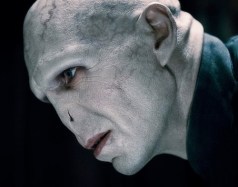
It’s interesting to consider that the ending was originally designed to be earlier, when Harry & co arrive at Malfoy Manor and Bellatrix sees his scar. It was moved it find an emotional connection for the ending, and I think it works. If it had ended where planned it would feel like a cliffhanger-ish point in a longer work; while there’s undoubtedly some of that in how it ends now, it’s a bigger, more dramatic point. A change for the better, then.

(As an aside, I think the order of the cast in the end credits reveals who has the best agent and whose could’ve worked harder. Have a read and think about the relative size and importance of their roles.)
Boo, hiss!
Deathly Hallows Part 1 is, indeed, Part 1; but despite that it functions rather well as a film in its own right: there’s story development, character development, action sequences, and even a semblance of an ending. In terms of Being The Middle Instalment, it’s at least as successful as any other I can think of.

4 out of 5

The final Harry Potter film, Harry Potter and the Deathly Hallows: Part 2, is released on DVD and Blu-ray in the US tomorrow, Friday 11th November, and in the UK three weeks later, on Monday 2nd December.

Saw 3D [2D] (2010)

aka Saw: The Final Chapter

2011 #67
Kevin Greutert | 90 mins | Blu-ray | 1.78:1 | USA / English | 18 / R

Before gangs of youths knock on your door to rob you under threat of violence, as is traditional on Halloween, why not enjoy my thoughts on a now-dead ’00s Halloween staple: the Saw movie.

I say “enjoy” — it’s almost as bad as those greedy kids…

Saw 3DWhat’s this, the first Saw movie, now in 3D?

No.

So it must be the third Saw movie then, in 3D?

No, not that either.

It’s the seventh, in fact. But it is in 3D, hence the only-slightly-confusing Saw 3D moniker. I guess Saw 7 plus the tagline “see Saw 7 in 3D!” wasn’t considered clear enough.

And to top the stupidity off, I didn’t watch it in 3D, but the 2D prints are still called Saw 3D. What?

I was going to say that’s not even the most stupid thing about the film, but the rest of it isn’t so much stupid as disappointing. The problem is that there are some good ideas, but few are executed as well as they could be or paid off appropriately. The setting for the opening trap — it’s played out very publicly in a shop window — is a marvellous twist on the format. Is this an escalation? Are we going to see Jigsaw playing to the crowd all the time? No. It’s a one off. It doesn’t even have any bearing on the rest of the plot — it simply occurs and is never even mentioned again. That’s appalling.

Likewise, the support group for Jigsaw survivors: nice idea, but they don’t find anywhere to go with it. At least the notion of a fake Jigsaw survivor making a mint out of selling his fake story is an idea that has legs. Not long legs really, but they at least get a decent amount out of it — that is, it’s a set up for the Game of the Film. As ideas for The Final Film go, it’s a perfect match — a bit meta and all that jazz. Accompanying this is, of course, the arc plot that has stretched across the series. As the final film it’s time to wrap that up… Sadly, it isn’t particularly satisfactory. Guess who's backWith so many characters killed off in the preceding films we’re not left with anyone to really care about — certainly not the new gang of coppers we’re introduced to. Actually, to say we’re “introduced to” them is a kindness — they just turn up and begin to lead that part of the plot.

That said, the final five minutes are pretty good — just when I was thinking Cary Elwes’ cameo earlier had been underwhelming and pointless, there’s a final reveal to pay it off, and also neatly tie together and round off the whole series. It’s easily the best bit of the film.

It might seem daft to say this about a Saw film, but it’s a bit too gory for my liking. I know that comes with the territory in a film like this, but I think others in the series have managed the level better. This is up with Saw 3 in the stakes of needless torture-porn-level blood ‘n’ guts. The near-pointless car trap is the worst offender, as much as anything because it’s almost entirely ancillary to the plot — it’s a trap for the sake of a trap, and it’s a nasty one.

The film’s extended version (no idea if it’s included on the UK release I watched) only adds 12 seconds, and that’s all gore. Most of that occurs in extensions of literally a few frames. Earlier extended entries added both plot and gore, so that’s… pathetic, really. (According to the BBFC, the PAL-speed DVD versions run 23 seconds longer than the theatrical version. My info on the 12 seconds comes from my usual source.)

Aiming to live up to its title, the whole affair has clearly been designed with 3D in mind. That means a few moments of things flying at the camera, but they’re surprisingly rare. OK, so people explode or are pulled apart Big pointy thing, perfect for 3Da lot more regularly than they were in previous films, and bits of them swing in the direction of the camera, but that’s in keeping with the style of the series and doesn’t jar massively — if you didn’t know it was shot for 3D, you wouldn’t notice most of it.

Other bits, though, you really would. One trap sees three spikes headed for a woman’s eyes and mouth, so naturally we’re treated to some POV shots. This probably worked great in 3D, but in 2D they literally fall flat. Better is a trap that sees two men having to negotiate planks of wood on the second storey of a building that doesn’t have a floor. It works fine in 2D, but I imagine 3D added some lovely depth to the layered drop to the floor below. Never mind the odd things flying at the camera, this was the only time I really wished I was watching in 3D.

Some people lay into 3D for having stuff poke out at the audience for barely any reason. I have no problem with this in a movie like Saw — it’s all part of the fun. It gets tiresome if that’s all it’s doing, or if it happens too often, but once or twice it’s a good laugh; part of the gimmick of a thoroughly gimmicky format. In 2D, of course, that all falls dead. Luckily, as I said, not too much is randomly flung at the screen.

The final final trapThe worst side effect of 3D, however, is that the colour looks ridiculous in 2D. I’m glad they’ve shot it with 3D properly in mind — everyone knows the glasses make 3D films darker, but not every filmmaker seems to be compensating appropriately (see, for example, the criticism of The Last Airbender’s post-converted 3D), so it’s nice to see someone that is. But they haven’t un-compensated (as it were) for 2D. Much of the film just looks weirdly… not bright, exactly, but too light. It’s fine, just a bit unusual. But then some of the blood is a bit of a funny colour and, by the end, has turned a garish shade of pink. Oh dear. It continues to amaze me that no one’s come up with a simple grading solution to make colours look the same in regular 2D and glasses-effected 3D. It can’t be that hard, surely?

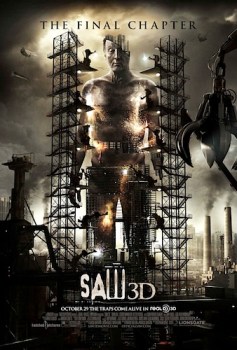
Saw 3D has a big pile of good ideas, but all of them are underused. The film just feels boring, somehow; workmanlike, maybe. It lacks the inspiration of earlier Saw films, despite on paper having some of the very best ideas of the entire series. It feels silly to say it about the seventh film in a yearly churned-out franchise, but Saw 3D is a disappointment; a lacklustre end to a variable franchise that started really rather well. Shame.

2 out of 5

I watched all seven Saw films within the past two years, donchaknow.

Saw 3D featured on my list of The Five Worst Films I Saw in 2011, which can be read in full here.

Tangled (2010)

2011 #69
Nathan Greno & Byron Howard | 100 mins | Blu-ray | 1.78:1 | USA / English | PG / PG

TangledDisney’s 50th animated feature is Rapunzel in all but name, for no particularly good reason. It seemed to be met with universal praise on its release last year, critics hailing it as a return to Disney’s previous quality after a run of lacklustre releases, in particular the underwhelming return to 2D in the year before’s The Princess and the Frog.

Well, to get that comparison immediately out of the way, Tangled isn’t as good as The Princess and the Frog in my estimation. I’m not sure why it seems to have been more widely praised — it’s solid and good fun, but I thought Frog had more going for it.

Which isn’t to say Tangled is bad. It’s funny, which is its biggest asset, and exciting at times — as usual, the highly moveable camera of CG animation adds fluidity, speed and excitement to the action sequences, making them one of the high points.

It’s not all good and shiny though. The setting — a comedic-ish fantasy-kingdom world — can come across a bit like lightweight Shrek, lacking the anachronistic postmodern real-world references that made that film zing. Worse, the songs are distinctly unmemorable — I’d forgotten some of them by the time it came to their own reprise. A gang of thugs singing about their dreams is the best thanks to its comedy, but I couldn’t hum or sing any of it for you now. I especially lament the lack of a decent villain’s song, Why not just call it Rapunzel?a number I usually particularly enjoy. It has one, I suppose, but it’s one of the weakest examples I’ve ever heard.
Tangled isn’t bad by any measure, but I don’t feel it should be the praise-magnet it became. There are certainly better Disney musicals — it can’t hold a candle to those; and there are better funny fairytales too — but at least it holds up as a solid addition to that sub-genre.

4 out of 5

The UK TV premiere of Tangled is on Disney Cinemagic this Sunday, 23rd October, at 5pm and 9pm.

Batman: Year One (2011)

2011 #85
Sam Liu & Lauren Montgomery | 64 mins | Blu-ray | 1.78:1 | USA / English | 12 / PG-13

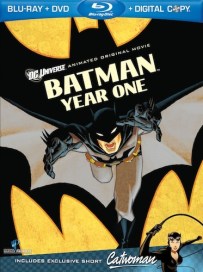
Batman Year OneDC Comics’ latest direct-to-DVD animated movie is an adaptation of Frank Miller and David Mazzucchelli’s seminal 1987 Batman story, acclaimed as one of the greatest graphic novels of all time, and one of those that is often credited with helping the comic book medium grow up in the late ’80s.
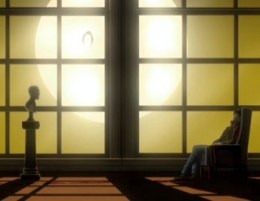
The story concerns two men arriving in a sprawling metropolis that has become a rundown hive of criminal activity and police corruption. One a police officer, who sets out to be an honest force in a corrupt organisation; the other a billionaire who has trained himself to become a vigilante; both setting out to solve the city’s crime problem in their own way. They are, of course, Lieutenant James Gordon and Bruce Wayne, and the fact we know where this is going is incidental.

The film tells, quite literally, the story of Batman’s first year fighting crime — there are on-screen dates and everything. I say “quite literally”, but that’s not really true: Batman doesn’t turn up until a few months in. The plot description I’ve written above is actually a pretty decent variation of how the film pitches itself. Of course we know where it’s going, but it tries to make the emergence of the Batman concept more natural by treating it as if we don’t know. Because in the real world, dressing up in a cape and pretending you’re a bat is far from the first idea that springs to mind if you want to fight crime.

Bruce pondersAs with the comic, this is a very down-to-Earth version of the Batman story. It’s even less sci-fi-y than Chris Nolan’s much-praised realistic films, in fact. There’s no Batmobile, no Batcave, no Bat signal, only a few gadgets (and those that are used are fully plausible), no cartoonish super-villains… This Gotham is a city where crime comes from gangsters, drug dealers, muggers and a thoroughly corrupt police force, and that’s what Batman sets out to fight. As in the Nolan films, the costumed foes will come later, a response to the Bat himself. It’s not afraid to take its time telling this story either. Especially at the start, the pace is very measured — there’s no rush to action or to Batman, but instead a slow build of character and drama. Some may see this as a flaw — those after a Batman Action Movie, largely — but it sets the tone for what is a more character-driven tale.

Top billing for the film goes to Breaking Bad’s Bryan Cranston, the voice of Jim Gordon. That might seem odd, but when you watch the film it becomes natural: there’s not just surprisingly little of Batman, there’s surprisingly little Bruce Wayne. It may concern the origin of Batman, but this is played as Gordon’s story; he’s the one who must face police corruption, a troubled marriage, personal threats, and hunt for the new vigilante stalking Gotham’s streets. Meanwhile, Bruce’s decision to adopt the Batman guise, plus his initial struggles to do it professionally, are conveyed in a couple of brief — albeit effective — scenes scattered throughout the film.

Jim GordonCranston, given easily the fullest character, gives the best performance too. Star of The O.C. and Southland, Ben McKenzie, was chosen to portray a 25-year-old Bruce Wayne in part due to his own youth. He’s fine when delivering dialogue, but his voiceover narration is oddly flat. Other ‘star’ name casting, like Battlestar Galactica’s Katee Sackoff or TV genre stalwart Eliza Dushku, only appear in small roles. Dushku makes for a surprisingly fitting Selina Kyle/Catwoman, considering the character design looks nothing like her. It’s a shame her story is such an aside — it would’ve been better to see some more of her and bring her up against Batman properly. Sackoff’s character, on the other hand, is just barely in it.
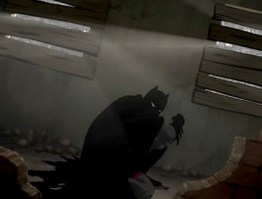
It’s been a good few years since I read the original comic, but it seems to me this was a pretty faithful adaptation — one of the reasons it’s shorter than the average DCU animated movie, in fact, is because they didn’t want to artificially draw out the story. This faithfulness certainly has its pros, but also cons. To put them succinctly, watching Year One can help you appreciate the work Christopher Nolan & company did expanding and rounding out the story when they more-or-less adapted it to make Batman Begins.

For those who’ve seen Begins but never read Year One, it’s not just the obvious “Bruce Wayne becomes Batman” plot that’s paralleled by Nolan’s work: there are numerous sequences, plot threads and themes that are taken almost verbatim from this telling of the story. These elements are integrated as one part of a different whole in that film, though — there’s nothing to do with Ra’s Al Ghul or the Scarecrow here. Batman in Year OneIndeed, you can tell Nolan cherry-picked most of Year One’s best scenes for his version, because they’re generally speaking the ones that shine here too. (It makes me want to watch Begins again to see just how much of this made it in there.)

The other con of being so faithful is that, unfortunately, some of what kind of works on the page doesn’t necessarily in a standalone film. The birth of Catwoman is a subplot that doesn’t really go anywhere, for instance. It has potential to, but it’s never adequately developed and certainly isn’t resolved. The comic gets away with this a bit because you’re aware her later development and adventures were already told, or will be told later, but in a standalone film it could do with rounding off. Despite the obvious fact that the whole point of the story is to setup Batman for future tales, Year One does manage an ending. Obviously it’s not completely resolved — as with any superhero film — but it rounds out much of what it set in motion… mainly, again, on Gordon’s side of the story.

As a film in itself, the animation is beautifully fluid, in particular creating some excellent fight sequences. Of course there are times when the limited budget of a direct-to-DVD feature shows through — the streets are always very empty during car chases; occasionally we see static shots where there should be some movement, especially during dialogue — but all told there’s nothing to really criticise and much to like. Christopher Drake’s music also occasionally shines through. I confess to missing the work of Hans Zimmer and James Newton Howard, which is Batman’s musical soundscape for me now, but Drake sensibly doesn’t try to ape their style and instead makes his own work.

Bruce mournsUnfortunately Batman: Year One has arrived at the party a bit too late to be the definitive screen telling of Batman’s origin — by taking the best bits of Miller & Mazzucchelli’s tale and expanding it with some work of their own, Chris Nolan & friends take that title. But as a film in its own right, Year One is largely successful. Children (or childish fans) seeking animated Batman thrills may be disappointed by its slower pace and focus on character, because this is solid adult-focused entertainment.
4 out of 5

Batman: Year One is released on DVD and Blu-ray in the US tomorrow, Tuesday 18th October, and on HMV-exclusive DVD in the UK on Friday 21st October.

Cameraman: The Life & Work of Jack Cardiff (2010)

2011 #45
Craig McCall | 82 mins | TV (HD) | 1.78:1 | UK / English | PG

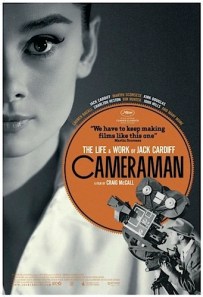
CameramanDocumentary telling the story of the career of cinematographer and director Jack Cardiff.
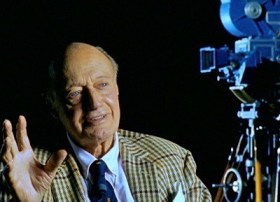
As the title implies, it focuses mainly on the former — despite the fact he directed 13 features, this part of his career is largely glossed over with a bit of discussion of one film, Sons and Lovers, which earnt some Oscar nominations (including one, slightly ironic, win). But that’s probably fine, because it’s for his work with the camera on films like A Matter of Life and Death, Black Narcissus, The Red Shoes and The African Queen that Cardiff is best known.

As a film, it doesn’t do anything fancy: talking heads, clips, photographs. There’s nothing wrong with that when your topic is engrossing and your content stands on its own. It’s a biography of Cardiff’s work, moving chronologically through his major contributions to cinema. The insights are numerous thanks to the number of films covered and a lot of footage from an interview with Cardiff himself. Though there are other interviewees, including some big names (just look at the list on IMDb), what Cardiff has to say of his own works dominates, which seems only proper.Man, camera

My overriding memory of the documentary is of a slew of beautiful-looking films, some well known and others not, but every one jumping onto want-to-see lists thanks to what’s shown here. Which just demonstrates how deserving Cardiff and his work are of a dedicated feature film of this quality.

4 out of 5

Cameraman: The Life & Work of Jack Cardiff is on Film4 and Film4 HD tonight at 1:20am, and Film4 +1 at 2:20am (of course).
Cameraman: The Life & Work of Jack Cardiff is on Film4 at 1:20pm.