
Matthew Vaughn | 132 mins | cinema/Blu-ray | 2.35:1 | USA / English | 12A / PG-13
Superhero films have been a significant regular part of the summer movie season for over a decade now, but this year really looks like it’s going to take the biscuit: The Avengers obliterated box office records Stateside last weekend, and has spent most of the week knocking down more worldwide; there’s a Batman sequel/finale to look forward to, which everyone has been expecting to do the same; and sandwiched somewhere between the two is a Spider-Man reboot that, provided it doesn’t get dwarfed by the other two and/or poor reviews, is likely to make a pretty penny. (If I recall correctly, the initial Raimi Spidey film was the first movie ever to make over $100m in its opening weekend; and now, 10 years later, The Avengers is the first to beat $200m — how neat.)
But that’s all still to come (I haven’t even seen The Avengers yet myself, and I won’t now until at least sometime next week, for various reasons. Grr.) Instead, here’s a review of my personal favourite from last year’s crop of comic book adaptations — indeed, I ranked it the second best film I saw all year.
 I made sure to see First Class soon after its cinema release back in June 2011 — an increasingly-rare cinema trip for me (previous one before this was Inception in July 2010), and even rarer to go so quickly, but it earnt it as probably my most anticipated movie of the summer. I’ve been a fan of the X-Men since the ’90s animated series was a defining part of my childhood; Matthew Vaughn has become one of my favourite filmmakers thanks to Stardust and Kick-Ass, both of which earnt 5 stars and spots on my end-of-year top 10s (and Layer Cake was 4-star-ly entertaining too); and the idea of doing a superhero film that was definitively set in a specific point in the past (namely the early ’60s), rather than the perpetual Now of every other entry in the sub-genre, is the kind of thing creative fans long for but risk-averse studios rarely greenlight. Plus the trailers looked brilliant.
So my long-held high anticipation (unlike many whingy comic-continuity-obsessed inexplicably-Vaughn-dubious internet fanboys, who needed the trailer to even consider thinking the film might be good) led me to the cinema quickly. Why so long to post a review, then? Because I’ve been waiting for Blu-ray to see it properly.*
As “Film fans”, rather than “movie consumers”, we’re supposed to believe 35mm cinema projection is the best way to view a film, rather than the cold hard digital realm that’s taking over, or the home cinema that is increasingly the viewing location of choice as people seek to avoid inflated ticket prices and noisy crowds, and gain a huge degree of convenience in the process. Well, sod that. I saw X-Men on 35mm. 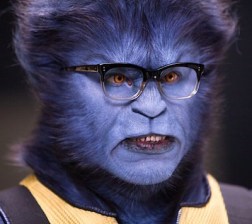 It was blurry, the sound was muffly. I saw a clip in a summer movies trailer just a few days later when I saw Pirates 4 in 3D (i.e. digitally projected), and had a genuine moment of, “oh, that’s how it’s meant to look”. So thank God for Blu-ray — never mind prices, crowds or watching when I want, the real advantage is seeing it as sharp as a pin and being able to hear everything the characters are saying. I can enjoy the cinema experience, but at the end of the day it’s about the film, and if the only way to see, hear and appreciate it properly is to watch it 5+ months later on a much smaller screen from a digital source, so be it. The fact that it’s usually cheaper to buy the Blu-ray to own forever than take two people to see it just once doesn’t hurt either.
But I digress massively. X-Men: First Class takes us back to the origins of the X-Men (at least, the movie-universe X-Men): it’s the 1960s, mutants aren’t widely known about yet, Charles Xavier is uncovering some interesting ideas at Oxford, and Erik Lehnsherr is travelling the world taking revenge for Nazi atrocities. But when some Evil People are plotting to do Something Nasty, the US government winds up bringing them together, and the road to establishing the X-Men begins…
I should give up on plot summaries again, I never write good ones. There’s so much more to First Class than that might suggest. Firstly, it’s very much a prequel to the other X-Men films, rather than a reboot. So no Cyclops and co in the original team-up, which really annoys some fanboys, but pfft, it doesn’t matter. It’s fair to say the characters who make up the eventual first X-Men team aren’t as iconic or memorable,  but that’s fine because here they’re just supporting characters. This is the story of two other young men, Xavier and Lehnsherr, aka Professor X and Magneto.
You need some pretty fine talent to replace two of our greatest actors — Ian McKellen and Patrick Stewart, of course — and in Michael Fassbender and James McAvoy you certainly have that. Fassbender carries much of the emotional weight of the film, and certainly received much of the praise from critics, but it’s thanks to McAvoy’s support that the film is lifted to a higher level. He provides calm, humour and fundamental decency to balance Fassbender’s rage and emotion. What’s fascinating about them as characters is that they are half-formed people. That is to say, while they are Wise Old Men by the time of X-Men, here they are still flawed and finding their way; witness Charles’ insensitivity toward Raven, for instance. That’s quite aside from all the little character-building touches. It all builds to the fantastic, heartbreaking climax on the beach. I’d also say it adds weight to the relationship between McKellen and Stewart in the original X films. Not significantly, perhaps, because those films are about other things, but I think you can feel their shared history more keenly.
The rest of the cast is suitably well equipped. There’s 2011 Best Actress Oscar nominee Jennifer Lawrence as Raven, aka Mystique. Little more than a henchman designed to bring sex appeal in the trilogy, here she’s given a significant degree of backstory that makes her an important piece of the overall series. Indeed, she comes across as woefully underused if you watch X-Men after this — 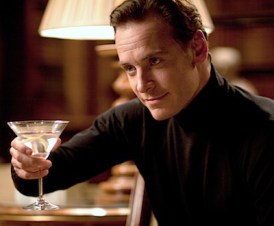 the flipside to the Xavier-Lehnsherr relationship working better, if you will. There’s also Kevin Bacon, playing his second superhero villain in as many years, who does sterling work as a former Nazi seeking world domination — remember the ’60s, when world domination was a valid aim for a villain? There’s more than a little Bond in the mix here.
Rounding out, we have the likes of Vaughn regular and perpetual “I’m only doing it for the money”-er Jason Flemyng, in an almost dialogue-free part that, while visually striking, doesn’t fare much better than his Kick-Ass ‘cameo’ in terms of screen time. There’s also a very flat (in every way apart from her frequently highlighted chest) turn from January Jones as a villainous sidekick, feeling every bit like the last-minute casting she was (after various other actresses walked away — considering the small size of both the role and costume, I can see why). Plus Rose Byrne, who’s always worth mentioning.
Much was made in some circles of a rushed production schedule leading to some of the film’s flaws. I think that’s only an issue because people know it could be one, because (on second viewing especially) I noted no such problems. The earlier parts are probably the film’s best — with Lehnsherr and Moira being all Bond-y, and Kevin Bacon’s Shaw being very much a Bond villain, making it feel more like a big ’60s spy thriller than a superhero movie in many ways — and when it tries to introduce an X-Men team made up of second-string leftover characters it loses its way slightly. But balance is everything with ensemble casts like this, and watching the film again gives a better perspective on its pace and its actual balance. First time through these things are distorted because you don’t know how far through the story you are, how long’s left, how long each scene will last, and so on; a second time, with an idea of where it’s going and so forth, you can better appreciate how it’s all actually weighed up, and I think First Class achieves a balance better than most have given it credit for.
Also worthy of a mention is Henry Jackman’s score. He gives us brilliant driving, menacing action themes, alongside some evocative ’60s stuff too, especially when they’re on the hunt for mutants for instance. I love a good blockbuster movie score, and this is definitely one of those.
Perhaps the thing that most impressed me about First Class, however, was its genuine sense of spectacle. The climax features master-of-magnetism Magneto hoisting a submarine out of the ocean with his powers. That’s not a spoiler, it’s in the trailers — so we’d all seen it going in. And we’re in an era of anything-goes CGI — nothing looks impressive any more because we know not only that it can be done, but how it was done too (greenscreen and pixels, essentially). But that’s not what happens, at least for me, especially on the big screen.

Between Vaughn’s direction, Jackman’s score, Fassbender and McAvoy’s performances, plus those of other supporting cast members, and sterling work by the visual effects team(s), the moment when that submarine floats dripping into the sky is hair-raising. It played to me as a moment of genuine cinematic spectacle; the kind of thing you used to get when big stunts had to be done for real somehow. It’s not a feeling I expected to get from a new film ever again.
I’ve mentioned a couple of times how it ties in to the earlier (set later) films in the series, and how some complained about it messing up X-Men comics lore. But this is an adaptation — it’s not beholden to what’s established in the comics. And it’s working around fitting into the world of the later films, so of course they’re not going to have Cyclops in a ’60s X-team, and so on.  It’s a complete non-issue for non-fans, and the same for any open-minded fans who realise they’re not trying to faithfully bring the X-Men canon to the big screen. Earlier films should already have shattered that illusion anyway.
As to the former, it largely fits well with the earlier films. There might be some questions about ages and events not lining up precisely (especially with the flashbacks in The Last Stand), but these are minor points that I think we can overlook for the overall quality of the film. Largely, a use of certain effects, call-forwards, cameos and little touches here and there really tie it in to the existing films. You don’t need to have seen them to get this — indeed, I imagine the ultimate way to experience it would be with no foreknowledge whatsoever of where Charles & Erik’s relationship is going — but for all those of us who have, it works very nicely.
Yet despite these links, and the 40(-ish)-year gap between the end of this story and the start of X-Men, if First Class never received a follow-up it would work perfectly as a standalone ’60s X-Men film. But I’m ever so glad we’re getting more, because I want to see this crew and this cast tell us more stories of the X-Men.
 After seeing First Class in the cinema I thought to myself that, while I would dearly love to give it a full five stars, in all good conscience I couldn’t; for whatever reason, it didn’t quite come together enough. Watching it again on Blu-ray, however, I’ve completely changed my mind: I wouldn’t change a thing. All my anticipation is more than paid off — I love this movie.

X-Men: First Class placed 2nd on my list of The Ten Best Films I Saw For the First Time in 2011, which can be read in full here.
* That was released back in October 2011, I know. The rest is general tardiness. ^
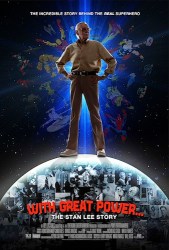 Stan “The Man” Lee is indeed The Man when it comes to the world of comic books. In the 1960s he revolutionised the medium in the US, introducing complex and realistic characters to a world that had previously focused on perfect super-humans like Superman, Batman and Captain America. In a period of just two years he co-created the Fantastic Four, Hulk, Spider-Man, Thor, Iron Man and the X-Men, and after that rejuvenated Captain America (cancelled a decade earlier) for a modern audience. If there’s anyone in the comic world deserving of a dedicated feature-length documentary, it’s Stan Lee.
 both in his Marvel heyday in the ’60s as well as before and since. It also really digs in to his personal life at time, getting very emotional. That Lee and his family appear and tell these tales mean it doesn’t feel intrusive.
  The first
  Thirdly, it has Gary Oldman as a villain. That should be wondrous, but it isn’t. He’s fine. Gary Oldman villains aren’t fine, they’re classic characters. But no, this one’s just fine. I guess he needed some cash.
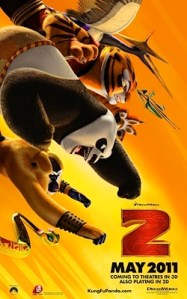
 Hopefully the inevitable third entry (this ends with a very obvious setup for where the series will go next) can regain some more of the first film’s magic. As things stand, I found Panda 2 to be a fairly decent 90 minutes — though, saying that, a slightly slow one — but not one that came close to the numerous joys of its forebear. Disappointing.
 The final entry in Marvel’s multi-film campaign leading up to big team-up
  The connections don’t stop there. Some people complained that
  It also has the same problem that the first
  It’s hard to say what exactly is wrong here, but it’s mainly an abundance of CG backdrops, green/blue screen stuff that doesn’t scan. Heck, in one shot you can see a blue glow around the edge of a character’s hair! That’s bordering on the amateurish.
 Still, do look out for
  Elsewhere, Tommy Lee Jones could play roles like this grumpy-but-good-at-heart-General in his sleep, but at least claims the film’s best line. Equally, Hugo Weaving could be in a similar state of unconsciousness and give a good villain, and while he does his best to chew the scenery, I thought he was fine but unmemorable in an underused role. As I said, the screenplay positions him as a “we need a villain for a climax”-level enemy when his character should be The Hero’s Nemesis, leaving a waste of both character and actor. Co-villain Toby Jones is similarly ill-treated, although at least he may return, semi-reincarnated as another villain (no explicit clues in the film, but he is one in the comics).
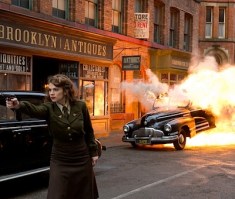 And I haven’t even mentioned the over-graded sepia hue, because it’s Set In The Past. Digital grading brought much potential to the film industry, but instead it’s pathetically and predictably overused. Whenever you compare a film itself to some B-roll footage in a behind-the-scenes documentary or somesuch, you suddenly noticed how not-like-real-life the film looks. In every thriller whites are actually blue, for instance. Here, I imagine if you compared it you’d find whites are actually bronze. I don’t imagine this kind of thing is going away now though.
 But hey-ho, here it is. Like I theorised at the end of Iron Man, maybe with this setup out of the way they can produce a better sequel… but considering the skinny-little-man-turned-muscly-superhero is one of the more interesting aspects of Cap, and they’ve done that now; and the World War 2 setting is another unique facet, which they’re leaving behind… sadly, I’m not holding out quite as much hope.
 If
If  which moves fairly swiftly into the fantasy of being a successful superhero, Super stays quite grounded. The ending allows itself to be a little more triumphantly heroic, but not far beyond the bounds of realism (unlike Kick-Ass).
 really, they are deciding something is right and something else is wrong”. The psychology of superheroes has been a factor to one degree or another for decades now, not least the Batman films making the parallel between the hero and his villains, but the difference in Super is it’s not a parallel — it’s primarily the heroes who are messed up. The villains are criminals and quite nasty at times, but they’re mostly quite normal. They may deserve their comeuppance, but wisely — and interestingly — they’re not over-written or over-played to heighten them to the level of the psycho-hero. The Crimson Bolt is a sledgehammer to crack a nut, even more so than Batman in
  Super is about a troubled human being and his relationship with faith, morality and what he perceives as his calling… I think that is part of why we gave him Ellen Page as a sidekick — because her character, Boltie, actually is insane. The Crimson Bolt is not doing what he does because he enjoys hurting people but Boltie is and that is the difference between the two of them. It starts to become a concern when you enjoy the violence.”
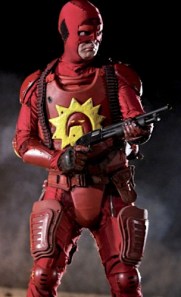 For all its grounded reality, Super lets loose in the final fifteen minutes, creating a punch-packing sequence that’s the rival of any comic book movie. It’s emotionally-charged action, all the more powerful for its semi-amateur-ness and realistic brutality. It climaxes in a face-to-face between our hero and the villain which is as good as any you’ll find in such a film. Is it revelling in the extremity of its violence? You might argue it is, but I don’t think it’s celebrating its gore so much as the triumph of its hero. And that’s followed by a neat epilogue, which I won’t reveal details of but is a kind of ending I’ve been wanting to see for a while.
 a decade-old track by Sweden’s 2007 Eurovision entry (they came 18th of 24. Don’t laugh — we were joint 22nd). And, despite the low budget, there’s great special effects. The tentacles are the rival of any big-budget movie; the blood and guts are all gruesomely realistic, not filmicly censored or reduced or cheaply fake; handdrawn-style Batman “kapow”s (etc) are very effective. The title sequence, in a similar style as the latter, but with a dance routine, is also a ton of fun.
 “I think that so many movies today try to be everything to all people and I’m a little sick of it. Super is not for everyone. It is for some people.” And for the people it’s for, I think it’s exceptional. If you were to compile a list of the greatest superhero movies, I believe Super’s unique style and perspective — plus its excellent climax — would earn itself a place right near the top.
 Included on releases of
  The quality of the action sequences outweigh anything seen in the main Year One feature. They’re original, exciting and very fluidly animated. Apparently Montgomery is known in fan circles for liking a bit of violence and trying to add it to the action in DCU films she’s worked on, and that’s in evidence here too. It gives it an edge, I think.
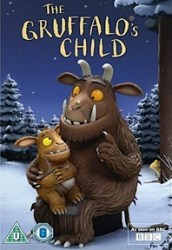 Shown on BBC One over Christmas, this animated adaptation of Julia Donaldson and Axel Scheffler’s The Gruffalo’s Child is the sequel to the Oscar-nominated adaptation of Julia Donaldson and Axel Scheffler’s The Gruffalo (of course). For my money, it’s every bit as good as the first film.
 RED here stands for “Retired, Extremely Dangerous”, a description bestowed by the CIA on a group of former agents who, for reasons I won’t go into — because, quite frankly, I can’t remember — fight back against the Agency when someone starts trying to kill them.
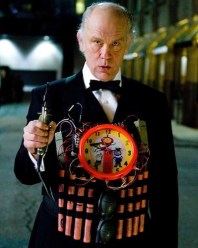 Naturally, considering the theme, the cast is made up of older actors — a neat twist on the usual action movie format of making people younger and younger. Expect this to spread, especially as anyone that could still just about be dubbed a movie star is ageing, replaced only by flash-in-the-pan teen idols. They’re all great because they’re all great actors. Well, Bruce Willis isn’t a Great Actor like Helen Mirren or Morgan Freeman, but he can do an action movie and he can do humour well enough. John Malkovich is as barmy as he always is, but here it works. Sometimes things just line up like that. Karl Urban also gives another solid supporting turn. I’m sure he’s had a few lead roles at this point, but maybe this autumn’s
 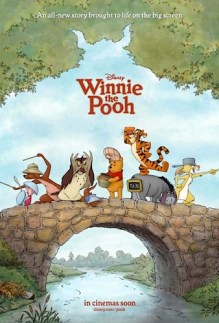 Winnie the Pooh, as many reviews on its release were keen to point out, is for small children. It doesn’t have the attempts to placate adults with their own jokes that elevate/plague most American animation; it’s only an attention-span-friendly hour long; and it has a lovely, genial, friendly tone, with brightly coloured characters, plinky-plonky songs and heartwarming moral messages.
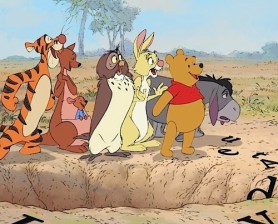 The majority of the film’s other elements click into place nicely too. The traditional animation is gorgeously executed, the voices are the ones we surely all know from growing up alongside Disney’s Pooh output, particularly Jim Cummings pulling double time as both Pooh and Tigger, as he has for decades. The exception I’d make is Bud Luckey’s Eeyore. I don’t know if he’s always sounded like that and I’d forgotten, but his voice didn’t work for me. It’s not the only problem: the songs can be a bit insipid; equally, a couple transcend that to work beautifully; and there’s no denying that it is a bit short; but then it doesn’t outstay its welcome, and hey,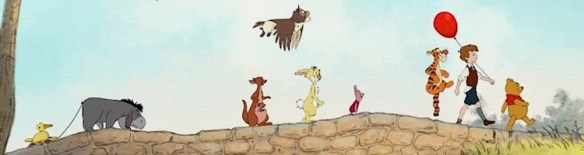
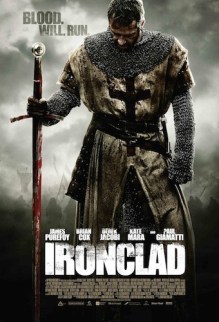 In medieval times, a group of filmmakers set out to prove you can make a Hollywood-quality historical action epic with independent funding in Britain, while in the present day a ragtag group of seven samurai— sorry, gunslingers— sorry, warriors, defend a small town— sorry, castle, from evil bandits— sorry, an evil king.
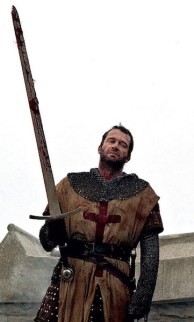 Anyway, it seems to me its use of facts are probably strong enough to support it as an entertainment. So some of the story structure may be reminiscent of
  I’ve seen some complain about the level of graphic detail in this regard, but this is medieval times, they didn’t just bump each other about a bit; and you don’t think a giant axe swung down on someone’s shoulder with all a man’s weight is going to just leave a scratch, do you? Director Jonathan English doesn’t linger on detail as if this were a horror movie. There’s cleaved bodies, severed limbs, squirts of blood and more, and it all feels gruesomely realistic, but individually each moment passes quickly.
 I imagine it also makes some of those fight scenes even more disorientating, which is a pity. Nothing will help the sometimes-too-obvious use of digital video though, which looks as nasty as ever.
 The unfamiliar true story also gives it the added edge of not knowing who lives or dies, or whether our heroes even succeed. If the ultimate end feels guessable, I think it’s only in retrospect. Of course, that doesn’t mean any of it’s historically accurate anyway.
 100Films.co.uk