
Gore Verbinski | 112 mins | Blu-ray | 2.40:1 | USA / English | PG
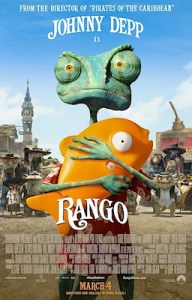 There seem to be an increasing number of live-action directors sticking their oar into animated films; and not just lending their ideas and name, as Tim Burton did with Nightmare Before Christmas, but properly directing them. Robert Zemeckis’ mo-cap obsession has given us that Christmas one, that other Christmas one, and Beowulf; Tim Burton supervised the stop-motion himself in Corpse Bride; then there’s Zack Snyder (Legend of the Guardians*), Steven Spielberg (Tintin), Peter Jackson (Tintin 2), and, here, first-three-Pirates helmer Gore Verbinski.
Perhaps this is because the increasing prevalence of CGI in big-budget movies (which all of these directors have also been responsible for) means the transition to 100% animation is easier — indeed, as I’ve said before, Avatar is classed as live-action but is basically a motion-captured animated film with a few live-action bits. This theory has added weight when you look behind the scenes at Rango: rather than teaming up with an established animation producer like Pixar or Dreamworks, Verbinski assembled his own team of pre-production creatives, wrote and designed the entire film independently for 16 months, then took it to ILM — who had never done an animated movie before — to do the heavy lifting. (The story of how the film was made is pretty much as interesting as the film itself, with Verbinski and ILM bringing their live-action-honed methods and sensibilities to bear on the production of a fully computer animated (not mo-capped) film. I heartily recommend the two documentaries on the Blu-ray. If you’re interested but don’t have the BD, you could do worse than read this article.)
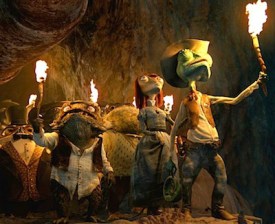 Indeed, perhaps the most striking thing about Rango is ILM’s hallmark, the extraordinary realism. Though some of the characters are rendered cartoonishly (just look at Rango’s face) and all are of course anthropomorphised, the textures and lighting are as true-to-life as any of their work in live-action movies. They consciously went for a photographic look, as if it had been shot with real cameras, including consultation with Oscar-winning cinematographer Roger Deakins, and it paid off because the whole thing looks incredible. I know I only just recommended it in the last paragraph, but the making-ofs are really great for an insight into why the film looks and feels so different to most current computer-animated films. The sequences of them recording performance reference are incredible — they essentially shot some scenes in full, with the entire cast, in costume, with full props, some sets, blocking, marks, camera angles, improvisation… (The only thing lacking on the Blu-ray is a Sin City-style full-length version of the movie using that footage.) Even though it’s not mo-capped (Depp refers to their performance-reference recordings as “emotion capture”), they used a mo-cap studio with virtual sets so Verbinski could find angles and so on — all the tools he’d have on a live-action set.
Is it cheating to make an animated film this way? Some people object to motion-capture; is this as bad, or worse? Some will say so; personally, I don’t care — it’s the final product that matters, not how you got there. Though how you got there can make for a damn fine story. (Watch the making-ofs.)
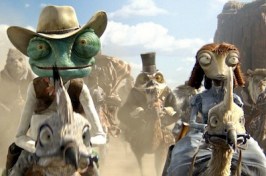 Back to the film itself. I know it’s less interesting, and it is far too slow at the start, but when it eventually gets underway it becomes very entertaining. Somewhere in the middle there’s a five-minute wagon/bat chase that’s a properly exciting action sequence, excellently realised. It was so good I watched it again immediately afterwards. It’s got a clever use of Wagner too, as well as some regular Hans Zimmer action scoring. Zimmer’s score throughout is top quality, referencing Morricone and all the other staples of Westerns.
There’s the quite dark, twisted, alternative designs for characters and locations — not too much (it’s still kid-friendly), but it’s different to what Disney, Pixar and Dreamworks are doing (after early attempts at realism, they seem to be really amping up the cartoonishness now). The cast are great, though there’s much fun to be had spotting voices: some are obvious (Depp, Ray Winstone), others not so much (Isla Fisher, Alfred Molina; Bill Nighy!). There’s a good John Huston impression by Ned Beatty, and Timothy Olyphant’s Clint is so spot on I checked it wasn’t actually him.
For the cinephile viewer, Rango plays as one big homage. The obvious is its deployment of all the cliches and tropes of a Western, including a relatively subtle nod to The Man With No Name (the lead character identifies himself as Rango, but his real name? We never learn). I’ve seen some commentators berate it for this, but it’s clearly paying tribute to the genre, not being a shameful attempt at it.  The plot, however, is clearly borrowed from Chinatown, but it plays out differently and there’s a clear acknowledgement of the similarities in its portrayal of the Mayor. Again, it’s homage, not rip-off. It does enough under it’s own steam on both fronts to avoid accusations of plagiarism, in my opinion.
On the down side, some of the ‘humour’ is a bit too mucky for my taste. The number of toilet-related gags goes way beyond necessary, and it’s slightly depressing that at least as many are aimed at adults as children. This is where a lot of the extended cut’s four-and-a-half-minutes comes in, incidentally, as this comparison shows. In their opinion, while the extended version’s jokes are still PG-level, they may have been cut to make sure it was absolutely family-friendly. (If you have access to the Blu-ray and want to see the added material without trying to spot it in the film itself, try the deleted scenes section — pretty sure that’s just the stuff from the extended cut.) Aside from muck, there’s an extended ending, though I’m not sure what I think of it. There’s a bit about a final sunset shot which is quite good, but I like the theatrical ending’s mirroring of the opening with the mariachi birds. All things considered, the coda was probably a wise excision in cinemas.
 With its detailed references to other films and real-world visual aesthetic, Rango may be more likely to find appreciation among grown-ups than the children who are the typical target for English-language feature animation. Then again, there’s that immature humour I mentioned. A ‘family’ film indeed. Either way, it’s an entertaining addition to — and alternative from — American animation’s usual offerings.

* which has nothing to do with Rise of the Guardians, even though that crazed mash-up looks like a Snyder film. ^
 Pixar, oh exalted studio of wondrous excellence, who produce naught but critically-acclaimed and audience-beloved films that may as well just be given the Best Animated Feature Oscar without the need for fellow nominees, dropped the ball with
 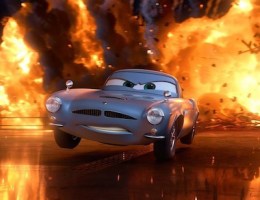 here we get an international spy movie — much more fun. The espionage stuff is clearly inspired by Bond (the primary secret service is British, for starters), and the opening eight minutes — an action sequence starring the film’s Michael Caine-voiced Bond analogy — is probably the best stuff in either Cars movie. Actors like Caine and Emily Mortimer lend the whole affair some much-needed class.
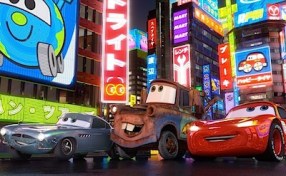 the back-and-forth battling, the last-minute surge, etc etc — so it’s not really any loss.
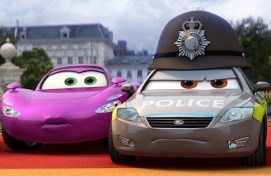 why is the police car wearing a giant hat?!
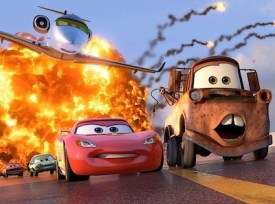 entertaining films, how can they also produce something so uninspired?
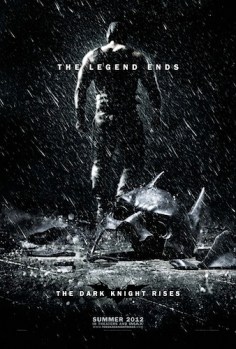 Everyone and their mother will be writing about The Dark Knight Rises over the next few days — I’m sure there’s already been an explosion in articles, blog posts and comments on both, not to mention various related terms trending on twitter almost constantly for most of the week already — so I figured I may as well add my voice to all the thousands shouting into the dark. But rather than a full review (which I’ll save for when things have quietened down a little, and perhaps there’s some kind of consensus or even just other reactions to respond too), here’s a couple of stray thoughts and paragraphs that immediately struck me.
 Remember when M. Night Shyamalan was the wunderkind of Hollywood? Seems so long ago, doesn’t it? But clearly someone somewhere is still invested in him — or he’s managed to limp on well enough that stuff he works on seems worth a punt — because a couple of years ago he was able to launch a series of films dubbed “The Night Chronicles”. I don’t remember the details and they’re not worth looking up, but as I recall the idea is they were a series of low-key/low-budget horror-thrillers conceived by Shyamalan (he has a Story and Producer credit here) but helmed by others. Devil is the first of these. I don’t recall a second turning up yet.
 not the best, but with enough action, intrigue and twists to fill its (admittedly very brief) running time. It comes to a head with a pretty good twist/reveal. Again, it’s kind of ironic that it’s the best twist in a Shyamalan film for years, but it comes in a movie he neither wrote nor directed. Maybe he should take another look at the kind of films he’s choosing to make. (I say “maybe”…)
 As an aside, in my occasional run of Comments Paying Too Much Attention To Certificates, it’s funny what Americans allow at what age rating. Here we have neck stabbing, hanging, creepy devil stuff… Seems a bit much for a PG-13, to me. The UK’s 15 is much more appropriate.
 This year’s 52nd film is, in many ways, thanks to DC’s The New 52 (the comic book initiative/publicity stunt that saw DC relaunch their entire universe across a series of 52 new #1 issues, for those who don’t do comics): it got me back into reading regular comics, and featured in multiple titles for several months was a cool-looking advert for the US release of Detective Dee, complete with the attractive review quote, “
 To take Time’s opinion as a starting point, I have to wonder if they would rank Detective Dee so highly if it had been an American-produced film with actors speaking English. I don’t mean if the film was Americanised, but exactly the same, just an American production. In that instance, I think it would very much be viewed as a summer blockbuster, because that’s definitely what it strikes me as. It’s one with lots of talky bits and an over-complicated story, certainly, but then it’s not unheard of for US blockbusters to confuddle the viewer with an under-written over-developed plot (less so these days, I grant you).
 not in awe of the performer’s abilities or entertained. One of them features the hero fighting a gaggle of cheap CGI deer. Yes, deer. Why?
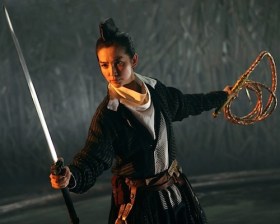 and they happily take its advice (see second paragraph)), a fighter whose arms fly off and turn into… something else (choppy editing means I’m not sure), facial transfiguration (imagine
 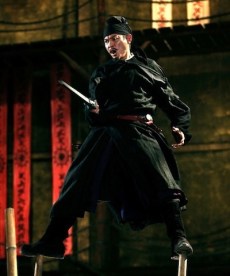 you could enjoy the characters, or the political machinations, but only if you take time to study them slowly and work out what was going on for yourself, because the film’s in too much of a rush to explain it to you. There’s something to be said for entertainment not spelling everything out — it’s often a highly-praised element of anything that achieves it — but Dee doesn’t do that, it rushes headlong past things that could do with more clarity. (One thing I should do is listen to Bey Logan’s commentary — there’s a fair chance he’ll have insights that illuminate me. But in a moment you’ll see why I haven’t done that before posting this.)
 I’m a bit young to have experienced seminal ’80s TV series
 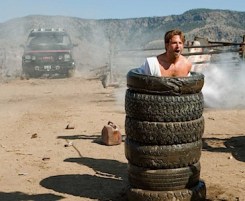 As much as I like serious action, I enjoy this kind of film too. I gave RED four stars; Shoot ‘Em Up the same. You may see where this is going. I am, once again, probably being too generous.
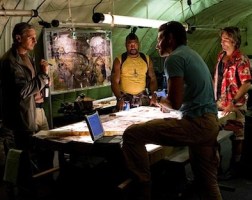 if that doesn’t or didn’t interest you, there’s no need for it. That said, one scene is apparently “big and puts some drama and emotion into the movie, maybe a bit too much for a PG rating”. (In the UK,
 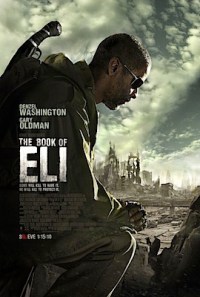 The directors of
 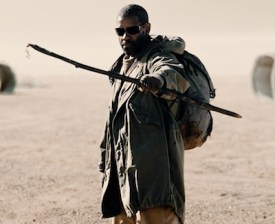 The music is by Atticus Ross, which was interesting because I’d thought it was reminiscent of
 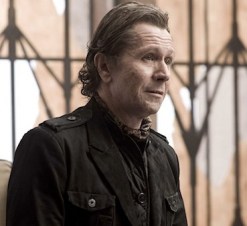 Late on the film pulls out surprise appearances from Michael Gambon and Frances de la Tour. Their roles aren’t even close to needing thesps of such calibre though — they appear fleetingly, the actors underused. Particularly Gambon, who really has nothing to do except fire a gun. I know it’s usually a joke to comment that a usually-better cast member must have needed the money, but that’s the only reason I can imagine he’s here.
 Newman concludes that “you can’t help feel you were invited to a party with fizzy pop and cream cake and got suckered into a sermon instead.” I couldn’t have put it better. Eli starts off with the potential for an arty 5; slips slightly to a solid 4 when the standard post-apocalyptic trope of a gang fighting for local power comes in to play; unsteadies that 4 with an increasingly atonal second half; and quite frankly borders a 1 with its sickening ending.
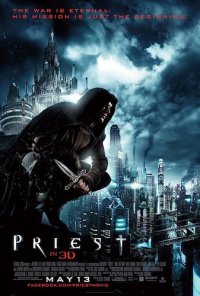 In a dystopian church-ruled future (could there be any other kind of church-ruled world), in which a war between men and vampires raged for centuries but has recently been settled (in man’s favour), no-longer-needed warrior-priest Paul Bettany is called upon to go against his vows and leave the city to rescue his niece after her parents are murdered and she is kidnapped in a vampire attack. I could go on, but it’s the kind of plot that sounds far more complicated in a short summary than it is to watch on screen.
 And after all that meandering, the story is a bit rushed. It tries to generate character and tension, but hasn’t spent enough time building them to earn it. There’s lots of awful dialogue, flooded with clichés… as is a lot of the plot, and the stock dystopian future setting, and the overuse of slow-mo. There’s some ideas with promise, but they’re largely shunted aside in favour of something from The Big Book of Standard Character Arcs. And I say “promising” — you know exactly how they’d play if the filmmakers had bothered to make more out of them.
 None of this is helped by weak acting, which considering the largely quality cast is probably down to the script and direction. How unlikely is Paul Bettany as an action leading man, eh? I thought Jason Statham was odd enough… And if you want a preview of
  Priest isn’t bad per se — well, depending on your tolerance levels. It’s no
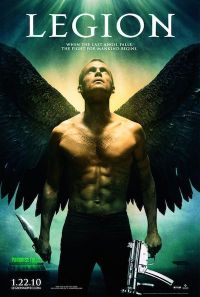 The first of two Christian-themed action movies directed by former visual effects man Scott Stewart (this his first feature as director) and starring British thesp Paul Bettany (here he plays a gun-toting angel,
  Even the action sequences not up to much, just guns firing and things exploding in the dark with almost no choreography. As an action movie you might forgive it some of the plot and character points if it could manage that, but it can’t.
 If 2009’s
  though perhaps not always as memorably, and Ritchie crafts an array of interesting action sequences. Some still accuse it of being a sub-
 Yet for all that, that climax is a game of chess: Sherlock and Moriarty come face to face while in the room next door Watson and gypsy Simza try to spot an assassin. It’s one of a couple of scenes where Downey Jr.’s hero comes face to face with his nemesis, played by Jared Harris, and these scenes are definitely some of the film’s high points. Harris makes a perfect addition to the cast, the only disappointment being that we don’t get to see even more of him. Downey Jr.’s become such a Movie Star recently that it’s easy to forget he’s a multiple Oscar-nominee, and he and Harris give as good a hero-villain act-off as you’re likely to find in a blockbuster.
 Better served is Stephen Fry as Mycroft, a role normally rendered as a brief cameo. And indeed it’s little more than that, but there’s more of him than I was expecting (certainly so in one (pointless aside of a) scene that I’m sure you’ve heard about), and Fry of course excels — it’s the kind of role he was made for. Meanwhile the award for best agent goes to Eddie Marsan’s: Lestrade appears late on for all of two shots, but Marsan is still billed high enough to be on the poster, above most of the cast.
 A Game of Shadows comes out as a fun ride with several stand-out moments, but not as a particularly exceptional version of Sherlock Holmes. It’s very enjoyable as a comedy-action movie with amusing characters and entertainingly-staged action sequences, but while my affection for the first has grown to make it one of my favourite movies, this is just an entertaining follow-up.
 100Films.co.uk