
Nimród Antal | 107 mins | Blu-ray | 2.35:1 | USA / English | 15 / R
 It’s two-and-a-half years since this was released? Never! If it didn’t say so on multiple websites, I’d never believe it. Where does the time go?!
But anyway…
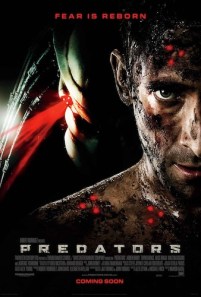
Predators is writer-director-producer-editor-composer-etc Robert Rodriguez’s attempt to relaunch the Predator franchise, after the mediocre Predator 2 killed it in 1990 and the utterly appalling Aliens vs Predator 2 killed it again in 2007. Based on the fact we’re two years on and there’s been no word of a sequel, I guess he didn’t succeed. Which is a shame, because the original film is fun action/sci-fi entertainment and this is very much in its spirit.
Based on a screenplay Rodriguez wrote in the mid ’90s (deemed too expensive at the time, and since re-written thanks to other films doing some of the stuff in it (chiefly Avatar, apparently)), Predators sees a bunch of unconnected people dropped into a mysterious jungle. All of them have some skill in the field of death-dealing — except, that is, for a doctor — and most are armed to the teeth. Where are they? Why are they there? And what’s that coming after them?
I’ve left my plot description vaguer than most you’ll find, including on the film’s own DVD/BD releases, because the more you know the more the early part of the movie drags. Most blurbs give away the revelations contained within the first act, which makes it an almost gratingly slow start. I reckon it would probably work well in isolation, but I’m not sure how many people are going to see this without having heard more of the premise than I’ve let on. When you know where it’s going, it seems to plod a little; equally, if all you know is that a group of people face a gang of Predators in a jungle then it works fine (it still takes the aliens a while to show up, but then so does the original).
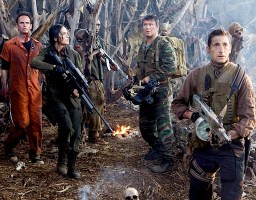 It’s a similar story elsewhere in the film. If you haven’t already accurately guessed what the ‘twist’ is with the doctor just from me even mentioning him, then I’ll be surprised. You may also be aware that Laurence Fishburne is in the film — he’s in the trailer and, naturally, one of the top-billed names. If you weren’t aware, sorry; but if you are (as, indeed, you now are), then his lack of appearance early on will likely clue you in to the circumstance under which he’ll be found. But if you’re not expecting him, that’s all fine and dandy. But now you are. Sorry.
In fairness, the story does manage to pull out a few mysteries. There’s a fair share of action sequences too, naturally, but it’s not an entirely stock plot merely peppered with gunfights. Rodriguez and co have made the effort to push the mythology in new directions; ones which seem to build naturally out of other Predator media, even though those aren’t specifically mentioned. Indeed, although there’s a direct reference to the original film (plus a smattering of callbacks in dialogue), the production team were told to avoid looking at the other films, games and comics for inspiration. You’ve no need to suffer anything else to enjoy this. Indeed, it works even without seeing the original film.
In the special features Rodriguez comments that the film could function even if the Predators didn’t turn up, because you’ve got a gang of characters who might be quite happy to turn on each other if need arose. There’s nothing revelatory amongst the gang of humans, but they’re more characterised than the simple canon fodder of the original film, and the relative dearth of big names will keep you guessing as to the order of their inevitable dispatch.
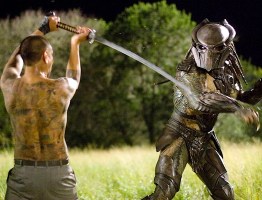 The main draw is still the action, which is suitably exciting on the whole. Best of all is a sword fight between a Yakuza and a Predator. Who’d’ve thought of engaging a Predator in a sword fight, eh? I love a sword fight, and while this is of course an atypical example, it shows the film’s level of creativeness with its inherited elements. It’s also a beautifully shot segment, making it one of the stand-out parts of the film.
Most of the direction is as good, though I have to mention it because of one unfortunate trope it develops: there’s an awful lot of lingering shots of the cast Looking At Something behind the camera, before we get to see it. Once you notice this — and you may well, like me, notice it pretty early on — it quickly becomes unintentionally comical, because it just. Keeps. Happening. And even when you think it’s gone, it makes a last-minute resurgence at an inopportune moment. I’m certain this wasn’t a deliberate comic device — it was probably employed to add tension and mystery and all that — but, for me, it just became a bit of a joke.
Then there’s the awful atmosphere-ruining end credits song. Honest to God, there’s weird artistic flourishes, and there’s immediately trashing the mood you’ve just strived to create. I know why it’s there — it’s another reference to the original — but it’s a glaring clash of styles that shatters the very particular ending the film has. On the commentary, Rodriguez asserts that it “deflates the tension in a great fun way.” Hm. Hmmm. What a misstep.
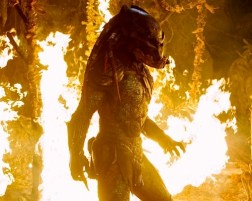 And the ending itself… is it sequel bait? It’s not as bad as Prometheus — an unintentionally resonant parallel given the franchises’ shared history, but not an inappropriate comparison. But where Ridley Scott’s confusing picture leaves glaring unanswered questions that demand a Part 2, Predators’ conclusion is both open-ended but also somehow fitting. Which is lucky, because I don’t think a follow-up is forthcoming.
For all the criticism, or gentle ribbing, I’ve levelled at the film throughout this review, it’s an enjoyable experience. There’s nothing deep or meaningful, and nothing that will enliven or revolutionise the genre, but as a sci-fi/action movie it’s at least as good as its blokey-classic predecessor.

The UK TV premiere of Predators is on Channel 4 tonight at 9pm.
This review is part of the 100 Films Advent Calendar 2012. Read more here.
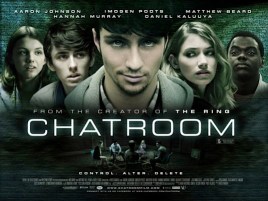 Chatroom is born of — or, at least, partly formed around — trying to find a viable way of depicting the world of online chatrooms on film. Putting on film this world it As It Really Is — people sat at a computer typing at each other — might work well enough for a single scene in
  in this environment is also truthful. There have been many reviews that are completely dismissive of this facet of the film, leaving me to wonder if they were written by people who haven’t used or experienced such things. It’s a shame, then, that the film’s degeneration into a thriller hides the arguably-worthwhile potential to explain to such people what that online world can be like for people/kids using it.
 Despite a strong-ish start, perhaps the whole second half of the film is a wobbly mess; not directionless exactly, because by then it does know broadly where it’s going, but it doesn’t do much to suggest to the viewer that it has a real goal in mind. Character motivations and relationships feel as if they’ve not been fully thought out, or at least not fully brought together on screen. Some threads take inexplicable jumps; others aren’t adequately explained or justified. Occasionally it’s Nakata’s direction that overdoes things, for instance laying the soppy “this bit is emotional” music on thick when Matthew Beard’s performance could easily carry a particular sequence.
 The aforementioned Matthew Beard, perhaps the least recognisable cast member (his
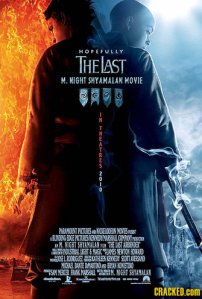 Consensus holds that the work of once-acclaimed director M. Night Shyamalan has managed a near-perfect trajectory of decreasing returns. I’m not talking about box office — I have no idea (or much interest) in how that’s gone for him — but quality, starting with supernatural chiller
 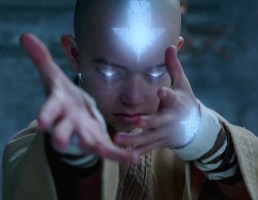 Chunks of it seem to be missing, conveyed through clunky voiceover rather than on-screen action. The first rule of screenwriting — literally, the first — is Show Don’t Tell, but Shyamalan does exactly the opposite.
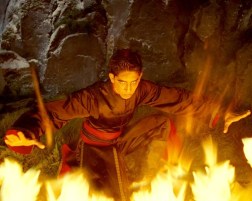 I wouldn’t call myself a Shyamalan apologist, but I think he has at times suffered harshly at the hands of critics and audiences disappointed that he’s never re-reached the heights of The Sixth Sense (though, personally, I prefer
 Mainstream US superhero comics underwent something of a revolution — or an evolution, if you prefer — in the ’80s, moving from simplistic good vs evil tales-of-the-week to deeper, thematic- and character-driven stories that in some cases took months or even years to relate in full. It’s a change that’s still felt today (some would contend that they’ve been stuck for decades in a rut these developments ultimately led to). It’s generally considered that there were three works at the forefront of this wave of more adult-orientated comics, all of which still rotationally top Best Graphic Novel Ever polls today: Alan Moore and Dave Gibson’s
  Like Year One before it, the team behind these direct-to-DVD DC animated movies have taken a reverent route to bringing DKR to the screen. It’s in two parts because the original story is too long to faithfully adapt in their limited-length movies (it’ll work out at about two-and-a-half hours all told, which isn’t commercially viable for a direct-to-disc animation), but that also works out OK from a storytelling point of view: this first half ends with a major threat wrapped up and a great cliffhanger to kick off the second half. Those with less appreciation for the economics of film production have slated DC/Warner for splitting the film in two like this, but in some ways it works to its benefit artistically as well as commercially.
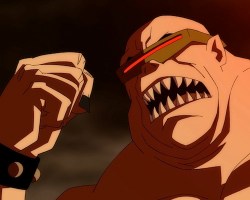 Stylistically, the film retains Miller’s designs, albeit a bit smartened up to work consistently as animation. Some will bemoan that homogenising but others may delight in it — Miller’s art is generally a bit on the scruffy side, I think. Is it an appropriate mark of respect that they’ve translated it so literally from page to screen, or would it have been more interesting for the filmmakers to have taken Miller’s plot and situated it in a world drawn from their own designs? I’m not going to argue that they could have improved on Miller’s work, but it might have been interesting to see the story given a spin in a different artistic style.
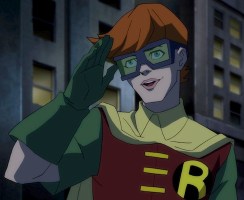 Voice work — the other major addition of an animated re-telling, of course — ranges from solid to very good. I wasn’t convinced by the casting of former RoboCop Peter Weller as Bruce Wayne/Batman, but he’s pretty darn good, carrying exactly the right kind of aged gruffness. It’s unique, I think, to see an active Batman this old on screen — sure, Nolan forwarded things eight years for Rises, but he’s still played by a relatively young and fit Christian Bale, whereas this Batman is grey, in his mid 50s and looking even older. I don’t recall a significant weak link in the rest of the cast, with
 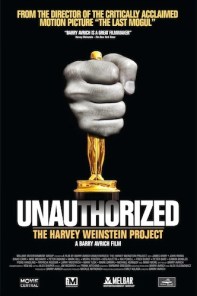 The documentary that Weinstein reportedly tried to stop existing, including discouraging people from participating in interviews. Either he needn’t have worried or really is a complete megalomaniac, because while there is a certain warts-and-all aspect to Avrich’s cinematic biography, it can’t help but admire all that Weinstein has achieved.
 Even for those who were following film culture through this era, and in spite of Harvey’s apparent efforts, there are numerous interviewees who were there — former Miramax employees, for instance — to offer insight. Thanks to archive footage we get even more opinions, including a fair few comments from Harvey himself. How much of this was available at the time, I obviously don’t know. Even if it is mostly recap, it’s a concise and well-constructed one.
 Bill Cunningham is 80. He lives in a small rent-controlled apartment in New York City that is filled with filing cabinets. His bed is little more than a mattress on some boxes. Each day, he dresses in the same distinctively simple blue smock and sets out on his bicycle. He eats at the same places each day; simple cheap food, cheap coffee. He doesn’t have a partner or kids; he may never have had a romantic relationship. He doesn’t watch TV or listen to music. It sounds like some kind of life of poverty or religious devotion. It’s neither, although you could make an argument for the latter, because all Bill does all day is photograph what people wear.
 Bill is, technically, a fashion and society photographer. His real passion, however, is clothes. Real clothes. The clothes people actually wear and how they wear them. His newspaper column — a collection of photos from the streets — is essential reading as far up the chain as Anna Wintour. He doesn’t set trends, he observes them. Exposes them, you might say, because in the past he’s used his work to call fashion designers on where they’ve copied (consciously or not) the work of another from years before, and that has sparked arguments.
 What he actually is, more than a “fashion photographer”, is a documentarian, recording how people choose to present themselves to the world, both as individuals and how that translates en masse. Fashion may seem like a meaningless, arbitrary, frivolous thing to afford such time to, and I’d have no argument against Fashion being called exactly that. But fashion — the actual clothes we wear in our actual lives — is something a good many people spend a good amount of time obsessing over; it’s how they choose to represent themselves in the world, how they indicate what they’re like as a person, how they show which groups or types of people they align with. We all do it, even if it’s not a conscious choice. Surely that’s worth recording?
 But that’s all an aside, probably because it’s so well done. What might be worth picking up on is that there’s no specific story. There are stories in there — like how Carnegie Hall is kicking out its handful of 80- and 90-something resident artists to make way for more office space — but the film doesn’t have an overarching tale. It’s a portrait; one of a fascinating, unusual, but likeable, and certainly unique, individual.
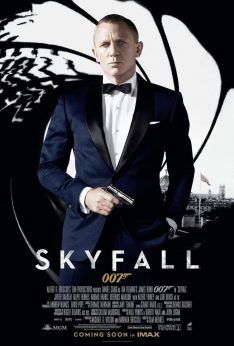 Bond is back, and you’ve surely seen the torrent of 4- and 5-star reviews (and the insignificant handful of dissenting voices). I’m pleased to report that the consensus is correct: Skyfall is Bond at his best.
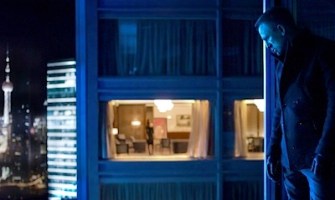 Technically speaking, the film looks gorgeous thanks to Roger Deakins’ cinematography. Best looking Bond ever? There’s little I can think of to dispute that. Obviously it could be said to lack some of that ’60s glamour, but from a purely photographic perspective, it shines. (Incidentally, this shot isn’t actually in the film.) I’m less sold on Thomas Newman’s score. While in no way bad, and with undoubted sparing but precise use of the Bond theme, it didn’t always click for me. The fact I at times felt like I was listening to cues from
 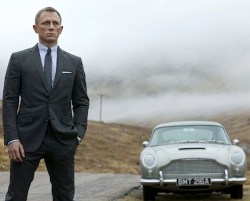 honestly, there perhaps aren’t as many twists as you might expect in that department, but the ways they’ve nodded to the franchise’s history are sublime.
 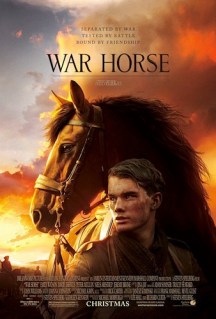 After decades telling tales from the Second World War, Spielberg moves back a conflict. That said, the BD’s special features make sure to point out this “is not his First World War movie” — it’s just a good tale about a boy and his horse.
 It can’t be denied that there’s factual inaccuracy here (the climax takes place at the Somme in the lead up to Armistice Day in 1918, but that battle was actually fought in 1916), or the occasional heavy dose of sentimentality (it’s directed by Spielberg and co-penned by Richard Curtis — what did you expect?), but I think it carries through these with a scale and heart that is, primarily, entertaining. It is based on a children’s novel and I think aims to be a family film (it should by rights be a PG; my twitter rant on that subject is
  Aiding the sense of the epic is Janusz Kaminski’s cinematography, which is regularly stunning and definitely one of the film’s standout achievements. The beauty of some shots is immediately obvious — he lenses the countryside idyll of Dartmoor in a sweeping fashion, bathed in summer sunlight — but there are striking compositions to be found throughout, be they in close-ups, cavalry charges, horse auctions, battlefield hospitals… There’s often a lovely texture to things too, from the likes of drifting snow or chaff, or the way light streaks across a room. The final scene, fully tinted orange, calls to mind the likes of
 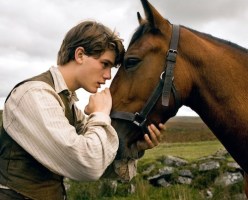 one that isn’t afraid to depict some of the nastier realities of the world, but in a way that makes them relatable for a younger audience. I think that’s important; but this isn’t a Worthy Film for that, it’s just something it does well. I think it also nails sensations of adventure and, yes, sentimentality.
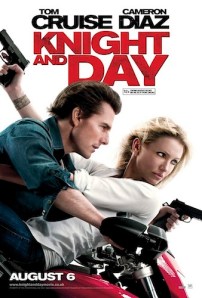 James Mangold is one of those filmmakers with a thoroughly eclectic CV, taking in crime thriller
  Knight and Day is nothing deep or revelatory or groundbreaking, but if you were expecting it to be then more fool you. If you can’t abide Cruise or Diaz (and I know some people really can’t) then it should certainly be avoided, but those caveats aside I thought it was good fun. No classic, and far from destined to be a standout on Mangold’s multi-Oscar-winning filmography, but an appropriately entertaining couple of hours.
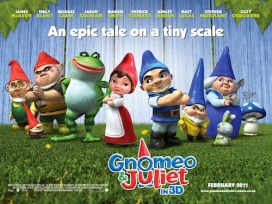 Gnomeo & Juliet is the latest British attempt to crack the lucrative CGI animated kids’ movie market, after the lack of success (or, alternatively, failure) from the likes of
  My only other note is that it ends with a truly awful cover of Crocodile Rock by Nelly Furtado. A storyboarded “all’s well that ends well” ending (included on the BD, and the DVD for all I know) looks much better.
 100Films.co.uk