
Tony Gilroy | 135 mins | Blu-ray | 2.40:1 | USA / English | 12 / PG-13
 As Jason Bourne flits around London and New York making trouble for what’s left of Treadstone, a group of shady men go about safeguarding their own secretive activities. When Bourne exposes Treadstone, a series of convoluted join-the-dots links means it could bring them down too, so they set about destroying their risky initiatives, including killing a bunch of medically-enhanced operatives. What they didn’t count on was one surviving…
That basic setup covers roughly the first 30-40 minutes of The Bourne Legacy. Normally I’d hate to describe so much of a film, but it’s not my fault that co-writer, director and Bourne series veteran Tony Gilroy takes that long to get his story up and running. And it’s another 20 minutes before the real meat-and-potatoes of the tale begins.
And it feels it, too. About 52 minutes in I paused it and went to the kitchen. Not for any particular reason; I just needed a break. There, I saw a slug crawling into my dog’s water bowl, drinking the water or something, I don’t know. I’d never seen that before. I ended up watching that slug slowly edge around the bowl for 15 minutes or more rather than go back to the film. It’s that engrossing.
Gilroy has written or co-written every Bourne film to date, so you’d think he knows his way around the franchise — and he does, but perhaps too well. Each Bourne sequel has basically relied on the same formula: “the conspiracy was bigger than you thought, and now the next level up want Bourne dead”. That was fine in Supremacy — indeed, it took characters left dangling from Identity and wrapped up their roles. 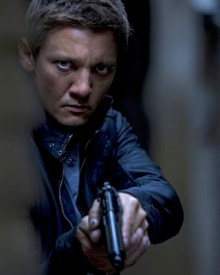 For my money, Ultimatum felt like it re-hashed this storyline, bringing in new characters to force a new level of backstory and hierarchy. (Clearly most viewers didn’t mind, as it’s widely regarded as the best Bourne film.)
And Legacy recycles this idea for a third time. Now, Treadstone and Blackbriar are just two of many such programmes run by the CIA and/or some shadowy higher organisation I’m not sure is real. On the bright side, they’re not after Bourne, but new escapee Aaron Cross. Not that it makes a huge amount of difference.
If such a repetitious story wasn’t bad enough, Gilroy spends a ludicrous amount of time setting it up. The beginning of Legacy overlaps with the end of Ultimatum, showing us in dully intricate detail what the numerous new CIA characters were doing during that time. And intercut with that we have our new hero wandering by himself across Alaska. For half an hour. This isn’t an art film meditation on isolation, it’s an action thriller — get a bloody move on!
What did Gilroy lose between Ultimatum and this? Well, co-creators. He co-wrote Identity and Ultimatum, and had two different directors across the first three films. Here he’s responsible for the story, co-writing (with his younger brother), and directing. He undoubtedly has some degree of talent, but maybe the other voices were essential to honing it. The other thing a fresh perspective could bring is fresh ideas. If Gilroy has rehashed the same basic plot three times now, surely they need someone with a new story to offer?
 Perhaps also, after four films, he’s too close. Clearly that has advantages for remembering the intricacies of the timeline and continuity, especially with the trilogy’s increasingly complex web of conspiracies and conspirators; but maybe Gilroy has become too deeply embroiled in that. After all, he thinks it’s OK to spend the first half hour of the film connecting up the dots between the previous story and his new plot — who really wants that? That’s for geeky fans to do later.
And yet, for all that, the timeline doesn’t quite make sense. If we assume Identity is set in 2002, because that’s when it was released, then Supremacy is two years later, in 2004. Ultimatum is six weeks after that, so late 2004 or early 2005, and Legacy is immediately after that (as I said, the start overlaps). So, it’s set seven years ago? But a character finds a moderately key plot point on YouTube as if it’s the most natural thing in the world… but the very first YouTube video wasn’t uploaded until April 2005. I guess the films operate on a sliding timeline now, much like long-running superhero comics or the Bond films. That or The Bourne Identity is really a sci-fi film set in the Future Year of 2009. Considering the ‘science’ brought to bear in Legacy, perhaps that is the idea.
This is also the first Bourne film that leaves its storyline truly open. The other sequels had threads to pick up on, obviously, but if the series had stopped after either Identity or Supremacy, you’d have still had a complete tale (or Ultimatum, of course). It’s ironic, because this is also the first time I’ve been left with no desire to see a follow-up. The ending reminded me a bit of Saw IV, actually. For those who don’t know their Saw films, that takes place concurrently to Saw III, following different characters and a different storyline.  At the end, the two films come together, adding a few seconds more story to what we saw at the end of IV, and ready to move on with unified purpose (well, sort of) in Saw V. Legacy feels like it concludes the same way: we’ve been introduced to new bad guys and a new hero, and the events that ended Ultimatum have been given a few seconds more development with a new twist; so now all is ready to rejoin where we left Bourne himself and continue afresh. Except Matt Damon seems to have ruled out that idea already. And, like I said, do we really want more of these characters and their increasingly ludicrous levels of conspiracy?
Legacy isn’t all bad. When it finally moves up to second gear (after a whole hour) there’s the occasional good action sequence. The requisite Bourne car chase is replaced by a bike chase, but I’d happily argue it’s at least the equal of any of the series’ other road chases — the only part of the film that can stand up to its predecessors, because the other fights and foot chases don’t have the same edge. Indeed, a rooftop/alleyway chase in Manila is just a rehash of Ultimatum’s Tangier sequence, but not as exciting. And through all that, the story remains resolutely uninvolving.
And don’t get me started on the cast. Jeremy Renner is fine as an action man but doesn’t deliver any other significant likeable qualities here (and I don’t think that’s his fault). Rachel Weisz is normally brilliant, but here is reduced to a snivelling plot piece. They’ve made her character a Clever Scientist, which is presumably supposed to make her a Strong Female Character too, but that’s not how it’s played at all. Edward Norton  is wasted staring at monitors; Albert Finney is literally wasted, his one meaningful moment relegated to the Blu-ray’s deleted scenes section; Zeljko Ivanek gets a pivotal character but is underdeveloped and so his talents are wasted; and some actors from previous Bourne movies appear to be credited merely for use of their photos, until they turn up for ten-second cameos near the end that you’d rather weren’t there because it means someone is planning on a Bourne 5.
After the muted reception Legacy got on release I was expecting it to be mediocre — or perhaps, if I was lucky, underrated — but I thought it was mostly just boring, worse than I’d heard, and not even close to any of the previous Bourne films. They’re exceptional examples of the action-thriller, of course, but this isn’t even good as a routine genre entry, because it’s quite spectacularly dull. I do believe they could have continued this series without the character of Jason Bourne — there’s potential in some of the ideas here. But this version just doesn’t work, as a compelling film or worthy successor.

The Bourne Legacy is on Sky Movies Premiere at 4pm and 8pm every day for the next week.
It featured on my list of The Five Worst Films I Saw in 2013, which can be read in full here.
 Quentin Tarantino made his name in the ’90s with a series of dialogue-heavy gangster thrillers that provoked a storm of imitators. Since the turn of the millennium, however, he’s contented himself with a series of extravagant hyper-cinephilic genre homage/parodies. After tackling Japanese action movies in
  It’s fair to say Django Unchained sprawls. But, unlike the chapterised character-flitting antics of Kill Bill and Inglourious Basterds, it has a straight throughline it follows from beginning to end, with only a few asides. In terms of length and scope, it’s perhaps not too much of a reach to evoke
  Or how about those action sequences? Months of work training real horses to do things never before seen pays off (and Tarantino proudly displays the “no animals were harmed” notice right at the top of the credits), while the blood-drenched Candyland shoot-out is arguably one of the best pure action scenes in years. Those are amongst myriad other sequences, from the small and transitory to the epic and vital.
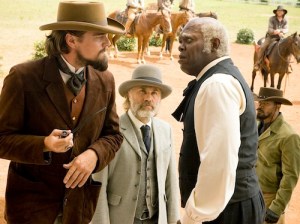 Still, best served — and, perhaps, more deserving of the Supporting Actor nod — are villainous duo Leonardo DiCaprio and Samuel L. Jackson. For starters, has Leo ever played a villain before? He’s on stonking form here as Southern gent Monsieur Candie (who can’t speak French), a sinisterly welcoming fellow with a dark side that’s on constant display. He’s all smiles and all lingering threat and menace. Indeed, scenes are often at their most tense when he’s at his nicest. I think there’s an argument for him to go down as one of the great screen villains — he even has the obligatory cool dispatch. “I couldn’t resist” indeed.
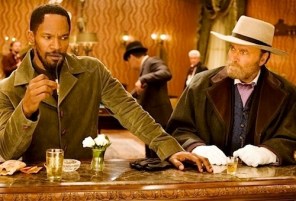 It does make you wonder if some of these people had bigger roles that got cut… or maybe there are just
 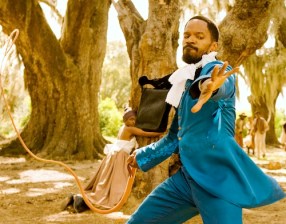 Tosh and piffle, I say. One of the best ways to skewer many an evil institution is to make them a laughing-stock, to take the piss out of them, and that’s exactly what Tarantino is doing. These aren’t likeable, funny people who are Klan members; they’re incompetent fools because they’re Klan members. The resulting scene is hilarious and deservedly one of the movie’s most memorable moments.
 After
After 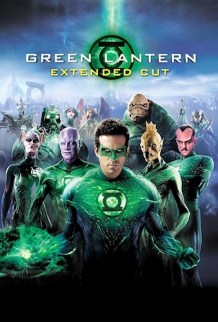 “Hype” has to be one of the biggest factors in how we view films these days. Technically it’s defined as “extravagant or intensive publicity”, I suppose thereby meaning something to “positive expectation”, but I think it also works the other way: if you’ve heard nothing but awful things about a film, its weakness has been ‘hyped’. It’s this latter point that applies to Green Lantern, which has an almost insurmountable degree of negative expectation attached. To summarise the headline points, it’s got a woeful rating of
 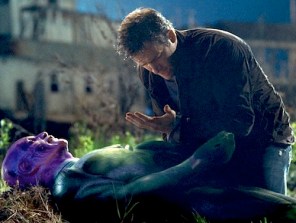 But I digress. Cocky jocky Hal is whisked off to the other side of the galaxy to learn how to be a Hero and use his ‘magic’ ring, which can conjure stuff up, then returns to Earth to save it from some menace(s). As superhero origin stories go, at least it’s got a couple of differences.
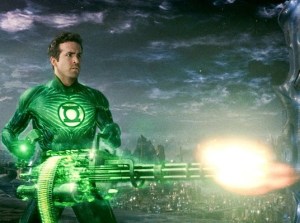 There are positives. The action sequences are good, which is a definite plus in this kind of film. The inventiveness with what the ring can do is fun. There’s a lack of relation to the sketchily-drawn characters that stands in the way of us truly engaging with them, and there’s a certain brevity and lack of scale that undersells the alleged threat to Earth (it’s a giant evil space-cloud that can barely cover a few city blocks, let alone the entire planet) — but, that aside, they’re entertaining enough. That said, much as the film pulls its punches with characterisation and threat, so it does with awe and spectacle. The Lanterns’ planet Oa doesn’t have the same impact as Asgard in
  Indeed, I’d say the Extended Cut doesn’t go far enough, with some of the disc’s deleted scenes meriting inclusion. However, the main one occurs on Oa, meaning an effects-heavy scene that hasn’t had CG work done or all the voices recorded, so couldn’t just be dropped back into the finished film as-is. I imagine that’s why it wasn’t. That said, even if they’d done such work, those scenes are minor points, not game-changers.
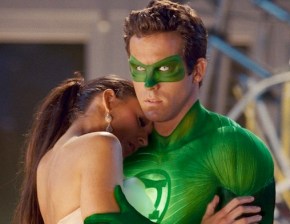 Still, I think there’s a better film lurking in Green Lantern, and it’s a shame it didn’t get the screenwriter(s) or director(s) required to bring it out. It’s even more of a shame that worse films than this have received a kinder critical consensus or huge box office. That leaves some suit feeling vindicated and churning out the same rubbish again, whereas with a bit more effort Green Lantern 2 could’ve been worthwhile.
 The first film from Seth MacFarlane, creator of
 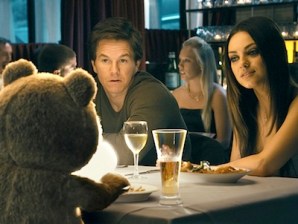 but then they’ve been known to get sidetracked into some smutty laughs on occasion, so that may not be the best example.
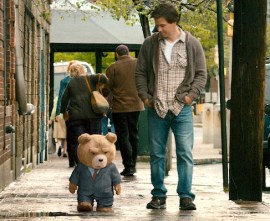 Wahlberg performances swing between excellent (
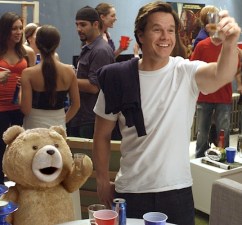 Ted is pretty much a walking talking definition of “not for everyone” — which is fine. If you like Family Guy, it’s definitely one to try (LOVEFiLM has plenty of “I love Family Guy but hated this grrr!” reviews too); if you dislike Family Guy, probably one to avoid; if you’ve never seen Family Guy, what can I say, that’s the standard reviewer’s barometer here. It is rude, is crude, and is mostly very funny. But, whatever you decide, don’t leave the kids with the movie about the talking teddy.
 Picking up more or less where
  their presence and storyline drag the film down.
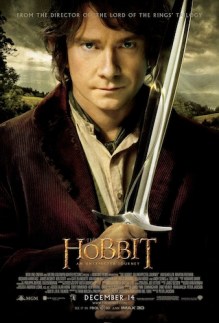 So here we are: nine years after his last tour of duty in Middle-earth, and after a Guillermo del Toro-shaped attempt at not having to serve again, Peter Jackson returns to the world of hobbits, dwarves, elves, orcs, and the rest, to tell the tale some have been clamouring for him to make since
  And, I have to say, as someone who hasn’t read the novel since primary school, I couldn’t spot the joins. I could take some guesses, but not many, and considering how long the film is I’m sure there must be quite a lot added.
 but I could have, and knowing you can do something makes all the difference. There’s also the little timer on the Blu-ray player, which means I can know that it took forty minutes to get out of Bag End rather than just thinking it feels like it. Does that somehow make it more palatable? Would I have been as bothered as others by the film’s length and pacing had I seen it in a cinema initially? It’s tough — nay, impossible — to say, because while there are those other subliminal factors, I also felt like I flat out enjoyed the film for itself, not just for my potential ability to escape it. But it is long and it is episodic, so maybe the association of watching individualistic episodes of TV back to back feeds into the acceptance of that? It’s a circular argument, so we’ll leave it there.
 Howard Shore returns to deliver another fantastic score. After he composed the iconic Fellowship theme for, um, Fellowship, I thought he could never muster anything else as monumental. And, in fairness, that theme is still the defining aspect of the series’ score (its absence here is at times felt, by me at least); but he produced another excellent motif for
  Without the breadth and world-changing story of The Lord of the Rings, The Hobbit was always going to be a somewhat smaller experience. By emphasising the backstory of the dwarves’ stolen homeland and the hints of war-to-come that will ultimately lead in to Rings’ story, Jackson has made it considerably more epic — for good or ill. For me, the whole experience clicked. I don’t think it’s as good as Lord of the Rings, but it is the next best thing.
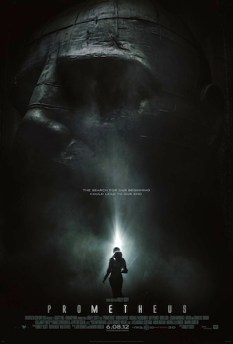 Ridley Scott’s not-an-
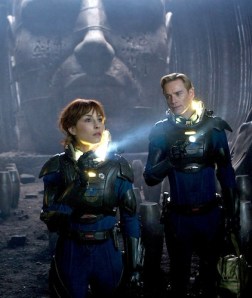 And then, to top it off, it doesn’t have a real ending! They may as well slap “to be continued” on screen, such is the obvious lack of conclusion. It’s immensely frustrating, only to be topped off with a “in case we don’t get the sequel” bit of connective tissue to the Alien series. Mysteries and unanswered questions aren’t a problem in and of themselves — there are plenty in Prometheus’ franchise forbears,
 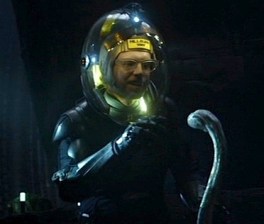 No character is fully developed. Some barely register, suggesting too big a cast, while others suffer from being plain stupid, or doing inexplicably stupid things, or just piss-poor acting. There’s some thing made about Shaw (Noomi Rapace) being religious or a true believer or something, but it’s not properly explained and doesn’t go anywhere. David (Michael Fassbender) and the way he’s treated by the other characters are both very interesting areas, and clearly of huge thematic resonance, but he acts inconsistently for no obvious reason, and despite the horrendous things he does to Shaw at one point, she just gets on with him again in the next scene, and… well, that’s far from being the film’s only plot hole or inconsistency.
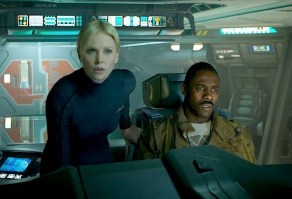 The daft thing is, I think a lot of people would’ve been happy if it had chosen to just go all-out as a schlocky alien horror movie. That’s what Alien is: an exceptionally well-made haunted house movie in space. There’s no shame in that (well, maybe in cinéaste circles, but pish.) But that’s not where Prometheus pitches itself. There’s too much other stuff for it to be just that; stuff that’s apparently aiming to be Profound. So when the horror does turn up, it doesn’t belong.
 Prometheus is a funny old beast, then. There’s lots of good stuff in there, but also lots of baffling decisions and confusing shifts of tone, emphasis, style… Considering it was made by an experienced master-filmmaker, who was presumably granted all the time, freedom and money he wanted to craft the film he desired, it’s baffling how it ended up feeling like such a hodge-podge. Many fans have blamed Lindelof, brought in late on to re-write the screenplay; but considering Scott ruined
  John Cusack stars as literary giant (figuratively) Edgar Allan Poe in this wannabe-Victorian-
 That they didn’t tone it all down just a smidge to match, and so go for the box office-friendly PG-13, is a surprise in these days.
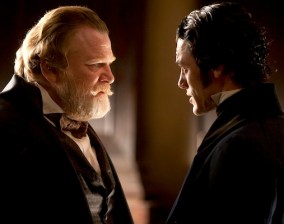 The rest of the cast are from Hollywood’s usual go-to for period tales: Brits; if not entirely then mostly so. (The film was shot in Hungary and Serbia, so I suppose our thesps have the additional advantage of being geographically favourable to Americans.) You know you’re getting a level of quality there, then, though for me Kevin R. McNally lets the side down (again). He’s only a supporting character and is fine most of the time, but there’s one bit when he’s talking to the lead detective and just rattles off his line… It’s not the world’s greatest speech, but you can hear there was meant to be more nuance and quiet in there.
 Se7en is probably my favourite film ever made, but criticisms that it’s quite a standard detective mystery are not invalid. It’s enlivened by Andrew Kevin Walker’s writing (great dialogue, engrossing structure, etc), some top-drawer performances (Freeman, Pitt, a loopy-calm Spacey), and, probably most of all, David Fincher’s inestimable touch. In making such a comparison it’s easy to see that The Raven lacks any of these, which renders it a solid period mystery, but no more.
 Shortly after I watched Tinker Tailor, it was announced that they (“they” in this instance being Working Title, I think) are planning a new film adaptation of Daphne du Maurier’s perennially popular novel Rebecca. This news was greeted (at least on the websites where I read it) with cries in the comments along the lines of, “you can’t remake Hitchcock!” Such is the power of
 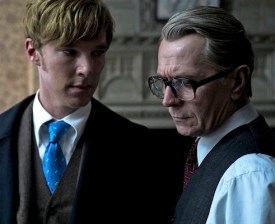 Yet, for all that, the film is excellent. It may not match the TV series in places, in my subjective opinion, but in its own right it shines. Gary Oldman does the impossible and offers a Smiley that is neither an imitation of Guinness’ nor a deliberate counterpoint, but stands apart as an equally proficient rendering of the character. The rest of the cast are equally up to task, with the exception of Kathy Burke, who stands out like a sore thumb in my opinion.
 Another noteworthy advantage of the film is that it’s gorgeously shot. The TV series actually has its own appeal in this area, with a realism that is quite pleasing. The film occasionally goes grander (look at the depiction of meeting rooms in The Circus for a major example — while the TV series goes for any old room in Whitehall, the film offers stonking soundproof ‘pods’), but it works in its own way.
 100Films.co.uk