
Francis Lawrence | 146 mins | Blu-ray | 2.40:1 + 1.78:1 | USA / English | 12 / PG-13
 Jennifer Lawrence (who, depending on your mileage, is either “the most charming young movie star in, like, forever” or “actually kind of a little bit irritating”) returns as the totally-plausibly-named Katniss Everdeen in this super-successful follow-up to the super-successful
 kids’ young adult novel adaptation that’s kinda like the new Twilight only actually quite good.*
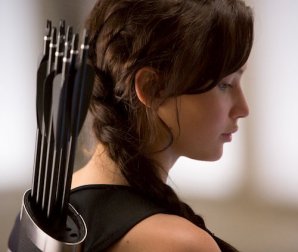
Having struck a PR blow to the ruling elite by forcing their hand at the end of the previous Hunger Games, joint winners Katniss and Peeta (pronounced “Peter” (Josh Hutcherson)) are back home. But not for long, because in an attempt to reassert control it’s decided the forthcoming 75th Hunger Games will feature previous combatants — and Katniss and Peeta are their District’s only choice. Cue an almost-rehash of the first film, but with different burgeoning political undertones, and the added twist of the competitors all being previous winners. There are much bigger twists than that coming, though…
Indeed, perhaps the most striking part of Catching Fire is its ending. That’s not to say the rest of the film isn’t entertaining — it really is, but it’s a variation on a theme; that theme being “the first one again”, even if this is arguably a superior version. The ending, however, suggests things are about to be launched off in a radically new direction, as well as casting a new light on the film we’ve just watched. These closing moments most literally remind me of The Matrix Reloaded: following a surprise world-changing development, our hero lies recuperating on a spaceship with new-found allies among the resistance, while outside in the rest of the world a final showdown brews…
 Tonally, however, it’s more similar to The Empire Strikes Back** — indeed, the Star Wars comparison applies to both Hunger Games films and their relationship to each other: the first is the story of an unwitting small-town kid becoming a hero and landing a decisive blow against the evil ruling body in a standalone adventure; but our heroes have only won the battle, not the war, and the evil empire rolls on… Cue Film #2, in which we get a wider view of the world, the bad guys seek our heroes more directly, and everything comes to a head in a blatant “to be continued” cliffhanger that unavoidably draws us on to the next instalment.
On The Dissolve, Tasha Robinson goes so far as to assert that, not only are they alike, but “Catching Fire’s ending is the most daring “to be continued” since Empire Strikes Back”. She argues that they are executed in a style which none of the multitudinous other cliffhanger-ending-ed films made since (including everything from Back to the Future to The Lord of the Rings) can claim to have achieved in quite the same way. To take her final sentences: “Most serial films end by spelling out exactly how the characters are headed into disaster, and in some cases, exactly what they plan to do about it. Empire and Catching Fire closes [sic] with a sense not just of something continuing, but potentially, even more thrillingly, of something new beginning.” Her whole piece is worth a read.
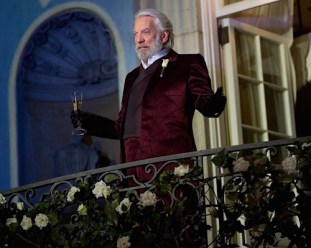 Of course, to an extent the tone of this ending comes from it being an adaptation: the filmmakers haven’t looked at the history of movie cliffhangers and chosen which to emulate, but instead brought someone else’s ending to the screen. Adapting doesn’t mean you have to take the original work faithfully, mind — you could go the Game of Thrones route and rearrange exactly where one book ends and the next begins; or the James Bond / Jason Bourne route of doing just whatever the hell you want. I haven’t read Suzanne Collins’ original novels, but I get the impression the films are pretty faithful.
Indeed, perhaps the real strength of Catching Fire being an adaptation of a novel is that it’s bedded in one author’s voice. My point being: it wasn’t written and constructed by committee, meaning we’re not subjected to the over-familiar beats of an action-adventure movie. There aren’t regularly-spaced action sequences of ever-increasing scale throughout, for instance — it’s not until halfway through that we end up in the arena, and up to that point it’s all story, the only action being ‘events’ rather than your traditional Action Sequence. This is no bad thing. If it’s adaptations of young adult novels that we need to save us from predictability, to deliver us a story rather than a thin excuse for the delivery of evenly-spaced action sequences, then so be it.
When the Games do arrive, director Francis Lawrence makes the most of it: as Katniss finally rises into the arena, the aspect ratio subtly shifts from filmic 2.40:1 to IMAX-derived 1.78:1. It’s remarkable how much impact this has even on a TV screen; nothing like what it must have in a proper IMAX theatre, but striking nonetheless — it really feels like things have just gotten bigger, both in terms of events depicted and the cinematography, 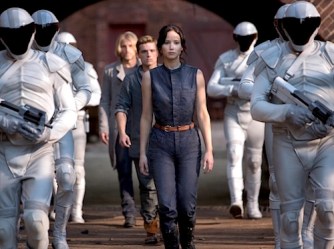 which seems richer, more detailed, despite no genuine increase in resolution. I guess it’s true what they say: if you start with a higher quality source, it filters all the way down. The “bigger screen” effect probably wouldn’t work for a film entirely shot on IMAX — it’d just fill your TV from the start — but, after an hour-or-so of black bars, it really feels like the screen has grown.
Last year was one of mixed fortunes for the blockbuster, when films that one might deem well-received actually had an equal number of detractors; but Catching Fire stands apart as an engrossing, entertaining, intelligent and invigorating success. I guess it too must have its detractors, but I suspect not as many, and not as deservedly.

The first Hunger Games is on Film4 tonight at 9pm. The next (and penultimate) instalment, Mockingjay: Part 1, is in UK cinemas from this Thursday, 20th November.
* I’ve still not seen any of the Twilight films, but I remain confident that, when I do, I’m not going to like them. ^
** I’m certainly not the first person to notice this: Googling “Catching Fire Empire Strikes Back comparison” brings up about 66,000 results — it used to be more, and obviously it misses anyone who’s making the comparison without using the world “comparison”. ^
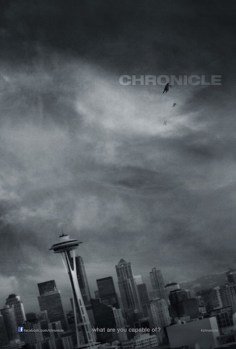 The birth of the “found footage” sub-genre and the resurgence of the superhero movie began around the same time, the former with
 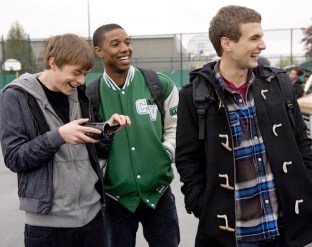 The story sees high school senior Andrew (Dane DeHaan) decide to start filming everything in his life, thanks to his borderline-abusive alcoholic father (Michael Kelly) and terminally ill mother (Bo Petersen). The same day (what a coincidence!), his cousin and only friend, Matt (Alex Russell), takes him to a party where, along with most-popular-kid-in-school Steve (Michael B. Jordan), they discover a hole in the woods with mysteries inside… Days later, all three begin to develop telekinetic powers, which they learn they can levy in various incredible ways — those ways being super, but largely without the heroic…
 This is even more pronounced in the extended version (“extended director’s cut” in the US), which includes over five minutes of extra bits that, in my opinion, make it a superior edit. Some are minor in impact, true, but there are a couple of short sequences with Andrew and Steve that deepen their relationship further, which enriches events at the end of act two. There’s also a moment that subtly prefigures the climax, and an extra bit in said finale that seems nigh-on essential to me. Considering the film still runs (just under) 90 minutes even with these additions, it’s difficult to see why they were cut in the first place. “Pace” is usually the rational for that, but if this is indeed a Director’s Cut then clearly Trank didn’t think they were an issue; equally, I can’t see why Fox would have objected. Still, they’re here to enjoy on Blu-ray…. though not on DVD… and I guess they’re not in TV screenings… Tsk.
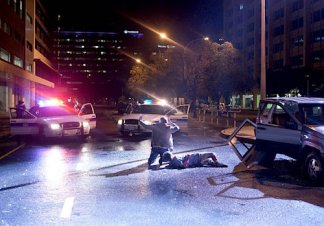 That said, spectacle it has. You wouldn’t expect that from a $12 million found-footage movie, but an epic duel through the streets of Seattle is one of the strongest climaxes to any superhero movie I can remember. It’s kind of like
  In the hands of many a desperate-to-get-noticed filmmaker, a found-footage superhero movie would likely have been a straight-to-DVD affair that could at best be described as “mediocre”. In Chronicle, however, Trank and co have crafted one of the best movies produced in either sub-genre. Most of the people involved — as well as the film they’ve all come from — can be classed as “one to watch”.
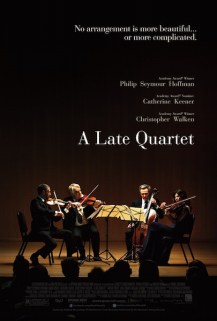 Set in the rarefied world of classical music performance, A Late Quartet charts the fallout among the members of a highly-acclaimed New York string quartet when their leader (Christopher Walken) announces his impending retirement.
 Where it does make a mistake is in divorcing Walken from the rest of the group for so much of the time. He ends up going to Parkinson’s groups and doing exercises as if this is some kind of “Issue of the Week” TV movie, while everyone else gets on with the plot. Some of the best bits belong to him though, like the story cribbed from a real musician’s autobiography.
 Based on the cult novel by Cracked.com editor David Wong, John Dies at the End is a bizarre horror-fantasy that defies easy explanation or summary.
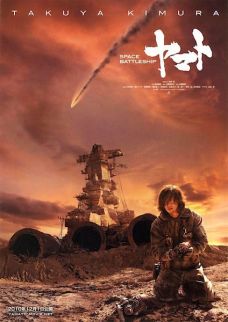 A live-action adaptation of the popular, influential and long-lasting anime franchise, known in the US as Star Blazers (here’s
 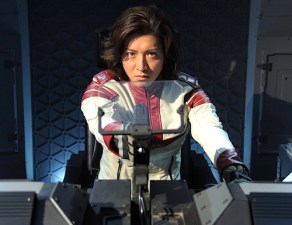 But this isn’t a mega-budget production (
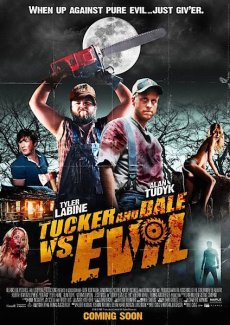 Riffing on the “evil hillbillies” horror sub-genre, a pair of simple country folk on a fishin’ holiday encounter a gang of college kids who, through a series of unfortunate coincidences, mistake them for murderous psychos — and decide to fight back.
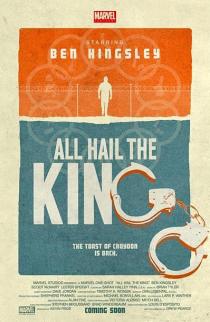 Presently it looks as if Marvel’s burgeoning TV empire (as I write,
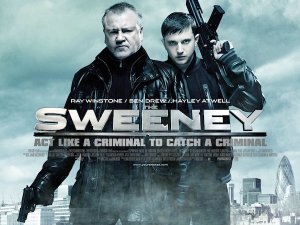 Despite a mediocre pedigree and TV-scale budget, this re-imagining of the iconic ’70s cop show is a solid thriller.
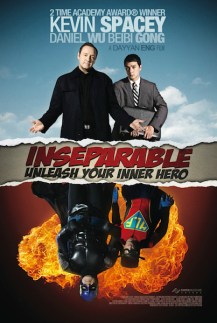 I’m a great advocate of tonally-mismatched films. When others are moaning that there’s too much darkness mixed in with their light fluffy film, I’m the one saying, “um, guys, have you ever lived in, y’know, real life?” Which probably explains why most of the internet reacts with anything between ambivalence and hatred towards Inseparable, whereas I really enjoyed it.
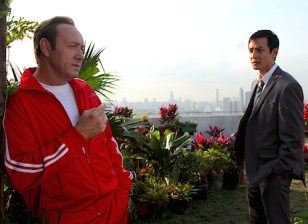 Clearly this will not be to everyone’s taste. Even at just over an hour-and-a-half it’s sometimes a little draggy, and the mishmash of kooky comedy with serious themes — not only suicide, but Li’s faltering marriage and the reasons for that — will turn some off. Anyone who likes their superhero entertainments to be more po-faced won’t be best pleased, either.
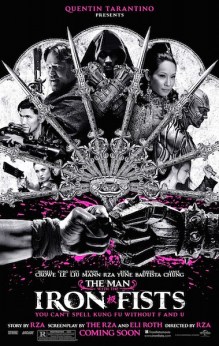 Starring, co-written and directed by rapper and Asian culture fan “the RZA” (he previously contributed to transnational anime
 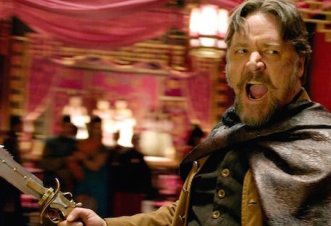 It’s a bit of a mess, then, yet somehow entertaining regardless. Despite a generally unfavourable reception, a (sadly Crowe-less)
  100Films.co.uk