aka Zootopia
2016 #116
Byron Howard & Rich Moore | 109 mins | Blu-ray | 2.39:1 | USA / English | PG / PG
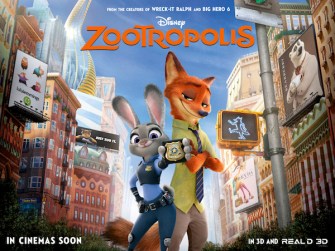 Disney’s 55th Animated Classic is their second highest-grossing ever, the 25th film to take over $1 billion at the worldwide box office, which makes it a hit of Frozen-sized proportions (at least financially — parents must be glad there’s no Let It Go-esque earworm involved). That said, I’d perhaps argue it’s a Disney movie aimed as much (perhaps even more) at the studio’s adult fans as its child ones. But I’ll come to that in a bit.
Set in a world of anthropomorphised animals, Zootropolis introduces us to Judy Hopps (Ginnifer Goodwin), a small-town bunny who joins the police force in the titular big city,* the first rabbit to do so. Despite there being a spate of mysterious disappearances across the city, Judy gets lumped with traffic duty, where she soon encounters small-time con artist fox Nick Wilde (Jason Bateman). That association comes in handy when she manages to get assigned one of the missing person animal cases and notices that Nick may have been a witness to the abduction. Soon, the mismatched pair begin to uncover an aggressive conspiracy…
Disney animations may be best known as musicals based on fairytales, but they certainly don’t make up 100% of their Classics line, especially in recent years.  I think Zootropolis may be the first time they’ve attempted a neo-noir crime thriller, though. And I bet no one ever thought they’d see a Disney film with a sequence set at a nudist resort. Or in a drugs lab, for that matter. Or one with a substantial parody of The Godfather and clear references to Breaking Bad. And you thought Inside Out was clever for having one line from Chinatown…
Once you factor in the many references to discussions that currently dominate social discourse — there are abundant riffs on the language of real-life concerns about race, gender, and sexuality — you begin to see how Zootropolis could be seen as a Disney film that’s primarily aimed at adults. Those concerns ultimately become thematic points so large that they cross the line from being subtextual “one for the adults” asides into being textual “vital to the plot” tenets of the film. So given the genre trappings, nudist resorts, drugs labs, parodies of 18-rated media, and very grown-up thematic points, you do have to wonder if Zootropolis functions better for adults who like Disney films than it does for kids who like Disney films. That sounds like a criticism, but it’s only one to an extent, because the kind of adult this notion supposes the film is aimed at is… well, me.
 However, that’s not to say kids can’t get enjoyment out of it: there are plenty of colourful characters and locations, relatable situations, cross generational humour, and a moral lesson young’uns will understand. There’s the DMV sequence, for instance, which is grounded in an adult experience but so funny it must cross over. Considering all the praise I’ve heard for that one scene, it’s also a feat it lives up to the hype. It’s gorgeously animated throughout, bolstered by a world that has been magnificently realised, with all the different themed districts of the city. (After all the Disney movies that have had contrived TV series spin-offs, this is a film that actually feels like it deserves one. The setup is obvious — a police procedural — and the world the film suggests is big enough to warrant it. Heck, it practically demands it — there’s so much more of this world, you want to see it explored.) Michael Giacchino’s score is different too: memorable and fun, in part thanks to using a cornucopia of unusual instruments to provide a ‘world music’ sound that’s in-keeping with the movie.
If I had any problem it’d be that the story takes a little while to warm up, really coming alive (at least for me) once it gets stuck into the main investigation. That’s not to say the first act is without its merits (there are both amusing and awe-inspiring sequences there, plus some moments that are nicely paid off later), but the film’s need/desire to establish the familiar “you can be whatever you dream if you just try” moral message makes it take a little longer than might be ideal. Adults will probably guess whodunnit well before the reveal, 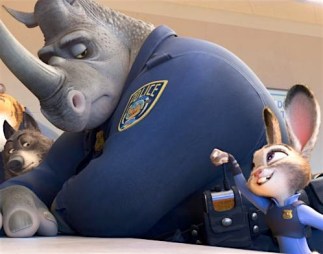 too, but that doesn’t mean the journey getting there is any less fun.
There’s a quote on the cover of Zootropolis’ US Blu-ray that calls it the best Disney movie in 20 years. As much as I liked Bolt and Tangled,** and Mulan and The Princess and the Frog, and, yes, even Frozen, I think Zootropolis is at the very least a contender for that crown.
Zootropolis is released on DVD and Blu-ray in the UK today.
It placed 15th on my list of The 20 Best Films I Saw For the First Time in 2016, which can be read in full here.
* I watched a US copy of the film, so I have a question for anyone who watched it in the UK: we all know they changed the title from Zootopia to Zootropolis, but did they actually change the name of the city in the film too? That’s a lot of redubbing if they did… ^
** Both co-directed by Zootropolis’ Byron Howard. Developing a pretty good track record, that man. ^

 The director of The Fountain tackles the Biblical tale of the flood as if it were also a science-fiction/fantasy adventure — familiarity with the story leads us to assume it’s set in the past, but watch without baggage and the setting looks like a post-apocalyptic future.
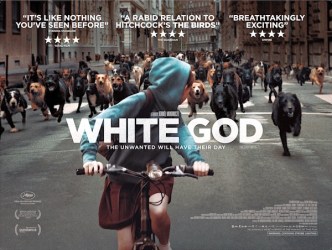 Thirteen-year-old Lili (Zsófia Psotta) and her dog Hagen are forced to temporarily live with her father, Dániel (Sándor Zsótér), because her mother is going on holiday with her new partner. Dániel doesn’t like Hagen anyway, but when the dog’s behaviour causes problems for him, he sets Hagen loose on the streets. Already angry with her father and his attitude, a devastated Lili sets out to find her beloved dog, who is busy discovering the darker side of mankind and our treatment of animals.
 For all the toughness of the journey, where it leads is triumphant; not entirely so, I must add, but enough. The film’s third act can pithily be described as Rise of the Planet of the Dogs: having seen the abuses of humans, an impounded Hagen leads a canine uprising that seeks to… well, they don’t speak (they’re dogs, remember, and this isn’t Disney), so who knows what their precise aims are? “Revenge” would be too cruel, but they definitely seeking some retribution. The film’s sadness doesn’t disappear (hence why not entirely triumphant), but some wrongs are righted.
 Some will find the middle of the film a slog, I suspect, both emotionally and with its occasionally lagging pace. However, the bookends seek to justify it. There’s catharsis in the finale, as described, but even better is the film’s opening. It has to be seen to be properly understood, but it’s operatically scored, shot, and edited, and involves hundreds (literally) of trained dogs en masse. It’s spectacular, unforgettable moviemaking; perhaps even one of the best openings to a film ever. And I don’t say that just as a “dog person”.
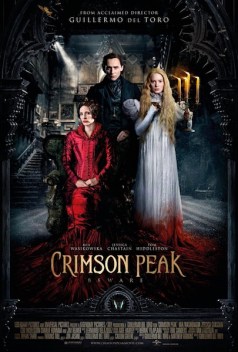 Mia Wasikowska stars opposite a British thesp best known for playing a comic book villain and a red-headed repeat-Oscar-nominee, in a Gothic drama-thriller from an acclaimed non-Anglo director? That’s a description of
 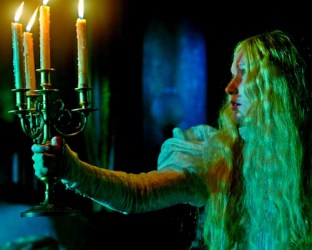 The story actually concerns Edith Cushing (Wasikowska), a well-to-do businessman’s daughter in upstate New York who is occasionally haunted by ghosts. She falls for visiting English gent Sir Thomas Sharpe (Hiddleston) and, long story short, moves with him and his haughty sister Lucille (Chastain) back to their crumbling — literally — pile in the English countryside. The house hides many secrets, and ghosts, too. Having said it’s not a horror movie, it would be unfair to class Crimson Peak as simply a tame drama — as you’d expect from writer-director Guillermo del Toro, those ghosts can be bleedin’ scary, and there are certainly a smattering of good old fashioned jumps to boot.
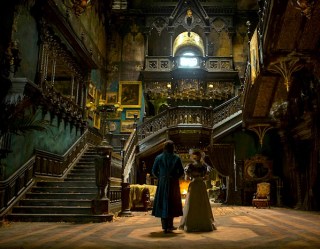 Whatever one’s thoughts on the story and tone of the film, it can’t be denied that its technical merits are extraordinary. Every inch of the design work is gloriously imagined, and the cinematography — the lighting in particular — is spectacular. And that gigantic house set…! And the climactic ‘limbo’ set, too — incredible work. (That’s not a spoiler, incidentally: it was the set’s nickname, not its literal location.) The ghost effects are excellent too — original, creepy, and executed in a way that blurs the lines between make-up, animatronics, and CGI. It’s a shame the film as a whole wasn’t better received, because I imagine that’s all that held it back from numerous awards-season nods.
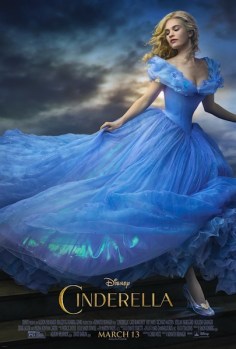 Disney’s animated classic is re-imagined in live-action, losing the songs but expanding the story. The latter serves to find a little more realism in the setup (how Cinders became a servant to her stepmother, etc), as well as in the characters’ motivations and actions.
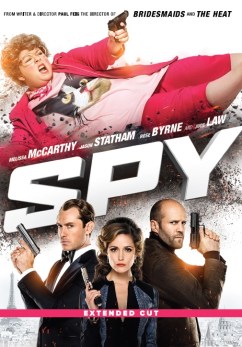 The cinema was blessed — or, depending on your point of view, blighted — by an abundance of espionage-related movies last year (see: the intro to
  that usually just means an overabundance of the F-word. Here we have at least one clear headshot, a dissolving throat, a knife through a hand, and more photos of a henchman’s penis than you ever needed to see. (That last one’s only describable as “gruesome” depending on your personal predilections, of course.)
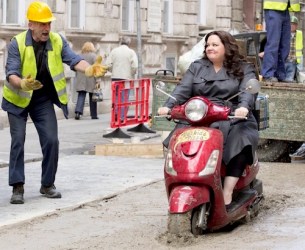 The extended (aka unrated) cut contains almost 10 minutes of extra material, detailed
 Written by Damien “
 It’s not so preposterous that it breaks the ‘rules’ of the thriller genre. Either you’re on board with that, or maybe you shouldn’t watch this kind of movie.
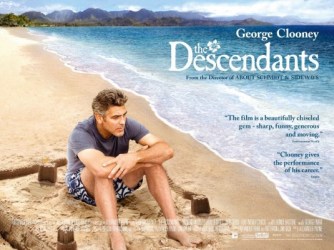 Comedy-drama starring George Clooney as a Hawaiian with family issues: his wife’s in a coma and may’ve been cheating; his daughters are unruly; and his extended family is considering a massive land sale that’s the talk of the islands.
 Donnie Yen returns as the eponymous kung fu master, who’s most famous for training Bruce Lee, to complete a trilogy of biographically-dubious but broadly entertaining actioners.
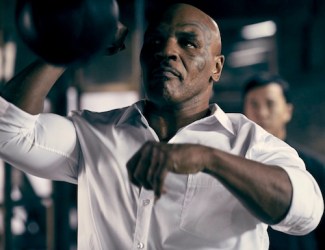 the less said about the film’s attitude to foreigners the better (though I guess Hong Kong’s British occupiers weren’t exactly above reproach).
 After an awkward first half, Ip Man 3 gradually transitions into a rewarding set of circumstances, on both the action and emotional fronts. The lack of consistency may mean it doesn’t satisfy fans as much as the first film did, but I’d say it’s a step up from the second, and definitely worth a look for fans of the old punching-and-kicking-and-hitting-each-other-with-poles-and-knives.
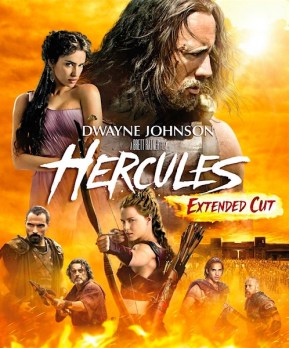 The answer to the question, “Hey, remember Brett Ratner? Whatever happened to him?”,
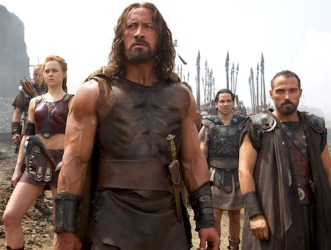 This extended cut wasn’t included on the UK Blu-ray, so no BBFC rating (it’s about a 15), but it is available on Netflix over here (it’s not listed as the extended cut, but it is). It’s no great shakes, though, adding only a couple of minutes. That’s made up of three short scenes, another half-a-dozen additional lines of dialogue, a couple of extra seconds of action, and some blink-and-you’ll-miss-it CG blood (full details
  100Films.co.uk