Mowgli: Legend of the Jungle (2018)

aka just Mowgli

2018 #252
Andy Serkis | 104 mins | streaming (HD) | 2.39:1 | UK & USA / English & Hindi | 12 / PG-13
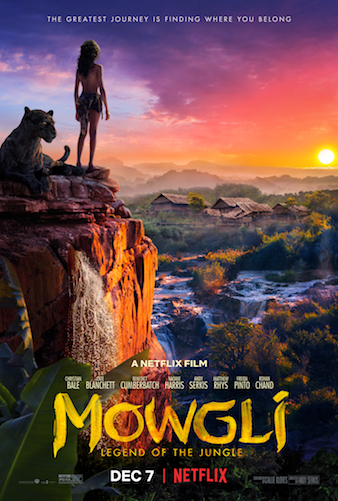
Mowgli: Legend of the Jungle

Hollywood has a long history of different people coming up with the same idea resulting in competing films — asteroid-themed Armageddon and Deep Impact is perhaps the best-known example. But often when the ideas are too similar, one of the projects gets scrapped — Baz Luhrmann ditched plans for an Alexander the Great biopic once Oliver Stone’s got underway, for instance. When Disney and Warner Bros both announced CGI-driven live-action adaptations of Rudyard Kipling’s The Jungle Book, I don’t know about anyone else, but I figured one studio would blink and we’d end up with just one film. That didn’t happen, and both movies entered production around the same time, and were even originally scheduled to come out the same year. In this respect it was Warner who blinked first, putting their version back to allow more time to finesse the motion-capture-driven animation, while Disney got theirs out on schedule. Unfortunately for Warner, it was a huge hit with critics and audiences alike, putting their version in a rather precarious position.

So when the news broke that Mowgli (as the film had been retitled to help distance it from Disney’s) was to be released direct to Netflix, well, I don’t think anyone was surprised: the streaming service has become a regular dumping ground for movies that studios have lost confidence in, seemingly happy to pay for any castoff a major studio throws their way. Apparently that’s not what went down this time, though: Mowgli had a theatrical release date set and the promotional campaign had begun, when Netflix approached Warner saying they loved the film and wanted to buy it. I guess the certainty of a large Netflix payday vs. the gamble of box office success on a film that could be seen by the general public as a Johnny-come-lately cash-in rip-off was an easy choice for Warner to make. And so here we are.

A legend in the jungle

Mowgli (as it’s always called in the film itself, the subtitle presumably being a Netflix marketing addition) has a story that will be broadly familiar to anyone who’s seen any other version of The Jungle Book, most especially that recent Disney one: the eponymous boy is orphaned when his parents are murdered by man-eating tiger Shere Khan, but he’s rescued by black panther Bagheera, who takes him to be raised by a pack of wolves. Shere Khan wants to kill the man-cub, however, and looks for an opportunity to separate him from the wolves’ protection. The difference, then, lies in the details: where Disney’s version was PG-rated and family-friendly, director Andy Serkis has given this a darker, PG-13 spin. It’s not an Adult movie by any means, but it’s definitely suited to slightly older children. That said, there’s a revelation at the 80-minute mark which is horrendously misjudged, and is liable to upset children of all ages (i.e. including some adults too).

That moment aside, the film’s more realistic tone manifests in multiple ways. One is characterisation, most notably of the bear Baloo. As we know him from Disney’s takes, he’s decidedly laid-back and chummy, casually teaching Mowgli some ways of the jungle. Here, he’s more of a drill sergeant for the wolf pack, explicitly training Mowgli (and his wolf brothers) in the skills required to fully join the pack. He has a softer side — he definitely cares for the man-cub — but this never manifests in the Disney-ish way. Elsewhere, there’s a drive at some kind of psychological realism for our hero. With Mowgli driven out for his own safety (again, an example of the animal characters being somewhat harsher than in Disney), he ends up in a human village. There, he comes to realise he doesn’t truly belong in the world of animals… but nor does he truly belong in the world of men. This internal conflict about his place in the world comes to underpin the climax, and arguably makes it superior to the over-elaborate forest-fire spectacle of Disney’s film.
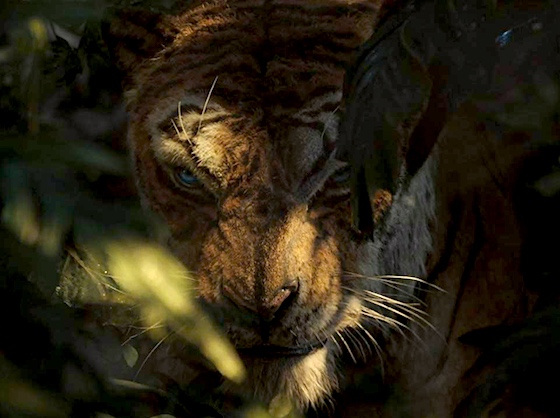
Not burning bright, but he is in a forest of the night

The realism extends to the overall visual style, too. Where Disney’s live-action version was all shot on L.A. sound stages, with the young actor playing Mowgli frequently the only real thing on screen, Serkis and co travelled overseas and actually built sets on location to shoot a significant portion of the film. Accompanied by cinematography that often goes for a muted colour palette, it seems clear the aim was to make a film that is perhaps not “darker” in the now-somewhat-clichéd sense, but more grounded and less cartoonish than certain other adaptations.

Unfortunately, Serkis made one design decision that threatens to scupper the entire endeavour: having motion-captured famous actors for most of the animal roles (including the likes of Christian Bale, Benedict Cumberbatch, Cate Blanchett, Tom Hollander, Peter Mullan, Eddie Marsan, Naomie Harris, and, of course, Serkis himself), someone thought it would be a good idea to try to integrate the actors’ features into the animal faces. The result is… disturbing. There’s so much realism in the overall design, but then they have these faces that are part realistic, part cartoon, part like some kind of grotesque prosthetic. It is so bad that it genuinely undermines the entire movie, for two reasons: one, it’s a distraction, making you constantly try to parse what you’re watching and how you feel about it; and two, a more serious take on the material asks for us to make a more serious connection to the characters, and that’s hard when they look so horrid. The section in the human village — which, by rights, should be “the boring bit” because it doesn’t involve fun animal action — is probably the film’s strongest thanks to its location photography and real actors making it so much more tangible. It suggests how much more likeable the entire film would be if they’d gone for real-world-ish animal designs — like, ironically, the Disney film did. (Now, that might’ve got away with cartoonish semi-human animals thanks to its lighter tone. Or it might not, because these are monstrous.)

Monstrosity!

It sounds petty to pick one highly specific element and say it ruins the film, but I really felt like it did. It’s a barrier to enjoying the bits that work (Rohan Chand is often superb as Mowgli; the always-brilliant Matthew Rhys is brilliant as always; there’s some welcome complexity and nuance to several characters and situations), and therefore it does nothing to help gloss over any other nits you want to pick (Serkis is miscast; Frieda Pinto is completely wasted; Cumberbatch is a little bit Smaug Mk.II; that revelation I mentioned back in paragraph three is brutal and I can’t believe it was okayed by the studio). Also, on a somewhat personal note, I felt there were times you could tell Serkis had made the film in 3D, but Netflix haven’t bothered to release it in that format (outside of some very limited theatrical screenings) — as someone who owns a 3D TV because, you know, I enjoy it, that miffed me.

On the whole, Mowgli: Legend of the Jungle is a frustratingly imperfect experience. I believe it’s fundamentally a unique-enough variation on the material that it could’ve escaped the shadow of Disney’s film, but a few misguided creative decisions have dragged it down almost irreparably.

3 out of 5

Mowgli is available on Netflix worldwide now.
Sorry to Bother You (2018)

2018 #250
Boots Riley | 111 mins | download (HD) | 2.39:1 | USA / English | 15 / R

Sorry to Bother You

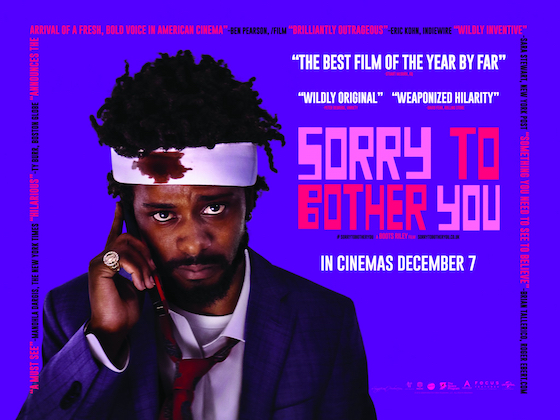
It felt like everyone was on about Sorry to Bother You early this year, after it was released in the US in July. It’s taken ’til now to make it to UK screens — I don’t know if that was a conscious delay, or if the outpouring of recommendations from critics and audiences on social media had something to do with creating demand for distribution. Anyway, it’s fortunate that, as a small movie, most of the discussion (that I saw) was about urging people to see it and not giving away the twist (naturally, this review is equally spoiler-free), because it is indeed a helluva turn to come across unaware. As for the rest of the movie, well, I was less convinced.

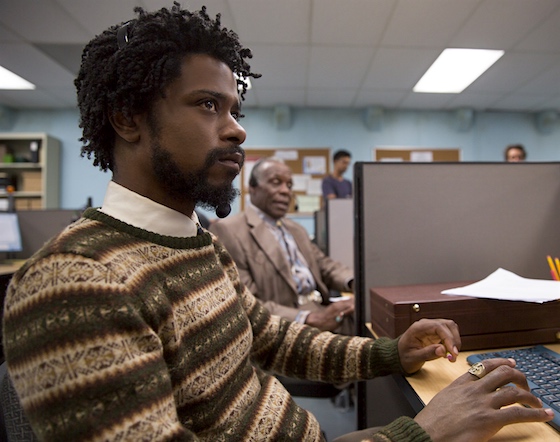
Set in a like-our-world-but-not-quite present day Oakland, the film centres around Cassius “Cash” Green (Lakeith Stanfield), a down-on-his-luck chap who lives in his uncle’s garage with his artist girlfriend, Detroit (Tessa Thompson). He manages to land a lowly job as a telemarketer, but struggles to sell anything. As his equally unsuccessful colleagues attempt to unionise, Cash discovers the key to the job and is soon on his way up the company, where there are dark secrets to be discovered…

That’s the simple version, anyway. First-time writer-director Boots Riley clearly has a lot on his mind, and it seems he wanted to say it all in this one film. The unifying theme seems to be “mega-corporations treat their workers like slaves and will go to extraordinary lengths to exploit them”, which is a worthwhile point but hardly a revelatory one. In the film, the concept is primarily satirised by the company Worryfree, which offers customers a home, employment, and food for life, in exchange for living in their facilities, working their jobs, eating their food, and not getting paid because they’re providing all you need. As a business concept you can kinda see the appeal, actually, but obviously it’s a form of slavery really. Capitalism is bad, y’all.

Too young for this shit

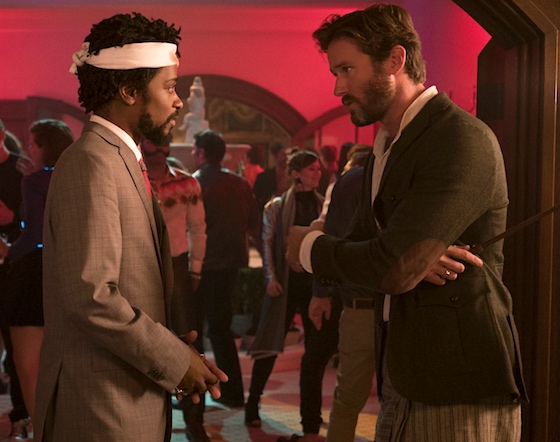
Naturally, with a black writer-director and black main cast, there are connections to be drawn out to history and the present black experience, and here the film finds somewhat more subtle and fertile ground. For example, the key to success in business turns out to be for Cash to use his “white voice” when selling — sounding literally like a white man, to the extent that Riley has these scenes dubbed by a white actor (in Cash’s case, David Cross; other characters’ white voices include Patton Oswalt and Lily James). As I say, it’s only “somewhat” subtle, but it’s effective. The film’s best scene, for my money, sees Cash attend a party thrown by Worryfree’s founder (Armie Hammer, perfectly cast), who urges Cash to rap — because all black guys can rap, right? Cash can’t. He tries. It’s painful. Then he hits upon an idea… I shall say no more (partly because I’d just have to censor it), but it’s both hilarious and true.

As for the aforementioned big twist, it’s absolutely barmy and out of left-field. Its utter craziness I have no problem with, but for me the film seems to fall apart after that point, as if including such a batshit insane idea was felt to be enough. Riley doesn’t seem to quite know where to go with it, except, frankly, some pretty obvious places. Arguably, the twist is too out there — it’s shocking and funny at first, but it completely disconnects the film from reality (and the connection was a little loose in the first place, thanks to the way all other parts are satirically presented). It makes the bad guys into cartoon villains with a crazy plan, rather than the scheming corporate overlords we recognise from real life. There’s plenty of other stuff in the film that doesn’t have 100% fidelity to reality, but they work in the name of satire. The twist isn’t really satire, it’s barminess for the sake of barminess; and in that sense I’m down with it, but it also means it somewhat undermines the film’s satirical goals, and that’s a shame.

Does he look worry-free to you?

While the finale might be the most obvious example, this lack of focus permeates the film, with scenes that are a total aside or subplots that go literally nowhere. Perhaps the most egregious example is a mystery VIP room in the shitty bar the characters drink in. It’s featured in one early scene, doesn’t introduce any characters or plots, and isn’t related to any of the film’s themes — it just is; a sketch-like vignette of silliness. Most viewers probably forget about it, even, because it occurs so early on and has literally nothing to do with anything else that happens, but that’s exactly what’s wrong with it, and why it should probably have been cut.

Riley clearly has a surfeit of ideas, which sometimes works to the film’s merit — there are effective, memorable visuals and concepts, a few solid characters (Stanfield is great as just an ordinary guy getting swept along by shit; the kind of person most of us would be, I feel), and a bunch of funny lines and exchanges. But there are so many different things all being rammed onto the screen at once that it becomes a tumult of stuff that the first-timer in charge can’t quite control (as a counterpoint to Stanfield, the regularly-brilliant Thompson struggles gamely to bring some depth to her thinly-sketched girlfriend/performance artist character, and can only partially succeed).

Sorry to Bother You seems to lack the behind-the-scenes acumen to make everything come together as a single, focused movie. It’s certainly an interesting film (well, apart from when I began to get a bit bored, frankly, as it dragged itself through that surprisingly predictable finale), and I can see why it got Film Twitter talking back on its US release, but I don’t think it coalesces into a fully satisfying whole.

3 out of 5

Sorry to Bother You makes its belated debut in UK cinemas tomorrow.

February Review Roundup

As 2018 races towards its finish line, I’m sat on a pile of nearly 130 unwritten reviews. Oof. And to think, I started that page when I first got 10 behind.

Anyway, as my (likely in vain) attempts to reduce that number continue, today’s roundup includes three reviews of films I watched all the way back in February:

  • WarGames (1983)
  • Being John Malkovich (1999)
  • I Origins (2014)


    WarGames
    (1983)

    2018 #22
    John Badham | 113 mins | streaming (HD) | 1.85:1 | USA / English | 12 / PG

    WarGames

    It’s Ferris Bueller’s Third World War as Matthew Broderick plays a precociously talented high schooler who unwittingly hacks into a government war planning supercomputer and instigates a countdown to nuclear annihilation.

    It’s a funny old mashup of genres that I’m not sure you’d get away with today. It starts out as a Cold War thriller, feeling almost like a Tom Clancy adaptation; then suddenly it’s a John Hughes high school comedy; then the two have to awkwardly mesh, before it turns fully into a young adult techno-thriller. Young Adult fiction is almost synonymous with dystopian future adventures nowadays, but WarGames reminded me nonspecifically of the kind of thing YA books used to be about when I was the right age for them — and, considering that would’ve been in the mid ’90s, those books were quite possibly inspired by this film.

    So, it’s inescapably of its era, but no worse off for that… though how The Youth Of Today would take to it, God only knows. If you stop to think too much (or at all) about the ins and outs of the plot then it becomes thoroughly implausible in so many different ways, but if you let those things slide and go along with the film on its own terms then it’s a cracking adventure yarn.

    4 out of 5

    Being John Malkovich
    (1999)

    2018 #28
    Spike Jonze | 113 mins | streaming (HD) | 1.85:1 | USA / English | 15 / R

    Being John Malkovich

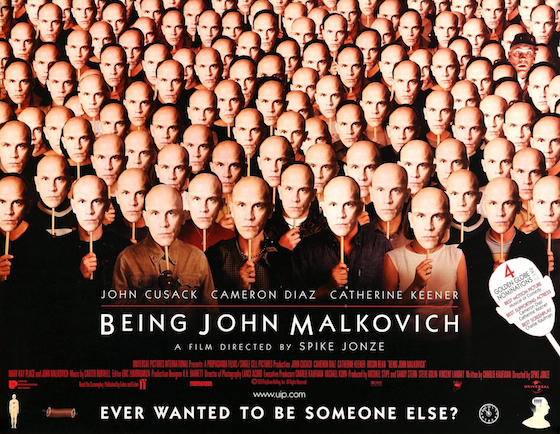
    The film that introduced the world to the kooky imagination of screenwriter Charlie Kaufman (almost 20 years ago now!), Being John Malkovich is about a failing puppeteer (John Cusack) who starts a new job in a bizarre office, where he develops an unreciprocated infatuation with a coworker (Catherine Keener) and discovers a hidden portal into the mind of actor John Malkovich (John Malkovich).

    Even with that mad premise, Being John Malkovich wasn’t the film I thought it was going to be. Well, I don’t know what I was expecting exactly, especially as it’s a Kaufman film so I knew to expect “weird”. But I guess I anticipated that it would focus on people inhabiting Malkovich and doing kerazy things as him, or something, rather than it being a four-way love triangle (in an Escher-esque way rather than an “uh, I think you mean love quadrilateral” sense) in which the whole “inhabiting Malkovich’s body” thing is more a means to an end rather than the film’s raison d’être.

    Said end is an exploration of identity and relationships — indeed, the screenplay reportedly started life as “a story about a man who falls in love with someone who is not his wife” and the kooky body-swap antics came later. I’ve read reviews that frame it in the context of films like Mulholland Drive and Persona as a “comedic meditation on identity”; though what it actually says about identity, I’m not sure (but then, I wasn’t really sure what Mulholland Drive and Persona were saying either, so maybe this is just me). But I wonder: does it just tip its hat in that direction while playing around with the situation to see what happens? Are the filmmakers “yeah, whatever”ing the broader psychological implications (as one of the characters does) while playing out the full bizarreness of the premise to its logical extreme? I’m not sure “logical” is quite the right word for what goes on in this movie, but what I mean is it works through the fullness of the idea, extrapolating it through various events and to a conclusion. Can you even consider the true psychological implications with something so out-there and not-real?

    Well, maybe. Indeed, the film kinda does, through its relationships. One character falls in love with another, but only when the latter is in Malkovich’s body; but then they’re tricked into falling for someone else in Malkovich’s body; but that doesn’t work out in the long run, and the first pair end up together in real life — so the physical body is the initial attraction, but it’s ultimately irrelevant to the actual person inside. Basically, is this just a kooky, crazy, bizarre film whose message is the age-old “beauty isn’t just skin deep”?

    4 out of 5

    I Origins
    (2014)

    2018 #36
    Mike Cahill | 103 mins | TV (HD) | 2.39:1 | USA / English | 15 / R

    I Origins

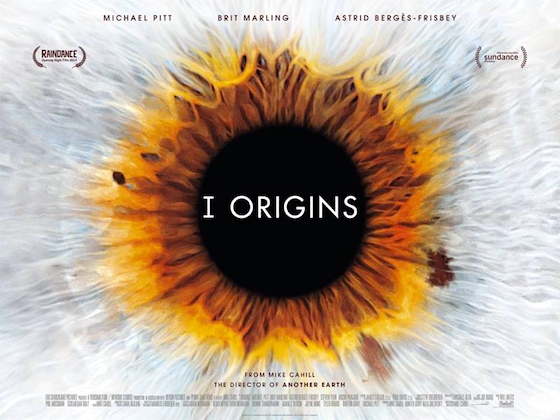
    The second film from Another Earth writer-director Mike Cahill, I Origins is another science-fiction drama with the emphasis on “drama” more than “sci-fi”. It’s about a scientist, Ian (Michael Pitt), who’s mapping the evolution of the human eye with his lab partner (Brit Marling), hoping it will help discredit the superstitious religious ideas that he despises. At a party, Ian is drawn to a masked woman (Àstrid Bergès-Frisbey) by her eyes, and they end up dating — but developments in their relationship send his research in surprising directions…

    I Origins is a consistently engaging, intriguing film; the kind of story that continues to develop and evolve its premise throughout its whole running time, so that I’ve had to be a bit vague to avoid just giving away the entire plot. My only real query is that I don’t know what it all signified in the end. Something to do with there being room for spirituality even in dyed-in-the-wool scientists? Or maybe it’s just about the personal journey of its lead character? Or maybe, as it was developed as a prequel to an unmade script, the really significant stuff lies there, and this is just backstory? (Cahill sold the rights to that screenplay in 2011, but it’s still not been produced.)

    It feels a bit disingenuous to praise a film where I don’t really know for sure what the point was, but I liked it quite a lot all the same.

    4 out of 5

  • Ant-Man and the Wasp (2018)

    2018 #247
    Peyton Reed | 118 mins | Blu-ray (3D) | 2.39:1 + 1.90:1 | USA / English | 12 / PG-13

    Ant-Man and the Wasp

    After the huge (in every respect) Avengers: Infinity War, the comically-minded Ant-Man and the Wasp feels like a palate cleanser for the MCU; a bit of light entertainment to help smooth the long gap between the Avengers film’s devastating cliffhanger and 2019’s double whammy of Captain Marvel (trailer today!) and Avengers 4 (trailer Wednesday!) Some people didn’t take too kindly to the ‘abrupt’ tonal swing (they’re completely separate movies, so that’s a pretty daft complaint to have, frankly), but I thought this sequel was a ton of fun.

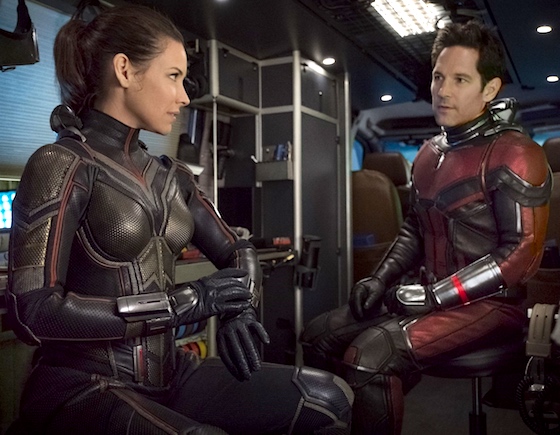
    It actually takes place before Infinity War anyhow: Scott Lang (Paul Rudd), aka Ant-Man, is finally coming to the end of two years of house arrest, his punishment for being involved in the events of Civil War. He’s also been forbidden from contacting the inventor of the Ant-Man suit, Dr Hank Pym (Michael Douglas), or his daughter, Hope Van Dyne (Evangeline Lilly), who are wanted fugitives; but when Scott has a vision of Hank’s wife and Hope’s mother, Janet (Michelle Pfeiffer), from his trip to the Quantum Realm (see the first Ant-Man), he becomes involved in Hope and Hank’s attempt to travel their and rescue Janet. Along the way they also have to deal with black market dealer Sonny Burch (Walton Goggins), who wants to monetise the tech he’s been helping them build, and a mysterious masked figure known as Ghost (Hannah John-Kamen), who can phase through solid objects and is trying to steal said new tech.

    The Wasp and Ant-Man

    Got all that? I haven’t even touched on some of the other subplots that get thrown in for good measure. For something that’s clearly been designed as a light romp, Ant-Man and the Wasp certainly has a lot of plot going on. That might be part of what keeps it romp-y, mind: with so much to get through, there’s always something happening, it’s always pushing forward. It arguably gets a bit bogged down having to line everything up in the middle, with some scenes that lean a little heavily on exposition, but it always finds time for a gag or two. Personally, I’ll let quite a lot slide if I’m having fun, and this keeps the fun quotient high throughout.

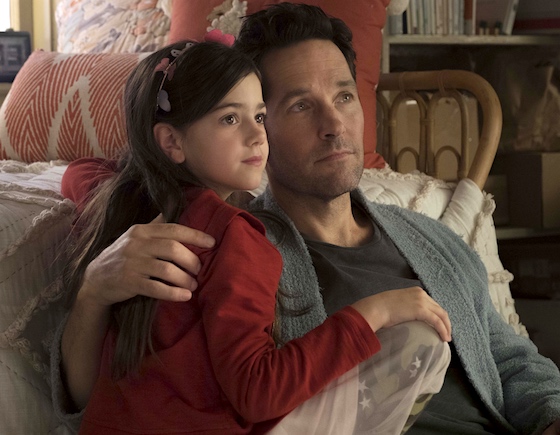
    Entertainment is definitely the name of the game here, and to that end director Peyton Reed and the five credited screenwriters (including star Paul Rudd) set out to tickle various emotional responses. The most obvious one is, as mentioned, the funny — there are laugh-out-loud moments here, as well as a never-ending barrage of one-liners and comedic business. But it also takes time to be emotive and heartfelt. Scott’s relationship with his daughter (a charming and likeable performance by young Abby Ryder Fortson) is a major character point, and a key touchstone for a definite parent/child theme across the movie. What we might actually ‘learn’ about parent/child relationships from all this, I don’t know, but it feeds some surprisingly heartwarming material at times.

    But which is the parent and which is the child?

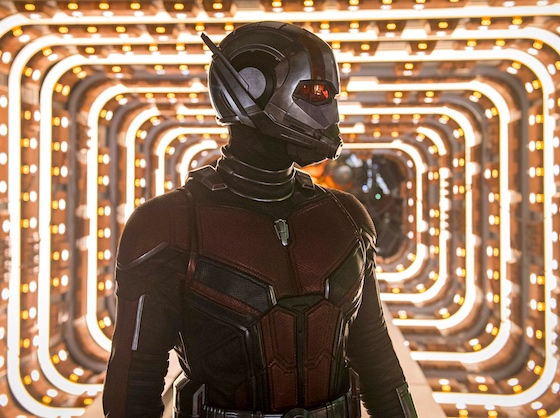
    Thirdly, there are thrills in the shape of multiple fantastic action sequences. Hope dons the Wasp suit — all the powers of Ant-Man, plus wings and blasters — shrinking and growing at speed to kick plenty of ass, though Ghost’s ability to just phase through objects presents a unique challenge. There’s a heist sequence, too, recalling the overall theme of the first movie… though as it’s in a primary school and occurs while Scott’s suit is malfunctioning, it’s played more for laughs. Well, so’s almost everything in this movie, but it works. Best of them all is the extended car chase finale, with the good guys’ size-changing vehicles used for some highly inventive antics, plus all sorts of other goings-on in a race with multiple pursuers. I’ve seen some criticise this part for going on too long, but I thought it was just right, and is a strong contender to be remembered as an all-timer chase sequence.

    Often when I watch stuff in 3D nowadays I don’t actually mention it in my reviews — I still enjoy the experience more often than not (some stuff underwhelms, naturally), but I know most people don’t have the option and, frankly, it’s rarely essential. Well, the 3D probably isn’t essential here either, but it is superb, really adding to the scale and impact of the big scenes — when things are switching sizes all over the place, that’s no bad thing. Plus it’s clearly effective in just regular moments, too: the film’s opening shot is just of a house, but the dimensionality is still palpable. Top work by whoever did the post-conversion.

    Plus, the 3D Blu-ray comes with the benefit of the film’s shifting IMAX ratio, where the frame expands upwards from 2.39:1 to 1.90:1 for certain scenes. This is commonplace for Marvel films nowadays, which means sometimes it seems to occur just for the sake of it, but Reed has put the effort in to make great use of the larger image. Okay, it’s no surprise that it’s used for the action scenes (including opening up for a whole half-hour-or-so at the film’s climax), but he’s mindful of the transitions between ratios and the effect that can have — at least twice the actual moment the film moves from one ratio to another is as effective as the bigger image itself. Some people hate shifting aspect ratios on Blu-rays, I know, but I love ’em, and this is a great example of why.

    Ant-Man will return... but will anybody else?

    In the year of Black Panther and Infinity War, the relatively frothy Ant-Man and the Wasp was always destined to be “the other one”. But just because it’s not Big or Meaningful doesn’t mean it has no merit. Far from it. Whether you want to view it as a palate cleansing instalment of the MCU or as a standalone adventure, I think it’s pitched almost perfectly as a fun, entertaining ride of a movie.

    The first Ant-Man is, to date, the only MCU film to make it onto one of my year-end best-of lists. The way things have gone in 2018, I won’t be surprised if this sequel is the fourth.

    4 out of 5

    Ant-Man and the Wasp is out on DVD and Blu-ray (regular, 3D, and 4K UHD flavours) in the UK today.

    The Greatest Showman (2017)

    2018 #237
    Michael Gracey | 105 mins | streaming (UHD) | 2.39:1 | USA / English | PG / PG

    The Greatest Showman

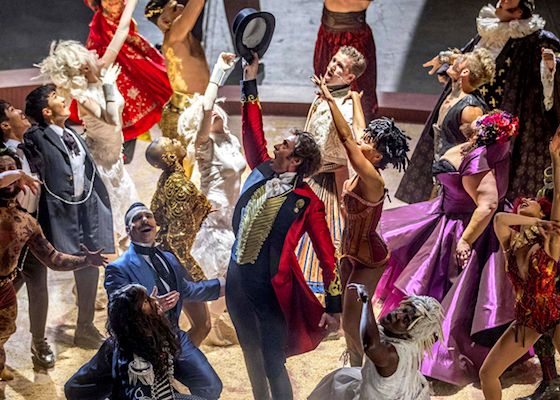
    There’s nothing inherently festive about The Greatest Showman (if it has even one scene set around Christmas, I can’t immediately recall it), yet it was initially released on Boxing Day last year and now kicks off December’s premieres on Sky Cinema, and somehow the association feels entirely fitting. I guess it’s something to do with the tone and style of the film itself: a big, cheesy, schmaltzy, cheery musical — just the kind of thing many people like to wallow in during the big, cheesy, schmaltzy, cheery end-of-year festival. It’s almost a John Lewis advert in feature film form, only with upbeat original songs instead of whispery female covers of old hits.

    Inspired very, very, very loosely by a true story, the eponymous gentleman is P.T. Barnum (Hugh Jackman), a man of low station in mid-19th century America who, via a cunning fraud, manages to buy a building that he turns into a museum of curiosities. With attendance poor, he adds a floor show featuring acrobatics and freaks. It’s slated by the critics, but curious audiences flock en masse. Barnum is suddenly a massive success — but at what cost to his personal life?

    Well, virtually none, because there’s barely any jeopardy to be found here (apart from a little forced something to push it into a third act). But jeopardy is not the point of The Greatest Showman, which is all about being a crowd-pleasing good time — like the show-within-the-show, it was poorly received by critics but a huge word-of-mouth success: it never made it to #1 at the US box office, but nonetheless stayed in the top ten for 11 weeks and earned $434 million worldwide; its soundtrack album was such a hit that they’ve already released another album of cover versions. It’s a phenomenon, basically, and I do think the lack of worry or tension in the story is a contributing factor, especially in these troubling times. That kind of lightweightness doesn’t please the critically-minded, but it doesn’t bother those simply after a good time. And why should it?

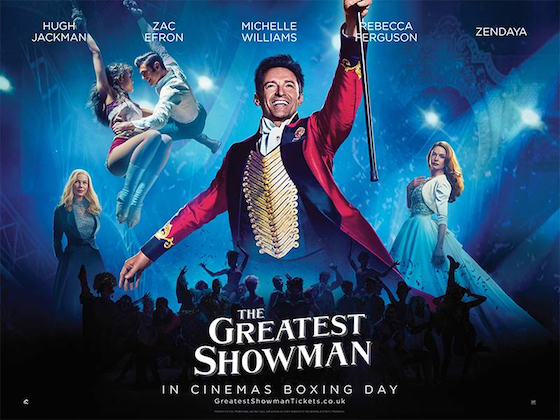
    The greatest show

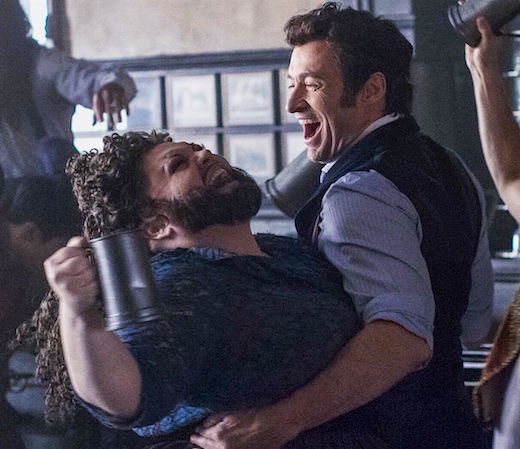
    It’s a Musical through and through, the movie equivalent of a broad stage-grin and jazz hands. The numbers are of a different ilk to traditional Broadway style, but not misplaced — it’s modern chart-pop style songs and music video choreography, wrapped up in a big showy old-school musical vibe. I know everyone’s latched onto This Is Me as the film’s anthem, and Rewrite the Stars earned a single release because it’s a pop love song sung by kid-friendly Zac Efron and Zendaya, but the one number that really works for me is opener/closer The Greatest Show (it’s even better on the soundtrack, because it isn’t awkwardly sliced in two with the rest of the movie shoved in between, as it is on screen). If that song doesn’t end up being co-opted for opening ceremonies and things like that, it’ll be kind of a shame. And if I was to point to a runner-up favourite, I’d go for The Other Side purely for how it’s staged: a barroom duet between Jackman and Efron with impressive drinkography. And talking of the songs, the Honest Trailer contains some excellent spoofs of them.

    Still probably best known as surly superhero Wolverine, Jackman was an established musical theatre star before his big-screen breakthrough, so this stuff is very much within his skill set — indeed, as his recently-announced world tour could attest, this show of song and dance may be more in his comfort zone than the superhero shenanigans. Either way, that he’s so effortlessly consummate at both proves he’s a performer of underestimated range. Less remarkable as allrounders are former Disney brats Efron (as a bored rich kid roped into Barnum’s enterprise) and Zendaya (whose qualifier for a freakshow seems to be that she’s somewhat dark skinned), but they’re perfectly adequate for their poppy against-all-odds romantic subplot. Less at home is Michelle Williams — not that she’s bad, but seeing her smiling and happy is weird

    Drinkography

    Altogether, I can see why The Greatest Showman was unpopular with critics but a huge hit with audiences — it’s a proper crowd-pleaser; a big, cheesy, easy extravaganza, similar to its pop-style music. That’s not the sort of thing critics are enamoured of, but it is the kind of thing that tickles the fancy of the masses. On the whole, it didn’t appeal to me — there were things it could’ve done better without betraying what it was aiming for, I think, like that total lack of risk in the plot, but also things I was never going to like, such as the music style — but it did have its moments.

    3 out of 5

    The Greatest Showman will be available on Sky Cinema from midnight tonight.

    Creed (2015)

    2018 #242
    Ryan Coogler | 133 mins | Blu-ray | 2.40:1 | USA / English | 12 / PG-13

    Creed

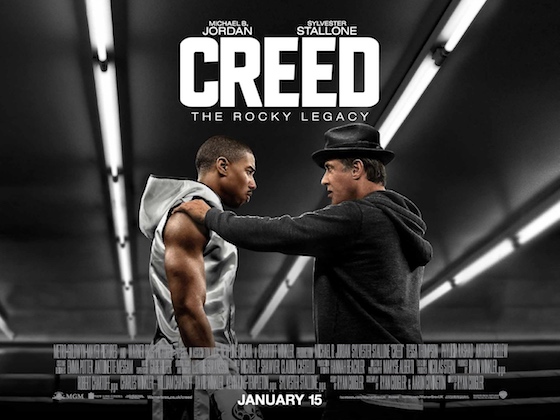
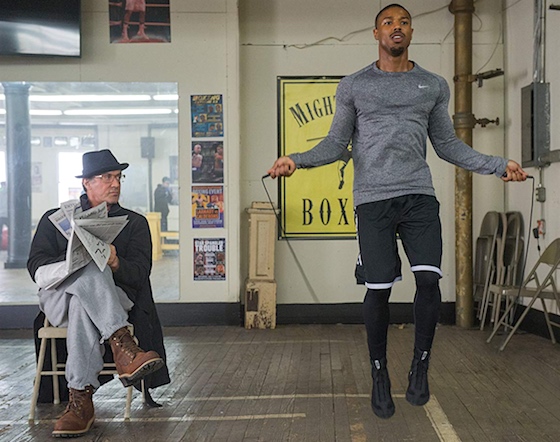
    Somehow, it took me a while to realise Creed was a Rocky movie. I remember hearing about the film; hearing its story of an underdog boxer taking on the world champion being compared positively to Rocky; and then beginning to hear kind-of-like-rumours that maybe, in fact, it actually featured the character of Rocky, and was, therefore, technically, a Rocky movie. Goodness knows what gave me that impression, because not only is Creed a Rocky movie through and through, with a major role for Sylvester Stallone’s character, but he’s on the bloody poster — and, in international markets, there’s a bloody big tagline emphasising how it’s a Rocky movie. Eesh. And all of that matters because, while there are a lot of things to like about Creed, I think my favourite was that it’s a proper Rocky movie.

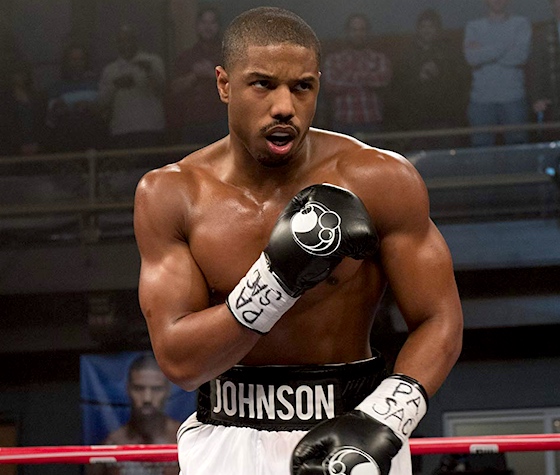
    The film introduces us to Adonis Johnson (Michael B. Jordan), the illegitimate son of Apollo Creed, born after Creed was killed in the ring (see Rocky IV for more on that). Adonis grew up in juvie, getting into fights, until Creed’s wife (Phylicia Rashad) adopted him and raised him as her own. So Adonis was raised in the luxury life Creed’s legacy left them, and is now successful in a cushty office job, but inside burns the fire of a fighter. Quitting his job to make a proper go of it, no one in LA will train him, thinking he’s a rich kid just wanting to trade on his daddy’s legacy. Determined to make a name for himself, Adonis heads to Philadelphia with the intention of being trained by his father’s best friend, legendary boxer Rocky Balboa (Stallone).

    Creed and Balboa

    Creed partly sets out to be its own thing, focusing on Adonis rather than Rocky (when you boil it down, the film actually has a similar plot to the much-despised Rocky V), but it doesn’t forget to be a proper instalment in the Rocky saga too, picking up on things from previous films (the restaurant; Rocky visiting Adrian’s grave) and moving them forward (where Paulie is; where Rocky’s son is). It’s unobtrusive for newcomers (it plays as character beats rather than overt references), but it’s satisfying for fans to feel that connection, that respect for the material. Creed sets out to tell a grounded and somewhat gritty story, like the original Rocky, but, as Matt Zoller Seitz put it on Twitter, the film pulls its “existence from what’s probably the dumbest and most cartoony of the Rocky movies. There are overt references to all 6 Rockys in the first Creed. No cherry picking. It’s all canon.”

    That influence extends to the whole shape of the film, which follows the Rocky formula: the underdog getting a shot at the big league; a hero who’s fighting to prove himself more than to win; the training montages; the simultaneous love life and/or personal storylines… It’s clearly a new story about a new generation, emphasised by the details of how co-writer/director Ryan Coogler constructs and crafts the film, but it also sits very comfortably as the seventh Rocky movie.

    As with any film that fits a genre template, it’s in the nuances that we find differences. For starters, Adonis’ route to the ring is a bit different to the norm. “Rags to riches” is a storyline we’ve seen a hundred times, but here’s a guy who has a lavish lifestyle, who could just trade off his father’s name if he wanted, but who has to find a way to prove himself in spite of that. It’s not just a personal demon: we’re shown that this is a world where only that “rags to riches” path is seen as authentic. It comes up several times throughout the film, but not least before the final fight, when Creed’s opponent taunts him with the fact he comes from such a background, that he’s more like Rocky than Adonis is. Of course, the net result to storytelling is the same: Adonis has to prove his worth to his doubters, and to himself.

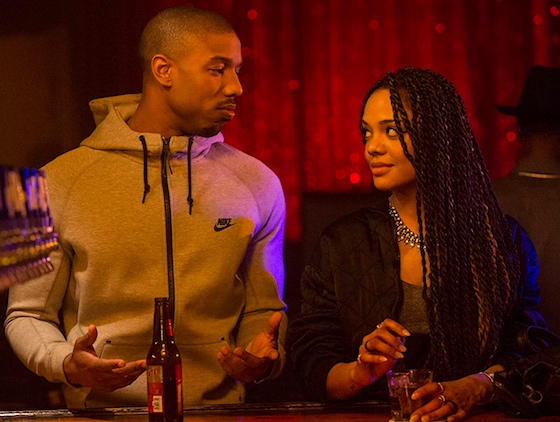
    Adonis and Bianca

    In a featurette on the Blu-ray, Coogler says that “at the core of these movies, they’re really relationship dramas with an action sequence at the end.” I couldn’t’ve put it better myself, and Creed continues that tradition by seeing Adonis hook up with Bianca (Tessa Thompson), a musician with problems of her own. According to Thompson, “Ryan really wanted to show a girlfriend character in the context of a sports movie that was complicated, that had her own life and own dreams.” I think that’s noticeably the case: her role in the film is obviously primarily defined in relation to Adonis, because this is his story, but she’s a rounded character with more agency than just “the love interest”. Depending how you view things, I think there’s an argument to be made that the Rocky films have often tried to give this depth to “the love interest”, i.e. Adrian. When we first meet her in Rocky she’s shy and quiet, which can come across as ‘secondary’, lacking depth or independence, but really it’s just a personality type. Adrian certainly changes and grows as the films go on, becoming more confident and forthright. Even compared to that, Bianca is more independent, more ‘modern woman’, driving the back-and-forth of the relationship as much as Adonis.

    Rocky himself also gets a significant personal subplot, which allows Stallone to give a powerful performance — and, as it turned out, an award-winning one, which is impressive (and probably unprecedented) for the seventh outing of a character. The film draws on Rocky’s past to show us a guy who’s kind of content with letting life go — the love of his life is dead, his best friend is dead, his son has moved away, so why keep going? — but is given reason to fight again by a new family. I did think it was lacking a bit of Rocky’s charming naïveté, the occasional misspeaks or what have you (except for one bit about ‘the cloud’), but it’s been replaced with a genuine lived wisdom that does still feel like Rocky.

    Training hard

    Coogler, in just his second feature, demonstrated he really knows what he’s doing. Perhaps the most striking part of the direction is that he chooses to use a lot of oners, with none more effective than covering the entirety of Adonis’ first pro fight in a single take. We stay in the ring with the boxers throughout, up close alongside them, following the fight almost from their perspective, with the noise of the crowd and the shouts of the trainers moving around the room if you’re watching with surround sound. It depicts an entire two-round match this way, and it’s a genuine single take (they shot it 13 times, with the 11th being the one used). It’s a very different and effective way of presenting a fight, but it’s more than just cinematic theatrics: to quote Scott Collette from Twitter, it’s “one of the smartest sequences in modern filmmaking. Coogler puts us into the ring and, in withholding an edit, he conditions us to trust in and rely entirely upon Creed’s skills and training to get us out, and he rewards that trust. In doing so, Coogler buys himself the freedom to edit the shit out of the final match. No matter where he cuts […] we never leave the ring. We’re always with Adonis because he’s the only one who’s shown us that he can get us through it.” That’s bolstered by another oner just before the climactic bout, in which Coogler makes us a member of Adonis’ squad: it begins in the quiet locker room, with Rocky’s prematch pep talk and a little warm-up, before the camera follows along as they walk down the tunnel, putting us in the middle of the team, all the way into the arena, the sound of thumping music and a baying crowd gradually growing, and it doesn’t end until Adonis is actually in the ring, ready to fight. Again, it’s all about aligning us with Adonis and his crew, emphasising how much we’re connected to him and his fate.

    The way Coogler and composer Ludwig Göransson use the famous Rocky theme is neat too: they hold it back, hold it back, hold it back, so that when it finally hits, just that burst of score makes for a triumphant moment. But then it’s not allowed to take over: Adonis may have been helped by the Rocky legacy, but this is his story now. Neither Adonis the fighter nor Creed the film exist purely by leeching off nostalgia.

    Gonna fly now

    And yet, as I said at the start, my favourite thing about the film is that it is a Rocky movie. But, importantly, it’s the way it doesn’t just indulge in references, but actually seeks to develop on the Rocky story — on everything that went on in the previous films — that makes Creed one of the very best in the series. To quote Matt Zoller Seitz again, “Creed is the ultimate Rocky movie, because all the other Rocky movies are somehow contained within it.” I feel wrong enjoying Creed the most out of the Rocky movies — like I’m just going for the most recent one, as if new = best — but the major reason I loved it so much is the way it has reverence for and builds on the past. As a standalone movie, it’s more-or-less equal to the best of the original Rocky films; but as specifically the seventh film in the Rocky series, it stands atop that 40-year history to add extra weight to everything. By itself, Creed is a very good 4-star movie, but its respect for the legacy tipped me over the top.

    5 out of 5

    Creed placed 19th on my list of The 26 Best Films I Saw For the First Time in 2018.

    Creed II is in UK cinemas from tomorrow.

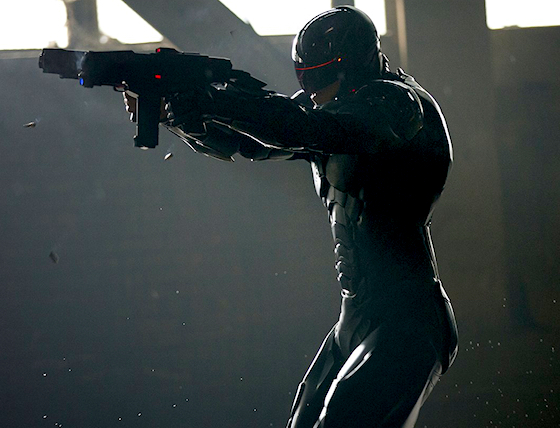
    RoboCop (2014)

    2018 #151
    José Padilha | 118 mins | streaming (HD) | 2.35:1 | USA / English | 12 / PG-13

    RoboCop

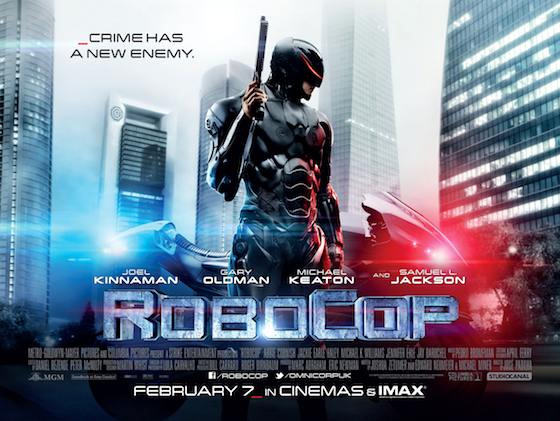
    This reboot of the popular sci-fi/action satire wasn’t received too warmly on its release back in 2014, but nonetheless I’d been vaguely meaning to watch it (just because every high-profile sci-fi/action-y kind of movie goes on my back-burner). Then, after the news earlier this year that Neil Blomkamp had signed on to direct a new sequel to the ’87 original, I saw a fair few people say this reboot was actually quite good; that it only suffered due to comparisons with an original that’s a beloved genre classic. So I watched it, and, well, those people were being too kind.

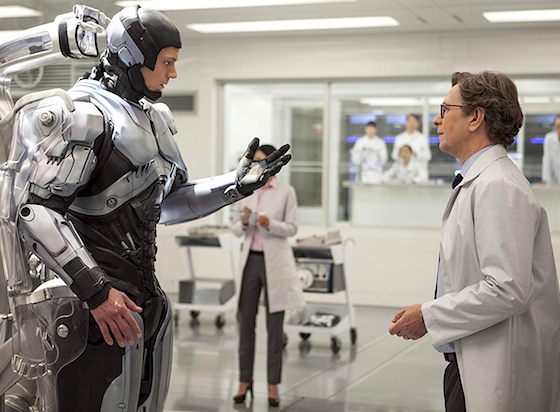
    The year is 2028, and mega-corporation OmniCorp have transformed warfare with their robot soldiers. Keen to deploy the same product as domestic law enforcement but blocked by legislation, they instead develop a proposal for a cyborg police officer — all the physical benefits of a machine, but controlled by the mind of a man. When Detroit cop Alex Murphy (Joel Kinnaman) is fatally injured in the line of duty, they have the perfect candidate; but they haven’t anticipated the emotional toll the procedure will take on its subject… So, it’s broadly the same plot as before, then. Well, it is a remake.

    I wasn’t actually a huge fan of the original — I didn’t dislike it, but in my review I did say I thought it’d had its day and the idea of a remake was fine because “the concept’s a good’un and could withstand a refresh.” I stand by that assertion, I just don’t think this remake is a very good film. Reportedly the screenplay was based on an unfinished draft from 1985, which was commissioned by director Paul Verhoeven when he was considering making the film more serious. After reading that draft he realised he was wrong, returning to the original idea of “humour and brutal satire on the corporate future.” To put it another way: this film is based on a serious/humourless screenplay that was rejected because it wasn’t as good, rather than the one that was made and which garnered all the praise and fans and everything. What a bright idea.

    Machine man

    It’s clear that the writers (whoever they are — there were numerous uncredited rewrites) have serious things on their mind, with the film touching on various topical issues — overseas wars, prosthetics, murderous law enforcement — but instead of satirising them it mostly wants to take them seriously. There is a bit of satire left (Samuel L. Jackson ranting away as a commentator on a Fox News-esque TV network), but it lacks anything deeper than surface spoofery. Primarily, I think the film wants to say something about corporate America — about big business being above the law, and indeed manipulating politicians to set the law — but it doesn’t have anything particularly insightful on that subject. Indeed, I think my previous sentence summed up all of the film’s points on the matter. And that’s annoying because, now more than ever, takedowns of that Fox News mentality are important to how America-as-it-knows-itself is being destroyed from the inside.

    The film also seems to have tried to switch satire for psychological matters, asking how this procedure would really affect a man. That aspect was in the original film too, but I felt it had greater focus here. Unfortunately, they cast personality vacuum Joel Kinnaman as the lead, immediately undercutting any attempt to effectively explore the character. He’s surrounded by an all-star supporting cast (Jackson, Gary Oldman, Michael Keaton, many other recognisable faces), who give decent performances, but the material hardly gives them a lot to work with. Oldman fares best: his character actually has an arc (unlike, well, pretty much anyone else in the movie), as he gradually sells out his ethics to attain his desired result. This brings in a theme of how good people can be corrupted bit by bit, but it’s still pretty thin. You never really feel that he’s selling his soul, meaning his redemption is kind of muddled. It doesn’t come off in the triumphant way you imagine someone had in mind when they wrote/filmed/edited it.

    Shoot 'em up

    If you want to block all of that out, sadly it’s not particularly satisfying as an action movie either. The attempt to genuinely focus on the morals leaves action pushed aside for most of the running time, which might be admirable if it worked, but it doesn’t. When it finally arrives, the action is as bland as the rest of the movie. In the original film’s climax, Robocop fought a stop-motion animated ED-209 that looks kinda clunky and cheap today; in this one, he fights half-a-dozen CGI ED-209s, but now they lack any weight and the sequence has no tension.

    Basically, the film does nothing particularly well. It’s not outright bad, but it’s not good either. It’s fine. It’s adequate. Normally I’d now say it’s good for a couple of hours of brain-off entertainment, but is it? The action quotient isn’t really high enough for that. More likely you’ll end up pondering all the things the film itself doesn’t bother to adequately work through. It should be cutting and provocative, but it’s just bland. That’s the biggest shame, because if there’s a movie 2018 needs it’s one about corrupt businessmen hijacking the government’s decision-making while right-wing TV chatterers cheer them on and police officers are replaced by an ultimate-killing-machine robot. Put another way: 2014 probably didn’t need a new RoboCop movie, but 2018 does — but it needs one with more smarts than this.

    2 out of 5

    RoboCop is part of the opening night of Film4’s Fantastica season, airing this evening at 11:50pm.

    The Hunt (2012)

    aka Jagten

    2018 #195
    Thomas Vinterberg | 111 mins | streaming (HD) | 2.35:1 | Denmark & Sweden / Danish, English & Polish | 15 / R

    The Hunt

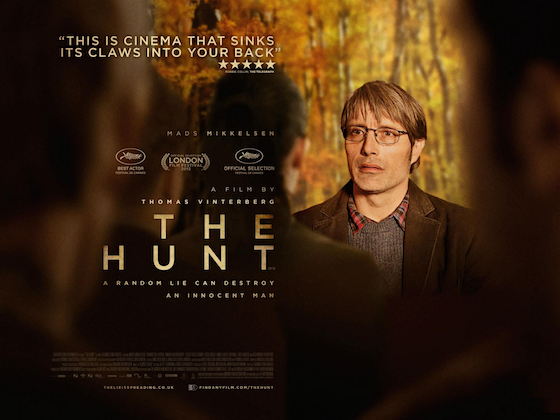
    Mads Mikkelsen stars as Lucas, a preschool teacher falsely accused of sexually abusing a child in his class, in this hard-hitting drama directed and co-written by Thomas Vinterberg, one of the co-founders of Dogme 95. That filmmaking movement is pretty firmly relegated to the past at this point, but its goals — to focus on story, acting, and theme — live on somewhat in powerful films like this.

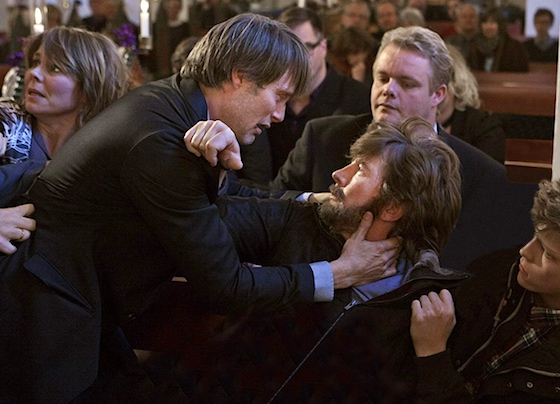
    In this case, primarily, one of the film’s great strengths is how plausibly the matter is handled. There are no screaming histrionics and no raging against the world from Mikkelsen, as slowly the entire town turns against him based on a few misguided and poorly-understood words from a confused child. Instead, he mainly conveys a lot of quiet desperation — a man who knows he’s innocent but can’t work out how to prove it, and is increasingly hurt as people he called friends almost all turn against him. And that, I suspect, is how a real-life version of this would go down, despite what some of the film’s few critics would prefer to think: most people would hunker down and hope the law would come through to prove innocence, not go on some screaming rampage.

    Nonetheless, it’s quite a damning film in its view of society. Most of what happens is due to adults getting carried away, misspeaking, and jumping to assumptions. It begins with a lie told by a child, but the intent is not truly malicious, but then things spiral out of her control. It’s also, naturally, even more pertinent now than it would’ve been when it came out, with allegations and denials of sexual abuse ever more often in the news. Fortunately, The Hunt is a mature and considered film, with something to say for audiences to consider, rather than hysterically coming down on one ‘side’ of an argument.

    With friends like these, who needs enemies?

    That said, I’m not sure some viewers are mature enough to take the film in. I’ve come across more than a couple of reviews that didn’t like it just because it was a difficult film full of unlikeable people. Sorry, but that’s life — there are annoying, stupid people out there just like the ones depicted here. Yeah, it’d be better if these morons didn’t exist, but they do, and that’s how shit like this happens in real life. Just because dickheads are real, and many of the characters in this film are inspired by those dickheads, doesn’t make this a badly-made film for depicting them.

    Obviously this is in the writing, by Vinterberg and Tobias Lindholm, and the way the former has translated it to the screen, but also the performances. Mikkelsen is fantastic, of course, offering a restrained and unassuming performance characterised by inner desperation that only occasionally leaks out, which makes the injustices against him feel all the more hurtful — it is, in the most literal way, not his fault. Even more incredible, however, is Annika Wedderkopp as the little girl who first accuses Lucas. I mean, with a child that young it’s as much the skill of the direction as the actress, but they’ve given real depth and nuance to her character. You can actually see and feel the conflicting emotions she’s struggling with written across her face, most of all in an extended scene where she’s first interviewed about her accusations, as she’s visibly torn between wanting to back out of the lie but also not wanting to be thought a liar.

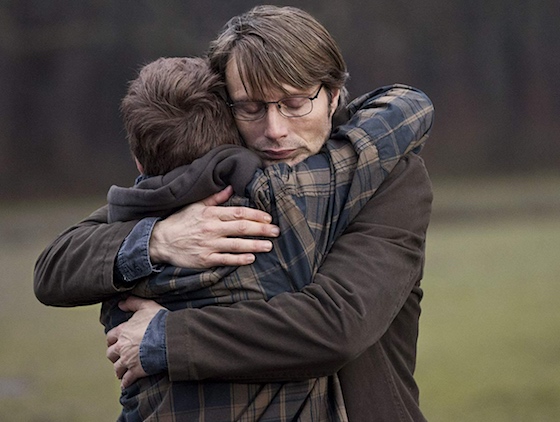
    It's okay, that's his son

    It all comes together to make a movie that is plausible, powerful, and pertinent — and kinda depressing for it, to be frank. I don’t want to spoil the ending (though I will say: dog lovers beware), but however it turns out legally for Lucas, the film suggests the reality of such situations: that some people will always follow the maxim “there’s no smoke without fire”. Once accusations have been made, is there ever really any going back?

    5 out of 5

    The Hunt is on BBC Two tonight at 12:25am, and will be available on iPlayer for a week afterwards.

    It was viewed as part of my Blindspot 2018 project, which you can read more about here.

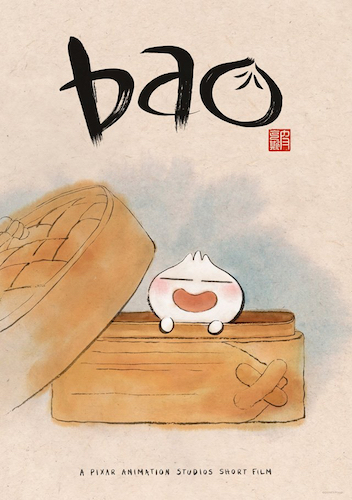
    Bao (2018)

    2018 #233a
    Domee Shi | 8 mins | Blu-ray (3D) | 1.85:1 | USA / silent | PG / G

    Bao

    This short film from Pixar played before Incredibles 2 in cinemas, so naturally it accompanies it on Blu-ray too. In it, a Chinese-Canadian woman is steaming dumplings (the titular bao) when one comes to life and grows into a little dough boy, who she begins to raise as a son.

    As with many of the best short films, Bao takes a simple theme (though to say what the real core of the short is would give away some of the ending) and executes it succinctly. As is often the case with Pixar’s work, it aims at packing an emotional wallop, using it’s fantastical story to elucidate a real-life situation. It also doesn’t stint visually, with an overall animation quality that wouldn’t be out of place in a feature.

    Bao is perhaps most notable as the first Pixar short to be directed by a woman. It only took 35 years and 35 shorts to get there. Considering some of the recent stories about the company, and the reputation it was gaining as a “boy’s club”, I guess this couldn’t come at a better time, though perhaps it’s to their credit that they didn’t seem to harp on about this aspect (I stumbled across the fact on Wikipedia). Given the quality and clarity of work on display, perhaps writer-director Domee Shi will get to be Pixar’s first female feature director too.

    4 out of 5

    Incredibles 2 (2018)

    2018 #233
    Brad Bird | 118 mins | Blu-ray (3D) | 2.39:1 | USA / English | PG / PG

    Incredibles 2

    Brad Bird — the director behind The Iron Giant, Ratatouille, and not letting them release the IMAX version of Mission: Impossible – Ghost Protocol on Blu-ray (I will never be over that) — returns to the movie that made his name with what must be Pixar’s most-requested (probably “only requested”, actually) sequel, Incredibles 2.

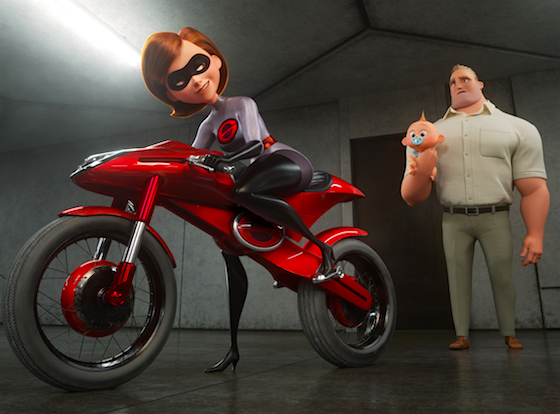
    It’s been 14 years for us viewers since the last Parr family adventure, but in-universe it’s been no time at all — literally, as Incredibles 2 picks up by recapping the closing moments of The Incredibles, which saw the eponymous family of superheroes about to face off against villain The Underminer. That confrontation goes disastrously awry, landing the family in a whole heap of trouble; but it also attracts the attention of media mogul Winston Deavor (Bob Odenkirk), who believes superheroes should be made legal again. Recruiting parents Bob and Helen Parr — aka Mr Incredible (Craig T. Nelson) and Elastigirl (Holly Hunter) — and their friend Frozone (Samuel L. Jackson) to his cause, the first step in Deavor’s public relations plan revolves around public crimefighting appearances by Elastigirl… alone. This leaves Bob holding the baby, literally, as he’s stuck at home with the kids while his wife gets to have all the fun.

    At its most basic, Incredibles 2 is a gender-reversed do-over of the first movie… to a fault, in fact. The closing moments of the first film suggest a “family of superheroes” future for the Parrs, with them battling crime together. The sequel immediately works to put everything back in its place: the kids aren’t allowed to use their powers (until they must for the climax, natch); one of the parents gets to go off and be a superhero, while the other has to stay at home. The difference is it’s the man staying at home, and where Helen was consummate at looking after the kids, Bob finds it a challenge — because Men, amirite?

    Left holding the baby... literally

    Part of what made The Incredibles so successful as a movie was it mixed a plausible family dynamic in with the superhero capers, but here that home life aspect is what holds the film back, because Bob’s struggles with the kids are 66.6% cliché. His son struggles with homework, and Bob doesn’t know how to do it either! His daughter has boyfriend problems! The 33.3% that works comes courtesy of baby Jack-Jack, who is beginning to develop powers — plural. As the middle of the film drags on, becoming a bit “we get the point!” with Bob’s familial woes, the bright spot is continually Jack-Jack’s humorous madcap antics.

    Mind you, the actual storyline in the superhero section isn’t much better. It revolves around the hunt for a mysterious villain, which naturally ends in a twist reveal… but as their true identity is pretty obvious as soon as they first appear earlier on, that reveal is a long time coming. Depending how critical you want to be, this part of the movie also has a lot of thematic points that seem to peter out or had nowhere to go in the first place. Is the film trying to say something about our addiction to screens and media? About the merits of vigilantism over bureaucracy? The dangers of being reliant on ‘higher powers’ to look after us? It touches on these things, and more, but they’re only given passing reference. Okay, yes, when you boil it down this is “just” a kids’ action-adventure movie and maybe we shouldn’t expect too much depth of thought… but Pixar are always hailed as being much more than that. Is it too much to expect that, if they’re going to introduce a topic or perspective, they’ll also at least close it out somehow?

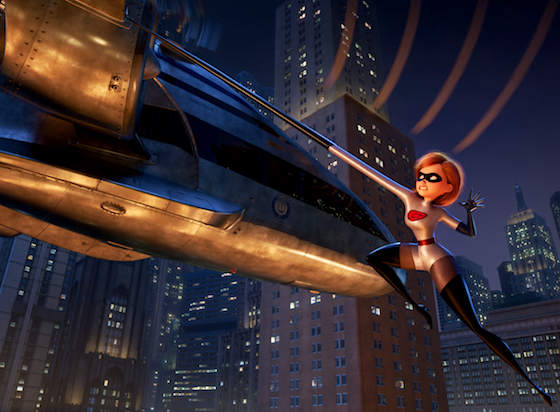
    Yet for all these story woes, Incredibles 2 does indeed work as a colourful action-adventure movie; gloriously so. The action sequences are absolutely thrilling, beautifully choreographed and constructed. They’re even better in 3D, too — Elastigirl’s stretchy powers seem to have been made for the format. And while the middle of the film may refuse to pay off the “family of superheroes” thing, the opening sequence and climax let them all in on the action, and it’s all the better for it.

    Stretchy superheroics

    What made The Incredibles one of Pixar’s best films, and one of the best films in the whole superhero genre, was the way it combined the action and adventure with family dynamics and concerns, seamlessly marrying the two. The sequel lacks the clarity and connectedness that first movie boasted, working very well as a fun superhero action movie but struggling as a family comedy-drama. It’s still an entertaining time (the sometimes-slow mid-section aside), but it’s not the genre and studio standout that the first film was.

    4 out of 5

    Incredibles 2 was released on DVD and Blu-ray (2D & 3D, but no 4K) in the UK this week.