No Country for Old Men (2007)

2009 #5
Joel & Ethan Coen | 117 mins | DVD | 15 / R

This review contains major spoilers.

When I saw No Country for Old Men, a new round of films were vying for the Best Picture Oscar. Now, as I finally post my review, a whole new load have been nominated, voted on, and await the final result. Sometimes I feel decidedly behind the times.

The first time I watched No Country for Old Men was in a screenwriting seminar. On R2 DVD (the format for said seminar) it runs one hour 57 minutes, but in the two-hour seminar we got through the whole film with plenty of pauses for discussion (of its narrative structure, with particular emphasis on the application of fate/chance/coincidence, if you’re interested). Obviously this entailed skipping chunks of the film to get to the end within the time. I was rather annoyed that our tutor hadn’t bothered to forewarn us this would be the subject of the seminar in such a way, because it meant I had no chance to see the film properly beforehand. Now, watching the film in full, I can clearly see the odd bit we skipped over, yet I don’t feel I missed anything terribly significant.

Cut short or no, it has an excellent use of no music — the Coens still create massive amounts of tension, numerous shocks, etc. It’s highly skilled direction and editing. There are a number of very good scenes along the way (even if the best remains somewhat dulled from constant repetition in the run up to the 2008 Oscars). And it all looks mighty pretty too, especially on Blu-ray (my re-watch format of choice here). The cinematography was probably my favourite part of the film.

As noted, it’s really about Fate, randomness, chance. Some clearly think this brilliant; I remain unconvinced. It lacks satisfaction. Maybe that’s real life — no, that is real life: random and lacking closure and satisfaction. But this isn’t real life, it’s a movie; and a movie with a near-fantasy (or, more accurately, horror) aspect too, in its unstoppable villain; so I think I want my proper tied-together plot, thank you very much, not a de facto hero who’s shot almost at random by a gang who have little to do with the story and a frequently irritating villain who exits the film fundamentally unscathed.

I’ve read one critic assert No Country for Old Men is the only worthy Best Picture winner of the past decade. I’ve seen another argue There Will Be Blood is the only genuine classic produced in the noughties. Any number of them have no doubt espoused similar such views. Critics, eh — always contradictory.

Anyway, No Country for Old Men: thoroughly unsatisfying,

4 out of 5

Originally posted on 5th March 2010.

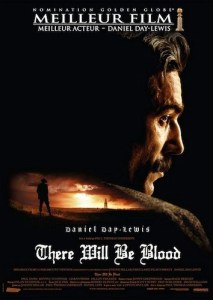
There Will Be Blood (2007)

2009 #7
Paul Thomas Anderson | 152 mins | DVD | 15 / R

There Will Be BloodI used to consider myself a fan of Paul Thomas Anderson; however, I’ve come to the conclusion that I’m merely a fan of the film Magnolia. As I explained when I covered Boogie Nights, I love Magnolia, thoroughly dislike Punch-Drunk Love, and was ultimately uncertain about Boogie Nights. There Will Be Blood’s significant Oscar nominations and wins seem to have cemented it as Anderson’s most acclaimed work, but I wouldn’t consider myself a fan of this either.

That’s not to say it’s a bad film, but it is at times a baffling one. It makes minimal concessions to its audience from the very start, beginning with an extended montage that covers relatively vast tracts of time with virtually no dialogue, before segueing into a story that introduces and discards characters and events with little hint of their relevance, and eventually makes a huge leap forward for an equally impenetrable ending, all the while under- (or perhaps over-) scored with Jonny Greenwood’s disquieting music, sounding like the THX logo writ large. I can’t help but wonder if I missed something crucial along the way because, even after two and a half hours, I had no real idea what the film was about.

Leaving that aside, the film is technically excellent in just about every field. Daniel Day-Lewis easily deserved his Best Actor wins for his role as oil magnate Daniel Plainview, a performance so subtle that there initially seems little to it but which slowly peels away the layers to uncover much more. Anderson’s screenplay helps him along with an array of scenes written to textbook levels of perfection (almost literally: in a screenwriting class we studied in depth the scene where Plainview negotiates a land purchase from the Sunday family). Little Miss Sunshine’s Paul Dano delivers a superb supporting turn too, even if his casting as brothers Paul and Eli Sunday adds a level of confusion where there isn’t meant to be one (considering there was originally a different actor cast as Eli). Dillon Freasier also offers good, understated work as H.W., Plainview’s 11-year-old son.

Individual scenes are certainly well handled. The opening may offer little in the way of explanation, but with minimal dialogue, well-chosen images and events it expertly conveys Plainview’s rise to prominence and establishes his position without ever doing more than is necessary. The sequence with the burning oil derrick is visually stunning and, for me, the first point at which the discomforting score really worked (though it must be worth noting that Greenwood actually composed that cue for a different film). As already mentioned, many of the dialogue scenes are also exemplary, among them the much-quoted bowling alley finale. Anderson is capable of crafting moments of immense power, even if their cumulative effect is perhaps unclear.

It’s difficult to judge a film I have such conflicted feelings about, especially when its high critical consensus leaves me with a nagging feeling that, somewhere along the way, I missed something of vital importance. I’m not really a fan, and I’ll no longer call myself a fan of Paul Thomas Anderson, but his work is certainly interesting and definitely merits revisiting.

4 out of 5

Originally posted on 5th March 2010.

Michael Clayton (2007)

2009 #87
Tony Gilroy | 115 mins | DVD | 15 / R

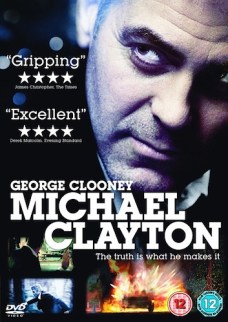
Michael ClaytonWhen Michael Clayton turned up among the contenders for 2008’s Best Picture Oscar I was a little surprised, because as far as I could recall I’d never heard of it. Then as I read about it a memory came floating back… a memory of a half-page (at best) review in Empire, of a George Clooney film that sounded like it should be good but was, they asserted, only worthy of three stars. As you’ve surely guessed, when I dug out this review it was indeed of Michael Clayton.

It is, I suppose, technically speaking, a thriller. That it’s not particularly thrilling doesn’t have to be a problem — this is the world of class action lawsuits, after all, which take years (decades sometimes, I imagine) of meetings and paperwork and ‘polite’ lawyer-arguing, and often writer-director Tony Gilroy seems to want to depict a moderately realistic version of this world. Clooney’s titular lead, for example, is effectively a middle-management dogsbody, albeit a highly talented one (so we’re told, anyway — the scenes of him doing his job don’t particularly convey this); but he’s certainly not some crusading young hotshot who is just gonna do what’s right, goddammit.

He does have the requisite seriously flawed personal life however, though Gilroy manages to make this feel fairly fresh. The latter is a big part of the film but feels unconnected to the main story… until the end, of course, when it all dovetails. Thankfully not in a cheesy “the bad guys kidnapped the kid” or “I have to do what’s right to get the girl” way, but rather as a means of motivating Clayton into doing… well, what’s right, more or less.

If this sounds more legal drama than legal thriller, it is. Where this comes unstuck is that Gilroy does seem to want it to be a legal thriller, and so uncomfortably squidged into the mix are a pair of surveillance experts/assassins and one of the least-tense car chases in movie history — 15 minutes in we see Clayton’s car blown up, with him safely on a hillside; the rest of the film takes place over the preceding days, eventually reaching that first night, where we see the bomb planted in Clayton’s car, and the assassins following him around trying to get signal to detonate it… and we might care, if we didn’t already know they don’t succeed until he’s wandered off up a hillside to cry over some horses.

The obvious point of comparison is Damages, the excellent TV series that also concerns such high-profile big-business lawsuits, but which pulls off every one of Michael Clayton’s facets with a higher degree of skill, interest and excitement. Company-sponsored murder sits believably in that world, but so does the characters’ personal life dilemmas and the court room (or, rather, pre-court room) battles between attorneys. And Damages sustains it for over 9 hours to boot, replete with cliffhangers and plot twists so far beyond what Clayton’s surprisingly straightforward (once you get down to it) story has to offer that Gilroy isn’t even dreaming of being that good.

Michael Clayton does have good bits, like the supporting parts played by Tilda Swinton and Tom Wilkinson, or any number of scenes or plot elements scattered around. What it falls short of doing is connecting it all up into a coherent whole: part realist legal/personal drama, part heightened Grisham-esque legal thriller, if it had settled on just one it might’ve been better.

3 out of 5

Michael Clayton is on BBC Two tonight, Friday 4th April 2014, at 11:05pm.

(Originally posted on 5th March 2010.)

Wallander: Mastermind (2005)

aka Mankell’s Wallander: Mastermind

2009 #88
Peter Flinth | 96 mins* | TV | 15

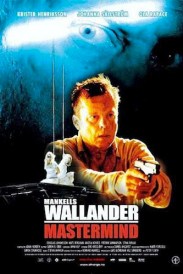
Sixth in the series of Wallander films starring Krister Henriksson as the titular Swedish detective, though only the second to be released theatrically.

Mastermind works to earn its status as a theatrical release, everyone upping their game to provide something more filmic than the other direct-to-DVD entries in the series. That’s not to say the other films in the series are bad — they’re certainly as well-produced as any other detective series on TV — but this episode seems to have been constructed from the outset with an eye on a standalone cinema release, rather than just randomly plucking an episode from the thirteen produced to receive such an honour.

From the start (literally) there are slicker opening titles, and longer end credits to bookend that. The direction is flashier too — still grounded in reality, unlike the heavily-stylised British Wallander, but with more filmic shot choices and editing. Take, for example, the Rear Window-inspired scene where Wallander looks out over the adjacent block of flats while listening to classical music that completely fills the soundtrack — not the kind of sequence you tend to find in TV drama. On-going subplots from the series go unreferenced — there’s no need to have seen a single other episode to follow the story without a hitch.

The main plot’s on a bigger scale — a serial murderer who has eyes and ears inside the police department — and This Time It’s Personal for good measure, with the villain targeting friends and family and (spoiler) a past connection to several characters. It’s not a realistic-scale case-of-the-week, but a once-in-a-career unusual case, the kind of plot that graces serial killer films (Se7en comes to mind, obviously) in a way those case-of-the-week plots rarely do. It stretches credibility a little, as these types of tale often do, which does at times leave it feeling a tad out of place in Wallander’s grounded world, which is usually about more realistic murders rather than megalomaniac super-powerful serial killers. Still, it ups the ante appropriately, making the events more action-packed and conforming to the theory that films should never have a “just another day at the office”-style plot.

With the extra effort afforded to make this series instalment appropriately cinematic, the Wallander team achieve their aim and produce one of the stand-out of all thirteen films. That said, some viewers of the whole series may find it a bit OTT when compared to the series’ regular style.

4 out of 5

* The running time is listed as 102 minutes on IMDb, but 96 is taken directly from the BBC’s iPlayer.

(Originally posted on 14th February 2010.)

Rage (2009)

2009 #81
Sally Potter | 98 mins | streaming | 15
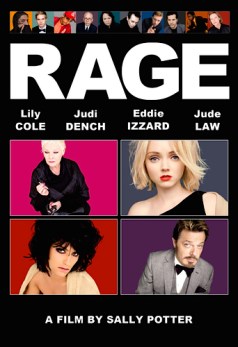
RageI really didn’t expect to like this: a series of straight-to-camera monologues, performed in front of just plain-coloured backgrounds, about the fashion industry, written and directed by the writer/director of Orlando, which I thoroughly disliked. But I watched because it was going free and, despite the concept’s innate pretentiousness, it’s an intriguing one. Once Rage settled into its stride (or, perhaps, I settled into its stride), however, I loved it.

The group of fourteen people who appear before the camera are almost entirely self-centred and/or not very nice, which you may guess from the outset considering their industry, though almost all still have something to reveal as the film progresses. It’s surprisingly funny too. The off-screen action is conveyed by a very effective sound mix — we see nothing but talking heads (until an incongruous final shot, at least), but there’s always background noise, however subtle, and the key action in the wider world is revealed to the viewer through this, plus comments from some of the talking heads. But time isn’t wasted spelling out what we can’t see; instead, a bit of the viewer’s own imagination is required in addition to the sound and dialogue clues to create a version of events.

A starry cast (Steve Buscemi, Lily Cole, Judi Dench, Eddie Izzard, Jude Law, John Leguizamo, David Oyelowo, Dianne Wiest… plus recognisable (depending on what you’ve seen, of course) faces like Simon Abkarian, Bob Balaban and Babel’s Adriana Barraza.) provide exemplary acting across the board, even if some of the accents (mainly Brits playing at yanks) are frequently dubious. It seems unfair to pick anyone out, but Lily Cole is perhaps the most surprising, her fragile character aided by her Pipling-esque eyes and pale skin, but it’s her actual performance that ultimately delivers more than her autobiographical-seeming first appearance would suggest. And one can’t ignore Jude Law playing a Russian/American female(?) fashion model — for once I actually thought he was quite good. Maybe this is his niche. The majority of the performances err toward the theatrical — something certain film viewers seem to struggle with — though the intercutting and passage of time, reflected in intertitles and costume changes, make the whole experience more suited to film; indeed, with the cameraperson being such a major character (as it turns out), it is technically unstageable. (It could be staged, of course, but it belongs as a film.)

And, talking of how things turns out, the most intriguing character of all is Michelangelo, the cameraman and only main character we never see on screen — indeed, it’s a considerable amount of time before we realise he’s a character at all and not just a filmmaking conceit. His presence and the filming style (supposedly shot on a mobile phone (or, I suppose, ‘cell phone’) camera) is not just a gimmick, but, as it turns out, vital to the story. It’s probably the only film ever made that perhaps works better viewed streaming online. All the characters are in some way unveiled throughout the film, but, almost without the viewer releasing it, so too is our supposedly-inconspicuous cameraman. By the end, what seemed to be a critique of the fashion industry — and a well-worn one at that — has something else to say too.

At least, one hopes this ‘critique’ of the fashion industry isn’t the main point, because it may be the film’s biggest problem. There’s very little, if anything, new to be found in the comments and criticisms made — we well know it’s a business filled with too-thin weight-obsessed diva-ish models, self-obsessed pretentious designers, money-grabbing moral-less Murdoch-alikes and no-hope fame-hungry wannabes, and Rage doesn’t have much more to say about it than this. Sure, no one sits around pontificating on why it’s all so evil, but it doesn’t take much to see the subtext. At least it’s often funny about it; though based on comments I’ve read online, it seems this humour may be too subtle for some. Perhaps they can’t see the inherent ludicrousness of it all, with the performances flying closer to realist than the My Family-level bluntness some require from their comedy.

It’s hard going at times, even if one is enjoying it — after all, it’s still just a succession of people talking to camera. Obviously what they say — and, indeed, don’t say — reveals things about themselves, others, and events off screen, but while I was never bored there were several occasions when my eyes strayed to the clock out of curiosity over how long was left. I’ve still seen much duller films.

I don’t doubt that Rage isn’t for everyone. Indeed, you only have to look at IMDb to see how many people loathe it with near-religious fervour. (Prepare yourself if you do, because some of the criticism is irritatingly brain dead. But hey, that’s IMDb!) Some people just won’t get on with its style, or find it too slow, and with 14 characters in 98 minutes, awarding them an average of under seven minutes each, you’re not going to get Alan Bennett-level character deconstruction. But Rage unapologetically is what it is, and I liked it.

5 out of 5

If you’re interested in an in-depth (and spoiler-filled) review of Rage which features phrases like “extraordinary testament to the mindbrain”, “Mugel and Potter use sound to build an entire lifeworld”, and “it enlivens, emboldens and enriches the film, engaging ear, heart, mind, memory, intelligence, even skin and senses as a brilliant texture”, try this one from Little White Lies.

Rage placed 10th on my list of The Ten Best Films I Saw For the First Time in 2009, which can be read in full here.

Rock n Roll Nerd (2008)

2009 #92
Rhian Skirving | 89 mins | DVD

I don’t usually bother with plot summaries at the start of my reviews, working on the assumption most readers will know (or know of) the film and so don’t really need one. My assumption here is that most won’t have even heard of this film, though.
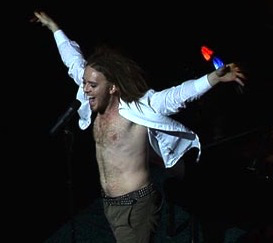
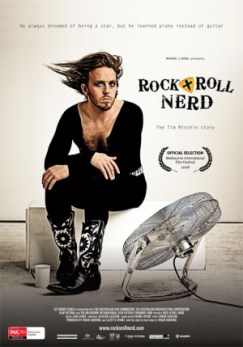
You may’ve heard of Tim Minchin, however, the Australian musician/stand-up who’s done a couple of tours, released a DVD or two, and popped up for guest spots on things like Never Mind the Buzzcocks and The Secret Policeman’s Ball. Back in 2005, no one knew who Minchin was — a struggling musician at the time, on the verge of quitting and finding himself a Real Job. He happened to live next door to aspiring filmmaker Rhian Skirving who, in more or less the same predicament, decided to film Minchin’s last ditch attempt at making it: trying his hand at comedy. They expected to film, at best, a small-scale suburban documentary about a wannabe failing to become a somebody, but what they wound up with was something rather different.

Almost as soon as filming began, Minchin was a hit at the Melbourne International Comedy Festival, where he was spotted by an Edinburgh producer and whisked off to the famous Fringe where (as the film’s own blurb describes it) he had “the most successful first season of any performer in the history of Edinburgh… walking away with the prestigious Perrier Newcomer Award, TV appearances, offers from Hollywood and the West End, the best management in the business and a gig at Albert Hall.” Not what either Minchin or Skirving had expected, that’s for certain!

What this tale creates is an unusual rockumentary. It’s obviously not a concert film, nor a tour film, nor a retrospective on someone’s career; instead, it’s the chronicle of someone’s relatively meteoric rise to fame, from two unique perspectives: the camera is there as it happens, not belatedly once Minchin’s become more widely known; and the writer/director/cameraperson is a close friend, not just any old filmmaker hoping to cash in. One almost has to wonder if Skirving has psychic powers, so perfectly timed was her idea.

Minchin is pretty honest with the camera in tow. When he’s a success, we see him struggle with things like management: does he owe it to the person who discovered him to make sure she’s cut in on the deal? Is it right to just abandon her and move on? Does she just see him as a potential cash cow rather than genuinely wanting to support him? And so on. His honesty extends to the awards — his show is so hyped he winds up half-expecting the near-impossible, to win the biggest award in his first year. He’s not even nominated, having to ‘settle’ for a win as Best Newcomer. His confounded expectations aren’t boastful or immodest, the viewer privy to how his hopes were unrealistically raised in spite of himself.

Alongside this, Skirving and Minchin allow us to see the toll his professional breakthrough takes on Minchin’s personal life. His wife — newly pregnant — is left behind in Australia while he’s becoming the toast of Edinburgh. The timing of some events in his personal life also couldn’t be worse, and Skirving documents them without ever becoming ghoulish or intrusive. It is, in a way, brave of both Minchin and his wife to allow their inclusion, but good filmmaking on the part of Skirving to know where to draw the line.

Documentaries such as this often rely on the viewer having a pre-existing affection for either the performer or their work. Though it seems impossible to believe, I’m sure there must be some who dislike Minchin (his show did get one bad review, after all) and it may be they wouldn’t engage with this film because of it. However, some stories are capable of transcending one’s feelings about the subject covered, and Rock n Roll Nerd may just be one of those: even if you don’t enjoy Minchin’s songs, or indeed comedy music in general, the tale of his success — and what it’s like for an ordinary person to live through such a thing — is a story whose unique interest extends beyond fans-only territory.

4 out of 5

Rock n Roll Nerd: The Tim Minchin Story is currently only available on an Australian Region 0 DVD, available from the distributor, your favourite Australian DVD retailer (y’know, like EzyDVD), or importers on Amazon. The film’s official website can be found here — sadly no trailer, but there are comments from Minchin and Skirving.

Rock n Roll Nerd placed 6th on my list of The Ten Best Films I Saw For the First Time in 2009, which can be read in full here.

Hamlet (2009)

aka The Royal Shakespeare Company’s Hamlet

2009 #90
Gregory Doran | 183 mins | TV | 12

Hamlet (2009)It doesn’t seem like 18 months since the RSC brought Hamlet to the stage with British TV’s biggest star actor (probably) as the titular Dane, but it is (more or less). Thanks to sold-out performances and largely positive reviews (theatre critics seem even less keen to agree on anything than film ones), we’re now treated to this film adaptation, shown on BBC Two on Boxing Day and released on DVD (but not Blu-ray, boo*) earlier this week.
Hamlet hangs primarily on its central performance — so we’re constantly told, anyway; this being only the second production I’ve seen I can’t confidently assert so for myself, but I can certainly see where the consensus comes from. Equally, I can’t accurately compare David Tennant’s performance to any other, which often seems to be a central consideration in any review of the play. In near-isolation, however, it’s a thoroughly convincing performance. He glides seamlessly from withdrawn and grief-stricken in his first appearance, to intrigued and excited by the ghost of his father, to clever and wily as he plots, and finally to an alternation between assumed madness and serious introspection as he enacts his plans.

Any number of scenes show off Tennant’s abilities, particularly the way he treats other characters. He resolutely takes the piss out of both Polonius and Rosencrantz & Guildenstern, but plays each in subtly different ways: the former is like someone intelligent teasing with someone who doesn’t get it, which sounds distasteful but is enjoyable because of Polonius’ plotting and influence; while the latter is like a cat toying with a pair of treacherous mice, who are aware they’ve been caught out but struggle on regardless. Hamlet’s pair of ‘friends’ can be seen as insignificant characters by some — it’s part of what led Tom Stoppard to pen Rosencrantz and Guildenstern Are Dead, after all — but with a few silent additions around Shakespeare’s dialogue and the way Tennant, Sam Alexander and Tom Davey choose to play the original lines, their roles seem to have increased importance.

The other notable facet of Tennant’s interpretation of the character is humour. Hamlet’s madness here is almost unrelentingly funny — even in deadly serious situations, like capture following a murder, Tennant’s Hamlet can’t resist taunting the other characters, keeping the viewer onside by keeping his apparent insanity entertaining rather than scary or darkly intense. If anything, however, this screen version fails to capture just how funny Tennant was on stage. Perhaps it’s the loss of a bigger audience, or the energy of performing on stage, or perhaps Tennant has reined in, switching from Stage Acting to Screen Acting. He’s still funny, certainly, but its not as striking as it was live. In fact, more laughs are earnt by Oliver Ford Davies as Polonius. As his lines dither on like many a real forgetful old man, it’s difficult to imagine the part played any other way.

The other stand-out is an award-winning Patrick Stewart in the dual role of Claudius and the Ghost, though the fact he plays both feels relatively insignificant. His cool politician of a King makes a perfect contrast to the crazed energy of the Prince, the latter constantly bounding around while the former remains still and collected. In my view it’s a shame Stewart has a beard in the filmed version (a necessity forced by his concurrent appearance in Waiting for Godot, I believe) — on stage he was clean-shaven and therefore somehow more reminiscent of numerous other political villains, both real and fictional, whereas his bearded visage is more reminiscent of a traditional Kingly role. Still, it’s a minor aesthetic point that doesn’t hamper his wonderful performance.

Director of the original stage production, Greg Doran, also helms this version. It’s a convincing adaptation too, making good use of sets, locations and, vitally, camerawork, rather than employing static shots of the original theatrical blocking. A quick shoot (18 days for an over-three-hours film) and single location combine to reduce the number of on-screen locations, unfortunately, though the main set is fairly well rearranged to stand in for a number of rooms. It does branch out occasionally, but it’s a shame this couldn’t have been done more often, as consecutive scenes on the same slightly-redressed main set occasionally confuse whether we’ve changed location or not.

Doran’s main screen gimmick, however, is security cameras. Every so often our viewpoint switches to a grainy black & white high angle as we survey the scene via CCTV. It’s a neat idea to convey the concept of Elsinore as a place where everyone is under constant scrutiny, and it’s occasionally used very well indeed — during the Ghost’s appearance to Hamlet, for example, or when he rips a camera down to declare “now I am alone”. Unfortunately, it’s not as consistently thought-out as one might like. When Claudius and Polonius spy on Hamlet and Ophelia, for example, they do so from behind a two-way mirror (as in Branagh’s film, incidentally) rather than, say, from a control room with a bank of security monitors, an idea which seems to naturally flow from the presence of CCTV. Following this, when Polonius talks to Hamlet he delivers several asides to camera — not the security camera, mind, just to the audience. It would have been more effective to have him offer them to a security camera, knowing Claudius to be viewing in another room. It’s moments like these that turn the omnipresent video surveillance from a clever idea to little more than a gimmick. And by the time it’s cut to during the climactic sword fight, you just want it to go away.

It’s almost certain that this production will be remembered as “The Doctor Who Hamlet” thanks to its leading man. Whether that’s unfair or not is another debate, though it shouldn’t mean this version goes ignored. Tennant’s excellent performance reminds us that he was an accomplished performer with the RSC long before he gained televisual fame, and a strong supporting cast ensure this can’t just be dismissed as a popularity-seeking vanity venture by the RSC. Indeed, if there’s one good thing about the “Doctor Who Hamlet” label, it’s that the potential viewership is increased massively, bringing some to Shakespeare who never would have bothered otherwise. Surely no true theatre aficionado could argue with that.

4 out of 5

* A Blu-ray was eventually released in April 2010. ^

Jumper (2008)

2009 #76
Doug Liman | 88 mins | Blu-ray | 12 / PG-13

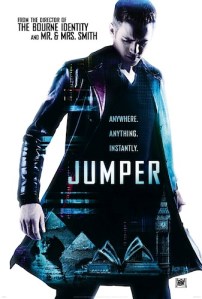
JumperIn honour of Jumper’s central conceit — that certain people can instantaneously transport themselves to any other point on the planet — I will conduct this review by jumping about through paragraphs I wrote without bothering to link them properly. (Also done in honour of my laziness.)
Jamie Bell’s character, Griffin, is much more interesting than Hayden Christensen’s lead, but he’s also amoral — from a storytelling point of view (at least, a mainstream one) he needs a controlling influence, which is why he’s reduced to supporting and he’s-a-bad-boy-honest Christensen is the film’s focus point.

Acting wise, everyone’s just fine. Christensen is perhaps not the most convincing rebellious hero ever, but that’s as much the script’s fault as his and he’s a heck of a lot better than in either Star Wars prequel. Jackson could be a decent villain in his sleep, though Roland could perhaps do with a little more menace to live up to his reputation, while Rachel Bilson is a likable (read: pretty) enough love interest. But it’s Jamie Bell who — once again — really stands out. Why he isn’t heading up his own franchise yet is a mystery. (Oh, wait.)

The beginning is at times a little dull. Considering the film barely crosses the 80 minute mark before the credits roll, early on it feels like there could be a little more excitement and drive. The second half almost makes up for it. Budget is plastered across the screen in incredible action sequences that show off the promise of the concept to good effect. Griffin jumping a double decker bus at Roland is a particular highlight. The jumping car chase, on the other hand, is visually neat and a good idea, but also entirely pointless — for one thing, it’s not actually a chase (no one’s pursuing them), and they do it for no reason other than the sheer hell of it. It’s a shame, because it would’ve been even better given a proper place in the story.

The rules of jumping and the world they exist in seem incompletely thought-out; or, at best, inadequately explained. They go on about having ‘jump points’ or something, but then seem to be able to jump about at will, so what are these points? What’s their significance? Their use? How are they established?

Liman also blows a potential twist — that David isn’t the only one who has these abilities — too early in an attempt to flesh out Jackson’s villain. It’s a good scene in its own right and does serve a purpose, but story-wise it would play better after Bell shows himself to David. As it is, his ability to mysteriously follow David around is not so mysterious, his reveal more “and?” than “oh!”

Bourne-esque final scene… except more Supremacy than Identity, so while Liman is copying, it’s unfortunately not from himself.

Jumper is promising rather than accomplished. In the same way many view X-Men as necessary character introduction and setup for X2, so Jumper appears intended as a primer for the sequels Liman and co have (had?) planned. It may reduce you to thumb-twiddling at times, but there’s enough on offer to make a follow-up desirable.

3 out of 5

(Originally posted on 8th February 2010.)

Hard Candy (2005)

2009 #72
David Slade | 100 mins | TV | 18 / R

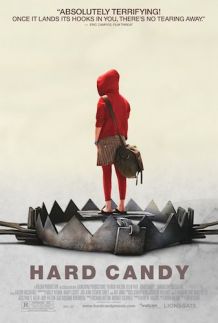
Hard CandyHard Candy’s director David Slade has followed this up with vampire horror with 30 Days of Night and will shortly unleash an altogether different kind of horror by joining the ranks of evil that are bringing us The Twilight ‘Saga’. His feature debut may be a two-hander between a teenage girl and middle-aged man, but in its own way it’s just as much a horror movie.
Actually, that’s mainly a review-opening conceit: one tense torture-ish sequence aside, Hard Candy is a consistently surprising thriller about real-world horrific things rather than depicting them itself. To reveal too much of the plot would spoil it, though I imagine most viewers will already be aware of the first big turn: the real intentions of Ellen Page’s 14-year-old protagonist. It follows this wannabe-surprise (“wannabe” because it occurs too early to escape description in most plot overviews) with a series of equally playful reversals. The viewer’s never quite sure of any fact about either of the two characters; never quite sure if they’re being genuine or at any moment will undermine their present emotion with the revelation it’s just an act, an attempt to fool the other. Arguably it’s played this card too often come the end, and perhaps it could have stood being a more efficient 80 minutes rather than pushing on to 100.

The other assertion in my introduction is also disingenuous, because there are more than two characters. It’s basically a two-hander though, reliant for great stretches on two people in a room conversing and attempting to outwit each other. It’s more exciting than that might sound — the action is far from limited to chatter. Such a production rests entirely on the skills of its two leads, and fortunately both provide excellent performances. Watchmen’s Patrick Wilson is perfectly cast to alternate charming and sleazy, though Ellen Page — pre Oscar nomination for Juno — is the stand-out. Actually 18 at the time, she’s more than convincing as an older-than-her-years 14-year-old, selling the character’s confidence but also revealing an occasional vulnerability and uncertainness that just about keep proceedings the right side of believable. Still, plausibility isn’t exactly the film’s strongest point. There’s enough that one follows it, with the more implausible sections wisely saved for later on, by which time we’re drawn in and accept that Page’s character is clever, cunning and above all prepared.

Other characters do intrude however, and it’s almost a shame when they turn up: it breaks the perfect technical accomplishment of a locationally-limited two-hander for little more than another few minutes of screen time. That said, it’s the arrival of the constantly-referenced former love that finally provokes the ending, a worthwhile climax to a film so caught up in its to-and-fros that anything less than the influence an external factor providing a conclusion would’ve been a disappointment. The neighbour character, on the other hand, feels a little too inevitable; an obvious attempt to ratchet up the tension that arrives too late. It seems Slade thinks it’s as compulsory as the audience might, and dispatches with it quickly… just not quickly enough.

Story aside, Slade’s direction makes for an interestingly shot film. There are many close-ups, in which characters and action are often calm, but then there are occasional explosions of flashy camerawork, usually during acts of violence or other sudden bursts of plot-driving action. The grading is similarly fiddled with during these sections, emphasising the primary-coloured walls of the house that make for an interesting backdrop. Indeed, the walls are used to particularly good — if, arguably, obvious — effect throughout, such as slowly panning across a red wall so that it fills the screen during the lengthy castration sequence.

Hard Candy is sort of a morality play, though it’s hardly a moral that requires increased awareness. Primarily it’s a revenge thriller though, and with limited settings and characters it makes for an admirably intense — if occasionally credibility-stretching — and pleasantly unusual entry in the genre.

4 out of 5

(Originally posted on 7th February 2010.)

The Gruffalo (2009)

2009 #89a
Max Lang & Jakob Schuh | 27 mins | TV

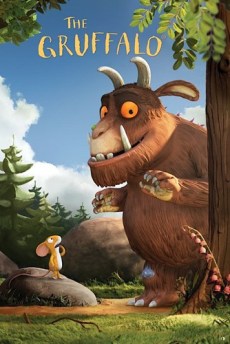
The GruffaloJulia Donaldson and Axel Scheffler children’s book The Gruffalo was a bit after my time but, I’m told, is incredibly popular with The Youth Of Today (not the ones that hang out on street corners earning ASBOs, obviously). It’s certainly a pleasant read, with rhythmic poetry and the kind of repetition that allows children to join in with ease, but it’s also quite short — fine for a children’s book, but not so good for attempting a screen adaptation of any length.

Having turned down numerous offers for feature-length versions, Donaldson accepted the half-hour short film treatment. Thank God she did, because even at under 30 minutes there’s some padding in evidence. There’s a brief bookend narrative featuring some squirrels, plus a leisurely pace throughout that takes in the scenery and wildlife of the forest world these character inhabit. Seeing a segment in isolation the film can look far too slow, with uncomfortably long pauses between each line of the original verse. As a whole, however, the viewer settles into its style and it rarely if ever feels forced.

The CG animation is well pitched. The textures and style at times left me wondering if the film was actually stop-motion animation, and consequently it carries the warm, cosy, intimate feel that such productions achieve and CGI almost universally fails at (even from Pixar). Whether it was the intention to emulate claymation or just a side effect, it’s certainly more effective than the work on Flushed Away, Aardman’s first CG outing that deliberately set out to look like their traditional stop-motion.

The voicework is equally spot on. John Hurt sounds fabulous in anything, Rob Brydon’s vocal changeability lends appropriate sibilance to the snake, it’s difficult to imagine anyone other than Robbie Coltrane providing the monsterly tones of the titular beast, and even James Corden fits as the mouse. Tom Wilkinson and Helena Bonham Carter also do fine work, meaning there’s not a weak link among them.

Despite being primarily aimed at kids — who hopefully won’t struggle too much with the languid pace — the very listenable poetry of the text and hand-made look of the visuals provide much for older children and adults to enjoy as well. Super.

4 out of 5

The Gruffalo can still be seen on the BBC iPlayer until 7:29pm today. It is also available in HD.

(Originally posted on 2nd January 2010.)