
Neil Burger | 104 mins | DVD | PG / PG-13
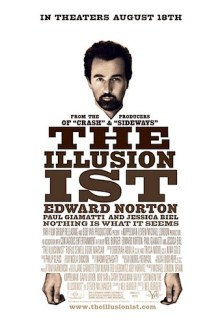 A Blu-ray release of The Illusionist has just been announced. Which is fair enough, of course. But if you were considering a blind buy, probably based on hearing it’s “a bit like The Prestige”, then please allow me to stick the knife in a little first.
Let’s begin with a pet hate of mine: this being a mid-’00s film, it of course begins near the end and finds an excuse to jump back to the start before eventually catching up with itself. As we move into the ’10s, I hope we’re seeing the back of this cheap and irritating screenwriting trick — which, having done my share of creative writing modules at university, I know is the kind of thing new writers are taught as a Good Thing because it allows you to jump right into the action. Maybe this helps you sell your script; personally, I’ve just found it a grating trend that needs bucking. What’s wrong with starting where the story starts?
At the other end — past the bit where we joined — sits a last-minute ‘twist’ explanation for all we’ve seen. But it’s a bit half-arsed, just repeating shots we’ve seen in a new order (with a few additions, to be fair), leaving the viewer to fill in the blanks… which is largely no chore (personally, I’d suspected that all along anyway), but it leaves significant important chunks unexplained, hoping to gloss over them by bamboozling us with a lot of other information. It doesn’t succeed.
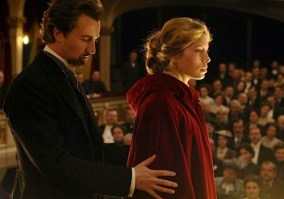 The story itself — you remember those? It’s the bit between the attention-grabbing opening and preposterous-twist finale — is mediocre with or without the finale. It’s a something-and-nothing account of a Poor Boy who loves a Rich Girl he can’t have and… oh, I can’t even be bothered to explain it.
Writer/director Neil Burger has some nice effects going to help conjure up the period, using lighting, grading and the occasional wipe to evoke silent movies and the like during some segments, particularly — and pertinently, if predictably — the flashbacks. Other effects are less welcome, however: the magic is all obviously fake. This rather takes away any mystery, leaving the entire film as just a fantasy — very different from The Prestige in this regard.
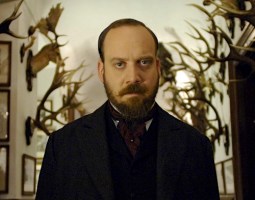
Performance wise, everyone struggles with their accents. That this is the most notable aspect of the cast is, obviously, not a good thing. Ed Norton, looking rather like Derren Brown, is suitably enigmatic as the titular magician, while Paul Giamatti delivers the best performance as a conflicted detective, torn between his intrigue at the illusionist, duty to the Prince, and respect for the law. He’s by far the best thing about the film.
 As comparisons with The Prestige are inevitable, particularly as both films were ultimately released around the same time, I’ll briefly put them head-to-head. Both concern stage magic in a similar-enough period setting, debate about whether the tricks are just that or actually supernatural powers, a love story that goes awry, which involves a fatal rivalry… But they’re actually very different films. The Prestige jumps about in time in a more complex way than The Illusionist, but this also has a point. The former’s story is more original, more engaging, its use of magic — real or not — more captivating. I fear I could go on, but it’s succinctly summed up thus: in this comparison, The Illusionist comes up short.
On the bright side, I avoided a pun there. You know, like, “The Illusionist just doesn’t have The Prestige’s magic.”
Oops.

 When I (first) reviewed
  is a new addition I swear, while he also listens to a (digital, at least) cassette player rather than an iPod (other MP3 players are available, naturally). It’s not a major flaw — unlike, perhaps, the fact that the “covert” and top-secret Nerv organisation has great big signs plastered all over town and everyone seems to know about them — but, still, maybe a new bit of animation to replace the tape-playing close-ups would’ve been nice.
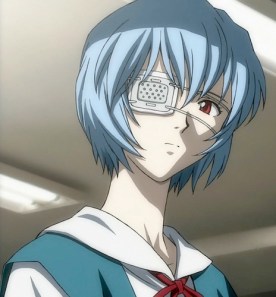 The pros and cons of the series remain. Shinji is alternately interesting, perhaps even complex, and a whiney little irritant. Here he has a character arc at least, suggesting he may be more sufferable next time out. His relationship with Major — sorry,
 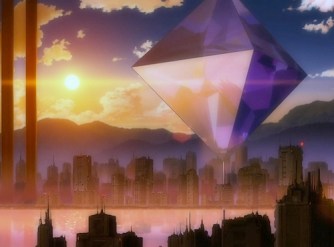 Another factor thrown up by the TV-series-to-feature conversion is the image quality. An HD big screen is a mixed blessing here. On one hand, it looks great on Blu-ray, with crisp lines and solid colours, the result of re-filming, colouring and CGI-ing the original animation elements rather than using the finished TV shots. On the other, such clarity sometimes shows up a lack of detail in the original animation — these elements were created for 4:3 mid-’90s TV, not a hi-def (home) cinema — and the solid colours and money-saving techniques (for example, showing something static rather than a lip-synched (ish) mouth during conversations) can remind the viewer of cheaper TV roots. Perhaps I’m being overly critical though, because much of it does look fabulous; at the very least, the thorough ground-up rebuild means it looks better than the TV series ever will, never mind has.
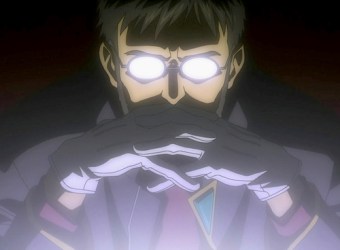 It’s enough to make one scurry back to the series for answers, though the three movies still to come promise whole new characters, plots and a — frankly, much-needed — brand-new ending. After two misfires (one in the series, one in
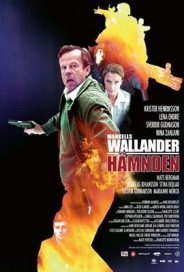 Krister Henriksson returns as the titular Swedish detective for a second — and final — series of feature-length investigations, though this time only this first has received a theatrical release (which means it’s likely the only one I’ll review, unless the series finale offers something that persuades me otherwise).
 The climax is a case in point. There’s no grand shoot-out or serious race-against-time-for-the-last-bomb, just Wallander and the criminal having a calm chat. OK, so there’s a kidnapped government minister, a gun, snipers and a big vest-bomb, but these are set dressing to the conversation. It’s proof if proof were needed (it isn’t) of Henriksson’s controlled skill in this role. As great as Branagh could be, it’s hard to imagine his introspective interpretation of a weepy Wallander slotting into this scene without making it unpleasantly histrionic.
 but also by adding two new recruits to Wallander’s team, Isabelle (Nina Zanjani) and Pontus (Sverrir Gudnason), and the introduction of prosecutor Katrina (Lena Endre). All are set up as key new characters for this run, though it’s clearly Only The Beginning here. Katrina is a little too blatantly a potential love interest for Wallander, while Isabelle and Pontus are… well, new characters. There’s little to say about them yet.
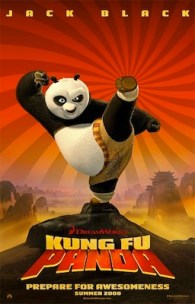 I nearly watched Kung Fu Panda on a plane once, but planes are rubbish places to watch films so I decided against it. (I watched
 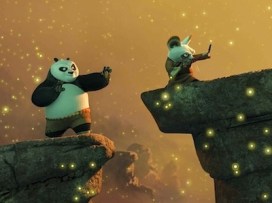 Panda features some beautiful animation — not a phrase you usually associate with CG ‘toons (though Pixar are pushing into this area with the likes of
  I think that — along with
  bring back the dead and let you see a teeny bit into the future, shortly before some baddies explode in puffs of green smoke and some more baddies are revealed to have full-on superpowers. Where did these come from? No idea. The film offers no explanation, be it mutant gene or radioactive exposure or plain old training, instead just assuming viewers will accept that this is the real world… oh, but some people have these cool powers.
 here there might at least be a reason to keep watching, but the weak action is just icing on the cake of the clichéd story and bland characters. Director Rob Bowman claims he made an R-rated film which he was forced to cut to PG-13, the implication being that neutered the whole thing. Maybe that’s where all the action went, though on the evidence of what’s left I’m not sure I believe him.
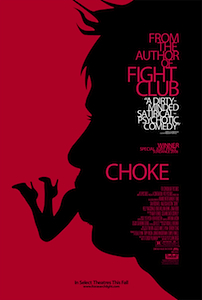 Choke is adapted from a novel by Chuck Palahniuk, the author of Fight Club, and you can tell.
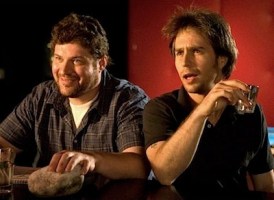 The cast are without fault. Sam Rockwell is brilliant as ever, continuing to build a body of work that suggests he’s been underrated. Perhaps there’s a similarity to some of his roles, but he has a sort of rough likability that can make one overlook that. I’ve still not seen
 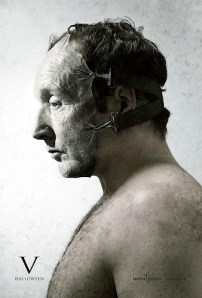 And so the never-ending Saw franchise trundles on to its fifth part. Indeed, Saw Part 5 might be a more apt moniker for this film: it picks up directly from the end of
  One of the franchise’s Big Things has always been the last-minute twist. Signalled by the Saw theme beginning to play and emphasised with an explosion of very brief flashbacks to earlier in the film, the twist shows us what we’ve missed all along and turns the story on its head. The
 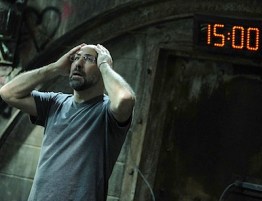 In fact, it’s this side of the film that holds a bigger and better twist than the highlighted arc plot one, though some viewers may miss its significance as it goes so unheralded. (Arguably this ease with which it might be missed says something about how significant it is; equally, perhaps I’m assuming a lack of intelligence on the part of Saw’s regular audience by implying they would miss it.)
 Million Dollar Baby currently places 143rd on the
  and it goes some way to make up for all the tedium that’s gone before. That it’s a grim and downbeat finale, however, serves an anti-boxing message I already get but does nothing to redeem the tale.
 and Frankie’s lost his daughter, gets screwed over by his protégé, and ultimately loses Meg too. In no way is this a cheery depiction of boxing.
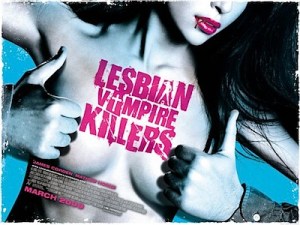 Pre-release hype pegged Lesbian Vampire Killers as the next
 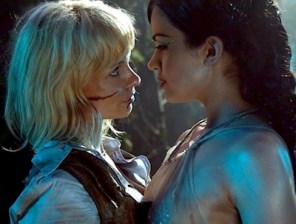 Unfortunately, even with corrected expectations, the film fails to deliver on its twin promises of raunch and horror. Aside from a couple of brief surgically-enhanced medieval boobs, a flash of knickers and the odd girl-on-girl kiss, the film’s sexy content is non-existent. Said Nuts audience would certainly get more from their weekly wank mag; this is mostly 12A-level. The horror, meanwhile, is reduced to well-signposted jump scares — and even then few enough to count on one hand — and the odd bit of comical decapitation/melting with holy water/axes in the head. To be fair, this is meant to be more comedy than horror, and in this sense a few such moments succeed passably.
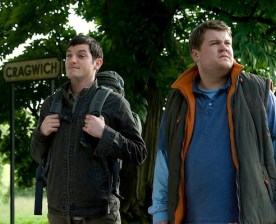 Indeed, consistency is not the film’s strong point. Everyone makes a big fuss about the vampires and how hard they are to kill, yet every one is dispatched with ease, the level of threat never allowed to even attempt an increase before there’s white goo splurting everywhere (that’s what happens when they die, incidentally, not someone’s reaction to the lesbianism). The climax is a mere extension of this, substituting a rising scale of action for running around avoiding the easy killing bit. Any good will amassed in the middle — and there may be a tiny bit — is dismissed in boredom.
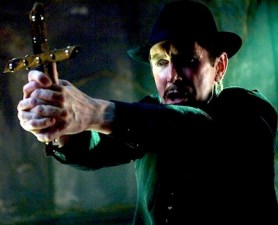 shot for the lowest-common-denominator lad’s-mag-buying audience, though quite what they made of the classic horror reference points that do remain is anyone’s guess. If we’re talking about expectations (and, clearly, I am), Lesbian Vampire Killers did somewhat defy mine — though as I was expecting it to be one of the worst comedies I’d ever seen, that might not be saying much.
 You may’ve noticed that it’s the 2010 Oscars this Sunday (technically Monday over here), finally bringing an end to the tale of movies from 2009 (Empire have their awards a while later, which is pushing into the pointless — OK, they’re never going to become an Oscar-predictor by moving up in the schedule, like the BAFTAs aimed for with their pre-Oscar move; but how many people still care about last year by the time we’re a quarter through the next?)
 “There’s underage sex, swearing, numerous displays of teen independence, divorce, love of rock music and horror films… All that’s missing from a Middle American Mom’s worst nightmare is drugs (there’s no violence either, but we know them there yankees love a bit of that).” –
 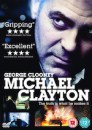 “The obvious point of comparison is Damages, the excellent TV series that also concerns such high-profile big-business lawsuits, but… Damages sustains it for over 9 hours, replete with cliffhangers and plot twists so far beyond what Clayton’s straightforward story has to offer that Gilroy isn’t even dreaming of being that good.” –
 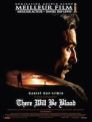 “not to say it’s a bad film, but it is at times a baffling one… I can’t help but wonder if I missed something crucial along the way because, even after two and a half hours, I had no real idea what the film was about.” –
  “it’s really about Fate, randomness, chance. Some clearly think this brilliant; I remain unconvinced. It lacks satisfaction. Maybe that’s real life — no, that is real life: random and lacking closure and satisfaction. But this isn’t real life, it’s a movie” –
  Of the five Best Picture nominees from 2007, the only one I gave five stars was
  100Films.co.uk