aka Alien³: Assembly Cut
2011 #14
David Fincher | 145 mins | Blu-ray | 15 / R
 It’s getting on for two years since I last (and first) watched most of the Alien
 Quadrilogy series, provoking some relatively lengthy (for this blog, anyway) debate on my reviews of the three sequels. I refer you to those at the outset for a couple of reasons. One, because a lot of my review of Alien³’s theatrical cut still holds true for this half-hour-longer version; two, because other points in that review may make an interesting counterpoint to the more positive thoughts I now have (“may”); and three, because some of the comments on the reviews also discuss this extended cut, which may also interest you.
They’re also relevant to highlight this point: it’s been two years since I watched Alien³ and I’ve only seen it once. Despite this extended version being 26% longer, that means I still found it hard to spot much of the additional material. I’m sure fans who’d seen the original multiple times in the decade between its theatrical release and this cut appearing in 2003 were able to spot changes much more readily. Nonetheless, a few obvious additions and modifications stand out: an extended opening when Clemens discovers Ripley on the beach; the Alien birthing from an ox (rather than a dog); the lack of a Queen chestburster at the very end. I could’ve turned on the Blu-ray’s “deleted scenes” marker of course, and I did consider that, but I thought it might just get distracting on a first viewing. And speaking technically, I don’t know what the new scenes looked like on the Quadrilogy DVD (as I haven’t watched that copy, obviously), but on Blu-ray the added footage, 2003-era new effects and 2010 re-recorded audio are indistinguishable from the rest of the film.
Readers interested in the history and reasoning of this new, significantly longer cut may appreciate the introduction it had in the Quadrilogy set’s booklet (sadly nowhere to be found on the Anthology Blu-ray). I’ve reproduced the majority of it below:
Following its troubled production and controversial release, Alien 3 slowly became something of a curiosity among serious enthusiasts of the Alien series. Not only would its first-time director, David Fincher, go on to become one of Hollywood’s most sought-after filmmakers but the film itself would generate quite a mystique thanks to heated rumours of creative interference, lost scenes and even a completely different cut of the film that supposedly restored Fincher’s original vision of what many believed to be a seriously compromised work.
Rumour control, here are the facts. There is no wondrous lost “director’s cut” of Alien 3. It doesn’t exist. Indeed, for such a dream to be realised, Fincher would have to be allowed to remake the film from scratch with complete creative control. What does exist is something perhaps equally fascinating.
For the first time, fans can now experience a restored and re-mastered presentation of the 1991 assembly cut of Alien 3. With a running time increased by more than 30 minutes, this Special Edition contains several never-before-seen sequences that offer a fascinating insight into the film’s difficult editing process. This cut also reveals a combination of vintage, previously unreleased optical effects shot and several newly-composited digital effects necessary to seamlessly integrate new footage into the body of the film…
The Alien 3 Special Edition offers fans a unique chance to witness the lost work of a remarkable director.
So there you go. As I mentioned, this version updates the 2003 one with some re-recorded dialogue.
On my original review, Matthew McKinnon commented that as he watched this new cut he realised “it wasn’t shaping up into a more coherent or purposeful movie… just a longer version with more of the same.” I agree that, to an extent, it’s “a longer version with more of the same”, but I found it more coherent too. While the major plot beats still occur at the same time and in fundamentally the same way, perhaps the myriad tweaks have made it clearer just what’s going on? Or perhaps I was just more familiar, having seen it once already? Either way, sequences and events that left me a bit lost last time seem to make perfect sense on this outing.
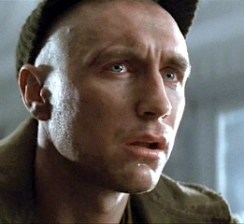 One of the biggest things I remember being told about Alien³, before the Special Edition, was that most of Paul McGann’s performance had been cut; that originally he had a sizeable role that justified his fourth billing, rather than his cameo-sized part in the theatrical cut. It doesn’t feel like there’s an awful lot more of him in this version, though scanning through Movie-Censorship.com’s thorough list of changes one can see a lot of brief shots as well as one or two significant scenes featuring him. Again, despite the sense that little has changed, his character does feel more comprehensible, so maybe these barely-noticeable additions do make all the difference?
As a little aside, I sometimes feel a little sorry for McGann — since his acclaim in The Monocled Mutineer, numerous shots at bigger success seem to have passed him by. He gets a key role in a Hollywood blockbuster, but is then largely cut out; he’s cast as Richard Sharpe in a major ITV series, but is injured and has to pull out (and we can see where that led career-wise for Sean Bean); he’s cast as the Doctor in a big-budget American backdoor pilot for Doctor Who, which flops Stateside and goes nowhere… He’s undoubtedly talented, but these days seemingly forced into lacklustre supporting roles in the likes of Luther. Maybe he doesn’t mind, I don’t know (at least he got “the largest insurance settlement in British television history” for missing out on Sharpe), but it seems like he deserved greater success. Poor guy.
Still, McGann’s performance here is exceptional, even if it’s still brief. He’s just one member of an outstanding British cast though, many of whom are recognisable for the excellent work they’ve done since.  Unsurprisingly, therefore, they’re almost all totally underused. Charles Dance gets the biggest slice of the cake and is as good as ever, but doing little more than show their face we have Pete Postlethwaite, Phil Davis, Peter Guinness, Danny Webb (they don’t all begin with P…) Alien³ is 19 years old now, no one could’ve predicted the future; but viewed with hindsight, the volume of under-utilised talent is almost astounding.
Hindsight also affords other interesting perspectives. Dance’s death is still very effective, for instance. It’s not surprising once you’ve seen the film more than once — obviously — but killing off really the only character our hero (and, by extension, the audience) has become sympathetic to at around the halfway mark? Not unheard of, true (see: Psycho), but still rare enough to be a shock, to disconcert and wrong-foot the viewer.
Plus, we can now look at it in the context of Fincher’s following work. Even though he had limited — often, no — control over much of the project, there are still signs that link it with his later films. It’s stylishly shot for one thing, most of the locations either soaked in shadow or cold light, with an often fluid camera. Darkness litters the film thematically too: setting it on a prison colony for murderers and rapists, the violent attempted gang rape of Ripley, the death and autopsy of a 10-year-old girl… Even if we see no real detail on screen (thank goodness this wasn’t made in recent torture porn-obsessed years), the implication and the emotional connection is harrowing enough. Then there’s the Alien itself, from its ugly birth to its violent murders. Fincher may have not turned so explicitly to horror since, but that brand of darkness does flow on into most of his best films: Se7en, Fight Club, Zodiac.
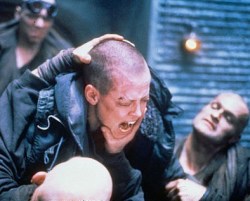 It’s also, perhaps, interesting to remember this being Fincher’s first film. He might seem like an odd choice, a first-timer paling beside the experienced hands of Scott and Cameron. But that would be to forget that, for both, their Alien films were only their second time helming a feature*; and while Cameron’s previous had been sci-fi (The Terminator), Scott’s was period drama The Duellists. A first-timer — especially one versed in commercials and music videos — isn’t all that different, really, and Fincher has certainly gone on to show his worth. Indeed, his very next film was the incredible Se7en.
Alien³’s Special Edition didn’t strike me as massively different from the theatrical cut, despite some obvious changes, with the exception that I now found it to be more intelligible. Whereas before I thought it started well and became less coherent — and, consequently, less good — as it went on, with this version I felt I was following the story and characters throughout. As a result, I enjoyed it more. Perhaps it also benefitted from my viewing situation: the first time I watched it within days of both Alien and Aliens; this time, I chose to watch it in isolation. Whatever the reasons, this Special Edition earns Alien³ an extra star from me.
* Cameron’s name is on Piranha II, and it is a fun joke to think such dross was his directorial debut, but his version (at least) of the behind-the-scenes story suggests it should in honesty be ignored. If you prefer, imagine I said Aliens was only his second major feature.
I watched the Alien³: Special Edition as part of a David Fincher Week. Read my thoughts on all his films to date here.

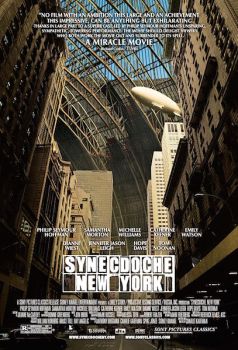 Despite its unpronounceable title, Synecdoche, New York starts out like a relatively normal comedy/drama… but then weird touches begin to creep in. A house that’s on fire when a character buys it and continues to be on fire for the next several decades, for instance. No one in the film bats an eyelid. Then the really weird bit arrives; the bit you all probably know; what the film’s about (except, of course, not what it’s About), as Philip Seymour Hoffman’s theatre director begins to construct a life-size New York within a warehouse.
 and I haven’t begun to care in the months since I watched it. It’s the kind of film where, as it gets on, you feel it’s a rich experience that you’ll have to ponder for a bit once it’s done, even if there’s something you quite fancy watching on the same channel immediately afterwards. But by the end it became the kind of film I was fed up with pondering, and I bloody well watched what was on the same channel immediately afterwards. Kaufman’s weirdness can wear you down to the point where characters who were interesting and ideas (both plausible and of Kaufman-logic) that had potential cease to be worth caring about; where you go from the point of “I’ll look up an explanation on the internet once it’s finished” to “…meh”.

 From the same production company that brought us the
  The original title translates as Men Who Hate Women, which is certainly very apt. The subject matter is grim and dark; horribly plausible, in fact. It’s unwaveringly depicted with some brutal, hard-to-watch scenes. They’re not exploitative though, as a lesser film merrily would be, and that makes them appropriate to the tale being told. Subplots about the two leads support the themes underpinning the main investigation — both about abuses of power, in different ways — justifying their apparent tangentiality, and consequently the film’s length.
 Despite the modern stylings, dark themes and attention-grabbing characters, much of the film unfolds as a procedural whodunnit like, for instance, the Wallanders, complete with piles of red herrings and last-minute twists. This is probably why the book has sold so well and the film has taken over $100 million worldwide: it tickles the same nerves as all those ever-popular TV police dramas. Indeed, this adaptation is rooted in a television miniseries (an extended version exists as two 90-minute TV episodes) but it doesn’t look like it: it’s quite beautifully shot; not showy or stylised, but there are some lovely shots of scenery in particular.
 With Dragon Tattoo featuring material that seems ideally suited to the director who gave us
 Bolt is the 48th film in Disney’s animated canon (whatever the official name for that is these days), from their CG-only era that filled most of the ’00s. It’s a period already remembered as When Disney Lost Its Way, after the second (or is it third? I forget) ‘golden era’ of the early ’90s; the time that produced flops like
 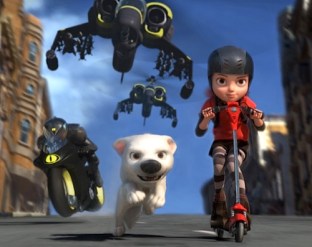 Also noteworthy are the action sequences. Far from being perfunctory attempts at liveliness, these are properly exciting, making full use of 3D CGI to create exciting and dynamic sequences. I’m not just talking about the couple we get from the TV-series-within-the-film either, but also the ‘real world’ ones as Bolt, Mittens and Rhino jump onto trains, out of moving vans, escape from a pound, etc. Of course, the TV-series-within-the-film is completely implausible — like you could film a TV show with massive action sequences in such a way that you only ever do a single take, never mind achieve all those effects on a TV budget. But then this is a film where a talking dog, cat and hamster work together to travel from New York to Hollywood entirely of their own volition — I think it’s safe to say no one’s aiming for documentary levels of realism.
 It would be easy to dismiss Bolt as part of Disney’s CG folly, especially as it stars Miley Cyrus and is immediately followed by their return to 2D animation, but I think that would be a mistake. It’s a fast-paced and fun adventure, with accurately-captured animals meaning it’s especially likely to appeal to dog lovers. Disney’s next golden era just might begin here.
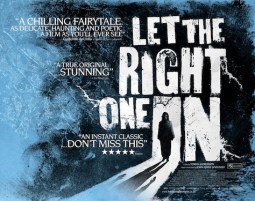 The most recent example of this speedy-remake phenomenon is Swedish vampire drama

 in fact, the director is keen to point out (in a surprisingly unpretentious fashion) that he doesn’t aim his work to slot into any particular genre — while Reeves set out to make a horror movie first and a young-love drama second. Though don’t go expecting out-and-out vampire thrills and gore from Let Me In, because it retains enough of the original’s DNA to make it still a pleasantly unusual genre entry.
 Oskar is a 12-year-old loner in Sweden in 1982, spending his days at school being bullied and filling his evenings with fantasies of revenge. Then a girl, Eli, and her father move in next door and it looks like he might finally make a friend.
 For instance, when the usual skills do crop up, they’re presented in a very grounded way — any CGI required is used subtly and incredibly effectively — or kept off screen. They’re at the best when used to slightly emphasise Eli’s weirdness — the way she drops ever so slightly slower than is natural from the climbing frame when she first meets Oskar, or to shape and manipulate her face almost imperceptibly at times.
 The story’s central relationships — mainly, Eli/Oskar and Eli/Håkan, he being the ‘dad’ figure who helps Eli survive — can be read various ways. The author/screenwriter, John Ajvide Lindqvist, has one interpretation — indeed, based on what I’ve read, the novel is quite clear on these points — but the film leaves many facts ambiguous. Is Håkan related to Eli? Does he love her? In what way? Does she love him? Does she even like him? Is he just a facilitator? Was he once in Oskar’s position? If he was, is she just manipulating Oskar? Or is it really love? Or is it just friendship? The joy of such well-placed ambiguities in a story is that each viewer can bring their own interpretation, without anyone being clearly right or wrong and without undermining the quality of the story being told. I think I know what I think; but, just as much, I enjoy the fact there are numerous possibilities. (Of course, equally valid is the argument that there are no ambiguities because most if not all have been cleared up Lindqvist and/or Alfredson in interviews. But where’s the fun in that?)
 Though most of Let the Right One In’s irregular take on vampires seems genuinely unique, one of those unusual elements — a 12-year-old girl being a vampire — immediately draws comparison to
  if they’d filmed some of the stuff in the novel, the filmmakers would’ve gone to prison — but also about refocussing the story to be a two-hour film instead of a novel. I’m not sure, therefore, how faithful the climax is, but it’s a sequence that seems made for the screen. I shan’t say much more on this point, just in case you’ve not seen the film and still read this far (tsk tsk), but it seems having a vampire for a best friend is a great way to deal with bullies.
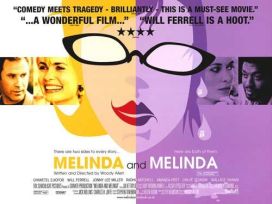 Despite the city being as associated with him as jam is with donuts, Melinda and Melinda was Woody Allen’s last New York-set film before he began his current European phase with London-set thriller
  If it wasn’t for the framing device that clearly tells us not only the thematic point of the film but also which bit is the comedy and which the tragedy, I don’t think it would be immediately possible to tell which was which. Indeed, one might think that was Allen’s point: life is neither tragedy nor comedy, but both at the same time, so of course you can’t tell the difference. But as it goes on the comedy does introduce a couple more laughs, but even more so a general niceness that leads to the predictable rom-com ending. Concurrently, the tragedy introduces darker elements and refuses to provide a neat, conclusive or satisfying ending, which is both thematically sound (I suppose) and also dramatically frustrating.
 and then they’ve crafted them completely independently. So that is to say, for instance, that the same restaurant may appear in both tellings, but at different points and with a different scene taking place; or in one storyline the director-character is an outsider who holds the husband’s future in his hands, while in the other the director-character is the wife and a different outsider holds her future in his hands. If that makes sense.
 I expect you know the setup for The Invention of Lying: in a world very much like our own — except for the crucial difference that people can’t lie — Ricky Gervais invents lying. It sounds a simple, strong concept. I like it.
 how religion is just a lie we tell ourselves to make us feel happy — and it says this quite explicitly! In an American film!
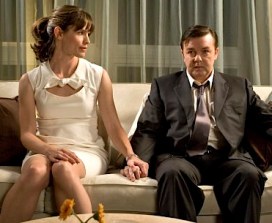 but that would miss the part where Gervais’ character helps her to grow as a person, to see beyond the surface gloss to the real people and situations underneath. OK, it’s not a groundbreaking message, but it suffices.
 They’re all fine, though the “oh, look who it is!” factor occasionally overwhelms the story briefly. (In the case of Merchant and Barry it’s more “oh, should’ve guessed they’d turn up”.)
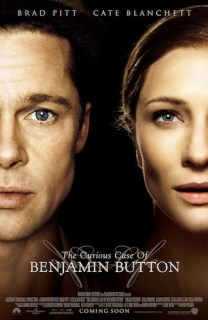 Benjamin Button was released in UK cinemas two years ago last week. Time really does fly. The critical reception was a little divisive — the
  The visuals in general may be Benjamin Button’s strongpoint, holding up a variety of era-evoking colour palettes and other design elements as it passes throughout the 20th Century. Flashback-like asides are conveyed in older film styles — scratchy prints for instance, or with a silent movie aesthetic — that on the one hand could seem an inappropriate indulgence, but objectively work very nicely. For a director who has a reputation in some corners for exhibiting excessive flair with swish shots and effects, Fincher shows steady restraint here — as he did in
  but Button didn’t feel nearly as episodic, nor nearly so obsessed with History. Benjamin encounters foreign diplomats and is embroiled in World War 2, but both are relatively non-specific and don’t colour his life in the way Gump’s parade of Defining Moments do. Instead the storytelling is character focused. Viewer awareness of time passing in the narrative is left to the odd snippet of dialogue or obvious jump; aside from a few clear points, there’s a less convincing sense of era than Fincher evoked in Zodiac. Whether this matters or not is debatable — Button isn’t a chronicle of the 20th Century through one man’s eyes, which is what Gump arguably was, but is rather the story of a (somewhat unusual) life lived during that timed period.
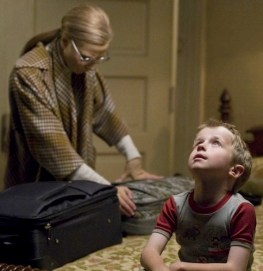 Or perhaps it’s the very point: the more things change, the more they stay the same. Benjamin is ageing in completely the opposite direction to the rest of us, and yet his life isn’t all that different. Witness the end of the film (naturally, spoilers follow): Benjamin loses his language and memory, his life fading away as his brain fails. Presumably this is because he’s regressing to childhood, his brain shrinking and devolving to that of a child/toddler/newborn, but don’t we see the same thing happen to adults with dementia? As Daisy observes earlier in the film, “we all end up in diapers”. A life backwards is not so different to a life forwards, then. It’s all in how you live it, that kind of thing.
 Ultimately, Benjamin Button strikes me as less than the sum of its parts. Bits are good, even very good — “bits” both as in story episodes and technical elements; and I particularly like the sections with Jared Harris, who’s always worth watching — but what does it add up to? It’s quite long and, unlike Zodiac, feels it. It may be easy to admire, but I find it awkward to love.
 How time flies — I’ve been meaning to re-watch Zodiac ever since I
 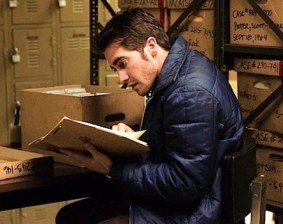 As the changes have little impact on the film’s fundamental quality, the points in
 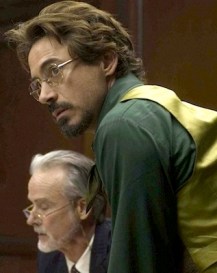 but the sheer weight of evidence the other way seems to leave little room for doubt. More so, then, is that the murders are done with before the halfway mark. That’s because it’s still following the story of the investigation, true, but a lesser filmmaker could have weighted it differently, rushing through Graysmith’s later enquiries in a speedy third act. Instead, Fincher’s focus throughout is on the people looking into the crime, and it’s as much the tale of their obsession — and what it takes to break their obsession, be it weariness or pushing through ’til the final answer — as it is the tale of a serial killer.
 and place-and-time subtitles too, but hey, sometimes you need specificity.
 100Films.co.uk