
 It’s funny what movies sometimes pique your interest. I saw a trailer for relationship drama Love and Other Impossible Pursuits (or, as it was retitled in America, The Other Woman) on some completely unrelated US Blu-ray earlier this year (I forget which film it was, but the only connection was the disc’s distribution company) and wondered why I’d never heard of it before — after all, it looked like a Worthy Drama, starring Oscar Winner Natalie Portman and Lisa Kudrow From Friends. Turns out it was shot in 2009 but not released until 2011, when it was slated by critics (a measly 39% on Rotten Tomatoes), flopped at the US box office (it opened at an unimaginably painful 67th place (who knew there were that many films out at once?), grossing just $25,423 total), and went straight to DVD in the UK. Ouch.
So, me being me, the double-whammy combination of “that looks like it might be quite good” and “wow, that’s meant to be terrible” put it straight at the top of my rental queue.
Emilia (Portman) is the titular Other Woman, but rather than the film telling the well-trod story of an affair, that part’s long over before the film begins — she’s living with Manhattan lawyer Jack (Scott Cohen, the magnificent Wolf in underrated miniseries The 10th Kingdom), trying to build a relationship with his son William (Charlie Tahan), who’s more attached to his mother (Kudrow). Colouring everything is the fact that, some time shortly before the film begins, Emilia and Jack had a baby who died.
 As I was brought to the film by its trailer, it pays to say it’s actually very different. The advert hides the baby’s death but hints at it, as if it’s a Big Reveal they clumsily didn’t want to give away. But no, it’s brought up within the first five or so minutes and actually drives a lot of the film. The emphasised “other woman” facet is present, though in a slightly different way to normal: this is how such relationships continue as a long-term status quo, rather than the immediate impact of an affair.
Or a version of that, anyway, because the presentation is a bit melodramatic. Melodrama can be fine; good, even — but it’s a style, arguably a genre; a heightened one, and that runs counter to realism. This is a film that shoots for realism and slides into melodrama, and that’s not good. There are powerful ideas for scenes, but most are badly handled. Portman and Kudrow are quality actresses who deliver some good bits, but also some that go OTT. Especially from the latter, who’s not given enough screen time to move far beyond a caricature of the vengeful ex-wife.
The single worst bit comes 13 minutes in: an extended flashback, the film’s only one (which, structurally, makes it stick out like a sore thumb), in which we see the affair I said they were doing so well not covering. Emilia and Jack fall in love. Why? Because the plot tells them to. It’s also the nadir of another irritant, the film’s sappy plinky-plonky music.
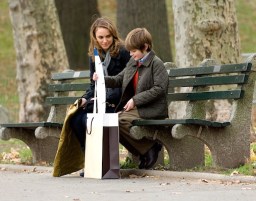 I can imagine that flashback working within the shape of a novel, where structure works differently. Indeed, I got the impression the book is probably very novelistic; maybe a character study, even. Those are two things that don’t always transfer well to film. I don’t think it’s about Being The Other Woman, despite the US title; nor do I think it’s about Being The Stepmother; nor is it about Losing A Baby. Those things are all in there, certainly, but rather than any of them be The Story, they’re elements in the exploration of the character of Emilia. I’m not sure that works for a movie; not for this one at any rate.
Not a complete disaster, but nowhere near a success. This score is perhaps a tad harsh, but any more would’ve been generous.

* Two quick notes about the UK Blu-ray. Firstly, according to IMDb, the film ran 119 minutes at the Toronto International Film Festival, but was cut to 102 by the US release. The UK BD is the shorter cut at PAL speed. Secondly, the original aspect ratio was apparently 1.85:1, but the BD has been cropped (or widened) to 2.35:1. Not sure I’ve ever seen that before, but there you have it. ^
 Controversial supernatural mystery drama. Nicole Kidman’s rationalist husband dies suddenly; years later, as she gets engaged to another man, a boy arrives claiming to be her husband reincarnated. More realistic art house drama about grief and insecurity than thrill-giving occult mystery, it nonetheless keeps you guessing as Kidman is slowly convinced by the boy’s tale, while family relationships collapse around her. Full of quiet understated performances, Kidman is particularly captivating and, as the boy, Cameron Bright is mesmerisingly unreadable. Poorly received, with some
 A lot of praise was slung
 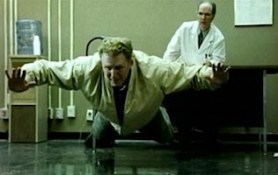 Those after a more genre-aware “real world superhero” movie would do better to stick with Kick-Ass or Super, but those who might embrace something a little different — especially something with an indie sensibility — would do well to take a look. Indeed, being a comic fan is certainly not a prerequisite for enjoyment here.
 Alex Cox’s belated non-sequel (despite the title, there are apparently no links besides some cast members) to cult favourite (and
  True, the other characters are mostly dim and unlikeable, but is that a problem? We don’t need a film full of characters we like (otherwise we’d never have villains) — do we need there to be any? Or is the problem not that we don’t like them, but that their dimwittedness makes them too-easy targets for humour? I suppose it’s easier to just hate the film than grapple with such questions.
 Samuel L. Jackson and Tommy Lee Jones star in this military courtroom thriller from the director of
  That’s not all that’s bungled. There’s numerous instances of awkward editing by Augie Hess; a screenplay from Stephen Gaghan that clearly wants to be
  Despite winning a bunch of Canadian film awards, this First World War drama seems to have been really poorly received by critics — the
 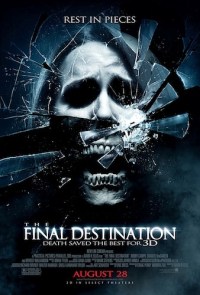 The best thing about The Final Destination is its title, because turning the series’ familiar name into a definitive article for the final entry is really quite a neat move. Sadly, it was a hit and they’ve made more. Why it was a hit… God only knows.
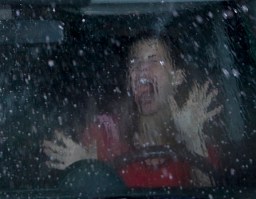 The focus is clearly on the deaths — at 11 it has the highest of the series, and with its short running time that means there’s a fatality every seven minutes. They’re also very gory, more so than in previous films I’d say, but they’re not commensurately more inventive. There’s a very thorough line in misdirection at times, but the whole enterprise feels painfully lacking in creativity. I’m not sure some of them even make sense. But then do they need to? Similarly, there’s some customary low-rent-horror-movie completely-gratuitous nudity too, which I’m sure delighted teenage boys even more in 3D.
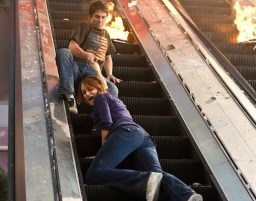 that’s a sure sign it was meant for cheap 3D thrills, but otherwise fine — here, stuff pokes straight out. That means in 2D you see, say, the flat end of a pole, with absolutely zero sense of depth. This happened with one trap in
 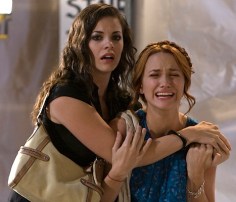 Elsewhere, one character starts talking about déjà vu before getting killed in the same way as the first film’s most famous death. I suppose it’s meant to be Meta and Funny, and maybe it kinda is, but again the CG is so cheap that the half-trained eye will spot an effect is about to happen, and the manner of death once again doesn’t really make sense. Later, we learn that shopping mall sprinklers can instantly extinguish all fires — handy!
 There’s potential in the concept of the Final Destination films, but clearly it’s either limited or the people in charge don’t know how to exploit it, because after making two quite-good films they’ve turned it into a repetitive, stale, uncreative, formulaic disaster. And there’s now a fifth too, and a sixth hasn’t been ruled out — surely it/they can’t be any worse than this? Based on form, maybe they can…
 In the wake of highly successful franchise launches for
  which
which 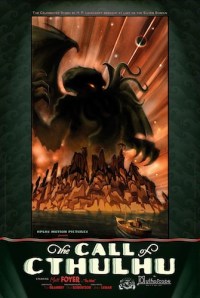 I must admit to not being at all familiar with the work of H.P. Lovecraft. I know the name, of course, and the titles of some of his stories, not to mention being aware of the array of well-known fans. Aside from that, I’ve only encountered his work through its influence — there’s some stuff in the
 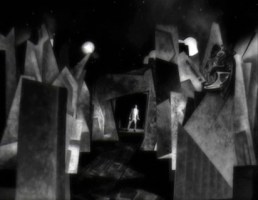 The marriage of low-budget and silent film style is one made in heaven, particularly when you add in the dedication of the makers. They built impressive props, ingenious sets, and employed model work in various inventive ways, all to execute a story that includes a cultist swamp orgy, a mysterious island, a sea battle, and a skyscraper-sized monster. Some online reviews have criticised the effects, but those people are quite frankly idiots. This isn’t meant to be slick CGI — it’s re-creating lo-fi early film techniques, and (aside from one or two rough-round-the-edges spots of greenscreen) it all looks fabulous.
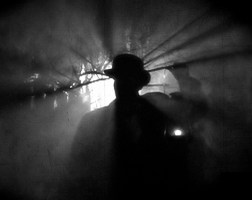 I have no idea how closely it hews to Lovecraft’s original, but there’s a layered stories-within-stories approach (I think it gets four deep at one point) that is difficult to pull off with clarity, but never falters here. Christopher Nolan would be proud. It also effectively builds a sense of uncanny mystery; not outright scares, but a kind of disquieting unease. It’s my impression that was absolutely Lovecraft’s aim too, so another job well done.
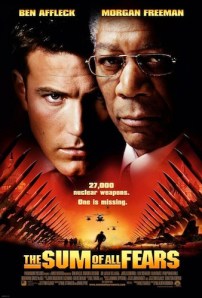 Paramount had a burgeoning franchise on their hands in the early ’90s with adaptations of Tom Clancy’s Jack Ryan novels. He first appears in
 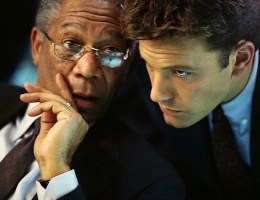 Ben Affleck is Ben Affleck, which means a lot of people won’t like him but he’s OK. Morgan Freeman brings instant gravitas to his role, though it’s not his most likeable or memorable part.
 100Films.co.uk