2013 #97
George A. Romero | 95 mins | Blu-ray | 1.78:1 | USA / English | 18 / R
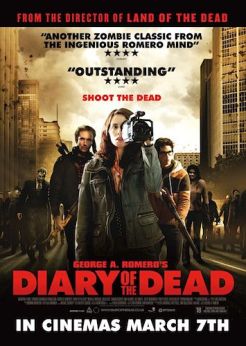 While making a horror movie in the woods, a group of friends hear news of the dead coming back to life. As they try to reach home, their aspiring documentary-maker director keeps his camera rolling, recording their encounters with the living dead…
After his first living dead movie, it took writer-director George A. Romero a full ten years to have a concept for a follow-up. Then it was seven years before he produced another, and then he skipped a decade entirely before he produced a fourth twenty years on. But it was only two years after that before he returned to the subgenre he’d spawned almost 40 years earlier.
The quick turnaround was thanks to Romero being inspired by the rise of ‘citizen journalism’ — that’s people who document events with mobile phone cameras and the like, telling their own alternative version of the news on blogs, YouTube, Twitter, and the rest. It gave him an idea for another of his zombie movies, which he rushed to make before anyone else could do it first. Too late, George: although he managed to get Diary of the Dead into festivals in 2007, its wider cinematic release came after Cloverfield, the high-profile big-budget version of Romero’s concept that’s rather kickstarted a whole found-footage subgenre. And anyway, both of them owe a clear debt to a film released eight years earlier, The Blair Witch Project.
I liked Cloverfield, and Blair Witch. I don’t object to found-footage as a genre when it’s done well. Diary of the Dead is… well, it’s a funny one. It marks Romero’s return to independent feature making, after producing Land of the Dead for a major studio, but he perhaps went a little too independent: with a clear low-budget ethic and a cast of unknown actors, criticism from some quarters that this is little better than a Syfy TV movie are not without basis. And the technological aspect is already beginning to feel dated after just six years (people use MySpace!),  so goodness knows how it’ll look after even ten. Thing is, despite all that, Diary still has one ace up its sleeve: it’s written and directed by George A. Romero.
What does that mean, then? Well, it means clear social commentary, as usual. Some people say that’s not as subtle as it used to be — again, as usual. Romero’s targets this time are the news: how the mainstream media lies to us, and how we’ve turned to alternative sources. But he’s also aware of the limitations of those alternatives: the lack of real-world contact, interacting with each other through cameras, phones and computers; processing the world not by going to see it but by watching it in little boxes on a screen.
In taking on this world, Romero has produced a movie that fits right in amongst it. Diary feels like it was made by some just-out-of-film-school kid rather than a 67-year-old moviemaking veteran. Romero is clearly a stylistic chameleon (as I noted on Land of the Dead), but that’s the surface sheen: the digital HD visuals, the syndicated-TV-level ability of the cast, the cut-price CGI… It’s also, sadly, sometimes the writing: the dialogue isn’t all it could be, and the characters are sketchy and archetypal — though, in fairness, that’s not unheard of from a Romero supporting cast. But, as ever, Romero adds his own spin by attempting to engage with social themes; not only those I’ve mentioned, but several more: “do we deserve to survive this?” is the closing note — again, taking on one of Romero’s pet subjects, the violence of humanity, against ourselves and others. Earlier in the film the military turn up, very briefly, but they are the opposite of all they should be. It’s not just that Romero hasn’t changed his views in 30 years or more, it’s that the world hasn’t changed either.
 That said, the thematic concerns feel less resonant than in Romero’s previous work. The found-footage has led him to frame this as a film-within-a-film — the first title card reads The Death of Death, followed by one noting it’s “a film by Jason Creed”, the aforementioned aspiring director — complete with montages of news footage and, at times, a voice over narration. This rather rams the point home at times, over-explaining features that previously Romero would have allowed us to spot for ourselves. In some respects you can’t blame him being more obvious in this day and age — it needs to be on the nose to get through to some people — but it’s less satisfying, the blunt information coming across as a statement rather than asking us for our own interpretation, which I feel can lead to a more insightful analysis.
This is coupled with arguably a greater focus on action and gore than ever before. The first three films limit the majority of their violence to a final-act brawl — think Night’s trip to the gas pump/zombie break-in, the bikers in Dawn, the zombie break-in (again) in Day, the zombie, er, break-in in Land — but here we’re given a smattering throughout, with no all-or-nothing finale. That’s not a bad thing, but it makes it feel more pervasive — even more so than Land, which was an action-adventure movie through and through. Is Romero playing to his crowd, here? The ones who have always looked to his films foremost for their zombie-killin’ special effects; the ones who think Zack Snyder’s Dawn remake is superior to most/all of Romero’s films? (Seriously, those people exist.)
 Such folks, and even genuine Romero fans, seem to have two major problems with Diary (aside from arguments about the acting, the storyline, or even the entire concept). First, the gore: where Land added CGI to the traditional mix, Diary’s almost exclusively courtesy of computer wizardry. That’s the age we live in: computer effects are so commonplace that they’re now the cheap and easy thing to achieve, rather than men with buckets of red food colouring and entrails from the local butcher. For me, it’s a mixed bag. I don’t think this is the worst CGI I’ve ever seen (unlike some commentators), but I do think it lacks the distinctive Romero feel — there’s none of his trademark eating of intestines, for instance, or the tearing a human in half that’s become a key visual in every film since Dawn. Perhaps that’s because of the realism angle? No one would film that; they’d turn away. Of course, when zombies get shot/beaten/etc, that’s different; that we can watch.
In fact, Romero kind of has his cake and eats it. There’s CG gore aplenty, and new and inventive ways to kill the zombies, but he still criticises that “violence for the sake of it” attitude, particularly in the film’s closing moments. He also takes pot-shots at fast-moving zombies and the treatment of women in horror films, but those are deserved, especially as they generate a laugh here. Nonetheless, said inventiveness is somewhat entertaining. There’s a particular good bit with an Amish man (the film’s best character) and a scythe, and another with a kid and a bow & arrow. I guess gorehounds will never be satiated by CGI, instead always moaning it looks cheap, but here at least it’s fine — doubly so for a film of such low budget.
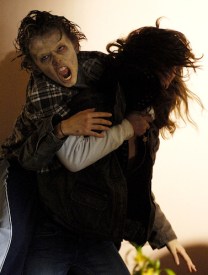 The other problem bemoaned by fans is that this is a reboot, of sorts. Romero’s previous zombie films feature no recurring characters and don’t sit properly within the same timeline, but they nonetheless feature an evolution of the zombie epidemic: it spreads from a one-night issue in Night to a dragging problem in Dawn, to an all-consuming one by Day, in which we see the zombies gaining in intelligence, to the point where they consciously form an invading force in Land. But Diary scraps all that, going back to the start of the epidemic. It doesn’t remake Night — in fact, it handles a few things notably differently (in Night the radio and TV report factual and helpful information; in Diary, they obscure the fact the outbreak is even happening) — but it does disregard the development Romero had taken the undead through.
This may, then, be the time to mention that Romero doesn’t consider his films to be sequels, because each one starts with a new set of characters and tells a self-contained story. He has a point: consider any of the first four films in isolation and you’ll realise you don’t need to have seen the preceding movie(s) to follow them, they just don’t take the traditional move of starting from the birth of the zombie problem. This is perhaps most evident in Land: the sci-fi-esque dystopian world, born of ours but notably different, is the setting for dozens of movies; we’re used to jumping into that without three films’ worth of exposition on how we got from here to there. So if you choose to consider each film as a standalone, self-contained entity, Diary going back to the start doesn’t seem quite so odd. It’s even necessary for the film’s theme: the premise requires it to be set in a present-day we recognise that’s then transformed by the zombie epidemic, rather than a sci-fi future set post-Land.
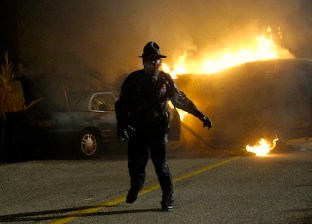 But, nonetheless, the epidemic did develop and evolve across Romero’s previous films, and that’s been lost here. Maybe there’s nowhere further to go with it? I’m not convinced of that. Perhaps Romero will have another idea and get to tell that story someday in the future, leaving Diary (and Survival) as an aside to his once-a-decade continuing series.
I disagree with those who think Diary is without interest or merit — clearly, as I’ve gone on this long about it. Romero brings a class to the concept that a lesser director wouldn’t, but it’s also a concept a lesser director could have realised much of in a similar fashion. It’s unquestionably the weakest of Romero’s first five ‘Dead’ films, then, but that still leaves it notably better than many, many other contributions to the genre.
Part of Week of the Living Dead for Halloween 2013.


 It’s tough to know where to begin slagging it off — there are too many options. How about the groundwork for any film: the screenplay. Never mind the storyline (a MacGuffin hunt designed to facilitate action sequences), but take a look at the dialogue — it’s all of the “oh hello, brother” / “you are finally home, my wife” / “I’ve not seen you for four years” level. After a while, you just have to accept it’s pushing so-bad-it’s-good; by the final act, I was laughing out loud at nearly every line.
 Almost as unintentionally hilarious is the Radio Times review. It praises all sorts of things that are actually awful — several of the things I’ve covered so far, in fact: “the dialogue is hilariously self-aware” (it’s hilariously unaware), “smart flashbacks” (pointless flashbacks), “high-quality visuals” (cheap visuals), etc.
 Some say this is the worst of the series, and I think I agree.
  Once, zombie auteur George A. Romero commented that he’d hoped to make one zombie film a decade — witness
 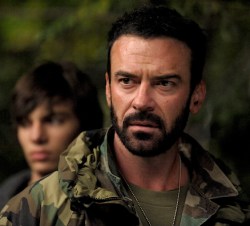 Well, that little gang of military types are back — and now they’re the heroes. Survival even takes the time to flashback to Diary, noting the release of the film-within-a-film led to the military gang’s leader, Sarge (Alan van Sprang), being recognised. It’s not a plot/character thread Romero chooses to develop further — there’s no about-turn in his values, or a desire to hide from said recognition — which is a shame, actually, because the plot supports such a move.
 It’s also here that they meet a character known only as Boy (Devon Bostick), who had been co-opted into the gang of hunters. Turns out he’s handy with a weapon himself, and resourceful and clever. What an intriguing mystery. But don’t get too caught up — Romero never again alludes to where such skills materialised from. In fact, he so doesn’t return to the Boy’s abilities that I wonder if we weren’t even really meant to notice. Which doesn’t make sense. Is he left over to be revisited in a third in this new zombie series? Romero doesn’t seem to be in any rush to produce one… but then, Survival was an almighty flop (it even went straight to DVD here), so I guess we’ll never know.
 also a definition of US foreign policy, is it not. And I’m sure it’s no coincidence that the islanders are Irish; and not just Irish in the way so many Americans claim to be “Irish” or “Italian” or whatever just because 200 years ago they had some relatives who emigrated, but properly, thickly-accented Irish. Which, yes, is kinda odd on an island off the coast of America, but hey, why not.
 I have no problem with CG blood splatter or what have you, and it’s as palatable here as it was there. There’s also a welcome return for his brand of humour, which went somewhat AWOL in the last couple of films. Those who criticise the film for being too comedic have, in my view, become too obsessed with modern cinema’s uber-serious tone. Lighten up folks, it’s a horror/sci-fi/fantasy movie.

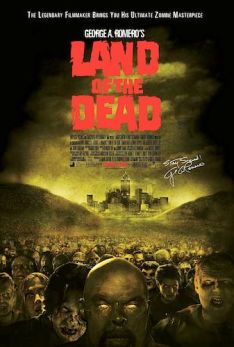 While the first three ‘Dead’ films (or “the original trilogy”, to put it in
 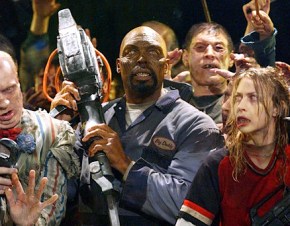 and then a desire for revenge, when he sees the glittering lights of the city in the distance. Lead he does, corralling the other zombies into a slow march towards their target.
 In the world of the humans, meanwhile, we also have an oppressed majority: the slum dwellers. Attempts at revolution there are soundly ignored, with the rich quietly taking the opposition out as ‘trash’ whenever able (which, I guess, is whenever they want). The people are controlled by drink, drugs, gambling, prostitution, and any other cheap entertainment you can imagine, all secretly managed from on-high to keep the general populace docile. And those entertainments are getting increasingly extreme, too: the zombie-on-zombie cage fights previously used cat or dog meat as motivation, but now they throw in Asia Argento. Again, Romero is holding a mirror up to present-day America, where the illusion of a ‘free society’ with easy social mobility is supported by the mega-rich in order to keep the poor down. It takes the zombie invasion for anything to change, which may be a case of Romero “following the story” rather than reflecting a political reality — who’s going to invade the US?
 Those commenters that do acknowledge these facets claim Romero’s just not as subtle as he used to be, which is also poppycock: Dawn’s criticism of consumerism is as blatant as anything listed here — perhaps even more so, because you can just watch Land as a near-future science-fiction humans-vs-humans-vs-zombies action flick, whereas I think Dawn’s ‘subtext’ is unmissable.
 If you want to see people getting ripped apart by zombies with their guts spilling out everywhere, in traditional Romero style, then… seriously, what’s wrong with you people?! But, erm, you should be satiated.
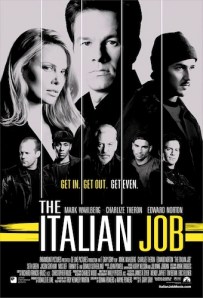 This came in for quite a bit of stick on release — how dare they re-make a British classic, etc etc. It didn’t help matters that one of the stars, Edward Norton, was apparently forced to appear against his will as part of his contract with the studio.
 and while Edward Norton’s performance is hardly remarkable, it doesn’t smack too much of being phoned in.
 The island town of Swallow Falls exists for one purpose: sardines; the fishing, packing, and distribution thereof. But when the world suddenly realises that sardines are gross, the town’s economy is left in tatters and the only foodstuff the islanders have is sardines. (While we’re on the glum bit, the location of Swallow Falls is identical to the real-world location of Bermuda, except in this reality almost every inhabitant is Caucasian and the island is indisputably part of the US. This is why you don’t scrutinise the geopolitics of kids’ movies, especially American ones.)
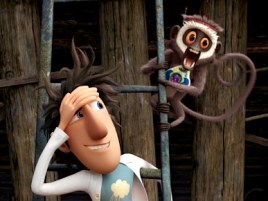 not an unworthy aim, and something Cloudy also achieves, but not a main consideration in my personal assessment of things. The main selling point is that it’s very funny. Of course there’s the slapstick cartoon humour, which is well done, but there’s also a lot of great one-liners, random asides, and the like. Not ‘adult jokes’ by any means, but I think it makes the film fun for grown-ups too.
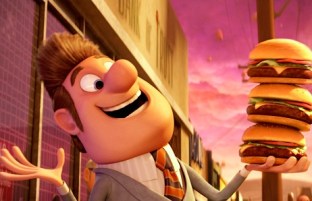 He’s a very funny character, but that’s in the writing, directing and animation — the voice work is spectacularly minimal. Apparently Harris was offered the lead but turned it down for the “more interesting” part of Steve. Nothing against Hader, but if I were the directors I’d have tried to persuade him to do both.
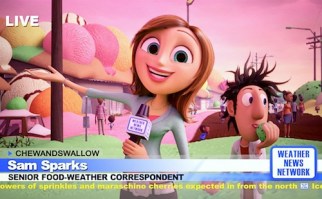 I should probably learn to stop writing off non-Pixar animated movies so readily (and, based on what I’ve heard and seen of their last few efforts, maybe slacken off on the Pixar love. I say that as if it’s news — plenty of people already have; and I’ve never been wholly on that bandwagon anyway. But I digress…) Big, bold, colourful, funny and exciting, Cloudy with a Chance of Meatballs is the kind of film I imagine a lot of kids love and watch on loop. In the process they may even be learning some Important Moral Lessons, which, crucially, aren’t too heavy-handed. Many of these aspects work for adults too. I don’t know if you’d want to watch it on loop, but you may certainly want to watch it again.
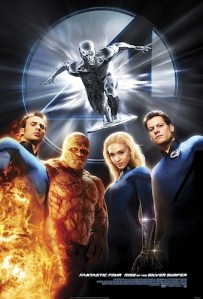 The Fantastic Four are the kind of superhero team that people in comics think are a big deal but the wider world aren’t so fussed about, as proven by the lack of success of their two film outings versus the likes of
  It’s also the kind of film where the US military have jurisdiction Everywhere In The World, which is again the kind of thing that used to just slide but doesn’t seem appropriate any more. Apparently the General character was originally meant to be Nick Fury — if it had been S.H.I.E.L.D., rather than the US military, at least that part might’ve made sense.
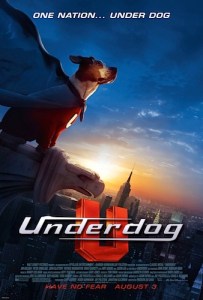 In this big screen live-action version of some old US cartoon, a dog gets superpowers and, naturally, becomes a superhero. That’s pretty much it.
 Notorious (to me) for unjustly beating
  100Films.co.uk