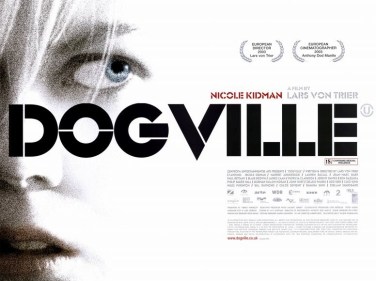
Dogville (2003)

100 Films’ 100 Favourites #25

A quiet little town not far from here.

Full Title: The film “Dogville” as told in nine chapters and a prologue

Country: Denmark, Sweden, UK, France, Germany & the Netherlands
Language: English
Runtime: 178 minutes
BBFC: 15
MPAA: R

Original Release: 21st May 2003 (Belgium, Switzerland & France)
UK Release: 13th February 2004
First Seen: DVD, c.2005

Stars
Nicole Kidman (Moulin Rouge!, Stoker)
Paul Bettany (A Beautiful Mind, Priest)
Lauren Bacall (The Big Sleep, The Shootist)
Stellan Skarsgård (Insomnia, The Girl with the Dragon Tattoo)
John Hurt (The Tigger Movie, Perfume: The Story of a Murderer)

Director
Lars Von Trier (Breaking the Waves, Antichrist)

Screenwriter
Lars Von Trier (The Idiots, Melancholia)

The Story
On the run from the mob, Grace arrives in the remote town of Dogville. Its residents agree to shelter her in order to prove their community values, though in return she must do chores for them. As the search for the missing woman repeatedly visits the town, the people’s demands for recompense for the risk they are taking intensifies…

Our Hero
Grace is a sweet, desperate young woman, happy to work for the good Christian people of Dogville in payment for their kindness. As her good nature is gradually worn down, she becomes enslaved by them — though it may turn out there’s more to her than meets the eye…

Our Villains
Of course there aren’t any villains in the town of Dogville — everyone’s a morally upstanding citizen.

Best Supporting Character
Not technically a character, but the Narrator is a palpable presence in the film. The material Von Trier has written for him is just the right side of verbose, and John Hurt delivers it with inestimable class.

Memorable Quote
“Whether Grace left Dogville, or on the contrary Dogville had left her — and the world in general — is a question of a more artful nature that few would benefit from by asking, and even fewer by providing an answer. And nor indeed will it be answered here.” — Narrator

Memorable Scene
The scenes that stick in the mind from Dogville — aside from the opening shot I shall discuss next — are either harrowing, spoilersome, or both, and so don’t merit discussion in a format potentially perused by neophytes.

Technical Wizardry
The famous bare set — a black soundstage with chalk markings on the floor to represent the houses, and minimal other features or props — was inspired by the theatre of Bertolt Brecht; as was the film’s plot, so it’s rather apt. The set (or lack thereof) seems like a very “art house” idea, and a distancing one for the viewer, but it’s surprising how quickly you forget and accept it.

Making of
The opening bird’s-eye shot of the town: physically impossible, because the studio’s roof wasn’t high enough, so the final result is actually 156 separate shots stitched together.

Next time…
Supposedly the first part of a trilogy called “USA: Land of Opportunities”. The second part, Manderlay, was released in 2005, starring Bryce Dallas Howard in Kidman’s role. The concluding part, Wasington, seems to have fallen out of Von Trier’s interest.

Awards
Nominated for the Palme d’Or.
Won the Palm Dog.

What the Critics Said
“Von Trier’s detractors – and there are many – will argue that this is nothing more than filmed theatre. […] But Anthony Dod Mantle’s digital video camera isn’t simply documenting a performance. It restlessly and fearlessly intrudes into this place and into these lives. Its close-ups – capturing key emotions as they flicker across the characters’ faces – are vital to describing the moral arc of the story. This is something that can only be achieved cinematically, an intensity that’s impossible to render elsewhere, not even from the front row of a playhouse’s stalls.” — Alan Morrison, Empire

Score: 70%

What the American Critics Said
“what most reviews are discussing is the success or failure of the film as a critique on America. There’s a sense of discussion, not of the themes dissected, but more of whether the film deserved consideration as an anti-American film, and whether it was a bad film because of it. Released in an altogether post-9/11 world, attacking America in any way shape or form, cinematic, politically, or philosophically, constituted an echo of the violence of two or three years before. […] now that we’ve learned to accept critique not as an attack, but for exactly what it is, critique, we can get to the real heart of Dogville, and we can stop nitpicking whether or not it was a deserved attack on American culture, or whether it should be written off as an “anti-American” movie” — Karl Pfeiffer
(That piece goes on to be a very interesting analysis of the film, by-the-way, particularly with regards to it being an allegory for Christianity.)

What the Public Say
“Lars, despite his ever intrusive camera, keeps us at a distance from his characters. This is not a criticism nor do I think this is unintentional. I think he does this to make sure we don’t lose sight of the message he is trying to share with us. He wants us to look at ourselves through these people, not get lost in their drama. The message of Dogville is a pessimistic one: At humanity’s core, we are bad people who will turn on our brother to protect ourselves. Altruism does not exist. Americans are smugly self-righteous. And even those of us who deem ourselves most pure are never above revenge.” — Cineaste

Verdict

It’s no surprise that Lars Von Trier would be responsible for such a provocative, difficult, divisive film — indeed, that’s what all his films are, aren’t they? Whether that works or not is often down to the individual, with each of his films being hailed as masterpieces by some and condemned as drivel by others. Dogville is no different. A three-hour movie that takes place in a black-box theatrical-style environment may sound tough, but engrossing performances and a symbolic storyline with a cathartic ending keep it… not enjoyable, exactly, but fascinating.

#26 will be… 28 days, 6 hours, 42 minutes, 12 seconds from the end.
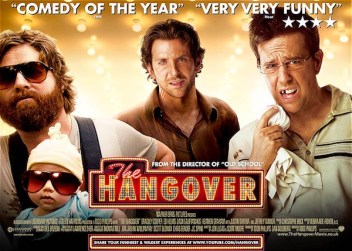
The Hangover (2009)

2016 #40
Todd Phillips | 96 mins | streaming (HD) | 2.35:1 | USA & Germany / English | 15 / R

I confess, I only watched The Hangover to see what the fuss was about, and to get the tick on iCM’s Most Checked.

The high-concept plot (guys on a stag are unable to remember the night before, but must use the evening’s bizarre detritus as clues to piece together their wild experiences so they can find the missing groom) is neat, though not as cleverly executed as it could be. The humour is straightforward, perhaps best exemplified by an Asian guy saying “motherfucker” in a silly high-pitched voice — and yeah, I did laugh at that.

It’s easy, decidedly uncomplicated viewing.

3 out of 5

For more quick reviews like this, look here.

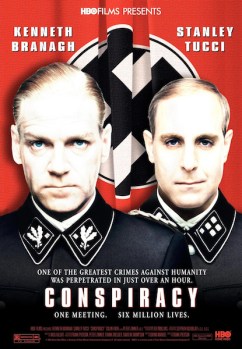
Conspiracy (2001)

100 Films’ 100 Favourites #20

One meeting. Six million lives.

Country: UK & USA
Language: English & German
Runtime: 96 minutes
BBFC: 15
MPAA: R

Original Release: 19th May 2001 (USA)
UK Release: 25th January 2002
First Seen: TV, 25th January 2002

Stars
Kenneth Branagh (Henry V, Valkyrie)
Stanley Tucci (The Terminal, The Hunger Games)
Colin Firth (Bridget Jones’s Diary, The King’s Speech)
David Threlfall (Scum, Nowhere Boy)
Kevin McNally (Pirates of the Caribbean: The Curse of the Black Pearl, Valkyrie)

Director
Frank Pierson (The Looking Glass War, A Star is Born)

Screenwriter
Loring Mandel (Countdown, The Little Drummer Girl)

The Story
1942, Berlin: a group of high-ranking Nazis gather for the Wannsee Conference, its purpose being to determine the method by which they will implement Hitler’s policy of making Germany free of Jews. Put another way, this is the meeting that created the Final Solution.

Our Heroes
I mean, they’re all Nazis, plotting the Final Solution — heroes are in short supply. That said, some object… just not very many, and not for long.

Our Villains
I mean, they’re all Nazis, plotting the Final Solution — there are plenty of villains. Chief amongst them, however, is SS-Obergruppenführer Reinhard Heydrich (Branagh), whose calm and charming demeanour hides a will of steel and a sure belief in their terrible purpose.

Best Supporting Character
There’s a strong cast of British character actors (as well as those mentioned above, we have Ian McNeice, Ben Daniels, Brendan Coyle, Owen Teale, Peter Sullivan, Nicholas Woodeson, and Jonathan Coy — you might not know all the names, but you’ll likely know the faces), so it’s hard to name just one stand-out. However, Dr. Wilhelm Stuckart (Colin Firth) is particularly memorable: he’s a nice guy because he only wants to sterilise the Jews. He’s also one of the few men in the room who’s aware of how the rest of the world will judge them if they proceed down a path of extermination.

Memorable Quote
Hofmann: “Evacuation to where?”
Heydrich: “Let us postpone that question for a while.”
Klopfer: “To hell, one hopes.”
Lange: “Many already have.”
Luther: “Do they even have a hell?”
Heydrich: “They do now. We provide it.”

Memorable Scene
Although it’s bookended by arrivals and departures, and occasionally broken up in the middle with pauses for food, etc, the film is essentially one long meeting. Which sounds incredibly dull, but of course isn’t.

Making of
Pierson chose to shoot the film’s meeting sequences in long takes, sometimes getting through 20 or more pages at a time. A highly unusual method for a screen production, so the fact most of the cast had a stage background must’ve been a boon. It was shot on Super 16 film for similar reasons: it has longer film magazines and smaller cameras, allowing the cameramen to get closer to the actors.

Awards
1 Golden Globe (TV Supporting Actor (Stanley Tucci))
2 Golden Globe nominations (Best Miniseries or TV Movie, Best Actor in a Miniseries or TV Movie (Kenneth Branagh))
2 Emmys (Actor in a Miniseries or Movie (Kenneth Branagh), Writing for a Miniseries or Movie)
8 Emmy nominations (Outstanding TV Movie, Supporting Actor (both Colin Firth and Stanley Tucci), Directing, Cinematography, Editing, Sound Editing, Sound Mixing)
1 BAFTA TV Award (Single Drama)
1 BAFTA TV nomination (Actor (Kenneth Branagh))
Peabody Award

What the Critics Said
“What a week for thoroughly exceptional, audaciously gripping fact-based dramas. We had Bloody Sunday on Sunday and now here’s Conspiracy. […] The performances are uniformly outstanding, but out of all of them it will be images of Kenneth Branagh as Heydrich you will take away with you. They may even haunt your nightmares. Branagh, who won an Emmy for the role, is flawless, and in Heydrich this fine actor has re-created a monster. Just watch the iron come into his eyes when he is contradicted or questioned. Watch that smooth charm slip as he calmly threatens those who are not completely on his side.” — Alison Graham, Radio Times

Score: 100%
(Sort of.)

What the Public Say
“to see the planning of the Final Solution played out is chilling, to say the least. Obviously, it’s not an easy watch, but it’s an important film. If you’re at all interested in how scary and terrible things happen in this world, and how the death of millions can be plotted the same way your company runs a board meeting, this is definitely a movie to see.” — Dan Bergstrom @ Letterboxd

Verdict

“A group of men have an administrative meeting” is possibly the least exciting logline for a movie you could ever read, but when those men are Nazis, at the height of the Third Reich’s pomp and opulence, and the businesslike meeting is to plot one of the greatest atrocities ever committed by mankind, it becomes horrendously fascinating. For that we can also thank Loring Mandel’s precise screenplay, and perfectly calibrated performances from a magnificent cast of seasoned actors.

#21 will be… nothing to do with Phillip Schofield.

Daredevil (2003)

100 Films’ 100 Favourites #22

Take the dare

Country: USA
Language: English
Runtime: 103 minutes | 133 minutes (director’s cut)
BBFC: 15
MPAA: PG-13 (theatrical cut) | R (director’s cut)

Original Release: 14th February 2003 (USA, UK & others)
First Seen: cinema, February 2003

Stars
Ben Affleck (Pearl Harbor, Batman v Superman: Dawn of Justice)
Jennifer Garner (13 Going on 30, The Invention of Lying)
Michael Clarke Duncan (The Green Mile, Sin City)
Colin Farrell (Minority Report, Alexander)

Director
Mark Steven Johnson (Ghost Rider, When in Rome)

Screenwriter
Mark Steven Johnson (Grumpy Old Men, Ghost Rider)

Based on
Daredevil, a Marvel Comics superhero created by Stan Lee and Bill Everett.

The Story
Blind New York lawyer Matt Murdock defends the innocent by day, and by night uses his special abilities to bring the guilty to justice as costumed vigilante Daredevil. When crime boss Wilson Fisk, aka Kingpin, hires Bullseye to take out a business associate, the assassin frames Daredevil for the crime, which brings him into conflict with the businessman’s combat-trained daughter, Elektra.

Our Hero
Blinded as a child, Matt Murdock found his other senses heightened. Following the murder of his father, he trained in the law. Now by day he’s a defender of the innocent, and by night hunts the guilty as superhero Daredevil. Even though the film mixes in his origin story, it doesn’t take a “Year One” approach to his crimefighting, which makes a change of pace even now. (In recent years a lot of the blame for the film’s failure has been laid at Ben Affleck’s door, because it’s popular to bash ’00s-era Affleck. Rotten Tomatoes’ short summary of contemporary reviews tells a different story, stating “Ben Affleck fits the role” as one of the film’s key qualities.)

Our Villains
Coming off the back of The Green Mile, Michael Clarke Duncan was the obvious chap to step into the giant shoes of Hell’s Kitchen’s crime lord, Wilson Fisk, aka Kingpin. The real fun comes courtesy of Colin Farrell’s crazy, campy killer, Bullseye, who enlivens the film any time he’s on screen.

Best Supporting Character
Jennifer Garner is terribly miscast as Elektra, really, but she makes a fair fist of it nonetheless, and the film doesn’t shy away from the outcome of that storyline.

Memorable Quote
“Hey, that light, at the end of the tunnel? Guess what? That’s not heaven… that’s the C train.” — Daredevil

Memorable Scene
Matt and Elektra spar in a children’s playground. It’s a scene some people despise, probably because of what it thinks passes for dialogue, but you can’t say it doesn’t stick in the mind.

Memorable Music
If you were of the right age and disposition back in the early ’00s, the Daredevil soundtrack was more influential than the film itself. It was partly responsible for launching gothy rock group Evanescence, who you may remember for Bring Me to Life, which was on the film’s soundtrack and was their biggest hit (it was #1 here for four weeks). I think they’re still going, despite numerous changes of line-up, though they release albums once in a blue moon.

Letting the Side Down
“All of it!” Oh, hush, you.

Making of
Originally greenlit as a relatively low-budget film, at roughly $50 million, during shooting Sam Raimi’s Spider-Man was released and became a huge hit (it was the first film to gross over $100 million in one weekend). Consequently, Fox upped Daredevil’s budget to $80 million, specifically to “enhance the film’s visuals”. I guess that’s where all the Spider-Man-esque CGI tumbling came from, then.

Previously on…
Although this is the first full-blown adaptation of Daredevil to actually make it to the screen, he’s turned up in other characters’ series down the years, including both live-acton (1989 TV movie The Trial of the Incredible Hulk, which starred John Rhys-Davies as Kingpin) and animation (episodes of the ’90s Spider-Man and Fantastic Four series).

Next time…
Although no sequel was forthcoming, Jennifer Garner starred in spin-off Elektra. Whatever you think of the 2003 Daredevil, Elektra is much, much worse. Numerous attempts at a reboot movie faltered, until the rights reverted to Marvel Studios, who used the property to kick off the Netflix arm of the MCU. As much as I like the movie, the TV series is much better. Season two is released this Friday, so if you’ve not seen any then you’ll soon have 26 episodes to catch up on, you lucky thing you.

Awards
1 Razzie (Worst Actor (Ben Affleck, also for Gigli and Paycheck))
1 Razzie nomination (Worst Actor of the Decade (Ben Affleck, also for everything else he did in the ’00s))
1 Kids’ Choice Award nomination (Best Female Butt Kicker)
2 MTV Movie Awards Mexico nominations (including Best Colin Farrell in a Movie (it lost to S.W.A.T.))

What the Critics Said
“This is the Unforgiven of superhero films. Conventions are turned on their head, twisted, questioned. […] In almost every superhero film, there’s another conventional scene where the villain has the hero cornered and helpless. Yet the villain never unmasks the hero. That scene drove me nuts in Spider-Man. […] In Daredevil, no one ever hesitates to unmask DD. That’s what I mean by this being a film grounded in reality. People act real, do real things. Even if they are wearing silly costumes.” — “Dr. Michael Hfuhruhurr”, Ain’t It Cool News

Score: 44%

What the Public Say
“Colin Farrell is deliciously hammy and steals every scene he’s in, showing he’s having a total blast (and to be honest, the hamminess suits Bullseye). Michael Clarke Duncan is PERFECT casting for Kingpin, for his size, stature, overall menacing feel. And honestly, I like Ben Affleck in this, too. He makes me believe he’s blind. He makes me believe that he’s a broken, tortured character who tries to put on a brave face in front of his friends.” — Nick Piers

Verdict

The runt of the litter when it comes to the (first) modern explosion of superhero movies, Daredevil has, believe it or not, always had its fans. The darker tone than contemporary X-Men or Spider-Man films works in its favour in that respect, though I know not everyone feels that way. Ben Affleck actually does a solid job as the titular hero, while Michael Clarke Duncan was perfectly cast as hulking villain Kingpin. Most enjoyable, though, is Colin Farrell’s finely-judged camp craziness as henchman Bullseye. Okay, the Netflix series has now easily surpassed it, but the Daredevil movie is still a moderately underrated film for its era. (The Director’s Cut is apparently much better, too, though I’ve still not made the time for it.)

Season two of Marvel’s Daredevil is available on Netflix from Friday.

#20 will be next… with character actors planning genocide.

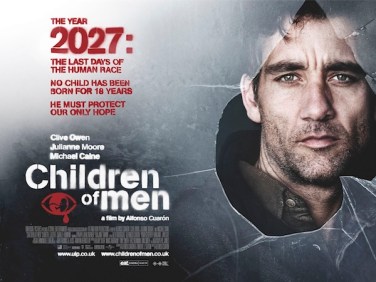
Children of Men (2006)

100 Films’ 100 Favourites #19

The year 2027:
The last days of the human race.
No child has been born for 18 years.
He must protect our only hope.

Country: USA & UK
Language: English… and German, Italian, Romanian, Spanish, Arabic, Georgian & Russian, apparently.
Runtime: 109 minutes
BBFC: 15
MPAA: R

Original Release: 22nd September 2006 (UK)
First Seen: cinema, October 2006

Stars
Clive Owen (Inside Man, Shoot ‘Em Up)
Julianne Moore (The Hours, Still Alice)
Michael Caine (The Italian Job, Batman Begins)
Chiwetel Ejiofor (Serenity, 12 Years a Slave)
Danny Huston (The Proposition, X-Men Origins: Wolverine)

Director
Alfonso Cuarón (Harry Potter and the Prisoner of Azkaban, Gravity)

Screenwriters
Alfonso Cuarón (Y Tu Mamá También, Gravity)
Timothy J. Sexton (Live from Baghdad, The Liberator)
David Arata (Brokedown Palace, Spy Game)
Mark Fergus (First Snow, Iron Man)
Hawk Ostby (First Snow, Cowboys & Aliens)

Based on
The Children of Men, a novel by P.D. James.

The Story
In the near future, mankind has become infertile, and no child has been born for 18 years. The world has gone to hell, with Britain one of the few countries that still has a functioning government, albeit a controlling, totalitarian one. In this world, government drone Theo is persuaded by his ex-wife, now head of an activist group, to escort a friend out of the country. Turns out that friend is a young woman… who’s pregnant — a situation that interests a lot of dangerous people…

Our Hero
Theo, disillusioned former activist, who’s roped back in, initially by kidnap, later with the promise of a hefty payday. Before long it turns out he’s actually a good guy at heart, of course.

Our Villains
“The rest of humanity” wouldn’t be a wholly bad answer here, as Theo and co keep bumping up against people violently concerned with their own interests. Within that, there’s the issue of if the activist group’s motives can be trusted…

Best Supporting Character
Theo’s friend Jasper, a former political cartoonist turned pot dealer, played by Michael Caine as a John Lennon-inspired old hippy.

Memorable Quote
“As the sound of the playgrounds faded, the despair set in. Very odd, what happens in a world without children’s voices.” — Miriam

Memorable Scene
Any of the (faked-)single-take action sequences is a worthy pick here. Alternatively, fans of a certain rock group will appreciate the inflatable pig floating over Battersea Power Station.

Technical Wizardry
As our heroes escape in a little Fiat, they’re attacked on a country road, the camera moving around the small person-filled vehicle in a single take. They used a special camera rig, along with a car modified to allow the windscreen to tilt out of the camera’s path, and seats that tilted to lower the actors out of the way too. The “single” shot took six takes in four locations, transition effects to seamlessly join shots, and CGI to create the motorbike, windscreen, blood, roof, and more.

Making of
The other most memorable single take is near the end, a running street battle during which Clive Owen’s layperson does his best to not get killed. It took 14 days to prepare the shot, with a delay of five hours every time it had to be reset. It was filmed over the course of two days, but only one complete take was actually captured. In the middle of one take, some blood spattered on the camera lens; Cuarón shouted “cut”, but was drowned out by the sound of tank and gunfire. Cinematographer Emmanuel Lubezki persuaded the director to leave it in, and that’s the shot in the final film. Pay attention during the sequence and you can see the liquid and dirt that gets splattered on the lens disappear during one of the ‘seamless’ cuts.

Awards
3 Oscar nominations (Adapted Screenplay, Cinematography, Editing)
2 BAFTAs (Cinematography, Production Design)
1 BAFTA nomination (Visual Effects)
1 Saturn Award (Science Fiction Film)
2 Saturn nominations (Actor (Clive Owen), Director)
Nominated for the Hugo for Best Dramatic Presentation, Long Form.

What the Critics Said
“[Cuarón] increasingly shoots the film’s set pieces in virtuoso long takes — gliding tracking shots that evoke Tarkovsky and handheld work that suggests Kathryn Bigelow. What makes these scenes stunning is not only mind-boggling choreography and timing, with Emmanuel Lubezki’s camera somehow capturing multiple planes of action even while continuously changing position, but also their ability to realistically evoke the frightening chaos and simultaneous madness of war. […] Such overwhelming studio work might be too arty for those who like their genre served sans showiness. But Cuarón is implementing a verisimilitude that both matches the film’s edge-of-your-seat escalations and demonstrates a new understanding of blockbuster realism.” — Michael Joshua Rowin, Stop Smiling

Score: 92%

What the Public Say
“Cuarón uses sequences evocative of Holocaust imagery and detention camps to implicitly communicate a world rife with injustice and pain. In designing the look of the film, Cuarón told his art department that he did not want inventiveness, but reference, so that an audience would be able to adequately recognize a distorted form of their own reality. For the reader and viewer who encounter this uncanny world, it feels all the more real because of its familiar elements.” — Mariel Calloway

Verdict

I saw Children of Men on a whim back in 2006. I can’t even remember why — I don’t think I’d seen any trailers or reviews, and it had been open for a good few weeks already. It was a time when I went to see loads at the cinema, though (in those days I paid good money to see Fun with Dick and Jane — does anyone even remember that?), and I think it may’ve been the only thing still on. Anyway, it meant I actually got in a little ahead of the hype that has gradually (and justifiably) grown around the film since, and still loved it. Cuarón mixes intelligent near-future sci-fi with exciting, and excitingly-realised, action sequences to create an action-thriller of a movie that stimulates both the mind and the adrenal glands. A fantastic film in every respect.

#22 will be next… to give the Devil his due.

Daybreakers (2009)

2016 #24
The Spierig Brothers | 89 mins | streaming | 2.35:1 | Australia & USA / English | 15* / R

Most of mankind have become vampires, but the blood supply is running out and without it people mutate into monsters. Ethan Hawke’s scientist is developing a substitute, but when he encounters human resistance fighters he learns there may actually be a cure…

Made by the guys behind Predestination, Daybreakers offers an original and imaginative world (how would mankind cope if we couldn’t go out in daylight? Maybe like this). It’s somewhat let down by a few campy performances and a sensibility that reverts to action sequences, but originality counts for a lot, especially for genre fans looking for something different.

3 out of 5

* The distributor chose to make six seconds of cuts to get a 15 in cinemas. The uncut 18-rated version was released on DVD and Blu-ray. No idea which version is available through Channel 5, where I watched it. ^

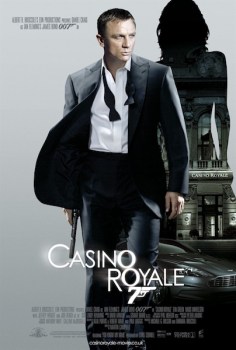
Casino Royale (2006)

100 Films’ 100 Favourites #18

Everyone has a past.
Every legend has its beginning.

Country: UK, USA, Czech Republic & Germany
Language: English
Runtime: 144 minutes
BBFC: 12A (cut, 2006) | 15 (uncut, 2012)
MPAA: PG-13 (cut)

Original Release: 14th November 2006 (Kuwait)
UK Release: 16th November 2006
US Release: 17th November 2006
First Seen: cinema, 16th November 2006

Stars
Daniel Craig (Layer Cake, The Girl with the Dragon Tattoo)
Eva Green (The Dreamers, Sin City: A Dame to Kill For)
Mads Mikkelsen (Valhalla Rising, The Hunt)
Judi Dench (Iris, Philomena)
Jeffrey Wright (Shaft, The Hunger Games: Catching Fire)

Director
Martin Campbell (GoldenEye, Green Lantern)

Screenwriters
Paul Haggis (Crash, The Next Three Days)
Neal Purvis (Die Another Day, Johnny English)
Robert Wade (Stoned, Skyfall)

Based on
Casino Royale, the first James Bond novel by Ian Fleming.

The Story
British agent James Bond, newly promoted to exclusive double-oh status, investigates a terrorist plot that leads him to Le Chiffre. Banker to the world’s terrorists, Le Chiffre has managed to lose a lot of his clients’ money, and intends to win it back in a high-stakes poker game at the eponymous establishment. Bond is charged with joining the game and bankrupting the banker, with treasury employee Vesper Lynd along to keep an eye on the money and off Bond’s perfectly-formed arse.

Our Hero
“James before he was Bond,” as the awful US tagline went. Daniel Craig instantly disproved the not-that-numerous-but-certainly-vocal critics (remember all the “Bond isn’t blond” rubbish?) by being perhaps the most convincing actually-is-a-highly-trained-agent Bond since Connery.

Our Villain
Le Chiffre, a total banker. Fond of poker, bleeds from his eye, brilliantly played by Mads Mikkelsen, who has deservedly gone on to many other things, no doubt some wholly due to this.

Best Supporting Character
Eva Green is Vesper Lynd, a woman so remarkable that Bond names his personal Martini recipe after her. He also falls in love with her. Considering the rest of the Bond canon, that’s not likely to end well.

Memorable Quote
“I’m afraid your friend Mathis is really… my friend Mathis.” — Le Chiffre

Memorable Scene
At dinner on the train to Montenegro, Bond meets Vesper for the first time. They verbally size each other up. She wins. “How was your lamb?” “Skewered. One sympathises.”

Write the Theme Tune…
Easily the best Bond theme of the Craig era (though I like the QoS one more than most, and my main objection to Adele’s is that it’s about a flying baby horse and its receptacle for bread waste), You Know My Name was co-written by the series’ regular composer since the mid ’90s, David Arnold. That meant he could integrate the tune into his score, which was a Good Thing.

Sing the Theme Tune…
Far removed from Bond’s Bassey-imitating default style, the slightly gravelly sound of Soundgarden’s Chris Cornell (the first male vocalist on a Bond theme for nearly 20 years) helped indicate the series’ harder, manlier new direction.

Technical Wizardry
After four films of honing the Maurice Binder “naked silhouettes” style, title designer Daniel Kleinman cuts loose with an array of inventive playing card-based imagery. The most original Bond title sequence since at least Thunderball and, by being so atypical, the most unique of them all.

Truly Special Effect
Chasing after a kidnapped Vesper in the middle of the night, Bond suddenly sees her in his headlights, tied up in the middle of the road. He swerves, his Aston Martin crashes, and barrel rolls… seven times. The stunt team set a world record with that, which (despite Fury Road’s best efforts) is still unbeaten a decade later.

Making of
James Ferguson, a doctor from Aberdeen, came up with the idea for the scene in which Bond is poisoned and then remotely diagnosed by experts at MI6 HQ in London. Ferguson, a Bond fan, was retained as medical adviser for future Bond films.

Previously on…
Casino Royale was adapted for TV in 1954, starring the great Peter Lorre as Le Chiffre, and its title (and little else) was used for the awful 1967 Bond spoof. This version is the 21st in the canonical James Bond film series, and the first time that series has performed a reboot: the film opens with Bond attaining his famed double-oh status, something we’ve never seen before.

Next time…
Daniel Craig’s second outing, the somewhat misunderstood and underrated Quantum of Solace, was the first direct sequel in the Bond canon, picking up on various plot threads from Casino Royale and even resolving a few of them. After Craig’s third, Skyfall, went off on its own, last year’s Spectre tried to tie together the entirety of Craig’s era, with mixed success. Beyond that, James Bond will return indefinitely, though Craig may not.

Awards
1 BAFTA (Sound)
8 BAFTA nominations (British Film, Actor (Daniel Craig), Adapted Screenplay, Music, Cinematography, Editing, Production Design, Visual Effects)
1 Saturn Award (Action/Adventure/Thriller Film)
4 Saturn nominations (Actor (Daniel Craig), Supporting Actress (Eva Green), Writing, Music)
2 World Stunt Awards (Best High Work, Best Stunt Coordination and/or 2nd Unit Director)
1 World Stunt Awards nomination (Best Fight)

What the Critics Said
“I never thought I would see a Bond movie where I cared, actually cared, about the people. But I care about Bond, and about Vesper Lynd, even though I know that (here it comes) a Martini Vesper is shaken, not stirred. Vesper Lynd, however, is definitely stirring, as she was in Bertolucci’s wonderful The Dreamers. Sometimes shaken, too. Vesper and James have a shower scene that answers, at last, why nobody in a Bond movie ever seems to have any real emotions.” — Roger Ebert

Score: 95%

What the Public Say
“While there is very much a dramatic and sensitive undercurrent to this Bond film, Casino Royale doesn’t shortchange the audience on action. From Bond chasing a skilled free runner enemy to a brutal staircase battle, Casino Royale delivers a harsher and bleaker sense of violence that had been missing from some of the predecessors and not seen since Timothy Dalton’s dark turn in Licence to Kill.” — vinnieh

Elsewhere on 100 Films
Just before Quantum of Solace was released in 2008, I wrote that Casino Royale was “a damn fine Bond film, returning to Fleming and resetting the character without losing anything truly essential about the franchise. […] this one’s up there with the very best, not just of Bond but of action-spy-thrillers in general.”

Verdict

In the early ’00s, it didn’t feel like the Bond series was in need of a reboot. Die Another Day had been a huge hit at the box office and gone down pretty well with critics (no, really, it did), and Brosnan was all set to do a fifth (though, considering his age, likely final) film as Britain’s top secret agent. Then Bourne happened, shifting the playing field of the spy-action genre, at the same time as Bond’s producers finally regained the rights to Fleming’s very first Bond novel. For the first time in the series’ 40-year history, they decided to reboot.

What Casino Royale does skilfully is acknowledge the changes brought by Bourne, but adapt them to Bond’s slightly more classical style (something Quantum of Solace fumbled). At the same time, it acknowledges and frequently subverts that Bond formula (“Shaken or stirred?” “Do I look like I give a damn.”), the antithesis of DAD’s uber-referentiality. In itself, it took Fleming’s relatively slight novel, with its lack of action by modern blockbuster standards, and expanded and modernised it effectively to fit current tastes. The result is arguably the best Bond movie ever made.

#19 will be… the last days of the human race.

Snatch. (2000)

2016 #2
Guy Ritchie | 103 mins | streaming (HD) | 16:9 | UK & USA / English & Russian | 18 / R

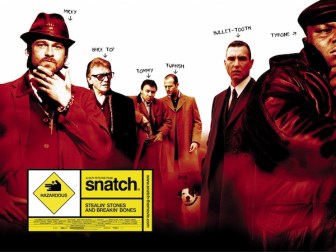
Guy Ritchie’s second feature met with relative indifference 16 years ago, consensus deeming it Lock Stock Mk.2 and finding Ritchie needed to branch out if he was to meet his debut’s promise. (It only took a further four films to realise that for himself.) The consensus is very different today: taking IMDb’s Top 250 as a bellwether, Snatch is #94 and Lock Stock is #138.

I thought it was like Pulp Fiction refashioned in the style of Lock Stock, but with more-connected stories that play concurrently.

It was fine. Above average, even.

That’s all I have to say about it.

4 out of 5

Snatch was viewed as part of my What Do You Mean You Haven’t Seen…? 2016 project, which you can read more about here.

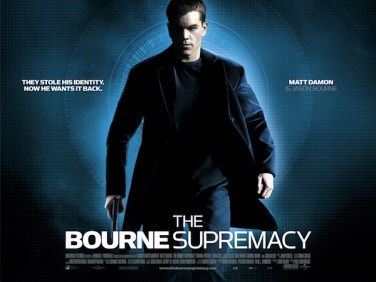
The Bourne Supremacy (2004)

100 Films’ 100 Favourites #16

They should have left him alone.

Country: USA & Germany
Language: English, Russian, German & Italian
Runtime: 108 minutes
BBFC: 12A
MPAA: PG-13

Original Release: 23rd July 2004 (USA)
UK Release: 13th August 2004
First Seen: cinema, August 2004

Stars
Matt Damon (The Talented Mr. Ripley, The Departed)
Franka Potente (Blow, Romulus, My Father)
Brian Cox (Manhunter, X2)
Joan Allen (The Ice Storm, Death Race)
Karl Urban (The Lord of the Rings: The Two Towers, Dredd)

Director
Paul Greengrass (The Bourne Ultimatum, Green Zone)

Screenwriter
Tony Gilroy (Proof of Life, The Bourne Legacy)

Based on
The character of Jason Bourne, created by Robert Ludlum. Not so much based on The Bourne Supremacy, the novel by Robert Ludlum.

The Story
Bourne and Marie are living a quiet life in India, until he’s framed for the murder of two CIA agents and the theft of files they were acquiring. After the actual culprit tries to kill Bourne, he believes the CIA have tracked him down, and makes good on his promise to bring the fight to them…

Our Hero
Living a life of seclusion with Marie, but still struggling with resurfacing memories from his time as a CIA operative, Jason Bourne has no intention of going anywhere near his former life… until they come for him, and the gloves are off. Bryan Mills ain’t got nothing on Bourne’s particular set of skills.

Our Villains
A whole host of interests are aligned against Bourne this time. From within the CIA, corrupt director Ward Abbott is still trying to cover his ass. A more physical threat comes in the form of Russian operative Kirill, referred to in early drafts of the screenplay as “Mock-Bourne” because he, a) frames our hero, and b) is his equal — well, almost.

Best Supporting Character
Pamela Landy brings some complication to the CIA side of the story: she’s out to get Bourne, same as the fellas from the first film, but that’s because she’s been conned too. Will she see the light and side with our hero?

Memorable Quote
Nicky: “It’s not a mistake. They don’t make mistakes. They don’t do random. There’s always an objective. Always a target.”
Landy: “The objectives and targets always came from us. Who’s giving them to him now?”
Nicky: “Scary version? He is.”

Memorable Scene
In Munich, Bourne visits the one remaining Treadstone operative. They fight, using household items as weapons (see “making of”, below). Then a team of soldiers arrive. Bourne turns on the gas, shoves a magazine in the toaster, and… well, the result was disproved by MythBusters, but it’s still cool.

Technical Wizardry
The cinematography and editing, according to some.

Letting the Side Down
The cinematography and editing, according to some.

Making of
The film famously features Bourne using a rolled-up magazine as a weapon in a fight with another Treadstone operative. Fight coordinator Jeff Imada looked over the set after it had been dressed to get an idea of what would be lying around that could be used as a weapon, and had the idea of a rolled up magazine. He had to demonstrate to sceptical crew members that it would indeed be a functional weapon, but was helped by actors Matt Damon and Marton Csokas giving each other bruises from practising with it.

Previously on…
The Bourne Identity left enough hanging to help fuel this movie.

Next time…
Although Supremacy was designed to wrap up the mysteries left dangling from Identity, they found plenty to drive a third film, which completes the trilogy by answering those remaining questions. A fourth film was essentially a spin-off. This summer’s fifth film will be about… something…

Awards
2 Saturn nominations (Action/Adventure/Thriller Film, Actor (Matt Damon))
2 World Stunt Awards (Best Work with a Vehicle, Best Stunt Coordinator and/or 2nd Unit Director)
1 World Stunt Award nomination (Best Fight)
2 MTV Movie Awards nominations (including Best Action Sequence (the Moscow car chase))

What the Critics Said
“Greengrass keeps you off-balance throughout. When the fight scenes and car chases arrive, there’s no telling, from shot to shot, what we will see next or how we’ll see it. […] Working with cinematographer Oliver Wood, Greengrass shoots the fight scenes and chases so close in that we see some moments almost as a blur. The editors, Richard Pearson and Christopher Rouse, break those sequences up into quick jagged shots that key us up and keep us hyper-alert. The world is being broken into bits of information, and we look hard at the screen to take it in. The approach could have resulted in the usual visual gibberish that defines contemporary action moviemaking [but] you can always tell what’s going on” — Charles Taylor, Salon

Score: 81%

What the Public Say
“I thought the movie was shot well, though at times I felt that the shaky cam effect was overused, as instead of pulling you into the action, it just gives you a headache and a dizzy spell” — Zoë, The Sporadic Chronicles of a Beginner Blogger

Verdict

Debate used to rage about whether Identity or Supremacy was the better film, centred on their very differing directorial styles. Fans of Greengrass’ sequel seem to have settled on Ultimatum as their preferred Bourne instalment now, though, leaving Supremacy to be generally regarded as the least-best of the first three Bournes. That does it something of a disservice: it’s an exciting, twisty, complicated thriller, and its groundbreaking visuals can’t be ignored for their contribution to the action genre — for good or ill.

#17 will… always have Paris.

The Bourne Identity (2002)

100 Films’ 100 Favourites #15

Danger is Bourne

Country: USA, Germany & Czech Republic
Language: English, French, German, Dutch & Italian
Runtime: 119 minutes
BBFC: 12A
MPAA: PG-13

Original Release: 14th June 2002
UK Release: 6th September 2002
First Seen: DVD, 2003

Stars
Matt Damon (Good Will Hunting, The Martian)
Franka Potente (Run Lola Run, Creep)
Chris Cooper (Lone Star, Adaptation.)
Clive Owen (Croupier, Children of Men)
Julia Stiles (10 Things I Hate About You, The Omen)

Director
Doug Liman (Swingers, Mr. & Mrs. Smith)

Screenwriters
Tony Gilroy (The Devil’s Advocate, Michael Clayton)
William Blake Herron (A Texas Funeral, Ripley Under Ground)

Based on
The Bourne Identity, a novel by Robert Ludlum.

The Story
Pulled wounded from the sea, Jason Bourne can’t remember anything about his life, but is a highly-trained combatant. That comes in handy when assassins begin to hunt him down, as he races across Europe with the aid of Marie, a German woman he bumped into, trying to establish the facts about his identity.

Our Hero
A man found floating in the ocean with two gunshot wounds in his back, who can’t remember his own name but can speak several languages and has knowledge of advanced combat skills. A laser projector implanted under his skin leads him to a safety deposit box in Zurich that contains thousands of dollars in cash, a gun, and an array of passports, from which he chooses a name: Jason Bourne.

Our Villains
The CIA’s Operation Treadstone, led by Alexander Conklin, who have an interest in Bourne — an interest that may primarily involve killing him.

Best Supporting Character
Marie, a German woman in the right place at the right time when a chap offers her $20,000 to drive him from Zurich to Paris… and in the wrong place at the wrong time when it turns out a bunch of people want to kill him, and she’s acceptable collateral damage.

Memorable Quote
Bourne: “Who has a safety deposit box full of money and six passports and a gun? Who has a bank account number in their hip? I come in here, and the first thing I’m doing is I’m catching the sightlines and looking for an exit.”
Marie: “I see the exit sign, too. I’m not worried. I mean, you were shot. People do all kinds of weird and amazing stuff when they are scared.”
Bourne: “I can tell you the license plate numbers of all six cars outside. I can tell you that our waitress is left-handed and the guy sitting up at the counter weighs 215lbs and knows how to handle himself. I know the best place to look for a gun is the cab of the grey truck outside, and at this altitude, I can run flat out for a half mile before my hands start shaking. Now why would I know that? How can I know that and not know who I am?”

Memorable Scene
Bourne arrives at the US consulate in Zurich, unaware his presence has been flagged after visiting that safety deposit box. As security guards surround him, Bourne demonstrates just what he’s capable of…

Making of
One of the most fraught productions of recent times, the behind-the-scenes woes of The Bourne Identity are too numerous to recount here, but too interesting (if you’re interested in that kind of thing) to overlook. Check out #4 here for more, like this: “It’s very rare that a movie comes out a year late, has four rounds of reshoots, and it’s good.”

Previously on…
Adapted as a TV miniseries in 1988 starring Richard Chamberlain, which is reportedly much more faithful to the novel.

Next time…
Three sequels to date, with a fourth out this summer. 2008 video game The Bourne Conspiracy takes place in and around the first film, though doesn’t use Matt Damon’s likeness. The film series also revived interest in Ludlum’s books, and consequently nine continuation novels have been penned by Eric Van Lustbader since 2004, with a tenth planned.

Awards
1 Saturn nomination (Action/Adventure/Thriller Film)
1 World Stunt Award (Best Work with a Vehicle)

What the Critics Said
“With a two-year shooting schedule, a script that was redrafted more times than the cast care to remember, and Matt Damon making at least two movies (Ocean’s 11 and Spirit) in the middle of all that mess, this thriller comes to the cinemas as much a marked man as its central character. Some of the joins do show, especially towards the end of the film, when a couple of minor characters disappear completely, but by then it has been too much fun to start picking holes.” — Emma Cochrane, Empire

Score: 83%

What the Public Say
“a point of departure from the action/spy genre, further making The Bourne Identity an anti-genre-genre film, is the cat like reflexes of Jason Bourne. Our first vision of him in action (remember, we’ve never seen Matt Damon like this before) is when he is laying on a park bench in Switzerland, approached by two policemen who are about to accuse him of loitering. Within the conversation, Bourne discovers he can effectively speak Swiss-German, and then as soon as one of the officers reaches to touch him, he responds with breathtaking speed and accuracy and before we know it, there is a little pile of police at his feet. […] nice guy Jason can’t really help it. Posit this against the casual cold blooded and calculated moves of the relaxed and suave Bond” — Lisa Thatcher

Verdict

The name’s Bourne, Jason Bourne… Maybe it was just me, but this Matt Damon action-thriller seemed to arrive under the radar back in the early ’00s (I don’t think I even heard of it until it was on DVD), but quickly established itself as the influential new kid on the block. Perhaps the Paul Greengrass-helmed sequels have been even more influential (they can be credited with bringing the much-derided ShakyCam style of filming action into the mainstream), but for me this first film is still the best of the bunch: an engaging mystery-thriller adrenalised by excellent action sequences.

#16 will be… Bourne again.