The Green Mile (1999)

2008 #78
Frank Darabont | 181 mins | DVD | 18 / R

This review contains major spoilers.

The Worst Movie Poster of All TimeFive years after making The Shawshank Redemption — somewhat ignored at the time, but now incredibly popular and constantly bidding for acknowledgement as The Best Film Ever — writer-director Frank Darabont returned to the Stephen King Non-Horror Well (quite a shallow one, I should think) to film this tale of a man on death row in the ’30s. Darabont writing & directing a three-hour adaptation of a Stephen King story set in a prison in early 20th Century America? But Shawshank 2 this is not; in fact, I would argue that, due to one key difference amid those similarities, it’s actually the anti-Shawshank.

The key difference, I should rush to point out, is not the presence of the supernatural. While obviously a major element of the film, the level of realism dedicated to it, plus the overall tone of the piece, means that it still doesn’t feel too far removed from its predecessor. Nonetheless, where Shawshank was very much a real-world story, The Green Mile gradually draws the viewer into believing that miracles may be possible. It’s a whole hour before Michael Clarke Duncan’s near-silent John Coffey (“like the drink, only not spelled the same”) does his healing thing, at which point what was apparently a straightforward period prison drama gains a new dimension.

The fact that this occurs so late, after a lot of effort has been spent establishing the normal real-world setting, means it is firmly grounded in reality. Where most supernatural-focused films ask the viewer to accept, “in this world, this is real”, The Green Mile forces us to ask, “in the real world, what is this power? where does it come from?” Perhaps this seems a subtle distinction, but it isn’t; and the film pulls it off with impressive ease thanks to Darabont’s writing and direction, plus the well-judged performances of Duncan, Tom Hanks as lead warden Paul Edgecomb, and the rest of the cast.

Up to this point, the film feels like a collection of subplots. It takes a slow and careful, but never dull, approach to storytelling, slowly unfurling details of the characters, their relationships, and the technicalities of prison life; but it’s not until Coffey’s power emerges that these really begin to come together. Within this process, Darabont’s writing cleverly structures the release of information to the viewer. We never learn any details of some of the inmates’ crimes, for example, allowing us to sympathise with them; indeed, a lot of subtle effort is put into making Michael Jeter’s Del likeable, serving the double purpose of making his death infinitely more shocking (that we don’t know his crimes largely removes the danger of a “well he deserved it” reaction from certain viewers) and, by his association with Coffey, helping the viewer to like the apparent child murderer. All sorts of details slip by almost as scene setting, only to have horrendous significance later on, and both the reveals and later revelations are played out perfectly.

The film’s ending successfully brings together a wide variety of these seeded elements, neatly melding the remaining subplots without pushing into the realm of unsatisfactory coincidence. But the conclusion is also unapologetically downbeat, and it’s this which affirms that anti-Shawshank status: where Shawshank ends with escape and hope, The Green Mile ends with injustice and imprisonment — the execution of an innocent, miraculous man, and Paul’s ‘imprisonment’ in an unknowably long (potentially, endless) life, suffering the constant loss of those he loves and the guilt of what he did.

If The Green Mile is not quite Shawshank then that’s because it’s not trying to be. It’s a superb film in its own right, but the lack of an uplifting ending is the reason it isn’t — and never will be — as popular as its apparent twin.

5 out of 5

(Originally posted on 28th January 2009.)

Die Hard 2 (1990)

aka Die Hard 2: Die Harder

2008 #95
Renny Harlin | 118 mins | DVD | 18 / R

Die Hard 2Good guides to how to write always advise that your hero is only as good as the villain. This is one of the reasons Die Hard is such an endlessly enjoyable film — as well as a great high-concept setup, excellent action sequences, and amusing one-liners, Alan Rickman’s villain, Hans Gruber, is one of the best ever committed to celluloid. Dry witted and clearly more educated than his opponent, Bruce Willis’ John McClane, he’s nonetheless defeated by that everyman spanner-in-the-works. Yippee-kay-aye indeed.

So how do you top that? Well, not like this. The generic Traitor General character offered here isn’t a patch on Gruber, meaning the hero/nemesis relationship between him and McClane never kicks off in quite the same way. The final act even tries to introduce a new villain, probably aware that the first one wasn’t quite working, though it’s to little avail. Their final duel — on the wing of a moving plane — is exciting enough, but doesn’t pack the same punch as the first film’s verbal sparring.

Arguably the other main reason Die Hard worked so well — the confined office block setting — is also discarded, giving McClane a whole airport to run around. We have to be grateful that this isn’t just a straightforward rehash of the first film — probably the advantage of being adapted from an unrelated novel, 58 Minutes, rather than a committee considering how to recycle the same idea — but it doesn’t have the same brilliant simplicity. That said, the line acknowledging similarities between the scenarios is a highlight, and good use is made of McClane’s fame following the events of the first film.

Die Hard 2 is by no means a bad action film — there are several sequences that are above par for the genre, an acceptable degree of silliness, and the odd spectacular explosion too — but the unavoidable comparison to one of the genre’s all-time classics is to its detriment. If only the villain was someone like Gruber’s brother…

4 out of 5

(Originally posted on 25th January 2009.)

The Cube Trilogy

Introduction

I watched the entire Cube trilogy in one night — boy was it a long’un.

“Three ninety minute films?”, some of you might think, “I’ve seen single films longer than that!” Yes indeed, this is true, and I’ve watched all of the extended Lord of the Rings in one day — but those are good, and the Cube sequels just aren’t.

Anyway, I’ve posted all three reviews at once — partly because things are lagging review-wise here and I want to get a wriggle on (17 days ’til 2009!) — and so here is a little summary of the trilogy, with a brief note on my thoughts on it as a whole at the end.

This is probably obvious, but in case not: click on each film’s title for the full review.


#83a
Cube
1997 | Vincenzo Natali | 87 mins | DVD | 15 / R

Cube manages to effectively juggle gruesome horror deaths, sci-fi mysteries, an awful lot of maths, and character-based drama. It’s a brilliant, low-budget, understated film [that] everyone interested in the more intelligent end of the sci-fi spectrum should see.”

5 out of 5


#84
Cube²: Hypercube
2002 | Andrzej Sekula | 90 mins | DVD | 15 / R

“The new cube set is bigger, shinier, simpler, emptier, always one plain colour, and devoid of traps. Consequently, but perhaps inadvertently, it seems to symbolise the film itself… Hypercube feels like expensive tosh based on a faux-intellectual idea.”

2 out of 5


#85
Cube Zero
2004 | Ernie Barbarash | 93 mins | DVD | 15 / R

“an entirely different setup: the people who observe the cube!… until one of them goes inside, and then we’re right back in familiar territory… Derivative and, worst of all, quite irritating.”

2 out of 5


Final Thoughts

I first saw Cube many years ago, certainly before it had any sequels, and have always thought it excellent. I picked up the trilogy DVD set a few years back, despite hearing advice that went, roughly, “never ever watch the sequels. Ever.” My God was that good advice.

The first remains a masterpiece, provided you can ignore the two sequels and their weak additions to the mythos. Try to integrate all three into the same fictional universe and you’re just going to wreck much of what’s great about the original. Watch that, love that, and pretend that was all there ever was.

Cube (1997)

2008 #83a
Vincenzo Natali | 87 mins | DVD | 15 / R

CubeI’ve seen Cube a couple of times before, but, as I’ve watched it again immediately before taking on the two heavily-criticised sequels, I thought it might be worth throwing in my opinion on the original too.
Cube has a deceptively simple concept — a sci-fi/horror/mystery in which six strangers are trapped together trying to escape a series of cube-shaped rooms, some of which contain deadly traps — but within that it pulls a lot together. The major element, arguably, is the mystery of what the cube is — where is it, who built it, how does it work, why are those people there, is there a way out? Some of these questions are answered but, crucially, not all of them, and it’s partly due to this, ironically, that it’s a satisfying experience. In its series of careful, measured, necessary reveals, the film strikes a perfect balance between what it lets the viewer know — and the revelations are expertly paced throughout — and what it keeps hidden, either for the viewer to deduce or interpret for themselves, or simply because one doesn’t need to know.

Within the cube and its mystery there are the characters. Depending on your point of view they’re either well-drawn sketches interacting realistically in an unrealistic situation, or archetypes representing different facets of humanity, or simply chess pieces to move the clever construction — of both plot and setting — forward. At times the movie does work like a slasher-horror, picking off characters one by one, but after a few grisly deaths it rather transcends that. The scenes where characters debate and argue aren’t quite as engrossing as when they’re puzzling over the cube, but nor do they drag. Not all the performances are good — Maurice Dean Wint in particular lets the side down for much of the film — but the character arcs are never less than believable and well considered.

Cube manages to effectively juggle gruesome horror deaths, sci-fi mysteries, an awful lot of maths (don’t worry, you don’t need to understand it) and character-based drama. It’s a brilliant low-budget (not that it shows) understated film, which seems to have been somewhat forgotten these days, probably under the weight of the two widely derided and unnecessary follow-ups. But that remains for me to see. Whatever they may be like, everyone interested in the more intelligent end of the sci-fi spectrum should see Cube.

5 out of 5

For a brief overview of the Cube trilogy, please look here.

Gasman (1997)

2008 #76a
Lynne Ramsay | 15 mins | DVD | 15

“Gritty”, “realist” and “indie” are just some of the stock terms that immediately jump to mind when watching this short, which directly enabled Ramsay to make her first feature, Ratcatcher.

Films with such words attached are not automatically to my liking, but Gasman succeeds in using the associated techniques to tell a simple story of complex emotions and meaning for the characters involved. There are times when its documentary-like style is indulgent — the opening goes on too long, for example, and some shots seem deliberately obscure — but it also relates the story effectively and produces a few beautiful views too.

Even cleverer is the use of sound: there’s virtually no dialogue, so the occasional half-heard splashes, often amongst background chatter, are all the more telling. Mostly this is in a subtle fashion, though the key phrase that reveals all is both pretty blunt (though not inordinately so) and repeated an awful lot in a very short space of time.

Gasman is not wholly successful, then, though it does have an interesting story with a strong ending, dialogue-free, that both completes the plot and leaves you wondering what happens next.

4 out of 5

This short is available on the DVD Cinema16: British Short Films, as well as the Criterion Collection and Pathe/Fox releases of Ratcatcher.

Fist of Legend (1994)

aka Jing wu ying xiong

2008 #77
Gordon Chan | 99 mins | TV | 18 / R

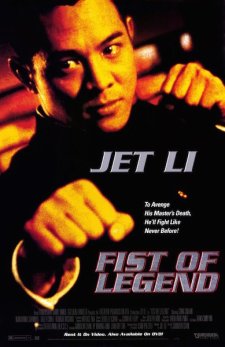
Fist of LegendI found myself watching Fist of Legend unintentionally following this year’s Children in Need appeal. The significance of this piece of trivia is that I watched it on TV, which means I had to watch it dubbed. Apparently, “it is regarded as one of the best martial arts films of all time, and almost universally viewed as Jet Li’s best” (thank you Wikipedia), but the dub does its utmost to obscure this.

Putting the audio aside (for the moment), the film has a lot to recommend it — primarily, the fights. At 2am, after seven hours of near-solid TV watching, it was these that drew me in. I’m no expert on martial arts, but I do like a good fight (on film) and Fist of Legend serves up plenty of those. In fact, there’s approximately one every five minutes, an impressively high ratio that consciously — and very pleasingly — fulfills what you want from this kind of film. This quantity doesn’t seem to have damaged quality either: all are generally impressive, but there are some particularly good ideas floating about too, such as a long fight where both participants are blindfolded.

There’s a plot too, which includes a few surprisingly surprising twists and an interesting undercurrent of Japanese/Chinese racial tensions thanks to the setting (1937, during a Japanese occupation of Shanghai). This adds an extra level to what could otherwise be a stock revenge plot.

So, that just leaves the soundtrack. The English audio is at least as bad as you’d imagine, and a reminder — if one were needed — about why dubbing foreign language films is so hated. Whatever the qualities of the film itself, the clichéd dub script and flat voiceover performances, awkwardly delivered to fit the actor’s mouth movements, make the film look cheap and poorly done. On the bright side, the main villain has an amusingly gravelly “I am playing a villain!” voice.

If you can look past the rubbish dub (which I should imagine is even easier on DVD, what with turning it off), Fist of Legend is very enjoyable. However, with the action being the primary source of pleasure, those who don’t like martial arts movies may want to imagine a lower score.

4 out of 5

The Cable Guy (1996)

2008 #79
Ben Stiller | 88 mins | download | 12 / PG-13

The Cable GuyThe best thing I have to say about The Cable Guy is that the opening titles were very well done.

The second-best thing I have to say is that a subplot featuring director Ben Stiller as a faded-child-star twin-killer is very neatly integrated into the film, seeming utterly pointless until it has a near-vital role in the climax. That’s a pleasing piece of writing/editing right there. Unfortunately, the point this seems to be aiming at — that TV rules our life too much, that we’re too addicted to it, etc etc — is not only old hat, but also rendered meaningless in this instance by the lack of impact: TV goes off for the night, and one guy picks up a book. Oh, wow. And to top it off, thanks to an unnecessary final beat, it seems Jim Carrey’s titular character hasn’t actually learnt the lesson we thought he had.

Incidentally, The Cable Guy is a comedy, though at times it seems to wish you’d forget that so it could be a psychological stalker thriller. Perhaps that’s what it had wanted to be — for one thing, there are surprisingly accurate predictions for the future of telecommunications, although their coming true may simply have killed another joke (“play Mortal Kombat with a friend in Vietnam!”) — until someone realised the idea was too silly to be taken completely seriously. How funny you find the end product will depend on whether you like the style of comedy Carrey employed in the early & mid-’90s, and whether you can stomach pointless asides that don’t do anything for the plot (final act freaky nightmare, step forward). There’s little else to engage interest — Matthew Broderick’s pseudo-protagonist is, perhaps, too nice and too eager to please, and the go-nowhere romantic subplot — his main action aside from being Carrey’s straight man — has all the depth and shape of something from a cookie cutter.

More fun than the jokes, actually, is playing Spot The Pre-Fame Comedy Star. Eyes open for young-looking turns from (in ease-of-identification order) Jack Black, Ben Stiller, Owen Wilson, Janeane Garofalo, and Kyle Gass. And Eric Roberts randomly shows his face too, not that that’s relevant to anything.

The Cable Guy is rated 12, or PG-13 in the US, which may also be the last ages you’d enjoy it at.

2 out of 5

In case anyone’s wondering what’s happened to #77 & #78… Despite spending 23 months carefully posting reviews in order (well, the first two months are actually a bit of a muddle), it’s now December and I’m a few behind, so I’ve decided to throw numerical sequence to the wind and just post reviews as & when I get round to completing them. The main reason for this is to help drive things forward so that I can actually end 2008’s posting by December 31st, rather than having it drag on into 2009 and overlap with Year 3. I’m sure no one will really mind. Or care.

Inside-Out (1999)

2008 #66a
Tom & Charles Guard | 7 mins | DVD | 12

This charming little short stars Simon McBurney as a hapless market researcher on a busy London street, failing to get a single passerby to complete his survey — perhaps the film’s greatest achievement is making a market researcher sympathetic. Anyway, he’s quietly observed by a woman, played by Lena Headey (yup, Mrs. Leonidas and the new Sarah Connor [and now Cersei Lannister, of course]), who’s dressing the window of a clothing/department store on the street. She notices his failed attempts, which amuse her; he notices her laughing, and begins to muck around to entertain her.

It’s a simple premise, but one that’s executed with comedic flair and a surprising amount of emotion. The music and lack of dialogue evoke an old-ish French mime comedy, making a nice contrast with the modern-day London setting, but it’s the relationship that silently develops between the two characters that provides the heart around the humour. And the ending, as carefully constructed as any moment of humour in the short, is painfully heartbreaking.

However many times you might want to re-watch this — and I think you would want to — you’ll always wish for the same outcome, and always be let down. It’s a sweet kind of pain and longing that, in spite of that French style, is very British.

4 out of 5

This short is available on the Cinema16: British Short Films DVD, and online free at Total Short Films or YouTube.

Hamlet (1996)

2008 #50
Kenneth Branagh | 232 mins | DVD | PG / PG-13

Hamlet (1996)Following his success with Henry V and Much Ado About Nothing, Kenneth Branagh tackled arguably Shakespeare’s most revered play, Hamlet. And he didn’t do it by half. It’s the first ever full-text screen adaptation, which means it clocks in just shy of four hours; he unusually shot it on 70mm film, which means it looks gorgeous; and, while he grabbed the title role himself, he assembled around him a ludicrously star-packed cast from both sides of the pond — in alphabetical order, there’s Richard Attenborough, Brian Blessed, Richard Briers, Julie Christie, Billy Crystal, Judi Dench, Gerard Depardieu, Nicholas Farrell, John Gielgud, Rosemary Harris, Charlton Heston, Derek Jacobi, Jack Lemmon, John Mills, Jimi Mistry, Rufus Sewell, Timothy Spall, Don Warrington, Robin Williams and Kate Winslet — not to mention several other recognisable faces. Even Ken Dodd’s in there!

But, with impressive statistics and name-dropping put to one side, what of the film itself? Well, it’s a bit of a slog, especially for someone unfamiliar with the text. While there is much to keep the viewer engaged, the high level of attention required can make it a little wearing; certainly, I took the intermission as a chance to split the film over two nights. Amusingly, the second half uses the original text to provide a sort of “Previously on Hamlet“, which was very useful 24 hours later. None of this is the fault of Branagh or his cast, who do their utmost to make the text legible for newbies — for example, there are cutaways to events that are described but not shown by Shakespeare, which, among other things, help establish who Fortinbras is (Rufus Sewell, as it turns out) before he finally turns up later on.

That said, some of the performances are a bit mixed. Branagh is a good director and not a bad actor, but his Shakespearean performances are variations on a theme rather than fully delineated characters. While there a new facets on display here thanks to the complexity of the character, there are also many elements that are eerily reminiscent of his Henry V and Benedick. The Americans among the cast seem to be on best behaviour and generally cope surprisingly well, while Julie Christie achieves an above average amount of fully legible dialogue. Perhaps the biggest casting surprise is Judi Dench, appearing in what is barely a cameo — one wonders if the film-career-boosting effects of a certain spy franchise would have changed that.

The best thing about this version, however, is how it looks. Much credit to cinematographer Alex Thomson for using the larger 70mm format to its full, loading every frame with vibrant colours and packing detail into even the quietest moments. Not every frame is a work of art — there is, after all, a story to be told — but there’s more than enough eye candy to go round. Also, a nod to the editing (the work of Neil Farrell), which makes good use of long takes — many of them full of camera moves — but also sharply edited sequences, such as the all-important play. The fast cuts make for a joyously tense scene in a way only cinema can provide, which I suppose is rather ironic during a ‘play within a play’.

For fans of Shakespeare, I suspect Branagh’s Hamlet is a wonderful experience, finally bringing the complete text to the screen and executing it all so well. For us mere mortals, it’s a beautifully shot and engagingly performed film, that I’m sure would benefit from a greater understanding of the text.

4 out of 5

Hard Boiled (1992)

aka Lat sau san taam

2008 #43
John Woo | 122 mins | DVD | 18 / R

Hard BoiledThe first John Woo film I saw was Mission: Impossible II. I think. It may’ve been Face/Off, which I love, but this works better with M:I-2 because most people don’t like it. Personally, I like M:I-2. It’s not the greatest action thriller ever, but it has its moments and the plot isn’t half as complex as some like to claim. It’s certainly more fun than Brian de Palma’s Euro-thriller first film, which in retrospect looks a bit like a proto-Bourne. Of course, what M:I-2 really had going for it were its action sequences, which are occasionally a bit out there but always expertly done. Face/Off’s are even better again. Anyone with a basic understanding of structure can’t fail to see what I’m going to say about Hard Boiled.

I don’t think realism is Woo’s strong point — at least, not in his straight-up action movies. That’s not a flaw, though, but a deliberate choice — he dispenses with the realism of what a gunfight would be like (presumably, bloody scary and with fewer shots fired) and pushes the male fantasy of mindless slaughter to the limit. Which means his action sequences are pure adrenaline-pumping fun. Chow Yun-Fat single handedly slaughtering a warehouse full of heavily armed gangsters? Well, of course! Or directly hitting a small object wedged in an electrical pipe with a shaky shooting arm? Naturally! The action may have all the realism of a Dali painting, but it also has all the gleeful fun of repeating everything your sibling said when you were five — except with more choreography. It’s a cliché, but there’s something about Woo’s action that makes you want to use the word “balletic”. Not that I’ve ever really watched ballet. I expect it involves fewer guns.

These sequences seem to have been designed with one thing in mind — cool. And they are. There are a few holes in the plot and characters’ logic, but that doesn’t matter when they can leap around firing two pistols at once and always hit their target, while the bad guys — who could shoot just fine when they slaughtered some innocents a few minutes ago — keep missing them… with machine guns. If you think about it too hard then of course it’s nonsensical, but somehow, in some way, this sort of action seems to appeal to most men (not all, of course, and if you enjoy it then don’t worry, it doesn’t mean you’re a bloodthirsty braindead weirdo). One particularly astounding sequence is achieved in a single long take, as Yun-Fat and Tony Leung make their way down several corridors killing Very Bad Men literally left, right and centre. It’s both exciting and technically impressive, considering how many squibs, blood packs, weapons and extras must have been involved to pull it off in one uncut shot.

If you don’t care for people shooting at each other, especially when it pushes believability beyond the limit, then there’s not really anything for you here. There’s some male bonding stuff, and other bits about duty and honour and sacrifice, and a climactic subplot involving lots of cwute lickle baby-wabies; but Hard Boiled is most at home when the bullets are flying and things are blowing up. And what a lovely home it is.

4 out of 5