Amistad (1997)

2016 #16
Steven Spielberg | 155 mins | streaming (HD) | 16:9 | USA / English, Mende & Spanish | 15 / R
Feeling in need of more intellectual fare after helming The Lost World, Spielberg turned to a project already in development at Dreamworks: an adaptation of a non-fiction book about the 1839 mutiny on the slave ship La Amistad, and the ensuing legal battle. Although not poorly received by critics, there’s a sense that the consensus view dubbed it “black Schindler’s List”, the implication being that by aping the earlier film it was inevitably inferior. I don’t think that’s a watertight chain of logic, but, nonetheless, Amistad is clearly a ‘minor Spielberg’.

Despite being “a slavery drama”, most of the film functions as a legal drama: though it begins with the slave uprising, and later has an extended flashback showing their kidnap and transportation, the thrust of the film lies in the courtroom arguments about who owns the ship’s ‘cargo’ and consequently what should be done with them. This is a period when capturing Africans into slavery, and by extension their subsequent transportation, was illegal by international agreement, but actually owning slaves was not yet banned (at least in the US). It’s before the American Civil War too, so there’s a political dimension: if these ‘slaves’ are freed, what tension might that spark between the north and south?

Though Spielberg is certainly not immune to the Africans’ plight — the depiction of life on a slave ship is appropriately harrowing — it’s clear from early on which side he expects us to identify with, in terms of cultural background if not shared morality: as survivors of the mutiny talk the next day, the slavers’ Spanish dialogue is subtitled but the slaves’ African dialect is not. It’s a simple but effective technique to align us with one side — as I say, not morally (in no regard is Spielberg trying to apologise for the slavers), but socially. Unfortunately, it’s not sustainable: later, when we need to understand the Africans to follow a scene’s point, their dialogue is suddenly subtitled, and from then it’s sporadically translated as needed. I can see why that choice was made, but it makes the unsubtitled bits feel like a cheat.

In most other regards, it’s kind of an old-fashioned movie. In a few ways that works: it’s got classical cinematography, both the use of film (obviously, this being well before mainstream adoption of digital) and the framing, the pace, the editing. In other respects… well, it feels very late ’90s now, the overall style of the screenplay and the treatment of the story reminding you that it’s not actually a moderately-recent film (which I guess I’d personally filed it away as, being the most recent of Spielberg’s pre-2010s films that I’d not seen), but is now nearly 20 years old. And, though I may be damned for criticising him twice in as many weeks, John Williams’ score is a little heavy-handed.
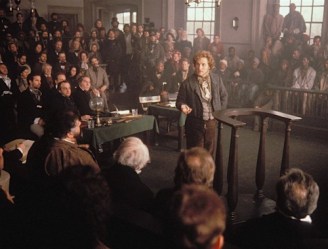
This can be said of Spielberg’s approach to the drama, too. Some of the courtroom stuff is suitably mired in legal technicalities and argument, but by film’s end it gets a little bit too… what’s the word? Not “preachy”. Not “sentimental”, exactly, though it’s born of that old criticism of Spielberg. “Melodramatic” may be on the money, though. It doesn’t help that everything reaches a climax — not only narratively, but also in the way it’s written, shot, acted, and scored — only for it to be revealed that it’s just the end of act two. Okay, that’s the truth of what happened (or near enough, for the purposes of this dramatisation), and by adapting it in that way it emulates the emotions the characters experienced; but from the audience’s perspective, you feel like you’ve reached the end… only to be served up another half-hour of movie. And it’s a long film too, so you feel that. It gets by because it’s fundamentally a good film, with strong performances and technical merits, but it’s a little bumpy for a bit.

There also seem to be a startling array of factual inaccuracies to level at the film. As ever with fictional adaptations of real life, it’s a difficult line. No fact-based fiction is 100% like reality, especially when you factor in unavoidable variances in people’s memories and opinions. However, the more serious or famous the events being depicted, or the more they’re being used to indicate some wider point about their setting, the greater the responsibility to present something that is at least passably accurate. I think some would contend that Amistad is not that. I’m no expert, but this section on Wikipedia, which is bolstered by multiple citations to suggest its accuracy, indicates the extent of the issue.
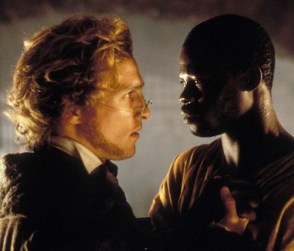
It’s easy to criticise Amistad, because Spielberg makes the production of very good movies look effortless, so the missteps stand out all the more. The story of La Amistad and its ‘cargo’ is a powerful one, and Spielberg has — naturally — turned it into a good film; but by remixing history to over-egg the message, it loses a little something. A valiant effort, but a film like 12 Years a Slave makes many of the same points in a less grandiose manner.

4 out of 5

Blade (1998)

100 Films’ 100 Favourites #12

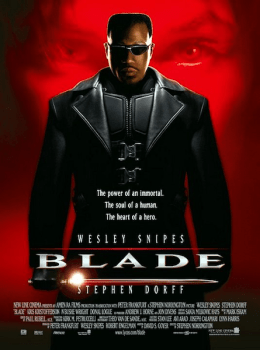
The power of an immortal.
The soul of a human.
The heart of a hero.

Country: USA
Language: English
Runtime: 120 minutes
BBFC: 18
MPAA: R

Original Release: 21st August 1998 (USA)
UK Release: 13th November 1998
First Seen: TV, c.2001

Stars
Wesley Snipes (White Men Can’t Jump, Demolition Man)
Stephen Dorff (Backbeat, Immortals)
Kris Kristofferson (Pat Garrett & Billy the Kid, Heaven’s Gate)
N’Bushe Wright (Zebrahead, Dead Presidents)

Director
Stephen Norrington (Death Machine, The League of Extraordinary Gentlemen)

Screenwriter
David S. Goyer (Dark City, Batman Begins)

Based on
Blade, a Marvel comic book character created by Marv Wolfman & Gene Colan.

The Story
When hospital haematologist Dr. Karen Jenson is bitten by a living corpse — actually a vampire — she encounters Blade, leather-clad badass vampire hunter. He mercifully takes her to his lair, where she hopes to create a cure for her impending vampirism. Meanwhile, mid-ranking vampire Deacon Frost aims to take over the world, for which he needs Blade’s unique blood…

Our Hero
The Daywalker — half-human half-vampire Blade, who can go out in sunlight (hence the nickname) and controls his bloodlust with injections. Passes his time helpfully killing vampires.

Our Villain
Being born human, turned vampire, and consequently looked down on by the purebred elders, probably gave Deacon Frost a chip on his shoulder, which may be why he believes vampires should enslave humanity. Which, despite his betters’ disapproval, he sets about doing.

Best Supporting Character
Blade’s mentor and Q-like gadgetmaster, Whistler. According to Wikipedia he was created for the film, but made his debut two years earlier in the Spider-Man animated series (voiced by Malcolm McDowell, no less). 20 years hence, apparently he still hasn’t appeared in any comics, which is very unlike Marvel.

Memorable Quote
Blade: “There are worse things out tonight than vampires.”
Karen: “Like what?”
Blade: “Like me.”

Memorable Scene
The opening action sequence sets the tone: a vampire nightclub, where the music pounds and blood pours from sprinklers, as the Daywalker slaughters everyone inside in a display of gleeful ultra-violence. Hard R indeed.

Letting the Side Down
Computer-generated liquid is still hard to do, so in 1998 it must’ve been a nightmare. Some CGI blood plays a key role in the climax — it looked terrible then, and I bet it looks worse now.

Next time…
Two direct sequels, the first directed by Guillermo del Toro, the second designed to launch a spin-off (it failed). A semi-related live-action TV series lasted one season in 2006, and an unconnected animated series was part of the Marvel Anime project in 2011. The rights have since reverted to Marvel, so there’s talk (largely from fans) of Blade joining their Cinematic Universe, with or without Snipes and possibly on the Netflix side of things.

Awards
2 Saturn nominations (Horror Film, Make-Up)
1 MTV Movie Award (Best Villain, tied with… There’s Something About Mary.)
1 MTV Movie Awards nomination (Best Fight, for “the fight against vampires”. Oh, that one!)

What the Critics Said
“Sure, the story is pretty standard, and the dialogue is laughable or worse. But creative cinematography and non-stop, decently choreographed gratuitous violence make watching this comic-book movie — Blade is a minor, almost-forgotten Marvel comic — entertaining. In fact, it’s arguably the best comic-book movie of the year” — John Krewson, A.V. Club

Score: 54%

What the Public Say
“Stephen Norrington’s direction is superb here, and he handles most of the action scenes very well, mixing some beautiful establishing shot with tighter, jumpier shots during the film’s immersive fight scenes. Fight scenes are well-choreographed and never feel like they are going on for too long, and thanks to the superb stunt work, feel thoroughly brutal.” — thatfilmbloguk

Verdict

Before comic book movies were the all-conquering box office behemoth they are today, Blade was a Marvel Comics adaptation in technicality only. A violent, dark, appropriately bloody (’cause, y’know, vampires) horror-tinged late-’90s actioner, Blade isn’t big or clever, but it has style and a glorious commitment to its extremeness. Some say the Guillermo del Toro-directed sequel is even better, but for me that came a little too far into the era of CGI dominance and comic book movie popularity — the original has a kind of analogue purity that can’t be beat.

#13 will have… moments lost in time, like tears in rain.

Funny Games (1997)

2016 #4
Michael Haneke | 104 mins | TV | 16:9 | Austria / German | 18

Arthouse favourite Michael Haneke criticises audience’s enjoyment of screen violence. It certainly achieves its aim of being a grim, brutal depiction of violence in real-life, creating a situation that feels inescapable not only for the characters but the audience too. Some cinematic trickery is also deployed to striking, if divisive, effect.
However, it’s more shocking that, as recently as the mid-’90s, Austria doesn’t seem to have a universal emergency services phone number.

The entire message is, “real-life violence is bad and you shouldn’t enjoy it in fiction, okay?” You don’t need to sit through a tough hour-and-a-half to know that.

3 out of 5

Beauty and the Beast (1991)

100 Films’ 100 Favourites #10

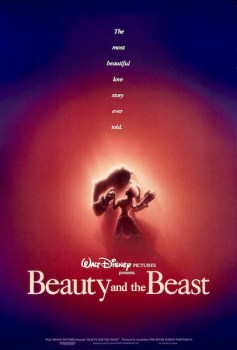
The most beautiful love story ever told.

Country: USA
Language: English
Runtime: 84 minutes | 92 minutes (special edition)
BBFC: U
MPAA: G

Original Release: 15th November 1991 (USA)
UK Release: 9th October 1992
First Seen: VHS, c.1993

Stars
Paige O’Hara (Beauty and the Beast: The Enchanted Christmas, Enchanted)
Robby Benson (Ice Castles, Dragonheart: A New Beginning)
Angela Lansbury (The Manchurian Candidate, Bedknobs and Broomsticks)

Directors
Gary Trousdale (The Hunchback of Notre Dame, Atlantis: The Lost Empire)
Kirk Wise (The Hunchback of Notre Dame, Atlantis: The Lost Empire)

Screenwriter
Linda Woolverton (Alice in Wonderland, Maleficent)

Story by
Deep breath… Roger Allers, Brenda Chapman, Burny Mattinson, Brian Pimental, Joe Ranft, Kelly Asbury, Christopher Sanders, Kevin Harkey, Bruce Woodside & Robert Lence.

Based on
La Belle et la Bête, a French fairy tale originally by Gabrielle-Suzanne Barbot de Villeneuve, but in this case (and most others) adapted from the retelling by Jeanne-Marie Leprince de Beaumont.

Music
Alan Menken (Aladdin, Hercules)

Lyrics
Howard Ashman (Little Shop of Horrors, Aladdin)

The Story
An arrogant prince is transformed into a beast, with one hope of redemption: someone must fall in love with him before his 21st birthday; if not, the curse’s effects become permanent. When elderly inventor Maurice is imprisoned by this Beast, his bookworm daughter Belle offers to take his place. Spying a chance to alleviate the curse, the Beast agrees. With only a short time until his 21st birthday, could a girl ever learn to love a beast?

Our Hero
A girl who’s strange but special — a most peculiar mademoiselle. With a dreamy far-off look, and her nose stuck in a book, she really is a funny girl, a beauty but a funny girl, that Belle.

Our Villain?
The Beast’s got fangs, razor sharp ones; massive paws, killer claws, for the feast. He was mean and he was coarse and unrefined, but now he’s dear and so unsure. Perhaps there’s something there that wasn’t there before…

Our Villain!
No one’s slick as Gaston, no one’s quick as Gaston, no one’s got a swell cleft in his chin like Gaston. Uses antlers in all of his decorating, my what a guy, that Gaston.

Best Supporting Character
The comedy double act of French candlestick Lumiere and English clock Cogsworth, voiced (respectively) by Law & Order’s Jerry Orbach and M*A*S*H’s David Ogden Stiers. Funny old business, acting.

Memorable Quote
“Try the grey stuff, it’s delicious / Don’t believe me? Ask the dishes / They can sing, they can dance / After all, miss, this is France / And a dinner here is never second best.” — Be Our Guest

Quote Most Likely To Be Used in Everyday Conversation
“It’s not right for a woman to read. Soon she starts getting ideas, and thinking…” — Gaston. (I didn’t say it should be used.)

Memorable Scene
The film’s prologue tells the story of how the Prince became the Beast through the medium of stained glass windows. It’s a beautifully realised fairy tale within a fairy tale.

Best Song
Titular Beauty and the Beast may’ve won the Oscar (“Tale as old as time, song as old as rhyme” — that one), but the actual best song is clearly Be Our Guest. A toe-tapping tune married with fun lyrics, fantastic choreography and superb animation combine to make it, for me, one of the greatest numbers in any musical, animated or otherwise.

Making of
Be Our Guest was originally to be sung to Belle’s father, Maurice, when he’s trapped in the castle. It was writer Bruce Woodside who pointed out that it was in the wrong place because such a key song shouldn’t be performed to a secondary character, so it was moved later to be sung to Belle. This is why you should always listen to writers.

Previously on…
Beauty and the Beast is Disney’s 30th Animated Classic, their official canon of animated movies. It’s the third film in the “Disney Renaissance”, the decade-long period (starting with The Little Mermaid and ending with Tarzan) when the studio enjoyed revived creative and financial success. In terms of this particular retelling of the tale, it owes a clear debt to Jean Cocteau’s La Belle et la Bête.

Next time…
Two direct-to-video animated sequels and a spin-off educational live-action TV series. In 1994, it was the first Disney animated film to become a Broadway musical. In 2002, it was extended with a new song, and in 2012 was re-released in 3D. An all-star live-action remake is out next year.

Awards
2 Oscars (Original Song (Beauty and the Beast), Original Score)
4 Oscar nominations (Picture, Sound, Original Song (both Belle and Be Our Guest))
2 BAFTA nominations (Original Score, Special Effects)
2 Saturn nominations (Fantasy Film, Music)
2 Annie Awards (Animated Feature, Individual Achievement in the Field of Animation)
Nominated for the Hugo for Best Dramatic Presentation.

What the Critics Said
“A lovely film that ranks with the best of Disney’s animated classics, Beauty and the Beast is a tale freshly retold. Darker-hued than the usual animated feature, with a predominant brownish-gray color scheme balanced by Belle’s blue dress and radiant features, Beauty engages the emotions with an unabashed sincerity.” — Variety

Score: 93%

What the Public Say
“The voice cast are perfectly suited to their roles and imbue them with dexterity and flair. Paige O’Hara splendidly combines strength and touching bravery as Belle. Her singing voice is a marvel as well, singing with clarity and loving kindness. Robby Benson’s deep but engaging voice is ideally suited to the Beast, and gives him depth and mournful sorrow that subsides into happiness as he develops feelings for Belle.” — vinnieh

Elsewhere on 100 Films
Back in 2010 I reviewed The Special Edition of Beauty and the Beast (to give its full on-screen title), describing it as “impossible to fault in any significant way. The design and animation are beautiful, the voice acting spot-on, the score exquisite, the story fast-paced and enthralling […] It’s hilariously funny, remarkably exciting, surprisingly scary, relentlessly romantic […] Every [song] bursts with memorable tunes, witty rhymes, genuine emotion — even the Soppy Girly Song is a good one!” Beat that, verdict section…

Verdict

Beauty and the Beast was, famously, the first (and, for a long time, only) animated movie to be nominated for Best Picture at the Oscars, and you could hardly think of a more deserving candidate. Every element of it displays artistry, from the the witty dialogue and lyrics, to the likeable and engaging characters, to the fluid and detailed animation, to the songs which help the film to run the gamut of emotions. In the field of Broadway-style Disney musicals, Beauty and the Beast is animation perfection.

#11 will be… a long nap.

Batman Returns (1992)

100 Films’ 100 Favourites #9

The Bat
The Cat
The Penguin

Country: USA & UK
Language: English
Runtime: 126 minutes
BBFC: 12 (cut, 1992) | 15 (cut, 1992) | 15 (uncut, 2009)
MPAA: PG-13 for “brooding, dark violence”

Original Release: 19th June 1992 (USA)
UK Release: 10th July 1992
First Seen: VHS, c,1993

Stars
Michael Keaton (Beetlejuice, Birdman)
Danny DeVito (Twins, The Rainmaker)
Michelle Pfeiffer (Ladyhawke, Hairspray)
Christopher Walken (The Dead Zone, Seven Psychopaths)

Director
Tim Burton (Edward Scissorhands, Dark Shadows)

Screenwriters
Daniel Waters (Heathers, Demolition Man)

Story by
Daniel Waters (see above)
Sam Hamm (Batman, Monkeybone)

Based on
Batman, a comic book superhero created by Bob Kane and Bill Finger.

The Story
Batman has a lot on his hands when abandoned Oswald Cobblepot, aka the Penguin, emerges from the shadows seeking acceptance by running for mayor, backed by corrupt businessman Max Shreck. Meanwhile, a newly-created Catwoman has an axe to grind with Shreck, and won’t let Batman stand in her way…

Our Hero
Nana-nana-nana-nana nana-nana-nana-nana Batman! But, y’know, with a kind of ’30s Gothic edge.

Our Villains
A triumvirate of terror! Danny DeVito is the Penguin, deformed, abandoned as a child, and out for revenge against the city. Michelle Pfeiffer is Catwoman, PVC-clad, kinky, and also out for revenge. Christopher Walken is Max Shreck, a morally corrupt businessman with political needs, who clashes with Bruce Wayne as much as Batman.

Best Supporting Character
The one significant constant through the four ’80s/’90s Bat-movies, Michael Gough is a near-peerless Alfred.

Memorable Quote
Batman: “Mistletoe can be deadly if you eat it.”
Catwoman: “But a kiss can be even deadlier if you mean it.”

Memorable Scene
Batman and the Penguin are having an argument. Suddenly, a figure comes backflipping towards them — Catwoman. They stare. “Meow.” The building behind her explodes. It’s not actually her first appearance, but it’s quite an introduction.

Technical Wizardry
The whole design of the film, and Gotham City in particular, is fantastic; a kind of ’30s-but-also-modern art deco style. It’s all quite Burtonesque too, though not too much so for my taste.

Truly Special Effect
The Penguin’s army of penguins, an effective mix of real birds, animatronics, and actors in suits.

Making of
The first draft of the screenplay was intended to be more of a direct sequel to Batman: subplots included gift shops selling fragments of the destroyed Bat-Wing, revelations about the past of the Joker, and Bruce Wayne proposing to Vicki Vale by the end of the film. However, Tim Burton was uncomfortable with making a direct sequel, so the script was rewritten. Ah, the days when people wanted sequels to be less connected…

Previously on…
Tim Burton’s first Batman film brought the dark ‘n’ gritty ’70s/’80s evolution of the character from the comic books to the big screen for the first time. It was a huge success, though I think it feels notably more dated today than Returns does.

Next time…
Two semi-direct sequels — though with Burton and Keaton both abandoning the series, they took a distinct downward turn in quality. The 2005 reboot has so far led to three more Bat-movies, and now another new series dawns starring Ben Affleck.

Awards
2 Oscar nominations (Visual Effects, Makeup)
2 BAFTA nominations (Special Effects, Make Up Artist)
1 Saturn Award (Make-Up)
4 Saturn nominations (Fantasy Film, Supporting Actor (Danny DeVito), Director, Costumes)
1 Razzie nomination (Worst Supporting Actor (Danny DeVito))
3 MTV Movie Awards nominations (including Most Desirable Female (Michelle Pfeiffer))
Nominated for the Hugo for Best Dramatic Presentation.

What the Critics Said
“Burton couldn’t play it safe if he wanted to, and he doesn’t want to. Entrusted with one of the most valuable franchises in movie history, he’s made a moody, grotesque, perversely funny $50 million art film. […] Something about the filmmaker’s eccentric, surreal, childlike images seems to strike a deep chord in the mass psyche: he makes nightmares that taste like candy.” — David Ansen, Newsweek

Score: 80%

What the Public Say
“unmissable in Batman Returns, Burton tends to employ the film noir style in his movies. […] a visual sensation from start to finish, nearly all to the credit of Tim Burton, and all of the other elements of the film noir style come together quite brilliantly to reintroduce Batman, as flawed antihero, back into popular culture.” — Kate Bellmore, Reel Club

Elsewhere on 100 Films
Just before the release of The Dark Knight Rises I went back over all the live-action Bat-films of the ‘modern era’. Of Returns, I wrote that “Tim Burton’s first Batman film is great, no doubt, but Returns is a much better film in so many ways. The direction, writing, acting, action and effects are all slicker. They spent over twice as much money on it and it really shows.”

Verdict

Controversial on release — and since — but for me, Batman Returns holds up best out of the four ’80s/’90s Batman movies. Tim Burton brings his own stamp to the Bat-universe, crafting a darkly Gothic fantasy world that’s both striking and effective, populated by grotesques (in different senses) like the Penguin, Catwoman, Shreck, and perhaps even Batman himself. There’s chemistry between the entire cast, memorable scenes and set pieces, and the sense of an entire artistic vision that the Bat-series wouldn’t have again for over a decade.

#10 will be… a tale as old as time.

Back to the Future Part III (1990)

100 Films’ 100 Favourites #7

They’ve saved the best trip for last…
But this time they may
have gone too far.

Country: USA
Language: English
Runtime: 118 minutes
BBFC: PG
MPAA: PG

Original Release: 25th May 1990 (USA)
UK Release: 11th July 1990
First Seen: VHS, c.1991

Stars
Michael J. Fox (Homeward Bound: The Incredible Journey, The American President)
Christopher Lloyd (Who Framed Roger Rabbit, Things to Do in Denver When You’re Dead)
Mary Steenburgen (Parenthood, Step Brothers)
Thomas F. Wilson (Back to the Future, Born to Be Wild)
Lea Thompson (SpaceCamp, Some Kind of Wonderful)

Director
Robert Zemeckis (Death Becomes Her, The Polar Express)

Screenwriter
Bob Gale (Used Cars, Back to the Future)

The Story
With Doc stuck in 1885, Marty McFly must travel back to save him before he’s killed by Biff Tannen’s ancestor, Buford “Mad Dog” Tannen. With the DeLorean damaged during his arrival in the past, they also have to come up with a plan to get back to their correct time…

Our Heroes
Marty McFly finally grows as a human being as he learns some stuff this time, while Michael J. Fox also gets to ham it up a little as his Irish ancestor, Seamus. Christopher Lloyd, meanwhile, is still the one and only Doc.

Our Villain
It’s Thomas F. Wilson again, this time as Biff’s trigger-happy Wild West ancestor, Buford ‘Mad Dog’ Tannen. Who also gets covered in excrement.

Best Supporting Character
Mary Steenburgen is one of the few wholly original characters in either sequel, the love of Doc’s life, Clara Clayton. She’s also a confident, competent, and capable female character — a character type that’s only now ceasing to be a rarity in effects-y blockbusters, 25 years after this was made.

Memorable Quote
“Your future hasn’t been written yet. No one’s has. Your future is whatever you make it. So make it a good one, both of you.” — Doc

Memorable Scene
Marty and Doc hijack a train in the hope of using it to get the DeLorean up to the required 88mph. As the looted locomotive heads towards a mighty fall off an unfinished bridge, it turns out Clara is on board too. Tension! Action! Excitement! What more do you want from a climax?

Truly Special Effect
With the DeLorean destroyed, the film ends with a reveal of Doc’s new time machine, and it’s awesome.

Making of
There are tonnes of lines, jokes, characters, locations, and even background details referenced back and forth across the whole trilogy, but only one actual scene appears in all three: the moment Marty travels from 1955 to 1985. It’s the climax to the first film, then appears at the end of Part II, and consequently is in the ‘recap’ at the start of Part III.

Previously on…
Part III indeed: this picks up exactly where the second film left off, and they were shot back-to-back. It’s fundamentally standalone other than that, mind.

Next time…
As mentioned on the first film, Back to the Future has continued in an animated series, theme park ride, video game, and a comic book that started last year. Plus Doc Brown turned up in A Million Ways to Die in the West, so… there’s that…

Awards
2 Saturn Awards (Supporting Actor (Thomas F. Wilson), Music)
4 Saturn nominations (Science Fiction Film, Director, Supporting Actress (Mary Steenburgen), Costumes)
Nominated for the Hugo for Best Dramatic Presentation.

What the Critics Said
Back To The Future Part II teed off a lot of critics by not being a remake of the first film, and for daring to be a) complicated, b) very fast and c) heartless. Part III, which is slightly less fleet of foot, restores heart interest of the first film and has a satisfying complete storyline.” — Kim Newman, Empire

Score: 74%

What the Public Say
“One of the clearest indications of an excellent series is an ending is so satisfying you can’t even be mad the adventure is over. Part III delivers a happy ending so well-rounded […] there is no yearning for more story. I remember feeling quite content after seeing that movie for the first time; actually more like thrilled that the trilogy ended on such a great note.” — Avril Brown, Comics Waiting Room

Verdict

The consensus used to be that Part III was unquestionably the weakest part of the trilogy, a slightly bizarre Old West-set addendum to the first two. These days, I feel like an increasing number of people say it’s definitely better than Part II. Personally, I’ve always had a particular fondness for it. I’m not entirely sure why. Much like the second film, it can’t attain the perfection of the first movie, but it can be the next best thing — a fun and funny adventure with these great characters. And even as I say “they’re not as good as the first one”, I don’t wholly believe it: to me, Back to the Future never has and never will be just one film, or one film and its two sequels — it’s a trilogy; a three-parter. (So there.)

#8 will be… an alliterative origin.

Aladdin and the King of Thieves (1996)

2015 #196
Tad Stones | 82 mins | streaming (HD) | 16:9* | USA / English | U

For most of the ’90s and ’00s, Disney churned out direct-to-video sequels to many of their most beloved animated classics. They have a reputation for being unremittingly awful, hence why Pixar’s John Lasseter put a stop to their production after he became Disney’s Chief Creative Officer in 2006. Despite that reputation, however, there are those who say one or two are actually quite good. One of those (and the only one I’ve previously seen) is The Lion King 1½ (released as The Lion King 3 in the UK), which is a sort of a Rosencrantz and Guildenstern Are Dead to the original film’s Hamlet, re-telling the story from the perspective of Timon and Pumbaa. I saw it years ago but would vouch for its relative quality — when I first re-watched The Lion King after, I briefly thought some scenes were missing, which I guess is testament to how well it fits.

Another such-praised sequel is this follow-up to Disney’s 1992 Animated Classic. It’s actually the second sequel (the first was also the first of those Disney DTV sequels) and also follows an 86-episode TV series. Fortunately, the makers dropped an early idea to use one of the series’ main villains as the film’s antagonist, and so it functions perfectly as a direct sequel to the original movie. Which is nice, because that first sequel isn’t meant to be very good and I imagine the TV series is hard to come by nowadays. Plus, neither of those can claim an ever-so-important distinction that this can: it features the return of Robin Williams as the Genie.

The film begins on the wedding day of Aladdin (Scott Weinger) and Jasmine (Linda Larkin), which is interrupted by the mysterious Cassim, the King of Thieves (John Rhys-Davies), and his gang of forty thieves seeking to steal an oracle from among the wedding gifts. Although they fail, the oracle informs Aladdin that the answers he seeks about his long-departed father are to be found with the forty thieves… I expect you can guess where that’s going. Fortunately the film gets there pretty quickly, then transitions into a story about the possible redemption (or not) of Cassim alongside the quest for the Hand of Midas, capable of turning whatever it touches into gold (natch).
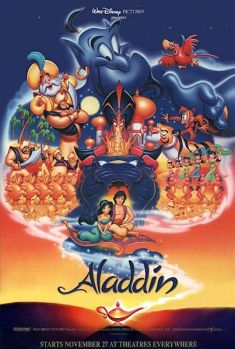
The King of Thieves has a few things in its favour. It’ll come as no surprise that the biggest and best is Williams reprising his iconic performance, and consequently being responsible for most of the film’s humour. There are a couple of fun nods to some of Williams’ other best-remembered roles, and plenty to other Disney films too. The rest of the film offers a fast-paced, action-packed narrative, with a few musical numbers to boot. The songs are certainly not as memorable as those found in proper Disney movies, but most are decent while they last. Jasmine gets somewhat short shrift, but this is really a story about father and son.

Those who dislike Disney’s Aladdin won’t find anything to enjoy here, but for fans of the original, Aladdin and the King of Thieves is a solid, fun follow-up.

4 out of 5

* The film was made for release on VHS, so it’s no surprise that the OAR is 1.33:1. The HD version is cropped for 16:9. It’s mostly alright, though anyone with an eye for composition will find it obvious at times. ^

What Dreams May Come (1998)

2015 #129
Vincent Ward | 114 mins | streaming (HD) | 2.35:1 | USA & New Zealand / English | 15 / PG-13

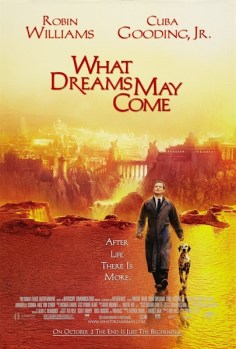
When What Dreams May Come first came out, the reviews seemed to conclude that it was rubbish, but at least visually splendid. Back in 1998, that put me off — “it’s not meant to be very good” was the takeaway thought there. As the years have gone on, for some reason those reviews (or possibly just one I extrapolated into a consensus, who knows?) stuck with me; and as my temperament as a film fan grew, that it was visually extraordinary (even if nothing else) began to seem reason enough to watch it. It lingered in the back of my mind, never quite becoming a “must see”, especially as the opportunity rarely (if ever) presented itself. So that’s more or less how I come to it now, 17 years since its release and those reviews — a long-awaited scratch of a long-lingering itch. (Perhaps this gives some insight into why/how it takes me so long to get round to watching recommendations/things I’m quite keen to see/etc.)
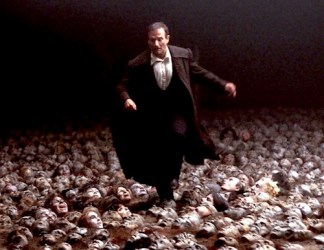
Adapted from a novel by Richard “I Am Legend” Matheson, the story concerns Dr Chris Nielsen (Robin Williams) and his wife Annie (Annabella Sciorra). Their perfectly lovely life is shattered when their two kids are killed in a car crash. Despite Annie suffering a mental breakdown, they hang in there… until Chris is killed in another car crash a few years later. He ascends to a kind of Heaven, a wondrous place controlled by his imagination — this is where those visuals come in. However, Chris learns that Annie has committed suicide, and so been condemned to Hell. He vows to do what has never been done, and travel to Hell to rescue her.

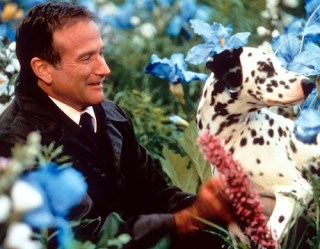
Hell, incidentally, also looks incredible, as do the various locales visited by Chris and his companions (played by Cuba Gooding Jr and Max von Sydow) on their way there. Director Vincent Ward and his team have created a rich, engrossing visual space here. It’s not just the Oscar-winning visual effects either, which create Chris’ initial realisation of Heaven as a kind of living painting, but also the locations, their decorations, and some fantastic sets. The design work is brilliant, and the vast majority of it still holds up today. Even the CGI doesn’t look glaringly like 17-year-old graphics, and in many cases what I presume is a mix of live action, models and some CGI is far more effective than the all-CG look it would likely have if made today.
However, the story is… problematic. Its logic comes and goes (the afterlife’s rules have to be obeyed or are able to be broken depending on the situation, for instance), it goes on too long, with too many asides, and there are needless twists, reveals, and reversals that are neither surprising (thanks to their ultimate predictability) nor illuminating (thanks to their unnecessariness). There were too many flashbacks and asides to real life, and I’d have liked it more if it stuck to the afterlife stuff — cut the flashbacks, limit the story to the afterlife quest, and stop mirroring it in the couple’s earlier real-life troubles. That would make the movie shorter, more streamlined, less wishy-washily sentimental, more focused, and therefore better.

Nonetheless, some will identify with the sentimental “love transcends death”-type message more than others, and there’s a chance those who like (or don’t mind) their films to be at the soppier end of the spectrum will genuinely love it. For the rest of us — for anyone who likes visual splendour in their movies, anyway — it does indeed merit a look for the imagery alone.
3 out of 5

Aladdin (1992)

100 Films’ 100 Favourites #1

Imagine if you had three wishes,
three hopes, three dreams
and they all could come true.

Country: USA
Language: English
Runtime: 90 minutes
BBFC: U
MPAA: G

Original Release: 25th November 1992 (USA)
UK Release: 18th November 1993
First Seen: VHS, c.1993

Stars
Scott Weinger (Aladdin and the King of Thieves, Shredder)
Robin Williams (Good Will Hunting, Insomnia)
Linda Larkin (The Return of Jafar, Joshua)
Jonathan Freeman (The Return of Jafar, The Ice Storm)

Directors
Ron Clements (Basil the Great Mouse Detective, Hercules)
John Musker (The Little Mermaid, The Princess and the Frog)

Screenwriters
Ron Clements (The Little Mermaid, The Princess and the Frog)
John Musker (Basil the Great Mouse Detective, Hercules)
Ted Elliott (The Mask of Zorro, Pirates of the Caribbean: The Curse of the Black Pearl)
Terry Rossio (Shrek, Pirates of the Caribbean: At World’s End)

Story by
Deep breath… Burny Mattinson and Roger Allers, Daan Jippes, Kevin Harkey, Sue Nichols, Francis Glebas, Darrell Rooney, Larry Leker, James Fujii, Kirk Hanson, Kevin Lima, Rebecca Rees, David S. Smith, Chris Sanders, Brian Pimental & Patrick A. Ventura.

Based on
The folktale of Aladdin and the magic lamp from One Thousand and One Nights, aka The Arabian Nights.

Music
Alan Menken (Little Shop of Horrors, Tangled)

Lyrics
Howard Ashman (Little Shop of Horrors, Beauty and the Beast)
Tim Rice (The Lion King, Evita)

The Story
Street urchin Aladdin falls for bored Princess Jasmine when she sneaks out of her palace one day, leading him to the clutches of evil vizier Jafar, who needs Aladdin to retrieve a magic lamp as part of his scheme to rule the land. When Aladdin accidentally discovers the lamp’s inhabitant, a wish-granting Genie, he uses his wishes to set about wooing the princess. Jafar, of course, has other ideas…

Our Hero
One jump ahead of the bread line, one swing ahead of the sword, steals only what he can’t afford (that’s everything). Riffraff, street rat, scoundrel. It’s Aladdin, of course.

Our Villain
Grand Vizier Jafar, a plotting underling — the kind of role that has strong precedent in fiction, I’m sure, though Conrad Veidt as villainous Grand Vizier Jaffar in The Thief of Bagdad is rather clearly the direct inspiration.

Best Supporting Character
Oh, I don’t know, maybe… the Genie! Fantastically voiced by a heavily-improvising Robin Williams, praise is also deserved for Eric Goldberg’s character animation, which matches him every step of the way. In fact, it was an animation Goldberg created using one of Williams’ stand-up routines that convinced the comic to take the part.

Memorable Quote
Aladdin: “You’re a prisoner?”
Genie: “It’s all part and parcel, the whole genie gig. Phenomenal cosmic powers! Itty bitty living space.”

Memorable Scene
Trapped in a desert cave, Aladdin accidentally rubs a lamp and unleashes the Genie — and with it, Robin Williams’ all-time-great hilarious performance.

Best Song
For me, it’s Prince Ali, the huge Genie-led number as a disguised Aladdin arrives back in town in grandiose style. The Genie’s big solo number, Friend Like Me, is an incredibly close second. Soppy A Whole New World won all the awards, because of course it did.

Truly Special Effect
Only the second time Disney used CGI with 2D character animation. In Beauty and the Beast, it built a room for the characters to dance in; here, there’s a character (the entrance to the cave) and a whole action sequence (the flying carpet escape from said cave). It earnt the team a BAFTA nomination. There’s no shame in what they lost to: Jurassic Park.

Making of
Robin Williams ad-libbed so much of his role as the Genie — generating almost 16 hours worth of material, in fact — that the film was rejected for a Best Adapted Screenplay Oscar nomination.

Previously on…
Aladdin is Disney’s 31st Animated Classic, their official canon of animated movies. It’s the fourth film in the “Disney Renaissance”, the decade-long period (starting with The Little Mermaid and ending with Tarzan) when they had a run of films that were critically and financially successful (unlike those before and after said period).

Next time…
Two direct-to-video sequels, the second of which is quite good; in between those, a TV series ran for 86 episodes(!); a Broadway adaptation debuted in 2014 (it’s coming to the West End in May); not to mention numerous video games and appearances in other works, almost all still voiced by the less-starry names among the original cast. The go-to new voice for the Genie? Dan “Homer Simpson” Castellaneta.

Awards
2 Oscars (Original Song (A Whole New World), Original Score)
3 Oscar nominations (Sound, Sound Effects Editing, Original Song (Friend Like Me))
2 BAFTA nominations (Score, Special Effects)
1 Annie Award (Animated Feature)
3 Saturn Awards (Fantasy Film, Supporting Actor (Robin Williams), Younger Actor (Scott Weinger))
1 Saturn nomination (Music)
Nominated for the Hugo for Best Dramatic Presentation.

What the Critics Said
“What will children make of a film whose main attraction — the Genie himself — has such obvious parent appeal? They needn’t know precisely what Mr. Williams is evoking to understand how funny he is. […] What will come through clearly to audiences of any age is the breathless euphoria of Mr. Williams’s free associations, in which no subject is off-limits, not even Disney itself.” — Janet Maslin, The New York Times

Score: 94%

What the Public Say
“the perfect Disney film, one that cleverly combines the sensibilities of classic and modern audiences, one that matches toe to toe with many of the studio’s greatest films. You may prefer the emotional heart-ache of The Lion King or the romantic magic from Beauty and the Beast, but I would always prefer the witty and charming Aladdin.” — feedingbrett @ Letterboxd

Verdict

Hailing from slap-bang in the middle of the Disney Renaissance, Aladdin may not be quite as strong as the films either side of it (Beauty and the Beast and The Lion King), but it’s the next best thing. Buoyed by Robin Williams’ top-drawer performance (have I mentioned that yet?), multiple toe-tapping musical numbers, and a dastardly villain who’s among Disney’s best — and is just one of several great supporting characters here, actually — Aladdin is an A-grade animated Arabian adventure.

In #2 no one can hear you scream.

Boyz n the Hood (1991)

2015 #137
John Singleton | 112 mins | streaming (HD) | 16:9 | USA / English | 15 / R

John Singleton became the first African-American Best Director Oscar nominee, as well as the youngest, for this debut. 23 years on, his story of the lives and troubles of young black men in L.A. remains sadly pertinent.

Unfortunately, the film’s style doesn’t: some parts are plainly constructed and others have dated badly, like the horrible score — bland of-its-time TV soap music, when something befitting the characters (like the hippity-hop tunes that surface occasionally) would seem more appropriate.

Nonetheless, the believable characters, effective storytelling, and authentically new voice (even so temporally removed as we are now) mean it remains powerful filmmaking.

5 out of 5

This drabble review is part of the 100 Films Advent Calendar 2015. Read more here.