Heaven Knows, Mr. Allison (1957)

2011 #7
John Huston | 102 mins | TV (HD) | PG
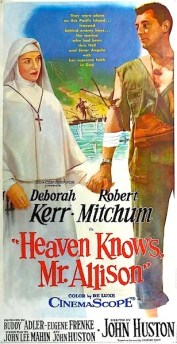
Heaven Knows, Mr AllisonThe title may sound like a ’40s rom-com or a ’70s TV sitcom, but Heaven Knows, Mr. Allison is nothing of the sort. It’s set in the south Pacific in 1944, at the height of World War II, and begins with titular US Marine Allison (Robert Mitchum) washing up on an island that’s occupied only by a novice nun, Sister Angela (Deborah Kerr). He was the only survivor of a Japanese attack on a submarine; she ultimately the only survivor of a Japanese raid on the island. With no hope of rescue they must plot their own escape.

If this were made today, Allison and Angela would surely turn out to be dead and in purgatory; 50 years ago, however, all is as it seems. What we get is almost relentlessly a two-hander. Some Japanese turn up, and (spoilers!) some Americans, but there’s only one line of English dialogue spoken by someone other than the two leads. Luckily, Mitchum and Kerr are talented enough to carry a film alone, while Lee Mahin and John Huston’s screenplay (from a novel by Charles Shaw) has enough events to keep things ticking along — this isn’t the kind of two-hander where a pair of characters sit around and natter until something turns up to end their conversation.

As well as playing on their plans for escape and the tension of survival once the Japanese occupy the island, the film also draws a lot of thematic weight from the interesting comparison between the Church and Angela’s devotion as a nun, and the Marines and Allison’s devotion as a soldier. Though one may be opposed to violence and the other created purely for it, the kind of loyalty and rituals they both entail reflect each other intriguingly.
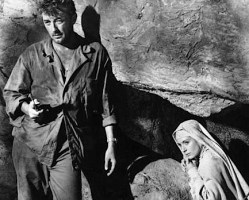
Heaven Knows, Mr AllisonThere’s also a kind of burgeoning romance between the two — as a novice nun she has yet to take her final vows — which creates a different kind of will-they-won’t-they than the usual love-hate dynamic. It all leads to a pleasing ending, where your expectations for what a Hollywood film will do (especially with the groundwork that’s been laid) are subverted in favour of a more plausible turn of events. It’s not the kind of ending that makes the film — it’s already done more than enough to hold one’s interest — but if done wrong I think it would have undermined the rest.

The idea of a two-hander can be off-putting — how can just two characters sustain a whole film without it becoming overly philosophical or overly dull? Heaven Knows, Mr. Allison does have some elements of the philosophical, but there’s enough action going on to satisfy the need for dramatic momentum, and Mitchum and Kerr are effortlessly watchable. It could’ve done with a better title though.

4 out of 5

Monkey Business (1952)

2011 #15
Howard Hawks | 93 mins | TV | U

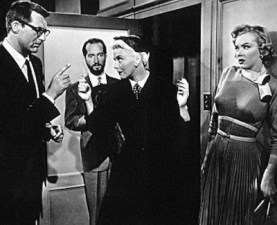
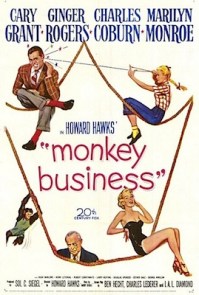
Monkey BusinessMonkey Business came recommended in the Radio Times as a forgotten gem from the ’50s. Hm. And on DVD it’s branded as a Marilyn Monroe film. Hm.

Let’s take the second first: Monroe has a small supporting role. That’s fine, but it makes for some mighty misleading DVD packaging. Luckily that wasn’t why I watched the film. Why I watched the film was the first thing, the Radio Times recommendation. I’m not an expert on ’50s comedies, but I wasn’t convinced this was a “forgotten gem” so much as a decent-enough effort. Comedy-wise it’s daft and silly. That can work, obviously, but it didn’t work successfully enough in this instance, at least for my taste. It’s funny in places but not consistent enough.

It isn’t helped by the non-existent story arc. The plot sees a married couple accidentally take a youth serum the husband has been developing, causing them to inexplicably start acting younger — much younger. But in terms of the story, we see a happily married couple wind up happily married having been through no real strain. Maybe if they’d been having some differences and their childhood regressions had reminded them how much they really love each other or something, then it would’ve felt a bit more worthwhile. Or if the regressions had forced them apart — in a real way, rather than the brief and vague way it does once or twice — only for them to come back together via whatever means, maybe then it would have felt more coherent. Instead, the story consists of “Cary Grant behaves like a college boy” followed by “Ginger Rogers behaves like a stroppy newlywed” Getting up to... yeahfollowed by “Cary Grant and Ginger Rogers behave like 6-year-olds”.

There are good moments nonetheless — particularly the very meta opening titles — but not enough for my liking. It could do with a bit more speed too — compared to something like His Girl Friday it’s positively sluggish. Though I suppose it’s unfair to try comparing the average to the exceptional.

3 out of 5

Monkey Business featured on my list of The Five Worst Films I Saw in 2011, which can be read in full here.

Roman Holiday (1953)

2011 #21
William Wyler | 113 mins | TV | U

Roman HolidayRoman Holiday is the kind of film where its list of achievements don’t quite precede it — Best Picture nominee (it lost to From Here to Eternity), places on the IMDb Top 250, They Shoot Pictures’ 1000 Greatest and one of the AFI’s 100 Years lists — but something else certainly does: this is the film that made Audrey Hepburn a star.
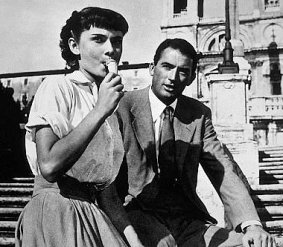
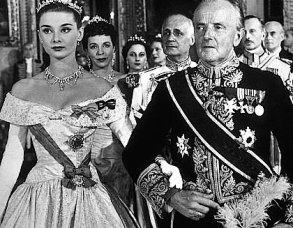
So let’s start with Hepburn. Here she plays a European Princess on a world tour, for various diplomatic reasons, which is coming to an end in Rome. She’s not happy, running off to see the real Rome, and sending her entourage into a quandary as they try to cover up her disappearance. It’s a role that could easily be intensely irritating — the spoilt little brat who doesn’t know how good she has it / with no sense of responsibility — but Hepburn seems to be effortlessly likeable, and it’s easy to sympathise with the idea that seeing the sights and having fun in an iconic city is a lot better than meeting a bunch of stuffy old men.

Through various contrivances, the Princess winds up in the flat of journalist Joe Bradley, played by Gregory Peck. He initially doesn’t realise who she is; he’s helping her out by giving her a bed for the night — the fact he’s Fundamentally Kind will become important in a bit. The next day, when he sleeps in and misses his scheduled interview with the Princess, he twigs who she is and sets about a plan to secretly get a world-exclusive, roping in photographer friend Irving Radovich (Eddie Albert) to get candid shots of Princess and ice creamthe Princess as they take her on a day messing about in Rome.
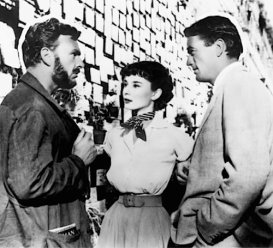
So, essentially, Joe is conning her. He doesn’t let on that he knows the truth, keeping up the act that he thinks she’s a school runaway after a good time; he tricks her into it so he can get a story that will undoubtedly bring some degree of shame, shock and/or scandal to her family and/or country. His moral underhandedness occasionally undercuts the movie: they seem to be allowing her to finally do the things she wants to do, but all along he’s memorising quotes and Irving is secretly snapping away. It all works out in the end — realistically, and therefore, perhaps, surprisingly — but on the way there…

On the other hand — and without wishing to give too much away — morals do get the better of Joe and Irving, and they do often seem quite genuine in the way they help the Princess do what she wants, and they have a good time too (and not because they stand to be rolling in it if they pull it off); and, naturally, Joe ends up in love with the Princess and all that, and it does all work out in the end… It’s a matter of interpretation, perhaps. If you choose to focus on Joe’s ultimate aim — selling the story — then most of the film is a nasty trick. Princess and (Eddie) AlbertIf, instead, you remember that he’s Fundamentally Kind, it might be less troubling that he has a secret plan most of the time.
Morals aside, the cast work well together. The film is often painted as a Peck/Hepburn two-hander — easier to sell the romance angle that way — and I’m sure it would work as that, but Albert’s in it enough to qualify for attention, and is fairly essential to what makes it quite so likeable in my opinion. He and Peck carry much of the humour while Hepburn charms as a sweet girl finally allowed to be herself.

The bulk of the narrative is structured as a series of set pieces and individual sequences/moments, taking the cast from situation to situation: her scooter riding, cafe foolery, barge dancing/fight, and so on. In some ways, it’s just taking the audience along with them — there’s the Princess’ entourage trying to recover her and Joe formulating his story, but it’s more about the fun the characters are having doing whatever than the way it contributes to either of these plots. Wyler puts the genuine Rome locations to good use — and when you’re the first Hollywood film to be shot entirely in Italy, why wouldn’t you? It’s a cliché I know, but the city is as much a character as any of the cast.
Princess and stuffy old man
In spite of some characters’ moral underhandedness, Roman Holiday emerges as a very likeable film about, essentially, having a lovely time on holiday somewhere nice. Hepburn may not be as obviously iconic here as she would become thanks to Breakfast at Tiffany’s, but I think it’s clear to see how she would become a beloved star.

5 out of 5

Roman Holiday is on More4 today, Thursday 23rd April 2015, at 10:50am.

The Big Heat (1953)

2011 #8
Fritz Lang | 86 mins | TV | 15

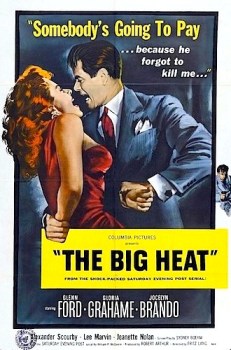
The Big HeatFritz Lang is probably best remembered for the films he made in Germany; medium-defining classics like Dr. Mabuse, der Spieler, Metropolis, Das Testament des Dr. Mabuse and M — I’d certainly heard of him in the context of those films long before I realised he’d emigrated to America and produced several noirs — but now, I’m increasingly discovering his American output is nothing to be sniffed at.
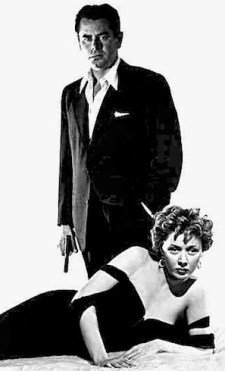
The Big Heat is, I believe, considered one of the best. It’s also still rated 15, which feels unusual for an American film of this era (I have no statistical information if it is or not, but remember US films were still under the Production Code at this point), and though the BBFC provide no more details, once you’ve seen it you can see why.

It’s rather grim and very violent, to be blunt. Even if most of the violence is off screen, it’s still described in fair detail — and most of it’s against women too. Indeed, I think the only on-screen deaths are female. Lang adds intensity to this mix, a quiet sort of tension (though I feel there may’ve been room for even more of this). It becomes clear that this is a tale where anything could — and does — happen; where it is, for once, genuinely true that no one is safe. The plot’s fairly straightforward — no big reveals here — This photo is all kinds of winbut it does manage what might be described as twists in how far it’s willing to go — mainly, who gets killed and how.
The cast are excellent. Glenn Ford is a suitably square-jawed lead; Alexander Scourby a detestable gentleman-villain; Lee Marvin a truly brutal thug. The best part goes to Gloria Grahame however, in a role that moves from a ditzy minor broad to so much more. In the performance stakes, it’s certainly her film.

I think I have more affection for Ministry of Fear (it’s barmy, especially all that palaver with the cake), but as a straight, hard-edged noir, The Big Heat looks tough to beat.

4 out of 5

The Big Heat merited an honourable mention on my list of The Best Films I Saw For the First Time in 2011, which can be read in full here.

Genevieve (1953)

2011 #3
Henry Cornelius | 83 mins | TV | U

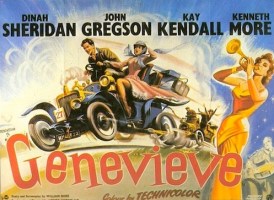
GenevieveThe further behind one gets on reviews, the easier it becomes to forget a film. Or not so much forget the film itself, but when one watched it. Or, to put it another way, I was a little surprised when I looked back over the 20 films I had left to review and saw Genevieve still there. At least I had a hundred or so words of notes for this one.
But I digress.

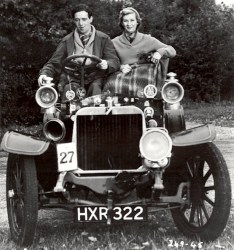
The titular Genevieve is a classic car — bearing in mind this was made in the early ’50s, we’re talking properly classic — that takes part in a two-day drive from London to Brighton and back again. It’s not a race, though competing friends turn it into one. That’s about the gist of it.

The plot rolls along nicely, driven by the narrative-generating setup of a there-and-back-again weekend road trip. The rivalry inherent in the first half’s genial journey-there is Genevieve herselfheightened by an evening of irritations and revelations, tipping the second half’s journey-back into an out-and-out race. It’s the second half that contains the more overt comedy as the rivals compete to scupper each other’s chances. That’s not to do down the more gentle style of the opening half, which has its moments. That said, depending on one’s perspective, the realistic sparring of the married couple during the opening scenes might be seen to give the film a bit of an edge of reality, making it not just the staged, (relatively) high-concept comedy it could have been.
According to IMDb, “the film ran into censorship problems in the US… because of the moment when Wendy asks for a coin so she can ‘spend a penny’. References to toilets were specially taboo in the US at that time.” Bless. The controversy of any such reference has obviously completely evaporated today, but even for the time it’s sweetly obscured — she doesn’t actually ask, she mimes. That said, the also-controversial references to weekends of illicit sex are also obscured while still leaving it abundantly clear what’s meant — more so than other works from this era, I think — which can feel rather surprising from a ’50s British comedy.

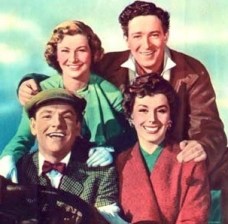
A splash more trivia: “Despite being one of Britain’s most well-loved films [is it?], this was apparently hell to make. Genevieve's castDirector Henry Cornelius was vetoed on most of his first [casting] choices… and he was forced to make it at studios he didn’t want to work at. Cornelius’ displeasure was acutely felt by cast and crew as he didn’t hide how unhappy he was. He was also seemingly highly lecherous. Consequently both Dinah Sheridan and Kay Kendall carried whistles on them at all times… Olive Dodds, Rank’s head of contract artists, later testified that every leading cast member came to her at one point and said they wanted off the film.”
Whether the cast and crew enjoyed themselves or not, and in spite of an occasionally plodding first half, Genevieve is an endearing enough comedy with a bit of an edge… if you pretend you’re still in the ’50s, anyway.

4 out of 5

Panic in the Streets (1950)

2010 #71
Elia Kazan | 92 mins | TV (HD) | PG

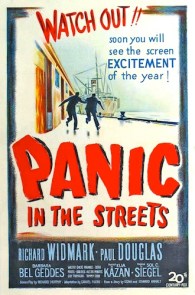
Film noir is a pretty unspecific genre, or unconscious movement, only really defined (however loosely) once it was already over. So to say a film noir isn’t particularly film noir-y might seem a tad daft, but, Panic in the Streets isn’t a particularly film noir-y film noir.

That’s not a problem, just an observation. There’s still a criminal underworld, a (slightly) downtrodden hero, criminal wrongdoings, some shadow-drenched photography, and a smattering of other traits that do place it within the genre, but it’s not a textbook example.

Its story is the methodical investigation of a potential plague outbreak in a hot, sweaty New Orleans, the latter often strikingly evoked. There are some good scenes — the discovery of the infection through to the immediate dealings with it; some of the villains’ sequences — but I’m not convinced by how it hangs together as a whole. Our heroes do have to go to some lengths in their battle to contain the outbreak and find its source, but it also seems relatively easily contained and kept out of the press. And when the dreaded happens and the papers do run the story, it doesn’t seem to affect much at all.

The cast are good, particularly Richard Widmark as Clint, the family man whose job seems under-appreciated and who longs for a bigger break. Is an outbreak his chance? He doesn’t approach it that way — he’s too busy getting the police to see sense, and managing his wife’s expectations and desires. Lead villain Jack Palance Palance in the Streetshas a beautifully bad-guy-friendly skull-like face, with his jutting cheek bones and flat-ended nose. (I imagine I’m far from the first to make this observation, but hush.)
The investigation is at times almost a straight procedural, for which you’ll find no complaints from me — there’s something inherently satisfying about a very precise, focused procedural, such as Anatomy of a Murder — but Kazan and screenwriter Richard Murphy cut through this with Clint’s home life and unorthodox investigative methods. The balance between investigation and Clint’s family issues is quite well maintained for most of the film, and admirably doesn’t dive for a pat resolve on the latter, but the home life subplot ultimately lacks any kind of significant resolution, leaving its various elements aimlessly hanging.

Some hail Panic in the Streets as a five-star classic, but the problems I mention mean it falls short of that for me. I don’t want my negatives and four-stars to come across as damning with faint praise, though: it’s still an engrossing thriller with much to recommend.

4 out of 5

The Band Wagon (1953)

2010 #91
Vincente Minnelli | 108 mins | TV (HD) | U

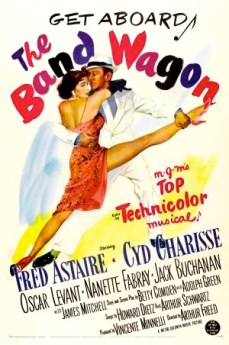
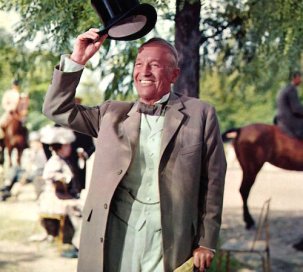
The Band WagonIn this behind-the-scenes musical, Fred Astaire plays Tony Hunter, a slightly washed-up star of stage and screen. One can’t help but wonder if his performance has an autobiographical edge. It’s of no concern to the viewer though, because he’s as wonderful as ever.
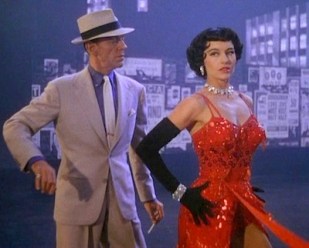
The plot sees respected musical writers the Martons (Nanette Fabray and Oscar Levant) penning a new production for Hunter to star in. They hire famed Theatre director Jeffrey Cordova (Jack Buchanan), who slowly turns the production into a rather serious version of Faust, starring ballet star Gabrielle Gerard (Cyd Charisse). She doesn’t get on with Hunter (thanks, of course, to a series of silly misunderstandings), while his role is slowly squeezed away. No one is happy. On the bright side, hilarity ensues. Everything turns out OK in the end, naturally, but along the way we get plenty of comedy and plenty of song & dance.

There are several great numbers: Astaire dancing his way around an amusement arcade; That’s Entertainment, written for the film and easily demonstrating why it quickly became a standard; a bizarre number with Astaire, Fabray and Buchanan dressed up as babies, dancing around on their knees (memorable, if nothing else); and a big closing dance routine… that I actually liked! It’s a hard-boiled crime thriller told through the medium of dance (obviously; plus voiceover). It’s different to the norm — the voiceover adds a discernible story, and rather than showcase ballet it reinterprets noir-ish tropes — and it works marvellously.

Minnelli shoots the dances in wide shots with long takes, using few if any cuts mid-sequence, which is of course the perfect way to watch Astaire in action. Every frame shows everything he’s doing, which is frequently essential, and there are no cuts to spoil his natural rhythm or shatter the illusion of a seamless routine.

I always feel like a four-star review should justify why there’s no fifth star — there must be something at fault, otherwise why not full marks? Perhaps this is a simplistic philosophy though, because I’ve not got a bad word to say about The Band Wagon, but it’s still:

4 out of 5

Gigi (1958)

2010 #95
Vincente Minnelli | 111 mins | TV (HD) | PG / G

GigiGigi is a film about largely horrid people doing morally dubious things. But of course it’s a musical from the ’50s, so it all has a veneer of loveliness and respectability.
It begins with an elder gentleman singing Thank Heaven for Little Girls; not because, say, they bring a youthful joy to old age, but because they’re a constant source of new young ladies for him to have affairs with — and not chaste, romantic affairs either. Actor Maurice Chevalier may have a twinkle in his eye and a conspiratorial tone with the audience, speaking directly to camera, but he’s playing a dirty old man really. Most of the film’s characters share his moral compass.

There are two exceptions, more or less. Gigi herself (Leslie Caron) is one, an innocent teen who isn’t as wise as her years, despite her grandmother (Hermione Gingold) and great aunt (Isabel Jeans) schooling her in preparation to be, essentially, a serial mistress. If one were to be unkind, you might say courtesan — the majority of women in the film are or were in the business of going out with men for money, status, etc; one man at a time (mostly), but on a serial basis. Gigi isn’t a simpering romantic, though, she just wants to have fun, and in her delightfully clumsy way can’t cope with her great aunt’s rules and restrictions.

The other decent character is Gaston (Louis Jourdan), although it takes him some time to get there. He’s super-rich, bored with everything, egged on and tutored in ‘relationships’ by the aforementioned dirty old man. Gaston would rather spend his time playing cards or larking about with Gigi; they may be related, I’m not sure. I hope not, because (spoilers!) Dirty old man with woodeventually Gaston realises he loves Gigi and her training is stepped up so she can become his latest conquest. I won’t go into the details of the ending, but their part of the story ends well.
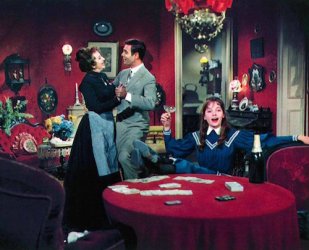
It doesn’t for the others. Not that it ends badly, but no one else changes their ways, despite the occasional hint they might. This is probably a good thing — it wouldn’t be particularly realistic if everyone reformed to the ways of Goodness and Honour. And there’s nothing wrong with a musical that tackles subjects outside the expected soppy romanticism — in fairness, many stage musicals are more risque, in part if not whole, but it gets removed for the film versions — and Gigi seems no exception, because while many of these activities and attitudes are quite amoral, it’s all given a lovely sheen. I’d excuse anyone who thought Gigi and Gaston were engaged when she agrees to be his whore (in fact — spoilers! — it’s only later he sees the error of his ways and proposes).

Part of the tonal clash — between the characters’ behaviour and the film’s ’50s niceness — comes in the musical numbers, most of which are very funny. Thank Heaven for Little Girls may be sullied, but It’s a Bore, The Parisians, The Night They Invented Champagne, and particularly I Remember It Well, are all very enjoyable with wonderful lyrics. In the red roomI’m Glad I’m Not Young Anymore is also a nice change of pace, celebrating old age for a change.
The film also looks the part, exquisitely detailed sets and costumes supported by genuine Paris locations, all shot vibrantly. It leaps off the screen, especially in HD — in particular, the home of Gigi’s grandmother, which must be the reddest room ever seen.

Gigi scored a then-record-breaking nine Oscars in 1959 (only to be beaten the next year), including many I’m certain it deserved — partly because I’ve not even heard of most of the films it was up against, but also because it is an entertaining musical, just one with, I would say, uncertain morals. Whether this makes a welcome change for the genre or is an unpleasant undermining of it is surely down to each viewer’s preference.

4 out of 5

Brigadoon (1954)

2010 #93
Vincente Minnelli | 104 mins | TV (HD) | U / G

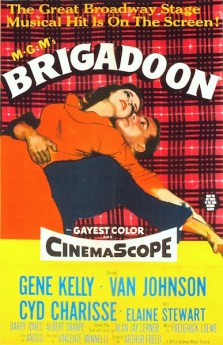
“Oh dear,” is surely the initial reaction to Brigadoon. The Scottish accents are appalling, the costumes and setting gratingly twee, the Highlands recreated entirely on a soundstage. I wonder if many Americans visited Scotland in the wake of this film expecting to find such things? If they did, I imagine they were sorely disappointed.
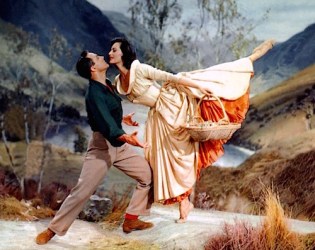
But, importantly — and thankfully — it does grow on you as it goes on. The ill-conceived cast, costumes and studio-bound setting begin to pale under the charm of Gene Kelly and the machinations of the plot. Even the Scottish accents, though consistently dreadful, eventually become less irritating. The casting of Kelly and Cyd Charisse resulted in several musical numbers being dropped and a greater emphasis placed on dance. As I think has become apparent in some previous reviews, I’m not the biggest dance fan, but luckily Brigadoon contains no extended sequence to rival those I dislike in An American in Paris or Oklahoma!. Instead, the routines remain at the kind of length where I can still afford them some appreciation, and they are worthy of that.

The reveal that Brigadoon is a village stuck in time, only emerging from the fog for a single day every hundred years, is saved for the halfway point. It’s one of those occasions where, as a modern viewer, you know the twist and almost wonder why it takes so long to be revealed; equally, it doesn’t hamper proceedings in any meaningful way. In fact, the shock when (spoiler!) the film suddenly cuts to a busy, noisy New York for the final ten minutes is a bigger one. There’s a neat conclusion though, working its way around the film’s self-established rules without destroying them.

If you go doon to the woods today...I think it’s fair to say this isn’t the greatest of musicals (though I know some might disagree). The poor realisation of Scotland takes some getting used to — and remains either irritating or amusing, depending on your mileage for such things — and generally there’s a dearth of particularly memorable songs or dances. But it’s not bad either, once things get underway.
My ultimate verdict is stuck somewhere between a 3 and a 4. I’ve erred on the generous side, again, because I liked it more than An American in Paris (which I also gave a 4) and I’m soft. I really need to stop giving every film I sort-of-quite-like a 4 though — a better scale/spread of ratings is needed on here, I feel.

4 out of 5

Ivanhoe (1952)

2010 #55
Richard Thorpe | 102 mins | TV | U

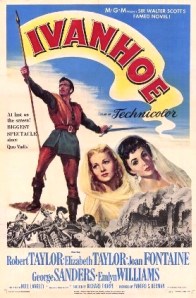
Ivanhoe is the kind of film they don’t often make any more, a pure swashbuckling romp. And when they do make them they tend to muck it up with over-complicated mythology-obsessed sequels — yes Pirates, I’m looking at you.
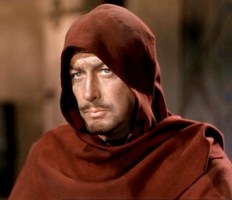
No such fate befalls Ivanhoe, of course. I’m not familiar with Sir Walter Scott’s novel, nor any other adaptation, so can’t comment in any way on the faithfulness, but adapter Æneas MacKenzie and/or screenwriter Noel Langley keep things moving at a fair lick, balancing well the romance, action, politics and humour. It’s an odd feeling seeing Robin Hood as a minor supporting character but, well, that’s the story I suppose.

But, as I said, it’s not really a film about acting or screenplay, though both are more than serviceable. No, swashing buckles are the order of the day, and here they certainly are. Most notable is an excellent siege sequence, a moderately epic extended battle that is certainly the film’s high point. The randomly hurled arrows and choreography-free sword fights may look a tad amateurish almost sixty years on, when we’re used to slickly staged and edited combat sequences, but the scale and rough excitement of the battle easily makes up for it. Though the final duel that ultimately follows can’t quite live up to this in terms of sheer scale and excitement, it impressively holds its own as a climactic action sequence.

I feel there’s a bit more to say about Ivanhoe’s story, particularly the love-triangle romance side of the tale, or the subplot about Jewish acceptance in a film made less than a decade after the Second World War ended, but I’m afraid those will have to wait for a more intelligent reviewer another time. Having chosen to watch Ivanhoe as a swashbuckler (you may have gathered that by now), my subtext sense was not fully tingling. But I can confirm that it is indeed a very enjoyable swashbuckling romp.

4 out of 5